Up to the close of the war our message had been confined to the eastern and central part of the United States. About this time Brother James Erzenberger came to this country from Switzerland to more fully learn the message, and later Elder J. N. Andrews went to Europe to carry on the work. A few years after the war Elders Loughborough and Bourdeau opened up the work in California, the Lord preparing the way.
As I think over the past and see how the Lord led in the work, and how, instead of a few conferences in the north-eastern part of our country, our work has gone to every part of the world, our membership has increased from a few hundred to over seventy-five thousand, and instead of one printing-press we now have papers printed in all parts of the world, and have founded schools, colleges, and Christian Help work in many places, I am deeply impressed that our consecration has not increased with our membership. In the ninth chapter of Ezekiel the sealing work is brought to view. This sealing is in the remnant church, and the seal will be placed “upon the foreheads of the men that sigh and that cry for all the abominations that be done in the midst thereof.” After the sealing work is finished, probation will close, and the plagues will be poured out.
The nations will be held in check until the number are sealed. I believe we shall be brought into as close places before the end as we were during the Civil War, and only those who believe and heed the whole truth will stand the test before us. In “Testimonies for the Church,” Vol. VIII, we read: “But there are many, many in our churches who know little of the real meaning of the truth for this time.”—Page 252. “A storm is coming, relentless in its fury. Are we prepared to meet it? We need not say, The perils of the last days are soon to come upon us. Already they have come.”—Page 315. How thankful we should be that the Lord is constantly sending us such timely counsel! May we each heed it.
I think it was during the war that I first met a young man who had recently embraced the truth. He possessed some good natural ability and a great deal of push, and the brethren of the conference encouraged him to enter the ministry. He soon started out in the tent work, and for some years was quite successful in bringing many into the truth. In the early days of his ministry he was quite humble, and willingly accepted the counsel of leading brethren. As success attended his efforts, he became exalted and more independent. Finally the Lord sent him a Testimony warning him of the danger of getting above the simplicity of the work. He was warned that unless he was guarded, he would go on until his weakness would be apparent to all. Instead of receiving the reproof the Lord sent him, he became disaffected and gave up preaching for some years, and engaged in farming. In 1884 he attended our Michigan camp-meeting; the power of God came into the meeting, and he humbly acknowledged his wrong course, asking Brother and Sister White to forgive him for wronging them. After that for some time he appeared a changed man. Soon after the camp-meeting he wrote a very humble confession in the REVIEW, telling of the remarkable change, saying it was directly from heaven, was the work of the Spirit of God. For some time after this he seemed to be a changed man, and preached and wrote with his old-time vigor. After a few years he again lost his hold upon the message, and in 1887 he decided that he would unite with another church and engage in gospel work. He soon began to preach and write, holding up the spirit of prophecy to ridicule.
As I think about this poor man, I am impressed with the long-suffering of our God. This man had defects that would unfit him for the kingdom of God. Time and again the Lord sent him corrections, bringing him over the same ground where he had fallen. Even after he had left our people and united with another denomination, the Lord sent him a Testimony, calling his attention to the terrible mistake he was making, and the final end if he persisted in such a course.
This is only one of the many cases where the Testimonies have been rejected and sad results have followed. Brethren, our only safety is in accepting and following the light that God in mercy sends us through his chosen servant. I have watched these things, and for over fifty years I have observed that those who reject the light that God sends, sooner or later give up the whole truth.
Cedaredge, Colo.
Will Power Without God
A SAILOR on one of Her Majesty's vessels tumbled out of the rigging; in his fall he caught with both hands a rope; and observers said, “He is saved!” But the rope itself had no fastening, and he fell farther and faster, as the rope payed out, till he struck the deck a mangled mass. A man may attempt to save himself by will power; but what if the will itself have no hold on God?—Canon Wilberforce.
Gardens
By Margaret E. Sangster
The wide, fair gardens, the rich, lush gardens,
Which no man planted, and no man tills;
Their strong seeds drifted, their brave bloom lifted,
Near and far over vales and hills;
Sip the bees from their cup of sweetness,
Poises above them the wild, free wing,
And night and morn from their doors are borne
The dreams of the tunes that blithe hearts sing.
The waving gardens, the fragrant gardens,
That toss in the sun by the broad highway;
Growing together, gorse and heather,
Aster and goldenrod, all the day,
Poppies dark with the wine of slumber,
Daisies bright with the look of dawn,
The gentian blue, and the long year through
The flowers that carry the seasons on.
The dear old gardens, the pleasant gardens,
Where mother used to potter about,
Trying and pulling, and sparingly culling,
And watching each bud as its flower laughed out,
Hollyhocks here, and the prince’s feather,
Larkspur and primrose and lilies white,
Sweet were the dear, old-fashioned gardens
Where we kissed the mother and said “Good-night.”
—Margaret E. Sangster.
The Dangerous Fraud in Patent Medicines
By Editor
[The following article is taken from The Literary Digest. We give it entire that the reader may have the benefit of the forceful and approving comments of the editor of the Digest.—Ed.]
ALL of the recent exposures and “muck-raking” articles have evoked more or less newspaper comment. But upon the series of articles in Collier’s Weekly by Mr. Samuel Hopkins Adams, laying bare the swindle and quackery of most patent medicines, the press has been absolutely silent. The Literary Digest, accustomed to present newspaper comment to its readers, must in this instance point to the singular scarcity of that commodity. The reason for that, we are told, is that the manufacturers of the nostrums, by means of their enormous advertising contracts, have succeeded in keeping the newspapers muzzled.
“I take it,” says Mr. Mark Sullivan in an article in Collier’s Weekly, “I take it if any man should assert that there is one subject on which the newspapers of the United States, acting in concert and as a unit, will deny full and free discussion, he would be smiled at as an intemperate fanatic. The thing is too incredible.” And yet it is shown with documentary proofs in the Collier’s series that contracts for advertising made by patent medicines with newspapers carry what is known as the “red clause,” which in the case of the Cheney Medical Company, makers of Hall’s Catarrh Cure, reads like this: “It is mutually agreed that this contract is void if any law is enacted by your State restricting or prohibiting the manufacture or sale of proprietary medicines.” This is printed in heavy red type across the face of the contract. The J. C. Ayer Company, makers of Ayer’s Sarsaparilla, has a provision against printing in the newspapers anything “detrimental to J. C. Ayer Company’s interests.” These are some of the ways in which the press is muzzled against the great fraud which Mr. Samuel Hopkins Adams has been exposing in Collier’s.
The danger in this article of commerce, the patent medicine, is that its fraud is not merely an imposition on the purse of the purchaser, but that usually it is a deadly poison, like the cocain and morphin of the so-called “catarrh cures,” “soothing sirups,” and “cough remedies,” or a mixture largely alcoholic, as the “bitters,” “sarsaparillas,” and “tonics.” By means of these medicines, many people who believe themselves to be leading temperate and exemplary lives are becoming drug fiends and alcoholics without knowing it.
In this article we can touch only the high places of Mr. Adams’s able series. We can only mention the better known “remedies,” the widely advertised. The alcoholic stimulants known as Peruna, Paine’s Celery Compound, Duffy’s Pure Malt Whisky, come in this category. Peruna, outside of an insignificant quantity of certain drugs (less than one half of one per cent) is made up of alcohol and water, in the proportion of one to three. The cost is about fifteen to eighteen cents a bottle, which sells for one dollar. A well-known authority on drug addictions writes Mr. Adams as follows:—
“A number of physicians have called my attention to the use of Peruna, both preceding and following alcohol and drug addictions. Lydia Pinkham’s Compound is another dangerous drug used largely by drinkers; Paine’s Celery Compound also. I have in the last two years met four cases of persons who drank Peruna in large quantities to intoxication. This was given to them originally as a tonic. They were treated under my care as simple alcoholics.”
In short, where a given bottle of whisky would contain 50 per cent of alcohol, the same bottle of Peruna would contain 28 per cent alcohol, Paine’s Celery Compound 21 per cent, Hostetter’s Stomach Bitters 44.3 per cent. The government has prohibited the sale of Peruna among the Indians because of its intoxicating effects. Other “remedies” are similarly alcoholic. As Mr. Adams says: “Lydia Pinkham appeals to suffering womanhood with 20 per cent of alcohol; Hood’s Sarsaparilla cures ‘that tired feeling’ with 18 per cent; Burdock’s Blood Bitters with 25 per cent; Ayer’s Sarsaparilla with 26 per cent.” So far as concerns the testimonials, Mr. Adams finds that in twenty-one of thirty-six letters by members of Congress “there is no indication that the writer has ever tasted the remedy which he so warmly praises.” As a matter of fact, there is a man in Washington who procures testimonials from Congressmen at so much a head.
As an example of how patent-medicine manufacturers work on human credulity may be cited Liquozone. Twenty years ago, when microbes became a leading topic, Radam’s Microbe Killer, a compound containing sulphuric and muriatic acids, was a widely advertised remedy. When the microbe gave way to the “germ” and the “bacillus,” Liquozone arose. This “relies on a weak solution of sulphuric and sulphurous acids, with an occasional trace of hydrochloric or hydrobromic acid. Mostly it is water.” It is advertised to cure thirty-seven varieties of disease, including “contagious diseases,” which he admits of further numerous divisions. The claim made is that Liquozone is liquid oxygen. “Liquid oxygen,” says Mr. Adams, “doesn’t exist above a temperature of 220° below zero. One spoonful would freeze a man’s tongue, teeth, and throat to equal solidity before he had time to swallow.” The truth is that the sulphuric acid of Liquozone is oil of vitriol; sulphuric acid is another corrosive poison.
In an article entitled “The Subtle Poisons,” Mr. Adams dwells on the danger of the number of ready “remedies” that reach even the thinking class. Orangeine, one of the best-known, prints its formula, but comparatively few people know what “acetanilid” is. To quote Mr. Adams: “The wickedness of the fraud lies in this: that whereas the nostrum, by virtue of its acetanilid content, thins the blood, depresses the heart, and finally undermines the whole system, it claims to strengthen the heart and produce better blood.” Mr. Adams subjoins a heart-rending list of deaths through headache-powders or “bracers,” containing acetanilid and taken without a doctor’s prescription. Bromo-Seltzer, so frequently taken, the usual dose being “a heaping teaspoonful,” contains about ten grains of acetanilid to the dose. Five13grains have been known to produce fatal results. Megrimine is another acetanilid “remedy,” and so, for that matter, are most other nostrums of the “headache” sort. Antikamnia, so often taken by women, is no less dangerous or fraudulent than Orangeine. Mr. Adams warns all against taking without prescription the following acetanilid “remedies:”—
“Orangeine, Bromo-Seltzer, Royal Pain Powders, Miniature Headache Powders, Megrimine, Anti-Headache, Dr. Davis’s Headache Powders, Antikamnia, Ammonol, Salacetin, Phenalgin, Cephalgin, and practically all of the drug-store-vended ‘headache cures’ and ‘anti-pain’ remedies.”
And so Mr. Adams goes on to show that Mrs. Winslow’s Soothing Sirup, for instance, is so often responsible for the opium habit; that Birney’s Catarrhal Powder, Dr. Cole’s Catarrh Cure, Dr. Gray’s Catarrh Powder, and Crown Catarrh Powder—“all of them are co-cain; the other ingredients are unimportant.” He shows that the so-called “consumption cures,” which patients clutch at pathetically, only hasten the progress of the disease, for they contain chloroform, opium, alcohol, and hashish. “Dr. King’s New Discovery for Consumption,” he shows, “is a morphin and chloroform mixture.”
He gives a long list containing Rupert Well’s Radialized Fluid, for cancer, Miles’s Heart Disease Cure, and a number of other epilepsy cures and cancer cures of the same sort. All are swindles, and the trail of fraud is over all, regardless of what they advertise.
The Little Mother’s Hands
[There is more truth than sentiment, more of fact than fancy, in this touching little story of unselfish service.—Ed.]
THE following story told by Dr. Dawson, in its beauty and simplicity teaches a lesson which it would be well to take to heart:—
“In the course of my ministrations,” said the doctor, “through the slums of London I came upon a sad case, that of a woman, the mother of five children, the eldest of whom was a girl of nine or ten.
“The mother at the time the family first came under my notice was dying of consumption. The father, a hard-working man, was barely able to earn sufficient to supply the meager wants of the family, and they were often in dire straits.
“The bulk of the work devolved on the oldest girl, Mary by name. Never have I seen the title of ‘Little Mother’ more appropriately earned. She not only had the invalid to care for, but the younger children as well, and Mary was often a very tired little girl.
“Mary’s duties soon were lightened to a certain extent by her mother’s death, but made heavier in another by the added responsibility of the little family. The burden of the children and the house was very heavy after the mother had gone. While she lived, Mary had always felt there was some one to direct and guide her, but now she was forced to rely upon herself entirely.
“Mary’s health, none too strong at any time, soon began to fail under the great responsibility which had fallen on her shoulders. The care of the children, the cooking, the washing and ironing, the sweeping and bed making were too much for the little woman’s strength. Day by day she failed, fewer and fewer became the outings which the lusty baby enjoyed. The little fellow soon became too heavy for the thin, weak arms of the ‘little mother,’ and it was but seldom that she could muster courage and energy enough to carry him down the steep stairs, which were his only breathing ground.
“The day came when even the slightest exertion was impossible for poor Mary, and she was forced to depend upon the kind services of neighbors as poor as she was herself. Mary failed rapidly. She was soon confined to her bed, and then I procured the services of one of my ‘helpers’ who took up Mary’s work where the ‘little mother,’ in sheer helplessness, had laid it down.
“On one of my daily visits, as I stood in the doorway, unannounced, I heard the murmur of childish voices. A little friend of Mary’s was sitting with her, and had been laboriously spelling out some verses of the Bible.
“‘O Maggie!’ I heard Mary say, ‘whatever will I say to Jesus when I meet him and he asks me why I did not go to church, and why I did not pray? You know I was so tired, Maggie, so tired, I just couldn’t.’
“‘Never you mind, Mary,’ the other child replied, ‘when you see Jesus, just show him your hands, Mary, and he will understand.’”—Selected.
Watching Baby’s Comfort
EVEN during the hot months, care must be taken that the baby does not suffer from changes of temperature. Our hottest days often begin with a very cool morning; or, a breeze may spring up at nightfall, giving us a cool night. It is much easier to add a light outer garment in the morning, or put on a heavier gown at night, than to cure a cold which, however slight, may bring on a hazardous bowel trouble. As the day advances, and the temperature rises, the outer garment may be laid aside. It is a real pain to one who is observant, and who loves babies, to see the little limbs roughen with “goose bumps,” and mottle with cold, to which appearance the thoughtless mother gives no heed, and yet wonders “how on earth the baby got the snuffles,” or what he has eaten to derange his little stomach. It is a pitiful thing to see the girl mother’s ignorance as to the meaning of the most glaring symptoms of discomfort and threatened illness of the baby she so dearly loves, yet exposes to such trying risks. Before we cry out for more children, let us teach our girls and boys the responsibilities of parenthood—the intelligent care of those given to them. Better one live, healthy baby than dozens of diseased or dead ones. If it is a truth that a baby has the right to be “well-born,” it is of equal importance that the little body should be intelligently cared for.—The Commoner.
Family Worship
Of all the forms of worship, none, it seems to us, is more beautiful than that which we see around the family altar. As a means of grace it occupies a distinct place of its own. The all-important “quiet hour,” when the soul alone, in the presence of God, seeks the divine blessing and communes as friend with friend, can not take its place. The hour of public worship, when we meet at the house of God for prayer and praise, can not take its place, for it stands alone.
It matters not so much at what hour we meet for family prayer, but the morning hours are best. Surely the ideal hour is immediately after the morning meal, when the whole family, including the servants, if there are any, retire to the library, parlor, or living-room, and after reading a morning lesson from the Word, kneel in prayer, asking the Father’s blessing on the new day. The benediction which will rest on each member of that household as he goes out into the world to fight the battles of life can not be overestimated.
We wish we might say to every young husband and wife who are beginning life in a new home of their own, “Do not fail to erect the family altar.” We had the pleasure recently of being in a home as a guest where morning and evening the young husband and wife knelt at an altar of prayer. It was truly beautiful, and in speaking to them, of the wisdom of their course, the husband said: “It seems a little time to give to God in return for what he has given to us.” Of course, there are times in our lives when it is impossible to observe this daily practise; but let each family do the very best it can, and often difficulties disappear faster than we imagine they could. We may not be able to choose the morning hour, and each family should observe the hour in whatever manner it chooses,—there are no set forms,—but family worship must be a scene which angels delight to see.—American Friend.
Truth Remains the Same
The horizon widens, the vision enlarges, the ideal changes. But wider than any horizon, because no line can circumscribe it, larger than any vision because the object of all vision, higher than any ideal because forever rising above the ideal, Truth remains the same, changeless amid the changing, permanent amid the transitory and fleeting.—William D. Little.
The Latin Union and Roman-Swiss Meetings
By Guy Dail
GUY DAIL
ON our delightful grounds at Gland, close to Lake of Geneva, where we have the sanitarium, school, and food factory for the Latin Union field, these two meetings were held conjointly, July 10-15. We are pleased that we can report the best meeting we have had in this field since the organization of the union, in 1902; it was the largest, and in many ways the most richly blessed of God by his presence. Harmony prevailed in the committee work, and in the proceedings in open conference. The proclamation of the Word was attended with power, and especially rich in blessing was the Sabbath day, when two thirds of the three hundred and fifty persons in the large pavilion made a forward move for a greater consecration to God and to his work. In the afternoon the Spirit was present at the ordination of Brother W. G. Bond to the gospel ministry, and in the baptismal service following, when nineteen were buried with their Lord, to arise again to walk in newness of life.
We were pleased to see such a good representation from various parts of the union, as well as some from other lands; two were from Algeria and Portugal, respectively; four from Spain; twelve from France; and fifteen from Italy.15
From abroad were brethren representing Egypt, America, Hungary, Germany, Russia, British East Central Africa, and Syria. Of course the large majority of the campers were from Roman-Switzerland. The help of Brethren Spicer and Conradi was a blessing to the people. Brother Lüpke and Schwantes conducted German meetings.
A few incidents that came to our attention on the ground may be of interest, as they show how God is working in some places: One of our brethren in Barcelona, Spain, formed the habit of taking with him to the barber shop, when he visited it, something to read. One of the barbers finally asked him what he was reading. The brother replied, “I have found the best thing in this world. You come with me and I will introduce you to a man who can teach you all about it.” The barber came. He was interested in the Scriptures from the very beginning, and continued coming every morning at half-past five for a Bible study. He accepted all that was shown him from the Word, and took his stand for the truth. He lost his employment because he would not work on the Sabbath, but God opened the way for him to sell our Spanish tracts. In the last two months and a half he has sold sixty-four thousand pages of the tract, “We Would See Jesus.” The first half year of 1905 our workers in Spain have given away seventeen thousand pages of literature, which we publish, and thirty-five hundred Gospels, and sold three hundred entire Bibles. The two Spanish students at Gland are doing well. We are glad Brother Frank Bond has returned from America to help carry forward the message in that land.
In Belgium, where we are having some good experiences among the French-speaking people, an incident may be related: Our minister was called upon to preach the funeral sermon of a man who had given his heart to God on his deathbed. About two thousand people were present. At the close of the service, a young gentleman stepped up to him, and said that he had been pleased with the words he had heard, and that he was with us in heart, but had not yet courage to step out and fully obey. He had read a little of our literature. He was working as a shoemaker, but was doing some really earnest Christian work also. The more he studied, and learned of the message, the more he felt that he must take an open stand in obedience to God. Finally, he told his Christian associates that he desired them to pray for him to be true in obeying God's law, which he had not yet had strength to obey, for he was transgressing the Sabbath. Of course this caused quite a stir, and he was misunderstood. But he still insisted that so long as he was not keeping the Lord's command, he could not expect that fulness of blessing a Christian ought to have. At last they agreed to pray God to help him do his duty. Shortly afterward he stepped out fully into the light, and now he is doing all he can to proclaim the glad tidings.
From Algeria we learn that five there have begun to obey, so our workers in that field are of good courage, and will return to their work more determined than ever to go forward. It has been decided to set apart about twenty dollars for literature for that country for the last half of 1906. A similar sum will also be devoted in the same manner for Italy, and for Portugal, and French Belgium. One hundred dollars was voted to assist in further equipping the treatment rooms we have in Algeria. This work has helped us in getting hold of the names of those who were susceptible to the message.
We might add that there is now in process of preparation in the French language a new book on Daniel, to be finished in two months, a book on Revelation, in six months, and a volume of the Testimonies to be ready in four months (the same as in the German and Scandinavian languages), and a health book. The canvassing work received some attention at the meeting; this is one of the most important subjects to be considered and planned for in the Latin Union, and it is here that there is yet much progress to be made in this department of the cause.
We are pleased to be able to report that there is a good class of patients at Gland, and that the sanitarium is full. Some remarkable cures have been wrought here, through the blessing of God, and the workers are of good cheer.
Our school is also bearing fruit, as it is now turning out workers for the great Latin field. It will be continued again the coming autumn. It is a small school, but it has come to stay, and will grow. As its work bears fruit, we believe that many others will be encouraged to attend. Certainly in a field with over one hundred million inhabitants, as has the Latin Union, there is plenty of demand for means and workers.
The plan of devoting the First-day offerings to Algeria will be continued. The afternoon meeting Sunday, in which the subject of missions was presented, awakened still deeper interest in what we are trying to do among the heathen, and the collection was about thirty-three dollars, and the Sabbath-school donations were about thirty-nine dollars, making seventy-two dollars for missions.
It was decided to make some advance into new territory. In the Italian-speaking part of Switzerland we have as yet done no work. A worker will be sent there in the near future, by the Roman-Swiss Conference.
In Italy there will also be another city entered—Turin. Two workers are to go there, and we hope this may prove a fruitful field. The efforts in Rome, where there are about fifteen deeply interested, will be continued. More aggressive work will be done in the Waldensian Valleys, also.
As a result of the suggestions that were made by the committee on nominations, these union officers were elected: President, L. R. Conradi; Vice-President, L. P. Tièche; Secretary, J. Vuilleumier; Treasurer, J. Robert; other members of committee, H. H. Dexter, J. Curdy, C. T. Everson, P. A. De Forest, E. Schwantes, and W. G. Bond.
The following were given Latin Union papers for the coming year: In France, ministerial credentials to H. H. Dexter and G. Roth; ministerial licenses to T. Nussbaum, J. P. Badaut, U. Augsbourger, A. Jaques, Jules Rey; Bible workers' licenses to F. Blanzat, C. Guenin, P. Steiner, Sisters Amélia Eva, Herminie Passebois, and Juliette Puech; canvassers' licenses to A. Mathy and M. Raspal; in Italy, ministerial credentials to C. T. Everson; ministerial licenses to L. Bénézet and P. A. Fant; missionary credentials to A. Vaucher and Mrs. J. R. Schell; in French-Belgium, ministerial credentials to J. Curdy; missionary canvassers' license to E. Delhove; in Spain, ministerial credentials to W. G. Bond; ministerial license to Frank Bond in Portugal, ministerial credentials to E. Schwantes; ministerial license to C. E. Rentfro; in Algeria, ministerial license to S. Jespersson.
The Board of Directors chosen for the Société Philanthropique de la Lignière consists of the following-named persons: L. R. Conradi (President), L. P. Tièche, A. Guenin, P. A. De Forest, J. Robert (Secretary and Treasurer).
For the Roman-Swiss Conference, the following officers were unanimously elected: President, L. P. Tièche; Secretary, E. Robert; Treasurer, International Tract Society (Geneva); other members of committee, P. Schild, A. Guenin, A. Borle, A. Beguelin.
Roman-Swiss ministerial credentials were granted to L. P. Tièche, J. Vuilleumier; ministerial licenses to P. Badaut, H. Provin, D. Lecoultre; missionary credentials to J. Bourquin, M. Hanhardt, E. Fawer.
We are glad that every church in Roman-Switzerland was represented at the meeting. One of the important actions taken in the sessions of this conference was with reference to the systematic distribution of foreign literature to the tourists constantly visiting Switzerland. We hope that our publishing houses in America and England may be willing to render some assistance in this work, as there are so many English-speaking people here from various parts of the world; there are hundreds of thousands of visitors to Switzerland every season. The Hamburg House will take an interest in supplying German literature, and the Latin Union Publishing House will furnish French periodicals.
As to finances: The Latin Union for 1905 showed a tithe of $9,210, a gain of $3,407 over the previous year; gifts, $1,758; previous year, $1,723; book sales, $3,653, against $3,322 for 1904; members received, 72, four more than in 1904.
The Roman-Swiss Conference had a tithe of $7,157 in 1905, and $3,808 in 1904; gifts, $1,415 in 1905, and $1,100 the previous twelve months; book sales, $3,222 against $2,605 in 1904. Number received, 30, or nine less than in 1904.16
All told, we feel glad that God has been with these two fields,—the Roman-Swiss and the Latin Union,—and we ask all to remember the work and workers here, that many souls may be converted. All at the meeting seemed to have a deeper desire for God's power and Spirit than before. To this end let believers everywhere work and pray, remembering Switzerland, France, Italy, Spain, Portugal, Belgium, and Algeria.
The North Brazil Mission
By F. W. Spies
F. W. SPIES
AFTER the various conferences and mission fields of the South American Union Conference had been organized and manned, naturally the laborers in each field studied the situation with a view to carrying on the work with greater rapidity and success within their own borders. So after the organization of the Santa Cathrina and Parana Conference, the last conference to be organized in Brazil, Elders W. A. Spicer and J. W. Westphal and the writer left Gaspar, for Rio de Janeiro. We made great haste to get to the port of Itajahy, setting out in a drenching rain, in an open farm wagon; for we felt we could not afford to lose the first north-bound boat.
When we arrived at Itajahy (although only about thirty-five miles from the port, we had no means of ascertaining anything definite as to the sailing of steamers), we could console ourselves with the idea that we had at least made an effort to be on time, even if we now had to wait five days before the first steamer would leave the port.
Reaching Rio de Janeiro, May 24, Elders Spicer and Westphal spent Sabbath, the twenty-sixth, there, and started that same night for the province of Sao Paulo, to visit Brethren A. B. Stauffer and Wilhelm Stein, who had been laboring in that State, and to get a view of the field and the work there. I remained in Rio, having my hands more than full in looking after matters there, as I had been away almost three months.
On May 30 the brethren returned from Sao Paulo, and the next day Elder Spicer embarked for Southampton, England. Elder Westphal and I spent Sabbath, June 2, in Rio, and on the following day we embarked for the province of Espirito Santo, where the last of Brazil's general meetings was to be held for this year. We arrived at Victoria, the capital of Espirito Santo, on Monday forenoon, and then had opportunity to exercise ourselves in obeying Luke 21: 19, with the dilly-dally methods of the crew that was to take us by canoe to Porto do Cachoeira. But we finally came to the latter place; and, being greeted by the familiar faces of our brethren, we, like Paul, thanked the Lord, and took courage.
From Porto do Cachoeira a seven-hours' ride on muleback brought us to the first of our brethren along this route. The following morning we continued our journey to Serro Palado, the place where our general meeting was to be held. As we approached the schoolhouse, where Brother Fred Berger, who teaches the church-school, lives, we were pleased to see that our brethren had made and pitched a good-sized tent for the occasion. All things were ready for the meeting.
On Friday evening, at sunset, our meeting began. The greatest attendance during the session was about one hundred. This was very good, considering the roads. This meeting was a blessing to our people. Yet we were made sad, also, to realize that while men sleep, the enemy sows tares, and some of the Lord's professed people are often found asleep, and Satan takes advantage of them. But the work offers much to encourage us in Espirito Santo. At this meeting we baptized thirteen souls who had decided to walk in the Lord's commandments.
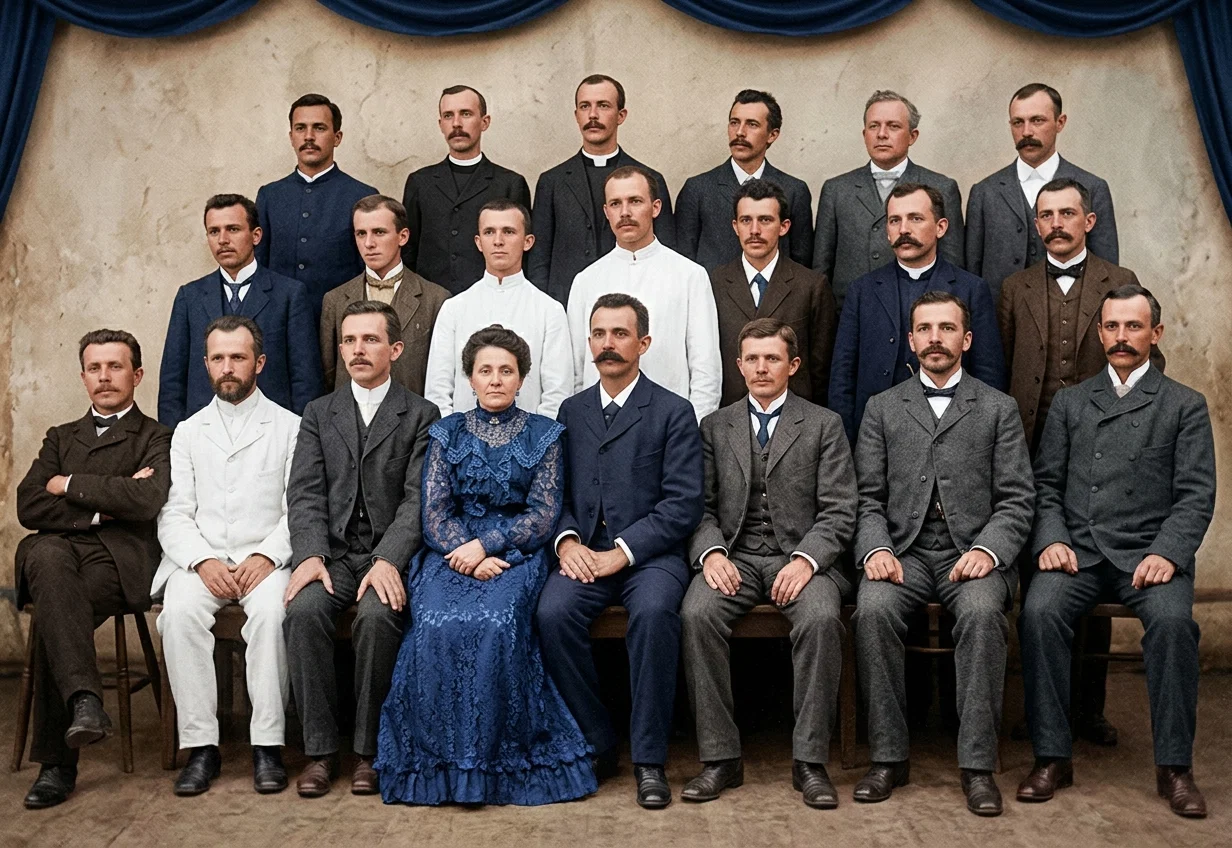
WORKERS AT THE BRAZILIAN MEETING AT TAQUARY
I had hoped to be able to return to Rio immediately after the close of the Espirito Santo meeting. But we found so much interest in different parts of that field, that this was out of the question. I found it necessary to visit all the other churches and companies. Eighteen other persons were baptized, making thirty-one in all on this trip. Others were for various reasons hindered from receiving baptism at this time, to whom it will be administered at the first opportunity.
Among the Brazilians (Portuguese-speaking people) I held several meetings, and a Sabbath meeting especially for them. Some of these decided henceforth to walk in God's commandments. I could have found work in that State for an indefinite length of time. A worker should be there; for in all the different places we visited, we found interested persons, or those who were willing to listen to the presentation of the truth. Especially is this the case among the Brazilians.
On the twentieth of July I reached Rio, after an absence of about seven weeks, instead of about three, as I had at first planned. Espirito Santo is also calling for several church-school teachers. Our brethren are feeling more and more the need of having instructors for their children who will not only teach them to read and write, but who will also teach them the Word of God, and prepare them for the stern duties that are before the Lord's people in these last days. May more be prepared to take up this work, and help hasten the glad day of Jesus' return.