Your ShelfYour Projects

The American Sentinel, The Sentinel of Liberty, Vol. 15, No. 25.

Rome Defies the Government in the Philippines
Earlier text: Rome Defies the Government in the Philippines

The True Standard of Human Legislation.

The divine law revealed in the Scriptures of the Old and New Testaments is not and should not be the basis of civil legislation.
The law of nature, written in the very constitution of things, not dependent upon a written revelation, but revealing itself in all the relations of life, is all-sufficient for the ends of civil justice. Of this law Blackstone wrote:
“This will of his [man’s] Maker is called the law of nature. This law of nature, being coeval with mankind, and being dictated by God himself, is of course superior in obligation to any other. It is binding over all the globe, in all countries, and at all times. No human laws are of any validity if contrary to this; and such of them as are valid derive all their authority, mediately or immediately, from this original.”
The same principle is set forth in the Declaration of Independence, in these words: “We hold these truths to be self-evident: that all men are created equal; that they are endowed, by their Creator, with certain unalienable rights.”
This endowment was not subsequent to man’s creation, but coincident with it. By the very act of making man what he is, the Creator endowed him with the rights which belong to him by the laws of his being. “Those rights, then,” says Blackstone, “which God and nature have established, and are therefore called natural rights, such as are life and liberty, need not the aid of human laws to be more effectually invested in every man than they are; neither do they receive any additional strength when declared by municipal laws to be inviolable.”
Lock, in his essay on “Civil Government,” says that “nothing is more evident than that creatures of the same species and rank, promiscuously born to the same advantages of nature, and the use of the same faculties, should also be equal one amongst another without subordination or subjection.”
“The sayings and doings of daily life continually imply some intuitive belief of this kind,” remarks Herbert Spencer. “We take for granted its universality, when we appeal to men’s sense of justice. In moments of irritation it shows itself in such expressions as ‘How would you like it?’ ‘What is that to you?’ ‘I’ve as good a right as you,’ etc. Our praises of liberty are pervaded by it; and it gives bitterness to the invectives with which we assail the oppressors of mankind. Nay, indeed, so spontaneous is this faith in the equality of human rights, that our very language embodies it. Equity and equal are from the same root; and equity literally means equalness. ”
Rights are not a matter of opinion but of fact; they exist in the very nature of things. In recognition of this principle Lord Coke remarks: “When anything is grounded upon the law of nature, they say that reason will that such a thing be done; and if it be prohibited by the law of nature, they say that it is against reason, or reason will not suffer it to be done.”
The one universal basis of civil legislation is, therefore, the inherent rights of man. These rights are self-evident. They are not dependent upon a written revelation, but appeal to all men everywhere, and are discoverable alike by pagan and Christian.
The Code of Justinian influences in large measure the legislation of to-day in both England and America. It is true that it was compiled in the 6th century of this era, but that in it which is best and most in accord with the demands of civil justice, is traceable to purely pagan times. Well would it have been for the world had no effort ever been made to model civil law after the supernaturally revealed law of the Creator; the law which he gave for the government of his own peculiar people, and which according to his own divine arrangement was to be administered by men divinely guided; but never to be the sport of contending political factions, or to be re-enacted by human legislatures. The legitimate sphere of human government is limited to guaranteeing natural rights and enforcing natural duties. It does not include the domain of morals. Moral government should be left with the only Being qualified to administer it, namely, the Creator.
B.

Jesuits and Peace in the Philippines

Commenting upon our note of two weeks since, in which we remarked that “three causes are operating to prevent the restoration of peace” in the Philippines, an exchange says: “The three ‘causes’ might be summed up in one word, ‘Jesuits.’ Then we have the root of the matter. The sooner Americans learn the methods of these slick underhand workers the better. The white ants of Popery, as they have been properly named.”

News, Notes and Comment

“Wholesale fraud and corruption,” says the Catholic Standard and Times, “honeycomb our public service in Manila. The Taft Commission just arrived there are said to be ‘staggered’ by the universality of waste and peculation under our ‘carpet-bag’ government. And General Otis goes on coolly referring to the Tagalo insurgents as ‘robbers.’”

A Rusty Statue of Liberty

The statue of Liberty Enlightening the World, on Bedloe’s Island, in New York harbor, is said to be in a rather woe-begone condition. The Herald of that city says of the statue:
“Standing as she does mantled in a heavy coating of green rust, she presents a much bedraggled appearance, and her condition is the occasion for much adverse comment among the many thousands whose business or pleasure takes them down the bay.”
Commenting upon this, the Springfield Republican says: “It is small wonder that a statue of liberty should grow rusty nowadays. Pull it down and put up a statue of Dr. Gatling.”

Truth and Fallacy.

A writer for the Christian Century says:
“A nation is not safe because of military supremacy only, or from the seven hills Rome would still rule the world.
“Nor do seminaries and scholars constitute a sure defense, else the land of Plato and Aristotle had never been subject to the unspeakable Turk.
“Nor does national existence running back into hoar antiquity safeguard the future, for the ‘Celestial empire’ seems now tottering to its fall.
“A nation is safe only when shielded by the eyes of Divine protection. This any nation can have that will coronate God as its supreme ruler and make His holy word its supreme law.
“These acts will in themselves counteract all tendency toward dissolution and promote national strength and grandeur.”
The writer we quote errs in this only when he attempts to tell how a nation can have “divine protection.”
God can be truly “coronated” only in the human heart. All any nation can do to honor God is to leave the individuals free to render Him such homage as they wish. Government cannot assist in this, and it should not seek to hinder.
Spain is an example of a nation which has tried to “coronate God.” Germany is another, and society is there honeycombed with infidelity more perhaps than in almost any other country.
Individual faith in God is the only remedy for sin; and this faith cannot be assisted by legislation.
The great trouble is that in attempting to “coronate” God, that which is really “coronated” is some self-appointed vicegerent of God.
To “coronate” God is to acknowledge his law and to bow to it. But when any nation undertakes to do this, that which is acknowledged and enforced is at best only some human interpretation of the divine law—usually far below the divine standard, and not infrequently in direct controvention to that law.
To “coronate” God by any state or national act is to make his law the football of contending parties, and the subject of court decisions, to be construed as other laws are construed; so that naturally men instead of seeking to know what the Lord says in His law, they will inquire what the courts say about His law.
The divine law “is spiritual” and since “spiritual things” are only “spiritually discerned,” the state, which is not spiritual, cannot even discern the divine law, much less administer it.
B.

Sunday Closing Ordinance in Hamburg

As noted in these columns last week, the Hamburg, Iowa, ministers are making a strong effort to secure from the city council an ordinance closing places of business on Sunday. A Hamburg paper says: “Rev. Enders made an eloquent and able plea before the council in favor of closing.” It is strange, indeed, what an interest the preachers take in “civil” matters when it comes to using civil law to enforce a religious institution.

Agitation for Sunday Store Closing

“The proverbial quietude and peacefulness of Englewood on Sunday mornings is being fearfully shattered these days,” says the Chronicle of this city. Every Sunday morning “there is a lively state of affairs in the neighborhood of Sixty-third and Halsted streets which occurs with such regularity that now crowds are beginning to assemble to see the fun.”
The occasion of the disturbance is an effort to induce a dealer in clothing and shoes to close his store on Sunday.
This merchant keeps open a few hours Sunday forenoon, but gives each of his clerks a whole day's vacation each week. These clerks have signed a written statement that they are perfectly satisfied with the arrangement; but though they are satisfied others are not, and demand that the store be closed all day Sunday.

The Catholic Truth Society’s Work

The Primitive Catholic, of Brooklyn, N. Y., notes that the Catholic Truth Society has prefixed the word “International” to its name. Among the items of work reported is “supplying regularly and gratuitously about nine hundred families with papers and magazines in sparsely settled localities in the South and West; the names being supplied by priests.”
“Another item in the report,” remarks the Primitive Catholic, “is the placing on the shelves of public libraries over eight hundred volumes of the ablest Catholic works. All this has been accomplished in one year.”
The secretary in making his report also notes “with satisfaction” “the work accomplished by the society in having expunged from text-books calumnies against the Catholic Church.”
“The calumnies against the Catholic Church,” says the Primitive Catholic, “are the true facts of history regarding Rome, and her past doings. It is to the everlasting disgrace of Americans that these histories have been mutilated. And even in this garbled condition, it is expounded, in numerous instances, in our public schools by Romish teachers.”

If Not Slavery, What Is It?

It has been repeatedly stated, and so far as we know has not been denied, that the rebellion in the Philippine Islands against Spain was “more a rebellion against the monks and clergy than against the sovereignty of Spain.” The same is true of the war which the natives have all along maintained against the United States.
But why a rebellion against the monks, and against the government of Spain and of the United States because of the monks?
Under Spain the monks were the real rulers, and the natives fear, and not without reason, that practically the same system will be continued under American government.
Under Spanish rule the monks taxed the people in various ways while living and even pursued them to the grave when dead. Marriages, births, funerals, etc., were all made a source of revenue to “the church.” Besides this the monks owned the land and the people being merely renters, eked out a precarious existence at best.
Moreover, these lands had not been acquired by the monks by purchase, but by confiscation; largely upon false charges corruptly sustained. “Whenever a man had a desirable plantation, they would trump up some charge against him, have him arrested, and, without investigation, shot; and the property was turned over to the monks. It was in this way, principally, that they had acquired their possessions.”
The avowed purpose of the revolutionists was to confiscate this property and turn it over to the government for the benefit of the people. This is exactly what was done in Mexico forty years ago. It was this
that led to the attempt by Napoleon III., backed up by Rome, to establish an empire in Mexico under Maximilian. This empire failed as soon as the support of France was withdrawn at the demand of the United States, and Maximilian was shot.
But now the United States have been entrapped by Rome and are being used to fasten upon the Filipinos the very system which this Government refused to permit France to fasten upon Mexico. The facts have been thus stated:
“When the commissioners met at Paris, to make peace between this country and Spain, it will be remembered that the Philippine government, of which Aguinaldo was the head, appointed a commissioner to appear before that body and state their grievances, but the commissioners refused to listen to them, or in any way receive him.
“About this time, Archbishop Ireland, as the daily press informs us, had an interview with President McKinley, and it was there agreed that the property rights of the church or monks, should not be interfered with. Accordingly, a clause was put into the treaty that all the property rights that existed under Spain would be accordingly respected by the American Government. So the people of the Philippine Islands found that practically everything they had fought for against Spain would be lost if the American Government’s supremacy was maintained.”
These facts are not very creditable to the United States which by papal intrigue were induced to bind themselves to take the side of Rome against the people, and this without regard to the real merits of the case. Right or wrong, this Government must maintain the claims of the monks, or of “the church,” as against the people of the Philippine Islands. If this is not enslaving them, what is it? B.

Foreign and yet Not Foreign.

  • (From the Springfield Republican.)*
Against Judge Lochren’s opinion as to the constitutional powers of Congress over the new territory of the United States, comes that of Judge William K. Townsend, sitting in the United States district court for Southern New York. The latter holds views quite the reverse of those expressed by the United States circuit judge at St. Paul in the habeas corpus case of the Porto Rican, Ortiz.
The case before Judge Townsend related to

AN ASSESSMENT OF DUTIES

on an importation of tobacco from Porto Rico after the treaty of Paris had been ratified and an exchange of ratifications had taken place. The importers, John Goetz & Co., appealed the matter to the board of general appraisers, which decided against the importers, who thereupon took the case to the United States court, contending that Porto Rico had become a part of the United States and within the tariff laws of the nation. Judge Townsend decides that Porto Rico is not a part of the United States to this extent and will not become such a part until Congress has expressly defined the status of the island to this effect.

THE TREATY OF PEACE

left with Congress the determination of “the civil rights and political status of the territories hereby ceded,” and it was within the constitutional authority of the treaty-making power, says Judge Townsend, to give Congress unlimited power in the matter. Congress meantime has refused to extend the Constitution and the laws to the island, and accordingly it remains outside of the Constitution. It is foreign country so far as the Constitution is concerned, but United States territory as against other nations.
Judge Townsend brings out no new authority or precedent in support of this side of the question, beyond the

STATEMENT OF CHIEF JUSTICE MARSHALL

(in American insurance company against Carter) respecting “the usage of the world” in the case of ceded territory: “It becomes a part of the nation to which it is annexed, either on the terms stipulated in the treaty of cession or on such as its new master shall impose.” The gist of Judge Townsend’s opinion is contained in the following:
“To deny this power, to govern territory at arm’s length would be to thwart that intention to make THE UNITED STATES AN UNFETTERED SOVEREIGN in foreign affairs. For if we wage war successfully we must some time become, as many think we are now, charged with territory which it would be the greatest folly to incorporate at once into our Union, making our laws its laws and its citizens our citizens, our taxes its taxes; and which, on the other hand, international considerations and the sense of our responsibility to its inhabitants may forbid us to abandon. The construction of the Constitution which would limit our sovereign power would force us into a dilemma between violating our duty to other nations and to the people under our care on the one hand, and violating our duty to ourselves on the other. That construction would in such case imperil the honorable existence of our republic.”
And so the president and the Senate, as the treaty-making power, may annex any territory they are able to; and may then delegate to Congress the power to act beyond the Constitution, and exactly as it pleases, in relation to the new territory.
Now the duly constituted government of the United States may indeed be AN UNFETTERED SOVEREIGN IN FOREIGN AFFAIRS; but when foreign territory has once been annexed to the United States we come to deal not with a foreign, but with a domestic affair—with territory of the United States and not of some other sovereign power. And here is the fatal weakness in Judge Townsend’s argument. When, therefore, he asserts the power of the president and Senate to delegate unlimited power to Congress in relation to territory of the United States, he is obliged to maintain that the government at Washington is a government of unrestricted powers rather than one exercising a certain measure of delegated authority from a power paramount to that of president and Congress.
Such views as these place the government above the people who created it, and who, in a written Constitution, imposed bounds upon the scope of its authority. They seem to us to be

Sunday Laws and the Workingman.

There are a good many labor leaders who are not in favor of Sunday laws, preferring to secure what they desire in the way of a weekly rest day through their own organizations rather than appeal to the state. In this they are wise.
The Sunday-keeping churches desire Sunday laws in their own interests. These interests demand laws not only prohibiting Sunday work but Sunday play as well.
Writing upon this subject in the Michigan Sabbath Watchman for October, 1891, Rev. Francis W. Ware said:
“ * Make it impossible to run the theaters, shut up the cigar stands, ice-cream saloons, and soda water fountains, and prevent baseball playing, put an end to railroad and other Sabbath excursions, and the masses will the more easily be turned to the house of God. Break down these sacrilegious but fascinating amusements and the church will have the right of way to our masses.”
This shows very plainly the real motive back of the demand on the part of the churches for Sunday laws and Sunday enforcement—it is that they may “have the right of way to our masses.”
But in the same paper, the same writer showed very plainly that they desire not only “the right of way to our masses,” but “the right of way” to the pocketbooks of “our masses.” He says:
“If the churches of this state (Michigan) were to contribute $10,000 this year to assist the American Sabbath Union to push its work, they would in our judgment make for themselves the finest possible investment. The money so invested would soon return to them with fine rates of interest. The money now spent in Sabbath desecration by those who are in large sympathy with the churches, but who are led off to the parks, on excursions, and to other places, where money is spent freely, * would, if our Sunday laws were enforced, return to the churches and contribute to their support.”
This was written nine years ago, but it just as truly reveals the real motive back of the “civil Sabbath” now as it did then. And the workingmen should understand—such of them as do not now understand it—that in joining in the demand for Sunday laws, they are only asking the state to restrict their liberties in the interests of the churches.
We believe that every man ought to be interested in religion and assist in supporting the gospel, but this he should do voluntarily, “not by constraint but willingly.” And certainly the church has no right to use the civil power to compel this, even indirectly.
It is no part of the duty of the state to foster religion or religious institutions other than by such just laws as will leave every man free to worship or not to worship just as he elects. Historically, religious liberty means not only the right to accept, to profess, and to observe the religion of one’s choice, but also the right to reject, not to profess, and not observe any religion. This right the “civil Sabbath” seeks to abridge by indirection.
B.

REVOLUTIONARY DOCTRINE

and to mark with renewed emphasis the great change which is quietly being forced into American institutions to meet the needs of a revolutionary policy of distant conquests and alien annexations. The people of the United States are, or were, the sovereign power in this country, and not the government at Washington. The people can, if they choose, delegate to president or Congress the unlimited power claimed for them by Judge Townsend; but this the people have not as yet done, and until they have done so Congress can step beyond the constitutional law of its being, in the government of territory of the United States only by an act of usurpation.

The Church Militant.

(Chicago, Journal, June 19.)
Quite the most surprising deliverance upon the Chinese question comes from Bishop Earl Cranston, who declared, in a sermon at Denver on Sunday, that it is worth any cost in money or bloodshed if we can make the millions of Chinese true and intelligent Christians. “I would,” he continued, “cut all the red tape in the world, and break all the treaties ever made, to place the armies of the United States in the fore next to Great Britain. We must not be the tail end of everything.”
Bishop Cranston was, we believe, elected to his present position at the Cleveland conference of ’96, and is now stationed at Portland, Ore. During the past three or four years he has traveled abroad, and travel seems to have enlarged—or perhaps “expanded” is the better word—his views.
The moral obloquy discovered by many men of many minds in discussing the Chinese is one of the most astonishing phenomena of a turbulent and strenuous age. Commerce, imperialism, and the followers of Christ, widely apart on many other questions, have been singularly unanimous in denying to the Chinese the common attributes of humanity, white, black or yellow. Hath not a Chinaman eyes? Hath not a Chinaman hands, organs, dimensions, senses, affections, passions? Evidently not. Commerce would force trade upon him, even though the trade be opium; imperialism would cut up his empire, upon this or that pretext; and the followers of Christ—the Christ that stands for peace on earth, good will toward men—would make the Asiatic empire run red with blood, transform its rice fields into shambles, ensanguine every river and tributary, if thereby, as Bishop Cranston says, “we can make the millions of Chinese true and intelligent Christians.” For the Denver exponent of the church militant does not stand alone in his views. He perhaps stands alone in audacity and bloodthirstiness; but others secretly believe what he has the shamelessness to avow.
The missionary question is a question upon which we hesitate to pronounce opinion. Much may be, much has been, said upon all its sides. It is not a question upon which an opinion can be passed at once sweeping, intelligent and final. Yet one can, with a clear conscience and a conviction of right, protest against any such monstrous, immoral declaration as that credited to Bishop Cranston. It is unspeakably odious.
Nor is it necessary that one should have any genuine sympathy with the Chinese to appreciate the shameful bullyragging that that peaceful people has put up with for more than half a century. The powers, one and all, but England in especial—the England that Bishop Cranston would like to see, with drawn sword, marching side by side with the United States—have outraged, abused and robbed China systematically. Every concession of importance that they have obtained from China has been such a concession as the victim of a highwayman yields at the point of a pistol. When Europe has advanced another foot on Chinese soil the foot has been set down in blood.
And we, the lovers of Liberty, the writers about liberty, the orators on the subject of Liberty, and her sister, Justice—what have we done to help the cause along? We have denied the Chinese entrance to this country, and demanded entrance to theirs. At the same time we have opened our gates to the riffraff of Europe, and for fear that this might be contaminated by contact with the Chinese population already inside the country, we have, in one way or another, done our best to kill off the “pigtails.” We have been as unjust and cruel to China as almost any other power has been, but we have done it in another way, and have been a shade more gentlemanly in the doing.
It has been bad enough to watch commerce and imperialism holding up and slashing at the Chinaman; but now that Religion frets for the highway, the mask, and the blunderbuss, it is rather time to call a halt. What has come over the church lately? Sword and fire flash and curl around half the pulpits in the land. Here’s the New York Independent, which has long been suspected of religious leanings, clamoring for another Egypt under a joint protectorate of seven powers, including your Uncle Sam, of no-entangling-alliance fame. Verily, brethren, as the rural editor loves to inquire, “Whither are we drifting?”

A Momentous Question.

Testifying before the Industrial Commission in Washington, N. F. Thompson, Secretary of the Southern Industrial Convention, said of labor organizations:
“Their influence for disruption and disorganization of society is far more dangerous to the perpetuation of our government in its purity and power than would be the hostile array on our borders of the armies of the entire world combined. Organizations teaching such theories should be held as treasonable in their character, and their leaders worse than traitors to their country.”
Apropos of this the Springfield Republican says editorially:
“There are some very unlovely features about labor unionism in its current practical workings. We see these brought out in such contests as those being waged in Chicago and St. Louis—in the sympathetic strike, the boycott, the resort to violence when other means fail, the mob spirit that is so generally excited, and the temper which would deny by force and terrorizing practices the means of livelihood to the ‘scab’ or non-union workman.
“But what are you going to do about the unions, beyond holding them and their strikes within the bounds of law and order? Are you going to prohibit and suppress labor organization? If so, are you going to deal likewise with capital and prohibit not only combinations of corporations, but combination of capital in any and all corporations? Is the right all on the side of the strong, and the wrong all on the side of the weak? Is aggression against individual rights confined wholly to the organized laborer, and is organized capital wholly to be trusted not to exceed its own reasonable claims as against the laborer and the general public?”
Then answering in part its own question, the Republican has this to say:
“This cannot be, and in a popular government it is simply idle to talk about prohibiting labor organization and strikes without also considering the necessity of applying equally severe restrictions to capital. Nevertheless the people at large are getting exceedingly weary of these constant and most disturbing and destructive and often bloody outbreaks between organized labor and organized capital, which are a disgrace to the civilization of the time. Some means must be found to stop these assaults on peace and order and progress in wealth production.”
Of course “this cannot be” and popular government be maintained. But the facts here enumerated, and others of like character, are sounding the death knell of free institutions in this country.
As a people we talk about teaching the Cubans and the Filipinos the art of self-government, and yet are daily demonstrating that we do not possess the faculty ourselves.
Two things are absolutely essential to government of the people by the people; namely, self-control and love of liberty for its own sake—that is, love of the principle apart from one’s own participation in its benefits. In other words, love of liberty not simply for one’s own self but for all men.
It has been truly said, “That government is best that governs least.” But any government to be effective must govern sufficiently to preserve the peace—to make life and property safe, etc. But this can be done with the minimum of government only where the people govern themselves; each respecting his neighbor’s rights, etc.
Just now complaint is made that in a certain section of this city, every man out after a certain hour is arrested by the police and required to give a satisfactory account of himself. This is of course very annoying to good citizens, and some of the papers are crying out against it. But why is it done? Surely not because the police want to persecute law-abiding men. It is done because there are so many law-breakers operating in that section that the police consider it necessary for the protection of the city. In this case the criminal element by their failure to govern themselves make it necessary in a measure for the police authorities to place restriction upon all that work a hardship upon honest people necessarily out at unseasonable hours.
Again, much is said about the necessity of restricting the trusts and corporations. But why this necessity? Simply because men of wealth also are losing the faculty of self-government. Greed leads, them to overreach and wrong their fellow-men; hence the necessity for more government. And so our state and national governments are constantly becoming more and more paternal, that is, they are constantly intermeddling more and more with that which ordinarily ought be left to the individual.
It matters not how intelligent a people may be, if they lack the faculty of self-control—if they refuse to do that which is demanded by the principles of justice—they show themselves unfit for self-government and invite despotism.
Nor is it possible for such a people to make laws that will compel themselves to deal justly. This is illustrated by the situation in St. Louis to-day. The mayor of the city belongs to one political party; the governor of the state to another. Each fears to take any decisive step to restore order and protect persons and property in the city, lest he may alienate votes from his party. Thus the laws which the people have made for their own protection fail when that protection is most needed, because those whose duty it is to enforce them fear to offend the people, who, by their representatives, made the laws. Such a condition of affairs is certain in time to destroy representative government. Such a state of affairs is anarchy and anarchy always invites despotism. B.

THE GLAD TIDINGS.

A verse-by-verse study of the book of Galatians. By E. J. WAGGONER.
“The Epistle to the Galatians, together with its companion, the Epistle to the Romans, was the source through the Spirit, of the Reformation of the sixteenth century. The reformation then begun is not yet complete, and the same watchword—the just shall live by faith—needs to be sounded now.” You will find this book a “feast of good things,” even the “glad tidings of salvation.” 265 pages. Cloth, 60c.; paper, 25c.
Address any of our agencies, or our nearest House.
PACIFIC PRESS PUB. CO., 39 Bond St., New York. Kansas City, Mo. Oakland, Cal.

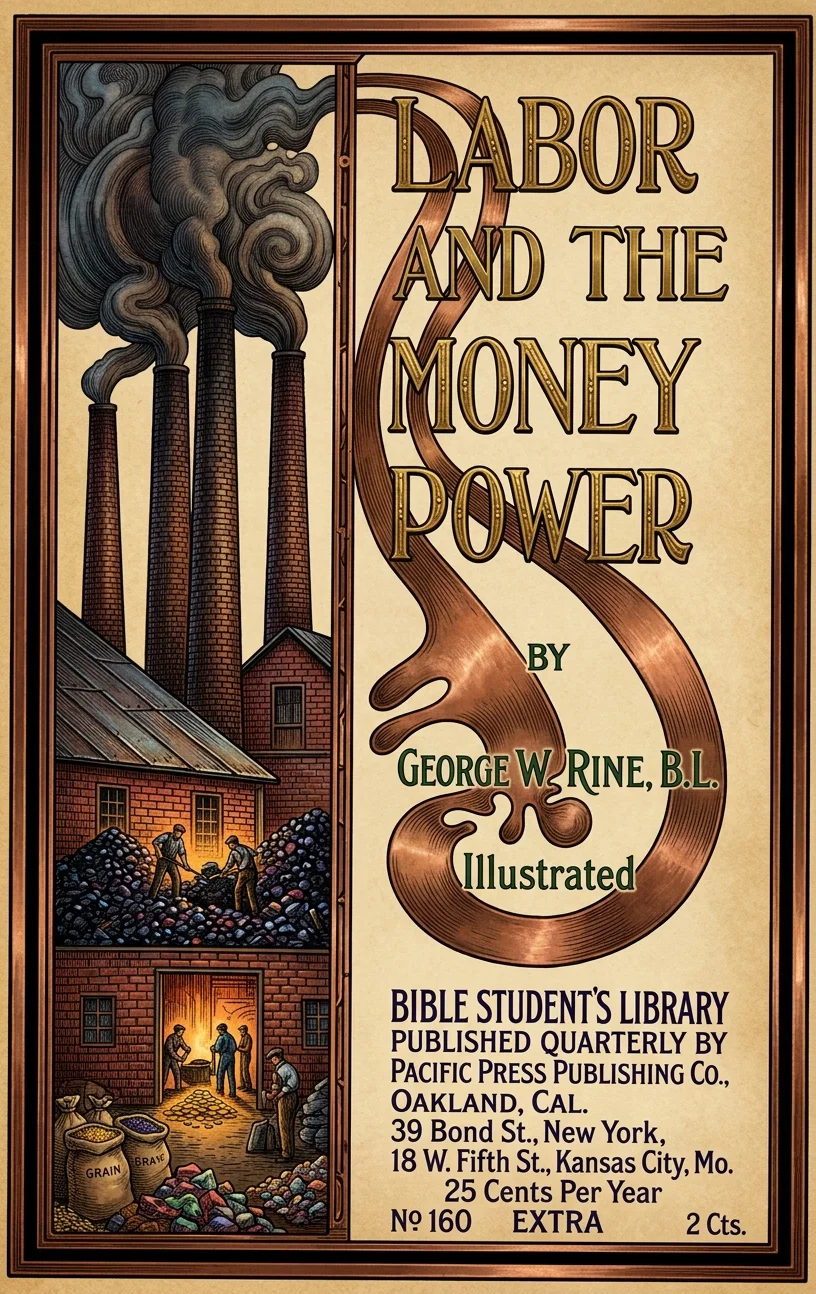
LABOR AND THE MONEY POWER.

By Prof. G. W. RINE, B. L.
Says a well-known editor in a recent editorial notice of this tract:—
“It presents in a most striking way the facts as to the enormous accumulation of wealth, especially in the hands of a few, and the meaning of it as foretold by the Scriptures concerning the last days. It ought to be in the hands of every person in the nation.”
This tract contains 32 pages and is illustrated. It is issued as Bible Students' Library No. 160. Price, $2.00 per 100.
Address any of our agencies, or our nearest House.
PACIFIC PRESS PUB. CO., 39 Bond St., New York. Kansas City, Mo. Oakland, Cal.

SUBSCRIBE FOR . . .

THE

SENTINEL . . .

. . . OF . . .

. . . LIBERTY.

A paper set for the defense of liberty, both Christian and Constitutional, and opposed to everything tending toward a union of church and state, either in name or in fact.

You Need this Paper

—AND—

Your Neighbors Need It.

If you are not familiar with this subject you will be surprised, not only at what is proposed, but at what has been already done in the direction of nullifying the constitutional safeguards of Liberty of conscience.
Single copy of the paper:
One year........................................ $1.00
Six months ........................................ .50
Three months ...................................... .25
In clubs of five to twenty-four, to one address, one year................75 cents
In clubs of twenty-five to forty-nine, to one address, one year, 60 cents
In clubs of fifty to ninety-nine, to one address, one year................55 cents
One hundred or more, to one address, one year.........................50 cents
ADDRESS,

SENTINEL OF LIBERTY,

324 Dearborn Street, - - CHICAGO, ILL.
Continue reading: BIBLES