The following graphic account of affairs in Ireland is from the London correspondent of the New York Times, as republished in the Congregationalist of Jan. 5. We call the reader’s attention to the fact that both writer and publishers are too conservative to be accused of fanaticism. But it would be impossible to tell how far the gloomy predictions here presented will be realized; for no one can foresee the influence on the Irish problem of measures now before Parliament,78nor the outcome of Fenian raids and Land-League fermentations:—
Ireland is the topic of the hour. Greece puts in a claim to consideration, but we talk of nothing but Ireland. English people begin to think there is really something seriously amiss this time. The old Fenian scare was hardly as bad as the present more vague terrors of the League. I called upon an Irish landlord yesterday who has just come to London on business.
“You have no idea in England, near as you are to us,” he said, “of the silent, ominous terrorism that is creeping over the land.”
“Do you fear a rising?” I asked.
“A rising!” he exclaimed, “a massacre!”
“As bad as that?”
“Yes, sir,” he answered. “I am no alarmist, and I am not a coward, for I am going back to-morrow; but I am well armed, and shall sell my life dearly.”
“I thought your part of the country was quiet?”
“No part of the country is quiet. Two months back my county was as orderly and peaceable as Berkshire or Surrey in England: my tenants were respectful and friendly; I helped the men if they were in trouble, my wife assisted the women; I made some reductions in their rents last year; all was pleasant enough, and we looked with regret toward the west as the scene of agitation and anarchy. One fine morning a deputation of the Land League came to our village; that was three weeks ago. In that time we are a different community. My tenants, who were thrifty and industrious, have suddenly become reckless and lazy. They who were a respectful and orderly set of men are within three weeks a scowling, discourteous mob of vagabonds. They hang about silent and morose, or they scream and yell in drunken madness. They are waiting some preconcerted signal for a revolution or a massacre.”
“Why, only a week ago a government official,” I answered, “informed me that things were improving, that the situation had been greatly exaggerated.”
“He did not speak the truth. Affairs grow worse from day to day. The disaffected districts are more disaffected, and the influence of the League is spreading like fire on the American prairies. You think I am excited, that I am coloring the aspect of the crisis. No, sir; I am not. Fire-arms and powder are common property. The rifle has taken the place of the stick. Deadly weapons are publicly paraded, threatening letters pour into the houses of all respectable people; not a day passes that some outrage is not committed, some murder perpetrated. Horses are mutilated, their tongues cut out, cows are barbarously killed: the priests are either powerless or unwilling to interfere; the magistrates have not the suspension of the habeas corpus act to help them, and we are at the mercy of a howling mob of drunken fanatics who openly declare for the violent severance of the union between England and Ireland. A government that can stand by and allow liberty to degenerate into a bloody license is a disgrace to the age, and will become a by-word and a jest in the future, when the worst has come and is over, for it will come; there will be a fight as sure as we live.”
“You are angry.”
“I am in earnest, and I wish you to understand that I am; good heavens, man, the League has courts and institutions of its own. It forces men to join them, and it tries and punishes deserters. It is an organized system, a government with an army. It drills, it parades, it issues orders and proclamations; and yet a government official tells you things are mending, and a Foreign Secretary announces that he does not consider the suspension of the habeas corpus act necessary. They are fools, or worse; their conduct is criminal in the highest degree. A government that cannot protect its peaceful subjects and punish the lawless, exists in a fool’s paradise, and will have to wade back to common sense through the blood of its victims, loyalist and traitor.”
THE KANSAS T. AND M. SOCIETY DEBT.
By Smith Sharp
At the Osawkee Institute last fall, the subject of raising means to pay the debt of the Kansas Tract Society was discussed, and it was unanimously agreed that we make an apportionment of the State debt to each local society. We have therefore taken the amount of S. B. actually paid into the State treasury as the basis, and apportioned to each church the amount it should pay. This will be found to be an equal and just apportionment if all have been faithful during the past year in paying into the Lord’s treasury in proportion to their ability. And if the circular containing the apportionment shows that you have not as much assigned you as some other church no more able financially than you are, it simply shows that that church has paid more in proportion to its ability than your church has.
We certainly think that all our ministers and tract-society officers will feel the importance of earnest effort in this matter. The most of the districts are in debt to the State society, so that the aggregate would very nearly pay off the debt of the society; and the districts are only asked now to pay off their indebtedness, and then receive credit for all the surplus. The debt is so heavy ($1500), and has been so long standing, that I have instructed the secretary to make no further orders for stock, thus increasing the indebtedness, but to apply every dollar received on the debt.
Brethren, which shall we do, raise the money and pay the debt, or let the T. and M. work stop? Responses to this call will be the answer. There is financial ability in this Conference to pay this debt. If our brethren will all bear their part, it can be paid, and we will hardly feel it. Will we do it?
Will the ministers all co-operate?
1. Obtain all the members you can; each member who joins the tract society will increase the fund one dollar.
2. Obtain all the money you can as a donation to the district in which you are laboring.
3. Solicit pledges to be paid before May, 1881, where they can be obtained.
4. Take pledges to be paid Jan. 1, 1882.
Brethren, let your money and pledges come in, and let us pay this debt.
SMITH SHARP, Pres. Kansas T. and M. Society.
Notes of News.
—Wm. H. Vanderbilt owns $50,000,000 in government bonds.
—There is great distress among the laborers in some parts of Ireland.
—Sara Bernhardt has drawn over $227,000 out of the American pocket.
—An American-built railroad, the first in Japan, has been opened in Yeso.
—Spain is asserting her claim to be considered one of the powers of Europe.
—The Russians have captured Geok Tepe, completely routing the Turcomans.
—Messrs. Moody and Sankey will commence a series of meetings in New Orleans shortly.
—The farmers of Germany ask protection against the importation of American produce.
—The earthquake shocks at Agram, Austria, have been renewed, causing a renewal of the panic.
—There is said to be a serious uprising in Turkish Armenia, which has been in an unsettled state for some time.
—There are about 200,000 miles of railroad in the world, of which about 92,000 miles are in the United States.
—A desperate fight recently occurred at the Atherton Colliery in England between the miners and police and soldiers.
—There is a report that over seventy lives have been lost by the capsizing of a local trading steamer near Singapore, India.
—The Peruvian towns of Chorrillos, Barraca, Miraflores, and Lima have surrendered to the Chileans after severe fighting.
—The Egyptian obelisk which has been transported to our shores, now stands on its pedestal at Central Park, New York City.
—A rich Chicagoan has willed $100,000 for the establishment of a mission church in the most thickly settled part of that city.
—Alaska has a population of 30,146, and the value of its annual production of furs is $1,680,000, and of its fisheries, $80,000.
—Since the organization of the mission church among the Telogoos in Ongole, India, in 1877, 15,796 members have united with it.
—A Mr. Richardson, of Mississippi, is the largest cotton planter in the world. It is said that he has made $20,000,000 from his fields.
—Some wealthy citizens of Chicago have taken steps to organize a new telegraph company, which is to be independent of the Western Union consolidation.
—The Assembly of Michigan have passed a joint resolution, expressing sympathy for the suffering people of Ireland, and inviting them to settle in this State.
—The officers of the Western Union Telegraph Company promise to make no advance in their rates on account of consolidation, except at a few suburban points.
—In a mine near Wilkesbarre, Pa., two miners were recently buried under two thousand tons of top-coal and rock. The bodies have been recovered, but were horribly mangled.
—It is proposed to construct a line of telegraph through the whole extent of the continent of Africa, connecting the English South African colonies with the Egyptian lines at Kartum.
—The remains of Lieutenant Irving, one of the officers of Sir John Franklin’s expedition in search of a northwest passage, have been recovered, and interred at Edinburgh with honors.
—There is a report that President Hayes intends to visit England next May, and will remain in Europe until fall, so as to be present at the Methodist Ecumenical Congress to be held in London in September.
—The news of the presidential election held on the 2d of November reached Santiago, Chili, on the 4th of that month. It was sent to England, thence to Brazil, and across the Andes to Montevideo and Santiago.
—The British government is taking precautions to prevent a Fenian uprising. All the armories and manufactories of arms are strongly guarded. The towers containing the arms of the Tower of London are closed to the public.
—The trial of Parnell and his colleagues has at last terminated. The jury failed to agree, ten of them favoring a verdict of not guilty, and the traversers were, in consequence, discharged. The people of Ireland are very enthusiastic over the result.
—As soon as the Atchison, Topeka, and Santa Fé R. R. is completed as far as the Rio Grande, work will be commenced on the Central Railroad of Mexico. These important lines will render vast regions of territory accessible to commerce and modern civilization.
—Eighty laborers of Kanturk, Ireland, recently entered the workhouse, made prisoners of the poor-law guardians, and refused to let them go until they promised to give them work. The guardians promised to give out-door relief for one week to the starving families of the unemployed.
—There is a great depression in the cotton and woolen trade of Russia. One manufacturing firm,—that of Thornton, the English millionaire,—discharged fifteen hundred weavers at one stroke. Other mills are on short time, or closing. The failure of the harvest leaves the peasants too destitute to purchase cotton goods.
—In several unimportant engagements in South Africa the Boers have been victorious. One English garrison has surrendered, and another will probably be obliged to do so. The Boers have captured some guns. Reinforcements for the British have landed in South Africa, but have not reached the seat of war.
—The Greek Church celebrates Jan. 6 as Christmas Day. On that day commemorative services were held in the Russian chapel in New York City. These services are described as being “singularly strange and impressive, consisting of the reading of the Scriptures and prayer by the priests. The lighted candles, emblazoned altar, and the elaborate silk and gold robes of the officiating priests, presented a scene not soon to be forgotten by the casual visitor.”
—On the 22d inst., five persons,—four mailing clerks and an express agent,—lost their lives by a railroad accident near Owego, N. Y. One of the driving wheels of the locomotive broke, and the entire train, going at the rate of thirty-five miles an hour, was thrown from the track. The forward cars were turned over and over, but none of the passengers were injured. The postal car burned, and the victims of the disaster perished in the flames.
—The native Christians of the North India Methodist Conference have held a camp-meeting lasting several days. There were eighty tents on the ground, and from five hundred to seven hundred in attendance. “The meetings were interesting and impressive. At the close, all joined hands, making an unbroken ring, representing that they were one in Christ. All who retained enmity or caste spirit were requested to leave the ring, but the answer came, ‘There are none such now.’”
—The European conference which is soon to be held at Constantinople to settle the Turko-Grecian difficulty, is to hold secret sessions, and Greece is to be excluded. The Porte is to be called upon to indicate the frontier it will concede, and Greece will be required to accept the decisions of the conference. Italy favors admitting the Grecian representative. The armies of Greece are ready for war, and Turkey has forces on the frontier sufficient to meet any Grecian force that can be brought against them.
—The London Times thus comments on the increase in population of the United States, as shown by the recent census: “These eleven and a half millions of people are not a poor, indigent, and untaught mass, such as would be produced in any European State by so great and rapid an accession to the population. They are well fed and clothed, well-to-do, and, as a rule, well educated. There is room, and to spare, for them all, and for as many more during the next ten years. We cannot but look with some envy on a nation whose easy lot it is to gather up the things which fortune casts to it.”
Obituary Notices.
“Blessed are the dead which die in the Lord from henceforth.” Rev. 14:13.
Powers.—Died of pneumonia, in Rochester, Ind., Jan. 12, 1881, Ellis R. Powers, aged 63 years. About five years ago, Bro. Powers accepted the third angel’s message, and united with the Rochester church. He died in hope of a part in the first resurrection. Funeral discourse by the writer, to a large congregation of sorrowing friends. W. W. Sharp.
Grant.—Died in Oswego, Kan., Nov. 11, 1880, in the twentieth year of his age, Dudley Grant, son of Graves and Margaret Grant. About three years ago, he had the misfortune to lose both his arms by a fall from a reaper. He has since studied hard, with the hope of educating himself, but his efforts were cut short by disease and death. He was a commandment-keeper. E. J. Stover.
Weaver.—Died near Middle Grove, Saratoga Co., N. Y. Dec. 10, 1880, Bro. Wm. Weaver, aged 75 years. Bro. Weaver had been a firm believer in present truth for nearly thirty years, and died in full faith and a blessed hope of a speedy resurrection. He was a faithful and exemplary Christian, and was respected by all who knew him. Words of comfort were spoken at the funeral by Wm. Armstrong, of the Christian denomination. W. N. Parker.
Hill.—Died of diphtheria, at Eagle Lake, Minn., Oct. 5, 1880, Frankie, son of Eld. W. B. and Sister Emma Hill, aged 10 years. Also at the same place and of the same disease, Jan. 15, 1881, little Guerdon, aged 5 years. These dear little boys had a remarkable understanding of, and love for, the present truth, so precious to their parents. Funeral services Jan. 16. Remarks by the writer, from Rev. 14:13. F. W. Morse.
Wood.—Died of dropsy, at Bertha, Todd Co., Minn., Ettie Wood, aged 33 years. Sister Wood had long been a sufferer, but was cheered by the hope of a better life. She embraced present truth about six years ago, at Golden Gate, Minn., and has since lived a consistent Christian life, although much of the time deprived of church privileges. A husband and one daughter mourn their loss. May they ever imitate her virtues, and meet her in the first resurrection. Words of comfort were spoken from 1 Thess. 4:14–18. John I. Collins.
Stafford.—Died of pulmonary consumption, in Tompkins, Jackson Co., Mich., Jan. 9, 1881, Eva G. Stafford, eldest daughter of E. P. and Jennettie Giles, aged 26 years, 9 months, and 17 days. Sister Eva Giles Stafford has been an honored member of the Jackson church for a number of years, and her life has ever been that of a humble, consistent follower of Christ. She bore her protracted suffering with Christian fortitude and patience. She was conscious till the very last moments of life, and left the very best of evidence that she has fallen asleep in Christ. A husband, little daughter, parents, sister, two brothers, and a large circle of relatives, mourn their loss; but they sorrow not even as others who have no hope. They are comforted with the thought that soon the dear Saviour will come, and bring Eva from the grave, and give her a part with his people, where there shall be no death.
Discourse to an unusually large congregation of sympathizing friends, from Rev. 21:4. E. R. Jones.
REVIEW AND HERALD PUBLISHING HOUSE.
BOOK AND JOB PRINTING, BOOK BINDING,
Electrotyping, Stereotyping, Paper Ruling, Blank Book Manufacturing, Etc.
The largest and best equipped printing office in the State. Orders by mail promptly attended to.
Address REVIEW AND HERALD, Battle Creek, Mich.
BATTLE CREEK COLLEGE,
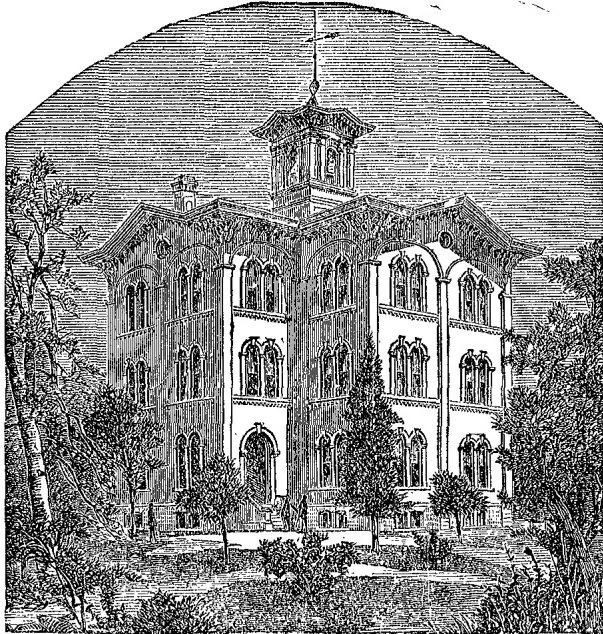
This institution, since its establishment in 1874, has gained an enviable reputation, and in many respects its success has been unparalleled in the history of colleges during the first years of their existence.
NEARLY FIVE HUNDRED STUDENTS ENROLLED EACH YEAR.
It Is Thoroughly Practical in Its Methods of Instruction and Discipline.
In the various departments young men and women are receiving just what they need as a preparation for the positions in life which they intend to occupy.
THE COLLEGE BUILDING IS NEW, SPACIOUS, AND BEAUTIFUL,
Five Departments of Instruction are open to receive students:— 1. Department of the Arts and Sciences. 2. Normal Department, with its Model School, and Course of Four Years. This includes all the Common Branches. 3. Biblical Department. 4. Commercial Department. 5. Department of Hygiene, with a Course of One Year.
For full Descriptive Catalogue, address,
BATTLE CREEK COLLEGE, Battle Creek, Mich.
MEDICAL AND SURGICAL SANITARIUM,
By John Harvey Kellogg
Battle Creek, Michigan.
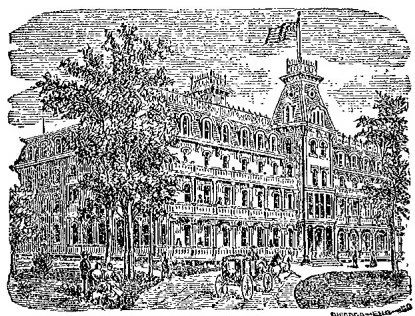
This institution, beautifully located in one of the most healthful cities of Michigan, is everywhere recognized as the
GREAT SANITARIUM OF THE WEST.
More than 4,000 patients successfully treated. The erection of new buildings and the addition of all the most approved remedial appliances known to the profession, have made it The Most Complete Institution of the Kind in America. All modern hotel conveniences furnished. Terms very reasonable.
J. H. KELLOGG, M. D., Medical Superintendent.
Address,SANITARIUM, Battle Creek, Mich.
THE SIGNS OF THE TIMES.
PUBLISHED WEEKLY AT OAKLAND, CAL., FOR THE
MISSIONARY SOCIETY OF SEVENTH-DAY ADVENTISTS.
TWELVE-PAGE EDITION.—A live Religious Family Paper, containing, in addition to the great variety of original articles, which make it a desirable prophetic journal, Departments devoted to Temperance, The Home Circle, News, The Missionary Work, and the Sabbath-school. Price per Year, $2.00
In clubs of ten or more copies to one address, to be used for missionary work, each 1.50
EIGHT-PAGE EDITION.—Condensed from the above. Per Year, 1.25
In clubs of ten or more, each 1.00
Address SIGNS OF THE TIMES, Oakland, Cal.,
—OR—
REVIEW AND HERALD, Battle Creek, Mich.
ELDER J. N. LOUGHBOROUGH, Ravenswood, Shirley Road, Southampton, England.
MISS ELIZA THAYER, Secretary N. E. Tract Society, So. Lancaster, Mass.
WM. LEAVITT, Salem, Oregon.
ADVENT HAROLDEN.
By Editor
SIXTEEN PAGES.
A SWEDISH RELIGIOUS MONTHLY.—PUBLISHED AT BATTLE CREEK, MICHIGAN, AND CHRISTIANA, NORWAY.
Advent Harolden is devoted to the proclamation of the second coming of Christ, the explanation of Prophecy and Bible doctrines in general, and the defense of the commandments of God and the faith of Jesus. Its family department is filled with instructive reading, accompanied with beautiful illustrations, and also gives valuable hints with reference to the preservation of health and the treatment of disease.
TERMS, INVARIABLY IN ADVANCE.
TO AMERICAN SUBSCRIBERS.
One copy, one year — 75 cents.
To new subscribers, with Way of Life as premium — $1.00.
Five or more copies to one address, per copy — 50 cents.
Ten or more copies, per copy — 40 cents.
TO EUROPEAN SUBSCRIBERS.
One copy, one year — 90 cents.
Five or more copies, per copy — 60 cents.
Ten or more copies, per copy — 50 cents.
Address REVIEW AND HERALD, or,
ADVENT HAROLDEN, Battle Creek, Mich.
GOOD HEALTH.
By Editor
J. H. KELLOGG, M. D., EDITOR.
This popular health journal enters upon its fifteenth volume with the most flattering prospects for a continuation of the prosperity that has attended its publication in the past. It has for several years enjoyed the
LARGEST CIRCULATION OF ANY HEALTH JOURNAL IN AMERICA,
and its publishers are determined, not only to maintain the high position already attained, but to greatly increase its circulation the coming year, and thus enlarge its field of usefulness.
During the year each number will contain a large amount of valuable and interesting matter on the subjects of Health, Temperance, Popular Science, General Literature, and other topics of interest. The practical information in its pages on Sanitary Science, Public and Domestic Hygiene, and topics of kindred nature, gives it a scope and field of usefulness peculiar to itself, and unoccupied by any other journal.
AN ILLUSTRATED ARTICLE
on practical hygiene, or some other topic of general interest, will appear in each number, as a new and permanent feature of the journal in the future. In addition to this the Department of Questions and Answers, which has contributed so much to the success of the journal in the past, will be revived in a practically useful form, and made more valuable than ever before.
SUBSCRIPTION PRICE, $1.00 A YEAR.
PREMIUM FOR NEW SUBSCRIPTIONS.—The “Household Manual,” a work of great value as a book of ready reference, packed full of practical information, and sold at retail for 75 cents, is offered to new subscribers with GOOD HEALTH for one year, for $1.25. We regard this as the best premium offer ever made, as the book alone is well worth the subscription price of the journal, and 25 cents extra secures both.
Specimen copies of the journal will be sent free to any address on application.
Address GOOD HEALTH, Battle Creek, Mich.
THE YOUTH'S INSTRUCTOR.
By Editor
WEEKLY AND MONTHLY.
AN ILLUSTRATED PAPER FOR YOUTH AND CHILDREN, DEVOTED TO MORAL, MENTAL, AND RELIGIOUS CULTURE.
This paper is not devoted to insipid stories and religious fiction, but is filled with a great variety of that kind of reading which tends to the healthful development of the youthful mind. Its pages are made bright by the choicest illustrative pictures, and its columns are always full of useful information.
WEEKLY EDITION.—FOUR PAGES, WITH SABBATH-SCHOOL DEPARTMENT.
As a Sabbath-school and Lesson paper, it is suited to the wants of scholars and teachers, and is calculated to increase the interest of all who read it, in thorough Bible study.
The Sabbath-school Department will contain two series of lessons, one for children and one for youth. Lessons on Prophecy for Bible Classes will also be furnished with the Weekly INSTRUCTOR in the form of a monthly supplement.
SUBSCRIPTION PRICE, 75 CENTS A YEAR.
All new subscribers paying the above price will receive the “Child’s Poems” as a premium without extra charge.
TERMS TO CLUBS, PAID IN ADVANCE.
Price per Copy, Post-paid.
5 to 10 copies — 55 cents a year.
10 copies and upwards — 50 cents a year.
10 copies and upwards, without supplement containing Lessons on Prophecy — 45 cents a year.
Subscriptions for 5 to 10 copies will be taken for six months. Larger clubs may be paid for quarterly.
MONTHLY EDITION.—EIGHT PAGES.
SUBSCRIPTION PRICE, 50 CENTS A YEAR.
The publishers are determined to increase their already large subscription list, and therefore offer, as a special inducement to new subscribers,
THE “CHILD’S POEMS” AS A PREMIUM,
at the price of the paper alone (50 cents). This beautifully bound and illustrated little book has 128 pages of choicest poems for children, price 30 cents. Six thousand have been sold during the past year, and the children call it a treasure.