The Youth’s Instructor, Vol. 36, No. 32.

AUSTRALASIAN PELICANS

The Youth’s Instructor

Aug 8, 1888

S. D. A. Publishing Association · Battle Creek, Mich. · Aug 8, 1888

AUSTRALASIAN PELICANS.
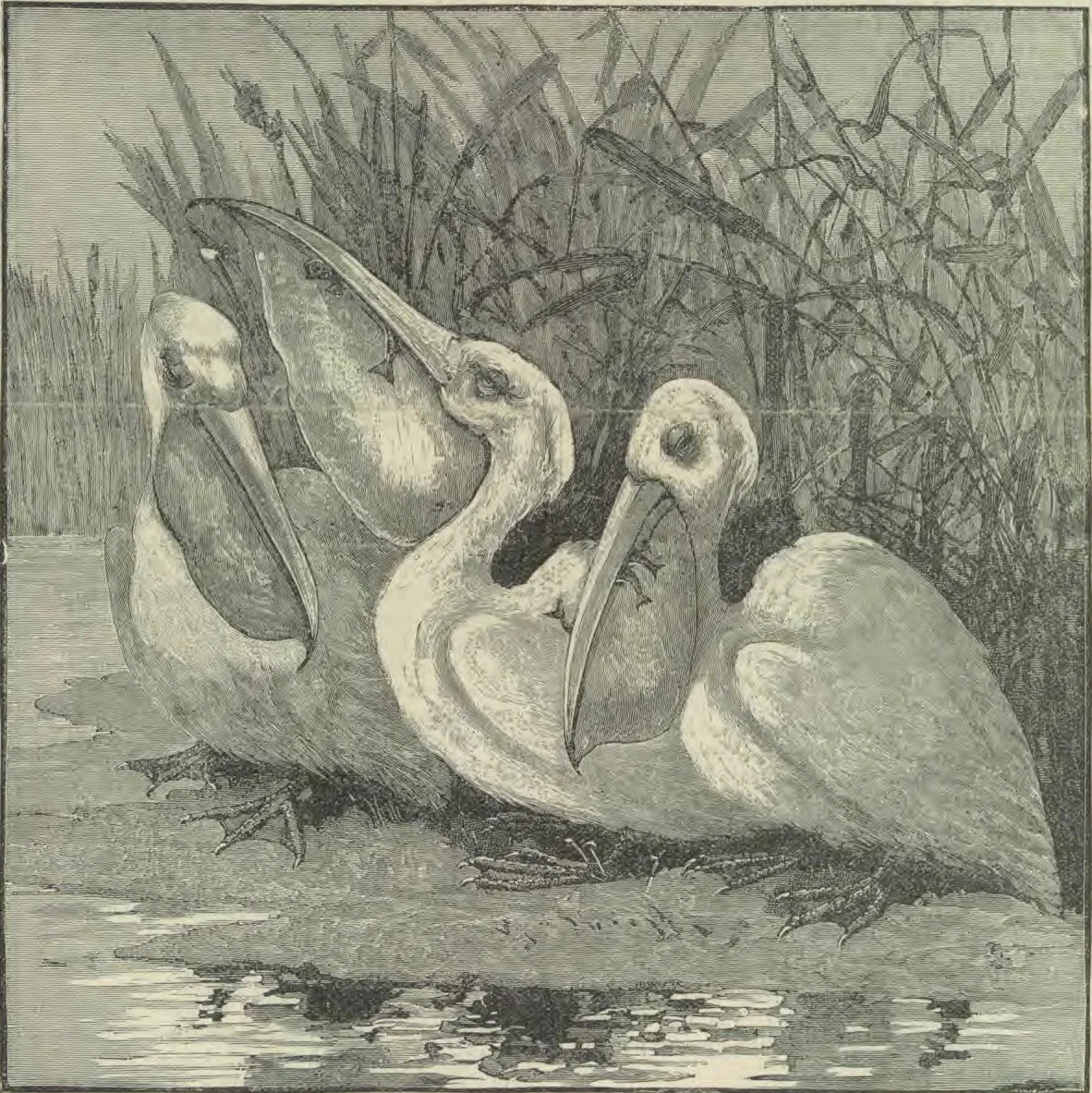
THE strange looking birds shown in the picture are called pelicans. They are large water-fowls, and live almost entirely on fish. There are said to be ten species of this family of the feathered tribe, some one or other of which are found in nearly every part of the globe. They are, however, most numerous in mild climates, and where the country abounds in shallow lakes and rivers, although they are frequently met with along the sea-coast.
The pelican of Australasia builds its nest on the ground among the reeds bordering the waters it frequents. Its young during the first year are of a greyish-brown color, but afterward all the plumage, except the large wing and tail feathers which are black, gradually becomes white, deeply tinged with a rich rose or salmon color, passing into yellow on the crest and lower part of the neck in front.
It seems astonishing what a quantity of fish one of these birds will devour at a single meal. Early one morning one of them alighted in the pond at the Melbourne Botanical gardens, and began to devour the gold-fish it found there. He was shot soon after, and upon examination it was found that he had caught sixteen good-sized fish, which will give some idea of what it requires to give one of these birds a decent breakfast.
We are told that years ago pelicans were very plentiful about the numerous lakes of Gippsland, in the extreme south-eastern part of Australia. Now one is seen in that region but seldom, they having left that part for a more congenial country. In Western Queensland they say that the pelican has transferred its home to the unexplored lands in the direction of the setting sun. It has therefore become in those parts a common saying of one who goes into the interior that he has gone “where the pelican builds its nest.” But this is not wholly true; for they are found in great numbers upon the islands of Bass’s Straits, and also about lake Corangamite in Western Victoria. Like the aborigine, the pelican will not remain with the white man. The two can never thrive together. As the tread of the settler advances, the pelican retires before it, choosing its haunts amid the most desolate scenes of nature. In whatever country it is found, its isolated habits are the same, and may still, as in the days of David, be appropriately called “the pelican of the wilderness.” See Ps. 102:6.
J. O. Corliss.

THE BOY SCULPTOR.

Long ago in the olden day, On a slope of the Tuscan hills there lay A village with quarries all around, And blocks of marble that piled the ground; And scattered among them, everywhere, With wedge and hammer, rule and square, With the dust of the marble powdered white, Sat masons who chiseled from morn to night.
The earliest sound that the baby heard Was neither the whistle nor song of bird, Nor bleating of lambs, nor rush of breeze Through the tops of the tall old chestnut trees, Nor the laughing of girls, nor the whoop and shout Of the school at the convent just let out, Nor the tinkle of water, plashing sweet, From the dolphin's mouth in the village street;
But foremost and first that sharp and clear Arrested the little Michael's ear, When he waked from sleep, was the mallet's knock On the chisel that chipped the rough-hewn block; From the dawn of the day till the twilight came, The clink of the tools was still the same; And, constant as fell the fountain's drip, Was the tap-tap-tap! and the chip-chip-chip!
And when he could crawl beyond the door Of the cottage, in search of a plaything more, Or farther could venture, a prying lad, What toys do you think were the first he had?— Why, splinters of marble, white and pure, And a mallet to break them with, be sure, And a chisel to shape them, should he choose, Just such as he saw the masons use.
So Michael, the baby, had his way, And hammered and chipped, and would not play With the simple and senseless sort of toys That pleased the rest of the village boys. They laughed at the little churches he Would daily build at his nurse's knee; They scouted the pictures that he drew On the smooth, white slabs with a coal or two; They taunted and teased him when he tried To mold from the rubbish cast aside Rude figures, and screamed, “Sculptor!” when His bits of marble he shaped like men.
But who of them dreamed his mallet's sound Would ever be heard the earth around? Or his mimic churches in time become The mightiest temple of Christendom? Or the pictures he painted fill the dome Of the Sistine—grandest of sights in Rome? Or the village baby that chiseled so Be the marvelous MICHAEL ANGELO!
—Wide Awake.

CHARACTER BUILDING.

He builds a great thing who builds a pyramid; but he builds a greater thing who builds a character. Michael Angelo's frescoes are not to be compared with the frescoes that are being painted in that wondrous hall, the human soul. He who knows how to live a life sweet, beautiful, harmonious, of good report, and knows how to store his whole mind and soul with noble thoughts and heroic traits of excellence, builds and adorns as no artist ever did in manner. And this mental and spiritual development is not a work of to-day or to-morrow; and men should not be discouraged because its results are so long delayed.—Sel.

DIAMONDS

THE PROCESS OF WASHING, STATISTICS, ETC.

Last week we learned how the earth containing diamonds is obtained from the mines. A short distance from the place where the diamondiferous ground is spread out for pulverization are located the washing-machines. It is a difficult matter to give the reader a clear understanding as to just how one of these machines looks. Perhaps we can do no better than to quote the following description, given in the “Official Handbook” of the Cape of Good Hope:—
“The Rotary Washing machine consists of an annular-shaped pan, eight to fourteen feet in diameter, being closed by an outer and an inner rim, the latter being about four feet in diameter, and not so high as the outer rim. A vertical shaft rotates in the center of the open space, and carries ten arms ranged radially round the shaft, each arm having about six vertical knives, or teeth, which are set to be within half an inch of scraping the bottom of the pan. The diamondiferous ground mixed with water enters through an orifice in the outer rim of the pan, and is stirred up into a ripple by the revolving knives, whereby the lighter stuff comes to the surface, and continually floats away through an orifice in the inner rim, whilst the heavier gravel falls to the bottom of the pan. For additional safety, the teeth are set so as to form a spiral, revolving, and co-operate with centrifugal force in throwing every stone they strike towards the outer rim of the pan.
“The mud, or ‘tailings,’ which flows to waste over the inner rim, is led by a shoot to a pit, whence it is lifted by a chain and bucket elevator some twenty or thirty feet high. At the top of the elevator the buckets deliver the tailings on to suitable screens, over which the solid mud runs to waste, whilst the muddy water is led back by an overhead shoot to the machine, to assist in forming a puddle of sufficient consistency to float the lighter stones in the pan and allow only the heaviest gravel to accumulate at the bottom. For the better mixing of this puddle, an inclined cylindrical screen is fixed above the level of the pan. The dry ground from the mine is tipped into the upper end of the screen, where it is met by the muddy water from the elevator and a certain amount of clean water. The large stones of a size unlikely to include diamonds roll out at the lower end of the cylinder, but the puddle, carrying all the smaller stones with it, passes through the wire netting of the screen and down a shoot into the pan as above described. At the end of the day’s work, the machine is stopped, and the contents of the pan emptied [taken out, for the pan is stationary] on to the sorting table, first undergoing an intermediate process of cleaning, either in an ordinary ‘cradle’ [a kind of sieve] or a small gravitating machine styled a ‘pulsator.’”
These “tailings” referred to are again washed and rewashed by private parties, thus affording a livelihood for many families. A certain per cent of the value of each stone found by these individuals must be paid to the company to whom the debris belongs.
It may be interesting to some of the readers of the Instructor to know that a portion of the tithe money paid into the South African S. D. A. mission arises from this source. One of our ambitious sisters supports a large family in this manner.
Now we have followed the diamond from its dark earthly home, far down in the ground, to the “sorting table;” rather a long and expensive route, too. From the sorting table the diamonds find their way to the “Diamond Market” of Kimberley, at which place the Jew thrives exceptionally well. The diamonds are mostly all purchased from the different mining companies by “brokers,” the greater portion of whom are Jews.
The buying and selling of diamonds occurs on Monday morning. Passing through this market on that morning, you have an excellent opportunity to gaze on immense fortunes, in the form of literal heaps of diamonds.
You cannot help exclaiming, on seeing so many of these precious stones, “Where do they all go? How are they utilized?”
If the present rate of production from these mines continues many years, diamonds must, beyond question, become comparatively valueless. From a few figures and facts, which I will here give, I feel sure you will draw the same conclusion. The Kimberley Mine alone (remember this is only one of the four regular mines of Africa; besides which, many other diamond diggings exist, not alone in Africa, but various parts of the world) yielded between 1871 and 1885 over seventeen and one half million carats, equal to three and one half tons’ weight of diamonds, in value about £20,000,000, or nearly $100,000,000. From the four mines above mentioned, up to 1886 more than six and one half tons’ weight had been extracted, realizing in round numbers forty million sterling, or about $200,000,000.
A certain amount of diamonds are mailed to England every Monday. If you should pass by the Kimberley post-office on Monday evening, you would notice soldiers stationed in and around the building, and a little later on you would see a body of soldiers accompanying the mail wagon to the depot. The train is also escorted by a number of soldiers.
Every year the mines of Africa are becoming richer, the method of mining more easy, and new deposits opening up. At present there are about 10,000 native laborers and 1,200 European overseers and artisans daily at work in these mines. The average wages earned by a Kafir is about 21 s. per week ($5.00), and by a white man £5 ($25.00). Some 2,500 horses, mules, and oxen are also employed about the mines; and 350 steam engines, at work and idle, are fixed around the four mines, aggregating nearly 4,000 horse power. The annual expenditure in labor, material, etc., is not less than £2,000,000 ($10,000,000). Next week we will consider how diamonds are stolen.
R. S. ANTHONY.
South Africa.

The Grace of Thrift.

It isn’t acquired in a day—this habit of thrift, and the sooner young people set about cultivating it, the better their chances of success.
It may begin with small things, and it may begin with great. Sometimes its youthful disciple is one of a large family of moderate means; then the saving of pennies forms its foundation. It often happens that a wealthy family suddenly loses most of its money, and then a careful expenditure of what remains and a use of one’s talents form the groundwork of future prosperity. Thrift will make a gardener get the greatest possible yield from his garden; it will make a school-girl save her ribbons; and it will make a school-boy let his head save his heels.
Boys and girls hate stinginess, and rightly, too; but thrift need not be of that kind. It is quite possible to be generous and economical at the same time. For instance, I know a dear old lady who darns her gloves that she may buy each week a few flowers for a sick friend. The little act of flower-giving is a beautiful bit of generosity, but it required forethought and economy to make it possible.
Some girls learn this from example. They are blessed with mothers who teach them that a little care and trouble can freshen ribbons, clean gloves, and make old dresses look like new. These happy people will always have a little spare change in their pockets, and be ready for an emergency.
The national character of an American tends to this economy. New improvements are eagerly accepted, and cities are built with a view of getting the most out of the least; and for the man who works his way up from poverty to wealth, there is great respect.
But among certain foreign nations it is not so. The Spaniards live their careless, indolent lives, and let their cathedrals crumble and decay. The Italians, too, are prone to let the future take care of itself. As a result, the people are poor, and the lower classes suffer greatly if the crops fail. Among the provident nations, Scotland stands first. With a sterile country, a rigorous climate, and a government they dislike, they yet send forth sturdy sons whose economical ways enable them to win high positions of wealth and influence, and hold the respect of the world.
To busy people, time is money; and the habit of saving moments comes to be a first consideration with them. Mrs. Terhune, who is better known by her nom de plume of “Marion Harland,” writes many a chapter while she waits for breakfast. When dusk had ended his uncongenial labors at the Salem Custom House, Nathaniel Hawthorne hurried home to put on paper those beautiful fancies which have made him famous. Louisa M. Alcott wrote with the presence of other duties strong upon her; and the poet Steadman composes many a bit of musical verse between banking hours of one day and banking hours of the next.
Nor are authors the only people who put into time all it can possibly hold. Many a scientist has found that his only hope of success lay in using the “betweenwhiles.” Of these, Robert Dick is only one example. This Scotch baker, working hard for the necessities of life, yet planned his time in such a way that he accumulated a large and very valuable natural history collection.
The old saying, “A penny saved is two pennies earned,” still holds good; and the boy or girl who puts it in practice will find that the advancing years bring prosperity and happiness.
“Be saving,” says Joubert, “but not at the cost of all liberality. Have the soul of a king but the hand of a wise economist.”—Sel.

THE TREE.

The Tree's early leaf-buds were bursting their brown: “Shall I take them away?” said the Frost, sweeping down. “No, leave them alone Till the blossoms have grown,” Prayed the Tree, while he trembled from rootlet to crown.
The Tree bore his blossoms, and all the birds sang: “Shall I take them away?” said the wind as he swung. “No, leave them alone Till the berries have grown,” Said the Tree, while his leaflets quivering hung.
The Tree bore his fruit in the midsummer glow: Said the girl, “May I gather thy berries now?” “Yes, all thou canst see; Take them: all are for thee,” Said the Tree, while he bent down his laden boughs low.
—From Bjornstjerne Bjornson.

FAITHFUL IN LITTLE THINGS.

“This,” said Deacon Hays, “is probably the last ship I shall ever build, and I intend to have her as perfect as possible.”
So he selected a beautiful model, and, knowing that the owner wanted something very superior, he spared no time or money in procuring the best timber to be had and the best workmen to be found; and then he watched over every stick as it was hewn and fitted in its place, every plank that was spiked on the timbers, every spar that was prepared. When they came to put the copper sheathing over the bottom of the ship, the deacon watched it very closely. At one spot he found the head of a copper nail which fastened the sheathing split. The deacon’s eyes were becoming rather poor, but he saw the broken head. “Jim Spiker, I see a nail broken; isn’t there a little hole by its side?”
“Not a bit of it, I’m sartin. There couldn’t a drop of water get in there in a century.”
So the word of Jim was accepted, the ship was finished and launched, and made two or three prosperous voyages. During one of these she lay at a wharf in Calcutta. Now, these waters swarm with that little pest, the ship-worm. They crawled all over the ship, but could not get through the copper sheathing. At length Mrs. Teredo lit upon the broken nail, found the little hole, and squeezed herself in. Then she began to eat the timber and lay her eggs in it. Soon they hatched and increased, till that timber was full of little teredoes, and then the next and the next, till every stick in the whole ship was very badly worm-eaten. Still, the ship looked sound, sailed well, and made her long voyage. At length, when in the middle of the great ocean, a terrible storm met her. The wind howled through the rigging, as if singing a funeral dirge. The waves rolled up, and writhed as if in agony. Every spar was bent, and every timber and spike strained to the utmost. The cargo which filled the ship was of immense value. The crew was large, and the passengers were many. Worse and worse grew the storm, till at last a huge wave struck her with all its power. The poor ship staggered, groaned once, and crumpled up like a piece of paper. She foundered at sea, in the dark night, in that awful storm. The rich cargo all went to the bottom of the ocean. The drowned men and women sank down, down, miles before they rested on the bottom. All done through the neglect of Jim Spiker, who was too unfaithful to mend the hole made by the broken nail.—My Paper.

DEATH IN THE POT.

In the days long since passed, some young prophets, while making broth, put in a poisonous herb by mistake. Running to Elijah, they cried in great fear, “O thou man of God, there is death in the pot!”
“Bring meal!” commanded the prophet. They did so. He cast it into the poisoned mixture, and behold! the poison was destroyed.
That was a wonderful deed; but, my children, a greater wonder is wrought daily in these times. Selfishness is to a child’s heart what the poisonous herb was to the prophets’ broth. It is death in the heart. The Bible is like the old prophet’s meal. If a child will put its truths into his heart, it will heal his selfishness, and make him a happy, loving disciple of the Lord Jesus.—Selected.

Sowing Wild Oats: A Father's Sorrow

A SYMPATHIZING friend, hoping to comfort old Dr. Richards concerning his profligate son, remarked: “Oh, never mind, he is only sowing his wild oats.” “Aye,” replied the good father, sadly, “but I must remember that ‘whatsoever a man soweth that shall he also reap.’”

LESSON 8.—THE MAKING OF THE IMAGE OF THE BEAST.

1. What Government have we proved to be represented by the second beast of Rev. 13?
2. What power is to be exercised by this beast? Verse 12, first clause.
3. For what purpose does he use this power? Remainder of the same verse.
4. What is said by him to them that dwell on the earth? Verse 14, last part.
5. What power is represented by the first beast? Ans.—The papacy.
6. What have we found to be the great characteristic of the papacy? Ans.—The union of Church and State—the Church using the power of the State for the furtherance of its own aims.
7. For what then are we to look in this nation? Ans.—For the religious power to exalt itself to that place where it shall dominate the civil, and employ the power of the State for the furtherance of its own ends.
8. Is there any effort even now being made in this direction? Ans.—Yes; a large and influential organization is working to this very end.
9. What is this organization called? Ans.—The National Reform Association.
10. What, according to their own words, is the object of the association? Ans.—“To secure such an amendment to the Constitution of the United States as shall suitably express our national acknowledgment of Almighty God as the source of all authority in civil government; of the Lord Jesus Christ as the ruler of Nations; and of his revealed will as of supreme authority; and thus indicate that this is a Christian nation, and place all the Christian laws, institutions, and usages of the Government on an undeniable legal basis in the fundamental law of the land.”
11. Of what does the organization consist in itself? Ans.—Of a president, the names of about one hundred and twenty vice-presidents, a recording secretary, a corresponding secretary, a treasurer, seven district secretaries (at present), and the Reformed Presbyterian Church as a body.
12. Who are some of the prominent men actively engaged in favor of it? Ans.—Joseph Cook; Herrick Johnson, D. D.; Julius H. Seelye, president of Amherst College; Bishop Huntington, of New York; Hon. Wm. Strong, ex-justice of the United States Supreme Court, and many others.
13. Of what other important bodies has it gained the support? Ans.—The “principal” churches, the National Woman’s Christian Temperance Union, and the Prohibition party in many States.
14. What was the prevailing theory of the church leaders in the time of Constantine? Ans.—“The theocratical theory.”
15. What is the theory of the National Reformers? Ans.—“Every government by equitable laws, is a government of God; a republic thus governed is of him, and is as truly and really a theocracy as the commonwealth of Israel.” Cincinnati National Reform Convention, p. 28. “A true theocracy is yet to come, [and] the enthronement of Christ in law and law-makers, hence I pray devotedly as a Christian patriot, for the ballot in the hands of women.”—Monthly Reading, W. C. T. U.
16. What had the church leaders determined to do in the days of Constantine? Ans.—“To make use of the power of the State for the furtherance of their own aims.”
17. What have these in our day determined to do? Ans.—The same thing.
18. What came of that in the fourth century? Ans.—The Papacy.
19. What will come of this in the nineteenth century? Ans.—The image of the papacy.
20. Of what other bodies is the National Reform Association diligently working to secure the support? Ans.—The Workingmen and the Catholic Church.
21. What does this association say of the Catholic Church? Ans.—“We cordially, gladly, recognize the fact that in the South American republics, and in France and other European countries, the Roman Catholics are the recognized advocates of national Christianity, and stand opposed to all the proposals of secularism. . . . Whenever they are willing to co-operate in resisting the progress of political atheism, we will gladly join hands with them. In a World’s Conference for the promotion of National Christianity—which ought to be held at no distant day—many countries could be represented only by Roman Catholics.”—Christian Statesman, December 11, 1884.
22. What are all Catholics commanded by the pope to do? Ans.—“All Catholics should do all in their power to cause the constitutions of States and legislation to be modeled on the principles of the true church; and all Catholic writers and journalists should never lose sight, for an instant, from the view of the above prescription.”—Encyclical of Pope Leo XIII., 1885.
23. Then is not the National Reform Association aiming to form a government modeled after the principles of the papacy?
24. Then, if professed Protestants under the leadership of the National Reform Association succeed in this, what will there be erected in this government? Ans.—An image of the papacy.

PREPARING RAISINS.

A few paragraphs about the manner of preparing raisins from grapes will interest particularly those boys and girls who are fond of this fruit. A writer in a late copy of Golden Days says:—
“Malaga, Valencia, and Smyrna raisins derive their names from the places whence they come. Of these, the Smyrna black raisins are the cheapest; the Malaga being held in the highest estimation, and fetching fully a third more than any other description of raisins.
“The growth of the vines in Spain is different from those of Italy. In Andalusia, they creep along the surface of the ground as strawberries do, thus gathering all the atmospheric heat; the branches appear like roots, and the grapes, though white, have a golden tinge. The vintage is very carefully conducted, the fruit not all being gathered at once, but the same ground gone over three times, so that all the grapes are properly ripe when picked. As they are gathered, they are placed in baskets, and carried, either in carts or on the backs of mules and donkeys, to the place where they undergo the drying process. The fruit, however, is often much injured in transit; and as no broken grapes can be properly dried, the loss from this cause is considerable.
“The grapes are prepared for the market in three different ways—by simply drying in the sun, by washing, and by steam-drying. In following the first mentioned, which is the general process in Malaga, divisions are constructed of either brick or stone, in an inclined position, exposed to the sun’s rays. These divisions are built in at one end with a triangle formed of masonry, and so arranged that the sun always shines on their contents. The interior of these compartments is thickly spread with fine gravel to absorb the heat. As soon as the grapes are gathered they are put into these divisions, and are fully exposed to the intense heat of the Andalusian sun. It is stated by experienced cultivators that during the month of August they attain a temperature of a hundred and forty degrees Fahrenheit.
“While drying, the grapes which remain green are carefully picked out, as they are spoiled; the others are turned, each grape singly, so that the proper uniformity of color is observed. At night the fruit is protected from the heavy dews or rain by stout canvas being stretched over the tops of the divisions. Some people use blankets instead. Grapes take a longer time drying in this manner than by the scalding plan, as then they are ready in four days; but dried only by the sun’s heat, they take ten days. This loss of time, however, is fully compensated by the economy of the process.
“Drying by washing and drying by steam are inferior to the sun-drying process, because they are more expensive, involving outlay in buildings, furnaces, and steam-pipes; and the raisins are, moreover, liable to the danger of fermentation during their transportation. Besides, they always have to be dried in the sun for a certain time before being ready to pack, whatever plan is pursued in curing them other than the sun-drying process. When the drying is thoroughly accomplished by whatever plan pursued, the raisins, prior to being packed for exportation, require to be carefully looked over, and all those broken and bruised ones removed, as a drop of moisture from such would very likely damage a whole box.
“After this comes the proper classification, by no means an easy affair, as merchants and cultivators differ, often very materially, on this subject. The boxes are generally made by contract. The best are made from firwood, which is imported from Portugal. The producer provides and packs these boxes, which the merchants frequently repack, employing women and girls to perform this office. The boxes are generally divided into layers. Four layers will be contained in a whole box, representing, if of full size, about 22 pounds of fruit; the total weight with the filled box being from 20 to 29 pounds.
“Besides the raisins already named, may be mentioned Sultanas, Muscatels, Lipari, Belvedere, Bloom, or jar raisins, and sun, or Solis. The best kinds are imported in boxes and jars—such as Malagas and Muscatels—while the inferior sorts are shipped in casks and barrels, trails and mats.”

THE GRUMBLER.

He sat at the dinner-table With a discontented frown: “The potatoes and steak were underdone, And the bread was baked too brown. The pie too sour, the pudding too sweet, And the roast was much too fat; The soup so greasy, too, and salt, Sure ’twas hardly fit for the cat.
“I wish you could eat the bread and pies I’ve seen my mother make; They are something like, and ’twould do you good Just to look at a loaf of her cake. Said the smiling wife: “I’ll improve with age, Just now I’m but a beginner, But your mother has come to visit us, And to-day she cooked the dinner.”
—Lizzie M. Hadley, in Good Housekeeping.

LIFE IN ATHENS.

Life in Athens, Greece, begins early in the morning. The milkmen cry “gala” before sunrise. At six o’clock on a May morning most of the citizens are about their work, although the people of the metropolis are later risers than those of the country towns. The people’s costumes have been modernized, and the poorer men often wear shabby, ill-fitting European clothes, instead of the white fustanella (kilts), gay jacket, and red fez which had become the national dress, although it was originally Albanian. In the country the rustic dress is more picturesque. The home-made garments of coarse cloth, of goatskins and sheepskins are attractive to the eye, even when ragged and stained. Capuchin cloaks are commonly worn by the men in cool weather, the hood being drawn over the head in a storm. These serve as mantles by day and blankets by night. The women in the country are dressed very simply on ordinary occasions, but are perhaps more extravagant in dress for special occasions than in anything else. Hats and bonnets are almost unknown except in towns; ladies often wear a long veil-like wrap, or the fez, of which the red is very becoming as it lies on their dark hair; women of the lower classes often bind a kerchief about the head. A face-cloth may conceal the lower part of the face from strangers. Women are still kept in half-oriental seclusion. They have a retired gallery in the churches. They may perform hard labor in the fields, but they do not go freely upon the streets. Peasant girls shrink from going out to service, and much domestic work is done by boys. Greek women of the lower classes are seldom beautiful; if they ever have beauty as girls, they lose it under the hardships of their life. They carry heavy burdens. Near Eleusis, I met a dozen young women carrying kegs of water, each crouching under the load. The lads, on the other hand, are tall, straight, and dignified. Their dress is often much like that of their sisters, and more than once I exclaimed at the beauty of a maiden who proved to be a shepherd lad. The Greek ladies of Athens incline to a full habit, and most would appear to better advantage in the more flowing robes of the country dress than in the close-fitting Parisian costume.—Selected.

INVENTING A WRITTEN LANGUAGE.

ABOUT the year 1821, Se-quo-y-ah, a Cherokee Indian, heard a white man who was visiting his tribe read a letter. Those who have all their lives been accustomed to seeing people read have no idea of the effect produced on this untutored child of the forest when he discovered that the curious little black marks on paper had conveyed ideas to the mind of his visitor, and that there were other white men who would find the same meaning in them. He began to think and to ask questions about this strange fact, and slowly he grasped the idea of making characters which should represent the different sounds of the human voice. After months of study he found that eighty-five distinct sounds, or syllables, were used in Cherokee conversation, and that all the words with which he was familiar were combinations of these. He contrived eighty-five signs, or characters, which represented these sounds. This done, it was easy to put them together to make words, and the Cherokees had a written language so simple that under the guidance of Se-quo-y-ah these Indians have gone beyond their white brethren, and in their system of phonetics have got rid of a world of rubbish in the shape of useless or silent letters, with which our written words are encumbered.—Well-Spring.

EXHIBITION OF LIVE ANTS.

The feature of the meeting of the British Royal Society last week was an exhibition by Mr. Henry Burns of a class of nests of live ants. These were so arranged that all the elaborate internal economy of the insects could be fully observed. A cable dispatch says that “in one cell was the queen, with servants attending upon her. In another were the aphides, or cows, watchfully herded by their keepers, and a party of workers were engaged in walling up an intruding queen, which had been placed in the nest that morning. The state of ant civilization was so remarkably high that nobody would have been much surprised at a party of scientific ants in spectacles, taking notes on the Royal Society.”—Science.

SUMMER'S SERMON.

Sing a song for summer-time, Happy, merry days! When all nature seems to be Running o'er with praise To the Giver of all good, All things fair and light, All things beautiful, that make Living a delight.
Nothing in the meadow grows— Be it e'er so wide— Which cannot our every thought To the dear Lord guide. Nothing blossoms, nothing blooms, Be it large or small, Which does not the glory give To the Lord of all.
Every little running brook, Every lake and sea, Sings, and tells the love of God, Given us so free. Sun and shadow in the sky, Come they as they may, Yet but teach the loving care Of our Lord each day.
Happy, merry summer-time! How it loves to show All the dear Lord's gifts to man On this earth below! With the summer birds we sing Willing songs of praise. May our hearts for Jesus grow With the summer days. —Mary D. Brine.
Continue reading: THE BOY KING