ONE of our exchanges has a long article on lying, and enumerates about every kind except the lie of exaggeration.
To exaggerate is to make more out of a thing than is in it. This deceives, and hence is falsehood. So apparent is this, that the oath required in our courts of justice is not only to “tell the truth, the whole truth,” but also “nothing but the truth.”
There are two methods of this kind of lying. One is to overstate your own deeds and goodness, and the other is to understate facts concerning others whom you do not like. Some people always do wonderful things. So they say. They have meetings where “lightning bolts flash from heaven,” “tornadoes of glory devastate the country.” “The oldest inhabitant says he never saw such a revival before.” Everything they do is wreathed in a cloud of glory. All workers who went before them were nothing, and the inference is that power will never be so manifest again. It is very difficult for them to see any good in any one else. They look through the magnifying end of the telescope when they describe their own virtues, and through the other end when they speak of the virtues of others. If there is any flaw in the other fellow, in any way, shape, or manner, they take out the big microscope, and show that he is straight on the road to hell. They magnify the virtues which they are sure they possess, and the faults that they are sure other people possess.
Many people who mean to be good fall into this habit. Nevertheless it is lying. To state the position of other people unfairly, and declare that it is the truth, is lying. God help the man who wants to reform others to get the beam of exaggeration out of his own eye!—Christian Witness.
Pure as Snow
By EUGENE A. BROWN
EUGENE A. BROWN
WILL you take it all to Jesus?
This life that's filled with woe.
How much he loves to help you!
He will make you pure as snow.
I will take it all to Jesus,
This life that's filled with woe.
How much he loves to help me!
He will make me pure as snow.
Will you give your heart to Jesus?
For O, he loves you so!
How much he gave to save you!
He can wash you white as snow.
I will give my heart to Jesus,
For O, I love him so!
How much he paid to save me!
He will wash me white as snow.
Will you keep your steps with Jesus?
For O, you need him so!
How much he has to teach you!
He will keep you pure as snow.
I will keep my steps with Jesus,
For O, I need him so!
How much he has to teach me!
He will keep me pure as snow.
The Gospel of Health
LEXICOGRAPHERS define the gospel as good news, but the Bible tells us that it is “the power of God unto salvation.” Salvation implies a lost condition, or an imminent danger of being lost. There is but one source of reliable information upon a subject of this character, and that is the Word of God. By consulting it we find that in the beginning God made man upright; he gave him noble traits of character, with no bias toward evil. He endowed him with high intellectual powers, and presented before him the strongest possible inducements to be true to his allegiance. Obedience, perfect and perpetual, was the condition of eternal happiness. On this condition he was to have access to the tree of life. The holy pair were not only children under the fatherly care of God, but students, receiving instruction from the all-wise Creator. They were visited by angels, and were granted communion with their Maker, with no obscuring veil between. They were full of vigor, imparted by the tree of life, and their intellectual power was but little less than that of the angels.
By transgression, man in the beginning of his history lost his innocency; lost the dominion God had given him over all the earth; lost his beautiful home, and access to the tree of life; and thus became subject to sickness, decay, and death.
Results of Sin
The abnormal and uncontrolled appetite that opened the flood-gates of human woe upon the world, has been the bane of mankind from that day until the present time. Excessive eating and drinking, which produced lustful desires and practices, caused the destruction of the antediluvians. Our Saviour says of them, “They were eating and drinking, marrying and giving in marriage, until the day that Noe entered into the ark, and knew not until the flood came, and took them all away.” Pride, fullness of bread, and abundance of idleness caused the destruction of Sodom.
There is abundant evidence both in the Word of God and in secular history to show that the declension in virtue and the degeneracy of the race are chiefly attributable to the indulgence of perverted appetite. The average length of life, having dropped from nine hundred and twelve years in the days of Noah to thirty-five years in our time, is a significant fact that should arrest our attention, and cause us seriously to consider these things.
Amid the general ruin and sadness that came as the result of the first transgression, there was, however, a ray of hope; for even before they were expelled from the garden, the promise was given that the seed of the woman should bruise the serpent’s head.
A few men of every age in the past grasped this promise by faith, and overcame through the strength imparted. But in the fullness of time, when the world had reached its most corrupt stage, Jesus Christ, the promised Seed, the second Adam, was born into the world, and in human form took up the controversy right where the first Adam failed—on the point of appetite. Seemingly to impress the fact upon the minds of all that the battle would turn upon this point, the one who was sent to prepare the way for the coming Messiah was a man of abstemious habits, subsisting upon a simple diet.
In order to make the victory complete, and once for all secure eternal redemption for man, our Saviour, at the beginning of his public ministry, was led into the wilderness to be tempted of the devil. After a fast of forty days and nights, while hungry, weak, and emaciated, the tempter came to him, and said, “If thou be the Son of God, command that these stones be made bread.”
Although suffering the pangs of hunger, and having the power as the Son of God, he would not obey Satan to work a miracle in his own behalf, but trusted his Heavenly Father to supply his need in his own time and way. Christ’s reply to the tempter, “It is written, Man shall not live by bread alone, but by every word that proceedeth out of the mouth of God,” was the turning point in the contest, so that after two other minor temptations the enemy left the field a beaten and vanquished foe. As Eden was lost through the indulgence of appetite, it was regained by denial, and our only hope of regaining it is by entering into the victory of Christ through faith, and by a firm denial of appetite.
A Complete Gospel
Any so-called gospel that ignores man’s physical condition and needs, or sanctions his giving loose rein to the appetite, will fail of meeting the case. “The good news,” or “power of God unto salvation,” must be as broad as the offense and its consequences. That this includes the body as well as the soul, is clearly proved, not only by the nature and consequence of the transgression, but by the teaching and practice of him who came to seek and save that which was lost. The Scriptures clearly teach that the curing of disease and the healing of physical maladies were considered a very important part of the gospel. Furthermore, we find upon a careful study of his earthly ministry, that our Saviour devoted more time to the healing of the sick than to preaching.
Satan is the originator of disease. Jesus came to “destroy the works of the devil.” “In Him was life,” and he says, “I am come that they might have life, and that they might have it more abundantly.” Christ, in his own person, was the embodiment of the gospel in its fullness and completeness. As he passed through towns and cities, he was like a vital current diffusing life and joy wherever he went.
The aged apostle John, in writing to his friend Gaius, reveals clearly his belief in regard to the intimate relation that exists between physical health and soul prosperity, when he says, “Beloved, I wish above all things that thou mayest prosper and be in health, even as thy soul prospereth.”
Of the great apostle to the Gentiles, it is recorded that “God wrought special miracles by the hand of Paul: so that from his body were brought unto the sick, handkerchiefs, or aprons, and the diseases departed from them, and the evil spirits went out of them.” Yet later we read these words from his own pen, showing his belief in regard to healthful living, and its influence and effect upon one’s spiritual welfare and prosperity: “Every man that striveth for the mastery is temperate in all things. Now they do it to obtain a corruptible crown; but we an incorruptible. I therefore so run, not as uncertainly; so fight I, not as one that beateth the air: but I keep under my body, and bring it into subjection: lest that by13any means, when I have preached to others, I myself should be a castaway.”
We are not our own. Our bodies are God’s property, having been purchased at an infinite cost, even the blood of the Son of God. So whatever we do, whether we eat or drink, we are to do all to the glory of God. The laws governing our being are just as much the law of God as are the ten commandments, and to violate either is sin; for sin is defined as the transgression of the law. The gospel is salvation from sin, both moral and physical; hence the “gospel of health,” or a complete gospel, enjoins a thorough knowledge of the laws governing our being, and a conscientious and faithful compliance therewith.
A constant recognition of God’s ownership in us lies at the foundation of all true education and reform, and will result in peace and happiness in this life, and insure us an entrance into our Edenic home when it is restored to its original place never again to be removed.
Fruit for the Table
By G. C. Tenney
G. C. TENNEY
With many people fruit is for use only as a titbit between regular meals. People who have grown fruits all their lives have said they never once thought of placing them upon the table. But the use of fruit or any other food between meals is an absolute injury, and should not be indulged. The use of fruit in connection with meals should be encouraged as a most salutary addition to the regular diet. It is true that most fruits contain but little solid nutriment, though people have subsisted upon them for quite a while; and in many troubles of the stomach and other digestive organs greater benefit may be derived from one, two, or three days’ exclusive fruit diet than from many visits to a doctor. The juices of fruits contain acids and other elements of great value in the assimilation of food. Fruits used with bread and grains provide every element needed for nourishment, unless there be a deficiency of fats. This latter element is supplied by the use of nuts.
In a country like ours some kinds of fruits are available the entire year. In apples, grapes, raisins, figs, and dates there is considerable of the nutritive elements; and this is especially true of bananas. In grapes, oranges, lemons, and other juicy fruits, the juices are of great medicinal value.
A false impression prevails to some extent that to the use of fruits in summer may be attributed stomach and bowel complaints. Whatever foundation such an idea has in fact is based upon the misuse rather than the right use of fruit. Unripe fruit contains starch, which, uncooked, is indigestible and deleterious. Decayed fruit is liable to contain the elements of disease, and should be rejected. Sometimes fruit is forced upon the stomach after that organ is already filled with a conglomerate stuffing of rich viands of every sort; and the trouble that follows is charged to the fruit. A man who had eaten an enormous late dinner of soup, rich pastries, wound up with a beautiful apple. He was very ill, and declared he would never eat another apple. The apple got into bad company, and received a bad name. Ripe, fresh fruits, eaten seasonably, may be taken without fear. Let us learn to appreciate the divine bounty that grants us luscious fruits, by giving them a prominent place on our tables.
Keeping the Baby in a Stew
BABIES have troubles enough which are unavoidable, so that when the baby struggles with unnecessary trouble, it ought to have prompt sympathy. A great proportion of adult people, both men and women, are made very uncomfortable by certain forms of motion, such as that which is produced in a small boat on a heaving sea, or when swinging, and some even by the motion of a rapidly moving railroad train. Yet the majority of babies are obliged to submit to an endless swinging and trotting, sick or well, full or empty, cheerful or fretful.
A child accustomed to a cradle may cry when a familiar motion is stopped, but a baby that never has known such motion is not only better off without it, but makes a fuss when the motion begins. The constant jogging and swinging, especially after full meals, and in certain ways, is just as likely to produce seasickness or similar discomfort as the similar motion would in an adult. Baby, however, is powerless to protest or to stop; for when he cries, he is only jogged the harder.
It is a safe rule to carry an infant in arms as little as possible. Few people know how to handle him so that he lies in comfort. A good way is to put him in his little basket, which may be passed from hand to hand for inspection, if necessary, for the delectation of admiring friends.
A child should always be lifted with both hands, and held lightly, but firmly, the entire length of the back, the head being carefully supported. It is a common and dangerous error to leave the back and the head unsupported. When the little one is not properly carried, the movement of the mother or nurse in walking, or indeed the sudden lurching of the baby itself, may seriously affect the head and spine.—Selected.
Borrowed Trouble
THERE is one kind of trouble in the world which God never sends, and which never brings a blessing with it. It is the borrowed trouble which people get by giving anxious thought to to-morrow, instead of being content to bear the burden of to-day. That is the one kind of suffering which God bans and bars out of his kingdom, and yet even good people do not ban and bar it out of their lives. A true Christian on his death-bed confesses that the greatest worries of his life had been through his anticipations of evils which never arrived. As our Lord tells us, it is quite enough to bear those which do arrive; and we might take a lesson from the ravens, which may suffer from the hunger of to-day, but never from that of to-morrow.—S. S. Times.
Work and Worry
“It is not the work, but the worry,
That makes the world grow old,
That numbers the years of the children
Ere half their story is told;
That weakens their faith in heaven
And the wisdom of God’s great plan.
Ah! ’tis not the work, but the worry,
That breaks the heart of man.”
“I’ll Pay You for That”
THIS little parable by an unknown author teaches its own lesson:—
A hen trod on a duck’s foot. She did not mean to do it, and it did not hurt the duck much; but the duck said, “I’ll pay you for that!” So the duck flew at the old hen; but as she did so, her wing struck an old goose, that stood close by.
“I’ll pay you for that!” cried the goose, and she flew at the duck; but as she did so, her foot tore the fur of a cat that was just then in the yard.
“I’ll pay you for that!” cried the cat, and she started for the goose; but as she did so, her claw caught in the wool of a sheep.
“I’ll pay you for that!” cried the sheep, and she ran at the cat; but as she did so, her foot hit the foot of a dog that lay in the sun.
“I’ll pay you for that!” cried he, and jumped at the sheep; but as he did so, his leg struck an old cow that stood by the gate.
“I’ll pay you for that!” cried she, and she ran at the dog; but as she did so, her horn grazed the skin of a horse that stood by a tree.
“I’ll pay you for that!” cried he, and he rushed at the cow.
What a noise there was! The horse flew at the cow, and the cow at the dog, and the dog at the sheep, and the sheep at the cat, and the cat at the goose, and the goose at the duck, and the duck at the hen. What a fuss there was!—and all because the hen accidentally stepped on the duck’s toes.
“Hi! hi! What’s all this?” cried the man who had the care of them. “You may stay here,” he said to the hen; but he drove the duck to the pond, the goose to the field, the cat to the barn, the sheep to her fold, the dog to the house, the cow to her yard, and the horse to his stall. And so all their good times were over because the duck would not overlook a little hurt which was not intended.
“A little explained,
A little endured,
A little forgiven,
The quarrel is cured.”
—The Christian Advocate.
Straits Settlements and Malay Peninsula
By E. H. Gates
E. H. GATES
AFTER finishing our work in Medan, Sumatra, Brother Munson and I sailed for Singapore, via Penang, a city on a small island a mile or two west of the mainland. This is the most northerly of the English settlements on the Malacca Straits, known as the “Straits Settlements.” The other towns and provinces included in these settlements, are Province Wellesley, the Dindings, Malacca, and Singapore. Province Wellesley is a narrow strip of country on the peninsula opposite Penang; the Dindings comprises a small territory and some small islands farther south than Penang; Malacca is the name of a small province, as well as the name of a city one hundred and ten miles north of Singapore; Singapore is the name of a small island, as well as of a city, off the south point of the peninsula.
A GROUP OF MALAYS
In all these places, nothing has been done to give the present truth, except as some of these places have been canvassed by Brother Meyers now of Burma, for “Great Controversy” and health books. As a result of this work, one Eurasian lady accepted the truth at Penang, though I did not know it till after my last visit there. We placed publications in the hands of some of the English-speaking people there, and sent other matter later.
When proceeding to Singapore along the west coast of the peninsula, we passed close to the city of Malacca, which is the oldest European settlement in the far East. This place was settled by the Portuguese in 1511 A. D., during their splendid era of discovery. The inhabitants are a mixture of Malays and Portuguese, and are mostly Catholics. St. Francis Xavier, who was sent to India by Ignatius Loyola, the founder of the Jesuits, soon after the formation of that organization, labored here with his “burning zeal” for the “conversion” of the Malays. And without doubt they were “converted.” From our ship we could plainly see on the hill the old cathedral where this “saint” carried on his work, and where, after his death (which took place on the coast of China), his body lay in state before being carried to India for burial. A silver tablet marks the spot in the old church where his body lay.
Malacca has had a checkered history. After being held by the Portuguese for over one hundred years, it was captured by the Dutch in 1640 A. D., passed into the possession of England in 1795, was restored to the Dutch in 1818, and in 1824 again became English possession by exchange for territory in Sumatra.
The principal political divisions of the Malay Peninsula are the federated states of Perak, Selangor, Pahang, and Negri Sembilan, known as the “Federated Malay States.” These are administered under the advice of a British resident general, but governed by native rulers. The inhabitants are principally Malays, and the religion is Mohammedanism. The peninsula contains some extensive tin mines; gold is also mined to some extent. The exports of the country are tea, coffee, rice, sugar, pepper, sago, gutta percha, spices, tobacco, gums, etc. Railways have been built in some parts of the country, and plans are on foot in Singapore to run a railroad from that place through the whole extent of the peninsula into Burma and India. Thus the way is prepared for the rapid spread of the gospel message among the millions of Malay Mohammedans.
In the extreme southern part of the peninsula, which is the most southern point of Asia, is the state of Johore, still ruled by a native Mohammedan sultan. This state will probably sooner or later come under British rule. Just before leaving for my home, I had the privilege of spending a few days in the town of Johore, the guest of one of the leading English citizens. Johore is a lovely spot, being pleasantly located on the narrow strait that separates the peninsula from the island of Singapore. My host called Johore the pleasantest spot in the world. It certainly was not so hot nor enervating as Singapore. The wife of my host was the daughter of the Rev. Keasberry, one of the very first English missionaries to open up gospel work in Singapore, while her mother was an American.
While at this place, I visited the palace of the sultan, and also the magnificent mosque erected by him. This is by far the finest one I have seen. The palace grounds were beautifully laid out with all manner of tropical trees and flowers, while the interior of the building was splendidly furnished with all that wealth could purchase. I was permitted to visit the room containing the sultan’s regalia and treasure, and there saw ornaments of gold and jewels probably worth millions of dollars. But how valueless did these baubles seem in comparison with the “treasure” which every child of grace may have “in earthen vessels”!
While to human appearance it seems a hopeless task to try to place the spiritual truths of the gospel before Mohammedan Malays, we know that some of this nationality will swell the great company around the throne of God. One needful thing for this people is an abundance of wisely prepared literature, to remove, if possible, the bitter prejudice that has for centuries been cherished against the gospel. Since my return to Australia, Brother W. R. Munson has written and put through the press our first tract in the Malay language. This was written primarily for the use of the Chinese of Sumatra and the Straits Settlements, who nearly all speak the Malay language; but this will do as well for the native-born Malays. The subject of this publication is the Second Coming of the Lord and the End of the World. The money for this enterprise was furnished by the Sabbath-schools of Australasia, which also supplied other funds to be used in sending European literature into the benighted regions of the East.
Singapore is so located as to be a natural base of operations for our work in this field, as well as in the great East India island field. From this place ships run to all parts of Malaysia, the Straits Settlements, the Philippines, Siam, Burma, British India, as well as to Europe, Japan, China, and Australia. In fact, Singapore is one of the great commercial centers of the world. War ships of all nations put in here when in the East. No better place could be found for ship mission work. At present there is as much liberty to propagate the gospel message as anywhere in the world. Our doctors would have full liberty to practice here, there being no restrictions on medical practice. On account of the enervating climate and the unhygienic habits of the people, much sickness exists, which calls for consecrated nurses. Shall we not rise and occupy this field before greater difficulties close up the way?
Cooranbong, Australia.
South African Conference
By G. W. Reaser
G. W. REASER
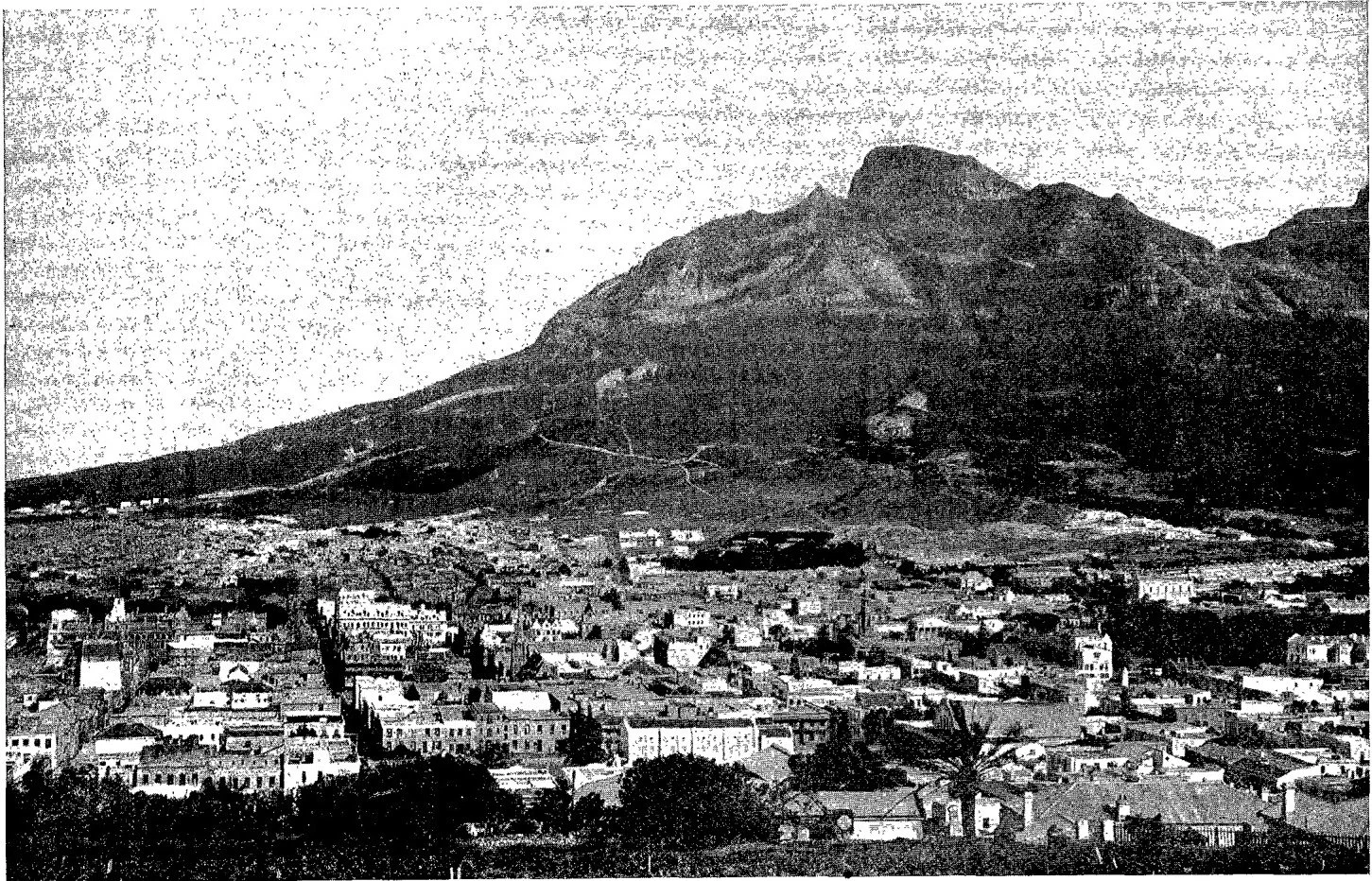
BUSINESS SECTION OF CAPE TOWN, SOUTH AFRICA
THE tenth annual session of the South African Conference was held at Uitenhage, in the Eastern Province of Cape Colony, Jan. 15-26, 1903. The organization of the Natal-Transvaal Mission field into a conference, during the past year, made it possible to effect the organization of a union conference in South Africa, embracing, in addition to the conference just named, the Cape Colony Conference, and the various mission fields in Africa, south of the Zambesi River. Having this organization in mind, the executive committee of the South African Union Council called its constituency together for the first annual meeting of the society, and in response, delegates came from the Matabele Mission station, near Buluwayo, Rhodesia; from Pretoria and Johannesburg, in the Transvaal; and from Durban and Pietermaritzburg, in Natal; as well as from the different provinces of Cape Colony. Orange River Colony was also represented. The attendance from the different portions of Cape Colony was much larger than was expected. This was the only camp-meeting that some of our mission workers had enjoyed the privilege of attending for a period of nine years. The location of the camp was central in the city, and the attendance from without was good.
Before the meeting convened, perplexities which from the human point of view seemed insurmountable confronted the delegates; but one of the most remarkable features of the meeting was that each mountain of this character, when approached, almost immediately became a plane, as the Lord led his servants by the unerring guide, the Holy Spirit; and the blessedness of it all was that all saw the leading of the Lord, accepted the deliverance, and thanked the great Counselor for his presence and help in the solution of most difficult problems. Perhaps the most complete triumph of the meeting was the spirit of union and harmony which prevailed. The union of the whole field in one common cause and in one united effort for the advance of the message, seems to be more complete than ever before.
One great need of our field is more laborers. It was decided to appeal to the Mission Board in America for two more experienced ministers, besides the three already booked for the Natal-Transvaal Conference, and also to ask for three church school teachers and three canvassers.
At the request of the Natal-Transvaal Conference, the Cape Colony Conference surrendered its claims upon Elder H. J. Edmed, who was immediately chosen as president of the former conference. Elder W. S. Hyatt was chosen as president of the South African Union Conference, and the writer as the president of the Cape Colony Conference.
The name of the South African Conference was changed to the Cape Colony Conference, so that its territory might be designated in its name, and so that it might not be confused with the name of the South African Union Conference.
It was decided to begin advance work at once in the Orange River Colony, by selecting two workers who speak the Dutch language, to go to its capital, the city of Bloemfontein. Brother G. W. Shone was selected to go to this field to engage in ministerial work, and Brother and Sister Tickton to lead in the canvassing work.
Financial reports from nearly all branches of our work in South Africa—attested by careful auditing—made good financial showing.
The medical missionary work, which has been conducted in our field during the past year, has been most encouraging. Especially is the work accomplished by the Kimberley Baths noteworthy as having made a remarkable financial gain, as well as a gain in prestige in the city in which this institution is located, and also in the entire conference. It is our confident expectation that within the next few weeks we may have a sanitarium well under way in a building well adapted for the purpose, in the charming suburb of Capetown, known as Plumstead.
The matter of raising a material fund for "Christ's Object Lessons" received consideration, and in one short meeting about $850 was subscribed for this purpose, which, with previous donations, makes a total of about $1,425. This will secure fully five thousand books.
The last Sabbath of the meeting was a day of special refreshing for those assembled on the camp-ground. Through the revival effort in the forenoon and the consecration meeting in the afternoon, nearly all who were present gave themselves to the Lord for cleansing and for service in soul-winning.16
As a result of the meeting, new confidence and renewed courage have taken firm hold on the people of God in South Africa. With the war, which has so long unsettled the country, now in the past; with the political conditions favorable for the advancement of the message; with confidence and courage restored; and lastly, with, we trust, perfect union in heart and purpose existing among the workers as well as in the "rank and file," we hope that renewed energy may revitalize every department of the work and every individual connected with the cause in this field, and that the present year may be the most triumphant for the truth of any similar cycle in all the history of the work in "darkest Africa."
Cape Town.
Mission Notes
THE MOHAMMEDANS comprise about eight tenths of the whole population of Egypt. Thus far we have been able to do nothing for them.
BROTHER B. CONNERLY writes that he hopes that the needy millions in Porto Rico may be remembered at the General Conference, and that prayers may be offered that the Lord will lay upon the hearts of some of our brethren a burden to go there, or to send some one else. He adds: “There could scarcely be found a needier field.” He offers to correspond with any who may contemplate coming as a self-supporting worker.
DR. R. S. INGERSOLL writes from the Calcutta Sanitarium that they are planning to open a training school in connection with the institution, for the training of workers. Of his own experience, he says: “The Lord certainly is very good to us, and I feel more than ever in my life that his hand is in this work. I never yet had reason to doubt it; but certainly my faith is stronger, in spite of difficulties, than it ever was before. I have been thinking much of late of how little we realize the shortness of time, and how differently we would do the work if we fully realized that the coming of our Saviour was so near. I am sure that if this truth could take hold of our lives, this one thing would constitute a grand revival, and would mean an increased success in our work.”
The West German and German Union Conference Committee Meetings
By Guy Dail
GUY DAIL
In Hamburg, the home of the first organized Seventh-day Adventist church in Germany, seventy delegates assembled January 14-18, to take part in the proceedings of the West German Conference, which was held in our own chapel, at Grindelberg 15a. Hamburg contains about 750,000 inhabitants. It is one of the three free cities in Germany (Bremen and Lübeck are the others). In this place is our German Union Publishing House, whose capital is about forty-six thousand dollars, with which it is doing a large amount of missionary printing and publishing. The school, sanitarium, and health food factory, located in Friedensau, are also within the limits of the territory of the West German Conference, so that this field derives a large share of the benefit of these two union institutions,—the Hamburg Publishing House and the Friedensau plant.
The time was fully occupied with work. There were, daily, two Bible studies, two conference sessions, one preaching service for strangers, and an early morning meeting for workers. Much thought was given to the work in mission fields, especially in our home territory and in German East Africa, and to the education of workers, and the strengthening of the colporteur work. The same plan was followed here which has been mentioned in our reports of the other German meetings,—the choosing of a large general committee, which appointed the subcommittees.
These actions of the conference may be of general interest:—
1. The Lord has richly blessed the West German Conference during the past year; especially are we thankful for the gratifying progress made by our union institutions in Hamburg and Friedensau, and we pray that the Lord may give us grace to serve him with all our ability and strength in the future, that the coming year may witness a still greater advance in his work through us.
2. We rejoice that the first edition of “Christ’s Object Lessons” is almost disposed of; and therewith a good beginning has been made; but we would encourage the brethren and sisters to take up with renewed energy the circulation of the second edition, that we may quickly free our school from its indebtedness, and that our young people may have an opportunity of preparing themselves for work in the field.
3. In consideration of the small corps of workers in our great field, we would ever remember the words of our Saviour, “Pray ye therefore the Lord of the harvest, that he will send forth laborers into his harvest,” and our duty as members of the church. Let us remember the same during the coming year, and seek out promising young people of good report, who should attend the school at Friedensau.
Whereas, We believe that our message should go to the ends of the world, therefore,—
4. We recommend, That the First-day offerings be dedicated to the opening of the work in German colonies, and that they be strengthened through free-will offerings.
5. Inasmuch as God is a God of order, we would recommend each colporteur to remain in the field assigned him until it is thoroughly worked, and the general canvassing agent assigns him other territory.
6. We would further recommend that we carry our part of the Material Fund for “Christ’s Object Lessons.”
There were some very encouraging experiences reported with reference to the selling of “Christ’s Object Lessons.” In some cities, when the authorities were made acquainted with the end had in view through the distribution of this book, and learned that it was purely a missionary enterprise, and that the brethren received no money from the profits made on their sales, they willingly granted to all our church-members the right to circulate the work freely, without paying for the right to canvass.
Four were baptized at this meeting. Elders Erzenberger, Conradi, and H. F. Schuberth were present, as well as Elders Boettcher, Frauchiger, and C. W. Weber.
The conference officers for the ensuing year are as follows: President, J. Pieper; Secretary, O. Luepke; Treasurer, B. Severin; Sabbath-school and Missionary Secretary, K. Laubhan; Canvassing Agent, J. Lippert. There are now four ordained ministers, two licentiates, and seventeen Bible workers in this field.
The report for the year 1902 shows 34 churches and companies, with a total membership of 1,093; 205 persons were baptized, and 27 received by vote. The tithe amounted to $9,978.76; Sabbath-school offerings to $728.29; First-day offerings to $162.84; annual offerings to $439.81. There were 60 canvassers, whose book sales amounted to $13,973.37; 32 Sabbath-schools, with 763 members. Three hundred and thirty-four dollars was voted toward the German East African Mission.
In connection with, or rather, immediately at the close of, the West German Conference, the German Union Conference Committee spent three busy but happy days in planning for the work in the union, and especially in the proposed mission to be opened in German East Africa. We have now secured written permission of the government to enter that field, provided we open a mission where no other society is operating. Two young men have been selected to go, and, if no overruling providence forbids, we expect to begin the work next fall. This is certainly a worthy enterprise, and we believe that it will elicit the hearty co-operation and sympathy of our brethren in America, our German-speaking friends, especially, giving it their support.
The report for the year shows that the German Union Conference had employed 22 ministers, 13 licentiates, 47 Bible workers, and that there were 160 churches and companies, with a total membership of 4,256; 725 persons were baptized, 186 received by vote; the tithe was nearly $27,000. Sabbath-school offerings, $2,423.24; First-day offerings, $449.42; annual offerings, $998.68. There are sixty students in the Friedensau school, and the sanitarium has had a successful year. We have no discouraging report to make concerning the work in this great field. The work is onward, for God is with it.