THE first meeting of the sixth annual session of the Upper Columbia Sabbath-school Association, was held on the Milton camp-ground, June 3, 1885. Representatives were present from the schools at Walla Walla, Milton, Dayton, Alba, Garfield, and Farmington. The president reported that two new schools had been organized during the year: one at Garfield, W. T., and one at Boise City, I. T.
After the reports had been read, the question box was opened, and half an hour was profitably spent in answering questions pertaining to the Sabbath-school work.
The chair appointed committees as follows: On nominations—W. L. Raymond, W. W. Steward, Adna Hesseltine; on resolutions—E. J. Waggoner, H. W. Decker, E. G. Winkler.
At a second meeting, the Nominating Committee made the following report: For president, Elder H. W. Decker; secretary, Mrs. N. J. Decker; Executive Committee, H. W. Decker, B. F. Winkler, Mrs. Mary Goodwin. The persons recommended were duly elected as officers for the coming year.
The Committee on Resolutions presented the following:—
Resolved, That we consider it the imperative duty of all who accept any position in the Sabbath-school work, whether as State or local officers, to use every possible means to thoroughly qualify themselves to perform their duties.
Whereas, The Sabbath-School Worker, published by the General Sabbath-school Association, is especially devoted to giving the best methods of Sabbath-school work for the instruction of pupils, as well as teachers and officers, therefore,
Resolved, That we request all Sabbath-school officers in the Conference to take the Worker themselves, and to work for its circulation in their schools.
The merits of the Worker having been set forth by Elders Loughborough and Waggoner, Brother B. F. Winkler was requested by vote of the meeting to take subscriptions for it on the ground. (As the result of this action, twenty-four subscriptions for the Worker were taken.)
At a subsequent meeting the following additional resolutions were adopted:—
Whereas, We believe that giving is a part of the worship of God, and should be performed regularly, the same as any other act of worship, and
Whereas, We desire that our children should be instructed in all parts of the service of God, therefore,
Resolved, That we will henceforth carry out the system of Sabbath offerings, as recommended by the General Association, and that as individuals we will use our influence to have the system adopted in all our schools.
Resolved, That we recommend that the proceeds of these Sabbath offerings be devoted to such missionary enterprises as shall be advised by the Executive Committee of the Association.
Much of the time of the session was devoted to answering questions and giving instruction to officers and teachers. The matter of more earnest work for the children, in getting them interested in Bible study, drew out the following resolution:—
Whereas, The country is flooded with trashy literature that is poisoning the minds of the young, and benumbing their sensibilities, therefore,
Resolved, That we recommend that parents use great care in selecting reading matter for their children, and that schools in establishing libraries, purchase only such books as have been critically examined by competent persons.
After the discussion and adoption of this resolution, the meeting adjourned sine die.
J. N. LOUGHBOROUGH, Pres.
L. J. HALLEY, Sec.
British and Foreign Bible Society Report
The eighty-first annual meeting of the British and Foreign Bible Society was held May 6. The issues for the year were 4,161,032 of Bibles, Testaments, and portions. The total issues from the commencement of the society are 104,196,965.
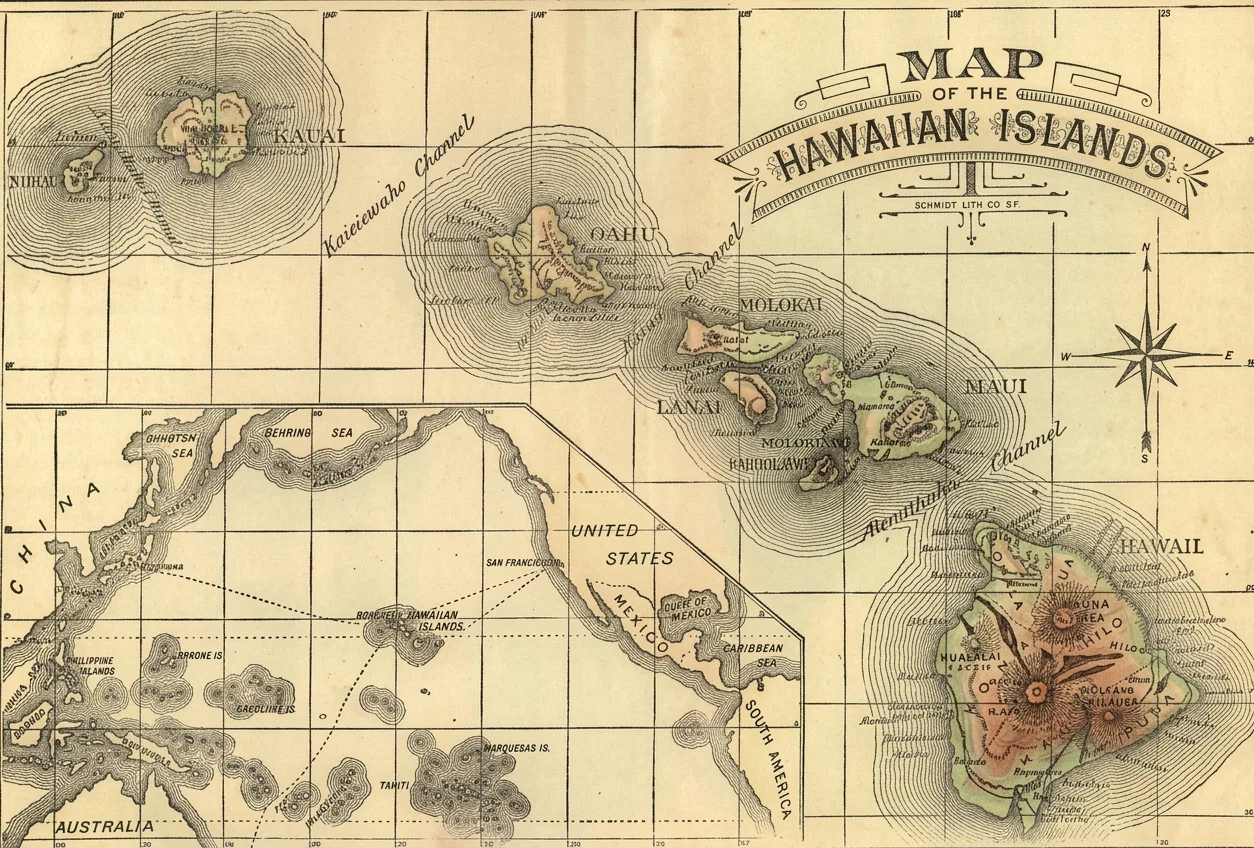
The Sandwich Islands.
“THE SANDWICH ISLANDS” is the popular name of a group of islands in the North Pacific Ocean. We were informed by a native preacher that they dislike the name “Sandwich,” and wish their ocean home to be called by its proper name—Hawaii. The following description is from Lippincott’s “Gazetteer of the World:”
“Hawaii (hä-wi'ee), a kingdom of Polynesia, consisting of a group called also Sandwich Islands, or the Hawaiian Archipelago, in the North Pacific Ocean, mostly between lat. 19° and 22° 20' N., lon. 155° and 160° W. There are 15 islands, only 8 of which are inhabited. The principal are Hawaii or Owyhee, Maui or Mowee, Oahu or Woahoo, Kauai, Molokai, Ranai, Nihau, and Kahoolawe. Area, 7,629 square miles; pop. in 1872, 56,897. The singularly rapid decrease of the native population, estimated by Cook at 400,000, commenced with the visit of that discoverer to these islands. Palmyra Island, lat. 6° N., about 800 miles S. of this group, belongs also to the Hawaiian kingdom; it has an area of 60 square miles, but is scantily peopled.
“In general, the surface has a great elevation, and in Hawaii are several active volcanoes, of which Mauna Loa is one of the highest active volcanoes in the world. The climate is salubrious, with sea-breezes and moderate rains; mean temperature, 75°; range of thermometer, 60° to 88° Fahr. The soil in the uplands is better adapted for grazing than for agriculture; fine wheat is, however, grown there, and the valleys produce coffee, sugar, cotton, tobacco, cacao, arrowroot, the mulberry, yams, sweet potatoes, and taro. Sugar is the staple article of export. Sandal-wood was formerly an important product, but the forests have been too rapidly thinned, and little is now produced. Live-stock of all the ordinary species thrives well. Honolulu, the capital, on the island of Oahu, is an important entrepôt for trade with all commercial nations. On Cook’s discovery of the group each island had a separate ruler; but afterwards the whole of the islands were consolidated under one government, and idolatry was abolished. Missionary stations were established in 1820, and the natives are now converted to Christianity, and have printing-presses and newspapers. The islands are frequented by whaling-vessels, and are in the great line of commerce between California, China, and Australasia.”
Incidents by the Way. No. 1.
By Stephen N. Haskell
SUNDAY, May 10, we sailed from San Francisco. After parting with friends on the shore we watched with interest the waving of handkerchiefs, and the motion of the hand, until distance forbade the recognition of friends. We then turned to cast the last look at the old familiar San Francisco docks. As we passed out the Golden Gate we heard the cry of, “Whale!” It so happened that this monster of the deep gave us a view of his back and tail, and then receded from view under the briny wave. We then turned our attention to our fellow travelers to see whom we were to have for companions for a month on the ocean. It should be remembered that we are shut up to 36x400 ft., the extent we have for exercise, eating, drinking, and sleeping; although like Noah’s ark our ship was built three stories high (an iron ship of 3,200 tons burden).
We found about sixty cabin passengers, mostly Americans. One hundred officers and sailors manage the ship, wait on passengers, etc., all Englishmen, gentlemanly and kind. They ever manifest an interest in making the voyage as agreeable as possible. This was, however, rather difficult the first few days. As usual on such occasions, we were strongly inclined to remain in our rooms and be waited upon. This gradually wore off, and we found that the voyage was a pleasant one, considering the circumstances.
Among the cabin passengers we found a Presbyterian clergyman and his family, consisting of a wife and three children and an adopted daughter. He was from Pennsylvania and is to settle in Melbourne. There is also a Presbyterian minister from San Francisco. He rooms beside us. In the night, and once or twice during the day, we are reminded that he is in his room by the disagreeable smoke of a cigar which comes into our room. There is yet another minister aboard, from the city of Melbourne. Then taking the three of our own company that are of the ministerial order there are six of that class on board. We were told that seven are enough to sink a ship, but the sea is unusually smooth, and the wind fair, so that we are left to conclude that the voyage is not endangered by so many of that profession on board. Then there is another man of note, the new American consul, and his wife, for Melbourne. He is from Kentucky. There is also a gentleman and his wife from Oakland, Cal., who have started on a tour around the world, to exhibit a fire extinguisher. She is acquainted with us as a people, and our work. She expressed confidence in our views.
We also found a lady to whom we handed a paper to read. Upon receiving it she said when she was in New York City one was handed her that she had read with interest; and upon her arrival in Chicago the next number was handed her; then again in San Francisco she received the third paper; the one we handed her was the last one published up to the time of our leaving, so that by the hands of some friends she had received four copies. She is on her way to New Zealand. We also became acquainted with a gentleman who is a member of the Legislative Council, and a large flour dealer in Adelaide, Australia. He stated that he had ever had his mind troubled on the Sabbath question and had always queried why the Sabbath had been changed to the first day of the week. He said that he had suffered in his mind much on account of the inconsistencies of professed Christians, especially when considering the number of sects that exists, if the Bible be what they claim it to be. He expressed his interest in the doctrines of the SIGNS, and had noticed that the paper advocates that men are not to be tormented eternally, as is commonly taught. Our conversation was an interesting one, and from him we obtained much information about the country to which we are going.
When out of sight of land it is interesting to see anything that has life and intelligence; it furnishes a new theme for conversation, till it has passed out of sight. Occasionally we had this privilege in passing vessels. Sabbath, May 16, we met the steamship Mariposa. She belongs to the regular line of steamers that run between San Francisco and Honolulu. There was something more than usually interesting in the passing of this ship. They ran up three signals, called “International Signals,” by which they inquired about the war. Up ran three little flags that answered, “Peace is patched up.” There was a reason for this, we found when we arrived at Honolulu. At that place they expected that the war had commenced, and consequently they did not expect that the steamer, being an English vessel, would enter the port. There was a Russian man-of-war lying in the harbor, which, we were informed, was ready to capture any vessel that sailed under the British flag. S. N. H.
The Harm of Preacher Donations
By J. M. Long
WE think it a great mistake for the preacher to allow himself to be placed before society as a ward and pensioner. The habit of looking for and receiving presents tends to eviscerate all the manhood out of a preacher. Donation parties gotten up for the preacher, are, in nine cases out of ten, efforts to cover over the failure to do simple justice, with the thin veil of liberality.—J. M. Long.
Hypocrisy Is Found Everywhere
By Rev. Albert Goodrich
SOME people speak as if hypocrites were confined to religion; but they are everywhere: people pretending to wealth when they have not a sixpence, assuming knowledge of which they are ignorant, shamming a culture they are far removed from, adopting opinions they do not hold.—Rev. Albert Goodrich.
A Woman's Little Sermon.
THE congregation consisted of one woman, who sat in her own house at about six o'clock in the evening.
As the congregation, in this instance, seated herself for her evening's work with the pile of stockings, the preacher's voice was suddenly raised. No anthem preceded him—or her, or it, as you please—no comforting word of Scripture was read. The preacher, invisible and inspired, simply announced his text in the silence of the room, and began. The preacher's name, for want of a more accurate one, we call Conscience. His text he drew from memory: "The young grow into the air; the old into the earth;" and the sermon ran as follows:—
"You stand between the young and the old. The fancies and follies of youth are no longer alluring to you. Indeed, you have been at times conscious of a half-sad feeling of superiority in a company of young women; you have felt that there was a great gulf fixed between the thoughts of youth and your thoughts, so that the young could not pass to you, nor you to them. But, though it is clear that you are no longer growing into the air, is it not equally clear that you are growing into the earth? Are you any larger or better for being older? Are your troubles, now, about the corners not quite clean, the carpet awry, the servant who persists in being an individual with preferences of her own, rather than a machine that you can manipulate at your will—are these so very much more noble and dignified than the thoughts and troubles of your frivolous youth? Is it nobler to be taking thought concerning what one shall eat and drink, and wherewithal one shall be clothed, even though you make these anxieties cover twenty years of the future, than to be building rosy and impossible castles on airy heights, where, whatever of folly might be, sullen care was not?
"Is age, of itself, adding anything to you that makes up for the perhaps mistaken trustfulness and thoughtless confidence of your youth, when you were sure that life was worth the living, though you could not tell the reason why?
"Ah, it is surely no better to grow into the earth than into the air.
"And this is the danger that besets a woman when she bids farewell to her youth, with all its beautiful visions, and settles down to the realizing of these visions out of the homely materials of her daily life and toil; when, instead of the perfect house of her fancy, she is given an old and time-stained dwelling, whose every line and angle, whose every tone and tint, are an offense to her esthetically educated eye, and is told that of this she must make her ideal home; when, instead of the hero and saint combined, of her girlish fancy, toward whose lofty height of character she should be ever climbing, she finds herself possessed of an ordinary flesh-and-blood husband, whose chief desire is to be well fed, who doesn't like poetry, and who tells her that her theories will do very well for Heaven, but won't work in this world; who keeps the most important part of his soul locked up from her, that part in which he makes his plans, in which he transacts his business, that part of his soul which is having most to do with the making of his eternal character; when, instead of the golden plenty with which she might add grace and beauty and an air of ease to her ancient dwelling, she finds herself set to make one dollar do the work of five; when, instead of the heroic deeds and sublime services she had planned, she finds herself stooping to carry a thousand paltry, mean-looking, unsymmetrical daily loads; when, instead of treading an upward path over grand though rugged mountains of difficulty, she finds herself in a narrow way full of little sharp stones that hurt her feet at every step; when, whatever her lot or station, she finds the actual in her hands differing from the ideal of her early aspiration—then it is that she is in danger of bending over and growing into the earth as she grows old, so that food and clothes, and paltry neighborhood strifes, and small social triumphs, and the gaining of place and power for her children, become the reason and the end of her life.
"Is it not just this danger, perhaps dimly recognized, that has led women of late to form all sorts of self-improvement societies? Is it not the instinct of self-preservation blossoming out into societies of decorative art, scientific clubs, and reading circles? Women see that there is no life so apt to grow small and ugly as theirs unless it be inspired with great thoughts. It is made up of such little things. It deals continually and unceasingly with dirt, either at first or second hand. It is the ignoble question of meat and drink three times a day, so that often a man's chief memory of his mother is of the pie she used to make. It means perpetual indoor contact with ignorance and ill-breeding. And because of all this, it needs a mighty inspiration.
"And to no woman on the earth can there come a greater inspiration than to you, a daughter of America, born in the cradle of liberty, reared in freedom's native air, and free now, as the women of no other land are free, to use every power that God has given you. To you, thus prepared and equipped, comes the call to a service grand enough to lift your life up from its earthward growth, great enough to overflow your house and fill with its glory the doubtful corners on all your doors, to drown in sunshine the picture of the carpet askew that you see when your eyes are shut, and to substitute for that list of things that you want but cannot have, the nobler list of things that you can do without.
"And what is this noble service, this worthy inspiration? It is the cleansing and purifying and sweetening of your beloved country; it is the making a home for Christ which shall include the sunny slopes of California, the rich valleys of our mighty rivers, the fragrant groves of Florida, and the glorious mountains of the West.
"Who shall say which is first in God's mind when he shuts himself up to work through you; what those for whom you work shall become by your labor, or what you shall become by the passing of his power and love through you?
"This missionary work, to which you have so often to be urged, is not a stern duty which you must do in order to be saved, or to have a star in your crown by and by; it is not a cross which you are to take up; no; it is your salvation. It means hope and progress and development for you. It is the antidote to the pettiness of your life, to the belittling influence of small cares and sordid anxieties. Its rewards are not future; they are not something to be given you, but something to be wrought in you. Who that ever gave a cup of cold water, in the name of a disciple, has waited for her reward? There was never a true gift made in all the world but that instantly and eternally rewarded the giver.
"Consider, further, the adaptation of this inspiration to your condition. It does not say to you, 'Come out of your quiet home, despise your petty burdens, and seek a wider service.' It says: 'Let me come into your home and enlarge its borders until it includes every room, in palace or cabin, where a baby opens its eyes to the blessed birthright of freedom.' It says: 'When you stand over your children, let me put into your heart the thought that in a certain high and sacred sense all the children of this great country are yours; yours to mould, to teach, to love, their future is for your honor or your shame.'
"And there is no inspiration for a woman's life like this, for it appeals to woman's peculiar power, love. You remember reading, when you were young, that love was incidental in a man's life, but to a woman it was all of life, so that if she failed in her love-life, she was undone. And you remember the indignation that stirred within you at the seeming injustice of such an arrangement of Providence,—that a woman should be given but one chance of success. Hear, then, these words of a wiser than worldly philosopher: 'Love never faileth.' Knowledge, and prophecy, and understanding, and eloquence, and skill, and hope, and faith may fail—'love never faileth.'"—Christian Union.
The Home Circle.
SUPPOSE.
SUPPOSE, my little lady,
Your doll should break its head,
Could you make it whole by crying
Till your eyes and nose were red?
And wouldn't it be pleasanter
To treat it as a joke;
And say you're glad 'twas dolly's
And not your head that broke?
Suppose you're dressed for walking,
And the rain comes pouring down,
Will it clear off any sooner
Because you scold and frown?
And wouldn't it be nicer
For you to smile than pout,
And to make sunshine in the house
Where there is none without?
Suppose your task, my little man,
Is very hard to get,
Will it make it any easier
For you to sit and fret?
And wouldn't it be wiser
Than waiting like a dunce,
To go to work in earnest
And learn the thing at once?
Suppose that some boys have a horse,
And some a coach and pair,
Will it tire you less while walking
To say, "It isn't fair"?
And would it not be nobler
To keep your temper sweet,
And in your heart be thankful
You can walk upon your feet?
Suppose the world don't please you,
Nor the way some people do,
Do you think the whole arrangement
Will be altered just for you?
And is it not, my boy or girl,
The wisest, bravest plan,
Whatever comes, or doesn't come,
To do the best you can? —Selected
Cutting Things under Water.
By Scientific American
WHEN science was in its infancy, much of its fact was mixed with nonsense, and some of the nonsense shows a wonderful vitality. A case in point is the recent republication of a nonsense bit that was current at least forty years ago. It is a recipe for cutting glass with shears or scissors. The statement is that sheet glass can be cut with the greatest ease with a pair of scissors if the glass is kept under water and kept in a level position. That there is not a word of truth in it any one may easily prove on a trial, with the result of dulling a pair of shears.
There is one cutting process that can be better done under water than out of water; that is, the paring of onions. When pared under water the acrid emanations, so unpleasant to the mucous membrane of eyes and nose, are dissolved or held in the water. But neither the quality of glass nor the power of scissors is changed by immersion in water.—Scientific American.
The Origin of Persimmons
PERSIMMONS were first spoken of in print by Captain John Smith, who classed them among Virginia plums, but called them putchamins, remarking that if eaten before they were fully ripe they "draw a man's mouth wrie with much torment." The name persimmons was evolved from putchamins. Both are of Indian origin.
Health and Temperance.
By Harriet M. Morris
Food and Dress.
Nor only should the food be plain and nourishing in order that children may grow up with normal appetites, but the dress should be simple. "A child decked in silks and ribbons, in tucks and trimmings," says Mrs. Bascom, "is not only a sad sight morally but an offense against good taste. Undue attention to dress in childhood is often fruitful of life-long mischief. It is tainted with that spirit of self-indulgence and excess which is the very gist of intemperance."
It has been said that if children were given plenty to do, were taught to admire the beauties of nature and of art, their talents, literary, artistic, and mechanical, given proper encouragement and aid, this matter of drunkenness would right itself.
Undoubtedly, music, painting, sculpture, poetry, and all the arts by which the beauties of nature, and the genius of human thought find expression, have a refining tendency. However, the special moral effect ascribed to them by some writers and speakers, is to be doubted. If we find, upon inquiry, that those whose talents or genius have delighted the watching eyes and listening ears of the world, have been persons of uniform high moral character; if our musicians and artists have been in any degree notable for their mastery of self; if our lawyers and our statesmen have been sober of life, and strong to resist temptation, we may be convinced of the adequacy of this method of outwitting the enemy. How is it? Have not our men of most brilliant accomplishments been the slaves, rather than the masters of their appetites and passions?
If any art could be in itself a safeguard against vice, music, of which Jean Ingelow says,—
"We know they music made
In Heaven ere man’s creation;
But when God threw it down to us,
It dropt with lamentation;
And ever since doth its sweetness shade
With sighs for its first station,"—
It would seem, should be the one whose hold upon the higher nature of man should be the strongest and sweetest of any.
And yet, have not our great musical composers and artists been proverbially men whose excesses have brought shame to their friends and ruin to themselves?
It is plain that something more is needed than mere mental culture and artistic or mechanical skill, though these are not to be underrated as important aids in the development of worthy and useful men and women.
Children should be given special training in regard to physiological laws. A knowledge of the processes of digestion, circulation, and nutrition in their own bodies should be held as more important than the conjugation of verbs, and the bounding of States and Territories.
They should be taught the effects of stimulants and the danger of indulgence therein. They should be made to realize the holiness of life and health and the exceeding sinfulness of abusing their bodies.
Girls should be taught that life is as real and earnest for them as for their brothers; and boys, that there is not one code of honor for them and another for their sisters.
Let them be given large views of the fatherhood of God and the brotherhood of man, the sacredness of their relations to humanity, and the eternal, inevitable consequences of wrongdoing.
With all our care and thoughtful foresight, there are many outside influences for evil which we cannot avoid. We do not wish our children to be kept from contact with the world. We do not wish to shut them in bandboxes for fear they will be soiled. We do not wish to make Pharisees of them, thanking God that they are not as others are.
We want them not simply pure, but strong; not simply good, but good for something.
So we must give them the best that is within our souls, and send them out into the battlefield of life, forewarned and forearmed, clad in the armor of God, that they may be able to stand in the evil day.
Female Beauty and Ornaments.
THE ladies in Japan gild their teeth, and those of Indies paint them red. The pearl of the teeth must be dyed black to be beautiful in Guzerat. In Greenland the women color their faces with blue and yellow. However fresh the complexion of a Muscovite may be, she would think herself very ugly if she were not plastered over with paint. The Chinese must have their feet as diminutive as those of the she-goat; and to render them thus their youth is passed in tortures. In ancient Persia an aquiline nose was often thought worthy of the crown; and if there was any competition between two princes, the people generally went by this criterion of majesty. In some countries the mothers black the noses of their children, and others press the head between two boards, that it may become square. The modern Persians have a strong aversion to red hair: the Turks, on the contrary, are warm admirers of it. The female Hottentot receives from the hand of her lover, not silks nor wreaths of flowers, but the entrails of animals, to dress herself with—enviable ornaments.
In China, small, round eyes are liked, and the girls are continually plucking their eyebrows, that they may be thin and long. The Turkish women dip a gold brush in a tincture of a black drug, and pass over the eyebrows. It is too visible by day, but looks shining by night. They tinge their nails with a rose color. An African beauty must have small eyes, thick lips, a large, flat nose, and a skin beautifully black. The emperor of Monomotapa would not change his amiable negress for the most brilliant European beauty.
An ornament for the nose appears to us perfectly unnecessary. The Peruvians, however, think otherwise; and they hang on it a weighty ring, the thickness of which is proportioned by the rank of their husbands. This is rather troublesome to them in blowing their noses, but the fact is, and some have informed us, that the Indian ladies never perform this very useful operation.
The female head-dress is carried in some countries to singular extravagance. The Chinese fair carries on her head the figure of a certain bird. This bird is composed of copper or gold, according to the quality of the person: the wings spread out, fall over the front of the head-dress and conceal the temples. The tail, long and open, forms a beautiful tuft of feathers. The beak covers the top of the nose; the neck is fastened to the body of the artificial animal by a spring, that it may the more freely play and tremble at the slightest motion.
The extravagance of the Myantsees is far more ridiculous than the above. They carry on their heads a slight board, rather longer than a foot, and about six inches broad; this they cover with the hair, and seal it with wax. They cannot lie down, or lean without keeping the neck straight; and the country being very woody, it is not uncommon to find them with their head-dresses entangled in the trees. Whenever they comb their hair, they pass an hour by the fire in melting the wax; but this combing is only performed once or twice a year.—Curiosities of Literature.
Caste and the Dignity of Labor
By Sarah K. Bolton
We profess in this country to be far removed from caste; but I fear that the Wendell Phillipses who believe in the equality of all, women with men, black with white, poor with rich, are not found in every American home. We talk well about the dignity of labor, and bring up our daughters in idleness, fearing the speech of so-called good society!—Sarah K. Bolton.
Wisdom in Heeding Reproof
“A fool despiseth his father’s instruction; but he that regardeth reproof is prudent. In the house of the righteous is much treasure; but in the revenues of the wicked is trouble.” Prov. 15 : 5, 6.
Tobacco a Poison.
By T. De Witt Talmage
“Let the earth bring forth grass, the herb yielding seed.” Gen. 1:11.
THE first born of earth were the grass blade and the herb. They preceded the brute-creation and the human family—the grass for animal life, the herb for human service. The cattle took possession of their inheritance, the grass blade; and man took possession of his inheritance, the herb. This herb we have for food in case of hunger, for narcotic in case of insomnia, for anodyne under paroxysm of pain, or for stimulus when the pulses flag under the weight of disease. The caterer takes the herb and serves it up in all delicacies. The physician takes the herb and compounds it for physical recuperation. Millions of the human race take it for ruinous delectation of body and mind. The herb, divinely created and for good purposes, in cases without number is prostituted for evil results.
There is a lawful and unlawful use of the herbaceous kingdom. There sprang up in Yucatan, on this continent, an herb, which has bewitched the world. It crossed the Atlantic Ocean in the fifteenth century, and captured Spain; then it captured Portugal, and then the French ambassadors took it to Paris, and it captured the French Empire. Then Walter Raleigh introduced it into England. The botanists ascribe it to the genus nicotiana; but you all know it as the inspiring, the elevating, the radiating, the nerve-shattering, the dyspepsia-breeding, the health-destroying tobacco.
I shall not be offensively personal while I speak on this subject, because you all use it, or nearly all. Indeed I know from personal experience how it soothes and roseates the world, and kindles sociality, and I know what are its baleful results. I know what it is to be its slave; and, thank God, I know what it is to be its conqueror. I have no expectation that I will persuade the great masses of you to change your habits upon this subject; but I thought I might help you in some advice to your children.
You say: “Didn’t God make tobacco?” Oh, yes. You say: “Isn’t God good?” Oh, yes. You say: “Then God, when he created tobacco, must have created it for some good purpose.” Oh, yes. It is good for a great many things—tobacco is. It is good to kill moths in the wardrobe and tick in sheep, and to strangulate all kinds of vermin, and to fumigate pestiferous places, and like all other poisons, God created it for some particular use. So he did henbane, so nux vomica, so copperas, so belladonna, so all those poisons which he directly created, or had man to extract.
But the same God who made the poisons also created us with common sense to know how to use them, and how not to use them. “Oh!” say some of my friends, “don’t people use it without seeming harm to themselves, and are there not cases of plethora which absolutely need this depletion?” Oh, yes. Skillful and prudent physicians have sometimes prescribed it, just as they sometimes prescribe arsenic; and they prescribe it well. There can be no doubt about its being poison. There was a case reported in which a little child lay upon its mother’s lap and a drop from her pipe fell on the child’s lip, and it went into convulsions and into death.—T. De Witt Talmage, D. D.