ARE you a husband? Do you suppose, then, when worried with business, that you have all the trouble, and your wife none? Do not go home and there vent your ill humor upon your wife. Recollect that she has cares as well as you. If you are annoyed at anything—worried by money matters, or alarmed at the failure of debtors—keep it to yourself if you can; at any rate do not take vengeance on your wife, and render the household miserable with your sour looks and ill temper.
A husband should throw off his cares the moment he enters the door, just as he throws off his overcoat. It is not so difficult as you suppose. Habit is everything. With a firm will, you can do it. The practise resolutely persisted in will eventually become a habit, and you will reap your reward in a more cheerful home and pleasanter evenings. Recollect all your tormenting about business will not render you one penny richer; and wives, you must remember, are not angels, and must be managed as well as loved.
This is plain talk, but it may do you good, if you will follow its precepts.—The Western Rural.
It Was the Drink
MRS. MICHAEL KORNET, dying in a Cleveland hospital as the result of her husband's drunken fury, said in broken English:—
“I hold nothing against Michael. It was the drink. He used to be a good husband. Liquor made him a demon. I forgive him.”
The same old story.
It has been told again and again in every language. It is the heart-rending tale of many a death-bed scene the world over, and alas, it is the tale told in the tear-dulled eyes and care-worn face of many a wife not lucky enough to be murdered at one blow, but who must die the slow death of fear and despair.
“If it were not for my children,” this dying woman said, “I would be glad to go.”
Aye, no doubt.
To her, tied to a man whom liquor made a brute, death must have been sweet release. Drink, not Michael, was the devil who ever walked at her side, revolver in hand. Hers was a life of constant fear and hopelessness. It was hell on earth. At last it ended in the natural way—in the way she had long expected it to end. Is it any wonder that, but for the children, she would have been glad to go?
O, a mother's love!
She would stay in hell for that.
For her children she would gladly have gone on living in terror of that murderous demon which Michael again and again unloosed.
This poor woman's last words were to her son—to one of the children for whom she would have gone on in martyrdom if she could:—
“Good-by,” she said to him. “And William, don't drink! promise me!”
The boy William ought to have been impressed. Perhaps he will keep the promise that he made. Certainly the dreadful object-lesson came close home to him, with his mother dead and his father in jail for her murder, and all of it due to drink.
What a fool William would be to go off and get drunk!
William has learned no more than any sane man may learn who keeps his eyes open to the effects of drink.
The fate of this woman is the fate of thousands. The liquor that made her husband a brute has made brutes of millions. It is not a lesson for William alone.
“Dead!” exclaimed the husband, when he heard. “I did not mean to kill her!”
Of course not. Nothing was further from his sober intentions. But what could his intentions amount to after he had permitted his spirit to be bound in slavery to a demon?—Cleveland Press.
A Woman's Sigh for a Pocket
By Carolyn Wells
How dear to this heart are the old-fashioned dresses,
When fond recollection presents them to view!
In fancy I see the old wardrobe and presses
Which held the loved gowns that in girlhood I knew.
The wide-spreading mohair, the silk that hung by it;
The straw-colored satin with trimmings of brown;
The ruffled foulard, the pink organdie nigh it;
But O, for the pocket that hung in each gown!—
The old-fashioned pocket, the obsolete pocket,
The praiseworthy pocket that hung in each gown.
The dear, roomy pocket I'd hail as a treasure
Could I but behold it in gowns of to-day;
I'd find it the source of an exquisite pleasure,
But all my modistes sternly answer me “Nay!”
'Twould be so convenient when going out shopping,
'Twould hold my small purchases coming from town;
And always my purse or my 'kerchief I'm dropping—
O, me! for the pocket that hung in my gown!—
The old-fashioned pocket, the obsolete pocket,
The praiseworthy pocket that hung in my gown.
A gown with a pocket! how fondly I'd guard it!
Each day ere I'd don it I'd brush it with care;
Not a full Paris costume could make me discard it,
Though trimmed with the laces an empress might wear,
But I have no hope, for the fashion is banished;
The tear of regret will my fond visions drown!
As fancy reverts to the days that have vanished,
I sigh for the pocket that hung in my gown—
The old-fashioned pocket, the obsolete pocket,
The praiseworthy pocket that hung in my gown.
— Carolyn Wells, in Christian Endeavor World.
The Ministry and Value of Song
THE history of the songs of the Bible is full of suggestions as to the uses and benefits of music and song. Music is often perverted to serve purposes of evil, and it thus becomes one of the most alluring of temptations. But, rightly employed, it is a precious gift of God, designed to uplift the thoughts to high and noble themes, to inspire and elevate the soul.
As the children of Israel, journeying through the wilderness, cheered their way by the music of sacred song, so God bids his children of to-day gladden their pilgrim life. There are few means more effective for fixing his Word in the memory than repeating them in song. And song has wonderful power. It has power to subdue rude and uncultivated nature; power to quicken thought and to awaken sympathy, to promote harmony of action, and to banish the gloom and foreboding that destroy courage and weaken effort.
It is one of the most effective means of impressing the heart with spiritual truth. How often to the soul hard-pressed and ready to despair, memory recalls some words of God's,—the long-forgotten burden of a childhood song,—and temptations lose their power, life takes on a new meaning and a new purpose, and courage and gladness are imparted to other souls!
The value of song as a means of education should never be lost sight of. Let there be singing in the home, of songs that are sweet and pure, and there will be fewer words of censure, and more of cheerfulness and hope and joy. Let there be singing in the school, and the pupils will be drawn closer to God, to their teachers, and to one another. As a part of religious service, singing is as much an act of worship as is prayer. Indeed, many a song is a prayer. If the child is taught to realize this, he will think more of the meaning of the words he sings, and will be more susceptible to their power.
As our Redeemer leads us to the threshold of the Infinite, flushed with the glory of God, we may catch the themes of praise and thanksgiving from the heavenly choir round about the throne; and as the echo of the angel's song is awakened in our earthly homes, hearts will be drawn closer to the heavenly singers. Heaven's communion begins on earth. We learn here the keynote of its praise.—Education.
Among the Churches in Brazil
By F. W. SPIES
F. W. SPIES
ON the third of February of this year, the writer, accompanied by Brother Emil Hoelzle, two canvassers, and a teacher for the Itarare church-school, started out for the latter place. Having left Castro on Friday morning, we reached Pedras just before sunset, and spent the Sabbath with the few Sabbath-keepers who reside at that place. While at Pedras we were encouraged by seeing a man, who had for a long time been halting between two opinions, decide to step out fully on the Lord's side. Thus was added another witness for the truth to those who had already been holding up the light in this section.
On Sunday we rode two leagues (eight miles) farther on our way, and stopped at a little town called Pirahy, to visit several families who had recently begun the observance of the Sabbath. After encouraging these, we continued our journey the next day. But soon after we got started, a severe rain-storm set in, and at 2 P. M. we were glad to accept the hospitalities of a Brazilian who offered us a room in his shanty. We soon made a fire on the earth floor, and proceeded as best we could to dry our clothes. The next day was still rainy, though not so bad as Monday, and on Wednesday, the eighth, about noon we reached Itarare, thankful to be once more greeted by the familiar faces of our brethren, after the unpleasant ride across the campo in the driving rain.
At and in the vicinity of Itarare we remained two weeks, visiting the brethren who were scattered over a radius of four leagues. We were glad that we could note progress among those who had been keeping the Sabbath for some time, and that a number had overcome the tobacco habit, and were now ready for baptism. In this country the people seem to think that what is good for one is good for the other, so the women use tobacco as freely as do the men. And no doubt they are logical in this; for if tobacco is a benefit to the head of the family, why should it not be to all the other members? We were also glad to find here some who had recently begun to keep the Sabbath.
On the last Sabbath of our stay we had a general gathering of all the brethren and sisters in the vicinity, and after baptizing those who were prepared for this step,—eight in all,—we celebrated the ordinances of the Lord's house. This was a day of great blessing to all present.
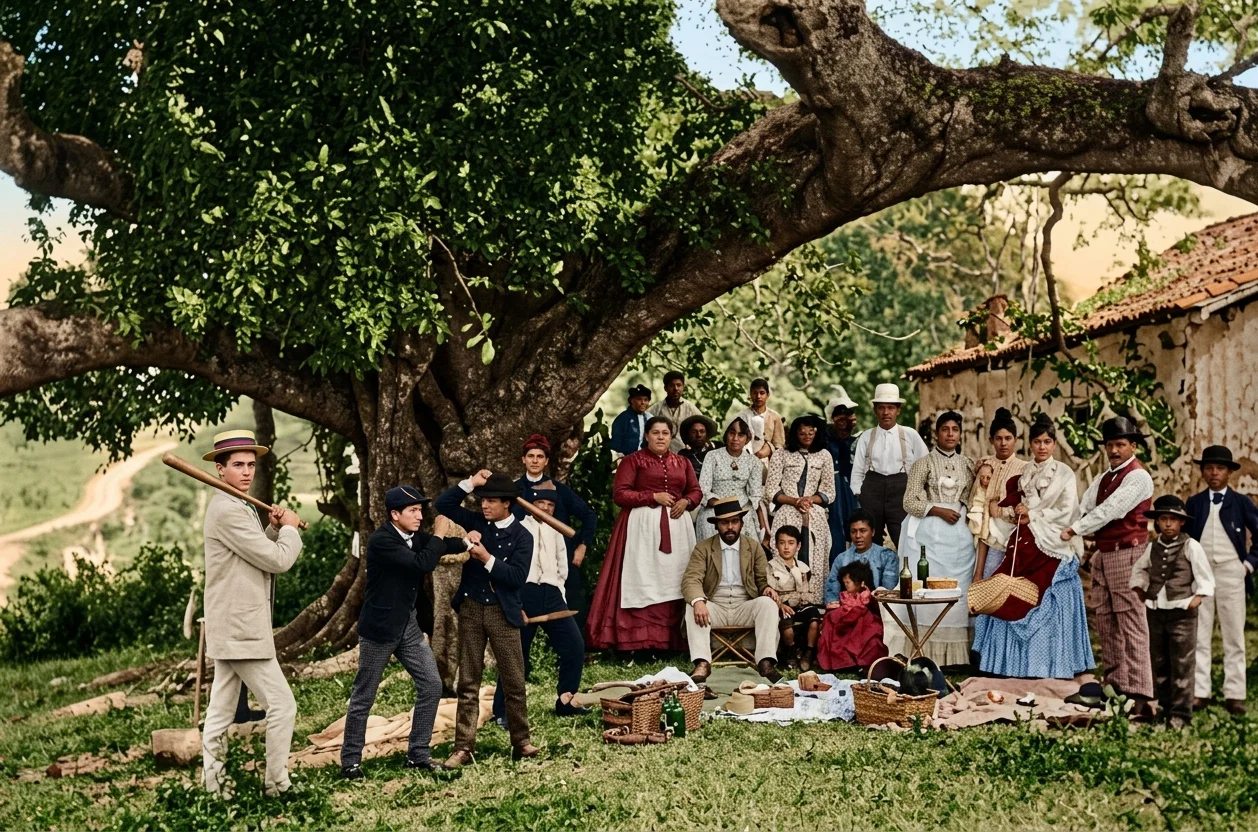
A BRAZILIAN PICNIC PARTY
Having previously received an invitation to come to Taquary, to attend a council of the conference committee in the early part of March, my stay here was necessarily short, and accordingly, Tuesday, February 21, Brother Hoelzle and I started for Castro, where we arrived safely on the twenty-third.
These trips on the table-lands, across the campos, have always been a pleasure to me. But the country is so thinly populated that at times in a whole day's ride of forty miles one meets only a few families.
The people in this country are, as a rule, bound in the chains of many vices and bad habits. But we can also see here the power of an uttermost-saving gospel; for as low as some of these people are found at times, the gospel, which is the power of God unto salvation, can save them as completely and as truly as it saves those who were more favored in life in their rearing and surroundings.
We are still of good courage, and thank the Lord for his grace that sustains us day by day.
A Visit to the Iberian Peninsula
By L. R. CONRADI
L. R. CONRADI
While I had visited almost every other country in Europe, it was not my privilege to see Spain and Portugal until last March. In order that I might be of greater assistance to our brethren in that field in counsel, I accepted their invitation to spend a short time with them, and left Hamburg March 9, stopping in Berlin, Friedensau, Basel, and Gland, and reaching Barcelona March 14. There was quite a difference in the snow-covered landscape of northern Germany and the blossoming almond-trees of the sunny south.
I was glad to find the home of Brother and Sister Robinson, who had been laboring faithfully in this field for about a year. While Spain has a population of nineteen million, only eight thousand of these are Protestants, whose faith has been tolerated by the Romanists for a very short time. Spanish history is very much like the history of other Catholic countries, and even to-day there are still many difficulties that stand in the way of the advancement of the pure gospel of Christ, unmixed by human traditions, unadulterated by man-made theories.
In the province of Cataluna, of which Barcelona is the chief city, they do not speak the real Spanish, but a dialect; however, this is the most progressive province in Spain, and commerce and industry flourish here. Barcelona, a city of five hundred and fifty thousand, is the chief commercial center of this part of Europe. After getting my bearings here, I took a direct route to Madrid, where I stopped two days—the sixteenth to the eighteenth.
En route to the Spanish capital, I found much rocky country. In many places in Spain one sees only the bare rocks, as in parts of Scandinavia. In general, the rivers do not contain much water, and where water is to be found, it is used for irrigating purposes, and the land that is supplied with sufficient moisture, seems to be very fruitful.
During the day the weather was very warm, but at night it was quite chilly; and as the ordinary cars are unheated, I was glad I had my good warm blanket with me. As a rule, the trains move slowly, and about fifteen or twenty miles an hour is as much as one can make.
While Madrid, the capital of Spain, has by no means a beautiful location, yet it contains some fine buildings. The city lies over two thousand feet high, and its climate is anything but favorable. The most interesting part of my visit at this place was the time I spent with the sons of Pastor Fliedner, who came here years ago from Germany to do missionary work. They had to be satisfied with very narrow, unhealthful quarters.14
Later the way opened for them to purchase, at a reasonable figure, some property outside of the city, not situated on a good road. Still later they purchased another property, and as the city desired a part of the first land for their water-works, the pastor was able to sell for a good price, so that he could pay for the property last purchased, and still have a few thousand dollars left. When he wanted to begin building, and the Spanish architects learned that he was a Protestant, they declared they would not put up an institution for a heretic. He secured a German architect, and then the cardinal of the papal legacy tried in every way to prevent his securing the necessary permission to build. Finally, the pastor succeeded, and there is now a beautiful college, where hundreds of young people are educated.
From the school one obtains a fine view of the whole city of Madrid. One can even see, away in the distance, the monastery Escorial. The terrible persecutor of Protestants, Philip the Second,
built this monastery among the mountains, as he desired a place where he might spend his life in retirement. It cost nearly three and one-half million dollars. The immense building forms a rectangle six hundred and eighty feet long, and five hundred and thirty feet wide, and the combined length of the corridors is said to be one hundred miles. While superintending the details of the construction of this remarkable structure, Philip lived in a small building near by, for a number of years; and strange as it may seem, that small building has since been converted into a Protestant orphanage, so that where once the power of the Spanish Inquisition was supreme, to-day the Holy Scriptures are being taught, and Protestantism is doing its deeds of mercy.
I enjoyed my visit with Mr. Fliedner, who is president of the college, and also with his brother, who is editor of several Spanish papers. He knew of our work, and was much interested in our literature. One of the great journalists of Spain, Senr. Echegaray, was celebrating his jubilee, and all the newspapers were filled with articles about it; but when Mr. Fliedner made use of this occasion to republish a speech the gentleman once made in the House of Representatives (1869) in favor of religious liberty he
had the greatest difficulty in securing permission for getting out a reprint of the document. I was glad to learn from Mr. Fliedner of the wonderful manner in which the eight thousand Protestants of Spain have been brought together; and surely if Protestantism, with only a part of the great truth for this time can gain such a foothold, we, with the message God has committed to us, ought certainly to gain a footing here.
Twenty hours on the slow train brought me from Madrid to Lisbon, where I found everything decorated for the reception of the queen of England. Immediately afterward, the German emperor also visited this place.
I was happy to find the home of our workers, Brother and Sister Rentfro, and enjoyed a few days' stay with them. Portugal has a population of five and one-half millions, and there are nine millions more in its colonies. Lisbon is widely known on account of its great earthquake in 1755. It is a hilly city, and in some places the streets are so steep they are climbed by the electric incline roads.
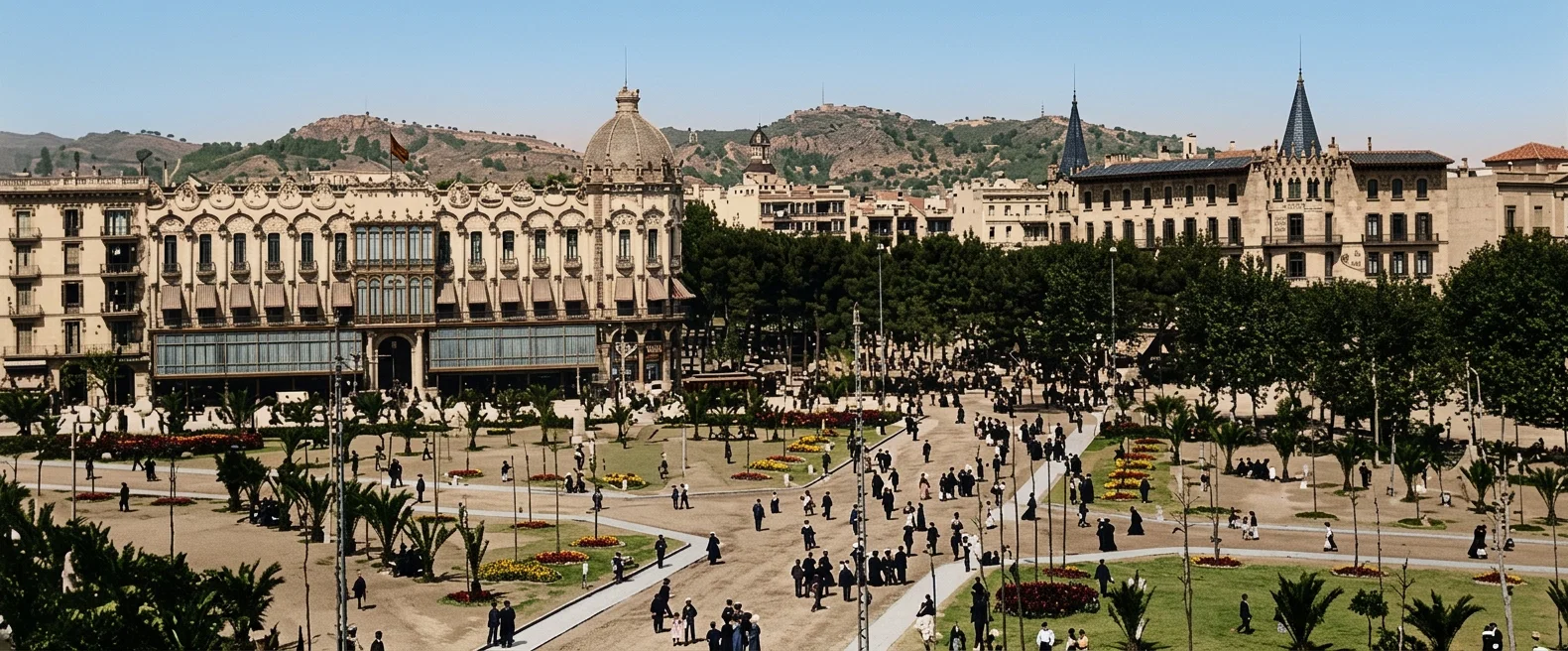
PLAZA CATALUÑA, BARCELONA, SPAIN
In all Portugal there are but five hundred Protestants, and many of these are foreigners. The circulation of periodicals is rather difficult, as such high customs must be paid when importing them. The next morning after my arrival, I visited the British Bible Society's headquarters, which are now in an old monastery. Where the monks once lived in their secluded cells, there are to-day large stacks of the precious Word of God dispensed from this place to all parts of Portugal and her colonies. The director of the society told me that one of his colporteurs living in the northern part of the country had his Bibles and other publications taken away by the authorities, and he was imprisoned. He was finally released, but they had to appeal to the government for the recovery of his books. I was glad to say that they were not the only ones who suffered for the truth of the gospel.
As Brother Rentfro must first acquire a knowledge of the Portuguese, we thought it best to advise that he get out of the hot city of Lisbon, into the cooler suburbs, where he could have better health, and just as easily learn the language. He has felt benefited by this change.
On the twenty-first I started homeward, going via Badajoz and Valencia, to Barcelona. I was two nights and three days on the cars. The region through which I passed was not very fertile, but as soon as I neared the coast at Valencia, the picture changed. Here I was in the midst of almost a paradise. The forests of orange-trees and palms, and the many mulberry-trees testifying of the silk culture, were a delight to the eye. There were also many fields of rice. The country has an oriental aspect, and the climate is singularly mild and dry. Sabbath, June 24, I spent with our small company at Sabadell, about twenty miles from Barcelona. Here is our first small church in Spain. Lately Brother Robinson had baptized two souls. There are now eight believers, mostly from among the Roman Catholic section of the community. They are happy in the Lord, and search his Word diligently. Two young people were anxious to go with me to our school at Gland, but as the young man was taken
sick, he could not come at the time, but will be at the school later. The sister is at Brother Vuilleumier's.
What we need in Spain and Portugal are some good colporteurs and Bible workers to sell our publications, thus assisting the ministry in their work. God promises to gather a people from every nation, and kindred, and tongue, and if we are faithful, we shall ere long see a number of groups and churches in these two dark lands. Let us remember the work in these fields, and liberally support it with our gifts, and pray the Lord of the harvest to send forth the necessary laborers to this great Iberian
Peninsula, with its twenty-three million souls.
Wadenswil, Switzerland, July 9.
The Call to Missionary Service
“THERE is nothing so fatal as disowned responsibility.”
“GOD does not call every one to go, neither does he call every one to stay, but he does call every one to a post of service in his kingdom.”
“A CENTURY ago men who were eager to obey Christ’s last command had to organize a missionary board among the home churches, before they could go. To-day the great missionary boards of America are searching constantly for capable men and women who are willing to go.”
A HEATHEN woman went to a missionary in India on the occasion of an anniversary of the mission children, and said: “Why did you not come sooner, that my little boy might have been here?” She explained that once she had a little boy whom she took into the jungle and slew before the missionary came. She represents millions who say, “Why did you not come sooner?”—
Texas
By H. B. FRENCH
SINCE my return from the General Conference I have been laboring in Houston County, in connection with Brother W. L. Brandon, near one of the largest lumber mills in east Texas. The report had already been published in the Baptist Standard that we would soon be at this place to sow it down with heresy; so when we arrived and applied for the union church, we were denied, notwithstanding the Adventists had donated to its building. Next we were refused the public school building, and the only showing we had left was to use an arbor which had been built by the Holiness people. And to further show the intolerant spirit prevailing, the shelter of brushes that shielded us from the scorching summer sun by day and the dew by night, was taken away and scattered about the grounds three days before our meeting closed.
But in spite of all the opposition, and still hunted by the so-called ministers of God, we found a few precious souls who were seeking and hungering for righteousness. God's promises were at least partially fulfilled to them. We hope soon to organize a church at this place.
We organized a church at Liberty Hill, Sabbath, July 22, with ten faithful souls to hold up the banner of truth.
As I read the REVIEW from week to week, and see the opposition arising to our work everywhere, it gives me faith and confidence that the Lord is soon to finish the work and cut it short in righteousness. Even so, Come, Lord Jesus, come. Pray for us.
H. B. FRENCH.
Burma
By H. H. VOTAW
INSEIN.—In my last letter I noticed only one of the tribes of Burma, the Burmese. These form the major portion of the population, but there are several other tribes to be found here; namely, Shans, Karens, Talanigs, Chins, and Kachins. It would perhaps be unadvisable to attempt to describe, even briefly, all of these tribes, but the history of one, the Karens, has proved most interesting to me.
During the days of Burman supremacy, the Karen fared badly, indeed. The Burman scorned him because he had no written language, and because he was a spirit worshiper. The proud and haughty Burman considered him fit only for a slave; he had no rights which the government recognized. If by chance he cultivated land in the fertile plains, his crops were confiscated, and if he resisted, his life was forfeited. This constant oppression drove the Karens into the hill country, where kindly nature provided some protection. Here among the friendly hills, they eked out a precarious existence, not caring to accumulate any store to tempt the avarice of the Burman, and thus invite an invasion into their retreat.
The Karen cleared and burned a side hill, planted his rice, and as soon as he had harvested his crop, moved to other quarters. The next year the same field was not tilled again, but another one was cleared. But, as it often happens, God had looked with great compassion upon this despised, mistreated people. Although wandering far from God in the dark night of demon worship, these Karens had retained in their hearts a knowledge of, and a belief in, the Supreme Being. They hold many traditions so akin to the Biblical account of creation, the fall, the flood, etc., that no one can doubt that at some remote time they knew Jehovah.
They further believed that, although they were under God's disapproval, he would remember them kindly, and send to them messengers with his whole truth. When the missionaries came, they found fruitful soil in the hearts of these simple, unsophisticated folk. While the pharisaical Burman clung tightly to his own righteousness, the Karens embraced Christ gladly. So general was the acceptance of Christianity by the Karens, that many writers have spoken of it as a 'nation in a day.' Thus, again, 'God hath chosen the weak things of the world to confound the things which are mighty; and base things of the world, and things which are despised, hath God chosen, yea, and things which are not, to bring to naught things that are.' Do I need to say more than this, 'We have no missionary to the Karens'? Will not some one say, 'Here am I; send me'?
The Karen language has been reduced to writing by the missionaries, and the Bible given to the people. But 'how shall they hear without a preacher? . . . How beautiful are the feet of them that preach the gospel of peace, and bring glad tidings of good things!' May God's Spirit stir the souls of those in the home land as it does ours who are face to face with the need.
H. H. VOTAW.
_The Work in Chicago_
By Wm. Covert
The meeting on the South Side, near Cottage Grove Avenue, closed last Sunday evening. It is said that there were about five hundred persons present at the last service. Six of these expressed their intention to keep the Sabbath from this time forward. Since the camp-meeting began in June, twenty-five persons have been baptized in the South Side church, and there are still others who will probably unite with us soon.
Elder L. H. Christian is conducting a series of meetings in the Danish language in a tent on Ohio and Center Avenues, and has a fair interest. The district where he is preaching has been worked in the past, and therefore the attendance is not so large as if it had been a new field.
Elder S. Mortensen is conducting a series of meetings in the Swedish language in a tent on the corner of Clark Street and Belmont Avenue, and he reports a very large attendance and a splendid interest. The tent is frequently full, and additional seats have to be supplied to accommodate the people. He hopes to raise up a church in connection with this series of meetings.
Elder Chas. Scholl is conducting a series of meetings in a tent, preaching in the German language, in the northern part of the city. I am not informed at this writing as to the interest that is manifest in the German meetings.
Elder Luther Warren was in charge of the English meetings held on the south side of the city, but it became necessary for him to take a rest, and Elder F. C. Gilbert took the place in the meetings that Elder Warren had been filling. An effort will be made to follow up the interest by holding Bible readings with the people, and by the meetings in a hall, and also in the Forty-sixth Street church.
Elder L. D. Santee and J. J. Irwin will now take charge of the tent that has been used by Elders Warren and Gilbert, which is being moved fifteen miles to the northwest, located near Ravenswood, still in the city of Chicago.
A school for training home missionary workers has been conducted this summer on Anthony Avenue, there being about twenty-five in attendance, and this training-school will be continued for a time. Elder Santee will have charge of it until Elder Warren can return. Elder M. P. Howe will probably connect with the tent work at Ravenswood for a short time.
It is certainly high time for this great city to have the message, and we are endeavoring, as best we can with the talent and facilities that we have at hand, to give this third angel's message to the people of this great city. We can see many omens for good, and therefore with courage proceed with the work.
WM. COVERT.
Report of the Northern Union Meetings
By R. A. Underwood
SINCE leaving Washington I have traveled more than six thousand miles in attending camp-meetings in South Dakota, Minnesota, North Dakota, Alberta, and Manitoba. I also spent one week at Leavings, Alberta, where we organized a church of twenty-five members.
Two other local camp-meetings have been held in the Northern Union Conference, which I could not attend. Nearly all of these meetings have been reported by others; however, I wish to speak of a few points in a general way.
These meetings have been occasions of great spiritual blessings. The Spirit of God accompanied the word spoken in power, and many precious souls were converted. One hundred and seventy were baptized at these meetings, and about forty have been baptized at their home churches since the camp-meetings. At all of these meetings a definite message was borne.
Another feature marked all of these meetings; namely, a spirit of unity and courage existed among laborers and believers generally. There was the utmost freedom in the discussions of methods to advance the work, and although different opinions were expressed, yet there was a spirit of fellowship and love that reminded one of the record in Acts 2:1. Liberal offerings were made to help the work at home and abroad.16
During these meetings Brethren P. A. Hanson, M. S. Reppe, E. W. Catlin, F. A. Detamore, and Henry Block were ordained to the gospel ministry.
The conferences have said to the Mission Board, “Select from our workers such laborers as you think best, and we will share our men and means with the fields beyond.”
The work in Northwest Canada has made progress the past year. Our camp-meetings in Alberta and Manitoba were about twice as large as one year ago. New churches are being added, and a good increase in tithes and offerings is seen. Our brethren, as well as the laborers, went from these meetings full of courage and hope for the future advancement of this cause.
At the close of the Alberta camp-meeting I spent two days at Edmonton, the capital of Alberta. This is the old trading station of the Hudson Bay Fur Company. It is over three hundred miles north of the south line of Alberta. Here in midsummer we have only about three hours of darkness in the night, the sun not going down till half-past nine or later in the evening. One might think this is as far north as people live, but it is far from the border of civilization on the north of Canada. Many people live to the north and west of Edmonton, to a distance of two thousand miles. This vast field has not been entered by one of our workers as yet.
Edmonton is as far north as our laborers have gone. Brother F. L. Hammel has started a small sanitarium there. He has made friends with many of the best people of the place, and has a good local patronage. Elders J. W. Boynton and Paul Curtis intend to pitch a tent in a good location in the city, and begin the first public effort in that place soon after the camp-meeting. We trust that our brethren will remember the servants of God in their effort at this important center of that great northwest field.
Brother J. S. James accompanied me to the meetings throughout my entire trip, laboring in the interest of the missionary canvassing work, with good results. Other laborers were with us at various meetings.
R. A. UNDERWOOD.
Sun River (Mont.) Camp-Meeting
By J. A. HOLBROOK
This meeting was held July 6-16. About sixty-seven of our people were camped on the ground, and they received much of the Lord's blessing.
As the searching truths for our time were presented, the Spirit did his appointed work of sending conviction to all hearts. Some were convicted of unfaithfulness in health reform, while others had been robbing God in tithes and offerings; but as confessions were made, the Lord gave freedom and joy where there had been condemnation.
The coming of Christ in this generation, also the necessity of a fully surrendered life in order to work for him and be ready when he comes, were themes dwelt upon throughout the meeting. All present seemed to receive these truths, and as a result much joy, peace, and fellowship were in the camp.
The outside interest seemed quite good, and several have already said they would keep the Sabbath. Fourteen were baptized during the meeting, ten of whom were young people from Sabbath-keeping families.
Elder and Mrs. Gosmer remained to continue the work for the outside people. They expect to be joined by Brother D. H. Hanson, of Missoula, in a few days, as Elder Iverson has already left the tent to prepare to go to Utah, his new field of labor.
J. A. HOLBROOK.
Central America
By H. C. Goodrich.
BELIZE, BRITISH HONDURAS.—The work in this field is sharply divided into two parts—English and Spanish. British Honduras and the Bay Islands are English. Nicaragua, Spanish Honduras, Salvador, and Guatemala are Spanish. In Guatemala there are a large number of Germans.
Here in Belize is a church of twenty-six members, only three of whom were here when I came; and the work is but just begun. A Bible worker would find this a good field. During the past winter, when I could not go up the rivers on account of the floods, nor across to the Bay Islands, owing to the storms, I worked here from house to house, holding studies with families. Eight were baptized as the result, and others are still interested who have not yet taken hold.
In Utilla, where we have three times, at great expense, located a teacher, there is now more interest to hear than I have ever seen before. I have just spent ten days of very hard work there. Three promised to keep the Sabbath, and one or two others are investigating. I preached each evening, and had one or two readings each day, besides visiting. While the majority rejected the light, some acknowledged it, and I yet expect to see some in Utilla accepting the message. They want a school. I have proposed to some of the merchants that they raise the amount sufficient to keep a teacher, and appoint a committee who would be responsible for the pay. I have left them to think of this. I think they will do it.
I hear that two families, and one member of a third, have begun the observance of the Sabbath at French Harbor, since I was there three months ago. I believe there is still a good harvest in that place. They, too, want a school, and propose to raise a fund for the support of the teacher.
The leader of the little company at Coxen Hole has been holding a few meetings on the north side, and there has come a call for more meetings there. Ruatan presents some good openings for work.
At Bonacca the church, the oldest and largest in this field, has greatly fallen off since we moved to Belize three years ago. But here also an excellent interest has sprung up. When I was there last, seven accepted the message. I expect to go again in a few days, God willing, and hope to see more obeying. This, with the calls coming from places up the various rivers in this colony, is all I could possibly do alone.
As to the work on the Spanish coast, I can not do better than to give our experiences. There are many negroes, and some Spaniards, who speak English, but most of the people are Spanish, and speak that language only, especially those back from the coast.
A brother and his wife at La Ceiba began keeping the Sabbath last October, from reading the “Prophecies of Jesus.” He has practised law, and has printed and edited a Spanish paper.
From Ceiba I went down to Porvenir, and found a colored man who has been a great gambler, who last January borrowed “Bible Readings,” and was converted, and kept the Sabbath alone. Through his efforts, a Spaniard and his wife have also received the message. While I was at Ceiba, a saloon-keeper, on his way home to Jamaica, had some Bible studies, and determined to give up his business, and keep the Sabbath. As I was talking to this man one day, a man who lives thirty miles up the coast came along, selling vegetables. I found he was troubled over the Sabbath question, having secured some papers from Bonacca. I sold him “Bible Text-Book,” and he went home promising to keep the Sabbath and start family prayers in his house. All of these except the man from Jamaica can speak Spanish.
Since coming home, I have read a letter from a man down in Nicaragua, who urges me to come to see him, and says there is an opening there. Mr. Allen is working there, and lives in Ceiba. He has a good start in the Spanish language, and has some interested ones there.
Lately in Utilla we have raised the money to buy a horse, which will be very necessary in going from place to place with books and Bibles.
We have in British Honduras one church at Belize, with one family each at Corozal, Sihan River, and Punta Gorda. In Spanish Honduras we have a company at Puerto Cortes, and Porvenir, and Ceiba, and a family each at San Pedro and Balfata. Utilla has a little church of seven members; Ruatan a little company at West End, also at Coxen Hole, and a church at French Harbor, numbering thirteen, which will soon be enlarged, also several families. The island is thirty miles long.
At Bonacca there are two churches—one with seventy members, which will no doubt be largely reduced, and the other with a membership of nine, which I hope to see increased. We can see the Lord is working on the hearts of the people here, and we will, by his grace, be workers together with him.