IN a Roman prison, a man, made prematurely old by persecution and incessant labor, is painfully and slowly writing a letter to a young friend whom he had been the means of “leading to Christ.” Before the young man are all the cares and anxieties incident to the pastoral oversight of many recently converted from paganism and still surrounded by all the luxuries and temptations of a heathen city. Before the aged prisoner there appears no earthly future. He anticipates almost momentarily the steady tramp and beckoning finger of the executioner, knowing that when he comes, there will be a short tramp outside the city gate, one blow of the flashing blade, and the things of time and sense will be no more.
Yet “Paul the aged” is filled with neither regret for the past, nor fear for the future. Looking back over his past life, and noting all the steps by which he has reached the present moment, counting well the price he has paid for his present position, he says three things concerning himself. “I have fought a good fight.” The severity of the struggle was only a fair price to pay for the joys of victory which now delighted his heart. “I have finished my course.” The great athlete, recalling the severity of the training and the strenuousness of the race, has passed the winning post a victor. “I have kept the faith.” Like a soldier on guard, by sleepless vigil and alert strength he has warded off all assaults of the enemy, and realizes that he has kept in all its integrity the treasure committed to his care.
As no regret mars the past, so no fear darkens the future. The victor’s triumph is his. The successful runner’s laurel will be placed upon his brow. The reward for duty faithfully done will be meted out to him. Looking into the future, he confidently declares: “Henceforth there is laid up for me a crown of righteousness, which the Lord, the righteous Judge, shall give me at that day: and not to me only, but unto all them also that love his appearing.”
This certainty as to the future must be purchased by faithfulness in the present. The one is the outcome of the other. We often hear the wish expressed that one might die the death of the righteous. This alone can be made certain by living the life of the righteous. The crown of righteousness is for the brave fighter, the strenuous runner, and the patient and faithful guardian of the faith.—Episcopal Recorder.
Insidious Habit
A YOUNG man had carelessly formed the habit of taking a glass of liquor every morning before breakfast. An older friend advised him to quit before the habit should grow too strong.
“O, there’s no danger; it’s a mere notion; I can quit any time,” replied the drinker.
“Suppose you try to-morrow morning,” suggested the friend.
“Very well; to please you I’ll do so, but I assure you there is no cause for alarm.” A week later the young man met his friend again.
“You are not looking well,” observed the latter. “Have you been ill?”
“Hardly,” replied the other one; “but I am trying to escape a dreadful danger; and I fear I shall be ill before I shall have conquered. My eyes were opened to an imminent peril when I gave you that promise a week ago. I thank you for your timely suggestion.”
“How did it affect you?” inquired the friend.
“The first trial utterly deprived me of appetite for food. I could eat no breakfast, and was nervous and trembling all day. I was alarmed when I realized how insidiously the habit had fastened on me, and resolved to turn square about and never touch another drop. The squaring off has pulled me down severely, but I am gaining, and I mean to keep the upper hand after this. Strong drink shall never catch me in his net again.”—Baltimore Advocate.
Our Children
By E. T. Russell
E. T. RUSSELL
Our children are a legacy from the Lord, and as such should be highly prized by us as parents, and also by the church. If we half appreciated the preciousness of the gift, like Hannah with Samuel, we would from their earliest infancy dedicate them to the Lord, and, like the mother of Moses, train them for his service.
Our children are talents which the Lord has entrusted to us; and he will hold us accountable for the use we make of the talents thus granted us. One thing is certain, he will not say “Well done” unto us if we misdirect their minds, and cause them to bury their talents in the earth. It is true that many parents are doing this, although they may not be conscious of the fact. They direct the minds of their children to the world by placing before them worldly inducements, and in their conversation they are continually dwelling on worldly things. Then they wonder why their children have so little interest in spiritual things. The children in their lives are reflecting the lives and teachings of their parents.
We desire eternal salvation for ourselves and for our children. This being so, why not be wise unto salvation? Why not instruct our children in the things of God? Why not talk to them of God's power and of his kingdom? Why not teach them that this world is nothing compared to the eternal world? Why not instruct them to form characters for heaven? Why not teach them that the work of the third angel's message is the grandest work in the world, and that they should fit themselves to become workers in this the grandest of all movements.
Greater pains should be taken by both parents and churches in the education of their children. There should ever be held before them the responsibility of becoming workers in some branch of the cause. O that we might manifest the same spirit of consecration as did the Waldenses when they dedicated their children for missionaries, well knowing that it meant hardships, trials, and possibly a martyr's death for them. In contrast to their spirit of self-sacrifice, there are many parents to-day professing this precious truth who would not for one moment consent to their children entering the work if they were so situated that they could spare them. O, shame on such parents! May God pity them! Some who are wealthy reason that they can not afford to send their children to our training schools because they must have their services. For what?—That they may make more money and buy more lands. Thus they and their children are fast becoming clusters of the vine of the earth, and not fruit of the heavenly kingdom.
As parents, as churches, and as conferences, let us see to it that our children receive an education for service. We should not be satisfied until we see our church schools, academies, and colleges well patronized by our children and our youth. Let us take special interest in this good work, that our young people may be trained for service.
Use Your Teeth
By L. A. S.
L. A. S.
ATTENTION is being called by the papers to some statements made at a recent convention of dentists at Asbury Park, N. J., regarding the deterioration of human teeth, which, at the present rate of progression, bids fair to result in a toothless race of human beings at a comparatively early date. One dentist declared that “predigested foods, toothpicks, and tobacco” have about ruined all the good teeth in the country. Another affirmed that the popularity of outdoor sports has been the only salvation of the teeth of children. A third speaker said that children are “insulted by a lot of stuff called food,” which was not worthy the name.
Certainly the teeth are capable of throwing considerable light on the question of the kind of food best adapted to the health of human beings, when common sense is exercised on the subject. Nature intended that man should eat food that must be chewed. Nature provided man with teeth; teeth can be kept sound and healthy only by exercise, like any other part of the body; and the exercise can be had only by chewing. Eating soft, mushy foods, or foods already ground fine, provides no exercise for the teeth. Something having a certain degree of hardness and necessitating the use of the teeth to prepare it for the action of the digestive fluids, is the thing required. And nature provides an abundance of such foods. Nature makes no mistakes, and has made none since time began, in the production of foods; for the operations of nature are only the working of the laws of God.13He who made man knew what to make for man's food.
A more simple diet; more eating of foods that must be chewed, and more thorough chewing of foods that are eaten, would work wonders for the health of many. Good sound teeth are a prime requisite to health. Use your teeth.
Say No
DARE to say “No” when you’re tempted to drink,
Pause for a moment, my brave boy, and think,
Think of the wrecks upon life’s ocean tossed
For answering “Yes” without counting the cost.
Think of the mother who bore you in pain,
Think of the tears that will fall like rain;
Think of the heart, and how cruel the blow,
Think of her love, and at once answer “No;”
Think of the hopes that are drowned in the bowl,
Think of the danger to body and soul,
Think of sad lives once as pure as the snow;
Look at them now, and at once answer “No!”
Think of manhood with rum-tainted breath,
Think of its end and the terrible death,
Think of home that now shadowed with woe,
Might have been heaven, had the answer been “No!”
Think of the lone graves, both unwept and unknown,
Hiding fond hopes that were fair as your own;
Think of proud forms, now forever laid low,
That might still be here had they learned to say “No!”
Think of the demon that lurks in the bowl,
Driving to ruin both body and soul,
Think of all this as life’s journey you go,
And when you’re assailed by the tempter, say “No!”
— Selected.
Humanity and Diet
By Ernest Bell
MANY persons are shocked at the cruelties involved in the fattening and slaughtering of cattle, pigs, and poultry for the production of meat, and would like to be vegetarians, at any rate in as far as abstinence from butchers' meat is concerned, but they do not know how to begin. They have grown up in the belief that meat is necessary to health, and foresee great difficulties where, in fact, none exist. The chief difficulty in becoming a vegetarian is in reality one of mind rather than body. The first essential is to have the wish. If there is a real wish, all supposed obstacles may easily be overcome; while on the other hand, if there is only a passing fancy, a score of reasons for giving up the experiment will soon be found.
Let us assume that some of our readers really wish to live without meat, and are willing to make some slight sacrifice in order to do so; the second important part is that they should have the belief that they can do so. In this, as in other matters, those who have no doubt have also no difficulty, while those who are timid and nervous see and feel difficulties at every turn, and never succeed.
A great step is gained if you can only realize that in giving up meat you are not doing anything at all extraordinary. Most of us must have known cases of cats and dogs, animals purely carnivorous by nature, that have learned to live in perfect health on a diet with no meat in it. How much more, then, should we, who have never been wholly carnivorous, be able to live healthfully without meat? The greatest meat eater is, after all, already more than half a vegetarian.
Many millions of people—some say more than half the population of the world—are at the present time living without meat in their diet, no less healthfully and happily than others. Until a few years ago, both in England and on the Continent, the classes who have done the hard work for the community have lived almost without flesh food except perhaps once a week, at the Sunday dinner. All the animals which supply mankind with sustained power—the elephant, camel, reindeer, ox, and horse—are purely vegetarians. Some of the greatest intellects the world has seen, have, at any rate for part of their lives, been vegetarians, as Plato, Newton, Shelley. The victims of the sweaters' den, with sixteen hours' work a day, and not much more than half that number of shillings a week, can afford no meat, but carry on their grinding work for years before they succumb. In face of these facts it is simply ridiculous to assert that our bodies can not be nourished without the sacrifice of animal life.
Looking at the workers of the world, we might almost say that the necessity for animal food and the amount consumed is in direct proportion—not to the work done, but to the leisure and idleness of those who suffer from this supposed necessity. When we are told, as we often are, that “it may suit some people, but I am sure it would not suit me,” we know that unfortunately this is quite true; but it is not the body that presents any difficulty, but the mind that is at fault—often, it is to be feared, hopelessly so.
If, then, the reader really wishes to abstain from meat, and also realizes that he can perfectly well do so if he likes, a very few practical hints will suffice to start him on his way. If his faith is strong, he will merely give up the meat and eat the other things.
A good deal of nonsense is talked about people being unable to change after they have attained middle age. There might be truth in this in the case of purely carnivorous animals, but with creatures frugivorous by nature, and always more or less vegetarian by habit, the change can be made at any time if the mind is in it.
That some people can not digest or assimilate some vegetarian foods is obvious, but if that is an argument against the bloodless diet, then the fact that some meat eaters can take mutton but can not digest beef or pork is also an argument against all meat eating. There is ample variety in the vegetable world to suit all constitutions and all well-trained palates.
It may be well to bear in mind,—
1. That most people eat more than is necessary for, or conducive to, health and strength.
2. That in their fear lest they should starve, many would-be vegetarians make themselves ill by taking too much of the more stimulating foods, such as peas, beans, lentils, nuts, and grains.
3. That fruits are not merely adjuncts to substantial food, but are themselves substantial articles of diet. It is quite possible to sustain healthy life solely on some fruits.
4. That the 'craving' for meat, like the craving for drink, is not an indication of the necessity for it. It is a morbid condition of mind and body, mainly the former, and will pass off under healthier conditions if the will is exercised as it should be in the matter.—Ernest Bell, in the Animals' Friend.
Sickness Barred
KEEP your vitality above the negative condition, and you will never know disease of any kind. No disease can exist where there is an abundance of pure blood. To get the necessary amount eat nutritious food; to circulate it perfectly take proper exercise; to purify it get fresh air and sunlight. If a perfectly healthy condition of the skin exists, and an even temperature of the surface of the body is maintained, it is impossible to catch cold. Cold-water baths taken every day will do much toward producing the former, proper food and exercise the latter. Nature gives you an alarm in the first chilly feeling. Heed it at once, or pay the penalty. Take a brisk walk or run, breathe deeply, and keep the mouth closed.—Selected.
What Foreign Countries Send Us
Most persons would regard as dullness concentrated the tables of “exports declared for the United States” from the various cities of the world, as compiled from the statistics of our consuls. They are but solid pages of figures. Yet in reality they tell many an interesting story of the currents of the world’s commerce. Important towns are associated quite as often in our minds with some distinguishing product as with historical events or political prominence.
Brussels suggests carpets, yet in ten years past Belgium has not exported to this country a thousand dollars’ worth of carpets. We get from that country plate glass, cement, linens, and laces in large quantities. Jamaica gives us some ginger, but a great deal more in value of bananas and sugar. Cologne sends us some cologne water, but forty times as many dollars’ worth of mineral water.
From Rome, the very name of which suggests art and literature, nearly one half of the imports is cheese; the rest is made up of the artistic things which we should expect. Athens, her older neighbor, exports to us but little, mostly iron ore. The other Greek cities sell us currants. Jerusalem leads in religious articles made of mother-of-pearl.
Genoa, the birthplace of Columbus, finds a market for olive oil in the land he discovered. Raw silks lead in Milan. Horsehides are among the great exports of Moscow. Clay pipes and lace are the peculiar combination which Calais submits. Antiquities and gum figure high in Cairo’s list; firecrackers, in that of Canton and other Chinese ports. Little but gold comes from Dawson City, coffee from Rio de Janeiro, kauri-gum from Auckland, or rabbit skins from Hobart, in Tasmania. Human hair comes in small quantities from nearly all lands, European and Asiatic.
The products of a country not only show its natural resources, but reveal much as to the skill and intelligence of its people. Many an export—like cotton, opium, sugar—has played a large part in the politics and history of the world.—Youth’s Companion.
Small Ways of Rejoicing
“There's never a rose in all the world
But makes some green spray
sweeter;
There's never a wind in all the sky
But makes some bird wing fleeter;
There's never a star but brings to
heaven
Some silver radiance tender;
And never a rosy cloud but helps
To crown the sunset splendor;
No robin but may thrill some heart,
His dawn, like gladness voicing;
God gives us all some small, sweet way
To set the world rejoicing.”
An Eastern Polynesian Gathering
By MRS. B. J. CADY
MRS. B. J. CADY
WE have just enjoyed the privilege at Papeete, Tahiti, of having most of our workers in this and adjacent groups associated for a time in meeting and counsel. Brother Gates, the superintendent of the Polynesian work, was with us for two weeks and a half, as he passed through this place on his way home to Australia from the General Conference. Taken as a whole, we were not a large company, for we were able to house all who came from abroad, with the exception of the Pitcairn brethren, who thought best to stay on their cutter, which was lying in the harbor, and then our family numbered only fifteen. But though we were but few in number, the Lord was with us, and we received much of his blessing, and we trust that the results of this meeting will be seen in more efficient and faithful work during the year to come.
As is probably known, communication between the islands is not very rapid, and it often takes months to get an answer from a neighboring island. In this case, we can see the providence of God, and that his Spirit directed the workers coming from different parts, so that all came together about the same time.
From Papeete, we had sent out word to Brother Gates in the United States, to Brother Piper in Rarotonga, and to Brother McCoy and Brother and Sister Jones on Mangareva, that we hoped to have the meeting in May; but we were not certain that any of them would come. So it was surely the will of God that we should meet together to counsel and lay plans for more aggressive work; for he brought us all together at just the right time.
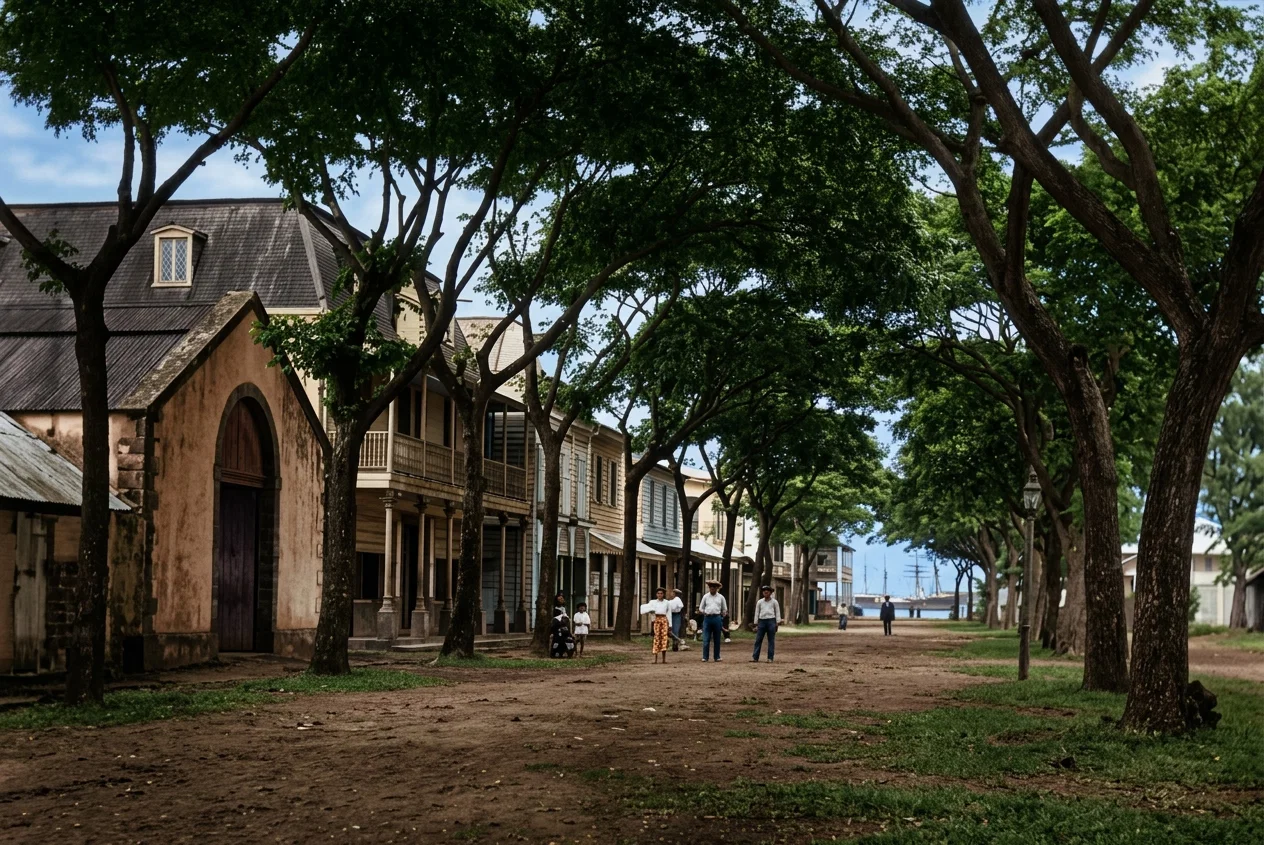
STREET SCENE IN PAPEETE, TAHITI
Brother Piper and a native family from Rarotonga came a little early, and as it was necessary for Mr. Cady to go to Raiatea to help put up a new copra drier in place of the one that was burned, and also to erect buildings for a sugar mill, Brother Piper was invited to go to Raiatea and spend a few days on our industrial farm, which he did.
The day after Brother Gates’s arrival from California, Mr. Cady, Brother Piper and his company, Sister Nelson, and three of our young people came from Raiatea; and five days after that we were happy to welcome the little cutter “Pitcairn,” with Brother and Sister Jones, Brother McCoy, and six other Pitcairn islanders on board. We felt that the Lord not only taught them when to come, but he also gave them favorable winds, so that they could get here in time for the meeting.
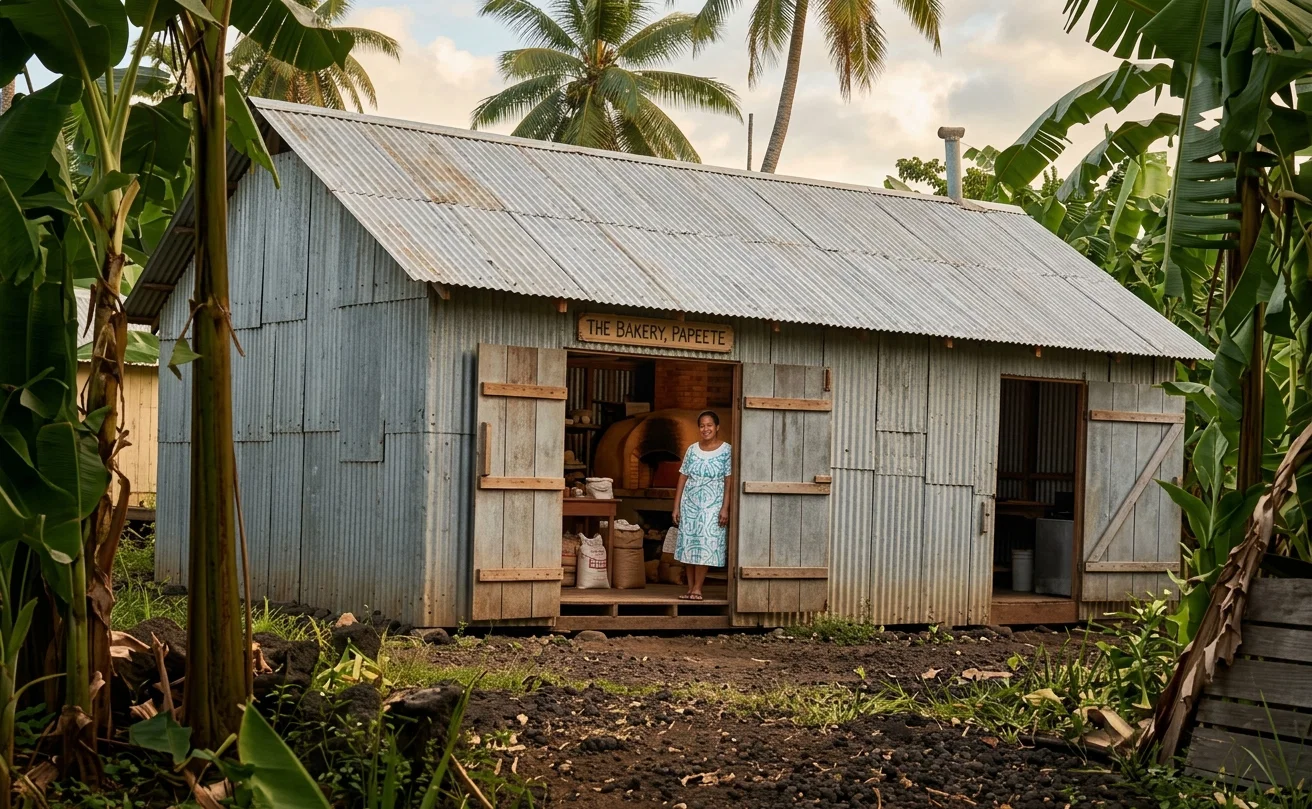
THE BAKERY, PAPEETE
This was quite a busy time for all of us. Before Mr. Cady went to Raiatea, he had been helping our native brethren in the district of Paea to build a little church, and they wished to have it dedicated at this time. But it was not ready, as nothing had been done on it since Mr. Cady went away, so our brethren went over and helped them finish it; then the next week we all went, and it was dedicated to the Lord, free of debt, except a small sum for the lamps, which will soon be paid. We all felt to rejoice with our Paea brethren in that they have such a neat little house in which to worship the Lord. It has been several years since they began to collect money for this church. Perhaps some of our friends who came out on the “Pitcairn” in 1896 will remember making a donation toward this same church. But if you knew how long it generally takes the natives to build a church, you would know that our brethren have done exceptionally well. They have a membership of only ten, so there were not many of them to help.
In several places the natives of the Presbyterian Church have no regular church building, but have met in roughly built sheds for years, while they are collecting money to put up a very nice building. In a certain district on the island of Tahiti, where the membership must number in the hundreds, the foundation for their church was laid, and a large tree grew up inside of it before they were ready to go on with their building, which is still unfinished.
While our workers were together here in Papeete, we had meetings nearly every evening from six to nine o’clock, and as much time as possible during the day was spent in counseling and laying plans.
A union was formed, which is called the Eastern Polynesian Union Mission. It includes the Society and Cook Islands, Pitcairn Island, the Austral, Paumotu, Marquesas, and Gambier Groups, and other isolated islands which may be found in this part of Polynesia. The representatives present from the various fields were heartily in favor of uniting our forces, and we believe that we have come to the time when such an organization is needed. It is not only a union in name, but because of a better understanding of one another and of the needs of the different parts of the field, it is a heart union also, and we take up our appointed work with new courage and determination.15
Brother and Sister Jones have been working at Mangareva; and as a result, one intelligent white man has fully accepted the truth, and is awaiting baptism, and others were deeply interested when they left there. Brother Jones was ordained at this meeting, so he will feel free to administer the ordinance of baptism upon his return to that island. Mangareva is about twelve hundred miles from Tahiti, which is a long distance to go in a small boat. The new “Pitcairn” left a few days ago with fifteen persons on board, including Brother and Sister Jones, who felt anxious to return to their work on Mangareva. After finishing their work there, they are to return to Tahiti, and then go to Rarotonga to relieve Brother and Sister Piper. As Brother Piper’s health is seriously impaired, it is thought best for him to return to New Zealand, where he will probably labor with the Maoris. We sincerely hope that in that climate he may regain his former good health.
Brother L. A. Roth was advised to give up work in the bakery, and to devote his time to evangelical work for the French people, so two of our island boys are looking after the work in the bakery, and Sister Laura Young is clerking in the store. Lydia Parker is to take up Bible and general missionary work. Our aim is to educate our young people for service, and then bring them into the work as far as possible.
Brother Paul Deane was recommended to go to the island of Huaheine as soon as convenient, and present the truth there. The church of which he has been elder ever since its organization will miss him, but we trust that this move will be for their good, and that as they have to stand alone, they will learn to look more to the Lord for help, and be more vigilant and watchful.
We decided to ask the Australasian Union Conference to print a small book on the prophecies of Daniel and the Revelation in the Rarotongan language for the Cook Islands, and also the book “Christ Our Saviour” in the Tahitian language, which is extensively used in most of the islands included in this organization.
At this writing, our laborers have all gone out to their respective fields, feeling that time is short, and there is much to be done. Now is the time for labor; and if we do faithful service, we shall soon have the precious privilege of entering the kingdom of God, bringing our sheaves with us.
Oncken’s Missionary Work
ONCKEN was a servant, bookseller, and tract distributor. With six others he organized a church in a shoe shop. He went forth visiting every part of Germany, scattering Bibles and tracts, and gathering converts into churches. In twenty-five years this was the result of his work: 65 churches and 750 stations, from 8,000 to 10,000 members, 120 ministers and Bible readers, Bibles and tracts scattered by the million, and 50,000,000 had heard the gospel. Give us two hundred and fifty such men as Oncken, and in a quarter of a century we can not only organize sixteen thousand churches, with two million five hundred thousand members, but may preach the gospel to every soul on earth.—Selected.
Quaint Wells of India
By N. Alma Courtright
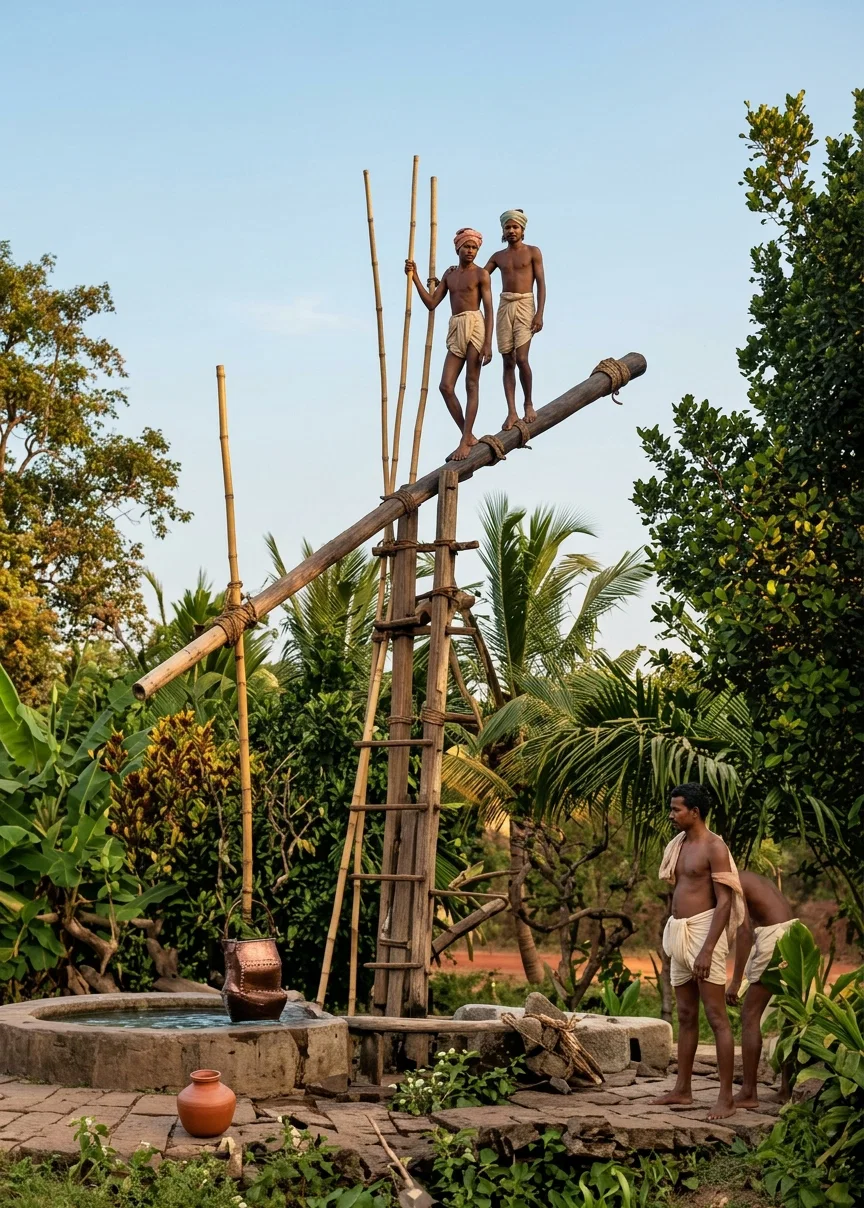
The wells of India are all built alike. They have a large, circular, open top, measuring about ten feet in diameter, and a substantial curbing four feet in height, made of cemented stones, plastered and white-washed. Just outside the walls are upright ladders, the rungs of which are built between posts planted firmly in the ground, and rising skyward fifteen or more feet.
A large bore has been made through a beam of the size and shape of a telegraph pole, at about its center. This pole is suspended by thrusting the top ladder rung through the hole. On the heavy end a large stone is securely bound. On the small end a long, thick, bamboo pole is affixed—parallel to the ladder, and at right angles to the telegraph pole. A huge kettle, made of narrow strips of copper riveted together, hangs from the bamboo. Lashed to each side of the upright ladder are lighter bamboo rods, which rise some distance above the top rung.
To draw the water, two men (coolies) climb the ladder, and tread the telegraph beam, nimbly balancing themselves by curling supple bare feet about the edges. They walk forward to drop the kettle into the well, and then scamper to grasp the tall rods, which are fastened above the ladder sides, and hold on to these until they are safely past the center. Then backward these agile men go until the stone-weighted end raises the dripping bucket.
A third man stands outside the curbing to empty the pail, and to force the emptied vessel back for another filling. During the entire operation all three coolies invariably chant a weird melody to the time of the measured movements.
These wells are fed by underground springs, and are built in paddy (rice) fields, cocoanut and plantation (banana) groves, etc., for irrigating purposes, and by the waysides for the convenience of passers-by.
One of these quaint wells is found just outside the fence of the botanical garden, at the edge of the broad, red-earthed highway, under shady trees. The Damodar School for Farialis is just across the street. The drinking water for the school children is brought from this particular well; and between school sessions the children themselves go to slake their thirst in the cool water.
Fancy my astonishment one day to see four men using this well as a bathing pool. Indignantly I called the head master of the school, and demanded that he stop these public seekers after cleanliness, as I did not understand the Tamil vernacular.
A NATIVE WELL
The head master kept an alert eye on my face, and tried to see whether the outward expression and gestures would afford him a clue to my spoken words. He was supposedly acquainted with the English language, yet here, evidently, was an unusual combination of words. He quite clearly understood that these men, who now came before us, had but just emerged from the well. They desired a bath; why not take one? What harm could there be in these coolies taking a plunge in a well so long as the well was not on Brahman (pertaining to the highest caste) territory?
My protestation met with blank ignorance; it was void of all meaning to these wondering natives.
In despair I looked about me for assistance of some sort; I was reluctant to part with my audience until they were duly impressed with the enormity of their offense. My eye caught sight of several long strips of white muslin, which had also been washed in the well, and then spread in the sun to dry.
The head master, who was still keeping a watchful eye on my face, saw me looking at the laundry, and immediately decided that he now understood the sense of my argument. He had suddenly remembered that the English-speaking people commonly dislike seeing the undraped human form divine. He gave a sharp command in Tamil, and presto! the four dark figures sped lithely away, snatched the almost dry muslin, and draped themselves on the way, as they16returned with broad smiles, confident of approval.
I forced an appearance of sternness, and once more tried to focus my objections. My point was the fact that from this well came, not only drinking water for our school children, but also for the entire population from the low, native village near by. This much was very clear, but again it threw not the faintest light on my opposition to the use of the well for personal cleanliness.
As I talked, the dazed coolies would occasionally give a smart toss of the head—done by jerking the chin to the right, which throws the top of the head to the left,—a peculiarly Indian custom, I believe, of giving assent.
Now and again our group received additions from the stream of passing villagers. They, too, joined in trying to see my point, but after a time, instead, saw the point—rather the nine points—on the other side presented by a wayfarer, to the effect that here in the East it is the custom to bathe, to wash clothes, and to drink from the selfsame well when the tanks or fountains are not near.
While bound to accept the situation with what calmness I could muster, you may rest assured the question of ways and means of performing similar functions on home ground was minutely enquired into at the earliest possible moment.—N. Alma Courtright, in The Union Signal.