IS man by nature mortal or immortal? Has he within him an immortal, indestructible principle, which survives the stroke of death and lives forever? This is one of the greatest questions of modern theology. For centuries sermons and eloquent orations have been delivered by doctors of divinity, intending to prove that man possesses a deathless spirit. Devout and pious writers of repute have written learnedly, and sought to prove that the soul is immortal. Poets have written about it, and congregations in all lands have it in their hymns, and have sung it through the centuries.
Man can never settle this question and solve the mysteries of life by mental reasoning. He can explore the heaven, and explain many of its mysteries; he can study the forces of nature, and gather from it many of its secrets; he can overturn empires, and blot out dynasties; he can make great achievements in science, and startle the world with his inventive genius and explorations; he can study the rocks, and divine, to some extent, the history of the globe; but he is utterly unable to solve the problem of his own existence, or determine his future.
In his most mature state intellectually, unaided by divine revelation, he stands dumb before the question of what lies beyond this life. And he has scarcely arrived at his maturity ere his strength wanes, and he is compelled to submit to the power of death. He perishes like the grass. The place of his fondest hopes and activities knows him no more. With millions of others of his fellow creatures, he lies down in the dust, and the portals of the tomb close about him. And from beyond the curtain which divides the present from the future none have ever returned with tidings of what lies hidden there.
The human mind is bound to reflect; and thoughtful men have asked through the centuries, "What is this mysterious doom of death which overshadows all?" Does death end all? Is man, who has existed a brief span in the midst of an eternity, to live again? Does he, as much of orthodox theology tells us, possess an immortal soul that can not die, but lives beyond what we term death, either in the realm of bliss or in the confines of despair?
Why should we conclude that man is immortal? No results of physical inquiry are favorable to such a conclusion. When we look at the question through the lens of scientific investigation, we find nothing that confirms the claim that man possesses inherent immortality, or a deathless spirit.
"The processes of development, nutrition, and decay, are identical for animals and for mankind. The faculty, whether of body or brain, gradually developed, as gradually wastes away. What ground for the confident assertion of a perishable life in the one case, of a deathless being in the other? Rather is it not evident that all through the lower world mind is but one of the manifold energies of life, and that life, whatever its essence, dissolves with the organization? Science knows nothing, affirms nothing, respecting substance or essence. It affirms nothing respecting metaphysical annihilation of the material out of which organisms are built. It declares simply that man and the animals belong to one system of life. They are brought into being under one law. And there is no material or positive evidence of the concrete survival of any portion of the one series of organisms more than of the other. Any expectation of the survival of the vital force of man in death must then be founded on something that is not science. . . ."
"But even if the repeated creation of species be admitted as a hypothesis, it is further argued that the case of man is not materially improved. Here are nearly a million of species on the earth. Man at the head of them appears, in his barbarous and savage state, superior to them, indeed, but not so superior as to suggest either to himself in that state, or to us, the idea of a wholly different nature. Why should 999,999 species of living creatures be voted mortal and perishable, and the millionth declared to be immortal as to the animating principle, just because he sometimes wishes to maintain a continued existence? Perhaps the higher animals wish it too. How know we that the thinking principle can survive the breaking up of the organization in the one species, when it is dissipated in the cases of the 999,999? . . . Since the production of mental and voluntary power in men and animals is subject to precisely the same laws, why should it be held that the dissolution of the brain is attended by such marvelously different results as these,—in the case of all other species to bring the individuality to an end, in the case of man to set free the animating force for a life immortal?"698—"Life in Christ," pages 7-9.
Apart from a divine revelation, there is no satisfying solution to the problem of our existence and the life beyond the grave. But the omniscient God has given us a revelation that answers all these queries, and settles forever the question whether the soul of man is mortal or immortal. Our appeal therefore is to the inspired Scriptures, which reveal the origin of man, how and by whom made, and the future that awaits him.
Does then the Bible teach that the human race is possessed of natural immortality? "There's the rub!" It surely does not, but teaches, instead, that eternal life is obtained through faith, the direct gift of God through Jesus Christ. The teaching of the Scriptures is well stated by the Rev. Samuel Minton in the following terse language:
"Scripture is silent on man's necessary immortality. It is trumpet-tongued on the other side. From beginning to end, it positively labors to impress upon man that he is not immortal, indestructible, but a dying, perishing creature, who, if he desires to inherit eternal life, must accept it as the free gift of God in Christ, and seek for it by patient continuance in well-doing. The alternatives of life and death, immortality and destruction, are incessantly put before us in every shape and form. Dogmatic assertions, warnings, promises, arguments, illustrations, and necessary inferences, are massed together in such a way that it might have been thought impossible for any human being to misunderstand them. The very object of Christ's death is again and again declared to be, 'that whosoever believeth in Him should not perish, but have everlasting life'; yet Scripture, we are told, presupposes that man is absolutely imperishable, and must spend an everlasting life of some kind, whether he believes or not. It teaches that 'whosoever doeth the will of God abideth forever'; but presupposes that every one must abide forever 'either in weal or wo.' It teaches that 'if any man eat of this bread, he shall live forever'; but presupposes that every man must live forever, whether he eat of it or not,—presupposes that 'unutterably solemn fact that each one of us in this cathedral must live on forever and ever.' It teaches that 'the wages of sin is death'; but presupposes that man's spirit is essentially deathless, and that his body, having been raised from its first temporary death, can incur no second death, but must 'live eternally on in weal or in wo.' It teaches that the 'end' of impenitent sinners 'is destruction,' even 'everlasting destruction'; that 'like natural brute beasts, made to be taken and destroyed,' they 'will utterly perish in their own corruption'; that they will be 'cast forth as a branch and withered, . . . cast into the fire and burned,—burned up like 'chaff' without unquenchable fire; that 'a fiery indignation' will 'devour' them; that they 'shall be cut off,' and 'shall not be'; that 'into smoke they shall consume away.'"
A WORD TO OUR READERS
By Editor
We send no papers from this office to individuals without pay in advance. When persons receive copies without ordering them, they are sent by other parties, and we can give no information in regard to them. Persons thus receiving copies of the SIGNS are not indebted to the office, and will not be called upon to pay for them. Please read the papers you may receive, and hand them to your friends to read.
DATE OF EXPIRATION
The SIGNS wrapper bears date of last issue due on your subscription. Unless renewed in advance, paper stops with expiration date.
If herewith is an order-blank, you will know you have overlooked sending renewal. You will not wish to miss a single issue. Back numbers often can not be furnished.
SCRIPTURE QUOTATIONS
Our authority for the doctrines we teach is the Bible. Quotations are usually from the King James Version or the American Standard Revised.
The Benefits of Prohibition
KANSAS has had a prohibitory liquor law for years, and a great deal has been said in regard to being able to buy liquors anywhere in the state; and therefore the conclusion some reach, that prohibition is of no avail. Nevertheless the report is that there are half a million boys in Kansas over school age who never saw a saloon. Eighty of the 105 counties of the state have not a single inmate in the poorhouses. There are sixty-one counties without any one in jail. There are seventeen counties without any jails at all; and eighty-seven counties last year did not send an inmate to the insane asylum. The state has about nine hundred newspapers that will not take a liquor advertisement, and the ratio of illiteracy is the lowest of any state in the Union. Facts of this character ought to overthrow readily all the statements that are made in regard to the failure of prohibition. If prohibition could be enforced throughout the United States, and for that matter, throughout the world, it would be only a question of a little time before insanity and crime would be reduced to the minimum.
God's Estimate of Man
By John Orcutt Corliss
THE great problem of human value and permanence can not be properly estimated by comparison with earth's unstable environments. After studying the permanency of heavenly bodies—the moon and stars especially—and the unerring accuracy of their appointed service, the psalmist raised the question of puny man's relation to all this handiwork of the great God, whose eternity of being and purpose he could not accommodate to prevailing conditions. While yet acknowledging man's original glory, and consecration to earthly dominion, he saw also that the mission assigned him, as God's earthly counterpart, had signally failed; and the unsolved problem to him was, how God could still be mindful enough of such a gross delinquent, as actually to visit and hold communion with him. Ps. 8: 3-6.
This was, in so early an age, a part of that wondrous mystery "which from the beginning of the world hath been hid in God" (Eph. 3: 9), and was therefore kept by Him a profound secret, to be revealed only through the preaching of Jesus Christ as the Son of the living God. Rom. 16: 25, 26. By this God-given standard, the great apostle undertook the unfolding of that glorious mystery which had been given him through heavenly vision. Eph. 3: 3; 2 Cor. 12: 1-4. Thus after quoting the perplexing question asked by the Hebrew king, and citing his admission of man's primary substance and kingly exaltation, he added the significant statement: "We see not yet all things put under him. But we see Jesus, who was made a little lower than the angels for the suffering of death, crowned with glory and honor [that is, He took man's original nature and position, for the identical test to which man had been submitted]; that He by the grace of God should taste death for every man." Heb. 2: 6-9.
The story unfolded in this chapter is, that since man failed to endure the proof of loyalty, God clothed His own faultless Son in fleshly garb (verses 16-18), and that, too, after ages of sin had so contaminated the world's flesh as to make it a veritable nest of iniquity (Rom. 8: 3), and thus permitted Him to be tempted in all ways that the wickedness of that fleshly age might suggest. Heb. 4: 15. But after enduring every earthly trial unscathed, and thus fighting successfully for the man the battle so ingloriously lost, He went yet further, and essayed to remove the stigma of death attached to the original failure, in order that every victim of the fall might live, if he so wills. Had Christ failed in any particular in His life-work, His death would have gone for naught in man's behalf, because then He too would have justly merited death on His own account, the same as those whose Example and Saviour He had attempted to be.
The fact that the only-begotten Son of the Eternal was freely put in the balance in man's interest, indicates, as far as possible to human reason, the estimation of mankind in the scales of heaven. There must therefore be some eminent reason for placing this infinite price on a mere creature. No other being aside from man is known to maintain so high a standing. We may then well ask, with the psalmist, What is man, that God is so mindful of him as to visit him through the infinite sacrifice of His only-begotten Son?
The story of creation must largely answer this query. Referring to man's beginning, we learn that though he was taken out of the earth, he was molded into the image of his Maker, and then endowed with the life of Omnipotence. If there can be anything in design to foreshadow destiny, it must be plain that man was at least made capable of eternal endurance. To insure this desirable result, it was therefore necessary that the creature should maintain in his conduct the conferred likeness of Him who alone could continue its accompanying life.
It seems very evident, since life was bestowed for the single purpose of maintaining the image of the invisible God amid earth's creation, that when that image should cease to be in evidence, the life by which it was to be supported could no longer be justly continued. Accordingly the man was duly warned that to disobey the voice of his Maker would mar the perfect image in which he was made, and deprive him of the heavenly life that had been so graciously bestowed upon him. These are the words to that effect: "In the day that thou eatest thereof thou shalt surely die." Gen. 2: 17.
No one can fairly say that God, who granted the original life on limited conditions, had no power nor right to withdraw His gift when the terms of the gift of life were ignored. The life was His absolutely, and He had conferred its benefits on the man with distinct understanding that in the day of disobedience, that life would be entirely forfeited to its legitimate Proprietor. There was, indeed, a specific reason, apart from man's loss of his original glory, why Jehovah could not consistently continue His own vitality in one whose time was wholly given to the service of Heaven's most ardent foe. Man having received dominion over the earthly creation as God's acknowledged representative of heavenly mastership, God's moral soundness would have been sacrificed had He not withdrawn from fallen man His own life support.
But God's infinite love for this noblest section of His creation was such that He could not entirely cast him away. Therefore a temporary expedient of animated existence was provided in a plan by which, through faith, man might have restored to him the true life, together with the high standing that he had so ruthlessly forfeited. After referring to man's failure to retain his original glory life, the apostle exclaims, "But we see Jesus, who was made a little lower than the angels for the suffering of death, . . . that He by the grace of God should taste death for every man." Heb. 2: 9.
What riches of grace, what holy love, was this that could take Christ away from the fulness of His Father's side and the leadership of millions of heavenly angels, and reduce Him to such poverty on earth that He had not where to lay His head! But this was done to meet the needs of the lowest of earth's destitute and suffering. Indeed, "every man" who will, may take of the water of life freely, because of what was included in the sacrifice of the Lord Jesus. But this promise does not mean that unlimited699life is an inherent possession of the natural man. Far from it; for when the dust of which every one is composed, returns to the earth as it was, then the spirit of life returns to God who gave it. Eccl. 12: 7. Indeed, the "wages of sin," which is death, must be paid, after which the "gift of God," which is eternal life, is given "through Jesus Christ our Lord." Rom. 6: 23.
Eternal life is again conferred on believers in Christ when He returns to earth at the close of earth's probation. This the Saviour teaches in the following: "The Son of man shall come in the glory of His Father with His angels; and then He shall reward every man according to his works." Matt. 16: 27. But how? the ardent inquirer may ask. The answer is supplied by the great apostle. This is what he says: "The Lord Himself shall descend from heaven with a shout, with the voice of the Archangel, and with the trump of God: and the dead in Christ shall rise: . . . so shall we ever be with the Lord." 1 Thess. 4: 16, 17.
Then it is that the heavens shake, and the earth is removed out of its place, as the Lord makes "a man more precious than fine gold." Isa. 13: 9-13. One never gives over here the attempt to bring forth earth's treasure of coarse gold. But in God's sight man is to be more precious than unadulterated and brilliant gold, which He is to call forth from the hidden recesses of the earth; and He will again transform him into His own glorious image, to live forever in His sight. Glory be to His name. J. O. C.
Question Corner
By Editor
WE can not answer repeatedly in the same volume questions upon the same scripture. The name and address must accompany question. It is well always to enclose stamp for reply.
4219—RENTING PROPERTIES AND OWNING STOCK
Is it right for a seventh-day keeper to own residences, shops, stores, and other buildings or property, to rent them to Sunday keepers, and thus take a profit from the rents? Is it not just as right to own shares of stock in corporations which pay dividends from work that is done in part on the Sabbath?
There is quite a difference between the two propositions. When an individual leases a house, or business property, or farm, or anything of that class, to another individual, he practically sells that property to him for a specified time, and during the time of this lease the actual owner of the property has no moral or legal rights in the premises so long as the renter is faithfully fulfilling his contract. You have, to all intents and purposes, sold your property for a specified time, and the renter has full moral and legal control of it, so long as he carries out the terms of the contract.
On the other hand, there might be corporations that it would be perfectly proper for us to own stock in; but as a general rule, corporations make the Sabbath day one of their big days for earning profits, and in owning shares of their stock we are reaping dividends directly from Sabbath work. But so long as we are in this world, which is so completely out of joint with the moral law of Jehovah, there will have to be questions of this kind that each individual must settle between himself and God. If we are wholly sincere in our determination to follow God and do right, no matter what the cost, nor how much the apparent loss in temporal gain, we will find it always the case that His Spirit and His word will combine to make duty perfectly plain to us. And in these matters, if we can not get another brother to see things exactly as we see them, we should not insist upon being his conscience, but, rather, let each pray for the other, that you may come to see eye to eye, not on what may be man’s opinions, but upon that which is God’s great truth.
4220—AN ALLEGORY AND THE NEW COVENANT
Gal. 4:22-24 says these are an allegory. I thought it really meant as it is written in the old Bible. Then why do they call it an allegory? Please also explain to me what is meant by the covenant mentioned in Heb. 8:8-13.
Close attention to just what the apostle says in these verses in Galatians, together with the verses that immediately follow, will make it quite clear what he is talking about. He speaks of the two sons of Abraham, the one that was born of the bondmaid and the other of the freewoman. The son born of the bondmaid was “after the flesh,” but the son born of the freewoman was “by promise.” These things are an allegory, or, as in the Revised Version, they contain an allegory. Then he continues to say that they are the two covenants, one of them from Mount Sinai, “which gendereth to bondage, which is Agar”—the Greek form of the word “Hagar,” the bondmaid, who was the mother of Ishmael. The twenty-fifth verse says that “this Agar is Mount Sinai in Arabia, and answereth to Jerusalem which now is,” that is, the Jerusalem which existed in Paul’s time, “and is in bondage with her children.”
There would be nothing difficult in this passage whatever, were it not for the strained interpretation that some men have placed upon this scripture in order to make it appear that God had abolished His ten-commandment law which was given at Sinai. But there is a vast difference between the ten-commandment law given on Sinai, and the covenant which the children of Israel entered into at Sinai to keep that law.
This ought to be made clear by referring to the scripture in the second part of your question. You ask for an explanation of the covenant mentioned in Heb. 8:8-13. The text there says plainly: “For this is the covenant that I will make with the house of Israel after those days, saith the Lord; I will put My laws into their mind, and write them in their hearts: and I will be to them a God, and they shall be to Me a people.” Whatever men may think in regard to what may be in the new covenant, or what may not be in it, it is perfectly clear, from this text, that the new covenant means the writing of God’s law upon the mind and in the heart of the believer.
Space in this department would not permit us to present the evidence which clearly shows that all who are saved, from the days of Adam to the end of time, are saved under the terms of the new covenant, which is established upon the strong and unfailing promises of God. The old covenant stands now, and always has stood, on the promises of men,—men entering into agreements to do deeds of righteousness that their carnal natures render them powerless to perform; while the new covenant rests wholly upon God’s great promises and upon His power to enter the life of the individual and enable him to perform that which in his weakness he can not do of himself. If we study the covenants in an effort to get rid of the conviction that we should keep God’s law, and especially His holy Sabbath, we can wander into the depths of spiritual darkness. If we study the covenants in the light of His plan of salvation, we will find in the subject the beautiful lessons of the gospel of Christ. We will find the power that can enter into the life and cleanse the soul temple from the defilement of sin.
4221—JOEL THE SON OF SAMUEL
Please explain Joel, chapter 1, verse 1. Is this prophet Joel the son of Samuel? If he is, what is meant by the word “Pethuel”?
No, Joel was not the son of Samuel. He was the son of Pethuel, just as the text says. The best authorities agree in placing Joel at least two hundred years this side of the time of Samuel, and some good critics affirm that he lived six hundred years this side. “Pethuel” is a proper name, the same as “Joel,” “Isaiah,” or any of the rest of the proper names of the Bible. There is no special significance attached to the name itself.
Opening West Africa to Missions
Lieutenant Hughes, of the English navy, has discovered an uncharted creek on the west coast of Africa, which proved to be the main channel of the Bonny River. Along this creek he discovered some cliffs that were as much as forty-five feet high, and there is a channel in the stream some seventy feet deep by which these cliffs may be approached. This territory is to be made the terminus of the railway, and will be the coal-distributing center for all west Africa. By enforcing some of the sanitary regulations that have been in operation in the Panama Canal Zone, they hope to make this section of the country sufficiently healthful for a white man to live there. This will be a great boon to missionary operations in that section of the world, because it has been practically impossible for white people to live there. Many a life has been lost in the attempt to do missionary work, to say nothing of the lives lost in business enterprises, along that coast. It is remarkable how God is preparing the way for His gospel of the kingdom to be carried into every nook of the whole world.
T. E. BOWEN
By T. E. Bowen
THE motorman has not to be told that the power is off. He knows it the instant it occurs. That unseen current which furnishes the power to propel the car has a steady pull that his experienced hand learns to know, and upon which he relies. Let it stop, and both he and his car are helpless. Thus the Christian should detect the moment his power is off. Yet many do not seem to know that their light is out and their wheels of service motionless. It is only by faith and prayer the connection is made and kept up with God’s heavenly power-house.
We finish 2 Corinthians, and read the first four chapters in Galatians. The epistle to the Galatians is addressed to a group of churches among the Gauls, or Celts, who in about the third century before Christ entered Asia Minor and established themselves west of Pontus and Cappadocia and north of Phrygia, becoming a Roman province in about 189 B.C. In 25 B.C. the province of Galatia included not only this region, but Lycaonia, Pisidia, Pamphylia, and a large part of Phrygia. Paul shows exceptional sympathy to the churches in Galatia. During his absence, Judaizing teachers had found access to them, and some of them were falling back into their old idolatry. Paul met them in a strong letter, in which wonderful condensation is given to important truth, and strong, rich arguments show the relationship of Christ to the law. Romans treats of justification by faith, but Galatians puts emphasis upon justification by faith in Christ.
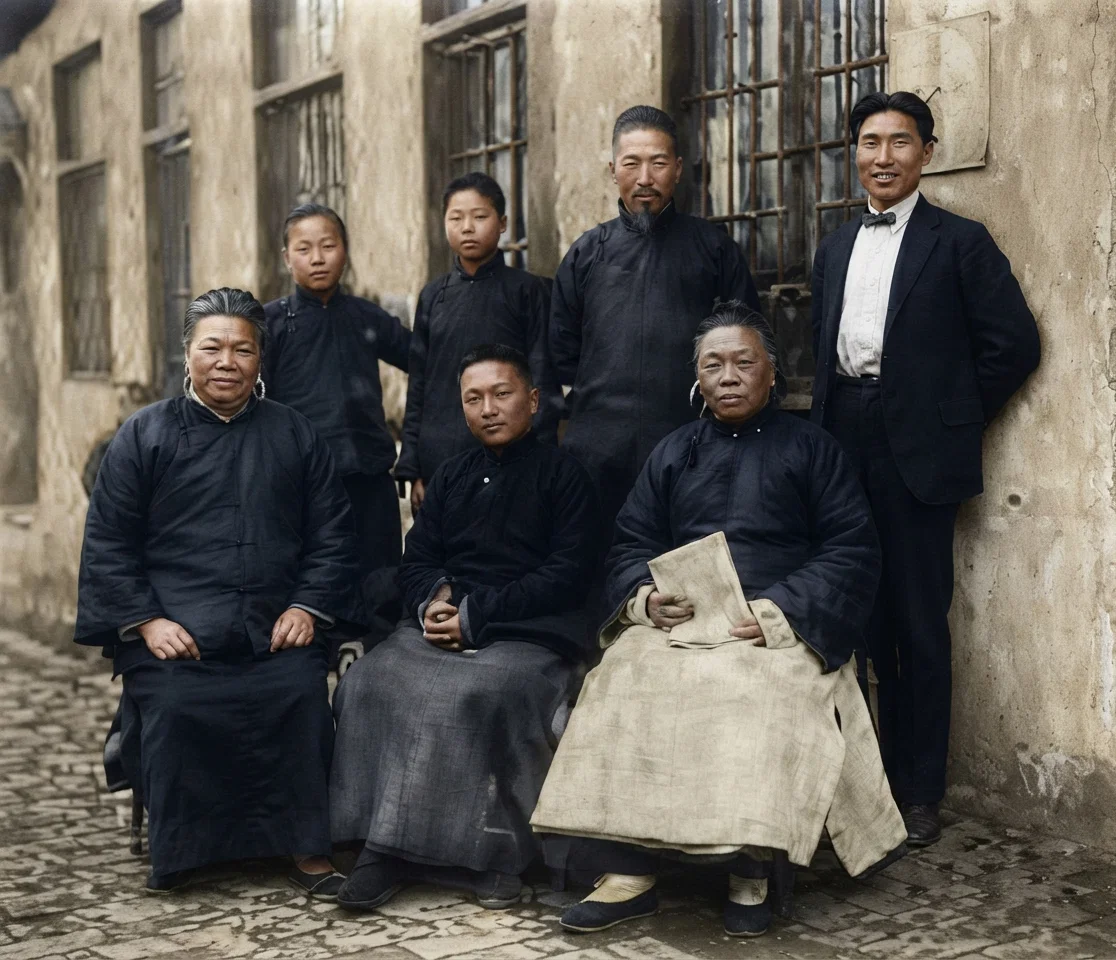
I HAVE just returned from a ten days' itinerating trip, visiting companies and interested persons. At Hui-An, China, a four days' meeting was held. A native evangelist has been working at this place for some time, and a good interest is manifested. At the close of the meeting ten souls were buried with their Lord in baptism. We expect that by the first of the year nearly as many more will be prepared for this sacred ordinance.
GROUP OF CHINESE NATIVE EVANGELISTS
The native evangelist at Hui-An had a singular experience this season. His little boy, about five years old, was taken with the plague, and from all appearances it seemed that he would soon be silent in death. The only hope of his recovery was in God. The child earnestly urged prayer. "Pray," he said; "there is wonderful power in prayer." One evening the believers, also a number of outsiders, gathered at the chapel and united in prayer for the child. There was a heathen man in the congregation who felt the presence of the Spirit of God, and that night while sleeping upon his bed he had a dream of Jesus standing by the child, and he was very definitely impressed that the boy would recover. He did get well, and the heathen accepted Christ as his Saviour.
B. L. ANDERSON.
A Miraculous Transformation
By R. F. Cottrell
A YEAR ago last spring, one of our brethren at Chang-Sha, China, brought us a man who had long been a slave to the opium habit, with the request that he be allowed to remain in our servant's quarters while he was trying to break away from his slavery. He said it would be easier to keep from using opium if he could remain with us.
He stayed. Morning and evening the brother who introduced him to us prayed with him, studied the Word with him, and encouraged him to continue the fight. He became very weak, and as it looked to us as if he might die at almost any time, we advised him to return home, but at his earnest request we finally permitted him to remain. At length he began to recover, and after several months became quite strong. The Lord graciously took away his appetite for the poisonous drug. He fully accepted the third angel's message, and was received into church fellowship upon baptism.
About four months ago, we took him on trial as a colporteur, and he soon became very successful. He has just returned from a trip to the northwest of the province, during which he sold nearly a thousand papers, and took a large number of subscriptions. With radiant face, he related how the Lord blessed him in his work, and preserved him from numerous perils by land and water. He brought a very intelligent young man with him to Chang-Sha to study further the Sabbath truth.
This man's experience is a fresh revelation of the power of God to transform the heart and life. R. F. COTTRELL.
Our Work and Workers
THE last of August, Brother J. A. and Mrs. Bodle left New Orleans for Guatemala, where they will connect with the school work in Guatemala City. On September 23, A. G. and Mrs. Nelson sailed from New York for England, en route to their new field of labor in the Falkland Islands and Patagonia. Elder and Mrs. E. L. Maxwell and their two boys also sailed in September for South America, where he will take the superintendence of the newly organized Northwest Union Mission of South America, which includes Peru, Bolivia, and Ecuador. Mr. and Mrs. Fred Hutchinson and E. Henriques sailed in July for Trinidad, West Indies. Brother E. Rosenwold left New York in September for Europe, having been invited to make northern Sweden his field of labor.
THE believers in Manteiga, Brazil, have erected a neat chapel, which was dedicated on the 24th of May. Three more souls have gone forward in baptism in Rio de Janeiro, and six at Serro Pellado.
PASTOR G. W. CAVINESS reports the baptism of eight individuals at Mexico City, Mexico, since his return from the General Conference.
NEWS comes from Egypt of the baptism of twenty-four persons at Beni Addi, in the Nile Valley, and two others have begun to keep the commandments since the baptism.
A REPORT from Rangun, Burma, states that four candidates were recently baptized, and united with the Rangun church, and that it is expected that several more will soon be ready for baptism.
BROTHER GEORGE L. STERLING, who has been laboring for the past year on the island of Aitutaki, Cook Islands, tells of the conversion of fifteen persons.
AT the Fijian council, held in the village of Lewa, Nadarivatu, Colo, August 7-11, baptism was administered to five souls.
THE result of a special effort in Hobart, Tasmania, is the conversion of ten adults, and a number of others are deeply interested. Most of this has been accomplished through the distribution of tracts by members of the church in that place. Five at Ulverstone and four at Penguin have also identified themselves with the message.
FOUR persons at East London, South Africa, have made decisions to obey the truth. Brother I. B. Burton, writing of some experiences in Kafirland, on the Fish River, said, "I had the blessed joy of seeing six souls take their stand for the truth." There are about one hundred in the candidates' class for baptism at the Malamulo Mission. The total number of those enrolled in the Bible classes in the schools of that section is 434, an increase of 55 over the number last year. Baptism has been administered to six at Rokeby Park, to three at Grahamstown, and to eighteen at the Maranatha Mission. Some of these latter are the first-fruits of the Fish River school, which was started two years ago. Two out-schools also have been started on the Fish River, taught by two of the native teachers, one with thirty-eight students and the other with forty-two.
IN German East Africa, last year, four mission stations were started,—Kihuiro, Mauiba, Vunta, and Suihi,—and fourteen believers were baptized. During the first quarter of this year the reports show that eighty persons were baptized at these four stations.
At a meeting of four days' duration at Hui-An, Fukien, China, ten souls were buried in baptism, and it is expected that by the first of the year nearly as many more will be prepared for this ordinance. At a recent general meeting held in Honan, 130 believers were baptized. In speaking to the brethren assembled there, Elder Westrup told them that "in Germany, Russia, and England, every worker gained ten persons on an average for the Master last year; that in Siberia every worker had gained seventeen believers; and that if we also should really repent and consecrate ourselves to Him, we could win two or three hundred really converted persons this year." Brother W. F. Hills, in telling of the work in Swatow, China, says that seventeen were baptized at the time of their general meeting there, and a large number have united on their former baptism. He says the membership has multiplied itself by perhaps six during the past year, and many others are on the point of stepping out.
THE brother of Dr. A. C. Selmon, one of our missionaries in China, was baptized into the Coquilla (Oregon) church on Sabbath, September 27.
The Home Field
(Since last reported)
Baptisms: Montana 5, Oregon 27, Washington 27, Idaho 73, Ontario 20, New Brunswick 29, Alberta 6, California 38, Missouri 11, Minnesota 73, North Dakota 9, South Dakota 3, Indiana 31, Wisconsin 13, New Jersey 14, Ohio 11, Virginia 11, Michigan 86, Kentucky 29, Illinois 80, Colorado 68, Maine 5, South Carolina 13, Iowa 83, Oklahoma1371, Pennsylvania 28, Kansas 66, New York 92, Vermont 4, Massachusetts 24, Texas 16, Alabama 3.
CONDUCTING A BIBLE STUDY IN OUR CHAPEL AT SHANGHAI
Conversions: Montana 28, Idaho 14, Oregon 13, Washington 15, Ontario 6, Manitoba 30, California 32, Illinois 26, Kansas 8, Missouri 8, Minnesota 13, South Dakota 9, North Dakota 4, Iowa 25, Indiana 5, Michigan 13, New Jersey 9, Virginia 13, Ohio 5, Mississippi 19, Florida 7, Pennsylvania 21, Maryland 10, New York 44, Kentucky 21, Maine 5, Vermont 5, Tennessee 15.
Churches and Companies Organized: Oregon 1, Illinois 1, Quebec 1, Saskatchewan 1, British Columbia 1, Texas 2.
Churches Dedicated: Ontario 1, Manitoba 1, California 1, Kentucky 1.
We learn that good progress is being made on the buildings of the China training-school in Shanghai. The brickwork is nearly completed. The work has been delayed somewhat on account of the revolution, as much of the material for the building has to come through the war zone south of the city. We will be glad to hear of the completion of this building, and of the opening of the school.
IN THREE DAYS
SAN FRANCISCO
Overland Limited
TAKES YOU
To Chicago
ACROSS GREAT SALT LAKE AND
HIGH SIERRA BY DAYLIGHT
Luxurious High-class Equipment Electric Lighted Throughout
Pullman Drawing-room
Stateroom
Vestibuled Sleeping-cars
Careful and Attentive Dining
Service
Parlor Observation-car with
Library and Cafe
Ladies' Reading-room
Gentlemen's Smoking-room
Daily News Bulletins
Latest Papers and Magazines
Southern Pacific
Wanted for Missionary Work
By Albert Benson, General Delivery, Prescott, Ariz., clean copies of our periodicals.
Mrs. S. D. Oldson, R. 1, Box 122 AA, Bartlesville, Okla., any Seventh-day Adventist literature.
A continuous supply of S. D. A. papers and magazines to C. T. E. Johnson, 333 W. Lake Ave., Seattle, Wash., for use in ship mission work.