The Youth’s Instructor, Vol. LI, No. 1

A True Story

The Youth’s Instructor

January 1, 1903

Review and Herald Publishing Company · Battle Creek, Michigan · January 1, 1903

A True Story

NEAR the summit of a mountain in Pennsylvania is a small hamlet called Honeyville, consisting of two log houses, two shanties, a rickety old barn, and a small shed, surrounded by a few acres of cleared land. In one of these houses lived a family of seven,—father, mother, three boys, and two girls. They had recently moved from Michigan. The mother’s health was poor, and she longed to be out on the beautiful old mountain where she had spent most of her childhood. Their household goods had arrived in Pennsylvania just in time to be swept away by the great Johnstown flood of 1889.
The mother and her two little girls, Nina and Dot, were Christians, and their voices were often lifted in praise to God as they sang from an old hymn-book, one of their most cherished possessions.
One morning the mother sent Nina and Dot on an errand to their sister’s home three and one-half miles distant. The first two miles took them through dense woods, while the rest of the way led past houses and through small clearings. She charged them to start on their return home in time to arrive before dark, as many wild beasts—bears, catamounts, and occasionally a panther—were prowling around. These animals were hungry at this time of the year; for they were getting ready to “hole up,” or lie down in some cozy cave or hole for their long winter’s nap.
The girls started off, merrily chasing each other along the way, arriving at their sister’s in good time, and having a jolly romp with the baby. After dinner the sister was so busy, and the children were so absorbed in their play, that the time passed unheeded until the clock struck four; then the girls were hurriedly started for home, in the hope that they might arrive there before it became very dark. The older sister watched until they disappeared up the road, anxiously wishing some one was there to go with them. The girls made good time until they entered the long stretch of woods, when Nina said, “O, I know where there is such a large patch of wintergreen berries, right by the road! Let’s pick some for mama.” So they climbed over a few stones and logs, and sure enough the berries were plentiful. They picked and talked, sometimes playing hide-and-seek among the bushes. When they started on again, the sun was sinking low in the west, and the trees were casting heavy shadows over the road, which lengthened rapidly. When about half of the distance was covered, Dot began to feel tired and afraid. Nina tried to cheer her, saying, “Over one more long hill, and we shall be home.” But now they could only see the sun shining on the top of the trees on the hill, and it was already twilight in the woods.
They had often played “trying to scare each other” by one saying, “O, I see a bear or a wolf up the road,” and pretending to be afraid. So Dot said, “Let’s scare each other. You try to scare me.” Nina said, “All right,” then pointing up the road, she said, “O, look up the road by that black stump; I see a—” She did not finish; for suddenly, from almost the very spot where she had pointed, a large panther stepped out of the bushes, turning his head first one way and then another; then, as if seeing the girls for the first time, he crouched down, and, crawling, sneaking along, like a cat after a mouse, he moved toward them. The girls stopped and looked at each other, then Dot began to cry, and said, in a half-smothered whisper, “O Nina! let’s run!” but Nina thought of the long, dark, lonely road behind, and knew that running was useless. Then thinking of what she had heard her father say about showing fear, she seized her little sister’s hand, and said, “No, let’s pass it. God will help us;” and she started up the road toward the animal.
When the children moved, the panther stopped, straightened himself up, then crouching again, moved slowly, uneasily, toward them. When they had nearly reached him, and Nina, who was nearest, saw his body almost rising for the spring, there flashed through her mind the memory of hearing it said that a wild beast would not attack any one who was singing. What should she sing? In vain she tried to recall some song, but her mind seemed a blank. In despair she looked up, and breathed a little prayer for help; then catching a glimpse of the last rays of the setting sun touching the tops of the trees on the hill, she began the beautiful hymn,—
“There is sunlight on the hilltop, There is sunlight on the sea.”
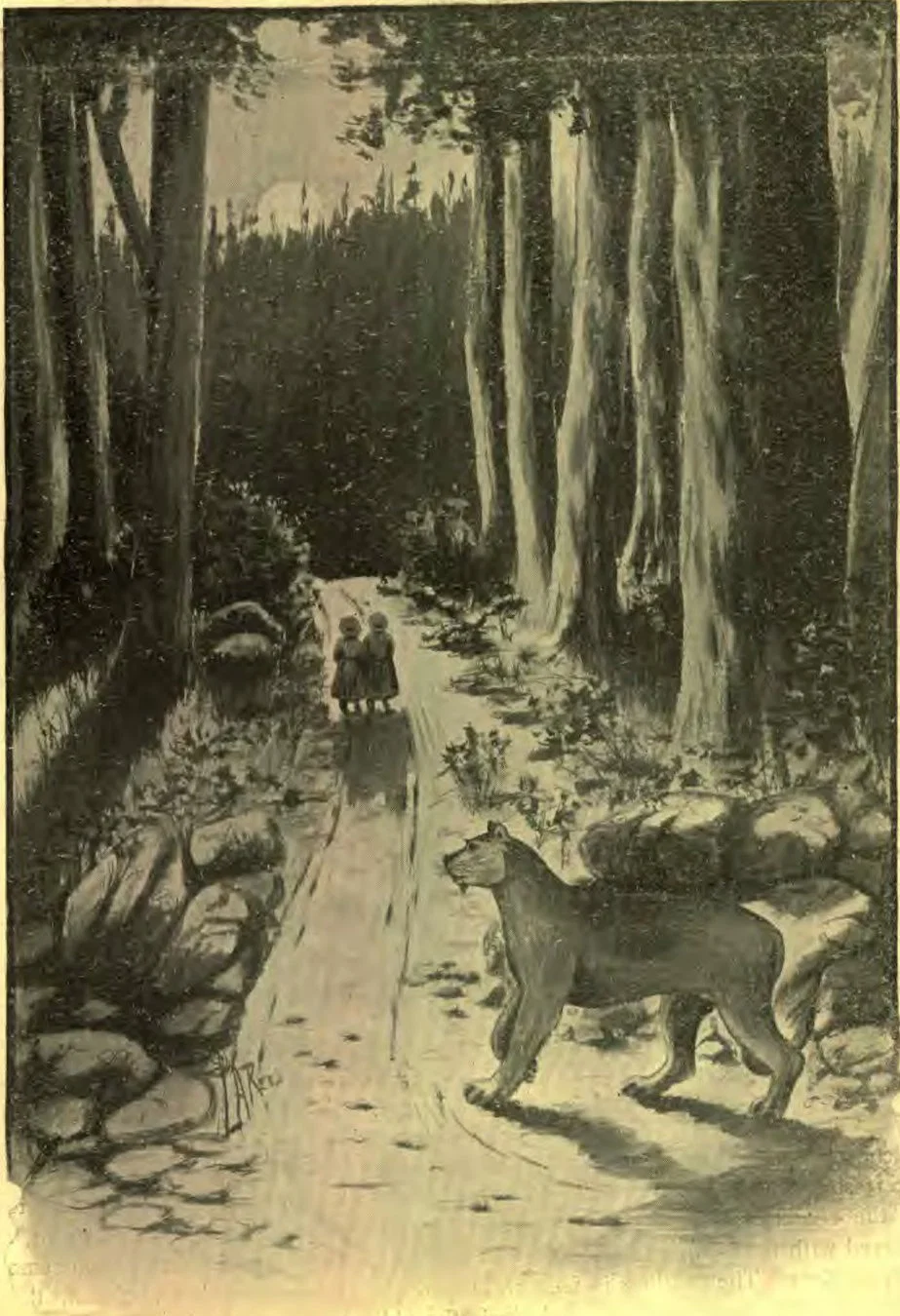
Her sister joined in, and although their voices were faint and trembling at first, by the time the children were opposite the panther, the words of the song rang out sweet and clear on the evening air.
‘THE GIRLS PASSED ON, HAND IN HAND’
The panther stopped, and straightened himself to his full height. His tail, which had been lashing and switching, became quiet as he seemed to listen.
The girls passed on, hand in hand, never looking behind them. How sweet the words—
“O, the sunlight, beautiful sunlight! O, the sunlight in the heart!”
sounded as they echoed and re-echoed through the woods. As the children neared the top of the hill, the rumbling of a wagon fell upon their ears, so they knew that help was near, but still they sang. When they gained the top, at the same time the wagon rattled up, for the first time they turned and looked back, just in season to catch a last glimpse of the panther as he disappeared into the woods.
The mother had looked often and anxiously down the road, and each time was disappointed in not seeing the children coming. Finally she could wait no longer, and started to meet them. When about half-way there, she heard the words—
“O, the sunlight, beautiful sunlight! O, the sunlight in the heart! Jesus’ smile can banish sadness; It is sunlight in the heart.”
At first a happy smile of relief passed over her face; but it faded as she listened. There was such an unearthly sweetness in the song, so strong and clear, that it seemed like angels’ music instead of her own little girls’. The song ceased, and the children appeared over the hill. She saw their white faces, and hurried toward them. When they saw her, how their little feet flew! but it was some time before they could tell her what had happened.
What a joyful season of worship they had that night, and what a meaning that dear old hymn has had to them ever since!
A few days later, a party of organized hunters killed the panther that had given the children such a fright. But the memory of that thrilling experience will never fade from the mind of the writer, who was one of the actors in it.
NINA CASE.

The Albatross

The albatross has been a favorite theme with poets and naturalists for ages. Scientists have offered many theories for the bird's long-sustained power of flight, but it remains as much a mystery as ever. An albatross will follow in a ship's wake for days, sailing steadily along with no other motion of the wings than an occasional veer when the bird desires to turn an angle, silent and inscrutable as fate. Despite the bird's marvelous power for sailing, it is very hard for it to rise from the water.
The home of the albatross is in the Antipodes and the Auckland Islands. No lighthouse rears its head there, and heavy fogs and treacherous currents swirl about the place. The land is rough, but covered with mountainous flowers,—wonderful asters, marguerites, lilies, and gentians; and here millions upon millions of birds make their homes.
Among the coarse herbage the pure-white head of the albatross meets the eye. The body is larger than that of the swan, and its expanded wings measure seventeen feet from tip to tip. But at home its glory is departed; for while nothing can be grander than its flight over the ocean, nothing is more ludicrous than its waddle on the land. Its only sign of defense is to clap its beak in a helpless manner.
The nest is a pile of earth like a child's sand castle, and in the cup-shaped top the albatross lays one egg. During the sixty days the egg is hatched, the mother does not stir from the nest; for if she did, the sea-hawk would swoop down on the egg and destroy it. The young bird is covered with fluffy down, pure-white in color and silky as floss. The nestling is fed so assiduously that it becomes immensely fat, and rivals the old birds in weight. It is then deserted by the parents, who wander over the ocean, sometimes encircling the globe before returning home.
The most remarkable thing in the history of the albatross is that during the absence of the parents the young nestling does not receive a mouthful of food. During the whole time, sometimes four months, it lives on the fat it has accumulated. In the open nest on a bleak hillside the young albatross is exposed all winter to sharp winds and the fiercest gales that rush across the ocean; yet at the end of its fast the young bird is lively and in good condition.
The reason the parent birds go away is not known. Their desire for flight is a mystery, for it is not the same as the migration of our Northern birds to the South. When the parents return, they unceremoniously bundle out the nestling, which has become a slate-gray in color, and set about repairing the nest. The young bird still stays around, evincing in many pretty ways its fondness for its parents, and not till next year does it take its first flight to sea in company with its hard-hearted father and mother.—Chicago Daily News.

Is a Horse a Horse?

If I were to point out a horse, and tell you confidently it is a cheval, you, as bright boys and girls, would tell me I was mistaken, and should I further insist that I was right in calling this commonplace quadruped by that queer name, and challenge you to prove the horse to be a horse indeed, the only reason you could possibly give would be that your father, and grandfather, and all your relations, as well as their relations, and in fact, all the people in the world who call themselves English, have called that particular animal a horse all their lives; and so you naturally conclude that the only one truly appropriate word by which to point out that animal, as you have before insisted, is “horse.”
But if, on the other hand, I should insist that my father, and grandfather, together with all my relations, and their relations, and, in fact, all the French nation have from remote times called that four-footed beast cheval, there is a possibility that your faith would be shaken in the idea that “horse” was the original name given that animal by Adam at the creation of the world, and that no other name than “horse” could with truth apply to that animal. And further, you might be led to wonder whether any one of the several hundred names by which the various peoples of the earth speak of a horse, was the one our first parent gave to that noble animal.
And what is true concerning this word is true also with reference to any other word, or letter used to spell that word. If I were asked to prove that a is a, the only proof that I or anybody else could give would be that the English-speaking people had agreed to adopt that character, and give it the name of a, and allow it to represent half a dozen elementary sounds of the language. They might just as appropriately have called it ah, or awe, or anything else. Or they might have made a vertical line to be a. For years I, together with a great army of stenographic writers, have been using a heavy dot for a instead of the ordinary character; and it can be demonstrated that the dot is as truly a as the more complicated figure.
Now by all this extended illustration, I wish to make emphatic this fact: that the truth of a thing is in the thing itself, and not in the name. Names of things come into being as fashions do, and differ in different localities as fashions differ. A word is but an arbitrary representation of an idea, and its only excuse for existing is that it may suggest an idea. The idea is the truth; and if the word is a strange one to me, it is, so far as I am concerned, but an empty sound,—a lifeless, useless, truthless thing.
The word of God is not a thing of life to me unless I can see God in it. And unless I get what is behind the words, I might as well be reading a fairy tale. Some of the commonest words of religious discourse—words which we all use, and think we know—prove, upon careful examination, to carry with them much that is deep and hard to understand. “Faith,” for example, we are apt to regard as a capacity to receive as truth anything hard to believe,—anything beyond the range of ordinary happenings. Yet many fail to get the deeper meaning of the word,—that of the reaching out of an empty hand after God, an inexpressible longing after him in whom we are complete.
Even God himself is to many a Christian but a miracle-working magician, a skilled architect, a great leader of armies, and an awful, uncompassionate judge. But when we come to study Christ’s interpretation of God; when we come to study the universe, in which space is as boundless as eternity; when we come to comprehend that the mightiest sun and the smallest atom obey with mathematical precision the laws that God has set and keeps in operation, he becomes a being altogether too awe-inspiring and sublime to liken to anything human, and yet a being so filled with the most heavenly attribute of humanity that we can joyfully say, with the apostle, “God is love!”
L. T. CURTIS.

Holy Scripture

I HAVE a garden fair, With heavenly breezes fanned, And every morning finds me there— It is the Lord’s command— To gather fruits and blossoms sweet Before the dusty world I meet.
I have a faithful Friend, Accustomed to advise, With whom each morn some time I spend, That I may be made wise To find and keep the only way Which issues in eternal day.
I have an armory bright, With shield and helm hung round, Where, duly as the morning light, The Spirit’s sword is found, With which to overcome the foe Who harasses the way I go.
I have a mirror keen Which shows me all I am; But, lo! behind me there is seen One like a dying Lamb; And, as I view his imaged face, My sins are lost in shining grace.
O, send thy Spirit, Lord, To make me wholly thine, That I may love thy blessed word And feel its power divine, And walk on calmly in its light Till faith is turned to glorious sight!
—Richard Wilton.

Little Guides on the Footpath of Peace

To be glad of life because it gives you the chance to love and to work and to play and to look up at the stars; to be satisfied with your possessions, but not contented with yourself till you have made the best of them; to despise nothing in the world but falseness and meanness, and to fear nothing except cowardice; to be governed by your admiration rather than your disgusts; to covet nothing that is your neighbor’s except his kindness of heart and gentleness of manners; to think seldom of your enemies, often of your friends, and every day of Christ; and to spend as much time as you can, with body and spirit, in God’s out-of-doors,—these are little guide-posts on the footpath to peace.—Dr. Henry Van Dyke.

Names by Which China Is Called

The name “China,” by which the great Chinese Empire is known to us all, is of uncertain origin. Some authorities affirm that it was in use in the twelfth century before Christ, while others fix its origin as much later.
Cathay, which is derived from Ki-tah, or Khitan (hence, Khitai, Khata, or Cathay), is a name of much later date, being derived from a people, the Ki-tah, who ruled the north of China in the tenth century. For nearly a thousand years this designation was employed by the inhabitants of Central Asia, from whom it spread to other nations. Among the Russians, China is still Khitai.
None of these names are used by the Chinese themselves. The name Tin-Chow, translated “Heavenly Dynasty,” is used by the upper classes of China, and it is the best Chinese excuse for the high-sounding name, “Celestial Kingdom,” current among Western peoples. The common people employ a variety of names to designate their country. Chung Kwok, “The Middle Kingdom,” is a popular designation; and Chinese maps often represent China to be not only in the middle, but as actually monopolizing almost the whole earth, while other countries are represented as small islands, or single cities lying on the border. This fact accounts for the distorted notions among the Chinese of the relative size and importance of their native land and other countries. Another name is Tong Shan, or the “Hills of Tong,” so named from a celebrated ancient dynasty. From this same source we have the term Tong Yan, the usual name in South China for “Chinese people.”
Again: the Chinese are called Lai Man, or “the black-haired race,” and Chung Wa Kwok, “the Middle Flowery Kingdom,” in contradistinction to Ngoi Lei, which means, “the Outlying Lands.”
Another old name for China is Wa Ha, “the Glorious Ha” (ha, “dynasty”). The most modern name for China is Tai Tsing Kwok, “The Great Pure Kingdom,” so named after the present ruling (Tsing) dynasty. To those acquainted with the characteristics of the present representative of this so-called “pure dynasty,” the term may seem somewhat misapplied.
The Buddhists have called China by the Hindu name Chin Tan, or “Dawn;” the Mohammedans call it Tung To, or “Land of the East;” while among the Jews, China was known as the “Land of Sinim” (Isa. 49:12), from which is derived the word “Sinologue,” a term applied to scholars of the Chinese language.
CHINESE OUT FOR A STROLL.
This last name is full of meaning and promise, not alone because it is found in the Bible, but because it is connected with God’s promise of salvation. Isaiah speaks of the gathering of the redeemed from the whole earth, and China is mentioned as one of the four divisions of the earth whence the Lord’s saints will come to people his new kingdom. As we pray, “Thy kingdom come,” shall we not also labor together with him for the fulfillment of this promise of an ingathering of souls from China?
J. N. ANDERSON.
Hong Kong, China.

A Bible in a Barn

St. Paul reminded Timothy that “the word of God is not bound.” More than once it has been known to reach and bless a pagan without missionary help.
Some years ago an ignorant but docile Japanese served as cook in an American family in San Francisco. His favorite resort, when at leisure from his duties, was a nook in the barn where a number of old books, discarded from crowded alcoves in the house, had been piled. He was trying to learn English, and the books stimulated his curiosity, and busied him for hours with the study of words.
A fellow countryman visited him in his barn library, and soon became as inquisitive as himself. One book with gilt-edged leaves attracted this friend. He opened it, and with the little knowledge they had between them, the two spelled out “Holy Bible,” and wondered what it meant. They agreed to investigate, and procuring an Anglo-Japanese lexicon, the cook and his companion met as often as they could, and pored over the pages of the Bible together, often by dim lamplight far into the night.
One evening another fellow countryman, who was a student in a mission school in the city, and a Christian, made them a call. Surprised to find them reading the Scriptures, he gladly translated for them several specimen chapters, and texts, promised them in the future he would help them to understand the book, and then and there told them the story of Christ’s life.
After such a beginning it is easy to guess what followed; but a commonplace sequel, as men see it, may be the first chapter of an eternal history.
The cook and the young student interested others of their nation in Bible study, hired an upper room, and organized a gospel society. This resulted, in May, 1885, in the formation of the Japanese Presbyterian Church.
In San Francisco the Christian Japanese now own a large building for Young Men’s Christian Association work, and support an outlying mission. Of the three hundred and eighteen who have from time to time joined themselves to this church, several have returned to their native land, bearing with them their Christian character and testimony. One of them is the cook’s friend, the man who found the Bible in the barn.—Youth’s Companion.

Interesting Contrasts between American and Chinese Customs
We bake bread; they steam it.
In rowing a boat we pull; they push.
We keep to the right; they keep to the left.
We use a soft pillow; they use a hard one.
Our sign of mourning is black; theirs is white.
Our windows are made of glass; theirs of paper.
We shake a friend's hand; they shake their own.
Our language is alphabetic; theirs is ideographic.
We eat with knives and forks; they with chopsticks.
We blacken our shoes; they whiten their shoesoles.
We write with a pen or pencil; they write with a brush.
We locate intellect in the brain; they locate it in the stomach.
We divide the day into twenty-four hours; they into twelve.
Our given name precedes the surname; theirs follows the surname.
We think milk and butter almost indispensable; they use neither.
In sewing we draw the needle toward us; they push it from them.
We take off our hats as a mark of respect; they keep theirs on.
Our calendar is based on solar time; theirs is based on lunar time.
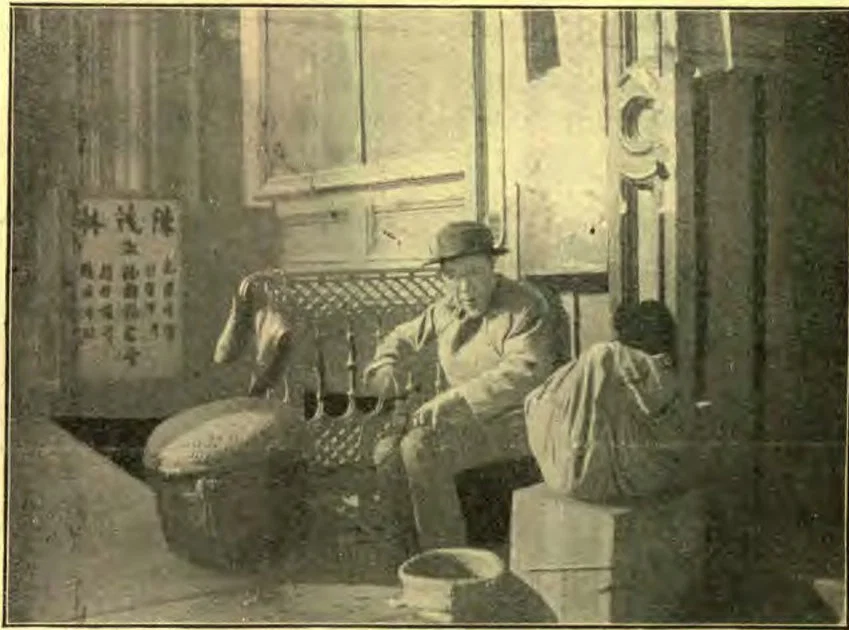
A CHINESE SHOEMAKER
A CHINESE SHOEMAKER
We are taught to study in silence; they are taught to shout aloud.
With us the seat of honor is on the right; with them it is on the left.
Here, desserts are served at the close of a meal; there, at the beginning.
The needle of our compass points to the north; theirs points to the south.
We read from left to right, horizontally; they read perpendicularly from right to left.
Our children stand facing the teacher to recite their lessons; theirs turn their backs to the teacher.
We have standard weights and measures; their weights and measures differ in each district.
Americans win their own brides; the Chinese have theirs chosen by the parents through go-betweens.
We should consider the gift of a coffin too suggestive; they consider it most acceptable, years before it is needed.
Our watchmen quietly go their rounds with a view to catching thieves; theirs beat gongs and yell to frighten them away.
We bury our dead a few days after their decease; they often keep theirs in the house in heavy, sealed coffins for years.
When our sons marry, they set up a home of their own; when their sons marry, they bring their brides to the parents' home.
We cut our finger nails; they think it aristocratic to have the nails from one to five inches long, often protecting them with a silver or other metal sheath.—Selected.

In the Master's Service

THERE is a battle for all to fight, for the young as well as the old. In the warfare against evil, every one has a part. Dear young friends, when you accepted Christ as your Saviour, you enlisted in his army. You left the black banner of the prince of darkness to stand under the blood-stained banner of Prince Immanuel. Your highest aim now should be to show yourselves faithful soldiers.
The powers of darkness are arrayed against you. Satan desires to see you deserting your Leader. He would be greatly pleased to see you disappointing the One who has done so much for you. Do not yield to his temptations. Fight bravely against his suggestions. Remember that God and Christ and the heavenly angels are fighting with you. John says, “I write unto you, young men, because ye are strong, . . . and ye have overcome the wicked one.” Had not God given his children power to overcome, these words would not have been written. In the strength of the Redeemer, you can be more than conquerors.
The history of Daniel and his companions is an illustration of what all youth may become in the service of God. The king determined to have them trained as statesmen, and with other youth they were given food and wine from his table. But they knew that if they ate of the king’s food, and drank his wine, their power to distinguish between right and wrong would be dulled. They would be unable to obtain the education necessary to make them successful Christian statesmen. They would not appreciate the knowledge God had to give. They determined to be true to principle, to eat and drink to God’s glory.
God honored their loyalty. He gave them wisdom and understanding; and when at the end of the term of years allotted to study, the king examined them, he found them “ten times better than all the magicians and astrologers that were in all his realm.”
It is your privilege—a privilege which many do not enjoy—to know what is meant by wholesome food,—food that will bring health to body and mind. Make right eating and right drinking a part of your religion. Thus you place yourselves where God can enable you to distinguish between right and wrong.
God has given every youth the talent of speech to be improved for him. This is a most important trust; for God declares, “By thy words thou shalt be justified, and by thy words thou shalt be condemned.” Let your words be life-giving, pointing those around you to the Saviour. Let them bring sunshine instead of gloom, harmony instead of animosity. Say nothing that you would not be willing to say in the presence of Jesus and the angels. Utter no word that will stir up strife in another heart. However provoked you may feel, restrain the hasty word. If you are Christ-like in speech and action, those who associate with you will be blessed by the association. Righteous words and deeds have a more powerful influence for good than all the sermons that can be preached.
Christ desires to use the youth in his service. He needs missionaries. The barren fields all over the world call to heaven for laborers. If the youth will give themselves to God, he will give them wisdom and knowledge, preparing them for service. If they will consecrate themselves to him, he will make them vessels unto honor, into which he can pour the precious oil of the Spirit, to be imparted to others. God’s helping hand—this is what you may be if you will yield yourselves to his keeping. He will help you to make straight paths for your feet.
Dear young friends, God loves you. He wants you to be saved. He wants you to make a success of the life that he has given you. If you let your life slip from you in idle dreaming, if you bring to the foundation wood, hay, and stubble, you may through repentance be saved; but where is your treasure? All eternity will testify to your loss.
You are not alone in the warfare against wrong. Could the curtain be rolled back, you would see heavenly angels fighting with you. This they must do; it is their work to guard the youth. “Are they not all ministering spirits, sent forth to minister for them who shall be heirs of salvation?” Ten thousand times ten thousand and thousands of thousands of angels minister to the youth.
As you move forward step by step, adding to your faith virtue, and to virtue knowledge, God will be with you, and you will never fall. As you work on the plan of addition, Christ works for you on the plan of multiplication. He aids you as you strive for the crown of life. Strive lawfully, serving God with heart and mind and soul and strength. Then when Christ comes to gather his jewels to himself, he will welcome you with the words, “Come, ye blessed of my Father, inherit the kingdom prepared for you from the foundation of the world.” MRS. E. G. WHITE.

January Study of the Field

(January 4-10)
“The Field Is the World”

Suggestive Outline

1. OPENING EXERCISES:—
Song Service.
Scripture Reading — Isa. 40: 1-11.
Prayer.
2. A Brief Review of the Field:—
(a) Mexico and the West Indies.
(b) South America.—Brazil, Argentina, Chile, Unentered Portions.
(c) Africa.—Egypt, Nyasaland, Matabeleland, West Coast, Unentered Portions.
(d) Asia.—India, China, Japan, Unentered Portions.
(e) Europe.
(f) Island Fields.
3. Our Attitude toward Missions during 1903.
4. Closing Exercises.

Suggestions

In the study to-day let some one take the entire subject, or several take different divisions of the subject, and give the population, the number of workers we have sent, and some statement concerning the condition of the work, needs, etc., gleaned from the reports published during last year.
Do not fail to use a map in your field study. If you do not have a good missionary or other map of the world, let some one draw such a map in outline. Even this will give some conception of the great world still to be warned, and the fields we have entered.
Being the first missionary service of the new year, a short time may very profitably be spent in a consecration service. This third angel’s message is the greatest thing in the world. It is the one thing to which we want to give our lives. Soon, very soon, the work will be closed, and the Saviour will come. We can not afford longer to spend our time on trifles. Let this day be a day of consecration to service,—consecration to a service that will not cease until Jesus comes.
It is sometimes worth the while to stop and review our position, take our bearings, and lay our plans intelligently for aggressive work. At no better time can we do this in connection with our foreign mission work than at this, our first missionary study in the new year.
This gospel of the kingdom is to be “preached in all the world for a witness unto all nations; and then shall the end come.” The year 1902 has been in many ways a remarkable one in connection with aggressive work in the regions beyond; but it has only been a mere beginning of what we must, and, praise the Lord, will do during the months to come. We have seen encouraging evidences that the advances taken during 1902 will lead speedily to the final triumph of this message.
If there are little companies who do not feel that they can follow this outline, such can find an abundance of material in the Review of the past month, from which they can draw for their meeting.
E. H.

Extracts from Quarterly Reports

North Warren, Pa.—This little Society of eleven members meets each Sabbath afternoon. The members have been especially interested in the work in mission fields, and mission-field subjects have been the prominent features of the meetings. This interest in the work abroad has had the effect of stimulating home missionary work. The members have sold several copies of “Christ’s Object Lessons,” and have circulated papers and tracts. The secretary closes her report by saying: “The interest in the Society is good. Several come that do not belong, but they take lots of interest. It is helping the young people to do things without waiting for the older ones.”
Altoona, Pa.—The twelve members of this Society pay ten cents each month, and the money is expended for papers and tracts for missionary purposes. They have been distributing literature to the jails, holding Bible readings, and singing at the hospital. Some of the most active members have recently gone away, but it is hoped that the work may be carried on successfully by those who remain. Weekly meetings are held, and the INSTRUCTOR lessons studied.
Ontario.—Two Societies have recently reported from this field. The members at Belleview number but seven, but they have collected $2.48, and have purchased tracts, and copies of the INSTRUCTOR and the Life Boat, which they have distributed in visiting the sick and poor. The Society at London has eleven members. They have been using the Bible reading outlines in the Bible Training School in their meetings. The members are visiting the jails and distributing tracts.
Welsh, Louisiana.—This Society has a membership of twenty-five, and holds its meetings on Sabbath afternoon. A Self-Denial Fund of $8.26 has been contributed, and expended for papers for missionary use. The secretary says: “We have a good interest, and are encouraged by the attendance of the older people at our meetings, and the amount of the Self-denial Fund.”
Hope Villa, Louisiana.—The only other Society in this State is at Hope Villa. They have eleven members. The distribution of literature is the principal missionary work undertaken. The leader of the Society writes: “Interest is good. Meetings are well attended. All of the members take some active part in each meeting. Individual growth is very noticeable.”

The Man Who Represents God's Will

“THE man who most represents the will of God for his age is the strongest man of that age, though the fact may not be realized until centuries after. The secret of power is to be in line with God’s will, which is the supreme power that works in history and in individual destiny.”
Continue reading: He Didn't See How