STEPHEN POTTER sat on the side of his bed, one shoe in his hand, the other on the floor, waiting. Stephen was thinking, going over the whole story for the twentieth time, and not understanding it a bit better than he had at first. Being twelve years old, he thought himself too big to cry; yet for all that he had shed some bitter tears in his trouble.
This is what had happened. His Uncle David's handsome nickel-plated acetylene lamp, that was new, and had cost four dollars, was found in the bottom of a basket that stood behind the door in the carriage-house, with its glass broken in many pieces.
This was hard for Uncle David, but much harder for Stephen. On the evening in which it must have been broken Stephen had had to ride to town with a telegram. He had borrowed the lamp without leave, and had gone off in triumph with it on his wheel. He was known to have been the last one in the carriage-house that night; for his Uncle David was in town, staying with a friend, and Sam, the hired man, was taking his three-days' vacation, and was twenty miles away.
Stephen had reached home by eight o'clock, and had reported that everything was all right in the carriage-house. Yet the next morning, when his grandfather went for the basket behind the door, behold, under a wad or two of paper, that looked as if they might have been thrown in to help hide the mischief, was David's lantern, that was known to have been all right the day before!
What could be plainer than that Stephen had had an accident and broken the lamp, especially when he promptly owned to having used it? But Stephen, in spite of earnest words from them all, and a few stern ones from his grandfather, and a few coaxing ones from his grandmother, had persisted in denying it.
“I took the lantern,” he said, his face very red and shamefaced as he confessed it; “but I brought it back again all safe, and set it on the shelf where it belongs, and shut the door; and that is the last I know about it.”
“You borrowed the lantern without leave?” said his grandfather. And Stephen, his face growing redder, dropped his eyes, and owned that he had.
“I've always wanted to try it,” he added. “And Uncle David was away; I knew he wouldn't want to use it, and so I thought—well, I thought I would just borrow it.”
“Just so,” said his grandfather. “And you thought no harm would come to it, and nobody would be the wiser. But you had an accident, and broke it, and then were scared into saying that you didn't, and think you must stick to it. Isn't that about it?”
“No,” said Stephen, and this time he looked his grandfather full in the face, “that isn't it at all. I didn't have any accident, and I didn't break the lamp.”
“And you don't know who did break it, or how it got broken?”
“No; I don't know anything about it.”
His grandfather had shaken his head and turned away, and Stephen knew that his story was not believed.
Then Uncle David had tried, his voice quite kind:—
“Look here, little chap; you are not the first boy who has had an accident, and a four-dollar lamp isn't the most precious thing in the world, even though I did think a good deal of mine. It isn't worth a lie, let me tell you; and there is nothing in the world that is. Why don't you own up that you were scared, or startled, or something, into saying, before you thought, that you didn't break it? You don't think we will send you to prison, I suppose, or eat you up! I'm the one that's the hardest hit, and I stand ready to forgive you if you'll do the honest thing. If you won't, I'll vote to have you sent to the house of correction or some other house! I hate lies.”
“So do I!” Stephen had said, and had marched away, leaving his uncle to consider him a very hard boy indeed.
But his grandmother had hurt him the most, though she talked to him with one arm around him, and with the free hand smoothing down the masses of his reddish-brown hair; and she called him “Stevie.”
“Listen to grandma, Stevie, dear. Your grandfather isn't a harsh man, and your Uncle David has one of the kindest hearts in the world. If you had spoken right up like a man, there wouldn't have been any trouble. Even now, they stand ready to forgive you and help you. A lie is about the hardest thing for your grandfather to forgive, but he'll do it if you will give him a chance. I can promise you that your punishment won't be half so hard as it will if you keep on denying it. There is no safe way out of the trouble but by the road named Truth. Stevie, dear, for your mother's sake, who, you know, was my own little girl, and who scorned a lie, tell grandma the whole story. I'll help you, and I'll explain it all to the others. Put your head down here on my shoulder and begin. You went to hang up the lantern, and it slipped and dropped, and hit the grindstone, and the glass broke; and you were scared, and picked up the pieces, and hid everything away in the basket, and were tempted to say that you didn't know anything about it. Wasn't it something like that?”
Stephen slipped away from the arm that was around his waist, and stood up, and began:—
“Grandmother, I set that lantern on its shelf, just where it is always put, and came out and shut the door, and that is everything I know about it. If grandfather were to kill me unless I told a different story from that, I shouldn't tell it; for that's the truth.”
After that he had marched out of the room, holding his head high; and had gone straight to his own room, and locked his door, and flung himself on the bed, and buried his head in the pillow, and cried out, “O mother, mother, MOTHER!” and it seemed to him that his heart would break.
Such was the state of things when he sat on the side of the bed, shoe in hand, and thought. Several days had passed since the accident, and nobody was any wiser than before. Stephen knew that he, Stephen Grand, who, ever since he was a little fellow in kilts, had prided himself on speaking the exact truth, was not believed.
More than that, being a just as well as an honest boy, he could hardly blame them for disbelieving him; everything was against him. He had spent but three months at his grandfather's, not long enough for them to know much about what kind of boy he was, and there was really nobody else who could be suspected. What had brought the tears again that morning was the fact that he had overheard some of the talk. His room was over the dining-room; and, when the register was open, as he had been directed to leave it, he could not help hearing what was said.
“I don't believe the child knows anything about the lamp.”
That was his grandmother's voice, and it had brought a rush of grateful tears to Stephen's eyes. Then his Uncle David had spoken, his voice sounding troubled:—
“If one could think that a gust of wind blew the wretched thing off the shelf, it would be a comfort; but there wasn't any wind that night, you say.”
Then his grandfather:—
“No, and if there had been, and it could have got at the lamp, wind doesn't pick up broken pieces, and hide them in a basket.”
Then Stephen had dried away the tears; he could not blame his grandfather for saying that, but it did not make him feel like crying.
His grandmother spoke once more:—
“But look here, father; why doesn't he deny touching the lantern? He owns that he took it, without leave, that very night. He hasn't thought of such a thing as hiding that.”
Here Stephen made a little moan that meant, “If I only hadn't!” That was the weak part in his story, the part which made him drop his eyes and feel ashamed when he tried to talk about it.
“That's easy to understand,” said the grandfather. “He doesn't dare deny it; he knows there are witnesses. Half a dozen of the village boys saw him flourishing around with his new light.”
“Well,” said his grandmother, after a minute's silence, “I can't help how it looks; I don't believe that Stephen had anything to do with breaking that lamp; he's got his mother's eyes, and I know he is telling the truth.”
Then Stephen, who had resolved not to shed another tear, come what would, cried as if he would never stop.
But he heard his grandfather say, “Who did break it?” and that question remained unanswered.
Both shoes went on after a while, and the heavy-hearted boy finished his dressing, and got himself ready for dinner. He wished that he could be allowed to stay away, for Uncle David had company, a college friend who had come out to spend a day at the farm. Stephen shrank from seeing him or anybody else. It seemed to him that everybody who looked at him was thinking, “There is the boy who told a lie!” He thought it more than likely that Uncle David had told his friend the whole story of the broken lamp.
As he brushed his hair, the boy's heavy eyes fell on the wall-roll that ever since he could remember had hung at the foot of his bed. His mother had always kept it hanging there. A leaf6had been turned since the morning before. A new verse met his gaze:—
“They cried unto the Lord in their trouble, and he saved them out of their distresses.” Here was somebody else who had been in trouble. A dull wish that he had been the one who had been “saved” floated through his mind, followed instantly by a flash of thought. It was the Lord who had delivered them, and the Lord still lived, and he was trying to be his servant, not trying as hard as he could, by any means, else he would never have touched Uncle David's lamp, for one thing; but still he was honestly trying.
Then there hurried forward another thought: he had been over his trouble a hundred times, and tried all sorts of ways of getting out of it, except one way. Not once had he “cried unto the Lord.”
“Still, I don't see how even God could do anything to help me;” this he said aloud.
“You don't have to ‘see’ how; that is his part.” The words were as plain to his ears as if somebody he could see had spoken them. They brought a sense of solid comfort to the troubled boy. They made him realize that God had a part in his life so big that with his little mind he could not understand it, and did not need to. Before he went down-stairs, he got on his knees, and, if ever a boy “cried to the Lord,” Stephen Grand did that morning.
There was pumpkin-pie for dessert, and the guest was saying how good it was, and that he had been trying for several weeks to get out to the farm for some, when he said, suddenly: “By the way, Dave, I don't know as you would let me finish this if you knew how little I deserve it. Have you discovered the mischief I did the last time I was here? You didn't know I spent the night here, a piece of it, a day or two ago, did you?”
“Riddles!” said his friend David. “I never guess them; rise and explain.”
“Well, your smashed lamp must have been a riddle! I ought to have apologized about that the first thing!—but I've got a new one for you. Why, you see, I came out Monday evening to the debate, and was going to spend the night with you. But you weren't at the debate, and I heard that you were in town somewhere for the night. So then I decided to spin back home, late as it was. I came by this road, because it's the best wheeling after dark, you know; and just as I got near your carriage-house it began to rain. I saw there was going to be quite a shower, and I found the carriage-house unlocked; so I just slipped in and waited. Your house was all dark, and I didn't like to wake people up at that hour of the night, and was going to skip off as soon as the shower was over, and nobody be the wiser.”
“But ill luck came to me. As I fumbled around for the door, I knocked into your lampshelf and knocked it down,—the lamp, not the shelf,—and the thing smashed against something, and went to pieces! Then I fumbled for matches, and lighted up, and picked up the pieces as well as I could for fear you would wheel in there in the dark and come to grief. I cut my finger with some of the glass, and had to mop up with an old newspaper that I stuffed in with the wreck; and I thought when you found them, you would be thankful that the tramp left a roof over your heads. But I've brought you a brand new lamp, a beauty, and came out to-day on purpose to ask to be forgiven. Hello! what does that mean?”
For David had risen and walked around the table to where his nephew, Stephen, was sitting, with eyes that shone like stars, and was holding out his hand and saying, “Stephen, little man, will you forgive your uncle?”
And then the head of the house, a curious tremble in his voice, spoke out boldly: “And your grandfather, too, my boy. I'm sorry I didn't trust you; but your grandmother did.”—Pansy.
Two Boys
By Mrs. P. Alderman
I KNOW a manly little man,
His father's trusty boy,
Who works upon the honest plan,
The golden rule his joy.
Another boy I know, who might
Be grand and noble too;
But oh the difference between
The selfish and the true!
Build characters, my boys, to stand
When earthly scenes are past;
Be faithful in the little things:
They're mighty at the last.
MRS. P. ALDERMAN.
First Lessons in Geography
By Floyd Bralliar
Lesson XX
As the water soaks into the rocks, and freezes in the winter, the strongest rocks are cracked and broken, and finally crumble to pieces. You can scarcely find a large stone that does not have some cracks in it, and there is no stone so hard but some water soaks into it. You know how water freezing in a tub or a barrel expands, and bursts it. It is just this way that the rocks are broken to pieces. In the spring the frost goes out of them, and these pieces fall to the ground. Year after year they break up finer and finer until they are so small that the water can wash them away. This very fine rock is called Soil. If you will look at the water in any creek, you will see that it is carrying soil, and you will remember how muddy the water is just after a rain. In speaking of this, God says, “Surely the mountain-falling cometh to naught, and the rock is removed out of his place. The waters wear the stones: thou washest away the things which grow out of the dust of the earth.”
The high land between two valleys is called a Divide, or a Watershed, because it divides the water that falls upon it, part of it running down one side, and part down the other. As the waters flow down into the valleys, they carry with them some of the soil from the higher land.
In each continent there are large watersheds that consist of mountain ranges.
Of course there are more stones in the mountains, and the water runs more swiftly there, so this work of the wearing away of the stone is best seen in such a place, though it may be seen anywhere. This new soil that is taken from the rocks is very fertile. The earth was much more fertile before the flood than it is now, but as wicked men used its products for sinful purposes, much of the most fertile part of the earth was stored up in the rocks, and is now given back slowly, as they wear away.
In the mountains so much soil is often washed away that great gorges are formed by the rivers. Such a gorge is called a Cañon if it is wide. We find many rocks near the mountains, but the best land is in the valleys, where it has been washed in. Of course most of the soil was formed at the time of the flood, but every time a river overflows its banks, it leaves a rich deposit of mud that is very productive.
See if you can find any soil near your schoolhouse that has been formed by the action of water.
REVIEW.—What causes the rock to crack and break in pieces? What is soil? Tell how the water carries the soil from the watersheds, and drops it in the valleys. What is a watershed? Why is the new soil formed from the rocks very fertile? What is a cañon, or gorge? Why is the earth not so fertile now as before the flood? Why is the soil fertile that is left by a river when it overflows?
Lesson XXI
As water always runs down-hill, the source, or beginning place, of most rivers is in the high hills or mountains. We call this beginning place the Head of a river. There is some salt mixed with almost all soil, and in certain parts of the world, the salt is in great beds of rock. The water washing through the salt, or over these salt beds, gradually washes the salt away. There is not enough of it to make the water taste salty, but if it flows into a lake that has no outlet, except as the sun draws the water up to the clouds, the lake becomes salty. In some parts of the world there are many salt lakes. The Great Salt Lake in Utah is a good example of salt lakes. This large lake is drying away, and a great deal of salt is left along its shores. It is said that before many years, there will be only a salty desert where this lake now is.
During the flood the surface of the earth was all broken up, and if the water had not been salty before that time, it would have dissolved enough salt to make it so; at any rate, all the water in the ocean is very salty. The mouth, or outlet, of most rivers is in the ocean, and they constantly carry their little particles of salt in it. When the sun draws the water back up into the clouds, the salt is left behind. You can see how this is done by putting some salt in a cup of water, and allowing the water to evaporate. The ocean is not so salty in some places as in others, but it is always too salty for men to drink. For this reason every ship that crosses the sea has to carry enough water in it for all the passengers to drink until they reach land again. Sometimes they carry an arrangement for boiling the water and cooling the steam. In this way they can get fresh water from the ocean. The fish and plants that live in our fresh-water lakes and rivers can not live in the ocean, neither can those that live there live in fresh water.
Ice is lighter than water, and therefore it floats on the water. The ice on the top of the water keeps the cold out, and so the ocean is not frozen to the bottom. Were this not true, the Arctic and Antarctic oceans would soon be frozen solid, and the whole world would be much colder. As it is, the snow and ice that have come as the result of sin, cover the earth as a warm blanket, and keep the cold from freezing everything to death. Thus we see how God has overruled all the results of sin, so that, after all, they benefit man.
Yet in the cold oceans the ice freezes hundreds of feet deep. Often the action of the waves causes large pieces to break off, and float in the water. These are called Icebergs. They sometimes float far south into our warm oceans before they are melted.
REVIEW.—Where is the head, or source, of most rivers? What causes salt lakes? Why is the ocean salty? How do men get water to drink while they are crossing the ocean? Can fish from fresh water lakes and rivers live in the ocean? Why? How do ice and snow protect the earth? What is an iceberg?
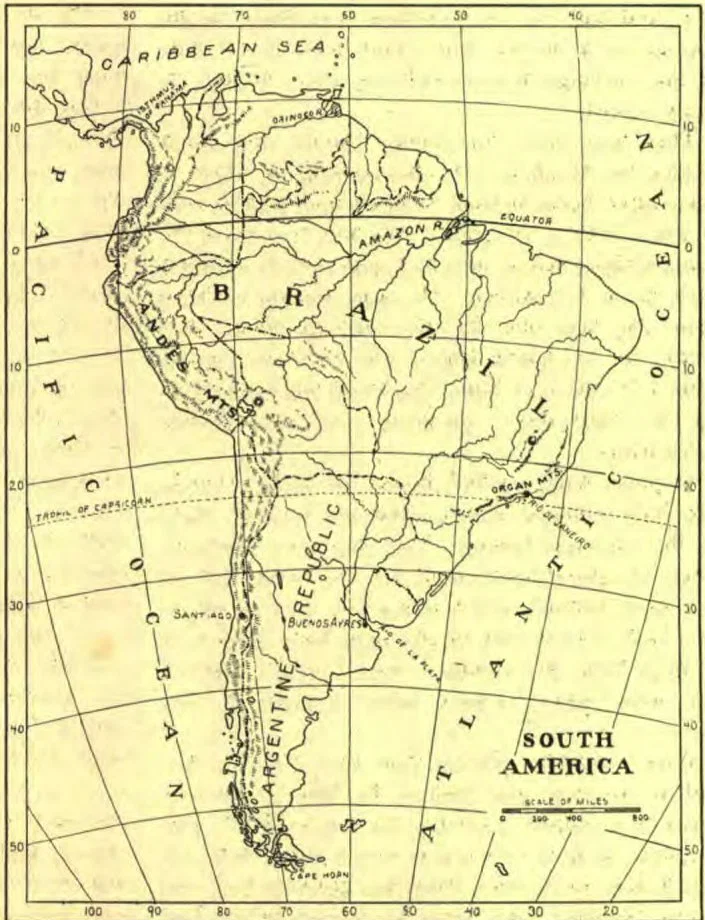
QUESTIONS ON MAP OF SOUTH AMERICA
What country is south of North America? What three large rivers in South America? In what direction does each flow? Why is there no large river in South America flowing west? What ocean is east of South America? What ocean is west of South America? What sea is north of South America? What mountains are in the eastern part of South America? What mountains are in the western part of South America? What isthmus connects South America with North America? What three large cities in South America?
MEMORY VERSE: “There shall no evil befall thee, neither shall any plague come nigh thy dwelling.” Ps. 91:10.
Although the plague of blood continued seven days, Pharaoh did not heed the message from the Lord. Again Moses and Aaron were directed to go into his presence, and make the same request. Each time Pharaoh was made to know that the people of God desired to go to worship him. If the king refused, the land was to be filled with frogs. As in the first plague, the Egyptians were shown how helpless their gods were. The Nile, their sacred river, was caused to send forth legions of frogs, which infested the whole land, and became a nuisance and a torment to the people. They were found in the houses, in the kneading-troughs, in the ovens, and even in the king’s bedchamber and upon the bed. Thus, by the power of the true God, their god was not only polluted, but turned into a source of pollution to its worshipers. The frog was regarded as sacred by the Egyptians, and they would not destroy it; but now it became intolerable.
The magicians appeared to bring frogs in the land, but they could not remove them. Pharaoh called for Moses and Aaron, and begged them to entreat the Lord that he would take away the frogs, promising to let Israel go.
This time Pharaoh had manifested some signs of harkening unto the Lord; but as soon as the plague was removed, he hardened his heart, just as the Lord had said he would.
At the command of God, Aaron stretched out his rod, and smote the dust of the earth, and it became lice upon man and upon beast throughout all the land of Egypt. This impure insect was specially hateful to the Egyptians, and no priest was allowed to approach the altars with any such thing upon his body. To make sure that they were perfectly free from everything of the kind, they shaved their heads and bodies every few days. But now upon priests and people came the horrible plague of lice, which must have put a stop to all their acts of worship, because they could not go near the altars till they were free from it. Then even the magicians said, “This is the finger of God.” But “Pharaoh’s heart was hardened, and he harkened not unto them; as the Lord had said.”
Another of the gods of Egypt was Beelzebub, the fly-god, who was supposed to protect the people from the swarms of flies that sometimes visited the land in very hot weather. The Lord now told his servants to go out to meet the king early in the morning, as he went to the river to worship, and tell him that if he still persisted in refusing to let the people go to serve him, he would send swarms of flies into the land.
This time the Lord said he would make a difference between his people and the Egyptians. While there were swarms of flies, darkening the air, filling the houses, and even covering the ground, in the land of the Egyptians, there were none in the land of Goshen. These flies were large, and their bite was extremely painful.
Pharaoh called for Moses and Aaron, and told them to sacrifice to their God in the land of Egypt. He was not ready to obey the command of the Lord, but hoped thus to appease the wrath of the God of the Hebrews and prevent any further calamities. Moses refused to accept his offer. The animals that the Hebrews must offer as sacrifices were considered sacred by the Egyptians, and such was the reverence with which they were held, that to slay one accidentally was a crime punishable by death. So they could not worship in Egypt without giving offense to their masters.
Moses again proposed that they go three days’ journey into the wilderness. Pharaoh consented, on condition that the plague of flies should be stayed. But Pharaoh’s heart had become hardened by repeatedly resisting the pleadings of the Spirit of God, and he again refused to let the people go as soon as the plague was removed.
Questions
1. What was the second plague?
2. How did the Egyptians regard frogs? Then what was the significance of this plague?
3. How thoroughly was the land filled with frogs? What effect did this have upon Pharaoh?
4. When did he tell Moses to entreat the Lord to have the plague removed? Why do you think he postponed it until the morrow?
5. What did the king do when the plague was stayed?
6. What was the next plague? Why was this so obnoxious to the Egyptians?
7. How was the power of the magicians shown in this plague? What startling truth did they now admit? What effect did this have upon Pharaoh?
8. What was the next plague? What proof did the Lord now give that he had a people in the land of Egypt?
9. What request did Pharaoh make of Moses? Give several reasons why the Hebrews could not sacrifice in Goshen?
10. What promise did Pharaoh then make? With what result?
11. What practical lessons do you see in this experience?
He watereth the mountains from his chambers:
The earth is filled with the fruit of thy works.
He causeth the grass to grow for the cattle,
And herb for the service of man;
That he may bring forth food out of the earth,
And wine that maketh glad the heart of man,
And oil to make his face to shine,
And bread that strengtheneth man's heart.
The trees of Jehovah are filled with moisture;
The cedars of Lebanon, which he hath planted;
Where the birds make their nests:
As for the stork, the fir-trees are her house.
The high mountains are for the wild goats;
The rocks are a refuge for the conies.
He appointed the moon for seasons;
The sun knoweth his going down.
Thou makest darkness, and it is night,
Wherein all the beasts of the forest creep forth.
The young lions roar after their prey,
And seek their food from God.
The sun ariseth, they get them away,
And lay them down in their dens.
Man goeth forth unto his work
And to his labor until the evening.
O Jehovah, how manifold are thy works!
In wisdom hast thou made them all;
The earth is full of thy riches.
Questions
Commit the lesson scripture.
From what source do the mountains receive their supply of water? Read also Ps. 65: 9, 10.
How is the earth filled with the fruits of God's works?
How has he supplied the need of every creature?
What spiritual lesson may we draw from this truth?
By what power does he cause the earth to bring forth food?
Where do we find the first record of this?
What evidence is given of God's care for the trees of the forest?
What tree is particularly mentioned?
Find texts comparing the growth of righteous people to the growth of the cedars of Lebanon.
How has the Lord provided homes for the birds and animals?
To what use has the sun and moon been appointed?
What marks the close of the day? When was this appointment made?
What animals go forth to find their food at night?
From what source do these animals seek their food?
What beautiful lesson did Jesus draw from the fact that God supplies all the needs of the animal creation? Matt. 6: 25–34; Luke 12: 24.
From what source does man receive his food?
For whom has the day been appointed for labor?
Why is man required to work? Is this the result of sin? What in connection with work is the result of sin?
What is said of the work of Jehovah? John 5: 17. How have the works of the Lord been wrought?
With what is the earth filled? How may we share in these riches?
Notes
1. Although the ground was cursed on account of the sin of man (Gen. 3: 17), yet the power of God is working through it to supply his creatures with food. This is a revelation of the power of the cross of Christ in overcoming the curse.
2. From verses 14, 15, we may learn that food, both for man and beast, is the gift of God. Read John 6: 5–12, 27, 32–35, and note the explanation thus given of the annual miracle of multiplying the loaves to feed the world. When the young lions roar after their prey, God regards it as a call upon him for food.
3. Work was not imposed upon man as a punishment for sin. The Father and the Son are both workers. John 5: 17. The experience of weariness and of wearing out while working is, however, one of the results of sin.—Senior Lesson Pamphlet.
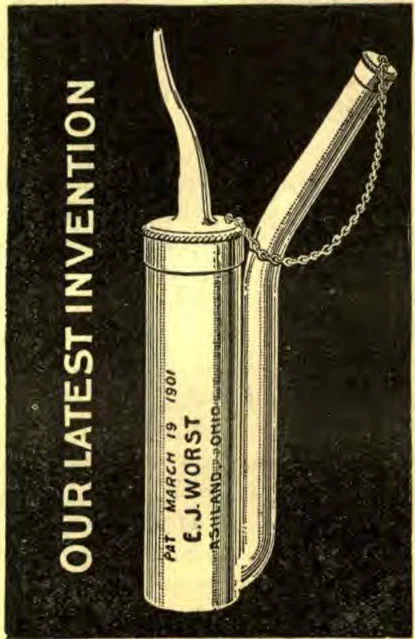
SENT ON THREE DAYS' TRIAL FREE!
By E. J. Worst
THE CO-RO-NA MEDICATOR CURES CATARRH
TWO-THIRDS ACTUAL SIZE.
Head-Colds, Pains and Roaring in the Head, Partial Deafness, Sore Throat, HEADACHE, La Grippe, and all Diseases of the air passages by inhalation. The most perfect appliance ever offered.
SPECIAL OFFER.
For a short time I will mail to any reader naming this paper, one of my new improved Co-Ro-Na MEDICATORS, with medicines for a quick home cure, on three days' trial FREE. If it gives perfect satisfaction, send me $1.00 (half price), if not, return it at the expired time, which will cost you only three cents postage. Could any proposition be fairer? Address,
E. J. WORST,
16 ELMORE BLOCK, ASHLAND, OHIO.
AGENTS WANTED.
EDITORIAL NOTE.—If you have the slightest symptoms of Catarrh, or are easy to take cold, you should send for a Co-Ro-Na on the easy terms offered. In writing be sure to name this paper.
SOLID THROUGH TRAINS OF
WIDE VESTIBULE COACHES and PULLMAN SLEEPING CARS BETWEEN
Battle Creek and Chicago, Buffalo, New York, Philadelphia, Toronto, Montreal, Boston
For time-tables, descriptive matter, and information, apply to any representative of the company.