ONE of the most striking and fruitful of modern discoveries in medicine is the restorative power of fresh air; and the out-of-door cure is now widely adopted for a great variety of diseases. What medicine can not do fresh air does with, rapid and astonishing effectiveness. This is another step, not in the direction of the discovery of remedies, but of a rational and normal way of life; it is as a preventive of disease even more than as a healing agent that out-of-door living assumes increasing importance in the experience of men. There is no doubt that the scourge of tuberculosis, which is a plague far more destructive than cholera or yellow fever, and nervous troubles of all kinds which sap the vitality, pervert the judgment, and blur the joy of life for multitudes of men and women, have their source or occasion chiefly in living too much indoors, and breathing the vitiated air of close, overheated rooms. Simply to throw the windows open is to invite health to come in, and to go out of doors and live is to take health by the hand. “Give me health and a day,” said Emerson, “and I will make the pomp of emperors ridiculous.”
Dr. Johnson once declared that a sick man is a rascal. The world has been well served by sick men, and their fortitude, resolution, and mastery of pain have written some of the most inspiring chapters in the history of human achievement. There is no doubt, on the other hand, that much of the crime in12the world is due to disease; that half the misery has its root in physical infirmities; and that to the same cause is due a vast number of harsh judgments, false and depressing views of life, misconceptions of motives, and morbid wretchedness. Health is not a luxury; it is a duty. He who lives with reckless disregard of the conditions essential to health invites disease, and may, in the end, incur the guilt of suicide. Parting company with nature in overeagerness to make a fortune or a reputation involves not only the loss of one of the great resources of life, but a diminution of the vital energy, and, in many cases, the premature ending of life itself.
If living out of doors is essential to physical health, it is even more essential to moral health. A vast amount of the moral illness in the world is caused by too much indoor life; by keeping too much within ourselves, walking endlessly around the little circle of our own experience, questioning our own motives, trying to settle the problems of the universe from our own individual standpoint, and treating our personal conditions as if they were the general conditions under which all men live. These and a thousand other forms the disease of egoism takes on, and disqualifies men and women not only from exercising sound judgment and seeing things as they are, but from winning contentment, happiness, and sanity. The man who is perplexed by questions about his own fitness to discharge a duty or perform a task can not solve it by thinking about it; let him set his hand to the work, put his strength in it, and he will soon discover whether he has blundered or not. And a multitude of people who are allowing their thoughts to brood continuously over their own misfortunes would find a great lifting of the weight if they would get out of themselves. The quickest and most effective way of helping one's self is to help somebody else. When the invisible house in which every man lives begins to darken, open the windows, set the doors wide, and escape at once into the great world. The remedy for egoism is a greater interest in the affairs, fortunes, and happiness of some one else. The world is full of opportunities for getting out of doors and escaping from the prison-house of our own experience; to take the sting out of your personal misfortunes, share the misfortunes of others.—The Outlook.
Father and Son
“I MUST look to the sheep of the field,
See that the cattle are fed and warm;
So, Jack, tell your mother to wrap you well,
You may go with me over the farm.
Though the snow is deep and the weather cold,
You’re not a baby—you’re six years old.”
Two feet of snow on the hillside lay,
But the sky was blue as June,
And father and son came laughing home
When dinner was ready at noon—
Knocking the snow from their weary feet,
Rosy and hungry, and ready to eat.
“The snow was so deep,” the farmer said,
“That I feared I would scarcely get through.”
The mother turned with a pleasant smile—
“Then what could a little boy do?”
“I trod in my father’s steps,” said Jack;
“Wherever he went, I kept his track.”
The mother looked in the father’s face,
And a solemn thought was there;
The words had gone like a lightning-flash
To the seat of a noble care;
“If he treads in my steps, then, day by day,
How carefully I must choose my way!
“For the child will do as the father does,
And the track that I leave behind,
It will be firm, and clear, and straight,
The feet of my son will find;
He will tread in his father’s steps, and say:
‘I’m right, for this is my father’s way.’”
O fathers, treading life’s hard road,
Be sure of the steps you take;
Then the sons you love, when gray-haired men,
Will tread in them still for your sake;
When gray-haired men, their sons will say,
“We tread in our fathers’ steps to-day.”
—Plank and Platform.
John Wesley’s Quarrel
John Wesley once had a disagreement with Joseph Bradford, his traveling companion of many years, and they agreed to part. They retired for the night, each firm in his determination, and each doubtless deploring in his heart the separation soon to follow between two friends who had been so devoted and mutually helpful. In the morning Wesley asked Bradford if he had considered during the night their agreement to part.
“Yes, sir,” said Bradford.
“And must we part?” inquired Wesley.
“Please yourself, sir,” said Bradford, grimly.
“But will you not ask my pardon?” demanded Wesley.
“No, sir.”
“You won’t?”
“No, sir.”
“In that case,” said Wesley, gently, “I must ask yours.”
It was not the ending Bradford had expected. A moment he hesitated, and then, breaking into tears, he followed Wesley’s example, and forgave and was forgiven.
Life is too short and friends are too precious to justify one in cherishing anger or resentment. Even if the wrong appears to us to be wholly on the other side, something may be conceded for love’s sake.
Worship of God is so joined to love toward men that the forgiving man is sure to be the forgiven man.—Selected.
Do Children Sleep Enough?
An English hygienist holds that in certain boys' schools the masters fail to realize that boys need longer hours of sleep to recuperate from mental fatigue.
“It has been gravely maintained that ‘mental’ action is something different from, and even distinguishable from, ‘bodily’ action; and it has been more than suggested that the energetic performance of the latter will in some way afford relief from fatigue incidental to the former. . . .
“The brain, like other structures of the body, is susceptible of exhaustion from overwork, and requires constant renewal of its energies by the action of sleep and food. In relation to these requirements, it is not possible to distinguish the divisions of the nervous system which governs muscular from those which govern intellectual effort; and to maintain, as is apparently maintained by many schoolmasters, that bodily exercise is itself recuperative after ‘mental’ effort, so that a boy who has been exhausted by study can be restored to his pristine ‘mental’ vigor by a paper chase or by compulsory running, or by any other form of severe and sustained ‘bodily’ exertion, seems to us to be the very extremity of physiological ignorance and of practical unwisdom. It is like lighting a candle at its lower end to make amends for its consumption at the top.
“The real question is simply whether the sum total of the boy's efforts, cerebral and muscular, are or are not in excess of his power to repair damages as fast as they are occasioned, and, at the same time, to provide for the proper growth of his muscles and for the proper development of his brain-cells. For the fulfilment of these essential steps toward the maturation of his powers, whether muscular or intellectual, a sufficiency of sleep is one of nature's conditions; and the inquiry whether the amount of sleep actually obtained, in any given case, is sufficient for the wants of the individual, is one for the physician or for the physiologist, and not at all for the members of the teaching profession. We have known more than one instance in which a boy, distinguished at his school, has employed the early days of his holidays chiefly in making up the arrears of sleep which had become due to him during the term, and in which the only opportunities of doing so had stood between him and complete breakdown. The time has come for schoolmasters to recognize that we know nothing about ‘mind,’ and that ‘brain’ is in no way an exception to other bodily organs.”—The Hospital.
Exploring the Upper Regions of the Sky
A STRING of six kites sent up from the German Aeronautical Observatory at Lindenberg recently attained an elevation of twenty-one thousand and ninety-six feet, or almost exactly four miles. This is the highest elevation yet reached by kite flying, and it illustrates remarkable progress during the last two or three years in this method of investigating the conditions in the upper air.
Three years ago a height of from two to two and one-half miles seemed to be the limit of attainment for kite flying, but there has been steady improvement in the forms of kites and the methods of handling them. The present achievement is all the more noteworthy because it was made on land, where the kites were influenced only by the natural winds. Judging from the work of last summer at sea, the prospect is that still higher kite ascensions will be made this season over the Atlantic, where vessels may steam against the direction of the upper air currents and force the kites to still higher altitudes.
The temperature and wind velocity records of this ascension were very interesting. The thermometer registered at the surface forty and eight-tenths degrees Fahrenheit, but it dropped at the highest point attained to minus thirteen degrees. The wind rate in the lower stratum of the air was eighteen miles an hour, but a fair gale was blowing aloft, where a velocity of fifty-six miles an hour was recorded.
Much higher altitudes are made by the little rubber balloons that the Germans and French are making for high air exploration. One of the balloons sent up at St. Louis last year, under the direction of Mr. Rotch, the director of the Blue Hills Observatory, recorded a height of forty-eight thousand seven hundred feet, with a temperature at that elevation of minus one hundred and eleven degrees. The lowest temperature ever recorded at the surface of the earth was about minus ninety degrees near the Siberian pole of greatest cold. When the dog-days come again, we may derive such comfort as is possible from the thought that only a few miles away a degree of cold is reigning that surpasses anything known in the polar regions.
A difficulty with the balloons is that they are likely to drift far away from the starting-point, and may never be recovered. One of the St. Louis balloons was found two hundred and eighty-five miles from the place of ascent; but an ingenious invention was tested over the Mediterranean and the Atlantic last summer which promises greatly to increase the efficiency of these appliances.
Two balloons are connected by a light cord about one hundred and fifty feet long. After reaching a great height, one of the balloons, which had been more heavily inflated than the other, bursts on account of the greater expansion of its gas. When the wreck reaches the surface, the other balloon is still one hundred and fifty feet in the air, preserving the records and serving as a guide to the place of descent.
Thus the means of exploring the upper air are constantly improving, and the work will be carried on this year with more enthusiasm and energy than ever. Clouds indicate air movements only in the lower strata of the atmosphere, and we knew very little of what is going on above them until high kite flying was introduced. Meteorological science has been considerably advanced by this new phase of exploration. The fact need only be mentioned here that the great result of Mr. Rotch’s expedition to the tropical Atlantic, north of the equator, last summer was the indubitable proof it secured that above the northeast trade wind a counter current (or, in other words, an anti-trade wind) is a persistent phenomenon of those regions.—N. Y. Sun.
Religious Influences in Japan—2
By Maria L. Edwards
MARIA L. EDWARDS, M. D.
The people of Japan to-day are, with small exception, adherents of three systems—Shintoism, Buddhism, and Confucianism—with no distinct demarcation between the three in the minds of the common people. Many worship deities, and observe rites, without knowing or caring whether they are of the Buddhist or Shinto kind. So far as the differences between Shintoism, Buddhism, and Confucianism are recognized however, Shintoism is the cult for the living, Buddhism is for the dead, and Confucianism is the moral code. For worldly prosperity, people pray to Shinto household gods, or at Shinto shrines; for things pertaining to the dead, or for prospect of death and the future life, they pray to the Buddhist idols, or go to the Buddhist temples; for moral guidance they study the literature of Confucianism, since neither Shintoism nor Buddhism has for the Japanese people any moral import.
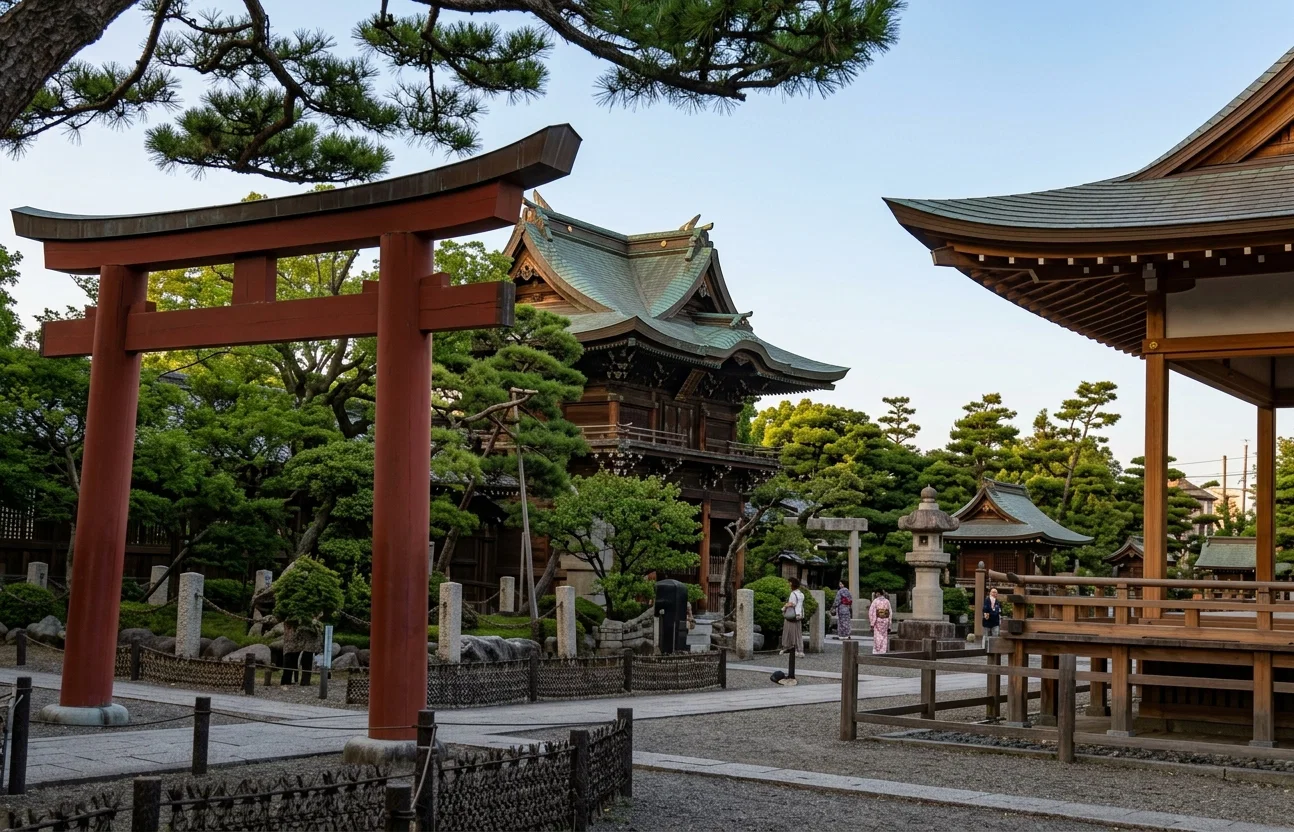
SHINTO GATE, AUSAUKSA PARK, TOKYO
The two classes of temples are to-day everywhere seen. In Tokyo you will not cover a distance represented by two or three blocks, without passing some temple, with its beautiful and neatly kept grounds. If it is a Shinto temple, there is always over the path in front a peculiar square, high gate, and as the worshiper steps up in front of the shrine to worship, he throws his money into a large receptacle, covered by grating, and then pulls a rope, which hangs within easy reach of the worshiper. This rings a coarse bell above him, that is supposed to attract the attention of the gods. The individual then bows, or prostrates himself, according to how devotional his frame of mind, or how great his needs, and then mumbles his petition.
If it is a Buddhist temple, the gate is different, and after the cash offering, the worshiper attracts the attention of the gods by clapping his hands twice—never three times, as that would be very improper.
When we contemplate the immense amount of money that must have been consumed in the erection of all these temples,—for there are many, many of them, and some are most elaborately carved, and covered with gold,—it is no wonder that the majority of the people must live in what seems to us like poverty. The plainest and simplest temple, compared with the common house of the people, is very elaborate and beautiful, and it is almost invariably surrounded by grounds which are more or less extensive, while the homes of the common people are rarely surrounded by any ground.
The “medicine god,” usually at the right of the central shrine, is found in all the temples that I visited, and is so well patronized that often the features, and many times its members, have been worn away by the hands of the supplicant. The hand is rubbed over the god, and then immediately applied to the corresponding sick member, for relief from suffering, or, as seemed apparent by the acts of some, as a sort of security against future ills. One poor, ignorant mother that I chanced to observe, came up to the god, leading two children, and carrying one. She rubbed her hand over the god, and then over each of the little tots in turn, and also over herself, and then moved on, well satisfied with what she had done for her family.
In almost every house, if we do not find the complete seven gods of the household, part Shinto and part Buddhist, we are sure to find the two—the god of wealth, seated on two sacks of rice, and the god of pleasure, with his happy, jovial expression of the face.
Not all the people by any means go to the temples to worship, or pay much regard to the household gods; but at times of death, unless the person is a Christian, the priest, who controls the cemetery rites, must be called to dispel the evil spirits, which are supposed to congregate about a corpse, conduct the funeral ceremonies, conduct the spirit through the realm of shades; and, lastly, prayers for the dead must be said by the priest. For several successive days he comes to the house to burn more incense and say more prayers, and after that he comes once a week, for a year. At that time the deceased is supposed to have entered paradise, and become a Buddha. Now he must be honored as a deity, and the priest offers him food, and gives him news of the home whence he departed. The relatives must also have a part in the service for the dead. They must make visits to the temple where the ashes are buried, on the monthly recurrence of his death-day, for a year, to bring food and flowers, and to pray that he may truly be brought into paradise, and that the dead may keep in peace and prosperity the home from which he departed. These acts and ceremonies for the dead are probably more universally carried out than any other of the Buddhist requirements. So, although nearly the whole population is Buddhist, it is in large part only in name.
The people of the country to-day may be divided into three classes, on the question of their relation to the faith: First class, those who are independent or skeptical. They have nothing further to do with Buddhism than to have their dead buried, and, perhaps, prayed for, by the priest. A large portion of those crowding the government classes and two imperial universities, or who have gone forth from them, are of this class. The student class, of whom I met many at my sister’s, Mrs. F. W. Field, since she lives near the Tokyo Imperial University, were very bright, intellectual, promising young people, and also very interesting. To my mind, this is a most hopeful class for the principles of Christianity. They have become too enlightened and too intelligent to any longer trust in the heathen gods and traditions, and are feeling after something better. A very frequent reply for this class to make when asked if they are Christians, is, “Not yet; I do not know, I have not had a chance to study,” showing that they are open to conviction. Second class, those who, though they have no positive faith in Buddhism, yet give alms to the mendicants, support the temples, and occasionally pray to the idols as a mere matter of decency, or with an idea of being on the safe side. Third class, those who endeavor to fulfil14all their religious duties regularly, as prescribed by the priests. They worship the household gods faithfully, and visit the temples regularly, and show the spirits of all dead all due reverence. This class is very easy to recognize, and according to my observations, those composing it are the most ignorant. Taking it all in all, the impression made on the observer is that the day has come when the ancient religion sits very lightly on the Japanese heart.
Christian missionary efforts for the Japanese did not begin until the sixteenth century. The first European landed in that country in 1542, the same year in which firearms were introduced, with which the natives were very much taken; in fact, Christianity to many of them means big guns and powder. In 1549 two Jesuit missionaries and two interpreters landed. Trade flourished in some of the cities, and remarkable success attended the efforts of these missionaries, so that in 1581, two hundred churches, with one hundred and fifty thousand converts, had been numbered. The Catholic faith became exceedingly popular. Temples were changed to churches, idols to the image of the Virgin Mary, and nearly everything that had been used in heathen worship was adopted and utilized in some way in the new religion. In 1583-84 young noblemen were sent to the pope, delivering themselves to be vassals of the Holy See. Converts numbered six hundred thousand (some give the number as high as two million), and among them were princes, lords, generals, officers of the fleet, ladies of the royal household, etc. The missions flourished for a hundred years, when a reaction came, persecution arose, and the priests were driven out, and thousands were martyred for their faith. So in earnest were the authorities in crushing out this religion, that they decreed that never again, so long as the sun should shine, would any foreigner be permitted to enter their country.
For more than two centuries Japan’s ports were absolutely closed to foreigners, until the wonderful treaty made by Commodore Perry, in behalf of the United States, in 1854. While the edicts against Christianity have never been repealed, they were removed from the public edict boards in 1873. Since that time the work of the Protestant missionaries has gradually gone forward. Quite a number of the denominations have churches built, and in some cases they are presided over by native pastors. In Tokyo there is a very creditable and substantial Young Men’s Association building. The Woman’s Christian Temperance Union established a good work among the Japanese Christian women. Several Protestant schools have been established in the larger cities, and are doing a good work. The fact that it was vacation, and the teachers were up in the mountains for their summer’s outing, prevented my visiting these schools and becoming familiar with their methods of work. But the buildings and grounds of such schools, in both Tokyo and Kobe, had the appearance of success.
In some cases the Japanese who accept Christianity must endure a great deal of opposition, if not persecution, from friends and relatives. One little lady whom I met, belonging to the Presbyterian Church, has nearly been disowned by her relatives. She has learned to speak the English very well, and was kind enough to go with me to many places, to act as spokesman for the party. She asked very many intelligent questions regarding the truth, which we gladly answered, and supplied her with the best literature at hand.
It seems to me that God has prepared this field for the present truth in a variety of ways: first, the country is again open to foreigners; second, the English language is required in the public schools, and the people of the better classes are not only willing, but anxious, to learn all they can of the ways of the Christian countries; third, the distribution of literature is permitted in hospitals and such places where people can be reached in large numbers; fourth, the work that other Protestant denominations and organizations have done in establishing schools and distributing the Bible; fifth, above all, the mind of the most intelligent classes is longing for something more satisfactory than Buddhism, is open to conviction, and they are literally waiting for the truth to be brought to them.
THE JAPANESE INTERPRETER
Let us not omit to work and pray for Japan, before what seems to be God’s opportunity is past.
Moline, Ill.
The Student Volunteer Convention
By Estella Houser
ESTELLA HOUSER
The fifth international convention of the Student Volunteer Movement, which convened in Nashville, Tenn., the closing days of February and opening days of March, was the largest gathering of its kind ever held. The motto of this movement is the “evangelization of the world in this generation,” and they are working to that end with a most commendable zeal, and singleness of purpose. They believe the evangelization of the world is possible, and are bending all their energies to accomplish it. Over five thousand delegates were in attendance, and more than fifty missionary boards represented.
Since the organization of the movement twenty years ago, more than three thousand volunteers have gone to foreign fields. And their work has not been limited to making missionaries. The reflex influence on the home churches has been incalculable. The growth of mission study, thus developing an intelligent constituency at home, has been phenomenal, more than one hundred and fifty thousand students having been enlisted in a year.
The gathering together of so many intelligent young people to consider the missionary problem is a significant occurrence to those who know the gospel will be preached in all the world in this generation. We quote briefly from the executive committee’s report, which will be of interest to every Seventh-day Adventist:—
“The year 1906 is a year of two anniversaries of unusual interest and significance to the student world. It is the twentieth anniversary of the inauguration of the Student Volunteer Movement for Foreign Missions at Mt. Hermon, and also the centennial anniversary of the American foreign missionary enterprise which began with the memorable Haystack Prayer-meeting at Williams College in 1806.
“The field for the cultivation of which the Movement holds itself responsible is among the students of the United States and Canada. Thousands of students have become volunteers by signing the volunteer declaration, thus indicating their desire and purpose, God permitting, to become foreign missionaries. A larger number of new volunteers have been enlisted during the past four years than during any one of the three preceding quadrenniums. The Movement has on its records the names of 2,953 volunteers, who, prior to Jan. 1, 1906, had sailed to the mission field. At the Toronto convention the hope was expressed that during the next quadrennium one thousand volunteers might go forth. It is a striking coincidence that the number who have sailed during the past four years, so far as we have information, is an even one thousand, about one third of whom are women. Not less than fifty denominations are represented in the sailed list.
“By far the greatest service, however, in promoting missionary education has been through its educational department, which was inaugurated twelve years ago. Since then the Movement has organized mission study classes in 668 different institutions. During the past year there were 1,049 mission classes with an enrolment of 12,529, an increase of over seven thousand students in four15years. The object of this department is to stimulate systematic, thorough, and progressive lines of study by volunteer bands, mission study classes, and individual students. This is developing an intelligent and strong missionary interest, and doing much to make such interest permanent. It is developing right habits of praying and giving for missions. It is promoting reality in Christian experience. It is equipping those who are to become leaders at home to be real citizens of a world-wide kingdom.
“The time has come to undertake things on a vastly larger scale. The conditions on the mission field favor as never before a great onward movement. The world is open and accessible as to no preceding generation.
“Momentous changes are in progress. On all the great battle-fields the conflict has reached the climax, and if the present attack be adequately sustained, triumph is assured. The watchword of the Movement, ‘The Evangelization of the World in This Generation,’ must be taken up in dead earnest by different bodies of Christians as the cardinal point in their policy.
“This work of making Christ known to all men is urgent beyond all power of expression. If these great things are to be achieved, we must pay what it costs. What will be the price? Undoubtedly it involves giving ourselves to the study of missionary problems. It will cost genuine self-denial. In all the hard, persevering labor to which we must give ourselves, not least must be the work of intercession. It is only when we come to look upon prayer as the most important method of work, as an absolutely triumphant method of work, that we shall discover the real secret of largest achievement.”
Takoma Park, D. C.
THOS. J. KENNEDY
By Thos. J. Kennedy
Jamaica
THOS. J. KENNEDY
“Then answered Peter and said unto him, Behold, we have forsaken all, and followed thee; what shall we have therefore?” Matt. 19:27. Many in the ranks of Seventh-day Adventists to-day are asking this same question—“What shall we have therefore?”—when those that have never heard the sound of the third angel’s message are dying at their very doors. Although in this, our beautiful little island of Jamaica, the gospel message of a soon-coming Saviour has been heralded, yet there is still much to be done. In the interior of the island there are those who are living in secluded places, down in the valleys, and on the mountain tops, who have never heard of this great threefold message of salvation, and yet we who profess to have the truths for this time, and are living almost in the midst of these careless ones, are asking the question, “What shall we have therefore?” How can we sit with folded arms when the enemy is rallying his forces to the front, and expect the few ordained ministers alone to combat with this terrible foe? We can not expect this. Their hands are already filled with their portion of the work, and the burden is very heavy on them—trying to encourage and keep close together those that have been already brought into the fold.
The burden of our work should be the salvation of souls. We should be anxious to see all saved in the everlasting kingdom of God. How gloomy is the thought that comes to us when sometimes we think of those we once loved and still love, but who are separated from us by death or distance! but greater still will be our sorrow to know that souls whom Jesus loves and died to save will be eternally separated from him and us, when we had the opportunity of saving them from eternal ruin. If the fourteen hundred and forty-two Sabbath-keepers in this island would awake to a sense of their duty, and go out into the highways and the hedges with the open Bible, what a mighty work would be done! Soon the warning message would be sounded in the very remotest parts of our island home. God is now preparing the hearts of men and women for the reception of his invitation; and as we go among the people, this is our experience. Let us all arise to our responsibilities, brethren, and instead of asking, “What shall we have therefore?” take for our consolation the twenty-eighth verse of Matthew 19: “And Jesus said unto them, Verily I say unto you, That ye which have followed me, in the regeneration when the Son of man shall sit in the throne of his glory, ye also shall sit upon twelve thrones, judging the twelve tribes of Israel.”
Warsop, Jamaica.
Bibles in All Lands
Story of Colporteurs in the British and Foreign Bible Society
THE hundred and first report of the British and Foreign Bible Society is a fascinating story of a British organization spreading Bibles by the million all over the world.
During the past year the society has issued a total of 5,857,645 Bibles, New Testaments, and portions of Scripture. In the course of its existence it has sent out 192,537,746 copies of the Holy Scriptures complete or in parts.
To carry the Scriptures from door to door, the society employed last year 950 colporteurs at a cost of over $200,000. “If our eyes could trace these ‘humble Bible sellers up and down the world,’” says the report, “we should see them busy among Indian rice-fields and along the Chinese waterways, across the Canadian prairies, and through the Australian bush, and beside the great African lakes; we should watch them sheltering in native huts in the snowy defiles of the Andes, and threading their path under trails of purple orchids through the forests of Brazil.” Stories of the colporteurs at their work provide interesting reading.
Petrenko, a Siberian colporteur, writes: “Between the villages of Berenovia and Kemarichi the driver and I nearly perished in a bad blizzard. We were on the steppes, some twenty versts from our destination. Thank heaven, we managed to get through; our horses were good ones.”
Sabrikin, also in Siberia, tells of how one of the Russian soldiers, on his way to the front, saw a New Testament being offered to some one else. He pulled out his purse, and counted out the money, and then, seizing the book in his hands, reverently kissed it.
Arequipa, “the city of the Sacred Heart,” in Peru, is a place where the Bible has been banned and burned, and where the colporteur has never been able to stay more than a few days. Two colporteurs went there, and were defended by a few liberal-minded men. Persecution followed, and Arequipa, as the following quotation from the report shows, was soon in an uproar:—
“The controversy between liberals and clericals in Arequipa became acute. The colporteur, Espinoza, while selling Bibles, was brutally attacked and badly mauled in the streets by the ‘secret police,’ and marched off as a prisoner. Once in the police office, Espinoza protested against this outrage, claimed protection, and asserted his rights in the circulation of the Bible, whereupon he was set free.”
Last year the colporteurs sold over 2,250,000 of the Scriptures.—Selected.
China’s Military Reform Scheme
CHINA'S latest reform scheme has been to transform the historic literary examination halls in Peking into a military school. The surprisingly fine record made at the recent army maneuvers by the thirty thousand soldiers — three quarters of the army already recruited in the metropolitan province of China — has inspired the Chinese authorities to redoubled efforts, not only in that province, but also in many others.
Other Sheep I Have
“And other sheep I have, which are not of this fold: them also I must bring.”
Oppression of Jews in Russia
The oppression of the Jews in Russia has long been a cause of wonderment to other nations. No Jew in Russia may buy land or farm it; he may not live in the country, and only in certain parts of a town. He may not be a schoolmaster or professor, or even a teacher in a Christian family; he may not be educated at a public school or university, unless he is included among the Hebrew “exceptions,” about five per cent of the whole student number, though in Odessa ten per cent has been granted.
MISSION Notes
“In vain the world would tempt me
To seek my fortune here;
In vain my heart would hold me
By friendship's bond so dear.
My Master calls me onward,
My heart is all aglow,
My home is with the heathen,
And O, I long to go!”
A New Church in Urbana-Champaign
By P. G. Stanley
Illinois
UNDER the direction of the Southern Illinois Conference, the past summer Elder M. G. Huffman and the writer held two series of gospel tent-meetings in Urbana and Champaign, the twin cities of Champaign County. As a result of the untiring efforts put forth, a church of twenty-four members was organized Sabbath, March 10. Three have united since, making our present membership twenty-seven. The church has secured a comfortable place for its meetings, and has paid one year's rent in advance.
Urbana and Champaign have a combined population of twenty thousand, and are located in a rich agricultural district. These cities respond readily to thrift and industry, and are an inviting location for resourceful artizans, such as carpenters, plasterers, and painters. One or two medical missionary nurses possessing tact and good address, could readily acquire a firm foothold in that profession. A baker would find a hearty response to his hygienic productions. Our health foods are in demand, and are found on sale by some of the leading grocers. The University of Illinois is located here, with an enrolment of between five thousand and six thousand students, the flower of the State. Urbana and Champaign affords an excellent opportunity for consecrated missionary enterprise. P. G. STANLEY.