Her boy. He had been hers in his youth. They said he was like her, and he loved her then. She had often sat for hours by his cradle, and read out of that beautiful face his future—and hers; for what was hers belonged to him, and what he had or made was hers. They were one heart. She had sacrificed her youth to give her boy a chance, and her joy had been the tears she shed on his pillow while he slept. He didn’t know, and if he did, he forgot. Most boys do. She had built air-castles for him, sleeping and waking, not of fancy, though her fancy retouched them. She knew his genius, and she knew as well the taint in his blood. She counted him up without it, and it was mother-like to forget it. She loved him as she loved no one else, and a mother’s love is not stern. If she made a mistake, she didn’t know it then. But in the wreck of the years she remembered.
To-day her boy is lost in a sodden, uncouth man of thirty. You would scarcely know in him the blue-eyed, dimpled child whose portrait hangs over the sofa where he lies in torpid slumber. The light is gone from his eye, his face is pale, and in it is the dark tragedy of a beaten manhood.
And the mother, bent not with the weight of her years, but with the burden of a great sorrow, gray with snows that have come in cruel haste on the very heels of summer, sits beside him—her boy. She loves him still—for what he was. She keeps the memory. No part of her early vision is left to her. Her day-dreams have melted, and to-day she gathers the broken threads together and seeks to weave them into the vague vision of other years.12
If you had seen him, you would have wondered if this could be that mother’s boy. Faded she is and marked with the years; but she is beautiful, compared with this soiled garble of a man buried in the fetid fumes of his own debauch. The wind howls against the eaves as if to twist the roof from the cottage shell it had been pledged to protect. The windows rattle in their cases, and the lamp on the rude table where she sits answers every gust of wind that blows. The shadows tremble on that pale, wan face, and she shivers. It is not because the little room is cold, nor because she fears the uncanny noises that the storm is tattooing on the old stove-pipe chimney, nor does she dread that the ragged form upon the sofa will rise from his heavy sleep. It is the bitterness of memory that chafes her sad heart, and makes her tremble. Her boy—still hers—but somehow to-night she wishes for death for him and her. She thinks of the then and the now, the days of his youth and his childhood—the first night he disclosed the appetite she dreaded, the kiss with which he had sealed her lips as he left her, her long delirium of wakefulness, the heavy footfall, the prostrate form lying in the hallway amid the shadows of the midnight, her own tears and the agony that filled her soul, and then the shame and humiliation of that morning meeting.
And now age had come and gray hairs. Now her child was a man—and such a man! The world despised him, and in his sober moments he despised himself; but to the mother he was still her boy. Battered and broken, the semblance of what he might have been, friendless and poor, he had still a mother, and she had still—a boy.
Rum may shatter homes and break friendships. It may damn and poison everything that a clean hand cares to touch. But there is a citadel that it has not taken, where, while life lasts, the prodigal may find an asylum for his penitence and his misery. The saloon has never yet dammed back the fountain of a mother’s tears, nor has it stifled the full and free affection of a mother’s heart.—Thomas A. Bagshaw.
The Work in the European Fields
By J. R. CONRADI
J. R. CONRADI
(Concluded)
In the Russian Union Conference there are three conferences and three mission fields. Several new missions are being developed in Siberia and Central Asia. Elder Boettcher is at present visiting some of these fields, expecting that advance moves will be made there as fast as our men and means will allow it. During the past three months, four hundred twenty-five members were added in the Russian Union Conference, and its membership is nearing three thousand.
In the British Union Conference there are two conferences and three mission fields, and the prospects are that before this year is past, two new conferences will be organized there.
While the work in the Latin Union Conference is moving slowly, yet we are thankful that the cause of God is onward in France, and that plans are being laid to increase our growth in that field, so that a mission in northern France may be organized erelong. Souls are also being added in Spain, Portugal, and Italy.
We are glad that we have succeeded in getting some more laborers into the Levant. Our forces in Turkey have been strengthened. We have begun labor among the Greeks in Greece and in Smyrna. Elder W. Ising has taken hold of the work in Syria, and additional help is being provided for that field. Elder J. J. Nethery is in charge of the work in Egypt, and we hope that additional help may be also supplied to him.
At our last German Union Conference meeting, four workers were provided for German East Africa, two to go to Palestine, and one to the Dutch East Indies, while two sisters are to join the Abyssinian mission. Thus a company of nine young workers will go from Europe into the “regions beyond” this fall.
While the financial depression continues in our field, we are thankful to God, who is at the helm, that his blessing makes up for any deficiency. In general, our European institutions have enjoyed a more prosperous year than ever before. Our Hamburg House increased its output by about one third last year, printing over sixty-two million pages of literature. Our missionary paper, Herold der Wahrheit, has now an average semimonthly edition of over fifty-five thousand, and we plan to get out one hundred fifty thousand copies of our extra number this fall. The other papers are likewise increasing in circulation. We are publishing in more than thirty languages in Europe; and over four hundred canvassers are at work distributing this literature.
Our sanitariums are enjoying the special blessing of God. The Friedensau School is increasing its facilities, by the erection of a new building to supply new classrooms, and living rooms for the teachers, and in the course of time, room for fifty more students. The Scandinavian Union Conference has decided to erect a suitable school building in connection with the sanitarium at Skodsborg, supplying the necessary strength to that growing sanitarium, with its one hundred sixty patients, as well as enabling the sanitarium workers to give proper instruction in medical missionary lines to the students of the school. England is also at present contemplating the erection of a college building at Watford, and plans for the building are under consideration. The Latin Union Conference has provided suitable classrooms; and the Russian Union Conference is gathering money for the erection of a union school there in a few years. Thus, whether we look at the publishing, the sanitarium, or the educational departments, the work is onward.
We also have a number of promising young men in the European universities who are preparing for the medical missionary work. We are especially thankful that these young people are inspired with the true missionary spirit, ready to work shoulder to shoulder with the workers already in the field, for that which is greatest of all—the salvation of souls.
The European field is also preparing to take another new step. In the past, the expenses of the men who were sent to the General Conference in America were paid by the appropriations; but now, seeing that there are about seventeen thousand members in Europe, and twenty-one conferences, which are self-supporting, and most of which are paying a second tithe to missions, these conferences themselves will send their delegates. As we presented this matter in the Scandinavian and German union conferences, the brethren all saw the need of sending a full delegation at their own expense, so that young, growing men, as well as older ones, may get the benefit of such a general gathering, and be still more filled with the true missionary spirit.
We are grateful to God that we can hear “the sound of a going in the tops of the mulberry-trees” on every side of us, as well as from the other side of the Atlantic; for we are happy to state that the third angel’s message is going faster and faster in Europe.
By the middle of September, I hope to have a meeting of the General Conference Committee in Europe; and then, with a number of faithful laborers, I plan to leave for Africa, first having a general meeting with the workers in the Levant field, where we expect also to meet one of13the brethren from the Abyssinian mission. Then we trust we shall be able to go on to British and German East Africa and Uganda, and, later, to attend the South African Union Conference.
These trips will call for the opening of new fields, for the sending out of more consecrated laborers, and for a larger investment of means. But as we are assured that the coming of the Lord is drawing nigh, we know that if God’s people will everywhere awake and consecrate themselves and their means to his cause, it will not be very long now until this threefold message will have finished its onward march around the world; therefore, let us pray for the laborers who go forth into these fields, and let us be faithful before God in supplying the necessary means. An eternal reward awaits the giver.
The Hague.
Origins of Common Plants
CELERY originated in Germany.
The chestnut came from Italy.
The onion originated in Egypt.
Tobacco is a native of Virginia.
The nettle is a native of Europe.
The citron is a native of Greece.
Oats originated in North Africa.
The poppy originated in the East.
Rye came, originally, from Siberia.
Parsley was first known in Sardinia.
The pear and the apple are from Europe.
Spinach came from Arabia.
The sunflower was brought from Peru.
The mulberry-tree originated in Persia.
The gourd is probably an Eastern plant.
Walnuts and peaches came from Persia.
The horse-chestnut is a native of Tibet.
Cucumbers came from the East Indies.
The quince came from Crete.
The radish is a native of China and Japan.
Peas are of Egyptian origin.
Horse-radish is from Southern Europe.
Barotseland Mission
By W. H. ANDERSON
W. H. ANDERSON
It has been some time since I sent in a report. I have often thought of writing, but have put it off; and now I have so many things to say that I hardly know where to begin. First, I must thank the Mission Board for the good help sent me in Brother and Sister J. F. Olmstead. They are just the help needed.
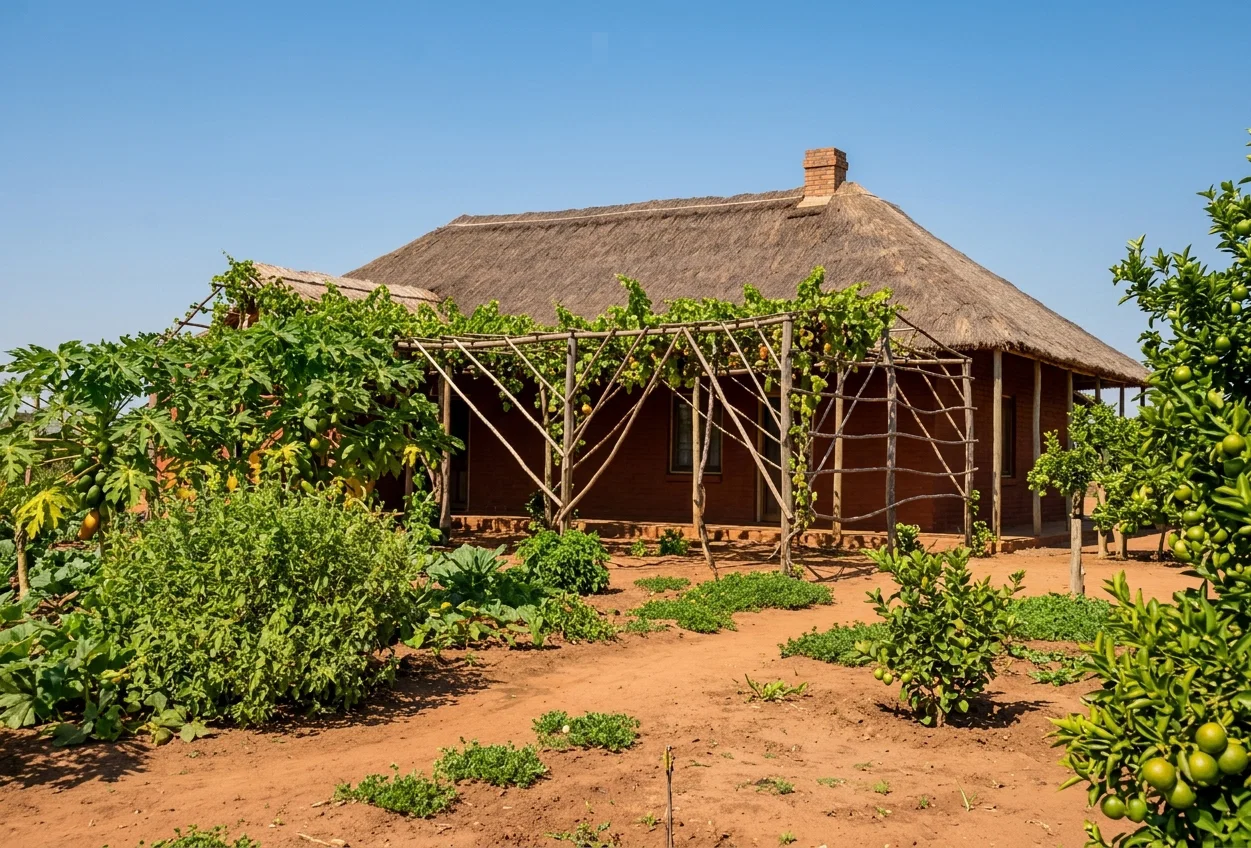
Our oranges are doing well, but it takes the trees longer to come into bearing than the lemon-trees. We had a few this year, and hope in December to put out one hundred fifty more grafted trees, that will be in full bearing in four years' time. Our bananas, pineapples, papaws, and guavas are looking well, and we have all the guavas and papaws we are able to use on the station.
W. H. ANDERSON'S NEW DWELLING-HOUSE
We have a nice plat of ground that we can irrigate from the spring, which will make us a fine garden for the dry weather. In this way we are able to grow three crops a year, and so have an abundance of vegetables all the year round. This is necessary for our health here, as we are not able to buy anything of that kind.
I am sending a picture of my new house. I can not tell how grateful I am for it. If only my dear wife could have lived to enjoy it for just a little while, how glad I would have been! Brother Olmstead shares the house with me until some time after we get this house built. I wish that we had had the help and the money earlier in the year, so that we would have been able to get the building finished before the hot season begins; for it is not pleasant to work in the sun when it registers 120°. But we will try to do the work in the early morning and in the evenings, so that we shall not get the direct rays.
SCHOOLHOUSE DONATED BY MRS. W. H. ANDERSON.
Since coming to Africa, I have never had such good health as I now enjoy. I have had no fever since last November. The end of the fever and moving into the new house coincide exactly. Yet I have never done the hard work since I came up here that I am doing now. You can imagine what my burdens are.
We have an attendance in the school here of forty-three. Thirty-one more are in school on the out-stations, and new ones are coming all the time. We are extremely busy with teaching and caring for the boys. However, that is what we are here for, and we are glad to be able to do it.
Brother Olmstead and I will go to the Falls next week to attend a conference of all the missionaries of Rhodesia. There will probably be a committee appointed to wait on the government to ask for greater freedom in the labors of the native teachers in this country. Papers will be read by old missionaries on almost every phase of the mission work, and our relations to the natives. Then the papers will be discussed by those present, and much valuable information will be obtained in that way.
Immediately on our return from the Falls, I shall make a trip to the out-stations, and assist in starting some buildings that are much needed.
We expect much help from Elder Conradi's visit, as we desire to profit by the experiences of the brethren on the east coast. Of course we have a people to deal with who are inferior to those on the east coast.
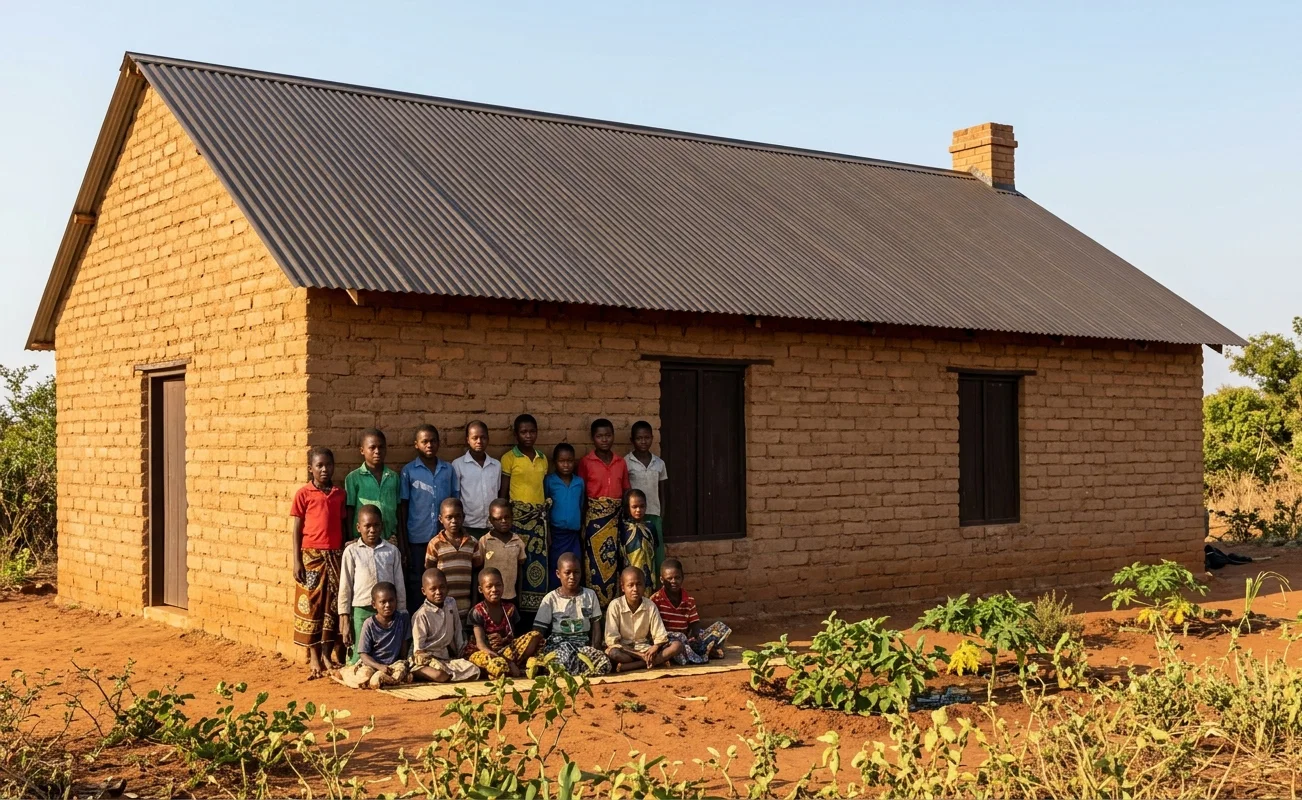
I will send you a picture of the school building. This building is a donation from my wife. Its cost, with furnishings, was one hundred pounds. That amount did not include the labor for making the bricks, as they were made by the boys in the school. In fact the school-boys have done all the work on the place.
Last week I was out to the east, to see some natives who had sent me word that they wanted a school. They received me very kindly. I held several meetings with them, with an attendance of about one hundred fifty. I will see what I can do for them when we go to the Falls. If I can not get the grants of the out-stations, there are five thousand acres here at this station, and we will establish them right here on our own land. As soon as Brother Olmstead gets hold of the school language so that he can help in the school, we shall take turns making journeys through the country, recruiting the pupils for the schools here. If we can not do the thing one way, we will find another. The work simply must be done; and if the way does not open on the right hand, we will break forth on the left hand. We have the grant of this farm, and none can interfere with what we do on our own land.
We are looking for a strong move forward when the new laborers arrive. We shall stand by them, hold up their hands, and help them in every way that we can.
Pemba, N. W., Rhodesia, So. Africa.
Santo Domingo
By B. E. Connerly
B. E. CONNERLY
I SUPPOSE that this is the first report from Santo Domingo that the readers of the REVIEW have ever read; and for this reason it may be well first to say a few words about the republic and conditions there, for there may be those who are not familiar with its history. Santo Domingo has an area of eighteen thousand square miles, five times that of Porto Rico, but the population numbers only six hundred thousand, thus making it, in point of numbers, one of the smallest republics in the world. The island was discovered by Columbus on his first voyage, and was made a Spanish possession. Later the great navigator made this island his home. The early Spanish colonists did no permanent good, spending their time in filibustering, warfare, and gold hunting.
In 1785 France took possession of the island, and it remained under French control until 1809, when it was again returned to Spain for a short period, becoming later a part of the republic of Colombia, organized by Simon Bolivar. In 1821 the Haytians took possession14of the country, and retained it until the rebellion of 1844, when the patriots were successful, and established the Dominican republic, which they retained until 1861. Then Spain again got a foothold, but succeeded in holding it only four years. The Dominicans again triumphed, and it has remained a republic up to the present time.
Because of incessant revolutions and political strife, there has been but little progress. One of the first maxims of the country is, “Men for war, donkeys for work,” and thus agricultural development has been neglected, education has received little attention, and foreign capital and settlers have been kept out.
Three years ago the American government came to the aid of the Dominicans by guaranteeing the payment of seventeen million dollars of debts to different European powers; and to secure themselves, they have taken possession of the customs of the republic, thus securing peace for at least ten or fifteen years. Already there can be seen multiplied evidences of prosperity. The foreign trade last year was more than twelve million five hundred thousand dollars, the exports $7,628,356, and the imports $4,948,961. Railroads and public roads are being constructed, and streets and sidewalks are being improved in the cities. Schools are being built, and the last legislature voted to make large inducements to foreigners to settle in the country and improve the vast tracts of virgin soil. We wish some of our Adventist brethren would take advantage of these inducements.
The country last year exported 108,210,326 pounds of sugar, 3,376,970 pounds of coffee, 22,384,082 pounds of cocoa, and 21,802,982 pounds of tobacco.
The Roman Catholic religion is, of course, the religion of the country, having been established there since the beginning. The people seem to be satisfied with that form of worship; for I failed to find here the general discontent with priestcraft which is found in many Catholic countries. However, the government tolerates, or rather ignores other religions. Protestantism was introduced into the republic in 1822, when three companies of colored people from Maryland and Virginia settled there; it can not be said, however, that they did much toward propagating their religion, but it was at least known that they were Protestants. Of late years the Methodists, Moravians, and two or three independent workers have been laboring among the English-speaking colored people, but practically nothing is being done for the Dominicans.
Brother C. N. Moulton and family went over there from Porto Rico last December to begin the distribution of our literature; we have also a faithful sister in Monte Cristi, another in Samana, and two brethren in San Pedro de Macoris. In the latter place as a result of seed sowing with the literature, I was permitted to baptize eight persons. This will give a good impetus to the work there. These seem imbued with the spirit of service for others of their countrymen. The Sabbath-school here numbers twenty-five. We now have two Sabbath-schools in the republic.
We began the circulation of El Centinela there last year, and had splendid success. This greatly stirred up the Catholics, and they have made a hard fight against us this year, but Brother Moulton is nevertheless prospering in his work, and selling a good many Bibles and a number of our subscription books. His address is La Cruz de Mendoza, Santo Domingo, R. D.
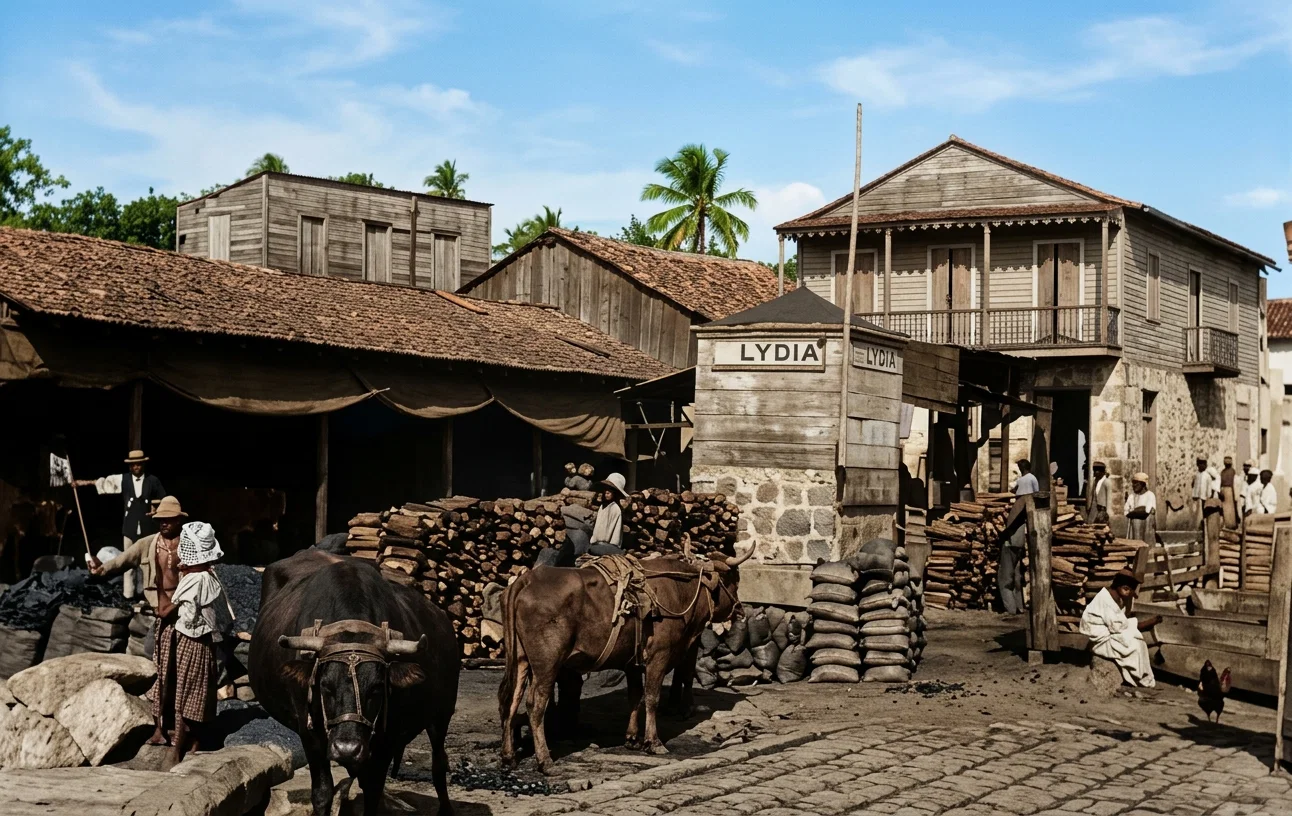
A CHARCOAL MARKET IN SANTO DOMINGO
We feel of good courage concerning the work in Santo Domingo, and earnestly desire that this neglected field may have an interest in the prayers of those who are aiding our work, and remembering us at the throne of grace.
Mayaguez, Porto Rico.
Another Foreign Field at Home
By B. E. Fullmer
B. E. FULLMER
THE city of Los Angeles, Cal., has among the other nations represented, a colony of about two thousand Russians. In the last few weeks a deep interest to know about the third angel’s message has developed among them; and in response to their call, some of the local church workers are distributing literature and holding meetings with them.
The history of these exiles at our doors is one of devotion, even to death, to what light they have received, there being of their early leaders not one who escaped a violent death at the hands of either the Greek Church or the Russian mob. Among these were M. S. Uklay and S. M. Dalmatoff, who were sawn asunder.
About one hundred years ago these men began a protest against certain customs of the Greek Church, especially the use of images and ikons. They also adopted Moses’ directions as to meats, and refused swine’s flesh. For the latter they were nicknamed Molokon, meaning literally ‘milk-eaters;’ but they themselves take the name of Spiritual Christians, from their belief in the perpetuity of the gifts of the Holy Spirit, which is one of the cardinal points of their faith. They also refused to bear arms, thus affronting the government as well as the church. These things brought upon them a bitter persecution, and all worship was conducted secretly and at night, as all who were detected were sent away in chains.
At the first about two thousand were sent away, the place of exile selected being south of the Caucasian Mountains, between the Black and Caspian Seas, in the country called Transcaucasia. This was intended to be death, as it was supposed that the Mongol and Tartar inhabitants would make a speedy end of the exiles. Many, however, survived, and their children, with the others banished during the century, now number about one hundred thousand. They are a pastoral people, living largely in the country. Nearly all can read, and they have some books on their faith, but the government does not allow them the privilege of printing any paper.
The only favor shown them by the government was a fifty-years’ exemption from war duty. This time is now expired, and present efforts to force them to arms has driven these people to our doors. No honors or offices are allowed them, and the priests of the state church at times display the ikons, and all who refuse to recognize them are sent to jail. Points of interest in their faith, showing how God has led them toward full present truth are:—
Belief in the soon coming of Christ.
Non-use of tobacco and liquor.
Refusing swine’s flesh, with a decided trend toward vegetarianism.
Belief that all rewards or penalties depend upon a coming judgment, and are not being received now.
Belief in spiritual gifts.
Added to these is a leavening of Sabbath-keeping, there being here members of a third generation of Sabbath-keepers. In the home colony there are about one hundred of these, though some of them have felt that to accept this they must deny Christ as do the Jews.
In their worship, all are considered equals; but if one among them shows special talent, he is by common consent allowed to lead, but speedily displaced if found in error. Their meetings are marked by earnestness, and we hope to be able to add to their present zeal a knowledge of what God has done for us, believing that their coming to us is for a purpose.
A Japanese Christian’s Door Notice
A JAPANESE has been in the habit of posting on his door this notice when he leaves home for his work in the morning: “I am a Christian; and if any one likes to go in and read my good Book, while I am out, he may.”
Florida
By R. W. Parmele
AMONG THE CHURCHES.— On the third day of July I started for a tour among our churches. Sabbath and Sunday, July 3, 4, were spent with the church at Lakeland. This church, being composed largely of members recently come to the faith, was without a full corps of officers. Some brethren of experience who had recently located there, made it possible to supply this lack. Brother P. Rothrock, formerly of West Salem, Ill., was chosen elder. By invitation of the Cumberland Presbyterian pastor, I spoke in the Presbyterian church Sunday morning and evening. At the close of the night service, the pastor very kindly invited me to occupy their pulpit at any time I could make it convenient.
Sabbath and Sunday, July 11, 12, I was with the Bartow church. A good interest was manifested, and on Sunday one sister was baptized.
The time from July 13-21 was spent at Orlando, looking after sanitarium business, quite full mention of which has already been made in the REVIEW. I am glad to be able to say that we have secured the services of some physicians and nurses of long experience in this cause. Among the latter is Miss Amelia Webster, well known to many of our people.
A few days were spent at Palatka, making further arrangements for our camp-meeting, after which I proceeded to Windsor. A company of colored brethren and sisters have stood faithfully for the truth here for a long time, but had never been organized. With the assistance of Elder C. B. Stephenson, and our colored preacher, Brother John Manns, a church of ten members was organized.
With the exception of one day, the time from July 24 to August 6 was spent at Gainesville. Elder C. B. Stephenson joined me at this place, and continued with me until my last appointment. The church building was finished, freed from debt, and dedicated, during our stay there. One was added to the church, and two others promised to keep the Sabbath.
Brooker was our next stopping place. The Lord blessed here also. The church building was cleared of debt and dedicated, and one member was added to their number.
The time from August 14-19 was spent with the Jennings Lake church. At our last meeting three came forward and united with the church. Two of these had not previously been Sabbath-keepers. One other promised to observe the Sabbath, but was not quite ready to make a complete surrender.
August 20-27 we were with the new company at Morriston. This company was brought to the truth as a result of tent-meetings held there last spring by Elders L. T. Crisler, C. B. Stephenson, and Brother Branson. This is the place from which our colored preacher was driven last spring because some had begun the observance of the Sabbath, thus interfering with the turpentine industry. We were happy to be able to organize a church here fully equipped with officers, and with eleven charter members. One brother deeded to our legal body a tract of land in the highest part of the little town, on which to build a church and school; and $134.50 was pledged by the brethren and citizens toward the erection of the church building. Truly, they “can do nothing against the truth, but for the truth.” I was greatly encouraged by my visit to this company, and believe their hearts were also cheered.
From this point Elder Stephenson was called home on account of sickness in his family, and I proceeded to Plant City, to spend Sabbath and Sunday, August 29, 30. My wife joined me at this place, and during these two days assisted in the meetings. She gave a lecture on health Saturday night, which was well attended and much appreciated. I spoke to the white brethren three times, received two members into the church, and baptized one.
Sister Ella Sanks and her associates have been conducting a school here for children of their race (colored). The Lord has blessed, and they have built up a good school. But it has required sacrifice and consecration. To our brethren in the North who have contributed to help the schools for the colored people, I wish to say, Your liberality is much appreciated, and is bearing fruit. By appointment, the Tampa, Lakeland, and Bartow companies of colored people met at Sister Sanks’s school in Plant City, and were organized into a church of sixteen members.
Summing up this two months’ work, in addition to the matters of business attended to, two church buildings were freed from debt and dedicated; money and a suitable location were secured for still another building, and three churches were organized; forty persons were taken into church fellowship on profession of faith and four by letter, five were led to accept the Sabbath truth, and two were baptized. I have personally enjoyed excellent health during this time, and feel as fresh for service as when the effort began. To our loving Heavenly Father be all the praise.
R. W. PARMELE.
Bonacca
By F. E. Cary
NORTHEAST BRIT.— It has now been some time since the work in this place has been reported. After a vacation of two weeks, I again opened school, with an enrolment of twenty-nine. The ages of the pupils range from six to sixteen, and we have seven grades. Although we are now having rainy weather, most all attend quite regularly.
At least half of the children are from homes where this precious truth is not obeyed; and while they may know it to some extent, still there is great need for missionary work with them. I am continually having opportunity to send them reading-matter, which they seem to enjoy. As I see some results of my work, I am filled with courage to press on as never before.
It is our prayer that God may use the training that these children are receiving to bring their parents into the truth. God alone knows the work that this army of children can do if they are dedicated to him.
“As the rain cometh down, and the snow from heaven, and returneth not thither, but watereth the earth, and maketh it bring forth and bud, that it may give seed to the sower, and bread to the eater: so shall my word be that goeth forth out of my mouth: it shall not return unto me void, but it shall accomplish that which I please, and it shall prosper in the thing whereto I sent it,” is a promise that buoys us up to sow the seed. Soon will the Master come. May we be faithful till that great day, and meet our Saviour in peace!
F. E. CARY.
British East Africa
By A. A. Carscallen
In the Kavirondo Country
“ETHIOPIA shall soon stretch out her hands unto God,” is a text quite well known; but the fact can not be realized until one comes to work among that people. We have been in this country for fourteen months and have every reason to feel encouraged for the success of the work. During this time we have gained the confidence and friendship of the people for many miles around, erected a good house large enough for two families, a schoolhouse sixty-five by twenty feet, and another large building for workshops and storehouse. We have also become well enough acquainted with the language to make ourselves understood wherever we go. As the language has never been reduced to writing, we have had no help from books, and we have just had to learn it by working with the people and hearing them speak. We are, however, beginning to write portions of the Bible now, and try to teach these texts to the people each Sabbath.
The people here are very superstitious, and have many objects of worship; but they pay very little attention to worship of any kind, except in time of sickness or fear. They acknowledge the sun to be a god, but I have never seen them worship it, and do not know of any form in which they do. They regard the crocodile as sacred, but only hang small pieces of a dead one on their persons as charms, and do not worship it when living. They look upon their ancestors as spirits, and often sacrifice to them to gain their favor or to appease their wrath. If any one worships or sacrifices to many different gods, he is generally regarded as a sinful man. I have never heard them speak of praying to anything but to the God whom they acknowledge to be the supreme being who rules over all things. Even this worship is of a very heathenish sort. It will be conducted at the time of a large gathering, and but one man prays. Such gatherings are generally held when there is something mysterious to be decided. If a person be found murdered; and the murderer is unknown, they will hold a meeting to decide who is guilty. At the meeting one of their head men leads, and orders a sheep to be killed. When the sheep is opened, he examines it thoroughly, then offers his prayer, or rather says a lot of words that no one understands but himself, and when the prayer is closed, he gives the name of the mur-16derer. At such a time woe to one of the leader’s enemies, for the one named is at once put to death.
The following extract from our local paper will give an idea of what we have to meet sometimes. This extract is a true report. I know the government officer who conducted the inquiry.
A Court Scene in British East Africa
“Scene: District Court at ‘X.’ Kavirondo witness, giving evidence, states that certain cattle, alleged to have been stolen, have been taken to ‘Y,’ a neighboring station.
“Court: ‘You say that the cattle have been taken to Y. How do you know this?’
“A: ‘I went to Y myself.’
“Court: ‘When did you go to Y,—before, with, or after the cattle?’
“A: ‘I went with the cattle.’
“Court: ‘You accompanied the cattle?’
“A: ‘No. I went before the cattle.’
“Court: ‘What do you mean by saying that you went before the cattle, when you have already stated that you went with the cattle?’
“A: ‘I went to Y after the cattle got there.’
“Court: ‘You have already made three contradictory statements. If you make any more, I shall be compelled to punish you for prevarication. Now, answer me truly. When did you go to Y,—before, with, or after the cattle?’
“A: ‘I did not go to Y at all.’”
Though on being questioned the natives make such statements, it is not that they wish to be untrue. They do it because of fear. They think they are being entrapped and wish to avoid it. We often find strangers giving just such answers, but when we become acquainted, and they learn to trust us, we can depend upon them in nearly every case.
A few weeks ago some government officers were over here, and called in some men to work for them. When the Sabbath came, many of the men refused to go to work. The officers asked for a reason, and the natives said, “This is the Sabbath, and we will not work on God’s Sabbath.” Though our ability to teach them has thus far been very limited, we are glad that the truth is coming before them. We are in a dark and heathen land, but it is filled with kind, tender, and simple hearts, which are open to the message of salvation, and we are sure that they will see the truth of this last message of mercy. We have many things to meet that are unknown in the home lands, but we do not have to present the gospel to hard, prejudiced hearts. We meet those who do not know God, not those who do not care for him.
We feel of good courage, and are sure that the Gentiles will come to the light, and that “from beyond the rivers of Ethiopia my suppliants . . . shall bring mine offering.” Will God’s people kindly remember us and our field before the throne of grace?