—In our own day the temptations which have been incident in every age are multiplied. We are living at a time when the crop of crime is enormous. Our statistical tables recount what the year has rendered of sugar, rice, indigo, hay, wheat, corn, and cattle; but there is no statistical table that I know of that gives us the growing crop that is harvested every year of crime and criminals. We scarcely recover from the surprise which the explosion in one direction produces before we are alarmed in another direction. Men are dropping like untimely figs from the boughs of prosperity. Crimes are happening all over the land, and they are largely crimes for the sake of procuring money. . . . I look with great alarm, though I am not an alarmist, on the times that are yet to come, as I see what are the great influences that are at work; what are the educating forces that are flowing through the commercial channels of society. Temptation belongs to our nation, our time, our business and our very life, and it becomes every man to feel that he is sending his children out upon an ocean that has swifter and deeper currents than any ocean that ever flowed.—H. W. Beecher.
Our Casket.
“A little balm, and a little honey, spices and myrrh, nuts and almonds.” Gen. 43:11.
—He who thinks his place below him will certainly be below his place.—Saville.
—A man may well bear his cross patiently, while on the road to wear his crown.
—Contempt is like a hot iron that brands criminals; its imprint is almost always indelible.—Albert.
—The neglect of one religious opportunity will, most probably, indispose and unfit for the next.
—All God’s providences are but his touches of the strings of the great instrument of the world.—Charnock.
—The greatest events of an age are its best thoughts. It is the nature of thought to find its way into action.—Bovee.
—Govern thy lips
As they were palace-doors, the king within;
Tranquil and fair and courteous be all words
Which from that presence win.
—Getting up in the morning is like getting up in the world. You cannot do either without more or less self-denial.
—Beautiful lives have grown up from the darkest places, as pure white lilies full of fragrance have blossomed on slimy, stagnant waters.
—If thou wouldst find much favor and peace with God and man, be very low in thine own eyes. Forgive thyself little, and others much.—Leighton.
—We might enjoy much peace if we would not busy ourselves with the words and deeds of other men, which appertain not to our charge.—Thomas a Kempis.
—There is nothing about which the world makes so few blunders, and the individual so many, as a man’s actual importance among his fellow-creatures.—Shaw.
Notes of News.
—An insurrection in Venezuela is reported.
—The French army in Tunis numbers 30,700 men.
—In Chicago there is one divorce to eight marriages.
—The French Chamber of Deputies has ratified the Franco-Tunisian treaty.
—Citizens of Columbus, Ohio, are taking measures to close the saloons on Sunday.
—The ex-postmaster of Houlton, Me., has been arrested for robbing the mails.
—Social and political affairs in Russia have seriously affected the trade of that country.
—A Roumelian bandit has captured a rich land-owner, and demands $30,000 for his ransom.
—A Nihilist bomb manufactory has been discovered in Paris. Three arrests have been made.
—The College of Physicians and Surgeons in New York has just graduated 120 new doctors.
—The Russian capital is honeycombed with dynamite mines, and plots and disasters are the order of the day.
—The emigration of Swedes to this country is little less than an exodus, and is alarming the Swedish government.
—There has been fighting between the Boers and Caffres at Pretoria, South Africa. The latter lost seventy men.
—The railway concessions which General Grant desired to obtain have been granted by the Mexican government.
—A law to repress the use of alcoholic liquors has passed the Second Chamber of the Netherlands by a vote of 60 to 11.
—A monument to Geo. B. Armstrong, the founder of the postal railroad service in this country, has been erected at Chicago.
—The ex-chief of the Albanian League has been court-martialed, and sentenced to death. Nearly all the other members of the League have been arrested.
—The Christian Union states that a post-route has been discovered over which the United States mails are carried at the rate of $700 a letter.
—Trouble is brewing for San Domingo. Haytians and Dominicans, well armed, are the hostiles, and the periodic San Domingo revolution, the object.
—There is a Jewish couple residing in Keesmet, Hungary, whose united ages amount to 217 years. The husband is 106 and his wife 111 years old.
—An English paper alludes to the United States as “a country where the dignitaries are not officials, however high, but railroad conductors and hotel clerks.”
—Aug. 5 will be observed by the Methodists all over the world as a day of prayer for the Divine blessing upon their Ecumenical Conference, which is to meet in London.
—At Mountain Home, Ark., a party of mounted men recently plundered the principal store, securing several thousand dollars in cash, and then set fire to the building.
—Brennan, Secretary of the Land League, has been arrested under the coercion act. There are six flying columns preserving the peace in the disturbed districts of Ireland.
—During the month of April about 60,000 immigrants landed at the port of New York. Besides this unprecedentedly large number, 95,930 landed at other ports in the country.
—The Ohio Central Railroad has announced that it will henceforth run no Sunday excursion trains, that its employees may have one day for rest and worship. Thus the Sunday movement progresses.
—Mr. Heap, United States Consul General at Constantinople, has reported to the government the continued prevalence and extension of the plague, in spite of the most vigorous efforts to confine it.
—On the 11th inst., the St. Louis Museum of Fine Arts was formally opened. The building is in the Florentine style of architecture, and contains a memorial hall, class rooms, and galleries. It cost $175,000.
—The new King and Queen of Roumania were crowned on Sunday, May 22. The crown was of steel made of Turkish cannon captured at Plevna. The new kingdom comprises the former Turkish provinces of Wallachia and Moldavia.
—The investigation of the star-route frauds has developed a contract to carry the mails six times a week, between Ozark and Eureka Springs, Ark., a distance of 80 miles, for $14,400. The contractor re-let the job for $4,800, clearing $9,600.
—The land troubles in Ireland are leading to incendiarism. At Mallow, County Cork, eight farm-houses have been burned. A collision between peasants and bailiffs and soldiery occurred at Mitchellstown. Several were wounded on both sides.
—Turkey made war-like demonstrations, apparently as a menace in the Franco-Tunisian affair; but as none of the powers saw fit to indorse her belligerent attitude, she prudently concluded that France did not mean to annex Tunis, and abandoned the field.
—In the case of Johann Most, the Socialist editor of the Freiheit, who has been on trial in London on the charge of inciting to murder the Czar, the jury have returned a verdict of guilty, with a recommendation to mercy on account of the prisoner’s being a foreigner.
—A frightful disaster occurred at London, Ont., on the 24th inst., the Queen’s birthday. The steamer Victoria, with over six hundred excursionists on board, suddenly collapsed, and became a complete wreck. At latest accounts, 238 bodies had been recovered, and there were still persons missing.
—At St. Joe, Mo., on the evening of the 23d, one hundred barrels of Danforth’s fluid ignited in a cellar located under a saloon much frequented by colored men. The building, in which a large number of persons were assembled at the time, was completely wrecked. Several bodies have been recovered.
—The late Czar of Russia in his will disposed of 48,000,000 roubles. Of this sum, 30,000,000 was bequeathed to his son and successor, Alexander III., and the remainder is placed at the absolute disposal of his morganatic wife, the Princess Dolgorouki. The Princess has instructed her financial agents to invest her great wealth in American securities, and several million dollars have already been thus invested.
—The commissioners having in charge the preparations for the Yorktown Centennial Celebration, have purchased a site of 500 acres of land, and have selected a site for the memorial shaft. President Garfield’s headquarters during the centennial ceremonies will be in the old Moor House, which witnessed the capitulation of Lord Cornwallis. The corner-stone of the monument will be laid Oct. 18, and on the following day, the anniversary of the surrender, the dedicatory exercises will take place.
—We clip the following curious item from the columns of the Christian Advocate: “Here is the record of another centenarian: Louis Lessard, of Montreal, was born in Paris, France, in 1777, and recently he fulfilled the duties of a coroner’s juror with the keenness of intellect of a man half his age. His extreme age was doubted until he produced a silver snuff-box which he said was presented to him by Napoleon I, after the battle of Austerlitz, and began a narration of facts that bore the impress of truth. He served under Napoleon in most of his great battles, ending at Waterloo. He removed to Canada in 1830.”
—Several well-known gentlemen of New York, including Dr. J. G. Holland, of Scribner’s Monthly, have organized a company to be known as the “Metropolitan Coffee-House Company.” The object is to furnish resorts, particularly for workingmen, which shall be as attractive as the rum-shops, and as free as they are, but without their evil influences and results. They design to erect a large building in one of the crowded sections of the city, which shall contain a spacious coffee-room, a well-supplied reading-room, rooms for games and smoking, apartments for the superintendent, and lodgings for single men. The projectors of this enterprise expect to do good and make money.
—In Philadelphia, the Jesuits arraigned the principal of a girl’s grammar-school before the Board of Education on a charge of instructing her pupils in doctrines contrary to the teachings of the Roman Catholic Church. It appeared that her crime was teaching the facts of history; and as these facts are not creditable to the humanity and Christianity of that church, they were unwilling to have the children learn them. After a full hearing, the Board sustained the teacher. Her priestly prosecutor was indignant, and bitterly denounced the schools, telling his people they could not again “send their children to such evil-teaching places,” except “under pain of mortal sin.”
—According to the Scientific American, it has been estimated that in 1878, on the 270,000 miles of railroad, there were at work 105,000 locomotives, aggregating 30,000,000 horse power, while the total number of engines amounted to 46,000,000 horse power. Taking the nominal horse power at an effective force equal to three horses, and the work of a horse as equal to that of seven men, it will be seen that the steam engines represent the force of nearly 1,000,000,000 men, which is more than double the amount of workers on the face of the globe. The steam engine, which is fed by coal, has, therefore, tripled the productive power of man.
—In view of the fact that the Woman Suffrage Bill was recently lost in the Senate of the Empire State, by the close vote of 55 to 59, the Christian Union thinks “it is high time for those women who value the right to be exempt from the duty of voting to bestir themselves in petitions against the present movement.” It adds that “the only arguments that carried any weight in the Senate against the bill were the doubts as to its constitutionality, and the claim—for which there is considerable ground—that the women generally were opposed to having this greatness thrust upon them.” The Evening Post suggests the propriety of submitting the question to the women, and letting them decide by vote whether they wish to vote or not.
—The German government has used every device to prevent the emigration of its citizens, but to no purpose. Failing to keep her sons at home, Germany has attempted, as the next best thing, to keep them German, and thus propagate a German influence throughout the world. But here, too, she has been defeated, and the despairing cry is, “Our children all turn into native Yankees in the second or third generation, and are lost to us.” As a last resort, an attempt is now to be made to turn the tide of emigration toward some part of South America, where it is hoped the German element may be able to maintain itself. To facilitate this enterprise, a leading German journalist is about to start on an extended tour through South America. There is quite a belief in Germany that a large and influential German colony with a decided German policy may yet be created under the Southern Cross.
Obituary Notices.
“Blessed are the dead which die in the Lord from henceforth.” Rev. 14:13
PEARCE.—Died of spinal disease and bronchitis, in Bull City, Kan., Feb. 18, 1881, our lovely babe, John Eli, aged 2 months and 12 days. M. AND C. P. PEARCE.
GILBERT.—Died at Lakeview, Mich., May 16, of nervous prostration, Eld. George H. Gilbert, aged 24 years. Bro. Gilbert was born at Tecumseh, Mich., Nov. 11, 1857. At the age of seventeen, while attending Battle Creek College, he became a Christian, and began preaching at twenty. Last fall, at our General Conference, he was ordained. He attended College during the winter, completing his fourth year. Being ambitious, he probably overstudied. Then he took the measles, which was followed by typhoid fever. He was sick about two weeks. One year ago he married sister Sarah M. Collard, a worthy Christian woman. He leaves a little babe.
At the funeral, our church was filled with sympathizing friends and relatives. Bro. G. was an excellent Christian man, beloved by all, and gave promise of becoming an able minister. But his labors are over, and he rests in hope. D. M. CANRIGHT.
POLLARD.—Died at Liberty Pole, Vernon Co., Wis., March 25, 1881, our dear sister, Lucina Pollard. Had she lived four days longer, she would have been seventy-eight years of age. Sister Pollard was much esteemed by all who knew her as a true woman and a Christian. She had been a member of the Reformed Methodist Church for twenty years. In 1871 she embraced the present truth, and was a consistent member of the Liberty Pole church till the time of her death. We have good reasons for believing she will rise in the first resurrection, and have a home in the kingdom of God. During her last sickness, she manifested much patience, meekness, and resignation to the will of God. She has always been a good, faithful mother to her large family of children, and has set a good example before them. Now she sleeps in Jesus. May we be prepared to meet her. Funeral discourse by Eld. Houghton, from Rev. 21:4. A. D. OLSEN.
HAZELETT.—Died of lung fever, at her home in Rochester, Ind., May 16, 1881, Martha A. Hazelett, aged 52 years, 9 months, and 15 days. She was among the first who began the observance of the Sabbath at Rochester, during the tent-meeting held by Elds. Waggoner and S. H. Lane, nearly seven years ago. As a Christian she was faithful and true, and died in the Lord, an inheritor of the special blessing pronounced by the Spirit in Rev. 14:13. She leaves four children, to whom she had always manifested the spirit of a loving, devoted mother. Her faithful prayers while in life for her beloved children have since her death borne fruit in her eldest child’s conversion, who has determined by God’s grace to meet her dearly loved mother in the first resurrection. May Sister H.’s three remaining children follow her example. Funeral discourse by the writer from Rev. 14:13. A. W. BARTLETT.
KELLOGG.—Died in Battle Creek, Mich., May 10, 1881, of consumption, J. P. Kellogg, in the 74th year of his age. The name of Father Kellogg is one with which the earlier friends of the cause are all familiar. Having become in his youth interested in the great question of the religion of the Bible, he made his influence felt wherever he might be. Entering a pioneer settlement in Livingston Co., Mich., forty-five years ago, he was the first to call in the living preacher and establish religious meetings in his neighborhood. As early as 1852, he embraced the doctrines of S. D. Adventists, and ever after manifested a deep interest in the progress of this work. At a Conference held in Battle Creek, Mich., May 20, 1856, his official relation to this cause began by his being appointed one of a committee of five, of which he was treasurer, to manage tent operations in this State. At the same meeting, he was elected one of a publishing committee of three on the REVIEW AND HERALD, in which capacity he served till the formation of the Publishing Association in May, 1861, when he became one of the corporators of that institution, and served on the Board of Trustees till 1863. In 1867, he joined with nine others in signing articles by which the Health Reform Institute, now known as the Sanitarium, was incorporated, leading the list by the largest subscription to its capital stock. He was elected one of the Board of Directors of that institution, and served till 1869. Bro. Kellogg was also the first superintendent of the first S. D. A. Sabbath-school in Battle Creek, which we believe was also the first Sabbath-school established among our people. The later years of his life, owing to increasing bodily infirmity, were years of comparative retirement and inactivity; yet he maintained an abiding confidence in the truth he had espoused, and a sustaining trust in the Lord, his Saviour. And thus his life came to a serene and peaceful close. A large congregation attended the funeral at the Tabernacle, the 14th, when remarks were made from Rev. 14:13: “Blessed are the dead which die in the Lord from henceforth.”
“Beyond life’s toils and cares,
Its hopes and joys, its weariness and sorrow,
Its sleepless nights, its days of smiles and tears,
Will be a long sweet life, unmarked by years,
One bright, unending morrow!”
“Ear hath not heard the song
Of rapturous praise within that shining portal;
No heart of man hath dreamed what joys belong
To that redeemed and happy blood-washed throng,
All glorious and immortal.” U. S.
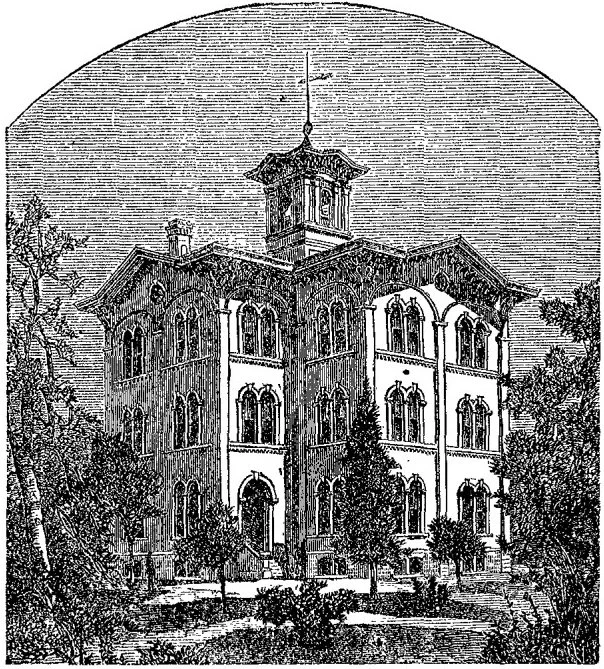
BATTLE CREEK COLLEGE.
A MODEL EDUCATIONAL INSTITUTION, COMPRISING FIVE DEPARTMENTS.
Nearly 500 Students Enrolled Annually, Coming from 32 States and Territories.
DEPARTMENTS.
I. DEPARTMENT OF THE ARTS AND SCIENCES.
This includes a Classical Course of FOUR YEARS and an English Course of three years, each with its Preparatory Course of two years.
II. NORMAL DEPARTMENT.
This includes a Teachers’ Course of FOUR YEARS, and a Model School. The course in this department includes all the branches required for a first-class certificate in any State. Professional instruction in Didactics is also given to those in this department who are expecting to teach.
III. COMMERCIAL DEPARTMENT.
This includes instruction in the following topics: Bookkeeping, Business Correspondence, Business Forms, Business Penmanship, Commercial Law, Banking, and Telegraphy. The common branches are also pursued in connection with the topics given above; also, French and German.
There are two sessions daily—afternoon and evening.
The courses in this department are of varying length, and the tuition ranges from $5.00 to $30.00.
Superior advantages for those desiring to prepare themselves for Tract and Missionary Secretaries and Librarians. (Send for special circular.)
IV. DEPARTMENT OF THEOLOGY.
This department has a course of three years, which includes, besides the usual common branches, Geology and Greek.
V. DEPARTMENT OF HYGIENE.
This department has a course of one year. It is designed for those who desire to obtain accurate and scientific information on all subjects pertaining to the preservation of health, together with a fundamental knowledge of anatomy and physiology, and a practical acquaintance with the nature and ordinary treatment of common diseases.
THE FACULTY
numbers fourteen members. They are all men and women of experience and critical scholarship.
The majority of the students are young men and women of true moral worth. Their influence over the unstable is highly restrictive and salutary, making it comparatively easy to maintain the most rigid discipline.
EXPENSES.
Probably there is no other College in the United States where a thorough education can be obtained at so small an expense. A system of clubbing, which has become very popular among students, enables them to secure excellent board at $1.10 a week, exclusive of lodging, which costs 50 cents to $1.00 more. The annual expenses of each student, including all but traveling expenses and clothing, need not exceed $113.00. A full descriptive Catalogue will be sent free, upon application.
Address BATTLE CREEK COLLEGE, Battle Creek, Mich.
REVIEW AND HERALD PUBLISHING HOUSE.
BOOK AND JOB PRINTING, BOOK BINDING,
Electrotyping, Stereotyping, Paper Ruling, Blank Book Manufacturing, Etc.
The largest and best equipped printing office in the State. Orders by mail promptly attended to.
Address REVIEW AND HERALD, Battle Creek, Mich.
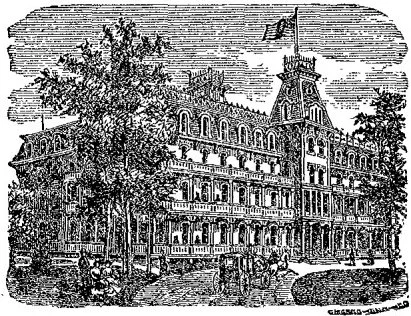
MEDICAL AND SURGICAL SANITARIUM,
By John Harvey Kellogg
Battle Creek, Michigan.
This institution, beautifully located in one of the most healthful cities of Michigan, is everywhere recognized as the
GREAT SANITARIUM OF THE WEST.
More than 4,000 patients successfully treated. The erection of new buildings and the addition of all the most approved remedial appliances known to the profession, have made it The Most Complete Institution of the Kind in America. All modern hotel conveniences furnished. Terms very reasonable.
J. H. KELLOGG, M. D., Medical Superintendent.
Address,SANITARIUM,Battle Creek, Mich.
GOOD HEALTH.
By John Harvey Kellogg
J. H. KELLOGG, M. D., Editor.
This popular health journal enters upon its fifteenth volume with the most flattering prospects for a continuation of the prosperity that has attended its publication in the past. It has for several years enjoyed the
LARGEST CIRCULATION OF ANY HEALTH JOURNAL IN AMERICA,
and its publishers are determined, not only to maintain the high position already attained, but to greatly increase its circulation the coming year, and thus enlarge its field of usefulness.
During the year each number will contain a large amount of valuable and interesting matter on the subjects of Health, Temperance, Popular Science, General Literature, and other topics of interest. The practical information in its pages on Sanitary Science, Public and Domestic Hygiene, and topics of kindred nature, gives it a scope and field of usefulness peculiar to itself, and unoccupied by any other journal.
AN ILLUSTRATED ARTICLE
on practical hygiene, or some other topic of general interest, will appear in each number, as a new and permanent feature of the journal in the future. In addition to this the Department of Questions and Answers, which has contributed so much to the success of the journal in the past, will be revived in a practically useful form, and made more valuable than ever before.
SUBSCRIPTION PRICE, $1.00 A YEAR.
PREMIUM FOR NEW SUBSCRIPTIONS.—The "Household Manual," a work of great value as a book of ready reference, packed full of practical information, and sold at retail for 75 cents, is offered new subscribers with GOOD HEALTH for one year, for $1.25. We regard this as the best premium offer ever made, as the book alone is well worth the subscription price of the journal, and 25 cents extra secures both.
Specimen copies of the journal will be sent free to any address on application.
Address GOOD HEALTH, Battle Creek, Mich.
NEW TESTAMENT.
REVISED VERSION.
Nonpareil, paper covers, $ 20
Nonpareil, cloth, flexible covers, 25
Nonpareil, French Morocco covers, 75
Brevier, cloth, flexible covers, 60
Brevier, French Morocco covers, 1 20
Brevier, Turkey Morocco covers, 2 35
Long Primer, cloth covers, 1 10
By mail, postpaid, on receipt of price. Address
REVIEW & HERALD, Battle Creek, Mich.
STIMME DER WAHRHEIT.
A GERMAN MONTHLY ILLUSTRATED FAMILY JOURNAL.
Devoted to the maintenance of practical Christianity and Bible religion. It is bold and outspoken in its explanation of the prophecies and defense of the doctrines of the near coming of our Saviour, and the binding obligation of the Law of God.
Its neat appearance secures general favor, while the low price at which it is offered places it within the reach of all.
TERMS, PAYABLE IN ADVANCE.
TO AMERICAN SUBSCRIBERS.
Single copy, one year — 50 cents.
To new subscribers, with Way of Life as premium — 65 cents.
Five or more copies for missionary work, per copy — 40 cents.
Ten or more copies — 35 cents.
TO EUROPEAN SUBSCRIBERS.
Single copy, one year — 60 cents.
To new subscribers, with premium — 75 cents.
Five or more copies, per copy — 50 cents.
Ten or more copies, per copy — 45 cents.
Address REVIEW AND HERALD, or, STIMME DER WAHRHEIT, Battle Creek, Mich.
JUVENILE BOOKS.
The Sunshine Series. Stories for little ones, in ten small books, adapted to children from the ages of four to ten years. In glazed paper covers, 320 pp. 50 cts.
Golden Grain Series. A choice collection of instructive stories suited to the wants of children from eight to sixteen years and older, illustrated and beautifully bound in three volumes.
THE HARD WAY, 160 pp. 40 cts.
THE SCHOOL-BOY'S DINNER, 160 pp. 40 cts.
GRUMBLING TOMMY, 160 pp. 40 cts.
Golden Grains in Ten Pamphlets. The same reading as in the first two volumes, without pictures, in ten pamphlets of 32 pages each, 320 pp. 50 cts.
Sabbath Readings for the Home Circle. In three volumes, containing moral and religious reading for the household; carefully selected, and compiled for the use of Sabbath-school and family libraries. Each 60 cts.
The Child's Poems. Containing Little Will and other stories, teaching beautiful lessons of temperance and virtue. Bound in cloth and richly embossed in gold and black. 128 pp. 30 cts.
The Game of Life. Three lithographic illustrations with explanations. These scenes represent Satan playing a game with man for his soul. Neatly bound in board. 50 cts.
The Advent Keepsake. A collection of Bible texts for each day in the year, on the subjects of the Second Advent, the Resurrection, etc. Muslin, 136 pp. 25 cts.