The Youth’s Instructor, Vol. 29, No. 41.

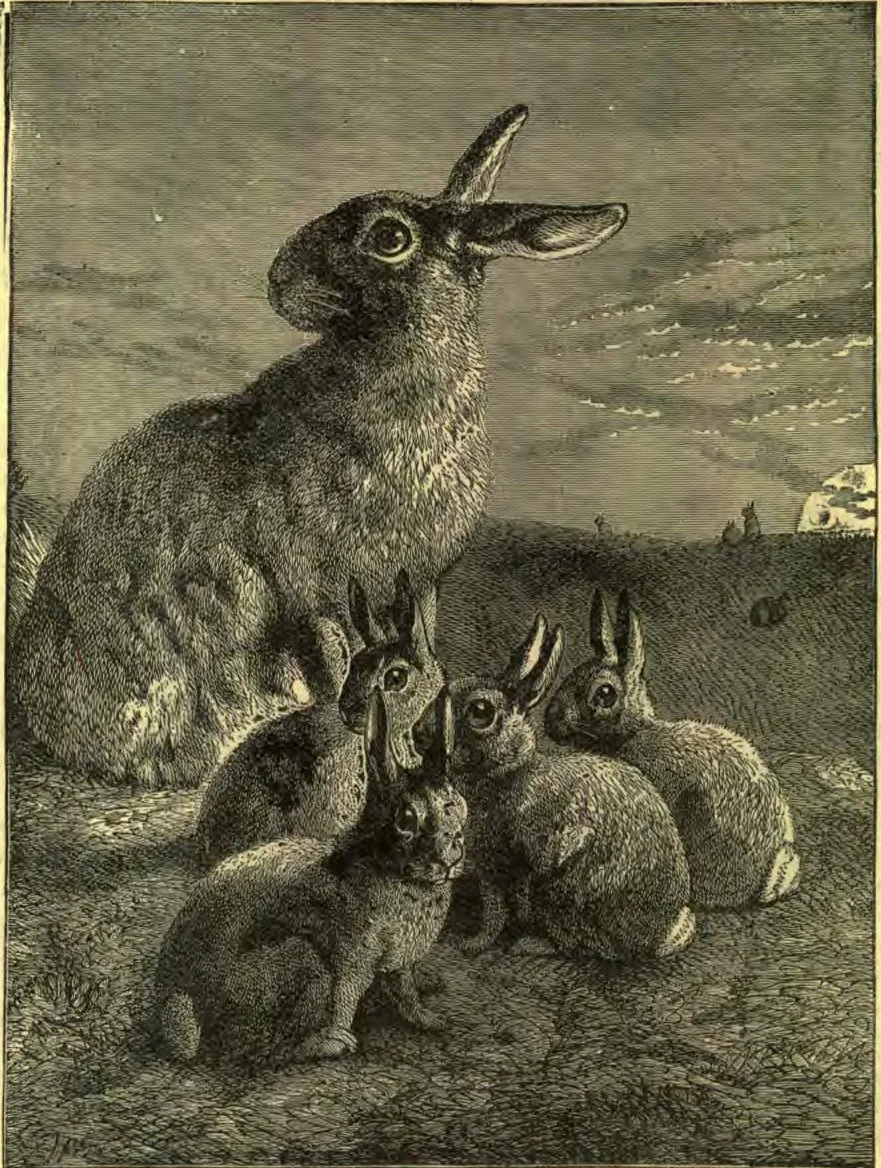
THE RABBIT

The Youth’s Instructor

Oct 12, 1881

S. D. A. Publishing Association · Battle Creek, Mich. · Oct 12, 1881

THE RABBIT.

RABBIT is the name commonly given to several species of the hare family. The pretty little creatures are found in almost every part of the world, although they are said to be natives of Spain. They are of many different colors and shades,—black, brown, gray, white, spotted, etc.
Rabbits build their nests in the ground, usually in meadows, but sometimes they are found in cultivated fields at the foot of a hill of corn, or some other plant that will afford them shelter. A few days ago a nest of young rabbits was plowed out from under a hill of sage in the middle of the field. There were four of the little fellows snugly hid away in a nest made of light brushwood, and lined with thistle-down. They were so young that their eyes were not yet open, and it seemed sad to give them so rude an introduction to the ways of the world; but after replacing the nest as carefully as possible, and marking the spot so as not to disturb it again, we found them all right and able to run about, on visiting them a few days later.
During the summer and autumn months, when there is plenty of clover, the rabbits fare pretty well, and they are somewhat shy of the farm buildings; but when the fields have all been cleared, they venture into the orchards and gardens, where they feed on the apples, and the leaves of the garden vegetables. They are especially fond of cabbage.
Although the rabbit is a very harmless-appearing animal, yet he sometimes does a great deal of mischief. In the winter, when the snow is deep and he can find nothing to eat, he gnaws the bark from the young fruit-trees, frequently destroying an entire orchard.
The rabbit is a very timid creature, and is usually so wild that the comparison “wild as a hare” has come to be a common one. When tamed, however, it often comes to be a very affectionate little pet. The poet Cowper, who lived in England about one hundred years ago, had a pair of them of which he was very fond; and as he lived alone most of the time, his rabbits were a real comfort to him. He is said to have spent several hours a day with them, feeding them and watching their pretty gambols; and when one of his pets died, he wrote a pretty little poem about it. This certainly shows the poet to have been a very kind-hearted man.
In these mild October days, when the summer’s work is done, and everything snugly stored away for winter, or later on, when the first light snow has fallen, the farmer lads like to get together and go hunting the rabbit and other small game. Of course this is fun for the boys, but I fear the tender-hearted poet would feel like reproving them for killing his pretty pets. And really, boys, does it not make you hard-hearted to find your sport in destroying life? Did you ever think that perhaps life was as dear to the little rabbit as to you? Think of it next time the one you are chasing looks at you so appealingly out of its great, frightened eyes, and see if you cannot find better sport. E. L.

SHOW YOUR COLORS.

“No more Bible-readings after to-night,” sighed Mattie Wilson, laying down her little Bible, after reading her evening lesson.
“Why not?” And the blue eyes of Gracie Grant opened wide at the thought.
“Didn’t you know we were to have a room-mate?” asked Mattie. “We are to occupy the bed in the alcove, while Miss Jennie Wilson will take possession of the chamber.”
“I didn’t know that would make any difference with us,” answered Gracie with meekness. “I guess auntie will allow us a lamp by ourselves.”
“But I wouldn’t think of opening a Bible or praying before a grown-up young lady, and she an infidel too,” replied Mattie.
“How do you know about Jennie Wilson? and what is an infidel anyway?” asked Gracie, in her usual quiet way.
“I heard auntie say she was sorry Jennie was coming just now, when so many young people were here, because of her infidel sentiments. I guess she don’t believe all of the Bible to be true by what aunt Lute said.”
“But we know it to be true, and that we ought to read it,” persisted Gracie.
“What good would it do under such circumstances?” queried Mattie. “I shouldn’t know a single word I read, if I thought she was looking at me.”
“We can show our colors,” said Gracie almost in a whisper; and Mattie was silent.
The dreaded Miss Wilson came, and the very first night she said,—
“I am weary, and shall go to bed with the little girls to-night;” and, chatting pleasantly, she followed Mattie and Gracie to the chamber allotted to the trio.
“Then you keep up the good old practice of reading the Scriptures,” she said, as Gracie took her little Bible to read. “I have a mind to join you.” she added gayly, letting her luxuriant hair fall over her shoulders; and, with one arm around Gracie, she bent over the book, and in her turn read through the Sermon on the Mount. With hands folded, and bowed head, she sat, while the girls knelt beside their little bed.
“I thought you didn’t believe the Bible, Miss Wilson,” broke forth Mattie, as they arose from their knees.
“I did when I was your age,” replied the young lady, somewhat disconcerted.
“Then I would become a child again,” innocently remarked Gracie.
Miss Wilson remembered enough about the Bible to know she had read, “Except ye be converted, and become as little children, ye shall not enter into the kingdom of Heaven;” but she said no more upon the subject.
Several hours later she bent over the youthful sleepers, exclaiming,—“Oh that I were a child again!” And the tears which glistened in her eyes testified of her sincerity.
During Miss Wilson’s stay at Eventide, she read with Gracie each night from the Holy Scriptures, and her evidently increasing relish for the truth, with her changed life, gave evidence that even a little girl can show on whose side she is, and thus glorify her Father who is in Heaven.—Mrs. E. C. Ellsworth.

OCTOBER

THE year grows old; Summer’s wild crown of roses Has fallen and faded in the woodland ways; On all the earth a tranquil light reposes, Through the still, dreamy days.
The dew lies heavy in the early morn, On grass and mosses sparkling crystal-fair; And shining threads of gossamer are borne Floating upon the air,
Across the leaf-strewn lanes, from bough to bough, Like tissues woven in a fairy loom; And crimson berried bryony garlands glow Through the leaf-tangled gloom.
The woods are still, but for the sudden fall Of cupless acorns dropping to the ground, Or rabbit plunging through the fern-stems tall, Half startled by the sound.
And from the garden-lawn comes, soft and clear, The robin’s warble from the leafless spray,— The low, sweet Angelus of the dying year, Passing in light away.—Selected.

Appearance Versus Character Before God

MEN will judge us by what we appear, but God by what we are.

GREENWOOD CEMETERY.

Perhaps some of you will ask, “Where is Greenwood Cemetery?” I will tell you; it lies only across the river from the great, live, bustling city of New York. From this noisy, living mart those who drop to sleep in the arms of Death are carried to return no more, into a city as large, but oh, so silent! My father and mother, a dear brother, and other kind friends, are here laid to rest; and how many times have I stood by the lake in this quiet city of the dead, and watched the willow trees droop their long tendrils into the quiet waters! What a beautiful spot it is—how lonely and retired! We can easily imagine the guardian angels of the dead gathering around us in such a spot, looking up from the shadowy waters, or whispering of the “sweet by-and-by” through the sighing, waving willows.
Space would fail me to speak of all the beauties of this sacred city; but just a few that have clung to my mind from childhood, and are pictured there, beautiful as memorials of the dead, will I mention. One is the Pilot’s Monument, which towers high enough to be plainly seen from the harbor where long years ago the brave pilot lost his life from the angry tempest. There is a beautifully natural, carved cable-rope attached to the monument, while at its base reclines a full-sized marble anchor, with a part of the cable attached, showing by its jagged ends where it was broken from the other above. This tells the story simply and beautifully—of how the cable parted and the ship went down, and the brave pilot with it.
The French Girl Monument is also a most exquisite piece of workmanship in white marble, the life-sized figure of the beautiful girl being almost hidden in the sanctuary of the marble tomb, among a delicate net-work of spiral columns and church-like vestibules. She is represented as the bride of Death, her fate as a bride being a very sad one in life. Just married to the man of her choice, they were on their way from the sacred edifice to her home, when the spirited horses took fright and ran away. The bride was thrown out and instantly killed. The sorrowing husband escaped unharmed, but his grief was so deep that he had this monument set up to her memory at an enormous expense; and it is said that until his death he would haunt this spot with unabated grief.
The next that I remember with peculiar interest is the Twin Monument. This consists of two monuments made exactly alike and attached to each other. It is dedicated to two little children who lost their lives in the burning of the Greenwich-Street School of New York many years ago. They loved each other so dearly that in the attempt to save them from a most perilous position, where it was impossible to save both at the same time, each held back, refusing to be saved before the other, until both were lost in the fiery flames. They now sleep in one grave, with these words carved on the entwining arch: “Loving in life, and together in death.” Beautiful vines have climbed up all over these twin monuments, and have intertwined just as the hearts of the loving little ones were intertwined in life. How joyful will be the resurrection to these innocent but brave and unselfish children! The fearful agonies of their death in that terrible fire all past and gone, the beautiful face of the risen Saviour will shine upon them as they rise together and are borne by their guardian angel, clasped in each other’s arms, to the great shining City of God, no more to be parted by death.
Everywhere, pastures of flowers, rippling fountains, and marble urns o’erloaded with blossoms, mark the resting place of the child of fortune; but farther on, where the trees are less thickly planted, graves lie close together,—close as the rows of tenement houses in the city of life beyond,—for there is only the six feet of earth and the grass that covers it. Here strangers lie side by side, so near that one coffin-side almost touches another coffin-side. Here and there a tiny slab of marble standing stark and upright, with its still smaller foot-board, tells the name of the one below.
But we pass on, uninterested, pausing now and then to glance at a simple bouquet laid by some loving hand on one or another plaster tomb, or some tiny relic that poverty has laid with sacred feeling on that sacred spot.
In thy bosom, O Greenwood, thousands, yea, millions are sleeping; the wicked and the good perchance slumber side by side, but “in that day” the tares will be separated from the wheat—rich or poor, it matters little! God knoweth his own. Yes, Greenwood, beautiful Greenwood! wealth and poverty are well-defined in this, the city of the dead. But, thank God! wealth can go no farther; and in the resurrection, poverty will stand by its side.
MRS. ELIZA JONES.

PUTTING JEREMIAH INTO THE PIT.

THE history of Jeremiah is a very sad one, and he wrote the most mournfully of all the prophets. This was owing to the troublous times in which he lived, for he prophesied when the children of Israel had already gone into captivity, and when that of Judah, having reached the height of its wickedness, was, therefore, fast approaching its end. He foretold the calamities that should overwhelm the kingdom when the Babylonians should come against it, and destroy Jerusalem and the temple, and take the people captives to Babylon, where they should remain seventy years.
This so enraged the princes, false prophets, and the unfaithful priests, that they begged Zedekiah to let them put the prophet to death; and the weak-minded king, not daring to act contrary to their wishes, left him in their hands. And a most terrible death was that which they intended for him. In many of the prisons of the Jews there was a place sometimes called the inner prison, and sometimes spoken of as the dungeon. But it was not what we should understand by a dungeon—merely a small, dark, underground room—but a deep hole in the floor of the prison, called by the prophet Zechariah a pit, and filled, not with water, but filthy mud, in which were, no doubt, creeping things. Into this horrible hole were put those prisoners whom the authorities wished to have most rigorously treated, and they were left, up to the chin in the mire, to die the slow death of starvation. As the princes and false prophets were very angry indeed at Jeremiah, they designed for him this fearful death; and having fastened cords to his body, they let him down into the dungeon, and left him without food.
But God, who did not forget his faithful servant, found a means of delivering him. In the palace of Zedekiah there lived a man called Ebed-melech, an Ethiopian, who feared God. So shocked was he on hearing of the horrible and unjust punishment inflicted on Jeremiah, that he went to the king, and told him what had happened in so mournful a strain that Zedekiah was moved to pity, and he commanded Ebed-melech to get Jeremiah out of the pit. But it was much easier to put a man into that loathsome dungeon than to get him out again; and the bitter enemies of the prophet might offer some resistance. Zedekiah, therefore, told his servant to take thirty men with him; and cords were lowered into the pit, with loops at the ends for Jeremiah to pass his arms through. And in this way he was drawn up. Though Jeremiah deeply lamented the fall of the city and the captivity of his people, he himself met with better treatment from the conquerors than he had received from his countrymen. “Take him, and look well to him, and do him no harm; but do unto him even as he shall say unto thee,” was the order given by Nebuchadnezzar to the captain of the guard. So when all the weeping captives were assembled at Ramah, waiting to be carried away from their beloved land, the captain of the guard told Jeremiah that he could remain in his own country if he wished; and he gave him food and money. So the prophet went to live at Mizpah.—Sel.

Autumn's Festal Garments and the Binding of the Year

For awhile gay Autumn yields the fruit and leaf, And doth her fairest, festal garments wear; And Time, all boundless in his mighty sheaf, Binds up the year.

TWO LITTLE PATHS.

Two little paths met by a sparrow's nest, Down in the meadow green and sunny, And, stopping there 'neath a rose-tree rare, Where a yellow bee was sipping honey, Made plans for the merry summer weather, With their dewy faces close together.
“Oh, I,” said one, “I shall stay in the field, And hither and thither through the clover Will trip away through the long bright day, But never stray to the woodland's cover. Here brooks and sunbeams laugh in the grasses, And I find bluebells for pretty lasses.”
“I,” said the other, “my fortune will seek, And find the fairies that somewhere cluster. Daisies are bright, but common as light And sunbeams, with all their merry lustre, Dull enough when one sees them forever;— What flowers, I wonder, live by the river?”
And where in the woods do rose-cups hide? Here there is never one, I am certain, For I've chased the brook into every nook, And pushed back the tall fern's green lace curtain.”
Then they said good-by, each one to follow Its own sweet way over hill and hollow.
But the one that went its fortune to seek, Never found it, but still kept peeping Mid clustering bells by woodland wells, And lost itself through a great marsh creeping; Was hindered by briers and choked by rushes, And always turning aside for bushes.
And the one who took for itself no thought, But sought for weary feet cool sweet places, Mid dewdrops bright, in midsummer night, Met troops of fairies with all their graces; And often felt through its velvet mazes The touch of light feet as soft as daisies!
—Wide Awake, for October.

TOM’S GOLD DUST.

“THAT boy knows how to take care of his gold dust,” said Tom’s uncle often to himself, and sometimes aloud.
Tom went to college, and every account they heard of him he was going ahead, laying a solid foundation for the future.
“Certainly,” said his uncle, “Certainly; that boy, I tell you, knows how to take care of his gold dust.”
“Gold dust?” Where did Tom get gold dust? He was a poor boy. He had not been to California. He never was a miner. When did he get gold dust? Ah! he has seconds and minutes, and these are the gold dust of time,—specks and particles of time which boys and girls and grown-up people are apt to waste and throw away. Tom knew their value. His father, our minister, had taught him that every speck and particle of time was worth its weight in gold, and his son took care of them as if they were. Take care of your gold dust!—Little American.

Gladness and True Thankfulness

There is a wide difference between gladness and thankfulness. The glad spirit may be selfishly happy; but the truly thankful spirit recognizes with gratitude the receipt of undeserved favor. If a contented mind is a perpetual feast, the truly thankful spirit is the only truly happy spirit. And how can we better show our thankfulness than by ministering to the wants of the poor and the suffering?

SCENES IN THE LIFE OF CHRIST.

LESSON 38.—ANOTHER JOURNEY THROUGH GALILEE.

“And it came to pass afterward, that he went throughout every city and village, preaching and showing the glad tidings of the kingdom of God; and the twelve were with him; and certain women which had been healed of evil spirits and infirmities, Mary called Magdalene, out of whom went seven devils, and Joanna, the wife of Chuza, Herod’s steward, and Susanna, and many others.” These waited on Christ and his disciples, and gave them such things as they needed.
The fame of Jesus was at this time very great. Multitudes of people came to hear him, wherever he went. At one time, when he had gone into a house, they crowded upon him till there was not room to eat. “And when his friends heard of it, they went out to lay hold on him; for they said, He is beside himself.”
“Then was brought unto him one possessed with a devil, blind, and dumb; and he healed him, insomuch that the blind and dumb both spake and saw. And all the people were amazed, and said, Is not this the Son of David? But when the Pharisees heard it, they said, This fellow doth not cast out devils but by Beelzebub, the prince of devils.”
“And Jesus knew their thoughts, and said unto them, Every kingdom divided against itself is brought to desolation; and every city or house divided against itself shall not stand; and if Satan cast out Satan, he is divided against himself; how shall then his kingdom stand?”
He also said, “No man can enter a strong man’s house, and spoil his goods, except he will first bind the strong man, and then he will spoil his house.” The one here meant by the “strong man” is Satan, but Jesus is stronger than Satan, and has power to overcome him.
After talking to them some longer, Jesus said, “O generation of vipers! how can ye, being evil, speak good things? for out of the abundance of the heart the mouth speaketh. A good man out of the good treasures of the heart bringeth forth good things, and an evil man out of the evil treasures bringeth forth evil things. But I say unto you, That every idle word that men shall speak, they shall give account thereof in the day of judgment. For by thy words thou shalt be justified, and by thy words thou shalt be condemned.”
Some of the scribes and Pharisees wanted Jesus to show them a sign; but Jesus knew that they did not ask for any good purpose, and that they had seen enough to convince any one who was honest, and willing to believe. So he told them that no sign should be given them but the sign of Jonah the prophet; for as Jonah was three days and three nights in the whale, so should the Son of man be three days and three nights in the heart of the earth.

QUESTIONS.

  1. Where did Jesus next go? Luke 8:1.
  2. Through what part of the country is he supposed to have taken this journey?—Through Galilee.
  3. What did he do, as he went?
  4. Who besides the twelve went with him?
  5. Name some of these women.
  6. What did they do for Jesus and his disciples?
  7. What may be said of the fame of Jesus at this time?
  8. How was his preaching attended?
  9. How did they crowd upon him when he went into a house at one time? Mark 3:20.
  10. What did his friends do when they heard of this?
  11. What did they say?
  1. What kind of man was brought to him? Matt. 12:22.
  2. What did Jesus do for this man?
  3. What did the people think when they saw such a miracle?
  4. What did they say?
  5. What did the Pharisees say when they heard of the miracle?
  6. Could they hide their thoughts from Jesus?
  7. What did he say to them about a kingdom divided against itself?
  8. What about a house or city divided against itself?
  9. How did he prove from these things that it could not be true that he had been casting out devils through the prince of devils?
  10. What did he say about entering a strong man’s house and spoiling his goods?
  11. After talking to these hard-hearted men a little while longer, what did Jesus cry out? Matt. 12:34.
  12. Why could not these men speak good things?
  13. How is a good man able to speak and do good things?
  14. Why is it that an evil man must of necessity speak and do evil things?
  15. What did Jesus say about our having to give account of the words we speak?
  16. How is it that all men are to be justified or condemned?
  17. What did some of the scribes and Pharisees want Jesus to do?
  18. Why did not Jesus do as they wanted him to do?
  19. What did he say was the only sign they should have?

NOTE.

By thy words thou shalt be justified, etc.—That is, words shall be the indication of the true principles of the heart; by words the heart shall be known, as the tree is by its fruit. If they are true, proper, chaste, instructive, pious, they will prove that the heart is right. If false, envious, malignant, and impious, they will prove that the heart is wrong, and will therefore be among the causes of condemnation. It is not meant that words will be the only thing that will condemn man; but that they will be an important part of the things for which he shall be condemned.—Barnes’ Notes. Dr. Clarke says on the same passage, “By thy words thou shalt be justified, etc.; that is, the whole tenor of thy conversation will be an evidence for or against thee in the great day. How many there are who count words for nothing! and yet eternity depends upon them.”

NEW-TESTAMENT HISTORY.

LESSON 51.—THE LOST SHEEP.

“Take heed that ye despise not one of these little ones; for I say unto you, That in heaven their angels do always behold the face of my Father which is in heaven. How think ye? if a man have an hundred sheep, and one of them be gone astray, doth he not leave the ninety and nine, and go into the mountains, and seek that which is gone astray? And if so be that he find it, verily I say unto you, he rejoiceth more of that sheep, than of the ninety and nine that went not astray. Even so it is not the will of your Father which is in heaven, that one of these little ones should perish.
“Moreover if thy brother shall trespass against thee, go and tell him his fault between thee and him alone: if he shall hear thee, thou hast gained thy brother. But if he will not hear thee, then take with thee one or two more, that in the mouth of two or three witnesses every word may be established. And if he shall neglect to hear them, tell it unto the church; but if he neglect to hear the church, let him be unto thee as an heathen man and a publican. Verily I say unto you, Whatsoever ye shall bind on earth shall be bound in heaven; and whatsoever ye shall loose on earth shall be loosed in heaven. Again I say unto you, That if two of you shall agree on earth as touching anything that they shall ask, it shall be done for them of my Father which is in heaven. For where two or three are gathered together in my name, there am I in the midst of them.”
“Then came Peter to him, and said, Lord, how oft shall my brother sin against me, and I forgive him? till seven times? Jesus saith unto him, I say not unto thee, Until seven times: but, Until seventy times seven.
“Therefore is the kingdom of heaven likened unto a certain king, which would take account of his servants. And when he had begun to reckon, one was brought unto him, which owed him ten thousand talents. But forasmuch as he had not to pay, his lord commanded him to be sold, and his wife, and children, and all that he had, and payment to be made. The servant therefore fell down, and worshipped him, saying, Lord, have patience with me, and I will pay thee all. Then the lord of that servant was moved with compassion, and loosed him, and forgave him the debt. But the same servant went out, and found one of his fellow-servants, which owed him an hundred pence; and he laid hands on him, and took him by the throat, saying, Pay me that thou owest. And his fellow-servant fell down at his feet, and besought him, saying, Have patience with me, and I will pay thee all. And he would not; but went and cast him into prison, till he should pay the debt. So, when his fellow-servants saw what was done, they were very sorry, and came and told unto their lord all that was done. Then his lord, after that he had called him, said unto him, O thou wicked servant, I forgave thee all that debt, because thou desiredst me: shouldest not thou also have had compassion on thy fellow-servant, even as I had pity on thee? And his lord was wroth, and delivered him to the tormentors, till he should pay all that was due unto him. So likewise shall my heavenly Father do also unto you, if ye from your heart forgive not every one his brother their trespasses.”

QUESTIONS.

  1. What warning does Jesus give against despising the little ones of his kingdom? Matt. 18:10.
  2. Who is meant by the “little ones”?
  3. What question did Jesus ask about a man who should have a sheep go astray from his flock? Verse 12.
  4. How will the man feel over that sheep, if he is fortunate enough to find it? Verse 13.
  5. What does this parable illustrate? Verse 14.
  6. If one of our brethren should trespass against us, what is our first duty?
  7. If he cannot be won by a private interview, what should next be done?
  8. If this effort should also prove unavailing, what final measure should be taken?
  9. What did Jesus say that seems to teach that the action of a sanctified church will be ratified in Heaven? Matt. 18:18.
  10. What saying of his proves the efficacy of the united petitions of God’s people? Verse 19.
  11. How does he assure us of his presence? Verse 20.
  12. What question did Peter ask about the duty of forgiving?
  13. What reply did Jesus make?
  14. Unto what did Jesus then liken the kingdom of heaven? Verse 23.
  15. Who was brought to the king, as he was reckoning with his servants?
  16. What command did the king give in regard to this servant?
  17. What did the servant then do?
  18. How was the king affected by the poor man’s petition?
  19. What kindness did he show him?
  20. Describe the course pursued by this servant toward one of his fellow-servants who owed him only a hundred pence.
  21. How did the other servants feel when they saw such cruelty practiced by one who had been so kindly treated by the king?
  22. What did they do?
  23. When the king had called the wicked servant to him, what did he say to him?
  24. What did the king then have done with him?
  25. How did Jesus apply this parable? Verse 35.

NOTES.

*Take heed that ye despise (stumble) not one of these little ones,—one of the least of those who believe in me.—Clarke.*
For their angels do always behold the face of my Father which is in heaven.—A difficult verse; but perhaps the following may be more than an illustration: Among men, those who nurse and rear the royal children, however humble in themselves, are allowed free entrance with their charge, and a degree of familiarity which even the highest state-ministers dare not assume. Probably our Lord means that, in virtue of their charge over his disciples (Heb. 1:13; John 1:51), the angels have errands to the throne, a welcome there, and a dear familiarity in dealing with his “Father which is in heaven,” which on their own matters they could not assume.—Comprehensive Commentary.
Dr. Clarke in commenting on the same clause, says: “Our Lord here not only alludes to, but in my opinion, establishes the idea received by almost all nations; i. e., that every person has a guardian angel; and that these have always access to God, to receive orders relative to the management of their charge. . . . Our Lord’s words give us to understand that humble-hearted, child-like disciples, are objects of his peculiar care, and constant attention.” Dr. Barnes further says on the same subject: “Jesus then proceeds to state the reason why we should not despise his feeblest and most obscure follower. The reason is drawn from the care which God exercises over them. The first instance of that care is, that in heaven their angels do always behold his face. . . . So, says our Saviour, we should not despise the most obscure Christians, for they are ministered to by the highest and noblest of beings,—beings who are always enjoying the favor and friendship of God.”
Let him be unto thee as a heathen man and a publican.—The Jews gave the name heathen or gentile to all other nations but themselves. With them they had no religious intercourse or communion. The publicans, too, were men of abandoned character, with whom the Jews could not have religious intercourse. This passage does not mean that we should cease to show kindness to the one who refuses to listen to the church, nor that we should neglect to aid him in affliction or trial; for this is required toward all men. It simply means that we should disown him as a Christian brother, and treat him as we do other men not connected with the church. This, however, should not be done until all the preceding steps recommended are taken. This is the only way of kindness; this is the only way to preserve peace and purity in the church. John Wesley says on this same passage: “To such an one thou art as a Christian to show earnest and persevering good-will and acts of kindness, but have no religious intercourse with him till, if he have been convicted, he acknowledge his fault.”
Whatsoever thou shalt bind, etc.—The phrase to bind and to loose was often used by the Jews. It meant to prohibit and to permit. To bind a thing was to forbid it; to loose it, to allow it to be done. . . . This does not refer to persons but to things—“whatsoever,” not whosoever.

Learning to Give Through the Sabbath School

“It is more blessed to give than to receive.” Do you believe that, my young friend? Then learn to give now. The Sabbath-school is a splendid place to teach giving. If your school hasn't taught you to give, freely and gladly, we are afraid it is not a very good school.

The Aim of Sabbath-School Teaching

THE full, ripe aim of all Sabbath-school teaching is to produce intelligent, practical Christians—Christian creed and character working out into Christian deeds and life.
Continue reading: AMONG THE ROCKS