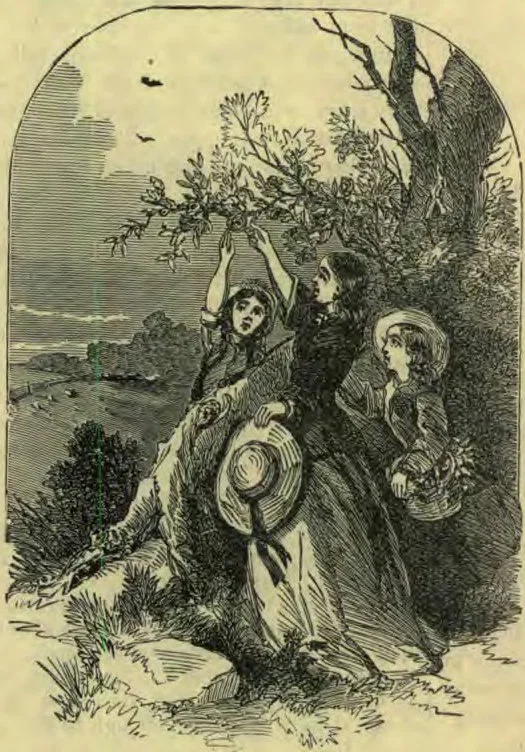
When we were at the sea-shore this summer, besides the waves and the sand, the forts we built, and the tumbles in the surf, we had such a nice time in finding so many curious things.
One morning when we were out walking on the shore, where the rocks slope down to the water, mamma stopped to look into a tiny pool of water that had been left on the rocks when the tide went out. It was a very clear little pool, with sand at the bottom, and all fringed around with green and purple sea-weeds, and it looked just like a great many others all around us; but mamma told sister to lift the weeds gently and see what was under them. There, lying imbedded in the sand, we saw a cluster of the most beautiful sea anemones; of course you know what those are, that is, if you have ever been at the sea-shore. They are curious plants, that are alive. All plants are alive, but these curious ones belong to the lowest order of the animal kingdom; and they stretch out their long feelers, that look so much like branches instead of hands and arms, to catch their food with. Those we found in the little pool were of a great many beautiful colors; blue, crimson, and buff. They were having a very nice time indeed, and stretching out their long arms for any prey that might come within their reach. The moment we touched one, it drew in its arms. How do you suppose it managed to hide them all, when there were so many of them, inside of its body?
After that, we looked in all the pools on the rocks up and down the shore for a long way every morning, and we found ever so many kinds of these wonderful and beautiful things.
Some of them looked ever so much like a strawberry, and some of them had blue “tubercles” around the top of them, that when they were open looked exactly like turquoise beads. In almost every pool, hidden under the long leaves of the plants, we found such beautiful anemones, bright green and violet, rose color and gray. Some of them are shaped like a daisy, and these are very funny; for when any one takes hold of them, they get very angry, and throw out long, white threads from their body, and try to strike the fingers that touch them, and all these little threads are poisonous. Sometimes we found a great many small crabs, and they always tried their best to pinch us if we took hold of them. Did you ever see a hermit crab? We used often to see old battered shells walking about on the sand, and when we turned them over, would find they were the houses of hermit crabs; for they must always have a house, and sometimes they even live in the bowl of an old pipe, if they can find one.
There is another kind of crab. We never found them on the rocks, but I have seen them at the New York Aquarium; they spend their whole time in dressing themselves up by fastening little pieces of sea-weed all over their shells. Don’t you think they must look funny? Why, they look just like little salt-water bushes, mamma says, walking about.
We had so many nice times at the sea-shore that I couldn’t begin to tell you half of them. Sometimes Nannie and I took turns in wading, because the crabs always bite your toes if they can; and besides the beautiful sea-weeds, we used to find star-fish; once a sea-urchin and a pretty, little spiky hedge-hog; only his prickles were of all sorts of colors instead of being just a dull brown.
When we got home, we went to see all the wonderful fishes and things at the Aquarium. It was so nice to know all about a good many of the sea-weeds, anemones, and the crabs, because mamma had told us all about them when we were away.—A Little Girl.
KATIE'S TREASURES.
In the soft October sunshine,
’Neath the forest’s golden eaves,
Roamed a merry band of maidens,
In a crimson rain of leaves,
And ’mid ringing bursts of laughter,
Fluttering through the misty air;
All their young heart’s cherished treasures
Each with other did compare.
“I dwell in a lordly mansion,”
Cried a pair of scarlet lips,
“In the carpet’s tufted roses,
Deep my lightest footfall dips.
Oh! the curtains and the pictures!
But more beautiful than all,
You should see the western sunlight
Creep along the painted wall.”
“Listen,” quickly cried another,
“Listen now, I pray, to me,—
Years ago there was a necklace,
Borne across the deep, blue sea;
In its velvet-cushioned casket,
Stars could not so brightly shine,
But this chain of prisoned rainbows,
By and by will all be mine.”
“I have not such wondrous jewels,”
Proudly spoke another voice,
“But I’d rather have my father,
If I had to take my choice.
He has grown so very famous,—
People almost kiss his hand,
And in time, I’m very certain,
He’ll be ruler of the land.”
Thus ran on the eager voices,
As they gayly had begun,
Till some tale of wondrous treasure,
Every child had told, save one.
“She will not have much to tell us,”
Whisper they, “poor little thing!”
But with smiles, said blue-eyed Katie,—
“I’m the daughter of a king!”
Then they laughed, “O princess, tell us
Where the king, your father, dwells;
Do your mighty palace portals
Swing at touch of golden bells?”
Meekly answered gentle Katie,
Brushing back a floating curl,
“All the shining wall is golden,
Every gate, a single pearl.
“And more glorious than the sunrise
Through the purple morning mist,
Brightly glow the brave foundations,
Jasper, sapphire, amethyst.
And within—such wondrous treasures!
Oh, what happiness to see!
But when home my Father calls me,
He will give them all to me.”
Then the little maids grew thoughtful,
And they looked with tender eyes,
On the sweet-faced little Katie,
Gazing upward to the skies,
And they said,—“O happy princess!
List’ning for the great King’s call,
You have found the greatest treasure,
You are richest of us all.”
STORY OF A NOTED HYMN.
AMONG the crowds that went to hear the famous Whitfield preach at Bradford in England, was a young fatherless boy about sixteen years old, who was learning a trade.
The sermon made a deep impression on the young lad's mind, and was the means of leading him to profess Christ. He was afterward known as the Rev. John Fawcett, pastor of a Baptist church at Wainsgate, England.
After he had been preaching for a few years, his salary seemed to be too small to provide for the wants of his family, and he thought it was his duty to accept a call to become the pastor of a church in London, to succeed the learned Dr. Gill, the author of the well-known commentary on the Bible.
He had preached his farewell sermon to the people in Wainsgate, and five or six wagons were loaded with his goods, furniture, and books to move them to London. But the members of his poor church were almost heartbroken. Fervently did they pray that Mr. Fawcett might not leave them, and as the time for leaving came, men, women, and children clung around him and his family in deep sorrow of soul. As the last wagon was loading, the good minister and his wife sat down on one of the packed boxes to weep with the sorrowing members of the church, over, what seemed to them, the necessity for parting. Looking into his tearful face, while her own was bathed in tears, his devoted wife said, “O John, I cannot bear this; I know not how to leave these friends!”
“Nor I either,” answered the good man, “nor will we go! Unload the wagons, and put everything in place again. Tell the London church I cannot come.” And he resumed his labors among the poor people of his former parish, on a salary of scarcely $300 a year. It was following this incident in 1772, that the Rev. John Fawcett wrote the beautiful hymn on Christian union:—
“Blest be the tie that binds
Our hearts in Christian love;
The fellowship of kindred minds
Is like to that above.”
—The Child’s World.
GOLDEN MOMENTS.
How sorry one would be for a man who, starting out upon a journey, had his pockets full of golden coins, which, one by one, had slipped through some unmended hole or rent, so that when he came to the end of his trip, he had not one left, but lay down upon his bed a beggar! How strictly we would look to our own pockets after hearing the tale, and make very sure that what coin we had should be well spent or hoarded carefully, and not scattered in the roadside dust! Yet we start upon our lives, each one of us, with a store of golden moments of which we keep little account. Rapidly they slip away through the rents of sloth or ignorance. Many a one, rich in all the golden moments of seventy years, lies down at last scarcely able to remember how he has frittered and scattered them, knowing only that he has no more,—that all are gone, and that he cannot say that he has purchased anything of use to himself or another with what might have bought so much.
LETTER BUDGET.
James Matterson writes from Washington Co., Alabama. “I am a little boy twelve years old. I have never been to school; my parents are poor and we live a great way from where there is any school, so I cannot read. I can spell a little. My brother’s wife is writing this letter for me. I go to Sabbath-school about one mile from our place, and I know the ten commandments and all of the names of the books in the Bible. I guess you will wonder how I learned them if I cannot read. My teacher would tell them over to me, and I would repeat them till I knew them. Eld. J. M. Elliott and Eld. C. O. Taylor are our ministers, and my sister-in-law is our teacher. I want to tell you what I am going to do for the Lord. I am going to give him a tenth of all I have, and I hope he will bless me. I want to be a good boy. My teacher has taught me to pray, and I pray every night. I have no own sisters, and my mother is in very poor health. We are very poor here, and have but little time to study. I have to help my father in the field. Give my love to all of the INSTRUCTOR family, and I want you all to pray for me.”
Minnie M. Moult, of Van Wert, Ohio, says: “This is a very nice day. I think all the INSTRUCTOR children will be happy when they look at all the beautiful things God has given us to make our homes pleasant. I want to live so that I may enjoy all these beautiful things in the earth when it is made new. This letter is not very good, but it is the best I can do now.”
THE YOUTH'S INSTRUCTOR
Is published weekly by the
S. D. A. PUBLISHING ASSOCIATION,
BATTLE CREEK, MICH.
The Instructor is an illustrated four-page sheet, especially adapted to the use of Sabbath-schools. Terms always in advance.