The Youth’s Instructor, Vol. 27, No. 4.

DAILY BREAD

The Youth’s Instructor

Jan 22, 1879

S. D. A. Publishing Association · Battle Creek, Mich. · Jan 22, 1879

DAILY BREAD.

A STORY FOR HARD TIMES.
IT’S dreadful to live this way! I do wonder why God doesn’t answer your prayers and send you some work, father.”
“Are you hungry, mother? I’m sure I thought we had a very good breakfast. And what a nice, pleasant house this is that we live in!”
“But we’ve nothing for dinner!”
“But it isn’t dinner time.”
“Well, I must confess I like to know what we are to have just a little while before dinner time.”
“God has said our bread and water shall be sure, but he has not promised that we shall know beforehand where it’s coming from.”
“Father,” said little Maggie, “do you s’pose God knows what time we have dinner?”
“Yes, dear, I suppose he knows exactly that. I’ve done my best to get work, and I’ll go out now and look around, and you go to school and don’t be the least mite afraid, Maggie. There’ll be some dinner.”
“But we’re out of soap and starch and saleratus,” said the mother.
“As for the saleratus, you couldn’t use it if you had it, unless you had some flour. I’m sure I had soap when I washed my hands this morning.”
“Yes, a little bit. But it’s not enough to do the washing.”
“But the washing won’t come till next Monday. As for the starch, it isn’t one of the necessaries of life.”
“If I had some potatoes I could make some,” said Mrs. Wilson, musingly.
“Well, I’m going out now to try to find some work. You just cast your care on the Lord, mother, and go about your housework just as if you knew what was coming next, and don’t go and take the burden right up again. That’s the trouble with you. You can’t trust the Lord to take as good care of it as you think you would, and so you take it up again, and go round groaning under the burden.”
“Well, I do wonder he lets such troubles come. Here you’ve been out of work these three months, with only an occasional day’s work, and you’ve been a faithful, conscientious Christian ever since I knew you.”
“I’ve been an unfaithful, unprofitable servant, and that’s true, mother, whatever you may think of me,” replied Mr. Wilson humbly. “God is trying our faith now. After he’s provided for us so long, what will he think of us if we distrust him now just because want seems to be near, before ever it has touched us?”
Mr. Wilson went away to seek work, and spent the forenoon seeking vainly. God saw that here was a diamond worth polishing. He subjected his servant’s faith to a strain, but it bore the test. I will not say that no questioning or painful thoughts disturbed the man as he walked homeward at noon. Four eager, hungry little children, just home from school, to find the table unspread and no dinner ready for them; an aged and infirm parent, from whom he had concealed as far as possible all his difficulties and perplexities, lest he should feel himself a burden in his old age, awakened to the realization that there was not enough for him and them,—these were not pleasant pictures to contemplate, and all through the long, weary forenoon Satan had been holding them up to his view, and it was only by clinging to the Lord, as drowning men cling to the rope that is thrown to them, that he was kept from utter despondency.
“Thou knowest, O Lord, that I’ve done my best to support my family. My abilities are small, but I’ve done my best. Now, Lord, I’m waiting to see thy salvation. Appear for me! Let me not be put to shame.”
“Increase my faith, increase my hope, Or soon my strength will fail.”
So he prayed in his own simple fashion, as he walked along.
It was true, as he had said. His abilities were not great. Some frivolous young people at the prayer-meeting smiled at the phraseology of his prayers. But there were educated men and earnest women who were helped and strengthened by those very prayers. Religion had raised a man above mediocrity to whom Nature had been niggardly. Without it he would have been a cipher in the community—or worse than a cipher.
He drew near to his own door with something of shrinking and dread. But the children rushed out to meet him with joyous shouts.
“Come right in, father; quick! We’ve got a splendid dinner all ready. We’ve been waiting for you, and we’re fearful hungry.”
The tired steps quickened, and the strongly drawn lines in the weary face softened to a look of cheerful questioning, such as was oftenest seen there. He came in and stood beside his wife, who was leaning over the stove dipping soup out of the big dinner-pot with a ladle.
“How is this, mother?” said he.
“Why, father! Mr. Giddings has been over from Bristol. He came just after you went out. And he says a mistake was made in your account last August, which he has just found out by accident; he owed you three dollars more, and he paid it to me. So I—”
“I don’t think it was by accident, though,” said Mr. Wilson, interrupting her.
“Well, I thought as we had nothing for dinner I’d better buy some meat and—”
“Do you think it was accident that sent us that money to-day, mother?” persisted the thankful man.
“No, I don’t think so,” said his wife humbly. “I think it was Providence. And I’m thankful, I’m sure. I did try to trust; but I’ll try harder next time. You haven’t heard the whole, though. Mr. Giddings wants you next Monday for all the week, and he thinks for all summer.”
The grace at table was a long one, full of thanks and praise, but not even the youngest child was impatient at its length.
—Christian Weekly.

KINDLE AND SMILE.

If the world seems cold to you, Kindle fires to warm it! Let their comfort hide from view Winters that deform it. Hearts as frozen as your own To that radiance gather; You will soon forget to moan, “Ah! the cheerless weather.”
If the world’s a wilderness, Go, build houses in it! Will it help your loneliness On the winds to din it? Raise a hut, however slight, Weeds and brambles smother; And to roof and meal invite Some forlorner brother.
If the world’s a vale of tears, Smile till rainbows span it! Breathe the love that life endears, Clear from clouds to fan it. Of your gladness lend a gleam Unto souls that shiver; Show them how dark sorrow’s stream Blends with hope’s bright river. —Sel.

THE RIVER NILE.

(Concluded.)
The river Nile is of the greatest importance to the Egyptian. He drinks of it, fishes from it, rides upon it, waters his fields and flocks from it, and carries his produce on it to the sea; and it is not strange that so idolatrous a people should have worshiped it as a god. They called it the “Life-giving Father of all Existences,” and made to it offerings of wine. But Nile worship ceased about the time of Mahomet, six hundred years after Christ.
This is the river whose waters went out over the land of Goshen to irrigate the pastures of the Israelites,—the wonderful river on whose banks grew the reeds in which was hidden the infant Moses,—the stream on whose brink the man Moses stood when he commanded its waters to be turned to blood.
In the history and present condition of Egypt we may trace the fulfillment of several remarkable prophecies. In Isaiah 19:4, it is said that a fierce king should rule over Egypt. It is thought by some that this was fulfilled in the reign of the cruel Persian Cambyses; but the rule of this king was short, and the term “fierce king” is thought by others more applicable to the Turks, who have held dominion over the land since 1517.
In Isa. 19:6 we read, “The reeds and flags shall wither.” This has been literally fulfilled; for although they once flourished in abundance on the banks of the river, they do not now grow there.
The mouth of the Nile once consisted of seven branches, emptying into the Mediterranean Sea; but in Isaiah 19:5, it is said, “And the waters shall fail from the sea,” also, chapter 11:15, “And with His mighty wind shall he shake his hand over the river, and shall smite it in its seven streams, and make men go over dry-shod.” Five of these branches have already disappeared, and the sixth is now rapidly filling with sand.
Thus we see that what Isaiah said thousands of years ago is coming to pass in our day. “A fierce king” rules over Egypt; the flags and reeds no longer grow on the banks of the Nile; five of its seven mouths are already destroyed, and the sixth will probably soon be gone.
Do not these things plainly show that the Bible is true? Yet these are only a few among many proofs that it is the word of God.
Let us love God, study to understand his word, and keep all the commandments, that we may have an inheritance in the new earth, and a right to the “tree of life.”
LIZZIE M. GREGORY.

For Boys

Tobacco.

For Boys.

Most boys are inquisitive, and, I have noticed, are most inquisitive about that which they have been positively forbidden to pry into. If father or mother says they must know nothing about a certain thing, that, of all others, seems to be the thing they wish to know most about. Frequently, I am sorry to say, they disobey their parents' command, and set about gaining a personal knowledge of the forbidden thing; and when they have learned all about it, and have their curiosity satisfied, they are ready to say, “Oh, that I had believed what was told me!” Now I want to tell the INSTRUCTOR boys about tobacco, and I hope they will believe what I say, without a personal experience.
Every boy who reads this article has doubtless seen tobacco. Some people smoke it, some chew it, others snuff and dip it. What do they use it for? Scientific men tell us they all use it for the same reason,—because of the poison it contains; and that if the poison were extracted, no one would care for tobacco. The name of this poison is nicotine. It is almost as deadly as prussic acid. When it is first taken, it will cause dizziness, vomiting (for proof, watch the boy who is learning to smoke), and bad taste in the mouth. Now take a larger dose, and you will have congestion of the brain; and if you live through that, you will find that your memory has been much injured and your courage weakened. Lastly, tobacco causes death.
These are the effects of the poison when first taken, and when taken in large doses. When taken in small doses, continually, as in smoking or chewing, the effect is not so violent, but rather an intoxicating, half-asleep, easy, quiet feeling which, after awhile, people learn to love, instead of the wide-awake, clear mind and tender conscience which they ought to love, and which I hope every one of my readers possesses.
Every one has to learn to use tobacco, for no one likes it at first. And I assure you it is no easy task to gain the mastery of the poison which it contains; and after you have mastered the habit, you find, to your sorrow, that the habit has at the same time mastered you. Now let us see if I am not right.
Suppose a man who is in the habit of using tobacco, “runs out;” he is a long way from a store, and if it were not for tobacco he would not go there for a week or more; what will his tobacco appetite say to him? “Go to-day!” “Don't put it off!” “Go right now and get some tobacco!” But suppose he really cannot go; what will his appetite say to him now? “Go to one of your neighbors and beg some!” And I have seen men do just as it said. So, you see, tobacco may actually make a beggar of a man. Some boys think it will make them look manly to use it. Does the one just described look manly, begging?
The boy who begins to use tobacco may have a tender conscience and gentle manners; he may be kind, obedient, happy, and truthful. But it will soon be found that his manly (?) habit has destroyed his tender conscience; in place of gentleness it has made him coarse; kindness is displaced by rough, unkind acts; disobedience takes the place of obedience; and oh, how many untruths it helps him to tell! Truly, tobacco hurts the morals, and deadens the conscience.
Boys, if you want a home in God's kingdom, don't use tobacco.
GEO. B. STARR.

HITTING THE MARK.

HERE is the boy who does not know the meaning of hitting the mark? for have not all boys at some time amused themselves in trying to cast missiles at a fixed point called a mark? But how to become first-class marksmen we think may interest our readers, and we therefore quote from the S. S. Advocate

HOW TO HIT THE MARK.

If one wants to hit a mark he must have three things—a steady eye, a strong arm, and a skillful hand. Now we all want to hit the mark success. That is what we are all aiming at—success in this world, and in the world to come. How shall we hit the mark? We must have three things, viz., H-o-n-e-s-t-y, I-n-d-u-s-t-r-y, T-e-m-p-e-r-a-n-c-e.
Peter Jones keeps a store, but he cheats his customers; they soon find him out; no one has any confidence in him. His store is a failure. He has not honesty, and he cannot hit the mark.
John Brown has a farm, but he is lazy; yes, that is the word—lazy. He lacks industry, and so he cannot hit the mark. You will see him described in Proverbs 24:20–34.
Harry Bright is a young lawyer, but he drinks wine. He is becoming very fond of it, and I fear it will be his ruin. A drunkard can never hit the mark.
Some persons are not honest toward God; they cannot hit the mark of salvation. Some are too indifferent, too lazy, to save their souls. Others are not temperate, that is, not self-denying enough to give up sin. Such persons will be sure to miss the mark.
Now, children, you notice that the first letters of the above words spell the word “hit”; so you can easily remember the words and their meaning. I hope all my young readers will take such sure aim at the right kind of success that they may make a happy Hit. M. J. C.

LESSONS FOR CHILDREN.

LESSON IV.—JERICHO.

WHEN the children of Israel crossed the river Jordan, they passed from the east side over to the west side. They first encamped at Gilgal in the plain of Jericho. Gilgal is only five or six miles west of the Jordan.
About two or three miles from Gilgal was a strong city called Jericho. Jericho was surrounded by high walls; but the Lord told Joshua that the city, and its king, and all its mighty men of valor, should be given into his hand. He said that all the men of war among the Israelites should march around the city once a day for six days. The ark of the Lord was to be in the middle of the procession. A part of the men of war were to march before the ark, and the others were to follow it. Seven priests were to go just in front of the ark, and blow upon trumpets of ram’s horns.
On the seventh day they were to march around the city seven times. When they had gone around the seventh time, the priests were to give a loud blast on their trumpets; all the people were to shout; and the walls of the city were to fall down flat. Then they were to burn the city, and destroy all its people. The Israelites were forbidden to take any of the spoil for themselves, but all the gold and silver and costly vessels were to be put into the treasury of the Lord.
Joshua commanded the people, and they followed out the plan which the Lord had given them. On the seventh day when they had passed around seven times, they gave a great shout, and the walls of the city fell down, as the Lord had said. Then the city was burned, and all the people destroyed except Rahab and her family. Before crossing the Jordan, Joshua sent two men to Jericho as spies; but the king found out that they were in the city, and sought after them to kill them. Then Rahab hid them till the gate of the city was shut at night, when she let them down by a cord through a window in the wall, and they escaped. So Joshua commanded that Rahab and all that were in her house should be left alive. Read Josh. 2.

QUESTIONS.

  1. In what direction did the children of Israel cross the Jordan?
  2. Where did they first encamp?
  3. How far from Gilgal is Jordan?
  4. How far from Gilgal is Jericho?
  5. With what was Jericho surrounded?
  6. What did the Lord say to Joshua in regard to this city? Josh. 6:2.
  7. What plan did the Lord give him for taking the city?
  8. For how many days were they to march around the city? Verses 3, 4.
  9. How many times did they go around it each day?
  10. What was to be done when they had gone around the last time?
  11. What was to happen to the city when the people shouted? Verse 5.
  12. What was then to be done to the city?
  13. What were the people forbidden to do? Verse 18.
  14. What was to be done with all the gold, and silver, and costly vessels, that might be taken? Verse 19.
  15. How was the plan carried out? Read verses 7-21.
  16. Who of the people of Jericho were saved alive? Verse 25.
  17. Why was this done?
  18. How did she save the lives of the spies?

BIBLE LESSONS FOR YOUTH.

LESSON XXX.—THE PASSOVER AND THE EXODUS.

1. What was the last plague?
2. What name was given to the solemn ceremony that was performed on the last night before the children of Israel left Egypt?
3. What was each household to kill?
4. What was to be done with the blood? Ex. 12:7.
5. Why was this done? Verses 13, 23.
6. What was done with the flesh of the lamb? Verse 8.
7. How were the people to be equipped when they ate the passover? Verse 11.
8. When was the first passover eaten? Verse 6.
9. How was this to be observed in after years? Verse 14.
10. What came to pass at midnight on the night when the first passover was eaten? Verse 29.
11. What effect did this produce on the Egyptians?
12. What did Pharaoh say to Moses and Aaron? Verse 31.
13. Why were the Egyptians so urgent upon the people, to get them out of the land? Verse 33.
14. Where did the Israelites encamp the first night of their journey?
15. Where was their second encampment?
16. To what place did they come on the third day?
17. Where did they encamp? Ex. 14:2.
18. By whom were they overtaken at this place? Verse 9.
19. How did the Lord protect them from their enemies? Verses 19, 20.
20. How did the Lord make a way of escape for his people? Verses 21, 22.
21. How did he prevent the Egyptians from coming upon them while passing through the Red Sea? Verses 24, 25.
22. What became of the Egyptians when the Israelites were safe on the other side of the sea? Verses 27, 28.

SYNOPSIS.

The last plague was the slaying of the first-born in every house of the Egyptians.
The Lord, by Moses, gave the children of Israel a very solemn ceremony, to be performed on the last night of their sojourn in Egypt. It was called the passover. Every household was instructed to take a lamb without blemish, a male of the first year, and slay it. The blood was to be sprinkled upon the lintel and door-posts of every house. When the death-angel should come to such a house, he was to pass over it; thus the term passover. The flesh of the lamb was to be roasted with fire, and eaten that night with unleavened bread and bitter herbs. They were to eat it in haste, with their loins girded, their staves in their hands, and their shoes on their feet, all prepared to start on their journey.
This was to be done on the night following the fourteenth day of the first month; and that day was to be observed forever throughout their generations, as a memorial of the great work which the Lord had done for them in bringing them out of bondage.
“And it came to pass, that at midnight the Lord smote all the firstborn in the land of Egypt, from the firstborn of Pharaoh that sat on his throne, unto the firstborn of the captive that was in the dungeon.” “And Pharaoh rose up in the night, he and all his servants, and all the Egyptians; and there was a great cry in Egypt; for there was not a house where there was not one dead.”
“And he called for Moses and Aaron by night, and said, Rise up, and get you forth from among my people, both ye and the children of Israel.” “And the Egyptians were urgent upon the people that they might send them out of the land in haste; for they said, We be all dead men.”
So all the hosts of the Lord went out from the land of Egypt. Their first encampment was at Succoth, the second at Etham in the edge of the wilderness; and the third day they came to the Red Sea, and encamped between Migdol and the sea. Here they were overtaken by the armies of Egypt led on by Pharaoh, who had come out to destroy them.
All that night they were protected by the Lord, who placed a pillar of fire between them and their enemies. To them it was light; to their enemies, darkness; and the Lord opened up the sea before them, and they went through on dry land, while the waters stood as a wall on either side. The Egyptians followed after them; but in the morning the Lord looked through the pillar of fire and of the cloud, and troubled the host of the Egyptians, and took off their chariot wheels, that they drave heavily. As soon as the children of Israel were all passed through, Moses stretched out his hand over the sea; and the sea returned to its strength, burying the proud hosts of the Egyptians beneath its waves.
G. H. BELL.

SABBATH-SCHOOL RECORDS.

EVERY successful Sabbath-school worker will feel the importance of keeping some kind of a Sabbath-school record. Such a record, if properly kept and rightly used, will promote thoroughness on the part of officers, teachers, and scholars. The chief requisites of the Sabbath-school record are,—
  1. That it should contain such items as will be valuable for future reference, as well as interesting for present reading.
  2. That it should be uniformly kept from year to year.
  3. That the plan should be so simple as to make it easy to find any item to which we may wish to refer.
  4. That it should be so arranged throughout as to economize the time of the Secretary.
In order to aid the Secretary in the thoroughness, convenience, and ease of keeping the records, a book has been published for this special use, called, “The Complete Sabbath-School Record and Register.” It contains ruled and printed blanks for the register of officers, teachers, and scholars; for the minutes of each Sabbath; for a weekly, quarterly, and yearly summary of class records; and for a cash account.
If any one thinks that it will take too much time to keep such a record, we would suggest that this book is intended to save time. It gives you a place for everything, and all you have to do is to put everything in its place. A systematic method of doing work is always best and cheapest.
W. C. W.

THE SONG ANCHOR.

A NEW and popular collection of stirring music for Sabbath-schools.
The Song Anchor contains a large collection of those pieces which, by their merit, have become popular throughout the world, and in addition to this a quantity of new music which is equal to the best. Over seventy of the pieces in the Song Anchor are entirely new, and appear in print for the first time. Hundreds of schools use it, and think it is the best song book that they have had. It is also especially adapted to the home circle and the prayer-meeting. The Song Anchor contains 160 pages, printed on fine tint paper, handsomely bound.
Price, 50 cents. $40.00 per hundred. Address, YOUTH'S INSTRUCTOR, Battle Creek, Mich.; or, Pacific Press, Oakland, Cal.

LETTER BUDGET.

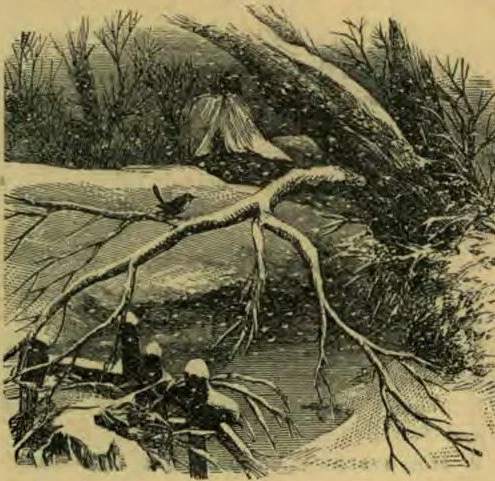
The beautiful snow! is it not pure? Our little folks have most of them had an opportunity to admire and enjoy it this winter. Did you ever see anything whiter? Though our sins be as scarlet, if they be washed in the blood of Christ, they shall be white as snow; and David said if he were washed from his sins he should be whiter even than snow. Oh! to be made white in the blood of the Lamb!
AURORAVILLE, WIS.
Dear Editors: We have taken the monthly INSTRUCTOR six years; we now send for the weekly paper. I am a little girl ten years old. I love the Lord, and try to keep his commandments, that I may be saved when Jesus comes.
Please send the paper in my name this year. NORA BOLLES.
DUNNINGVILLE, MICH.
Dear Editors: As I have the opportunity, I will write a few lines for the INSTRUCTOR. I am a boy twelve years old. I am very much pleased with the weekly INSTRUCTOR. I took the monthly paper three years, and liked that very much. We live six miles from any Sabbath-school, but we go when the weather will permit.
Yours truly, H. M. SPEAR.
ROCHESTER, IOWA.
Dear Editors: I am a little girl eleven years old. I keep the Sabbath with my mother, brother, and three sisters. Pa has been dead nine years. I love the INSTRUCTOR, especially the “Children’s Corner.” I lend my papers to my schoolmates after I have read them.
I was sorry when I found my last INSTRUCTOR had come, but I was glad when mother said I might take it another year. This is the first time I ever wrote a letter for the INSTRUCTOR. I hope to meet all the INSTRUCTOR family in the kingdom.
EMMA J. ADAMS.

ELLEN'S NEW KEY.

ELLEN came to her aunty one day, and said, “I have found a new key to open people’s hearts.” “Have you?” said Aunt Mary, as she dropped her knitting in her lap and looked up. “What is it?” “It is the word Please,” said Ellen, and she looked into her aunt’s face with a good-natured smile.
“When I ask the girls at school to please show me my lessons, they stop and help me, no matter what they are doing; when I say please to Jane, she does not scold me, but takes her hands from the suds to do what I ask her to; and when I say please to Uncle, he says, ‘Yes, my dear,’ and looks so good-natured. I think, Aunty, that I shall always use this key, it is such a nice one to unlock hearts with.” Her aunt smiled at the good resolution, knowing how it had been in the past. The fact is, Ellen had, like too many children, been in the habit of speaking to others in an ill-natured manner, calling upon them in a careless, and sometimes rough way to do favors for her, and was almost always told that she must not trouble them, or that she should come some time when they were not so busy. But now that she had resolved to be a better child, she had much less trouble to get along, besides having many more favors granted her.
If there are any of the INSTRUCTOR family, either boys or girls, who have fallen into the same habit that Ellen had, let them procure her new key and see if it will not unlock people’s hearts for them as well as for her. J. O. C.

YOUNG CANVASSERS WANTED.

The publishers of the Instructor are determined to make it the best youth’s paper in the land, and to place it this year in ten thousand families that have never read it before. To accomplish this we must have

ONE HUNDRED CANVASSERS

who will canvass their neighborhoods and towns, showing the Instructor and the beautiful premium to every family, and thus secure subscribers.
We published last week a list of the valuable prizes which we offer to the canvasser for securing eight, twelve, twenty, or forty new subscribers. Read it over, and then decide to become a canvasser and work for a prize. To aid you in this work we offer a

CANVASSER’S OUTFIT FOR FORTY CENTS.

This will consist of a premium book, “The Child’s Poems,” to use as a sample, a subscription book, ruled and printed for convenience in taking the names and addresses, subscription blanks for sending the names to the Office, also circulars to distribute, and full directions for canvassing. Address,
Youth’s Instructor,
Battle Creek, Mich.

BAD PROMISES.

PERSONS should have great regard for the sacredness of their word; but yet, it is truly said that “a bad promise is better broken than kept.”
Gossner tersely says, “God would rather have us break our word than his word.” Herod made a rash and therefore sinful promise to the daughter of Herodias. He was sorry when he knew what it would require to keep it, yet from a certain false regard for the honor of his word, he chose to commit murder rather than not keep his wicked oath. A teacher of long and successful experience in Hartford, Conn., properly counts this point of such importance as to suggest that teachers be requested strongly to enforce upon scholars the sin of keeping any wrong promise. Boys are often led into the sin of keeping a wrong promise, because they think it will be telling a lie not to do so; and older ones are often strengthened in the same way of evil doing, by the fact that they have made a promise. This is one of the methods Satan takes to blur their moral sight, and keep them out of the right way. They should be led to see clearly that to make a wrong promise is one sin; to keep it is a second sin; the only way is to repent of and confess the first sin at once, stoutly refusing to add another by keeping a wicked promise. Those who, like Herod, take any other course, have a slavish and cringing fear of man, but no true fear of God before their eyes.—Sel.

Kindness Melts the Hardest Heart

The warm sunshine and the gentle zephyrs may melt the glacier which has bidden defiance to the howling tempest; so the voice of kindness will touch the heart which no severity could subdue.

THE SNOW.

The snow! the snow! the feathery flakes of snow! How they're falling to the music Of the winds so sad and low! How they brighten, How they whiten, Over all the earth below!
The snow! the snow! the fluttering flakes of snow! What a soft and fleecy mantle They are spreading o'er below! How they gladden, How they sadden, As they tumble down so slow!
The snow! the snow! the feathery flakes of snow! As the night-wind sadly chanteth, They are tumbling down so slow; Uncomplaining, They are staining Their spotless robes below; But the hand that made the summer, And the balmy zephyr's murmur, And the fruit and grain to grow, Made each fragrant, blooming flower— Made the sunshine and the shower, Tinted gorgeously the bow— Made the wintry wind's lone wailing, And the frost, the rain, the hailing— Made the beauteous flakes of snow, That are bright'ning, Softly whit'ning, O'er the dark, brown earth below; That are falling to the music Of the winds, so sad and low.

You have reached the end of this edition.

The Youth’s Instructor · Jan 22, 1879