Your ShelfYour Projects

Signs of the Times, Vol. 28, No. 30.

OF WHAT DO THEY TESTIFY?

Earlier text: The Sabbath in the Apostasy
THE CHILD
By Mrs. Mary Wood-Allen, M.D.
THE CHILD By Mrs. Mary Wood-Allen, M.D.

THE CHILD

By Mrs. Mary Wood-Allen, M.D.

VII.—ORDERLINESS.

IN discussing the formation of habits, it might be well to consider somewhat the manner in which a brain grows. The brain at birth consists principally of nerve material, which is to be developed by the activities of life. This nerve material consists of embryo cells, the number of which is a fixed fact; but circumstances will determine how many will be developed. Prof. Elmer Gates declares that we do not develop more than ten per cent of our nerve cells. If that is true, there remains still vast possibilities for humanity in the discovering of new faculties through the development of unused brain cells.
The growth of the brain depends upon the development of existing cells and not upon the formation of new cells. All stimulation of cell function is followed by repose which secures recuperation. In children the functions are rapid, fatigue easily induced; and the periods for repose need to be frequent,—that is, attention must not be too long demanded in one direction. The same stimulus applied repeatedly calls the same cells into activity, and educates them into what we call a habit; that is, the quicker response to this particular stimulus until the activity becomes automatic.
By stimulus of course is meant something that calls into activity, as a sensation, a purpose, a command. If the stimuli are applied with regularity, and in a way that arouses only agreeable sensations, the cell development that results will be orderly and harmonious. If the stimuli are disagreeable, or applied in dissonance with the organization, the result will be disorder and inharmony.
"Order is heaven's first law," says Pope, and Jesus says, "The kingdom of heaven is within you." If we would have the heavenly mental and physical conditions, we should have orderly mental and physical conditions.
Regularity of life, then, even in the infant, is the beginning of that orderliness that shall make a harmonious maturity. The little immature brain learns to expect food and sleep at certain intervals, and these expectations being met, the brain is developed with according orderliness. It is not called upon to readjust itself constantly to new and therefore disturbing conditions. The child's outward orderly life creates an inward orderly state, and he begins to love order. Finding that things occupy certain places, he looks to find them there; and soon can learn that he has a responsibility in putting them there.
A little child of two years was given a bottom bureau drawer for his playthings, and was taught to keep them put away when not in use. He found it no trouble, and indeed took a pleasure in putting his various toys to bed when he was through with them. At the same age he always assisted in the process of undressing himself; and his was the special task of putting his shoes side by side, and hanging up his various garments. And as fast as he was able to care for his belongings, they were put in his hands, places prepared within his reach, and he was permitted as a favor to keep them in order. Thus order to him was not a punishment, but a reward; and to-day as a business man, his forte seems to be in systematizing and bringing order out of confusion. But was not this largely an inheritance? Perhaps he may have inherited a love for order; but this was not taken for granted in his training. He was carefully educated in orderliness both by precept and example.
In this as in other phases of education, it must not be supposed that precept is enough. If papa may throw his hat and gloves on the parlor table, or leave his shoes in the middle of the sitting-room floor, why may not Harry do the same thing? It will be difficult for him to understand why more leeway should be given to a grown man than to a little child.
When habits of disorder have been already formed, the conditions are more serious, even tho the years of life be few. Children who have grown to school age with no idea of caring for their own belongings, have already developed brain cells in the direction of disorderly habit; and to unlearn is a far more difficult process than to learn in the first place, as it involves the erasing of paths already made in the brain for one set of impulses, as well as the creation of new tracks for new sets of impulses.
"Mama, where is my hat? I can't find my books, and it is school time." These are samples of the anxious cries five days in the week, in many homes, as it nears nine o'clock. And mother and children begin the day in a state of nervous tension and irritation which would have been avoided had the children formed habits of good order. But these habits have not been formed, even tho mothers scold constantly and fathers occasionally punish. And from the standpoint of physiology, we have no reason to expect order to result from whipping or nagging. It can only arise from an orderly development of brain cells. How can we bring these cells out of disorder and irritation into order and repose? It can only come through a gentle but never failing persistence in requiring obedience to the law of order from hearts that are themselves in obedience to that law.
Do not begin in a too broad and general way. Take one thing at a time,—say, hats or other head gear. Have a place for them which the child can reach. Have a quiet talk when the child is in a receptive mental state. Present the case to him, and secure his co-operation; then he will have no cause to feel that he is unjustly treated. Make a rule with a penalty if not obeyed. Then set yourself to see that the penalty follows every failure to obey. Suppose the rule is that if he does not take care of his hat, you will; but that means that you will put it out of his way, and he must do without it a certain number of hours and forego any pleasure that its loss entails. Don't scold. Don't nag. Simply call to his mind the compact, and that, much as you regret his disappointment, you can not honorably fail in keeping your side of the agreement. Don't tantalize him because of failure; but encourage him when he succeeds and when he fails. Show him all the time that you have faith in his ultimate success, and then give him time to work out his problem.
When he has met with a measure of success, take up the next point, that of books perhaps, and follow the same plan. See that he has a convenient place for them, that no one else interferes with them, and be sure to make him feel that when you take possession of them it is not as punishment, but as an effort to aid him to remember.
Keep ever in mind the immaturity of his brain, and that he is naturally a creature of impulse. Be patient and gentle, but never let these qualities make you lenient in overlooking his failures. His success depends largely upon your uncompromising persistence.
One little word of warning may be needed. Order may be carried to an extreme, and become a cause of distress rather than of harmony. This is to be guarded against. The demands of life require that things should be subservient, not dominant. Things are to be used, and use sometimes requires a certain kind of disorder. I was once a guest in a home in which the mistress had a mania for order. If a book were laid on the table for a few minutes, it was to be found in the book-case. If a person rose from a chair leaving it out of line, the mistress went at once and replaced it. The whole family were slaves to order. As Emerson puts it, "Things were in the saddle and rode" the household, and no one was happy or comfortable.
Order should be a source of comfort; when things have served their purpose, they are to be put in their places in order that they may be found when again wanted; but while in actual use, they may subserve the need of the one using them in the place where he needs them.
The family sitting-room, orderly in the morning, lived in comfortably during the day, and put in order before retiring, creates the atmosphere that may be called "homey," and gives to the room the air of being an aid to living rather than an orderly prison.

DRINKING LIKE A BEAST.

The following story is told of the late Dr. Kidd, of Aberdeen, and his beadle. The beadle, it appears, was a victim to the national vice of spirit-drinking. He had been many times censured and as many times forgiven, but all in vain, for he frequently fell into his old ways. One day, in a state of intoxication, he confronted the doctor, and challenged him in a reckless way to come and drink with him. Recognizing the futility of trying to reason with the man in such a state, Dr. Kidd replied, "O, ay, Jeems, I'll go wi' ye, and I'll drink like a beast to please ye."
"Hooray!" said the beadle, "come along." So they entered an inn, that ill-assorted couple, the mark of observation of many of the curious. Jeems started to order a "mutchkin," while the doctor filled a glass with cold water. "Hoots," shouted the beadle, "ye said ye would drink like a beast, doctor." "Ah, Jeems, and so I have," was the prompt reply; "for ye know a beast is wiser than a man, and drinks only what's gude for it, and that's water."

HOW COWSLIP SAVED HIM.

In the Highlands of Scotland is a kindly custom to give names to the cows as well as to other animals. A Scotch lad had three to care for, and all three had names. The red cow was Cowslip, and the dun was Bell, and the black was Meadow Sweet.
The cows knew their names like three children, and would come when called.
"One day," the boy tells us, "I was not with them, but had been given a holiday and gone up on the side of the hill. I climbed until I was so high that I got dazed, and lost my footing upon the rocks, and came tumbling down and snapped my ankle, so I could not move.
"I was very lonesome there. It seemed to me that it was hours that I lay there, hitching along among the bracken. I thought how night would come, and nobody would know where I was. I could not move for the anguish of my foot. It was no use to call, for there was naught in sight save the crows, skirting against the sky. My heart was fit to break; for I was but a lad, and mother looked to me for bread. I thought I would never see home again.
"After a while I spied a cow beneath, grazing on a slip of turf just between a rift and the hills. She was a good long way below, but I knew her. It was Cowslip.
"I shouted as loud as I could, Cowslip! Cowslip! When she heard her name, she left off grazing, and listened.
"I called again and again. What did she do? She just came toiling up and up till she reached me. Those hill cattle are rare climbers.
"She made a great ado over me; licked me with her rough, warm tongue, and was as pleased and as pitiful as tho I were her own. Then like a Christian, she set up a moan, and moaned so long and so loud that they heard her in the vale below.
"To hear a cow moaning like that they knew meant that she was in trouble. So they came a-searching and seeking. They could see her red and white body, tho they could not see me. So they found me, and it was Cowslip saved my life."

A WORTHY EXAMPLE.

IN the career of Prof. S. P. Brooks, now president of Baylor University, at Waco, Texas, there is a valuable lesson of encouragement in persistence under difficulties. Twenty years ago Professor Brooks was a member of a railway section gang, laying track for the Santa Fe. But he was not content with his humble station. Often there would be whole days when the section gang could not work. On such occasions, when the rest of the company were engaged in frivolous or sinful amusements, this future college president was improving his time preparing for college; and when the day's work was done and his companions were smoking and rollicking over their games, he was poring over his preparatory studies.
By careful saving he had accumulated enough money in a year to pay a year's tuition at Baylor University, and had prepared himself to enter that institution. The persistence, ambition, and determination of the young man attracted the attention of the university president, and an arrangement was made whereby Brooks was enabled to get through his second session at the university. After graduating he was made a member of the faculty, continued in that capacity until two years ago, entered Harvard for a post-graduate course, and has now been chosen president of his own alma mater. Certainly Professor Brooks had no superior advantages to rely upon in accomplishing the object he had in view.
Many a young man under similar circumstances has made up his mind that everything was against him, has become discouraged, and done nothing but squander his time; others have been content to plod along, whatever the condition they may have found themselves occupying, and have never really tried to better either themselves or their condition; while still others have foolishly declared that the world owed them a living, and have proceeded to take it forcibly, or to collect it from door to door in hands that scorned the blister and the callous of toil. How much better, how much nobler, is such a course as that herein referred to!
The grand example is always the example of accomplishment. It is a great thing to be a king; but it is a grand thing to overcome the prohibitive handicap of discouraging conditions and accomplish such a victory as that of Baylor's new president.
Whatever our condition, we are responsible for the right use of our opportunities. They are our talents. We can bury them in the earth; we can hide them under a cloak of half-heartedness; but there is a day coming when demand will be made on us for the increase that would have come with their proper use. We can try to throw the blame on the one who gave the talent; we can berate those who we think should have given us help; or plead the superstitious folly that "luck was against us;" but the verdict is sure to be, "Thou wicked and slothful servant."
Obstacles are our stepping-stones, if we make the use of them which God designed we should. Muscle is increased through the very act of accomplishing difficult feats. Moral fiber is increased, character strengthened and perfected, by the very act of overcoming the obstacles of every kind that we find in our way. Grapple with the situation, whatever it may be. Every obstacle overcome makes us stronger for the next, and so we grow. Look on them as blessings. They may be disguised; but when you have mastered them, the disguise will have vanished, and you will see them as they are. Do not let any circumstance, however forbidding it may appear, become a permanent hindrance to your improvement and usefulness in the world.

AIM HIGH.

WOULD ye aim low, or at yon star? If high the mark ye fain would gain, Pursue perfection—'tis afar, Yet strive its merits to attain. —Fanny L. Fancher.

CURIOUS CANTON.

[W. G. Irwin, in April Era.]
CANTON, the home of Li Hung Chang, is perhaps the most typical native city of China, and it is one of the most fascinating and curious cities in the world. Canton can count her age in cycles of a thousand years, and yet this city of the dead ages is still alive. Its six-foot streets and the dazzling succession of colored signboards, its wondrous temples and pagodas and great idols, its gruesome execution ground and mortuaries gay with burial feasts, are things striking to the eye of one who is a stranger to the queer civilization of China as presented so strikingly in Canton.
To reach Canton, one takes one of the river boats of the Hongkong, Canton and Macao Steamboat Company at Hongkong, and journeys up the Pearl or Canton River a distance of ninety miles, the departure of the vessels being so arranged that the traveler is certain to have advantage of a day trip one way in order to get a sight of the scenery and points of interest on the trip. Shortly after leaving Hongkong, the steamer passes through the Throat Gates and enters the Capsuimoon Pass. The scenery here and about Castle Peak and Deep Bay, a few miles farther on, possesses some interesting attractions. The mouth of the Pearl River is approximately half way from Hongkong to Canton, and the entrance to the river is protected by the Bogue Forts, which are well manned with modern guns and by the Chinese considered impregnable. From this point to Whampoa the country is flat and relieved only occasionally by a pagoda or a village. There is a slight stop at Whampoa, at one time the head of foreign navigation on the Canton River and a place of considerable importance, but now containing little save Chinese Government docks and the Chinese Torpedo School. From Whampoa to Canton, a distance of twelve miles, the river swarms with craft of all kinds. There are huge salt junks, stern-wheel passenger boats, war junks, revenue cruisers, flower boats, and a myriad of smaller craft.

THE WILLING BOY.

THE willing boy despises wilfulness. He submits his will to higher laws. He does it willingly. His prayer is, "Lord, make me willing to be made willing." He may not gain fortunes, he may not conquer hearts nor lay waste cities; but he will make the world better, and other people will be glad he is alive. He is a blessing to a tired mother, a busy father, an anxious pastor, and a host of friends. There are many willing boys; would that there were more. A strong will is a blessing. Wilfulness is a curse. Willingness is a grace born of the power of self-conquest and illumined by divine example. The loveliest spectacle of history is the Man of will, strong enough to overcome all temptations and endure all things, praying humbly in the Garden of Gethsemane, "Not My will, but Thine be done." A strong will, subjected to God only, will destroy wilfulness and give a willingness that will leave no cause for sorrow.—Brotherhood Star.

Beautiful

I find that PEARL-INE is the best soap powder I ever used. I soak my clothes over night, and rub them out next morning with little labor, and my clothes are beautiful and white.
One of the Millions.

CHICAGO

IN LESS THAN

3 DAYS

From San Francisco at 10 a. m.

Chicago, Union Pacific & Northwestern Line

DOUBLE Drawing-Room Sleeping Cars, Buffet, Smoking and Library Cars, with Barber. Dining Cars—meals a la carte. Daily Tourist Car Service at 6 p. m., and Personally Conducted Excursions every Wednesday and Friday at 8 a. m. from San Francisco. The best of everything.
R. R. RITCHIE 617 MARKET ST. PALACE HOTEL SAN FRANCISCO or S. P. COMPANY'S AGENT

OUR DUTY TOWARD PORTO RICO

[From Mission Board Correspondence.]
I AM glad to note by correspondence received, that a genuine interest has been aroused in the minds of many of our brethren as to the needs and possibilities of Gospel work here. If our duty is great toward all parts of the world, it certainly includes this island. Here, close to New York, is an American possession teeming with souls steeped in spiritual ignorance and superstitions, with but one or two representatives of the advent message on the island. Can you, dear reader, close your heart to this need, and be guiltless before God?
You may already be a worker in the Lord's vineyard, taking up daily the work nearest at hand, be that work in the Sabbath-school, medical or ministerial work, teaching, Bible-work, or any other branch to which the Lord has seen fit to call you. Your heart and soul are in the work. That is good. But do not become so bound up in your own labors as to forget that there are other needy fields that claim your interest and efforts. The Saviour told His disciples—us as well as the first twelve—"Lift up your eyes, and look on the fields; for they are white already to harvest."
Our look should search the whole horizon of the world's needs. No matter where one travels, as long as the day lasts there is always a horizon. And "the night cometh, when no man can work." There will be no horizon then. The work will be closed, and your opportunities passed. Do you wish to wait till then? Or are you one of those who have circumscribed their horizon of spiritual vision by getting into a canon of despair with precipices of difficulties either side of you? Get out on the peaks of Mount Pisgah, whence you can see the rich promised land. True it is that as Moses' glance, when looking prophetically at the land flowing with milk and honey, had to take in the cruel sight of the cross, so you will see many sacrifices that must be made ere reaching that land; but will you halt or turn back?
Forward, always forward! China, India, Africa—these and other lands demand the Gospel of God's name. Can you, dare you refuse to go forward? True, many have responded nobly in the past to demands for sacrifices in order to establish and maintain the Lord's standard. I know that greater sacrifices still must be made in the future, nay, in the present, right now. Our Captain is calling for the forlorn hope, the last gallant attempt made by picked, veteran troops, scarred and battle-worn, but always true, to storm the city of Mansoul held by the enemy. Who will respond, "Here am I, send me"? Forward, even to death, if need be! Forward, trusting in our invincible Captain!
Among the most needy fields in the world, our poor Porto Rico stands out prominent. She is calling for men and women for all branches of the work. Ministers, medical workers, teachers, colporteurs, Bible-readers, and canvassers are needed—yes, and even self-supporting Christians to come and settle here. The way is wide open. Can you not come, dear reader? If not, then make Porto Rico a prominent topic in your prayers, your meetings your offerings, and your thoughts. Pray, talk, write, and give for Porto Rico. If many will do this, for even a few months, we who are here believe that Porto Rico soon will furnish workers for other fields.
If we do our part, the Lord will do His. We have confidence in His promises. "All things work together for good to them that love God." There are no exceptions with Porto Rico. A cruel war, strange as it may seem, was the means of bringing the island into prominence in the history of our nation and of the world. To whom is this thing to work for good?—To those who love the appearing of their Lord, and through them to the thousands living here, and through these to the people of other Spanish-speaking countries.
How is this to be? I will explain. For years the work in South America has been crippled by the difficulties of language, distance, and climatic conditions. But now the Lord says, "the work shall be delayed no longer." He has opened up the way for us in such a manner that it is positively simplified. In Porto Rico we can do such a work that will enable us to send Spanish-speaking people from this island to their brothers and sisters, their blood-kin, in South America, Cuba, Mexico, Central America, and the Philippine Islands. Porto Rico is the key to these countries. It has the same language, the same customs, practically the same climate, the same products, and the same blood-kinship. Shall we not begin to pray, talk, and give for the solid establishment of the work here?
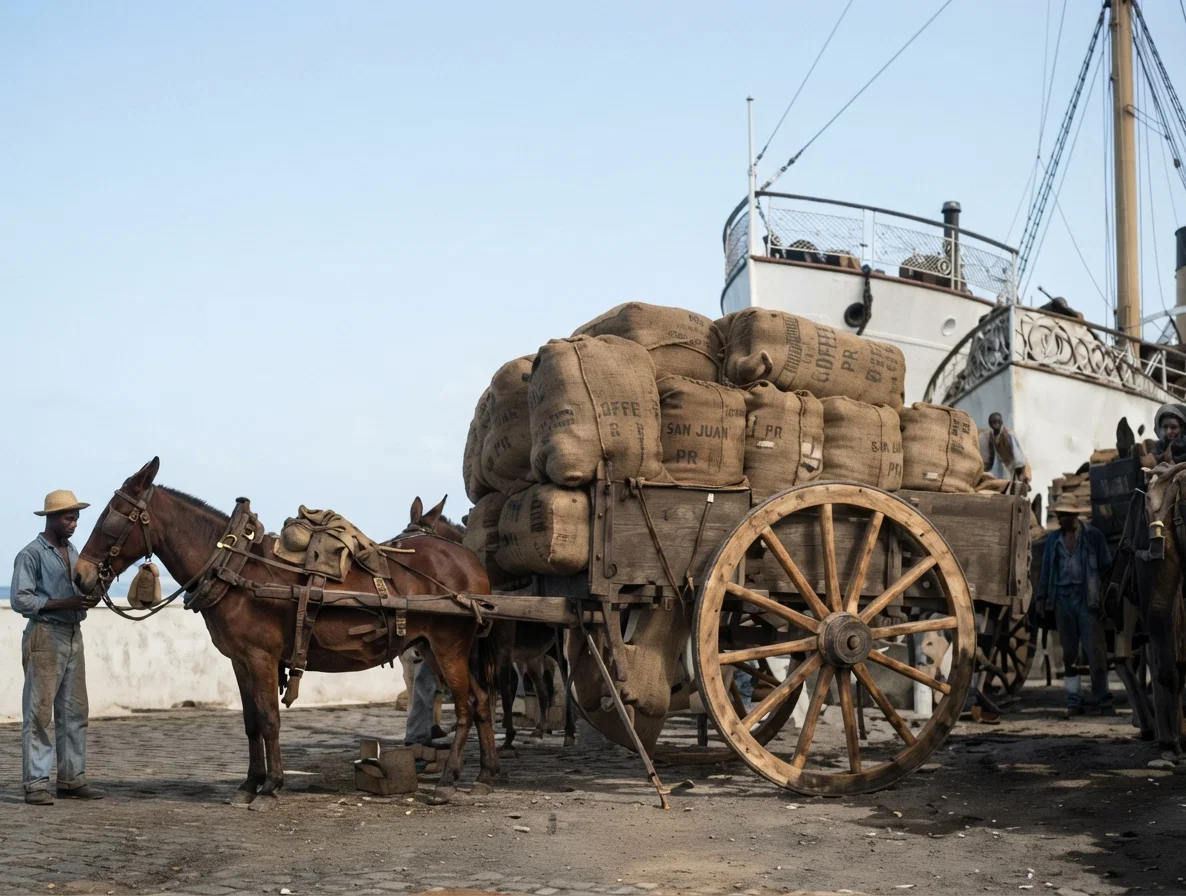
A West India Dray.
A West India Dray.
Everywhere, where two or three gather together in the Lord's name, we want this call to be known and prayed for. The Lord will respond to the moving of hearts, to the offering of lives and means. Be enthusiastic in your faith and in your works. The result is sure. Forward. D. M. TRAILL.

"FREE CHILDREN OF NATURE."

THE term " free children of nature " is sometimes applied to barbarous peoples; but the title ill befits that class. Free they are not. Children they may be, but in a sense the reverse of that which Paul commended when he said, " Be not children in understanding; howbeit in malice be ye children."
A Typical West India Lady.
Their " nature " is fallen human nature—very far fallen.
That such people are not free is usually apparent even in their civil life. Generally they are dominated by arbitrary chiefs; and their freedom is further circumscribed by intertribal wars and personal feuds. Domestic tyranny denies liberty to the women of most or all unchristianized countries. Even the conventions of society hamper barbarians as well as Europeans.
But the worst thralldom is that imposed by malign deities. Almost universally, people who do not know the true God, benign and beneficent, live in fear of malevolent deities. The gods of the heathen are commonly designated by their worshipers as " evil spirits " or " black gods," whose wrath must be appeased by offerings, sometimes by sacrifice of life.
Truly the title " free children of nature " is bitter irony when applied to pagans. Every unexplained phenomenon portends to them the anger of some deity; trivial coincidences suggest impending disaster; and the supposed terrors of the great beyond make these hapless creatures " through fear of death . . . all their lifetime subject to bondage."
The worst slavery to which any mortal is liable is that which rules the will. Many a wretched man—notably the drunkard—is in that state of helplessness which impelled one to declare, " What I would, that do I not; but what I hate, that do I." Certainly the uncivilized are not exempt from this soul-bondage. So obvious is the lack of self-control on the part of the aboriginal inhabitants of our own country, and likewise those of other countries, that special legislation is enacted to protect them from their own passions. The sale of intoxicants to those classes is forbidden by law.
Verily, not in the abandonment of wild life is freedom secured, nor in disregard of any just restraint. On the contrary, the appetite, or other carnal impulse that is not kept in subjection, will enslave its possessor. In rightful obedience is the only true liberty. " Humble yourselves therefore under the mighty hand of God." Then will the Son of God make you free. And " if the Son . . . shall make you free, ye shall be free indeed." MRS. ADA D. WELLMAN.
---
QUIT grumbling and grunting. To bear adversity in silence is proof of the reserve power that makes men " more than conquerors." FRED T. ELKIN.

THE UNNOTICED BOUND.

WHEN, passing southward, I may cross the line Between the Arctic and Atlantic Ocean, I may not know by any test of mine, By any startling sign or strange commotion Across my track; But, as the days grow brighter, one by one, And e'en the icebergs melt their hardened faces, And sailors linger, basking in the sun, I know I must have made the change of places Some distance back.
When, answering timidly my Master's call, I passed the bourne of life in coming to Him— When, in my love for Him, I gave up all, The very moment that I thought I knew Him I can not tell; But as increasingly I feel His love, As this cold heart is melted to o'erflowing, And now so clear the light comes from above, I wonder at the change, and move on, knowing That all is well! —W. R. Cochrane, D. D.

Inquisition Hall Becomes Mission Hall

The hall of the Inquisition in Bahia, Brazil, once the headquarters of the institution for the whole country, is now used as a Protestant mission hall.

A Presbyterian Missionary in China

A PRESBYTERIAN missionary in China, Dr. Kerr, has treated more than 780,000 patients, with 48,000 surgical cases.

ENTANGLING ALLIANCES.

"Thou therefore endure hardness, as a good soldier of Jesus Christ. No man that warreth entangleth himself with the affairs of this life; that he may please Him who hath chosen him to be a soldier." 2 Tim. 2:3, 4. One of these "affairs of this world" that is very entangling, because of the good it aims to do, is comprised in the category of secret societies. It is a peculiarity of worldly hindrances to the cause of Christ, that the better they appear the more subtle is their detriment to real Gospel work. In the Cynosure of June is a report of a certain experience meeting, in which Rev. W. L. Clapp, of Chicago, spoke in part as follows:—
As to the effect of secret societies in the work, I want to speak of an experience that we had in a little church in this city. I noticed that we had the prayer-meeting on Thursday instead of Wednesday evening. I learned afterward that the lodge met Wednesday evening, and therefore the prayer-meeting was changed to Thursday evening. After I had been there a couple of months, one of the deacons came to me, and I passed the time with him just before service, and asked him why he was not out to the morning service. "Well," he said, "it is like this. On Saturday night our lodge hold all their social gatherings, and as you know it is pretty early before we get away, and I never feel like coming to church on Sunday morning." I said, "You are not putting your lodge before your church, are you?" He said, "I think if I live up to what is taught in the ritual of our lodge, there will be no doubt about my getting to heaven."
And that is the conception that the ordinary person has about the teaching of the lodge. This is true of not only one deacon, but three others in that church, and one of them has never been in the prayer-meeting in all the time we have been there, nearly a year, on the ground that he has to be up at four o'clock in the morning. No trouble at all to stay out to the gathering of the lodge. It is true of all the deacons, and further, it has extended to the young people. In view of these men who are older in life, the young people say, "Here is So-and-so in a lodge; if they are in the lodge, it must be all right. I will take them as my guide," and the result of that has been that those whom we have had in office have objected to the proclamation of truth along that line, and have severed their connection, if not from the church, have at least dropped active church work, because they did not believe in that thing.
The above clearly shows what has been pointed out so many times, that in many cases, if not all, the lodge becomes a rival to Christianity, and is therefore anti-Christian. We do not see how this logic can be evaded.

NO STATE RELIGION IN JAPAN.

MUCH interest has been aroused in efforts of Buddhism to obtain governmental recognition in Japan. By its contact with Christianity, Buddhism has been aroused from its lethargy, and resumed somewhat of its activity as a missionary religion, even projecting a propaganda in America. Its renewed activity, which is evidently a conscious or unconscious struggle for very existence, in view of the spread of Christianity on the one hand, and atheism on the other, has been directed to an agitation in the Japanese Parliament looking toward the "establishment" of Buddhism as a state religion. The adoption of any such measure by the Japanese Government would do much to destroy the confidence of other nations in Japan as a progressive, civilized power. The zealous 'church party' has met with a decided set-back in the refusal of Abbot Shaku Shoyen to endorse the movement. That Buddhist dignitary is held in the highest esteem, and his opinion will carry great weight. He remarks very pointedly that a religion that needs the support of law is so weak and worthless that it does not deserve to live. If the Buddhists are to propagate their faith, it must be by the purity of their lives, and not by the aid of the law.—Missionary Review.

INDIA'S NEED OF CHRIST.

AFTER spending four months in India, the deputation sent out by the American Board has this to say:—
We return from our work upon the deputation profoundly convinced that no country in the world ever needed or more sorely needs to-day the saving Gospel of Jesus Christ than do India and Ceylon. We seized every opportunity to investigate the religions of those countries, and to study the public and private life they produce. They have utterly failed to inspire the people to anything that is uplifting and ennobling. Three thousand and more years of Hinduism have fully demonstrated its lack of ability to hold a mighty race from sinking lower and lower in ignorance and immorality. This condition is observed by the intelligent Hindus, who are free to confess that India's only hope is in the Christian religion. It is impossible for the foreigner to appreciate or understand the utter lack of unity or co-operation among the native peoples of India. With their more than one hundred languages and races, with their minute subdivision into thousands of castes, with their perfect chaos of nature-religions and diversity of cults, there seems to be no ground in which this great and really capable people can meet or hold fellowship, unless Christianity can come to them with its one God, its one human fraternity, its one tongue, and its one blessed hope for all, high or low, rich or poor, male or female. Hinduism confesses itself powerless, and, in its helplessness, turns to the West, from which the light of Christian civilization sheds its inspiring rays upon caste-bound, hopeless India.

WORKING FOR JESUS.

Just working for Jesus that is all To hasten His glorious appearing; Working while patiently waiting His call, And knowing the glad day is nearing. Our toil through the wearisome day is light When Jesus our effort is blessing; Our hearts sing his praises from morning till night, His love and our shelter confessing.
Just working for Jesus day by day, Not seeking the way of our pleasure; But scattering sunshine and joy all the way, And filling each hour of leisure. His yoke is so easy, his burden so light, Whenever the cross we are bearing, That whether the pathway be somber or bright, His love we will always be sharing.
Just working for Jesus every hour, To cheer up the fainting and weary; To plant just a seed of a joy-giving flower In a heart that is cheerless and dreary. Just working and trusting in Jesus alone, While others their pleasure are serving; And hoping at last for a place by the throne, In the midst of his blood-purchased treasure.
Cheney, Kansas. MRS. J. E. GILCHRIST.

THE MASTER CALLETH.

SISTER DORA gave up her life to nursing sick people. At the head of her bed a bell was fixed by which sufferers could summon her at any hour of the night. As she rose at the sound of the signal she used to murmur these words, as if they were a charm: 'The Master is come, and calleth for thee.' It was as if the sick sufferer faded away, and in the couch she saw the face that was once marred with the world's anguish.
Christ's face across her fancy came, And gave the battle to her hands — Word and Way.

Roman Catholic Images and Pagan Idols

The worship of images among the Roman Catholics is very confusing to the idolaters of pagan lands. They see no difference between their idols and the images before which the Roman Catholics bid them bow down. A missionary in Manila tells of a Chinaman who was heard to say that the only difference he saw between the religion of the Filipinos and that he had been used to at home in China, was that the Chinese gods sat down, and here they stood up.—Almanac of Missions.

THE BIBLE IN CHINA.

[A. C. J. in World's Crisis.]
ONE of the most hopeful signs in China is the wide circulation of the Scriptures. Notwithstanding the disturbances in 1900, the aggregate circulation of the Bible in that year was 1,523,930 copies; 991,300 of these were in Mandarin, and 291,900 were in Easy Wenli. These figures represent the operations of three Bible societies at work there. Then, too, the present year has opened most encouragingly in this respect. During the first eight days of January, orders were received at the Shanghai depot of the British and Foreign Bible Society for upwards of 150,000 copies of Scriptures, of which about 15,000 are Bibles and Testaments.
Continue reading: Pray About the Little Things