After the captivity the Jews did not depart from the day of the Sabbath as commanded in the law, but they did depart from the manner of Sabbath-keeping as contemplated in the Spirit of the commandment. This was illustrated in the example of Christ, who had given the Sabbath law and knew how to practically fulfil it as a Jew. So, in the line of apostasy in the Christian Church, a departure from the Sabbath of the Lord was conspicuous. This “Christian” departure, however, took on the nature of a gradual turning away from the day which the Lord had sanctified and blessed. This was mainly because that, after the apostolic period, the accessions to the church were largely of the Gentile, or heathen, classes, who were intensely prejudiced against the Jews. They discouraged Sabbath observance because they claimed that it was merely a Jewish custom. Various efforts were made to establish days of special observance other than the seventh day; for instance, Friday, because that was the day of the Saviour’s passion; Wednesday, because on that day the Lord was betrayed; and Sunday, because of Christ’s resurrection. The Eastern churches held longer to the true Sabbath than did those of the West.
But Sunday had the prestige among the heathen, because it was already an established holiday, or festival, dedicated to the popular sun deity. The leading spirits of the post-apostolic church were from the ranks of the heathen philosophers, and the coincidence of the resurrection of Christ, the “Sun of Righteousness,” made it easy for them to incline to the popular day which they had been accustomed to observe. This, too, made the reproach of the cross all the lighter, and made missionary work among their heathen friends much more successful. But no statement has yet been substantiated wherein any writer of the first three centuries ventured to call the first day of the week the Sabbath. Some of those who observed the first day did so in addition to a formal recognition of the seventh day, and others kept the day instead of the Sabbath, which they claimed was Jewish.
J. N. Andrews, who published an elaborate history of the Sabbath in 1873, fully investigated a large number of false statements in regard to the writings of the “fathers” prior to the Council of Nice, 325, and after a close research summarized as follows:—
The fathers are so far from testifying that the apostles told them Christ changed the Sabbath, that not even one of them ever alludes to such a change.
No one of them ever calls the first day the Christian Sabbath, nor, indeed, ever calls it a sabbath of any kind.
They never represent it as a day on which ordinary labor was sinful; nor do they represent the observance of Sunday as an act of obedience to the fourth commandment.
The modern doctrine of the change of the Sabbath was therefore absolutely unknown in the first centuries of the Christian Church.
Sir Wm. Domville, also author of a treatise on the Sabbath question, gives the following testimonial:—
“Not any ecclesiastical writer of the first three centuries attributed the origin of Sunday observance either to Christ or to His apostles.”
Sunday observance was only one of several “voluntary festivals” that sprung up in the church during the second and third centuries. But this particular feature of apostasy, which is not mentioned by any writer until A. D. 140, by Justin Martyr, took the lead, on account of its prominence among the heathen and the desire of Christians who were fast backsliding, to popularize the church. In this way the church increased in numbers and in political influence, but rapidly declined in spiritual power. Such was the deteriorating influence of the observance of this festival that it became necessary for both Justin and Tertullian to defend their brethren against the charge of sun-worship. This was peculiarly embarrassing to Justin, for, in endeavoring to gain favor for Christians with the emperor, he had laid special stress upon the fact of their holding meetings on this day of general observance. And Tertullian acknowledged that there was apparent ground for the accusation that Christians worshiped the sun. He admitted that they worshiped toward the sun like the heathen, and devoted Sunday to rejoicing, but he plead that they did so for a different purpose.
Of course they did it for a different purpose; but by departing from the commandment of God, and substituting human tradition, the people were misled, the truth was compromised, error was deeply rooted in the church, and the cause of Christ was brought under reproach.
What is meant by the phrase in Mark 9: 44, "Where their worm dieth not?"
The striking figure used by our Lord to illustrate the place of punishment of the wicked was the valley of Hinnom (in Greek, Ge-henna), south of Jerusalem. Into this valley were cast the offal of the city and the bodies of malefactors. Upon these the worms continually preyed, and constant fires were kept burning to consume what the worms did not devour. The unquenchable fire and the undying worm became the strongest expressions of utter and complete destruction. Compare Jer. 17: 24-27, with 2 Chron. 36: 19, 21, and note how the fire that "shall not be quenched" burned up Jerusalem. See also Isa. 66: 24; 51: 8, and note that the worm preys upon, not living souls, but dead carcasses, and eats them up. The "unquenchable fire" and "the worm that dieth not" are the divine symbols of destructive agencies which can not be checked till their work is done.
Will you give me light on 1 Peter 3: 19, 20? It appears that Christ preached to the spirits in prison that were alive during the days of Noah. Now most of the scriptures teach that at death the spirit goes to God who gave it, and that the dead know not anything.
The text reads (verses 18-20):—
"For Christ also hath once suffered for sins, the just for the unjust, that He might bring us to God, being put to death in the flesh, but quickened by the Spirit; by which also He went and preached unto the spirits in prison; which sometime were disobedient, when once the long-suffering of God waited in the days of Noah, while the ark was a preparing, wherein few, that is, eight souls were saved by water."
The work of the Son of God has been the same in all ages, "to preach good tidings unto the meek," "to bind up the broken hearted, to proclaim liberty to the captives, and the opening of the prison to them that are bound." Isa. 61: 1. When on earth He did this personally. Before He came to earth, as after, through His servants by the Spirit. See 1 Peter 1: 10, 11. The prison is the prison-house of sin. The sinner is there "shut up." Gal. 3: 23. Spirits here stand for the men, whose spirits were in bondage to the flesh. Gal. 5: 17; Rom. 7: 14-24. Christ went to preach to the spirits in prison when His Spirit strove with them for one hundred and twenty years, when the long suffering of God waited in the days of Noah, while the ark was preparing. See Gen. 6: 3. There is no proof in the text for purgatory or immortal soulism or second probation. The soul that dies in its sins shall die the second death. Eze. 18: 24-26. The Gospel comes to sinning men, when they are sinning, to turn them from their sins to God. All Scripture, rightly understood, teaches that "the dead know not anything."
1259. Who Named the Days?
Who named the days? and what is the right name of the first day of the week?
The common names of the days of the week came to us from different heathen sources, mostly from the Romans and Saxons. The right name of the first day of the week is "First day," or the "First Day to the Sabbath." This is the sacred name. God never gave it any other.
Well Said
By Editor
Well Said.—The Pacific Ensign, California W. C. T. U. organ, says: “Our national expositions are going the way of our county fairs. They mean large appropriations to exhibit our vices.” The temperance people of South Carolina are said to be “dismayed” at the display of vice, not only clandestine but open, at the Charleston exposition. It is the libidinous, loose, licentious life of that other great republic—Rome. That kind of life preceded her downfall; and that kind of life is the precursor of not only this republic’s fall, but the fall of the world.
NOT UNWARNED.
It is ever true that God in some way warns men of impending dangers and judgments, but almost never will they heed the warning till the heart and conscience and sensibility can no longer appreciate His goodness or hear His voice. Yet it is His constant purpose still to warn. Thus the prophet states it:—
“Will a lion roar in the forest, when he hath no prey? will a young lion cry out of his den, if he have taken nothing? . . . Shall the trumpet be blown in a city, and the people not be afraid? shall evil befall a city, and Jehovah hath not done it? Surely the Lord Jehovah will do nothing, except He reveal His secret unto His servants the prophets. The lion hath roared; who will not fear? the Lord Jehovah hath spoken; who can but prophesy?” Amos 3:4-8.
When about to destroy the primitive world-arrangement by a flood, “Jehovah said, My Spirit shall never pronounce judgment upon men unwarned. They are but flesh. Their days shall therefore yet be one hundred and twenty years.” Gen. 6:3, Boothroyd’s translation. When about to destroy Sodom and other wicked cities of the plain, “Jehovah said, Shall I hide from Abraham that which I do?” And He did not. He has revealed coming judgments to His prophets, and the prophets have ever warned and will ever warn, whether the people will hear or forbear.
Sometimes He warns in other ways, and always on the part of more or less of the people with an apprehension of dread of impending danger. Thus it was in the city of St. Pierre. For days before that fatal May morning, when the whole city was made a ghastly morgue, the people were warned of the great danger. This is shown in news that came from Paris ten days after the awful calamity. People who perished in St. Pierre wrote letters to friends in the French capital, letters breathing alarm five days before the horrible outburst of Pelee. Yet strange to say, while fearing the danger many flocked to the city; none left it. Some of the expressions are quoted from these letters by Murat Halstead, in his very recent work, “The World on Fire” (International Publishing Society, Chicago). One from a young woman, dated May 3, after describing the town lit up with flames from the volcano, everything covered with ashes, and the people greatly excited, contains this:—
“My calmness astonishes me. I am awaiting the event tranquilly. My only suffering is from the dust which penetrates everywhere, even through closed windows and doors. We are all calm. Mama is not one bit anxious.
“Edith alone is frightened. If death awaits us, there will be a numerous company to leave the world. Will it be by death or asphyxia? It will be what God wills. You will have our last thoughts. Tell Brother Robert that we are still alive. This will, perhaps, be no longer true when this letter reaches you.” The Edith mentioned was a woman visitor among the rescued. This and other letters inclosed samples of the ashes which fell over the doomed town. The ashes are a bluish-gray impalpable powder, resembling newly-ground flour, and slightly smelling of sulphur.
Another letter written the afternoon of May 3 says: “The population of the neighborhood of the mountain is flocking to the city. Business is suspended, the inhabitants are panic-stricken, and the firemen are sprinkling the streets and roofs to settle the ashes which are filling the air.”
Still another letter says: “St. Pierre presents an aspect unknown to the natives. It is a city sprinkled with gray snow, a winter scene without cold. The inhabitants of the neighborhood are abandoning their houses, villas, and cottages, and are flocking to the city. It is a curious pell-mell of women, children, and barefooted peasants, big, black fellows, loaded with household goods. The air is oppressive; your nose burns. Are we going to die asphyxiated? What has to-morrow in store for us? A flow of lava, rain of stones, or a cataclysm from the sea? Who can tell? Will give you my last thought if I must die.”
“A St. Pierre paper of May 3, received by mail, announces that an excursion arranged for the next day to Mont Pelee had been postponed, as the crater was inaccessible. Mr. Halstead tells us that “it was the fashion of St. Pierre to indulge the pleasant theory” that there was added interest in living near a dangerous mountain; “there was a charm in living so near” to an imminent peril; that it gave “a peculiar zest to life.” They felt that the town never had been destroyed and never would. The governor of Martinique assured the people “that there was nothing important likely to happen.” It is also reported that Professor Landes of the University of St. Pierre, after examining the volcano, reported to the governor that the destruction of the city would “not happen later than the 8th of May,” the very day of its destruction. American correspondents on the ground state that the despatch of Professor Landes predicting the end of the city is held a secret by the government. — “World on Fire,” p. 91.
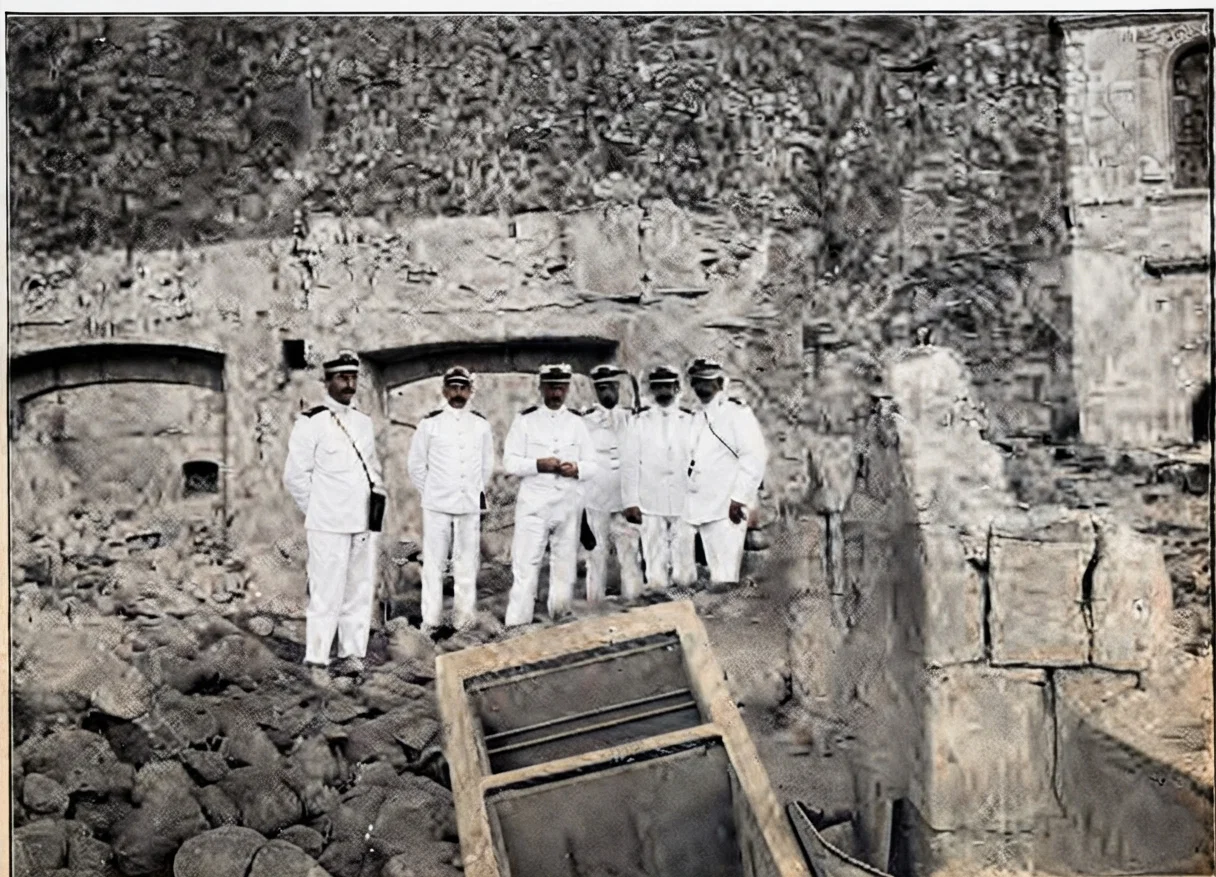
Interior of Bank of Martinique, Showing Group of Officers from Dutch Cruiser, Konigan Regentes.
The governor of the island went from Fort de France to St. Pierre, saying if St. Pierre were destroyed, he would be destroyed with it. He managed to keep the people from leaving, while he himself escaped. The Italian consul, warned by a sea captain, escaped. Mr. Le Clerc, a wealthy landowner, escaped the very morning of the disaster. He said to the United States consul, “I am getting out, and you’d better get out of this.”
The consul replied, “There is no need of any one going away.”
The gentleman responded, “It is better to be safe than sorry.”
Amid pleasure and revelry, alarm and fear, warned and yet held by the power of foolish fascination, 30,000 people perished and less than a dozen were saved.
When the great final convulsion and catastrophe of this sin-laden world shall take place, the division between the people will be strictly on the line of character. “The righteous shall be saved out of it.”
THE GREAT IRRIGATION MEASURE.
By G.
If time should last, much of the vast desert region between the Sierra Nevada and the Rocky Mountains might be made very productive. All that is needed is water, and the needed water is contained in the treasures of snow on these mountain ranges. A great general system of irrigation for this expanse of otherwise arid land, has been long talked of. Its feasibility has not been questioned, but private enterprise was not equal to the task. And if a great combination of capital should consummate the work, the result would be a vast monopoly of land and water. The only means by which the common people could be benefited, and moderate homes be the result, was for the government to do the work. But it takes a long time for plans favorable to the masses to develop, as there are so few men of influence who will devote the time and talent to enterprises in which there is no special large profit for the individual. It is so difficult to enlist the interest of public men where there is no personal gain in sight. There must always be at least a prospect of political gain.
At last, however, it seems that political interests, to a certain extent, may be subserved by encouraging a really good thing, and the long-talked-of irrigation scheme has received the sanction of Congress and the Executive. Its immediate sponsors are highly pleased with it, and it appears to be, as was desirable, well guarded against private monopoly. This, of course, time alone will tell; for these are days of "perilous times" to the common people, as it is a time specially noted in prophecy when "men will be lovers of their own selves, covetous," etc. All sorts of schemes have been concocted for securing large bodies of timber land under concentrated ownership, contrary to law, and no doubt plotters will follow up the Irrigation Law—and all human laws are vulnerable; but the framers of this one have done their best. Representative Newlands, of Nevada, has this to say of it:—
The bill has been so framed as not to require subsequent action by Congress or subsequent appropriation. It is perhaps the only bill ever passed which furnishes so complete, comprehensive, and automatic a plan of action. Under its provisions at least $150,000,000 of the proceeds of the sale of public lands will be available in the next thirty years for irrigation work, without further appropriation. The receipts from public lands of the last fiscal as well as the present fiscal year, and aggregating $6,000,000, are immediately available, and from this time on about $3,000,000 per annum will be available, which sum will be constantly increased as the lands are redeemed and sales are made. The bill is carefully guarded. The Secretary of the Interior can not let contracts, unless the money is in the fund. Land monopoly is impossible. In every9way the bill is drawn so as to preserve the public domain for home-seekers. The best feature of the measure is its automatic action. The entire work is done without the necessity of further legislation by Congress.
We take occasion here to remind "home-seekers" that there is open for them an opportunity to secure an eternal home, where there are none of the annoying obstacles incident to home-getting in this sinful world. Many of you will have passed from this life before your hopes of success here are realized, and then it will be forever too late to secure a home in the better land. The title must be made sure while the present life exists. According to the promise of God, "we look for new heavens and a new earth," after this one shall have been renovated by fire; but the special characteristic is, "wherein dwelleth righteousness." No one who has not in this life secured the righteousness of Christ by faith, will be admitted there. "Now is the accepted time; behold, now is the day of salvation."
Of the land in the renewed earth, we have the assurance that "the desert shall blossom as the rose," and that will be without the difficulties incident to laborious irrigation. We are also assured that "they shall build houses, and inhabit them; and they shall plant vineyards, and eat the fruit of them." But there will be no land or water monopoly; for "they shall not build, and another inhabit; they shall not plant, and another eat;" and "they shall not labor in vain, nor bring forth for trouble." Here is inducement not offered by any land enterprise in this world, and it is within the reach of all, together with everlasting life in which to enjoy it. A simple faith in Christ, a "faith that works by love," gives one an inheritance in this glorious prospect. This proposition, based on the sure Word of God, is worthy of every home-seeker's attention.
G.
A BROKEN PEOPLE.
By John McDowell
[From "The Strike of the Anthracite Miners," by Rev. John McDowell, in the July Pilgrim.]
THE miners, as a rule, have large families. Most of the boys are sent to work at an early age. The writer of this article began work before he was eight years old. The law of Pennsylvania has prohibited boys from working under fourteen years of age. But so great is the need of the family that oftentimes the law is ignored and boys under twelve are sent to work to help earn the living. There is no sadder sight than to see boys, young enough and small enough to be in their mother's arms, going back and forth to their daily toil. O, for a Mrs. Browning to write the cries of the miner's children! The miner and his brave wife do all they can to keep their heads above water, but sad to say their efforts are seldom successful.
In no part of this land will you find so many broken-down men,—cripples, widows, and orphans,—as in the coal regions. Last year 513 men were killed and 1,243 injured. In the past thirty-two years, over ten thousand men have been killed, and over twenty-six thousand injured. Think of the suffering and sorrow represented by these figures! There is not a day but the black, heavy ambulance may be seen slowly making its way from the mine to some home with a dead father or an injured son. Every day the miner takes his life in his hands for the sake of a scanty living for his family, which is always dearer to him than his life.
The mortality among the miners is very much above the average. Especially is this true of the children. Go into any mining village and ask a mother, "How many children have you?" The answer will be, perhaps, "I have had eleven and lost six." And such a statement is usually followed by this comment, "Thank God, they are spared a miner's life."
Railroad Speed of 180 Miles an Hour
THAT a speed of 180 miles an hour on the railroad is a possibility of the future, is firmly believed by practical engineers. At a recent meeting of electricians, Mr. Oberlin Smith, ex-president of the Society of Mechanical Engineers, stated that whenever capitalists would produce the money to prepare proper tracks, trains could be put on the rails that would run at that rate of speed. To attain such a speed, the roads must be straightened and elevated enough to be above all crossings.
Bolivia Appeals for U.S. Intervention
The Bolivian Government has appealed to the United States to intervene in its behalf in the triangular contest between Bolivia, Brazil, and Peru for the possession of the territory of Acre.
Religious Teaching in Philippine Schools
By Editor
REPORTS have recently been circulated to the effect that the Protestant teachers in the Philippines were using their offices to disparage the Catholic faith and build up Protestantism. The Catholic Times published a long article on the subject. Secretary of War Root at once cabled to Acting-governor Wright at Manila, stating the charge made and asking for a statement of the facts in the case. Acting-governor Wright's reply states that every charge in the accusation is untrue, and his statement is corroborated by William D. McKinnon, a Catholic priest who is a member of the advisory board of general education. The reply also brings out the fact that the great majority of the teachers in the islands are Catholic, and that priests have the privilege of teaching religion in the schools three days in the week, as a concession to the Catholic sentiment of the islands; but that no teachers are allowed to teach religion in the schools. This fair and clear refutation of the charge will certainly act as a boomerang upon those making the accusation. The Secretary of War states that it is the purpose of the government to give education, not to teach religion. This is as it should be.
Tolstoi Letter Prosecution in Germany
On July 9, at Leipsic, Germany, a certain theater manager was acquitted of the charge of blasphemy brought against him because of the circulation of Count Leo Tolstoi's letter to the Holy Synod of Russia. The State's attorney has appealed the case to a higher court, on the ground that the prosecution was necessary in order to maintain the creed of the established church. He stated that while Tolstoi's letter was moral and religious, yet it was plain that the letter was an attack on the orthodox church of Russia, and was therefore in principle an attack on the established church of Germany. Hence it could not be overlooked. Thus we have a self-styled Christian nation, whose emperor frequently preaches to his subjects from the Bible, prosecuting persons for the circulating of literature which is admitted to be moral and religious. It is an inconsistency that is bound to be met in every nation with an established religion, a state of things to which all religious legislation tends.
The Friars Must Leave the Philippines
In reply to the last note from the vatican on the friar question in the Philippines, the President is reported to have taken the position emphatically that the friars must be eliminated entirely from the islands. Advises from Rome indicate that there is a disposition on the part of the vatican to take advantage of the Philippine question to forward its desire for the establishment of diplomatic relations with the United States. The purchase of the friars' lands and the payment of the large sum of money involved it is thought will render some such relations indispensable, and by reserving the question of the withdrawal of the friars, the vatican hopes to prolong these relations.
Lord Salisbury Retires
After a long and successful career as a member of the official family of the British Government, the premier, Lord Salisbury, retired on July 13, and Arthur J. Balfour, leader of the House of Commons, was appointed to the place. The retirement of this last great statesman of the Victorian age is universally regarded as the transition from one generation to another, and as marking the close of an era in national life. No one since the Earl of Liverpool has been prime minister as long as Lord Salisbury, and only two have held this high office longer than he. He had served on many important missions before being appointed to the premiership of Great Britain.
Changes in China’s Diplomatic Service
Wu Ting Fang, Chinese minister to the United States, has been notified by his government that a successor has been appointed to his place, and that his services will henceforth be required in another branch of the government. New ministers have also been appointed to Russia, France, and Italy. The selections for those posts show that the dowager empress continues to regard the diplomatic service as unimportant, the new appointees being all men of little or no experience.
The New Battleship Maine
THE New battleship Maine, whose keel was laid on the anniversary of the destruction of the battleship Maine in Havana Harbor, February 15, 1898, left the ship-yards of the Cramps Shipbuilding Company on July 14 for her builders' trial trip. The new Maine is 388 feet long, 72 feet wide, her displacement is 12,500 tons, and she is said to be a much more powerful vessel than her namesake whose bones still lie beneath the waters of Havana harbor.
Highway from New York to Chicago
THERE is a plan now on foot for building a fine, broad highway from New York City to Chicago, a distance of about 850 miles. About 400 miles of this roadway is already built in various disconnected sections. The plans now being pushed are for filling in the missing links by local organizations along the route. The owners of bicycles and automobiles are hailing with delight the prospect of the completion of the road.
Harry Tracy Still at Large
The bandit, Harry Tracy, who some weeks ago broke out of prison at Salem, Oregon, with a companion, after killing three guards and a fellow prisoner, and afterward added three more murders to his list of crimes, is still terrorizing the vicinity of Puget Sound. Armed posses have been on the trail of the bandit continually, but he has eluded his pursuers and baffled the bloodhounds.
General Lord Kitchener Welcomed in England
GENERAL LORD KITCHENER has been given an enthusiastic welcome by his friends and admirers in England, having reached London on July 12. The coronation arches which were being torn down are now redecorated in honor of Kitchener.
King of Italy Visits St. Petersburg
THE king of Italy arrived at St. Petersburg, Russia, on July 13, and was received with all the courtesies due his rank by the czar and the ministers of his cabinet. A banquet in honor of the royal guest was held in the hall of Peter the Great in the palace, at which the cabinet ministers and the members of the Italian embassy and high court dignitaries were present. The official papers extend a hearty greeting to the visiting king, and congratulate both powers on the fact that there are no differences between them. It is not surmised that an alliance between these nations is the purpose of the Italian king's visit, and yet this visit coming so close after Russia's disappointment over the close of England's war in South Africa and the consequent disarrangement of the plans of Russia, is quite likely to mean the adoption of other plans that will have a far-reaching effect. Russia's unusual course recently of calling a council of educated men of various views to advise plans for the establishment of domestic peace, shows a desire on her part to have a tranquility at home which will enable her to present a solid front to any international problem that may arise. Her course in this being so unusual indicates a more than ordinary desire for domestic harmony.
Chicago Freight Handlers’ Strike Continues
The strike of the Chicago freight handlers continues, neither the railroads nor the strikers being willing to yield their positions. The strikers are asking for a rate of 18 cents an hour, which the managers of the railroads have declared they would not grant. There is also a sympathetic strike of the teamsters who haul the freight, and the ice haulers have refused to deliver ice to the railroads' refrigerator cars. The Chicago longshoremen are also on strike, partly in sympathy with the freight handlers and partly on their own behalf for an increase of wages.
Boilermakers’ Strikes Settled by Compromise
The strike of boiler makers on the Great Northern and the Northwestern system has been settled by a compromise. The wages of the men on the first named road were advanced 25 cents per day, and on the latter road 30 and 40 cents a day, according to kind of work done. The striking boiler makers of the Union Pacific still hold out, neither side to the controversy being willing to yield.
Cholera Ravages China and the Philippines
CHOLERA is said to be raging along the Kweilen River, in the province of Kwansi, China. United States Consul McWade reports that 3,000 have died in Pinglok and 10,000 in Kweilen. The ravages of the plague in the Philippine Islands continues, tho the latest reports indicate a slight falling off in the number of victims.
Earthquakes Damage Villages in Salonica
MANY villages in Salonica, European Turkey, have been damaged by a succession of earthquakes. Within two days thirty separate shocks occurred. While some of the shocks were sufficiently severe to destroy houses, the loss of life has been slight. In one small village alone 150 houses were destroyed.
Terrible Explosion in Johnstown Coal Mine
one small village alone 150 houses were destroyed.
A TERRIBLE explosion occurred in the coal mine at Johnstown, Pa., on July 11, entombing 200 men who were at work in the mine at the time of the explosion. According to the latest accounts 143 are known to be among the dead, and it is feared that the full number of victims will amount to over 150.
Ruin Threatens Chicago Corn Speculators
the full number of victims will amount to over 150.
RUIN is facing a large number of the wealthy corn speculators on the Chicago Board of Trade, who are being forced to the wall by the manipulations of those who control the corn market. It is rumored that the Chicago Exchange would be called upon to fix a price in order to avert a panic in the market.
Fernando Po Revolt
A DESPATCH from Madrid states that the inhabitants of the island of Fernando Po, in the Gulf of Guinea, have thrown off the yoke of Spain, and killed and eaten the Spanish garrison of 150 men stationed on the island. Spanish newspapers are demanding that the island be abandoned.
Mont Pelee Active Again
REPORTS from the island of Martinique state that the volcano of Mont Pelee is again active, throwing out mud, stones, and ashes. No lives have been lost in this latest activity, altho a party of British scientists are said to have had a very close call.
Portland Reaches Nome
AGAIN word comes from Alaska that the steamer Portland is safe, having reached Nome with the steamer Jeanie in tow. The latter had been disabled in the ice.
Diamond Mines in British Guiana
A REPORT from British Guiana states that diamond mines of great wealth have been discovered in that country, in an almost inaccessible portion of the interior.
Gold-Quartz Mine at Searsburg
A report from Vermont states that a gold-quartz mine has been opened at Searsburg, Bennington County, which gives promise of great richness.
Windward Sails for Arctic
The Peary Arctic steamer Windward, after having been refitted in New York, sailed for Peary’s headquarters in the Arctic regions on July 14.
The World's Debt Increase
In 1801 the world's debt was three billion dollars. In 1901 it had increased to nearly thirty-two billion, or more than tenfold.
King Edward's Coronation
King Edward continues to improve, and it is now stated that the coronation will take place about the middle of August.
Reservoir Bursts in Chile
By the bursting of a reservoir at Las Palmas, Chile, on July 11, 35 persons were drowned.
Spanish Fortifications Near Gibraltar
SPAIN is planning to strengthen and add to her fortifications in the vicinity of Gibraltar.
Revolution in Nicaragua
A REVOLUTION is reported to have broken out in the Republic of Nicaragua.
KEEPING TO THE PROPER PITCH.
THE regulating and holding to a certain musical pitch is not so easy of accomplishment as it appears at first thought, for it has a curious tendency to creep up. It is said that Bach's music sounds much differently now from what it did when Bach wrote it, because the instruments are now pitched higher. In 1882 it was found that the pitch of high A at the Vienna Court Opera had crept from the prescribed 435 double vibrations to the second, to 443, and in 1885 this number had further increased to 450. Accordingly a musical conference was held, and a resolution was taken to re-establish the old pitch of 435 vibrations per second. Upon this announcement the Reichsanstalt, the Imperial Physical and Technical Institute of Germany, set up standard instruments, and has since tested and corrected many hundreds of tuning-forks, shortening them if they are too low in pitch, and thinning the arms if they are too high.11All the military orchestras of Germany are pitched alike, and the Reichsanstalt keeps the tuning-forks correct.
NOT WORK, BUT WORRY
By Inez May Felt
It is not the work, but the worry,
That wrinkles the smooth, fair face;
That blends gray hair with the dusky
And robs the form of its grace;
That dims the luster and sparkle
Of eyes that were once so bright,
But now are heavy and troubled,
With a weary, despondent light.
It is not the work, but the worry,
That drives all sleep away,
As we toss and turn and wonder
About the cares of the day.
Do we think of the hand's hard labor,
Or the steps of the tired feet?
Ah no! but we plan and ponder
How to make both ends meet.
It is not the work, but the worry,
That makes us troubled and sad,
That makes us narrow and sordid
When we should be cheery and glad.
There's a shadow before the sunlight,
And ever a cloud in the blue,
The scent of the rose is tainted,
The notes of the song are untrue.
It is not the work, but the worry,
That makes the world grow old,
That numbers the years of its children
Ere half their story is told;
That weakens their faith in heaven
And the wisdom of God's great plan.
Ah! 'tis not the work, but the worry,
That breaks the heart of man.
—Inez May Felt.