Your ShelfYour Projects

The Review and Herald, Vol. 55, No. 5

WELL SAID
Earlier text: A GOOD WORD FOR THE REVIEW

MICHIGAN

Morley, Mecosta Co., Jan. 13.—Have been holding meetings in a school-house four miles east of this place. While we did not see all accomplished that we could desire, yet we leave a few witnesses to the truth. Bro. D. A. Wellman was with me during the first two weeks of these meetings. Obtained six full subscribers for the REVIEW and three for Good Health, and sold $37.85 worth of books.
We leave the brethren here in good courage, and with a desire to labor for others. G. H. GILBERT.
Carlton Center, Jan. 15.—Commenced meetings at this place Dec. 21, 1879. Held meetings two weeks, with fair attendance and good attention until the thaw and rains, when we deemed it best to close for a few days. We did so, and spent the time in visiting. We have commenced meetings again, and are speaking on the Sabbath question. We have some hope, and feel a degree of courage in the work. If we can have the help of Him who said, “Without me ye can do nothing,” we shall be able to accomplish some good.
Will our brethren remember us in their prayers. E. VAN DEURSEN.
Flint.—The quarterly meeting for Dist. No. 10, held at Flint, was thinly attended. But very few were here from other churches, and not all the members of this church even were present. This was owing to the almost impassable condition of the roads. The Spirit of the Lord came into the meeting, and more than made up for the deficiency in numbers.
The reports showed that there had been some activity in the missionary work, and still we had evidence that but little more than one-half that had actually been done was reported. At this meeting the Flint church cheerfully raised its proportion of the debt which has been on this district, and has crippled its efforts in the missionary work. The meeting closed leaving all of good courage, and fully determined to be more active and persevering in the good work of placing the light of truth before the minds of others. E. R. JONES.
Sand Lake, Kent Co., Jan. 19.—Jan. 1, 2, Bro. Burrill was with us at Morley. Three meetings were held, and a T. and M. society was organized. These meetings were timely, and a source of encouragement to the brethren.
Jan. 3–5, we were at Sand Lake. On account of the weather, but one meeting was held on the Sabbath. Sunday forenoon, Bro. Burrill spoke on the ordinances of the Lord’s house. In the afternoon a special effort was made for the young, and six came forward for prayers. The evening was devoted to the subject of S. B., the brethren present pledging themselves to pay the Lord’s tithe for the coming year. Monday forenoon the ordinances were celebrated, and a T. and M. society was organized.
The brethren here are of good courage, and we trust they will be benefited by the instruction received. D. A. WELLMAN.
Newton and Spring Arbor.—The T. and M. quarterly meeting of Dist. No. 3 was held at Newton, at the regular time. We were favored with the presence of Sister White, who gave us three discourses. She enjoyed a good degree of freedom, especially Sunday morning. As she earnestly warned men to turn away from burying themselves in the things of this life, and entreated them to seek the hope and joy there is in believing in Christ, hearts were melted to tenderness. Quite a goodly number not of our faith attended the meeting. They gave the best of attention to the word spoken.
There was not so good an attendance from all the churches in the district as we think such meetings demand; however, those present manifested a real interest in the T. and M. work. There were some present who were able to give good instruction in missionary labor, and not a few voted to devote one week’s time to this kind of work during the coming quarter. We have already seen the way open before some of these. How ready the Lord is to assist us if we will only work for him. Brethren, in the future let no trivial circumstances keep you away from meetings of so much importance. Let us be in earnest in this work, and then the Lord will work with us to the salvation of precious souls.
The quarterly meeting of Dist. No. 2, being one week late, was held Jan. 17, 18, at Spring Arbor. At this meeting there was a good representation of the churches in the district, individuals being present from Springport, Tompkins, Bunker Hill, Jackson, Summit, and West Liberty. Bro. W. C. White and W. C. Gage were with us, and rendered valuable assistance. Three discourses were given, and the rest of the time was devoted to the T. and M. and H. and T. work. Much interest was manifested in the T. and M. work, particularly that part of it that relates to arousing our own people to a more lively interest in the truth. Steps were taken to have Testimony No. 29 thoroughly circulated. The subject of family reading was not overlooked. Seven full sets of Spirit of Prophecy were sold.
To this point in the meeting a good degree of outside interest was manifested, but the circulation of an appointment for a temperance meeting Sunday evening brought many more. The church was filled, so that chairs and benches had to be placed in the aisles to seat the people. Thus crowded, they remained for two hours and a half, to listen to and participate in the exercises of the evening. Although a temperance club of fifty-five members had been formed here, yet at this meeting sixty-three signers were obtained to the pledges. The temperance work here reaches outside the ranks of the church, and we hope our brethren will have judgment to direct the work with discretion. M. B. MILLER.

FEED MY SHEEP.

BY S. O. JAMES.
Out of thy darkness into his light, (1 Pet. 2: 9.) Out of thy peaceful home into the fight, (Luke 14: 26-33.) Out of the world (its friendship you scorn), Jesus has called you, his truth to adorn. (John 15: 19.) Go, humble shepherd, through heat and cold (John 21: 15.) To feed his dear flock and add to the fold; (Acts 2: 47.) Quick on the water thy precious bread cast, (Eccl. 11: 1.) Loud blow the trump while the foe stands aghast, (Joel 2: 1.) Ne’er be it said of thee, “Nothing but leaves;” (Mark 11: 13.) Bring to the Master a harvest of sheaves. (Ps. 126: 6.) Walk with thy Lord, and his sufferings share; (2 Tim. 2: 12.) With the glory before you they cannot compare. (Rom. 8: 18.) Happy the servant who labors in love, (Heb. 6: 10.) His rest will be sweet in the mansions above. (Heb. 4: 9.)

SOUTHAMPTON, ENGLAND.

FINANCIAL REPORT.

Our people in America, who are using their means in establishing the English Mission, may be interested to learn its financial standing.
The expense of holding meetings in the tent and in halls was $129.80. Of this sum, $75.02 was paid in donations.
To Feb. 11, 1880, the expense for rent and fitting up of Ravenswood will be $177.39. Toward this, there has been received for rent of tenements, and as donations, $160.67. Of this sum, the donations were $80.86. The rents still to be collected, and our usual weekly contributions, will clear this, and leave a slight balance in the treasury.
Of the cost of tent and fixtures, $611.41, the sum of $151.89 was donated here. Of the expense of mailing Signs and other reading matter, which has been $149.93, $114.03 has been paid here.
So it will be seen that, although, with the exception of some few donations of provision, nothing has been done here toward supporting the missionaries, yet some proof has been given of the sincerity of the faith of those who have espoused the cause. We hope for still more in the future, as the influence of the truth extends.
I would state that during the year I have held two hundred and fifty-five meetings, the first one being held one year ago to-night. J. N. LOUGHBOROUGH.
Jan. 5, 1880.

KANSAS

Mt. Vernon.—Visited the church at this place Jan. 17, 18. I spoke four times, and we celebrated the ordinances. Three were disfellowshipped, one was placed under censure, and committees were appointed to visit absent members. We had no attendance from the outside, except on Sunday night, when the house was about full. SMITH SHARP.
Ottawa, Jan. 19.

NEBRASKA

Beaver City, Jan. 19.—Have held meetings one week at a large school-house, seven miles west of this place. The interest is quite good. GEO. B. STARR.
Weeping Water.—The 10th and 11th, I attended the quarterly meeting of Dist. No. 3, which was held at this place. The officers were unavoidably absent; but the interests of the tract society were considered. A vigilant missionary society was organized, and seventeen copies of the Signs were ordered.
The meeting was a profitable one, and a good degree of interest was awakened on the subject of missionary work. CHAS. L. BOYD.
Beaver City, Furnas Co.—The quarterly meeting of the Richmond church was a profitable occasion. All the members were present except four, the brethren attending from thirty miles up the Sappa. One of these absent ones sent in her letter, and two were detained by sickness. We had a precious season together. Sabbath morning Bro. Canright’s sermon, “God Weighs our Thoughts,” was read to a very attentive audience. In the afternoon we listened to testimonies. Four adults and one Sabbath-school scholar arose for prayers. We celebrated the ordinances, and everything seemed to indicate the presence of God in our midst.
On Sunday more than $40 was paid in on S. B. CHAS. P. HASKELL.

KENTUCKY:

Shepherdsville, Jan. 14.— I left my meetings at Seatonville, to attend our quarterly meeting. Opposition ran very high the last week I was at S. Four who had commenced to keep the Sabbath were caused to give it up. But three or four more told me that when I returned I would find them keeping the Sabbath, so I think the number that I reported last will be made up. Sunday (the 11th), I baptized four, among whom were a Disciple preacher and his wife. We appointed a leader for Sabbath meetings. In two months I shall return to organize this company. S. OSBORN.

IOWA

Dist. No. 4.—In company with Bro. I. J. Hankins, I have visited Bonaparte, Benton's Port, Birmingham, Farmington, and Douds. At Bonaparte the church seemed to be encouraged to take hold of the T. and M. work and willing to pay S. B., thus evincing an interest in the progress of the cause. The brethren at Benton's Port are trying to live out the truth. One brother takes ten copies of the Signs for missionary work. At Birmingham, arrangements were made for Sabbath meetings, and eleven joined the T. and M. society. The church at Farmington is small; but we hope all will take hold to keep up Sabbath meetings and try to advance the interests of the cause. At Douds we organized a church of fourteen members, all but one of whom are heads of families. The most of them are in middle life. We have hope of a strong church here. They have commenced to help in the tract work and in S. B.
Jan. 10, 11, I attended the district quarterly meeting at Mt. Pleasant. This church is trying to go forward in the different branches of the work. I have now visited all the churches and companies of Sabbath-keepers in Dist. No. 4, Iowa, and shall soon commence labor in a new field.
C. A. WASHBURN.

NEW JERSEY.

South Vineland.—Our quarterly meeting, Jan. 3, 4, was a season of encouragement. Though our numbers decrease by the removal of members to other localities, those who are still able to attend our Sabbath meetings are of good courage in the Lord. They manifest an increasing interest in the tract and missionary work, and a firm determination, in the strength of the Lord, to hold the fort. One sister walked between eight and nine miles to attend the meeting.
According to appointment, I met with the society in Camden, N. J., at their quarterly meeting, Jan. 10, 11. Held six meetings with them. Two united with the society, and there is an encouraging outside interest. These were some of the best meetings it was ever my privilege to attend. The Lord is at work for his truth and his people in that vicinity.
N. ORCUTT.

VIRGINIA

Mt. Zion.—The quarterly meeting at Mt. Zion, Page Co., Jan. 10, 1880, opened with an interesting discourse by Bro. Mowrey at the commencement of the Sabbath. There was a large congregation. The Lord was present by his Spirit. On Sabbath morning we had an excellent prayer and social meeting, and the ordinances of the Lord’s house were celebrated. Brn. R. T. Fultz, Stillwell, and Mowrey, of the Soliloquy church, and Bro. Frank Zirkle, of Indiana, were with us.
The church took fifteen copies of the Instructor for the Sabbath-school, and one of Good Health and three of the Signs to be used in the missionary work. Tithes were paid to the amount of $10.20.
Pray for us, brethren, that we may at last be saved in the kingdom. G. H. PETTEFISH, Church Clerk.
Soliloquy.—The first quarterly meeting of the Virginia Tract Society for the year 1880 was held at Soliloquy, Shenandoah Co., commencing Jan. 4. After the opening exercises, appropriate remarks were made by the elder, who urged to faithfulness and diligence in the work of the Master. Remarks were then made by Bro. J. R. S. Mowrey. Our social meeting Sabbath morning was interesting and profitable. Bro. H. A. Rife then preached a practical discourse. On examination of the church record, seventeen responded to their names, six by letter. Two of these letters were from Bro. E. B. and Sr. M. Gaskill, formerly of New York. Bro. F. Zirkle and his sister, of Mechanicsburg, Ind., were with us. Three were added to the church, two by baptism. The ordinances of the Lord’s house were celebrated, and all who took part in them were encouraged and strengthened.
At the business meeting $21.45 was raised for the T. and M. society, and $2.50 for the V. M. society. Twenty-one copies of the Signs were taken, fifteen of the Instructor, and seventeen of Good Health, besides eighteen copies of Testimony No. 29. And $28.40 was paid as tithes. Brethren, pray for us that we may be doers of the word, so that when the Master comes he will say, Well done, good and faithful servants. R. T. FULTZ, Librarian.

Wisconsin Labor Among the Churches

Wisconsin

Labor among the Churches.—Nov. 28, visited Berlin, where is a little company of nine or ten, who hold meetings regularly on the Sabbath, and also have a Sabbath-school. I remained with them one week. They are anxious that more meetings should be held in that city. Dec. 4, went to Poysippi, where we stayed about a week. The weather for the most part was unfavorable for meetings. This church, which is composed of Danish and English members, seems to be in a flourishing condition. They have a Sabbath-school of eighty scholars. We spent three Sabbaths with the church at Fremont. This church has been passing through trials; but the cloud is breaking, and we trust there are better days for them. We also met with the friends of the cause at Lind, Waupaca Co. The truth has steadily gained friends here since we first spoke to them three years ago. On Sabbath twenty-one bore testimony, one of whom was a brother ninety-seven years of age. I have also held a few meetings with the church at New London. They are somewhat behind in taking hold of some of the reforms and the tithing system, but most of them seem ready to learn and obey. I spent a few days at Clintonville. Here are twelve Sabbath-keepers, heads of families, besides children. They have a Sabbath-school, and are trying to let their light shine, that others may be led to glorify our Father which is in Heaven.
Jan. 20. C. W. OLDS.

NEW YORK H. AND T. SOCIETY.

A session of the New York Temperance Society was held at Adams Center, beginning Dec. 21, 1879. Minutes of the organization effected at Hornellsville, N. Y., were read and approved.
The State and Local Constitutions were being revised by the Association; hence the necessity of having a new Constitution drafted, also that there be a revision of the Constitution and By-laws for local clubs, for present, if not for future, use, was quite extensively discussed by Elds. Haskell and Whitney, and others.
The Chair having been empowered to appoint all necessary committees, the following were named: Committee for Drafting a Constitution and By-laws, Jacob Wilbur, Geo. D. Ballou, and J. E. Robinson; On Resolutions, M. H. Brown, C. C. Lewis, and E. W. Whitney.
Resolutions were unanimously passed, (1.) expressing sympathy with every effort to advance the interests of the temperance cause, and a determination to labor to secure the adoption of correct principles and habits; (2.) indorsing the steps taken by the H. and T. Association to arouse an interest upon this important subject, and pledging ourselves to second its efforts by organizing local clubs and bringing as many as possible under the influence of true temperance principles; (3.) urging all temperance workers to use their best endeavors to increase the circulation of Good Health, as it is an efficient auxiliary in this work, teaching the principles of the temperance reformation in a scientific and practical manner.
The new Constitution and By-laws were adopted, and the following-named persons were elected to fill the several offices created by the adoption of the Constitution: President, Milton C. Wilcox; Secretary, Isadore L. Green; Executive Committee, M. H. Brown, J. E. Robinson, and J. Q. Foy.
The present standing of the society is as follows: No. of local clubs, 4; No. of full members, 159; No. of pledge members, 120; initiation fees, $39.75; annual dues received, $3.29.
Meeting adjourned to call of Chair.
M. C. WILCOX, Pres.
ISADORE L. GREEN, Sec.

THOUGHTS ON MATTHEW 28:19.

BY G. W. A.
In this text our Lord commands that the nations of the earth be baptized “in the name of the Father, and of the Son, and of the Holy Spirit.” Question: Does not being baptized “in the name of the Father,” signify that our purposes and acts are in harmony with the Father’s holy will? Now, can persons, in the fullest sense of this passage, be baptized into the name of the Father, who are knowingly or ignorantly living in disobedience to the Father’s law? This law, the ten commandments, is a transcript of his mind. By obedience to it, through faith in the blood of Christ, we are brought near to God. But what about that baptism where individuals are baptized into the error of the observance of a false Sabbath? Can such, in letter and spirit, in the highest sense of the great commission, be baptized in the name of the Father?
Again, persons are to be baptized “in the name of the Son.” Does not this, also, signify that we are to be one with the Son? But how can any one in the complete sense of the text be baptized “in the name of the Son,” who wholly ignores some of the plainest requirements of the “faith of Jesus”? The “rejected ordinance” of John thirteen might be instanced as one particular, though many others could be mentioned.
Finally, persons are to be baptized “in the name of the Holy Spirit.” Now, in all candor, can a person in the fullest sense of this passage be baptized in the name of the Holy Spirit, and at the same time deny the perpetuity of the gifts of the Spirit of God? This idea might be greatly protracted, but the bare suggestion seems sufficient.
Do not the above suggestions have an important bearing on the subject of re-baptism?

PENNSYLVANIA CONFERENCE.

Ellicottsville, Cattaraugus Co., N. Y.—Dec. 26, I returned here after nearly four months absence on account of sickness. When the tent was pitched here last June, there was only one Sabbath-keeper in the place; but before the meeting closed, nineteen persons had signed the covenant. As we were obliged to leave them so abruptly, we feared some might become discouraged; but we have reason to thank the Lord that all maintain their stand more firmly in the faith, while some have made good progress. Truly the Lord has been good. This people manifest a willingness to take hold of the different branches of our work, as they are presented to them. They have secured a lot on which to erect a church, and expect soon to commence building. May the Lord help them to walk in the light, as he is in the light. D. T. Fero.

Bro. G. A. Hobbs on Growing Faith

Bro. G. A. Hobbs, of Sheridan, Ill., writes: “My faith in this great message is increasing. May the Lord help me to receive and hold fast all light, as fast as it is given. God bless our publications to the advancement of his glorious cause.”

CREATE

“What is the meaning of the term ‘create’ in Gen. 1:1?” “W. P.”
Ans. The most consistent criticism we have met on this question is that given by Dr. Clarke, which we quote below:—
“‘[Created] caused existence where previously to this moment there was no being. The rabbins, who are legitimate judges in a case of verbal criticism on their own language, are unanimous in asserting that the word ברא, bara, expresses the commencement of the existence of a thing, or egression from nonentity to entity. It does not in its primary meaning denote the preserving or new forming things that had previously existed, as some imagine, but creation in the proper sense of the term, though it has some other acceptations in other places. The supposition that God formed all things out of a pre-existing, eternal nature, is certainly absurd; for if there had been an eternal nature, besides an eternal God, there must have been two self-existing, independent, and eternal beings, which is a most palpable contradiction.’”

Notes of News.

—One of Brigham Young’s sons is studying law in Paris.
—The centenary of the establishment of Sunday-schools is to be celebrated June 28 to July 4, 1880.
—Germany used more than $5,000,000 worth of tobacco last year.
—The pope’s new paper, the Aurora, is really under the control of the Jesuits.
—Queen Victoria’s full baptismal and family name is Victoria Alexandrina Guelph.
—The Russians intend to build another ice palace this winter. They built one in 1740.
—The famine in Ireland grows more formidable. One death from starvation is reported.
—A recent fire in Hakodadi, Japan, destroyed about half of the city, and made 15,000 people homeless.
—The longest reign recorded in modern history is that of Louis XIV. of France, which was 72 years.
—The religion of the Mohammedans requires them to drink no whisky, and enjoins personal cleanliness. So far, good.
—A proposition is to be submitted to Congress, for the establishment of an experimental tea-farm, probably in South Carolina.
—Emperor William of Germany is the oldest reigning sovereign. He was born in 1797, became King of Prussia in 1861, and Emperor of Germany in 1871.
—As centennial celebrations are the fashion, an exchange proposes for consideration a commemorative meeting on the one-hundredth anniversary of the dark day, May 19.
—Messrs. Tiffany & Co., of this country, have been appointed “Jewelers and Silversmiths to H. R. H., the Prince of Wales.” This is a tribute to American taste and skill.
—The English National Lifeboat Association saved 21 vessels and 637 lives last year. Since its formation, it has contributed to the saving of 26,906 shipwrecked persons.
—A Presbyterian church in Philadelphia burned last December, entailing a loss of $100,000. A fair was being held to raise money to pay for an organ, and the evergreens caught fire.
—A statistician gives the number of ministers in Great Britain as follows: Protestant Episcopal, 25,163; Congregational, 5,266; Presbyterian, 4,951; Methodist, 3,969; total, 39,349.
—A correspondent of the Evangelist asserts that there were added to the Presbyterian churches of this country in 1876, 70,500 members; in 1877, 61,700; in 1878, 53,000; and in 1879, 49,000.
—The Cunard Company intend to start a line of steamers between Liverpool and Bombay and Calcutta. A great saving of time will thus be gained between New York and Bombay and Calcutta.
—Mohammed Jan, the leader of the latest insurrection in Afghanistan, is advancing on Cabul with 25,000 warriors; another chief, with 20,000 more, is moving in the same direction to co-operate with him.
—With the exception of the Sultan of Turkey and the King of Sweden, Edward III. of England was the common ancestor of all the present sovereigns of Europe, and also of the Emperor of Brazil, the only emperor in the Western Continent.
—An educated Japanese can acquire a competent knowledge of the English language in one or two years, while to learn his own language takes 10 years; hence there is a report that the Japanese intend to adopt the English language in place of their own.
—Religious liberty is making progress even in Spain. The Governor-General of Fernando Po issued an order closing the Protestant schools there, and expelling the missionaries; and this led to a royal order, not only disapproving of the Governor-General’s action, but even suppressing the allowance of public money made for the support of the Roman Catholic missions.
—A dispatch dated Jan. 21 gives the particulars of a terrible explosion in the Lovett colliery, near Newcastle, Eng. There were 77 men in the pit, nearly all of whom, it is believed, will perish. Some have been taken out of the pit alive, but burned and mangled in a horrible manner. A fire is raging in the mine, and another explosion is feared.
—According to Professor Egleston, of the Columbia College School of mines, the annual production of gold has decreased about 44 per cent during the past 30 years, and is now about $100,000,000 worth annually. All the gold in the world would make a pile only 45 feet long, 25 feet wide, and 25 feet high.
—Havana was agitated Friday night, Jan. 23, by an earthquake, the first experienced there since the settlement by the Spanish. The shocks are reported to have been quite severe, causing great alarm, although lasting only two seconds. No loss of life or damage to property at Havana is reported, but a few miles distant a number of buildings were destroyed.
—The first American patent was issued to Samuel Hopkins, at New York, July 31, 1790, for an improved process of making potash and pearlash. The document is now in the possession of a gentleman in Ohio; it is signed by George Washington, and certified by Attorney-General Randolph. The whole number of patents issued up to the close of 1879, is over 223,000.
—The Boston Herald of Jan. 10 contains an account of a “milkman’s ring” in the city of Cambridge. Some preparation is used by which the milk is adulterated, and made to appear much better in quality than it really is; and yet the work of adulteration is so skillfully done that no chemist can detect it. These milkmen combine, and have just been defeated in an attempt to drive an honest dealer from the field.
—At one time it appeared that the question of supremacy in Maine was settled, and that peace reigned; but last Friday a Fusionist plot to seize the capitol was discovered, and several companies of soldiers were ordered to Augusta to protect that building. Men are drilling all over the State; but the Republicans hope, by being prepared for any emergency, to preserve public quiet.
—An exchange credits the Boston Journal with the story that a wealthy family in New York City recently buried a favorite dog in a rich, cloth-covered casket, with velvet trimmings and solid silver plate and handles. The dead animal was wrapped in white satin, with white ribbons around the neck. It was buried in the family vault, six carriages containing the friends of the dog following the remains to the cemetery. We are led to ask, What next in the line of infatuation and folly?
—On the 26th of December, a terrible conflagration—the third in 7 years—occurred in Tokio, Japan. The flames swept over miles of ground, and rendered 50,000 persons homeless and destitute. The actual loss of life cannot be ascertained, but it is supposed to be not less than 100. Many died from exposure and cold, as the night succeeding the fire was exceptionally bitter. The people have been prejudiced against fire-brigades, but it is hoped measures will now be taken to organize one.
—The “Year Book of the Methodist Episcopal Church,” just published, gives the following statement of the strength of that church on July 1, 1879: Conferences, 96; itinerant preachers, 11,453; local preachers, 12,492; lay members, 1,696,837; church edifices, 16,721; parsonages, 5,599; value of church edifices, $66,639,990; value of parsonages, $8,603,293; Sunday-schools, 19,925; Sunday-school teachers and officers, 214,698; Sunday-school scholars, 1,543,386; infant baptisms during the year, 55,076; adult baptisms, 64,531; presiding elders, 444.
—The following is from the Christian at Work of Jan. 15: “The Freeman’s Journal—no slight misnomer, by the way—is shocked that one Roman Catholic priest of the archdiocese of Boston should have ‘publicly thanked a batch of infidel preachers’ for promoting his election to a public-school board, and that another priest of the same Archdiocese should have referred to Leo XIII. as ‘the old gentleman in the Vatican.’ The Boston Pilot, the accredited organ of Archbishop Williams, is politely referred to as formerly having been ‘under less infidel direction,’ and it wants to know if more must be said to stop this scandal. What a pity our amiable contemporary couldn’t have his own way, and work out his own sweet will on such abominable sinners!”

Obituary Notices

“Blessed are the dead which die in the Lord from henceforth.” Rev. 14:13.
STEWARD.—Died of heart disease, in Mansfield, Minn., Dec. 18, 1879, Amasa Steward, aged 74 years, 7 months, and 13 days. Bro. Steward embraced the Bible Sabbath and its kindred truths three and a half years before his death. About one year ago he laid aside tobacco, which he had used between fifty and sixty years; he also gave up tea. He rejoiced in the hope of a soon-coming Saviour. Funeral discourse by the writer, from Job 14:14, 15. L. H. Ellis.
* McGREGOR.—Died at Freeland, Mich., Dec. 17, 1879, our daughter, Ethel May, aged 6 years, 7 months, and 10 days. Her disease was consumption, from which she suffered severely for three months; but she evinced a fortitude and patience far beyond her years, giving evidence of a bright hope of a life beyond the grave. We mourn not as those who have no hope. Words of comfort were spoken from Rev. 21:4, by Bro. H. W. Rounds. J. AND A. McGREGOR.
PENNELL.—Died of typhoid fever, at Elk Point, D. T., June 26, 1879, Douglas Pennel, in the nineteenth year of his age.
TUCKER.—Also at the same place, Jan. 9, 1880, Thos. Wm. Tucker, aged 14. The circumstances of his death were peculiarly distressing. He was in the act of dipping a pail of water from a hole in the ice on the Missouri River, near his father's house, when by some means he fell into the water, and the current drew him under the ice. A younger brother was with him, but could render no assistance. He was born in Morchard Bishop, Devonshire, England, from which place his parents came about eight years ago.
A funeral discourse was given by request, Jan. 18, on the occasion of these two deaths, from 1 Thess. 4:18, to a large and attentive audience. S. B. Whitney.
McCLUSKY.—Died Dec. 26, 1879, aged 69 years, Samuel McClusky, companion of our dear sister, Margaret McClusky, of Dryden, Mich. The deceased was generally esteemed in the community where he lived. He was a kind husband and an affectionate father; and Sister M. has the sympathy of the church in her great affliction. May she have divine aid and comfort to cheer her in her lonely hours. Funeral services by A. B. Hazen, M. E. minister.
“Where no shadow shall bewilder, Where life's vain parade is o'er, Where the sleep of sin is broken, And the dreamer dreams no more: Where the bond is never severed;— Partings, claspings, sob and moan, Midnight waking, twilight weeping, Heavy noontide,—all are done: Where the child has found its mother, Where the mother finds the child, Where dear families are gathered, That were scattered on the wild: Brother, we shall meet and rest ’Mid the holy and the blest!”
ADEL HALL.

SCRIPTURE COMMENT.

BY JOSEPH CLARKE.
Let us suppose that an artist, after many months of careful labor, produces a very beautiful picture. But this costly and excellent painting falls into the hands of some person who, being destitute of taste and judgment, stows it away in the garret, where the dust collects upon it, until much of its beauty is obscured and marred, and it would be regarded with indifference by those who were not aware of its real value. The master now obtains it; he frees it from dust and mold, and retouches it with the same skill that he first exercised in producing it. The painting, so lately a cheap article in ignorant hands, again becomes an article of great value; and all admire, and wonder that the dusty and apparently worthless painting has become a thing of marvelous beauty, fit to adorn the palace of a king.
So of the Bible. When apostles and martyrs were its expositors, it was a thing of beauty and excellence, and the harmony and justice of its principles were truly admirable. But a change came. Heathen philosophers undertook to explain its doctrines according to their notions and preconceived ideas, thinking by so doing to popularize Christianity. The Bible was thus represented as saying things which did not comport with any intelligent idea of truth or justice; and this state of things has continued from the time of Constantine to the present generation. In consequence, many who do not realize these things, consider the word of God a very singular book.
Finally, the Master himself has undertaken the restoration of this priceless treasure. The dust of ages is being swept away; it is being cleansed from the fables of pagan philosophers and the grime of papal slime, and once more stands forth in its native grandeur and excellence. Many have attempted to do this work, but have failed. But, thanks to the Master, the colors are indelible, or all these bungling efforts would have ruined the work in its most important features.
Would you know how this work is being done,—how the book of God is being restored to its original truth and harmony? We refer you to the three volumes entitled, “The Spirit of Prophecy;” and to other standard works published at the office of the REVIEW AND HERALD. By studying the vital and important points presented in these works, you will see the wonderful things written in the word of God, all clean, and sweet, and pure. Try it, dear reader; we do not fear the result.

A BEAUTIFUL ILLUSTRATION.

In notes on Mal. 3, as given in the Cottage Bible, we find the following beautiful illustration,—an illustration which has in it a germ of comfort and peace for every tried and tempted child of God:—
Ver. 3. Shall sit as a refiner.—A band of pious females were accustomed to meet weekly to read and converse upon the Scriptures. This text came under consideration; one remarked that a peculiar emphasis seemed to rest on the verb sit, and as she was acquainted with a refiner of metals, she would make inquiries of him. She inquired of him, on her return home, if it was customary to sit whilst purifying silver.
“Oh, yes, madam, we always sit.”
“But why do you sit?”
“Because it is necessary to watch the metal with great care; for if it is suffered to remain beyond a certain point, the silver itself is materially injured; so that whilst we blow the coals to increase the heat, we must sit and carefully watch for the moment when it is purified.”
“But how do you know when it is purified?”
“That, madam, is very easy—it is the moment that the silver clearly and perfectly reflects the image of my face.”
Let the Christian remember that in all his afflictions and trials, Christ is blowing the coals—is making the furnace hotter: that he sits and watches his saints until his own blessed image is reflected in them; then are they purified.

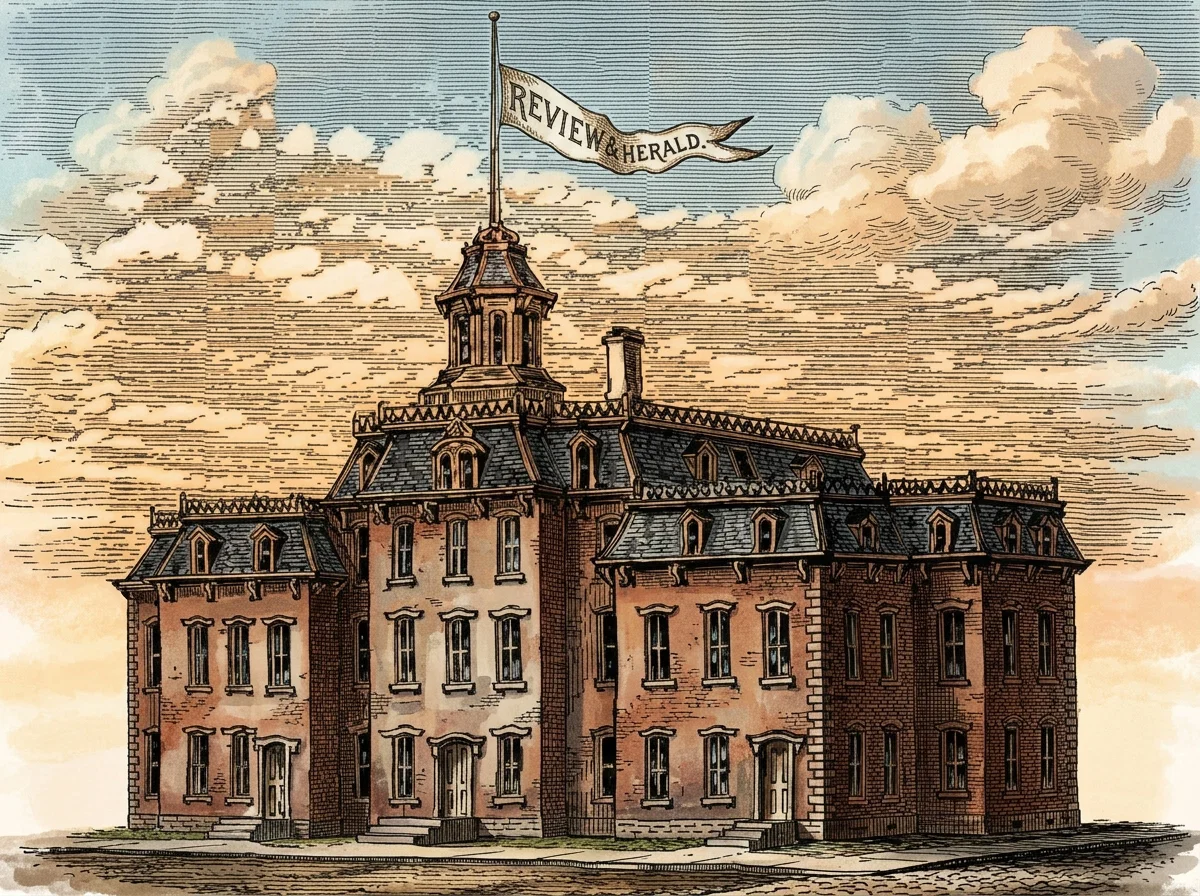
REVIEW AND HERALD PUBLISHING HOUSE.

BOOK AND JOB PRINTING, BOOK BINDING,

Electrotyping, Stereotyping, Paper Ruling, Blank Book Manufacturing, Etc.
The largest and best equipped printing office in the State.
Orders by mail promptly attended to.
Address REVIEW AND HERALD, Battle Creek, Mich.
Continue reading: BATTLE CREEK COLLEGE