A boy can make the world more pure.
By kindly word and deed;
As blossoms call for nature’s light,
So hearts love’s sunshine need.
A boy can make the world more pure
By lips kept ever clean;
Silence can influence shed as sure
As speech—oft more doth mean.
A boy can make the world more true
By an exalted aim;
Let one a given end pursue.
Others will seek the same.
Full simple things indeed, these three,
Thus stated in my rhyme:
Yet what, dear lad, could greater be—
What grander, more sublime?
—Crusader.
“FAITHFUL IN THAT WHICH IS LEAST.”
By Allie Veitch
“O DEAR,” said Marion, fretfully, “there is that horrid dusting to do again, and it takes so long to do it just right. I don’t see why I have to be so particular about everything I do.”
“Whatsoever ye do, do it heartily, as to the Lord,” replied Mrs. Lee.
“But, mother, I don’t see how one can sweep and dust ‘as to the Lord.’”
“It is not so much the kind of work we do, as the way we do it, and the spirit we do it in, that counts,” replied her mother. “The Bible tells us, ‘He that is faithful in that which is least is faithful also in much.’ Be faithful, Marion, in the little duties of every-day life, and do these little God-given duties without murmuring or complaining. Do cheerfully the work that lies nearest to you, and do it well. Ask Jesus to help you, remembering that without Him you can do nothing. Take Him as your Guide through life, Marion; and let Him work out His will in you.”
“I will, mother,” Marion said, thoughtfully. “I never realized before that being careful about our little home duties was one way of serving the Lord.”
“Whether therefore ye eat, or drink, or whatsoever ye do, do all to the glory of God,” Mrs. Lee quoted.
“You have a text for everything,” Marion said, as she kissed her mother.
That night as Marion knelt in the quiet of her own room, she earnestly asked God for strength that she might be faithful in the “least,” that she might more cheerfully do the home duties assigned her, and so be helpful to her mother. In the days that followed, Mrs. Lee noticed the change in her daughter, and knew she had sought and found the Master, who is ever able and willing to help all who ask Him, and her heart was filled with praise and thanksgiving to God.
ALLIE VEITCH.
LITERARY NOTICES.
“WHAT A WOMAN OF 45 OUGHT TO KNOW.” By Mrs. Emma F. A. Drake, M.D. Cloth, 211 pp., Vir Publishing Co., 113 Real Estate Trust Building, Philadelphia. Price, $1.00, net.
This is the last in one of the best series of books ever published, and the very best on the subject with which the books deal. It is greatly to be regretted that they were not published generations ago. The series is as follows: For men, by Sylvanus Stall, D.D.: “What a Young Boy Ought to Know,” “What a Young Man Ought to Know,” “What a Young Husband Ought to Know,” “What a Man of Forty-five Ought to Know.” For women, by Mrs. Mary Wood-Allen, M.D., and Mrs. Emma F. A. Drake, M.D.: “What a Young Girl Ought to Know,” “What a Young Woman Ought to Know,” “What a Young Wife Ought to Know,” “What a Woman of Forty-five Ought to Know.” The last is by Mrs. Dr. Drake. The book should be read by all women nearing middle life, both married and single. It is written with sweet delicacy and sympathy. May the whole series have a wide circulation.
“HOLY-DAYS AND HOLIDAYS.” A treasury of historical material, sermons in full and in brief, suggestive thoughts, and poetry, relating to holy-days and holidays. Compiled by Edward M. Deems, A.M., Ph.D. Cloth, 768 pp. (double columns), 6½ x 10½ in. Price, $5.00; postage, 38 cents. Funk & Wagnalls Company, New York and London.
This mammoth work will certainly prove a great addition to every good library. The preacher and public speaker, the student of history and the scholar, will find it a valuable work of reference. In this work there is arranged literature applicable, or supposed to be, of thirty-five commemorated days, including the chief religious festivals and holy-days, and the leading secular holidays that are observed in the United States, Canada, and Great Britain. The object of the compiler has been “to help busy people, in our busy age, to find and enjoy the very best that has been written on the vital events and great men whose memory society is trying to perpetuate.” Only the more important days of the calendar of the ritualistic churches are noted, and those secular anniversaries that have more than a local or provincial observance. There are sermons bearing on most of the various days, or the event for which the day stands, and outlines and extracts to help those ministers who depend on the encyclopedias. A large and valuable collection of facts, observations, suggestive thoughts, and brief illustrations, has been grouped around each of these anniversaries, drawn from numberless sources. These in each case are supplemented with often choice poetical extracts, that were for the most part called forth by the inspiration of the history through which its significance was gained.
And yet with all of the information which the book gives, it is often defective in tracing the various religious days to their originals. Religious prejudice or sentiment ought not to hinder a historian from giving facts. For instance, why does not the author give the heathen origin of Christmas, and tell us plainly that it was the Saturnalia? Why not a little fuller information regarding the nature-worship origin of Easter and of Lent? Why are we not given a fairer setting forth concerning the Sabbath? Invariably the term is made to turn on Sunday, a day to which the title in no wise belongs. Nothing is said of its observance by God’s people for ages, and by a whole people, the Jews, now, as well as by two denominations of Christians. One would expect to find something of the kind in the topical index, “Sabbath Views 226,” but not one word concerning Sabbath views is given on page 226. The Sabbath question will not be settled by such perversion and suppression in works which ought to stand for fact, nor will pagan counterfeits be sanctified by calling them Christian.
“TRAINING THE CHURCH OF THE FUTURE.” Auburn Seminary Lectures on Christian nurture with special reference to the Young People’s Society of Christian Endeavor as a Training-School of the Church. By Rev. Francis E. Clark, D.D. 12mo., cloth. Price, 75 cents, net; postage, 8 cents. Funk & Wagnalls Company, New York and London.
This book forms a compendium of the Christian Endeavor movement, and we should think that it would be just what every live Endeavorer would want. It will offer excellent suggestions for workers among the young.
“MARRIAGE: ITS DUTIES AND PRIVILEGES.” By Mary Wood-Allen, M.D. Cloth, 422 pp., with good index; price, $1.25. Fleming H. Revell Company, Chicago, New York, and Toronto.
This book is a splendid presentation by an experienced, Christian lady physician of what marriage involves. It is a book for all husbands and wives, and for all about to enter the marriage state. The first part of the book is a “General Discussion of Marriage,” including a serious study of the question, preparation therefor, respective duties of husbands and wives, cost of living, etc., etc. Part Two discusses the “Physiological Knowledge Necessary to a Wise Acceptance of Marriage;” Part Three, “Normal Pregnancy and Its Care;” Part Four, “Disorders of Pregnancy and Their Treatment;” Part Five, “Care of Newborn Child.” It is a book that every husband and wife ought to read.
“THE COURTSHIP OF SWEET ANNE PAGE.” By Ellen V. Talbot. Illustrations by Sewell Collins. Small 12mo., cloth. Price, 40 cents net. Postage, 5 cents. New York and London: Funk & Wagnalls Company.
A story of 1595, filling out some of the gaps in one of Shakespeare’s plays; told in the quaint English of the times.
REMINISCENCES OF JAPAN, II.
By John A. Brunson
Means of Communication.
First of all comes the railroad. There are perhaps between two and three thousand miles of railroad in operation in Japan. The trunk line runs north and south and connects the cities of the extreme north with those of the south. From this main trunk there are branches connecting with the west coast. The traveler has his choice of first, second, and third class fares, which respectively are three, two, and one cent per mile. The great masses of the Japanese travel third class. The accommodations vary with the price, of course; first class is good, second is fair, while third is poor.
Next come the coasting steamers, small boats of several tons burden, that ply among the many towns on the coast. They are poorly equipped, and the passengers suffer many inconveniences. Still the missionary can employ them advantageously in making short trips to coast towns that are not accessible by railroad. I have made the journey from Kagoshima to Kobe on one of them, a distance of perhaps 500 miles.
But while speaking of steamers we must not omit the superb ocean liners of the Nip-pon Yu-sen Kwan-sha, which run from Yokohama, Japan, to Shanghai, China. Chief among these boats are the Tokyo Maru and the Kobe Maru, twin sisters. They were built in Glasgow, Scotland, and are strictly first class in all their appointments. The Japanese have a proverb that one has never seen anything beautiful if he has not seen Nik Ko, a famous city to the north of Tokyo. We might add that one knows not what a trip of pleasure and comfort is till he has sailed the inland seas of Japan in one of these steamers. The excellent equipment of the ship, the smooth sea, and the exquisitely charming scenery which only Japan affords, all unite to beguile the hours and delight the soul. It seems almost like a trip through fairy land.
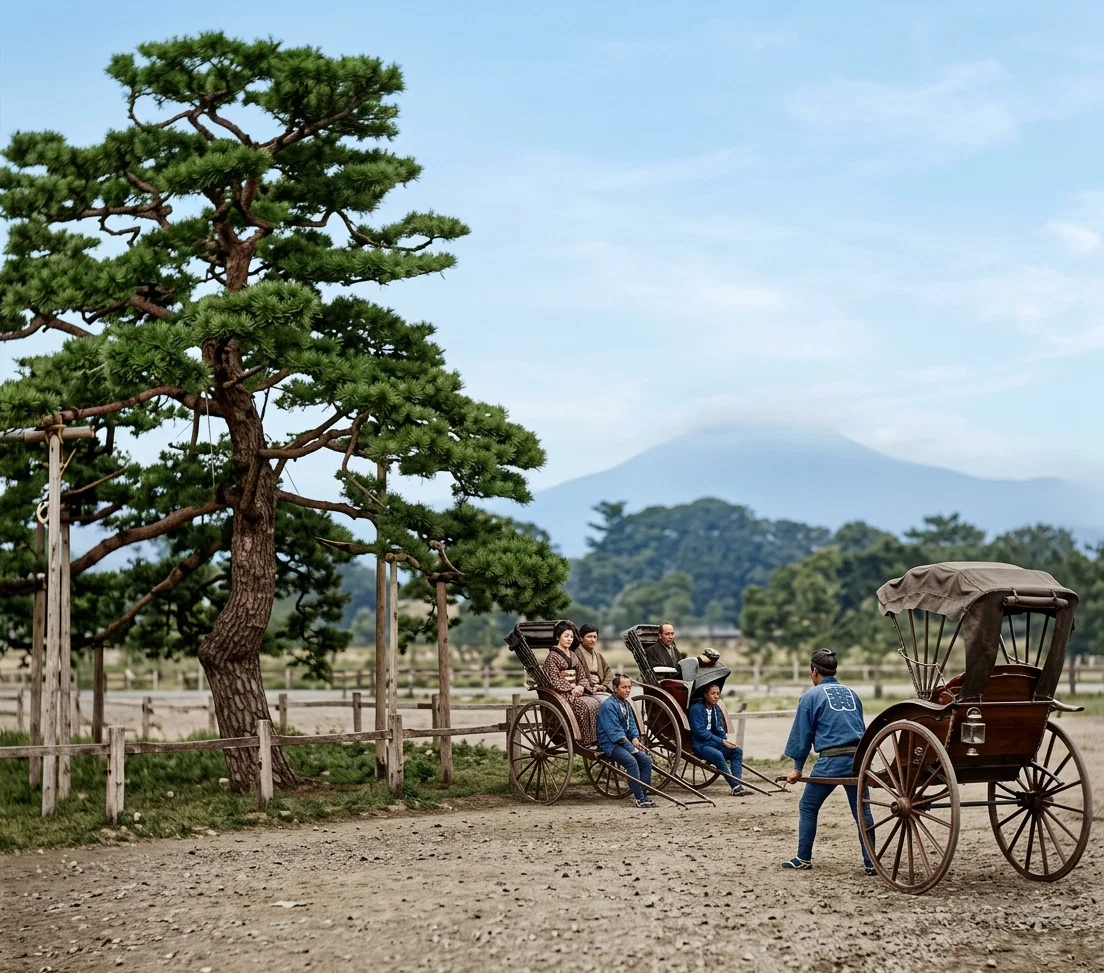
Jinrikisha Men, Waiting for Customers.
Japanese Court.
But after all, perhaps the most convenient and useful of the means employed for travel is the far-famed jinrikisha. The name itself, when understood, defines itself. Let us analyze it. Jin-riki-sha—three words. “Jin” means man, “riki” strength, and “sha” vehicle. Now read the meaning backward, and we have, as a definition of the word, a vehicle operated by the strength of man. And such it is in reality. It is small and light, having two wheels and an adjustable top. The body is well upholstered, and is mounted upon two elastic springs, which in turn rest upon the axle. A pair of shafts extend to the front, united at their ends by a cross-piece. That is the jinrikisha, the lazy man’s luxury, and the busy man’s convenience. One soon grows dependent on them, and when deprived of them feels their absence keenly. Their convenience, added to the fact that they are well-nigh ubiquitous, recommends their use to all. The prices charged for them are also reasonable. Ten cents per hour is good pay for the use of one. They are available at almost any hour of the day or night and at almost any street corner. It has been said that in the city of Tokyo alone, there are about 40,000 of them.
But, queries one, do the Japanese men actually pull them?—Certainly. Without any harness, or trappings of any kind, and perhaps with just enough clothes to cover the middle portions of his little brown body, a pair of straw sandals on his feet, and a straw sun-shield on his head, he steps nimbly between the shafts, and after the passenger has mounted and is comfortably seated, he stoops down, grasps one in each hand, rises up, and at the signal trots away with all the grace and ease of a well-groomed American roadster. Trot, do you say?—Yes; he trots. How fast and how long?—That depends upon the distance, and the time at the passenger’s command. He can go from three to seven miles per hour, and continue his trotting for miles together. I once traveled from Moji to Kagoshima, a distance of nearly 300 miles, and most of the journey was made in rikishas. There were three of us in the party, and our luggage. Consequently we employed four men and their jinrikishas. One of the men, of athletic build, strong, robust, and gifted with remarkable powers of endurance, remained with the party three consecutive days, during which he trotted 120 miles, 40 miles a day, and pulled a man who tipped the scales at 160 lbs. And what is more remarkable, he exhibited no symptoms of fatigue at the close of the third day’s run, and would gladly have gone farther with us, but we came to an arm of the sea, and quit the land, and traveled in a large canoe about thirty miles.
But perhaps the thought is constantly rising in your mind. Can one quite divest himself of the idea that his fellow-man between the shafts is reducing himself to the level of a beast of burden? Well, now there are two sides to the question. Remember, the whole of Japan is less than the one State of California, and into that little country are crowded more than 42 millions of souls. Extreme density of population is usually accompanied by great scarcity of work, much illness, and grinding poverty. Japan is no exception. Those men who draw the jinrikishas usually make about $10 or $12 a month,—good wages. They have no other means of living. They will beseech you to employ them. If you refuse for reasons of humanitarianism, you are depriving wife and babe of rice and raiment; and your philanthropic action will seem to him to be of misanthropic intent. But as a matter of fact, everybody who goes to Japan rides in jinrikishas, and if you go, you will, too.
These vehicles, combining cheapness with convenience and comfort, are a valuable auxiliary to the evangelist. He can by means of them penetrate far into the interior, away from railroad points, and dispense the blessings of the Gospel as he goes. If he contemplates a long journey, he can easily procure a fresh man every morning, if he chooses. He can also carry with him a good supply of books, papers, and tracts, for sale or free distribution. Japan without the jinrikisha would hardly seem like Japan.
Before leaving this portion of the subject, we must not fail to mention the postal facilities, which are truly efficient. They have free delivery of mail both in cities, villages, and even in the rural districts. Perhaps we can best illustrate the painstaking accuracy of the post-official by relating an experience. While living in the town of Kokura, I received from the Yokohama office an empty newspaper wrapper, bearing my address. Accompanying the wrapper was a prepared blank with instructions to fill the blank spaces by giving the name, date, etc., of the paper which the empty wrapper ought to have enclosed, and to return the same to the Yokohama office. Compliance with the request brought to us in a few days the missing paper.
During the long journey from America, many papers became separated from their wrappers. Consequently a number of wrapperless papers, and paperless wrappers were received at the office in Yokohama, and the officials had no way of determining which one of the many unaddressed papers belonged to any one of the many addressed wrappers. So they sent the wrappers to the parties to whom they were addressed, accompanied by the above-mentioned blanks. Upon receiving again those blanks properly filled, they, guided by the description it contained, sought out of the mass of papers the one described, wrapped it carefully, and mailed it to its owner.
The efficiency of the service is a source of great comfort and convenience to the missionary, and is a material aid in the prosecution of his work. Japan belongs to the Postal Union, and money-orders can be sent to any of the foreign countries.
JOHN A. BRUNSON.
A LETTER FROM FIJI.
By J. E. Fulton
We have had many evidences of the loving favor of the Lord, and His prospering care is exercised toward our work. It is making no rapid growth, but we trust that it is a sure and even growth that characterizes the sturdy trees rather than the gourds, that come up so quickly, but soon vanish away. We are cheered by the addition to our ranks of more native Sabbath-keepers. These are in another of the group. There will be, we hope, a good strong company there. Our native preacher is with them at present.
When I was attending conference in Australia, we had a little book printed at Avondale Press in the Fijian language. This we are now selling. We have disposed of several hundred, and when we get our launch finished, we hope to carry this book and our papers to all parts of the group. At present we are greatly crippled, for we are without a boat. It has always been thought a difficult thing to sell books to the Fijians. Others have made failures in this line; but I am very glad to say that we have been doing fairly well. I believe that we will be successful in disposing of our literature. We are printing a little paper every month, and we believe that it is doing good. It has cost a good deal of effort to write for it, and set up the type and print it. We have a very small outfit, but we have been greatly blessed. I am so glad that Brother Currow from Australia has joined us. He is a printer, and takes a great load from me. I really undertook more than I was fitted for when I started printing. We have now been printing our little paper for nearly two years.
We are now very anxious to get a part of Great13Controversy translated into the Fijian language. This I feel is greatly needed. There is not a word in the language about the history of the past. The natives know comparatively nothing about the struggles of the church of Christ during the ages gone by. They have not been informed as to what the great mystery of iniquity is. I fear they can not appreciate to any great extent what an “image to the beast” would mean, without this knowledge. I have been impressed very much that a history of the people of God as drawn out in Great Controversy, would be of great service to the cause here. We can not have a large book, but we can make suitable extracts from the Great Controversy, and make a beautiful and timely book. This book could be illustrated nicely and made very attractive.
We shall be in need of money to carry on the work of printing. I believe that our brethren will do something for us. This is certainly a worthy object. Just think of the books that we have in English, and here we have a poor race with hardly anything. “God is no respecter of persons,” but I am afraid that we are very partial to the white-skinned race. God loves the world. That means Fiji as well as any other part of the world. These natives cry out for light. My heart longs to help them. We are hampered for lack of funds. We stretch out hands toward you in other lands and cry for help. And remember we are only representatives of these poor people. They are crying for help, and shall it be in vain? We have been writing to some of our churches, trying to bring the needs of our work before them. We shall need several hundred dollars so that we shall be able to print this little book. Can you do anything for us in California? If you can, we shall be so thankful, and shall try to appropriate the funds to the best advantage.
I am glad to say that money for the oil-launch we are building is coming in very encouragingly. We hope to have a good boat.
I am sorry to say that Mrs. Fulton and myself are not very well. I hope that we will not have to sever our connection with the mission here, but I am quite sure we shall have to have change for a time to a cooler climate.
If there is anything in this letter that you can use to any advantage for the advancement of the work, I shall be pleased to have you use it.
Suva Vou, Fiji, March 6, 1902. J. E. FULTON.
HARVEST
By Emery Pottle
LORD God of Years, Thy contrite people stand
To render now Thy talent to Thy hand;
Forgive the meagre increase, Lord, we plead;
Forgive the wasting of Thy pregnant seed.
Where wide, white moons of harvest on us burn,
Amid the sweat of struggle we would turn
And thank Thee for these honest, toil-worn days;
In songs of work we give Thee truest praise.
Lord God of Years, thy grateful people stand
To render now Thy talent to Thy hand;
Judge Thou our service in its thought and deed;
Grant us the heart of joy,—Thy workers' meed.
—Emery Pottle.
OUR WORK AND WORKERS.
THE book “Steps to Christ” is being translated into the Zulu language.
Six members have been added to the church at Oakdale, Neb., the present year.
MEETINGS held in Highmore, S. D., last month, resulted in ten converts to the faith.
As a result of a five weeks’ meeting at Red Cloud, Neb., twelve persons accepted the message.
A CANVASSERS’ school at Morrisville, Vt., was begun on the 22d inst., to continue until May 8.
BROTHER S. W. NELLIS reports the organization of a Scandinavian church at Enterprise, Wash.
A SABBATH-SCHOOL of twenty members was recently organized at Youngsville, Pa., by Brother August Anderson.
A new house of worship is being erected at Redlands, Cal., where Brother S. Thurston has been laboring for a time.
The brethren at Taftsville, Vt., are pushing forward a new church and school building, to be ready for occupation by the middle of May.
A BRANCH sanitarium has been opened at 1809 Wallace Street, Philadelphia, by Dr. A. J. Read and a corps of helpers, and a good work is reported.
Ten persons recently began the observance of the Sabbath of the Lord at Gip, O. T., and a Sabbath-school was organized by Brother D. F. Sturgeon.
FROM the 16th to the 20th inst., Brethren A. T. Jones and J. O. Corliss held a series of profitable meetings at Reno, Nev., which were well attended.
MEETINGS at Divide, Oregon, by Brother C. J. Cole, have resulted in eleven converts to the truth. A Sabbath-school of twenty-five members has been organized.
A LETTER in the Dakota Worker, from Brother W. G. Kneeland, states that a new church building is being erected at Indian Walk, island of Trinidad. Tent-meetings at Prince had resulted, at time of writing, in eight converts, with an encouraging attendance.
In the Nebraska Reporter, Brother W. B. Hill notes that nine heads of families have taken their stand for the truth, and others are deeply interested in the meetings being held at Decatur.
At the late session of the Montana Conference, Brother W. B. White was re-elected president; Mrs. Nettie G. White was chosen secretary, and Brother T. G. Johnson missionary secretary and treasurer.
TWO CAMP-MEETINGS will be held in South Dakota this year; one in the southern part, beginning June 9 and closing the 16th, and one in the northern part, to commence June 16 and continue one week.
It has been recommended by the Northwestern Union Conference that North Dakota organize as a separate conference from South Dakota. Steps toward carrying this out will be taken as rapidly as may be consistent.
At the last quarterly meeting of the church at Clinton, Iowa, six persons expressed a desire to be baptized and unite with the church. They were received into the church, subject to baptism. The occasion was one of rejoicing.
MARCH 16, a church was organized at Monrovia, Cal. The ministers present were C. Santee, president of Southern California Conference, J. F. Ballenger, E. S. Ballenger, and R. W. Miller. Brother J. F. Ballenger was elected pastor of the new church.
At the late session of the Northwestern Union Conference, it was voted to indorse the plan of the Mission Board to begin work in Nyassa Land, Africa, about eight hundred miles northeast of our Matabeleland mission; and over three thousand dollars was given by conferences and individuals to help open that work.
BROTHER WALTER HARPER sends this report of labor at Rock Springs, Wyo., under date of April 13: “In one day I was favored with nearly $100 worth of orders. Not long ago the dear Lord granted $285 worth of orders in one week. In about six weeks I was blessed with orders to the extent of over $1,200. I praise the Lord for it all. He only can give success.”
On the 30th inst., Brethren A. G. Daniels, E. R. Palmer, and some other representatives to the General European Conference, will sail from New York. The following-named canvassers for England will also sail at the same time: G. W. Bailey, of the New England Conference; Joseph Brandt, wife, and daughter, of Wisconsin; W. O. James, of Nebraska; Ernest Taylor, of Texas; William Olmsted and wife, of Oklahoma; Charles E. Holmes and wife, of California; and W. B. Scott and wife, of Oregon.
FROM the Fortnightly Visitor we learn that a new house of worship was dedicated at Uitenhage, in the southeastern part of Cape Colony, South Africa, February 7. Most of the brethren and sisters from Port Elizabeth, and some families from country districts were present; also some from Grahams Town. Brethren H. J. Edmed and D. F. Tarr conducted the services, which were continued from Friday evening till Sunday evening. The building is said to be one of the neatest chapels in the conference. In connection with the occasion, four persons were baptized.
DURING the first week of this month the churches of Arizona were organized into a conference. Brother J. O. Corliss, representing the Pacific Union Conference, and Brother J. J. Ireland, secretary, conducted the organization. Officers were elected as follows: President, E. W. Webster, secretary and treasurer, Mrs. Pauline Heady; State Agent, J. E. Bond; missionary secretary, E. W. Webster; executive committee—E. W. Webster, C. D. M. Williams, Walter Black, J. E. Bond, and Eugene Brown. Brethren Williams and Black were ordained to the ministry. Brethren J. E. and F. S. Bond were given ministerial license, and Sisters Webster, Williams, Black, and Iles were granted missionary license. The conference numbers 150 members.
A LETTER from Brother G. W. Reaser, dated Durban, Natal, Africa, February 10, says: “Our work in Africa has brightened up very much of late. California has sent us a sufficient supply of tents for our present requirements; the New York Conference has made us a much-appreciated donation of $200, and the Upper Columbia Conference is supplying us with a few hundred dollars, according to the vote taken in conference session before I left that field. We are about to secure a splendid school site of more than thirty acres for dwellings and all, and we have the funds in hand for the erection of a modest school building. These things, with the fact that people are embracing the truth, and the mission board have voted to send us more help, including Brother E. E. Andross and family and Brother M. C. Sturdevant and wife, lead us to praise the Lord because He is working mightily for ‘darkest Africa.’”
REPORTING to the Fortnightly Visitor from East London, on the Indian Ocean coast of South Africa, Brother D. F. Tarr notes the baptism of six persons, in the Nahoon River. “One sister, as she rose from the watery grave, was healed of physical infirmity. She now rejoices in the healing and keeping power of God.” A church organization was also effected. Brother H. J. Edmed was present, and took part in the services.
ANOTHER of the California pioneer Seventh-day Adventists passed away on the 13th inst., at Napa. Sister Angeline Howard, wife of Brother J. S. Howard, elder of the Napa Church, came to California in 1846, crossing the plains with her parents. She embraced the Adventist faith in 1873, at a camp-meeting in Yountville. Some sixteen months before her death she had a severe attack of the grip, and her health continued to fail until the end. Deceased was aged 65 years and 24 days. Funeral services were conducted by Brethren J. N. Loughborough and Chas. T. Everson.
Selling Racine Brand Hosiery
WE can give enterprising and capable women pleasant and profitable work selling in their own town the well-known Racine Brand of Hosiery and Underwear. Quality of goods unexcelled. Commission liberal. Work permanent. Address, with references, Ames, Wyne & Co., General Agents, 214 Pine Street, San Francisco, Cal.
Bible Museum
For Sabbath-School Teachers
AVALUABLE collection of plants, seeds, etc., from Bible lands for use in Sabbath-school work. Almost all of the younger and most of the older people of this country are ignorant concerning the trees, plants, seeds, etc., spoken of in the Bible, and we believe this collection will be a great help to them in understanding those portions of God's Word where reference is made to them.
There are twenty-five articles in all, and the following is the list:—
Each article of the above is contained in a small box with glass top, and all are enclosed in a neat cabinet five and one-half by nine inches in size. A descriptive pamphlet goes with each collection, in which is given illustrations of many of the growing plants, etc., and considerable information concerning each.
We believe Sabbath-schools and teachers will do well to secure one of these sets, for the teacher that can engage the eye as well as the ear, in imparting truth, certainly has a great advantage.
The regular price of this collection is $1.50, but we have secured a number of sets that we will
Send post-paid for $1.00
ORDER OF
PACIFIC PRESS PUBLISHING COMPANY :: Oakland, California
LESSON 7.—MAY 17.—THE COMING OF THE SEED.
NOTE.—This series of lessons is entitled, “Studies on the Gospel Message.” For Introduction and excellent suggestions as to their study, we refer the student to the Lesson Quarterly.
In the first announcement of the Gospel (Gen. 3:15), the hope of salvation was made to rest upon a coming Deliverer (Rom. 11:26), who should appear in the flesh as the Seed of the woman. This was the last Adam, the second man. 1 Cor. 15:45, 47. By this promise human nature was brought into a personal relation with divinity (2 Peter 1:4), and the provision made for that power to conquer Satan and sin which is the very essence of the Gospel (Rom. 1:16). It was faith in this revelation of Christ in the flesh as a present Saviour which made Abel’s sacrifice “more excellent” (Heb. 11:4), which resulted in the translation of Enoch (verse 5), and which brought to Noah the experience of righteousness (verse 7). It was the rejection of this Gospel message which permitted corruption and violence to increase (Isa. 24:5; Gen. 6:11, 12), and bring destruction upon the earth (verse 13).
To Abraham the same Gospel was preached (Gal. 3:8), and abundant blessings promised, on condition that he should forsake all (Gen. 12:1–3). To him God made a promise (verse 7) which involved the coming of the Seed, the Messiah (Gal. 3:16). In the further development of this promise we find that it meant the restoration of the earth to man (Rom. 4:13) for an everlasting possession (Gen. 13:15; 17:7, 8). But it was distinctly stated that the consummation of these promises would not come during the natural lifetime of Abraham (Gen. 15:15), and they therefore included the resurrection of the dead. This was “the hope of the promise made of God unto our fathers” (Acts 26:6–8), and included the coming of the Lord and the new earth (2 Peter 3:9–13).
QUESTIONS.
What has been the central thought in the Gospel from the first announcement made in Eden?
What names indicate the relation of this promised One to humanity?
What union was accomplished through this promise?
What is the essential element of the Gospel? How was this brought within the reach of humanity?
What distinguished Abel’s sacrifice from his brother’s?
What made translation a possible experience for Enoch?
What saved Noah from destruction with the rest of the world?
What was the condition of the world just previous to the flood? What was the cause of this? What was the result?
What did the Lord instruct Abraham to do? What did He promise to make of him? What did He say he would be? How far would this blessing extend?
What was thus proclaimed to Abraham?
In what way was the promise of the coming Seed renewed to Abraham?
What was included in the gift then promised?
For how long a time was the gift assured?
In what way did these promises give the assurance of the resurrection of the dead?
How does the apostle Paul make this fact clear?
What other events are inseparably connected with the fulfilment of the promise?