The Youth’s Instructor, Vol. 54, No. 42.

The Man Who Feels

The Youth’s Instructor

Oct 16, 1906

Review and Herald Publishing Assn. · Takoma Park Station, Washington, D. C. · Oct 16, 1906

The Man Who Feels

THE man who feels is a happier wight, Than the man who is callous and cold, For if he weeps in the gloom of night, He laughs in the sunbeams’ gold; And if the tide of life runs low, It reaches the summits of cheer; He knows the heights, as the depths below, And he smiles through a pitying tear. And after it all, when all is done, The world has most of the gladdening sun, For the twilight lingers when day is done, And the sun’s benediction is dear.
The man who feels is happier far,— I say it again and again,— Than ever can be, or ever are, The pitiless sons of men; For if he sighs for his own gray woes, He sighs for another’s too: If the plant of pain in his bosom grows, It is covered by sympathy’s dew. And after it all, when all is said, Still pity and love forever are wed; That the heart unfeeling is chill and dead Is true, and forever is true.
The man who feels is a dear God’s gift To a sorrowful, travailing world; By the hands that the burdens of life uplift Is the flag of our peace unfurled.
We need not the souls that are callous as fate, And selfish, and wedded to greed, But the pitying tear for our fallen estate We need,— and we ever shall need. And after it all, when all is past, ’Tis the deed of love that alone may last, And the rest is chaff in the winnowing blast: In the garden of life, a weed.
— Alfred J. Waterhouse, in Success.

The Trees of the Lord

“The trees of the Lord are full of sap.” Ps. 104: 16.
A PINE forest is one of the most beautiful features of nature. Of all quiet scenes it is surely the quietest. The harsh sound of the busy human world, and even the dreamy murmurs of summer, are hushed there; no song of bird or hum of insect disturbs the solemn stillness; and only at rare intervals the mournful coo of a dove, making the solitude more profound, is heard in the deeper recesses. The weary, care-worn spirit bathes in the serenity of the silence, and feels the charm and refreshment of its highest life. The trunks of the trees have caught the ripened red of many vanished summers, and are bearded with long, streaming tufts of gray lichen, which impart to them a weird, savage appearance; but they are touched with grace by the wild flowers growing at their roots; childhood sporting in unconscious loveliness at the feet of old age. They form long-drawn aisles and vistas, like the pillared halls of Karnak, or the Thousand Columns of Constantinople, which are indescribably attractive, for they appeal to that love of mystery which exists in every mind; they reveal only enough to stimulate the imagination, and lead it onward to lonelier scenes beyond. It is the same vague sentiment of expectation or hope that gives the charm to every natural as well as to every moral landscape. Life itself without these vistas of expectation would not be worth living.
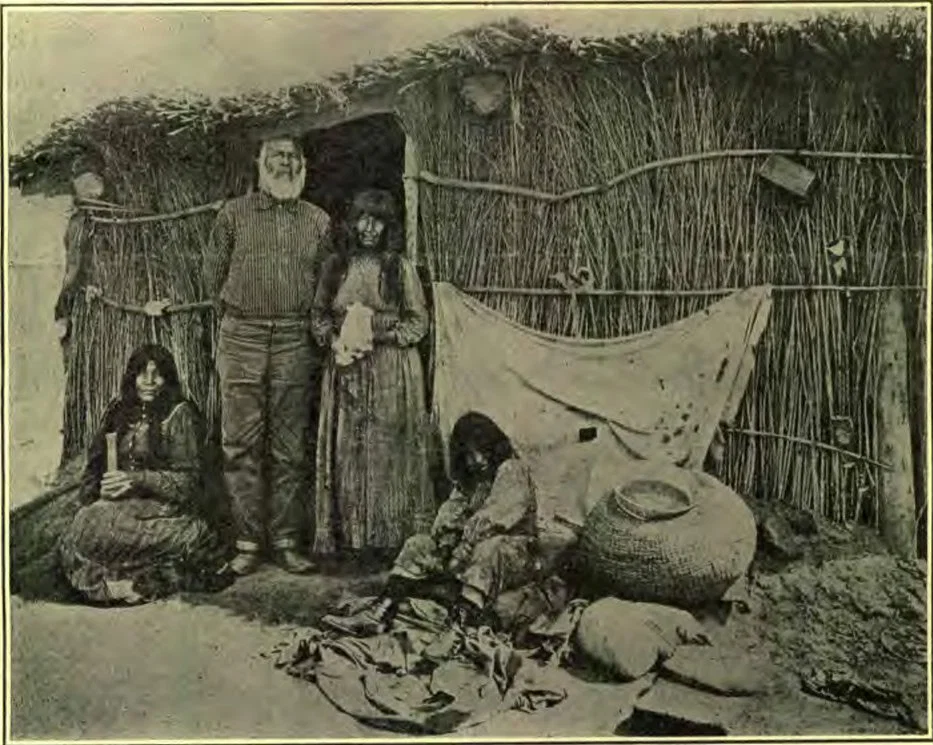
A MARICOPA (ARIZONA) DWELLING
When the sun is shining brightly, and pierces here and there through the dusky foliage, the effects of the checkered light and shade, the alternations of green and gold, are very lovely. Richly tinted mosses, that “steal all noises from the foot,” palmy clusters of delicate ferns, starry flowers of the Trientalis, waxen bells of the Pyrola, and green and crimson leaves of the blueberry, cover every inch of ground not occupied by the boles of the trees, and form mosaics more beautiful than those of the Vatican. The dim, slumberous air is laden with an all-pervading balsamic fragrance, strongly stimulating that sense which is more closely connected with the brain than any other, and suggesting numberless vague but sweet associations and memories of the past; while through the pyramidal tree tops may be obtained glimpses of the quiet sky, which seems to come close to the earth, as if in sympathy, and appears calmer and bluer than elsewhere, by contrast with the dark-green motionless foliage.
Beautiful indeed is the pine forest in all seasons; in the freshness of spring, when the gnarled boughs are penetrated and mollified by the soft wind and the warm sun, and, thrilled with new life, burst into fringes and tassels of the richest green, and cones of the tenderest purple; beautiful in the sultry summer, when among its cool, dim shadows the cheated hours all day sing vespers, while the open landscape is palpitating in the scorching heat; beautiful in the sadness of autumn, when its unfading verdure stands out in striking relief amid changing scenes, that have no sympathy with anything earthly save sorrow and decay, and directs the thoughts to the imperishableness of the heavenly paradise; beautiful exceedingly in the depth of winter, when the tiers of branches are covered with pure, unsullied wreaths of snow, sculptured by the winds into curves of exquisite grace. It is beautiful in calm, when the tree tops scarce whisper to each other, and the twitter of the golden wren sounds loud in the expectant hush; it is more than beautiful in storm, when the wild fingers of the wind play the most mournful music on its great harp-strings, and its full diapason is sublime as the roar of the ocean on a rock-bound shore. I do not wonder that its long rows of trunks, vanishing in the dim perspective, should have furnished designs for the aisles of Christian temples, and the sunset, burning among its fretted branches, should have suggested the gorgeous painted window of the cathedral. It looks like a place made for worship; all its sentiments and association, seem of a sacred and solemn character. Nature, with folded hands, as Longfellow says, seems kneeling there in prayer. It certainly reminds us in various ways of the power, wisdom, and goodness of Him who thus spake by the mouth of his prophet: “I will plant in the wilderness the cedar, . . . the fir tree, and the pine, and the box tree together: that they may see, and know, and consider, and understand together, that the hand of the Lord hath done this, and the Holy One of Israel hath created it.”—Hugh MacMillan, in “Bible Teachings in Nature.”
(To be continued)

At Wounded Knee

On the eve of the battle of Wounded Knee it happened that I found myself making my way on horseback through the crusted snow, across the country from Pine Ridge agency, when a snort and sudden stop of my horse aroused me. Just ahead lay a ravine skirted by a few pines, and as I looked, a flickering light was distinguished. It could be nothing else than the Sioux. Which band of the Sioux, of course, I could not tell, and for my personal safety it made a great deal of difference indeed. However, it was clearly a case of perish in the snow, or trust to chance in making for the fire, and I did not hesitate which course to choose.
Within five minutes I arrived at a lone tepee, in front of which a spot had been cleared, and the embers of several logs were yet burning. Nobody appeared; but as I stood there, a low voice began to croon, then to chant in a sort of mournful monotone which gradually broke into intelligible words, and this is what I heard:—
Heci Waun wanin, Heci Waun wanin, Mita Wakantanka Nikeyedan . . . Kakish Mayanpisha Etanlanto.
I was dumbfounded to hear under such circumstances the words and tune of “Nearer, my God, to thee,” in the heart of the bad lands of South Dakota, and coming from what must surely be the tepee of a hostile Indian. The snatches of song revived me. My blood seemed to quicken, and I staggered to the lodge, parted the flaps and entered.
Inside was another fire, and in one corner sat a squaw, who, although she saw me enter, looked up with only a sort of far-away stare, and continued singing, moving her body back and forth, keeping time with the tune. In her arms she held a bundle. The squaw seemed to be the sole occupant.
Drawing the only weapon I had, a revolver, I dumped the cartridges out upon the ground, and handed the weapon to her, handle foremost. Only then did the squaw cease her song and the rocking. Stretching out one hand, she took the revolver, and then handed it back in the same manner that I gave it to her.
“Keep it, Cugya,” said she; “it can not speak,” meaning that it was harmless without the loads.
No word was spoken for some time. I drew close to the fire and waited. The squaw showed me her bundle, which contained a dead babe.
“Cugya,” said she, mournfully, “when Death calls, there is no use to be deaf. Since dark I have sung the white man’s songs; but, Cugya, the Great Spirit hears not, for my people are on the war-trail against the whites who taught us songs and the Great Spirit’s words.”
Assuring the squaw that the song would go as far in the desert as from the agency Sunday-school, she seemed a trifle comforted, but would not be entirely satisfied until I joined in and sang the song with her.
It was while thus engaged that two buck Indians slipped into the tepee. My back was turned to them, but I could instinctively feel their presence, and half believed that I would be killed before turning about. The squaw, who sat facing the bucks, seemed in nowise surprised at their coming, and, although I watched her face carefully, she gave no sign until the song ended, when she raised a hand, and I cringed, feeling that I was about to be stricken down. My feelings of that moment are indescribable.
One of the bucks spoke. “How!” he said simply, extending a hand which to be sure I lost no time in grasping. Once more I proffered my empty revolver, but they waved it back. “Keep it,” said the one who had welcomed me. “The wise man should always have an arrow left,” which told me that on leaving the tepee I would not find friends so easily.
There were fully three minutes of silence in the tepee, during which I could hear the crunch, crunch of the snow, indicating the approach of other Indians. They came. How many I do not know, and down the gully I could hear an occasional “Yi, yi!” half suppressed.
“Sing, Cugya, sing!” commanded the squaw, again leading with the same song, and although it was the trial of my life, I sang again with her.
The squaw laid down her bundle and walked to the tepee door, standing there with arms across the opening, barring the passageway, while she delivered rapidly a few words half in command, half in pleading. Her words brought silence as if magical, for she told of the dead babe and of my words of consolation. Only one voice rebelled, crying: “The snake may often change its skin; but it is a snake.”
The two bucks re-entered the tepee, and the others left, followed by the squaw.
“They go to council,” one of the Indians said; and after half an hour passed, the squaw returned, and I was told to mount my horse and be as far away as possible by daylight.
Not an Indian watched me as I departed. Detouring, I arrived at Wounded Knee battlefield just as the guns ceased their thunder, and the cries of the wounded yet resounded.—Ross B. Franklin, in Sunday Magazine.

Chats on Letter-Writing — No. 2

Two things that aid in making a letter interesting are: first, the omission of that which is already known to the recipient; second, writing of those things that directly appeal to and concern the one written to. It is just as important to leave out, as to put in, certain matters. For example, details that are of a depressing, gloomy, unpleasant, or distressing character are much better left out entirely, or else dealt with sparingly; of course, being treated as the circumstances determine. But speaking as a principle, matters of this kind should be omitted. A letter that reads like a catalogue of woes can never be wholly satisfactory to the recipient.
One main feature of a good letter is its cheerful tone. If it breathes an atmosphere of gladness, hope, courage, optimism, sunshine, it can not fail to be of real interest. Such a spirit will be insensibly transferred from the page to the reader, and at its conclusion he will feel thankful for getting it. If received in the morning, such a letter will gladden the receiver’s heart the whole day long; and it will be as a welcome ray of sunshine. Better far is it that a letter shall exert such an influence than that it shall come as a shadow, or a foggy day, shedding depression and gloom.
As a general rule, governed of course always by the circumstances of any individual case, the writer of a letter should avoid references to himself, always giving the foremost attention to the one addressed. Attention should be given especially to matters which are of particular interest to the one written to, and all such items should be borne in mind. Thoughtfulness in this regard will add materially to the quality of the letter which makes it attractive, and such evidence of kindness on the part of the writer will materially enhance its appreciation.
If the writer of a letter is familiar with books, good and appropriate quotations might be occasionally introduced into correspondence. If this is judiciously done, it may be of great value, both for the writer’s own sake and in suggesting ennobling thoughts to the reader of the letter.
It must be remembered, however, that the character of a letter is determined largely by the personality of its writer. The sweet-tempered, cheerful, happy person will write bright and encouraging letters; the one who is doleful, morose, pessimistic, is certain to betray those qualities in the letters he writes.
Care will, of course, be taken to avoid references to any undesirable or painful topic. If the recipient is known to be sensitive along certain lines, that characteristic will be remembered, and the particular topics will not be mentioned. Kindness, sympathy, a desire to assist, a spirit of comradeship,—these qualities all go far toward making a letter interesting. And nothing tends to make a letter prosy more than the filling up of the pages with matters of little importance.
Henry W. Rose.

The Chrysanthemum of Japan

CHRYSANTHEMUM means “golden flower,” and it is the national flower of Japan. A day is yearly set apart in Japan for “The Festival of Chrysanthemums.” On that day his majesty, the emperor, will allow us to go into his garden; and each man that cultivates this flower is ready to show us his “flower paradise,” for that is the name he gives to his garden.
In most of these gardens the flowers are arranged as in ours. But the gardeners of Tokyo, the capital of Japan, train their plants, and often their trees, to look like pictures or statues. As we walk along, we see a Japanese hero dressed in bright pompon chrysanthemums. There is a picture of the setting sun, made out of gold-colored blossoms.
The Japanese are fond of seeing all these flower pictures, but there is one that is a great favorite. It is the picture of an old hero fighting with an eight-headed monster. A fair lady sits near by, looking on. She is made of yellow, red, and white chrysanthemums. This picture is thirty feet long.
From very early days, there have been two royal crests, or Japanese badges. One of these is the Paulonia-tree. This is seen only on the seals of the emperor’s family. The other crest is an open chrysanthemum, and is used for government purposes outside of the palace.
The soldiers of the army wear the chrysanthemum crest on their caps and coat buttons, and it is seen on their barracks.
This flower is embroidered on flags and banners and printed on important papers. Some coins have both the Paulonia-tree and the chrysanthemum flower engraved on them. Silk dresses and the finest porcelain have had the golden flower to decorate them for hundreds of years.
You have read about the “Wars of the Roses.” Well, the Japanese once had a “War of the Chrysanthemums.” This was a war between two branches of the family whose badge was the chrysanthemum. The soldiers of one army wore red caps and carried red flags. The soldiers of the other army wore white caps and carried white flags. The war lasted fifty-six years.
Japanese boys think of that war as they play some of their games to-day. The boys on one side will wear red caps, and those on the other, white caps. They often name their kites, too, of which they have a great many, after the heroes of this old war.—Fannie A. Deane.

As Years Go On

As years go on, we learn to say Not more, but less; To guard our lips from hasty speech Lest we transgress. As years go on, we train ourselves More oft to smile; And things that contradict, To reconcile.
As years go on, our vision widens, And we see That life, God-centered, is the life Of liberty; That death to self means life abundant, Sweet and rare; A character matured and precious, Bright and fair.
As years go on, we learn to know As we are known, With knowledge that can come From God alone. As years go on, we learn to lisp The angels' song, And weave a strain of heavenly music Through life's throng.
—Mary E. Kendrew.

Daily Bible Reading

“Who read a chapter when they rise, Shall ne’er be troubled with ill eyes.”

How to Do Personal Soul Winning

EVERY one who believes the third angel’s message, or who loves the Saviour, has a desire to have others receive a saving knowledge of the truth; but often one, from timidity or other reason, neglects to improve the opportunities that present themselves for helping those about him. But personal work is expected and required by our Father of every Christian. In a recent number of the Sunday School Times Mr. Charles Alexander gave some excellent thoughts in regard to personal work. These are reprinted here, for they are helpfully suggestive to all Christians:—
I am thoroughly convinced that every man and every woman who names the name of Christ should be a personal worker, and make it the aim of life to bring definite people to a definite Christ at a definite time. I have seen thousands of dollars wasted in so-called religious work wherever we have visited, which might have been used in the salvation of souls, but they had lost the idea of bringing people straight to Jesus, and were doing things which they named religious work. They blighted and withered where they should have been giving life. So my message to every one who names the name of Christ is, Go to work! You ask, “With whom?” With the person next you.
I was once being entertained in a beautiful home, and was telling my ideas on this subject. My hostess asked me what time she could find for personal work, and with whom she could work, with all her numerous duties in connection with her large home, her missionary society, choir, prayer-meeting, and other occupations. I asked her how many maids she had, and she told me. “Are they all Christians?” I inquired. “I do not know,” was the reply. I said, “Then I need not outline any more work for you until you have found out where they stand.”
Any one can do personal work. You must come in contact with somebody who is not a Christian, and there lies your opportunity. It straightens out the life. It drives people to their knees. It teaches them the value of the Word of God and its power to bring men to Christ. There is a revival wherever there is a true personal worker, for into that heart God has put his revival power. People who are all the time talking of past revivals and wondering why one will not come to them, can have one of their own, no matter how humble or ignorant they may be. God reaches people through people.
I have never seen a revival where people were not stirred to doing personal work. Here is a chance for any pastor or any community to have a revival. Comply with God’s conditions, get right with God, go right out immediately and find some one else and bring him to God. You learn to do a thing by doing it, and you never learn any other way. Do you ask me when and where? With the next man or woman you meet who is not a Christian.
Never talk lightly in personal work of God, the Bible, or the human soul. It is usually best to be very gentle and tender, and, above everything else, as polite and courteous as you know how to be. Don’t let people switch you off to talking about other things, but try to get that heart and Christ together. Keep those ideas in mind, and it will give point to your work.
One of the thousands who were thoroughly converted to the idea of personal work as the business of life during the Philadelphia campaign was Dr. C. R. Watson, Secretary of the Board of Foreign Missions of the United Presbyterian Church. In speaking at a revival luncheon of the new conception of personal work that he had gained through the mission, he said:—
“Before Mr. Alexander came here, I believed in personal work; believed in it mightily, theoretically, and practised it some. But at that time I always had the idea that you had to know a man about ten years before you could be polite enough to talk to him about his soul’s salvation. I never thought one could just hitch up to a streetcar and stay out in the cold with the conductor and talk to him all the way from Thirty-first Street to Broad Street about his soul. I used to think you ought to approach it gradually,—a sort of ‘inclined plane’ process, and have the inclined plane about a mile long, and by the time you had gotten to the top, the fellow had gone by, and the opportunity too.”
“I think the greatest thing the mission has taught me is that even on the train, in a streetcar, or wherever you may happen to be, you can open up a conversation with a stranger and go right to his heart; not ask him whether he is a church-member and try to get him to be good merely, but just to ask him the straight, blunt question as to whether he is saved. I must confess I have gotten a tremendous lot out of the mission in learning the lesson that one can do personal work suddenly, and that by following the providence of God he will show us where to do it.”
One day during our campaign in Scotland I urged Miss Blanche Torrey, the second daughter of Dr. R. A. Torrey, to go down and begin personal work. Two years later when I called upon her to tell what personal work had done for her, she said:—
“When I went to school in New York three years ago, I was thrown among worldly girls. I did not have the courage to talk to them about accepting Jesus Christ, although they knew the stand I took, that I did not go to theaters nor dances, nor care for the worldly things they did.”
“When I went to England with my father and Mr. Alexander, and heard them urge the Christians in the meetings to go down into the audience and speak to others about their salvation, I tried to hide behind some one big. But Mr. Alexander soon picked me out, and he said, ‘Blanche, you get down there and do some personal work,’ and down I had to go. That night I won my first soul to Christ by definite personal work. I think the Lord helped me win that girl to encourage me; if I had failed that night, I would have been very discouraged, and not have wanted to try again. Now I do personal work in the meetings, on the streets, and elsewhere, and it fills me with joy to do it. I thought I was having a good time in school, but since I have been trying to win souls, my happiness has been so much more real, and my life so much fuller than before.”
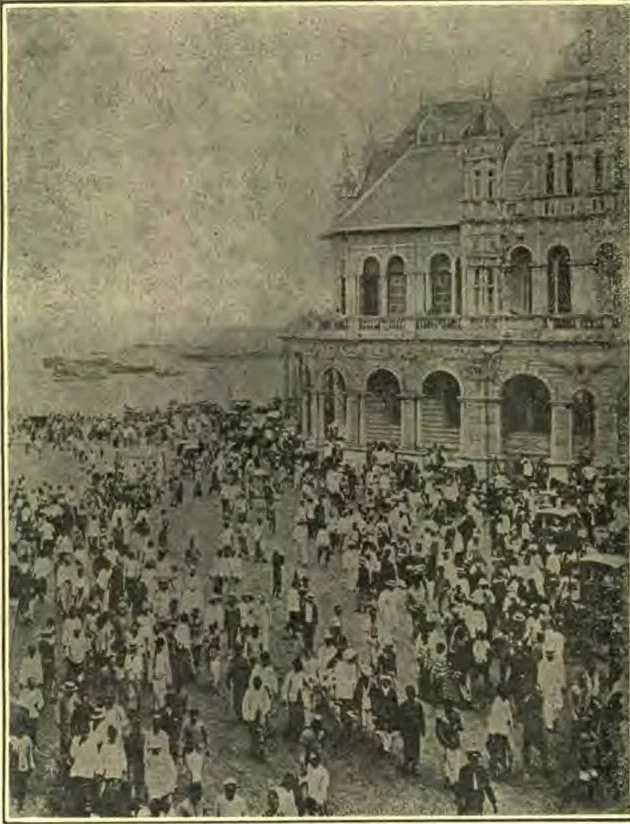
A STREET SCENE IN SINGAPORE
“Since returning to America and realizing the opportunities I lost with those girls in school, I have been writing them letters, telling them definitely what stand I have taken, and how personal work has brought so much more happiness into my life. My aim is now to try to help everybody with whom I come in contact to do better, just by a word, or by a definite talk, as I feel I am led.”
“I want to testify to every girl in this room that you will not know what real happiness is until you talk to others about Christ.”
My advice to you is not to wait to get ready to get ready to get ready to do personal work. Go at it! And keep at it! You must be willing to have your feelings hurt, your pride laid in the dust, or if necessary to be made a door mat for Christ’s sake. And sometimes it may seem as if you have made a mistake, but God overrules for his glory things which look like mistakes on our part. Trust him to bring everything out right, and go ahead. Every bit of culture and refinement you have or can get will be helpful; every bit of knowledge which you can accumulate can be used in personal work. It is a great mind-developer, as well as a heart-developer.
In your own strength you will be helpless. I would advise you to adopt this daily prayer: “Lord, fill me with thy Holy Spirit for Jesus’ sake. Amen.”

Perseverance

THE majority of young men to-day lack, to an amazing extent, the perseverance, stick-to-it-iveness, and the unswerving purpose that made their fathers rise and finally become successful in the trade or profession that they chose for a life-work.
We need not go far back into the history of our country to come to the time of sod houses and log cabins, the stage-coach and the prairie wagon, and the slow and laborious ways of doing things that these stand for. Now one can press a button, use the telephone, and have anything one wishes brought to the door.
What has brought about this change? It is the work of our fathers; it is their untiring efforts, in spite of the many failures that are always experienced in developing an idea. What would seem to many to be impossible, has been worked out by some persevering person.
Think for a moment of the repeated failures Mr. Cyrus W. Field experienced in laying the American cable. He knew his idea was all right, and that it would prove a boon to the world; but he had hard work to get his associates to help him, or to appreciate his scheme. To secure proper material and get it suitably prepared to stand strain and rough use, were two more obstacles that he had to overcome; but he triumphed in the end. The cable was laid; now one can read the world's news of the previous day and night at the breakfast table.
Many more instances of this kind might be cited. For example: John D. Rockefeller, when a boy, laid plans, and determined to control the production of petroleum. Sir Thomas Lipton was once a clerk in a small store; he now owns large tea and coffee plantations; he is very wealthy, and is known all over the world. Mr. Andrew Carnegie was a poor Scotch boy; by hard work and continued effort he is now a multi-millionaire; his libraries may be seen in many parts of the United States and in various countries of Europe.
The men just mentioned have achieved marvels in the financial world. That, however, is not the highest ambition one may have. A noble character, a good reputation, or an education, is above the getting of money; but the principle of hard work and determined effort, is the point to be emphasized in the illustrations which we have given.
We as Americans sound the name of Abraham Lincoln as high as any; how often do we think of the long, thorny road he trod from his poverty-stricken condition in the log cabin, to the presidential chair, where he guided this nation through, in some respects, the worst of our Civil War. He began his study by the flickering light of a pine-knot. In that man perseverance, honesty, and integrity were personified.
In a late paper is published an interview with one of our senators. At the age of thirteen he was working in a lumber camp; when sixteen, he had practically no education. A little later a friend gave him a start; he then went to school; by working and studying until he nearly broke down, he earned all the first prizes. He continued his studying and working until he finally finished as a lawyer. His first year's practise netted him over twenty-five hundred dollars. When a comparatively young man, he delivered prominent speeches in the South and West. One took twelve columns of a large newspaper to give it in full. He gave these all from memory, without the aid of notes.
Great satisfaction he must have when he looks at the rough road over which he traveled, and the difficulties he overcame.
Each one may have that same kind of satisfaction to the extent that he tries to better his own condition and surroundings. If many of our young people whose parents are in moderate circumstances, had more of this principle, our schools would be overflowing this school year. Make up your mind to have an education; bend every energy in that direction. There is much truth in the old saying, “Where there's a will, there's a way.”
It is very probable that you will sometimes wear clothes that are not of the best material and latest make; you will have to deny yourself some of the comforts and luxuries of this life; but what of that? Some day you will come out on top. The pleasure and satisfaction you will then have, no one but yourself can fully appreciate.
Many of the young men attending our high institutions of learning are supported by their parents. They have an easy time in school; they have all that heart can desire. When through school, many of them have no idea of the problems they are to solve when they come in contact with the hard, impartial world. It is a fact that there are many college graduates cleaning streets in our large cities; this work must be done; but the education they had should have enabled them to do their fellow men better service, and also put themselves onto a higher plane.
The thoughts in this article are not theoretical with the writer. He knows of what he is writing, and it is his hope that some one may arouse to the fact that the price of wisdom is above everything else, and that he may become fired with the determination to get an education, although it seems to be an impossibility at the beginning. “THE OPTIMIST.”

Word from Singapore

THE Chinese are brought up to obey their parents, and even after they are married, they must not do anything without the consent of their father and mother. Very often the married people continue to live with the parents of one or the other, and can have no say in the management of their own house or children. If any of these so situated see the truth and desire to obey it, they dare not do so on account of displeasing their parents. When one of our sisters wished to be baptized, she thought she would not tell her old mother until afterward, as she was sure her mother would not allow it. As she expected, the mother was very angry, and said very bitter things against her daughter to us, and declared that she would never forgive her. However, it was not many weeks before the mother herself became interested, consented to have Bible studies, and is now going to all her friends telling them what she has found to be the truth.
Forgetting her own late experience, she is astonished at their slowness and dulness in accepting what is now so plain to her. She has been keeping the Sabbath for several weeks, and we think it will not be long until she will wish to follow her daughter's footsteps in being baptized. Her son-in-law also fully believes and is preparing himself and his affairs so that he can observe God's statutes. Their children are members of our Sabbath- and church-school, and are a credit to their parents and to the cause.
There is another woman who was formerly much opposed to any religious teaching, caring for only the things of this world. But the Lord allowed a severe illness to come upon her, when she became willing to have some one visit her and pray for her, and in answer to our prayers, her life was spared. She was grateful to God, and wished me to continue visiting her and reading the Bible to her. I found her very ignorant, as she was brought up in the convent and was taught nothing of the Bible; but, the Lord having touched her heart, she was eager to learn. She is also much concerned about the salvation of her relatives. Her continual burden and prayers for them make me feel sure that sooner or later some of them will submit to the strivings of the Spirit. This lady is walking in the light just as fast as it comes to her, and I expect that she also will wish to be baptized soon. Some other time I hope to be able to tell you of the full surrender of an aunt of hers.
MARION V. JONES.

The Milch Cows of the Ants

MANY stories are told of the relations between the ants and the plant-lice, or aphides. The plant-lice secrete a sweet, sugary substance which the ants gather from them. On the leaves of young plants, numbers of the plant-lice may be seen, surrounded by ants, which, by means of their antennae, or feelers, seem to be abstracting the “honey” from the aphides. Some believe that ants keep aphides as we keep cows; not as unwilling prisoners, but as beloved domestic animals. Many doubt that there is any such relationship. One naturalist, Mr. Gentry, of Philadelphia, says that “when a young man, he was disposed to drift with the popular opinion in this particular, but a few facts that fell under his notice established in him the idea that with one species of ant at least this was the case.”
On one occasion he overturned a large stone where there were ants in their burrows, some caring for the immature ants, and others attending to the aphides, going from one to another, and with their antennae, seemingly extracting a small drop of the sweetened juice exuded by these insects. So busy were the ants, that it was some time before they noticed their danger. When they did, they did not desert the aphides, and run away, but carefully escorted each one to a place of safety underground.
“You should have seen their anxiety,” he says, “and the presence of mind they exhibited. Conscious of attack, and knowing the peril that beset them, they did not flee to their underground galleries, or to the adjoining grasses for shelter, and thus leave their flocks to the mercy of the invader, but they manifested the deepest concern for the little creatures, so unable to defend themselves, that had so willingly catered to their temporal wants. Not an ant was seen to desert its post, but all remained on duty till the last of their protégés was carried to safe and comfortable apartments in the ground beneath.”
Mr. Gentry believes that there is the same affection between the ants and the aphides that there is between man and the domestic animals. Interesting in this connection is a portion of a letter written by a lady who has been camping for the summer on the borders of the beautiful Lake Tahoe in the mountains in the angle of the boundary line between California and Nevada:—
“We saw a queer thing yesterday. I have read of ants’ milking cows, and I guess they were doing that which leads people to think so. There were two ants that seemed to be herding a few black bugs that looked as if they might be a species of aphis, but larger than the flower lice. The ants kept petting them with their antennae, and became much excited and angry when we touched them. So I suppose that is what people call ants’ milking cows.
“I never saw such a variety of ants in all my life as are to be found here. My pet ants will not touch sugar or jelly. The other day I put some malted nuts near the hole, but they would not allow it near their premises, but dragged it off and threw it down the rocks. They are very fond of meat, however.” G. H. HEALD.
Continue reading: A Psalm of Praise — Psalm 145