AMONG the learned men who came to America in the eighteenth century was George Berkeley, afterward bishop of Cloyne, Ireland. He went to Newport, Rhode Island, to found a university, afterward giving his American estate, and several hundred volumes of his library, to Yale College. It was while interested in America that he wrote his poem containing the oft-quoted stanza:—
"Westward the course of empire takes its way,
The first four acts already past;
The fifth shall close the drama with the day:
Time's noblest offspring is the last."
The stanza has been quoted as prophetic. As a matter of fact, it is founded on Bible prophecy. The first four acts of the great world drama are the history and life of the empires of Babylon, Medo-Persia, Grecia, and Rome. Three of these, as world powers, had for almost two millenniums passed away. Rome had been for centuries in a divided state. But when Bishop Berkeley wrote his poem a new Star had risen in the horizon. A new World was opening before the nations. A new Flag was about to be unfurled to the breezes of heaven.
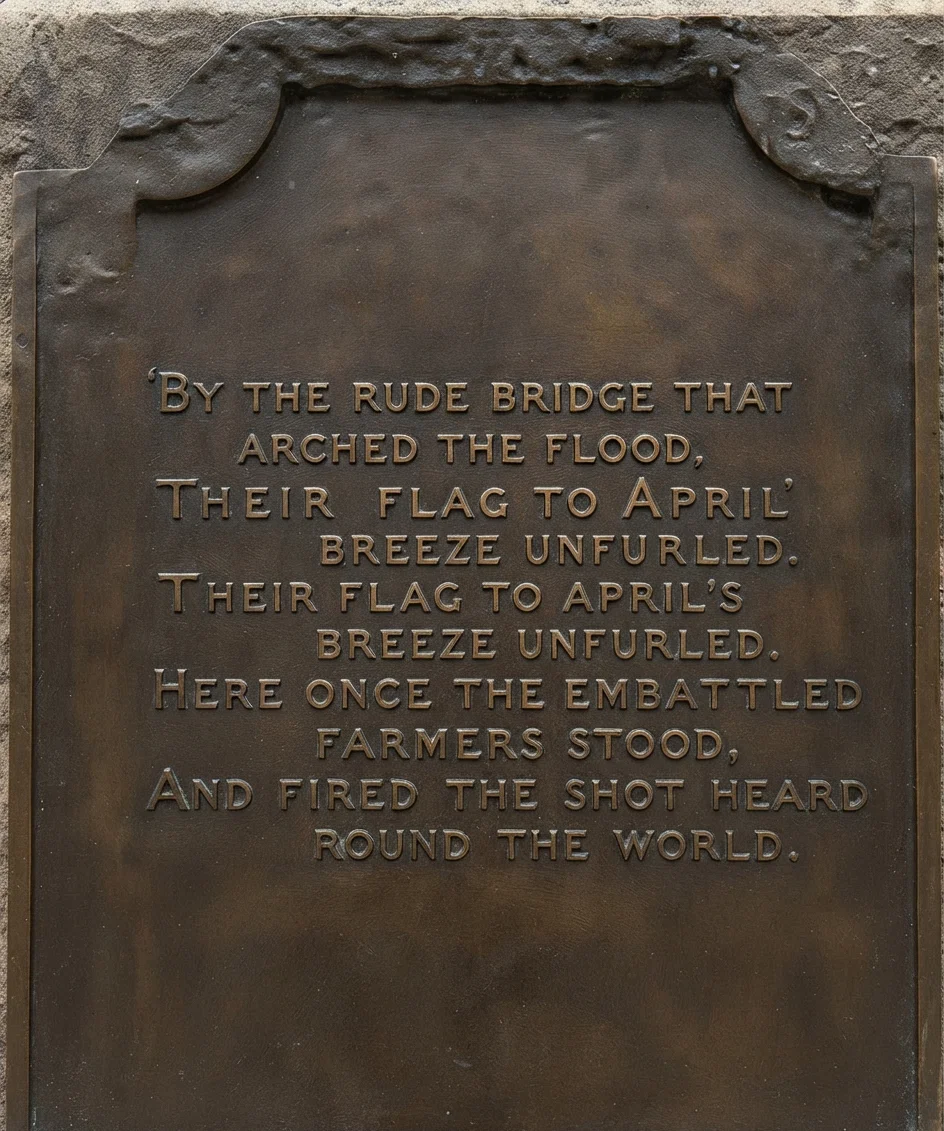
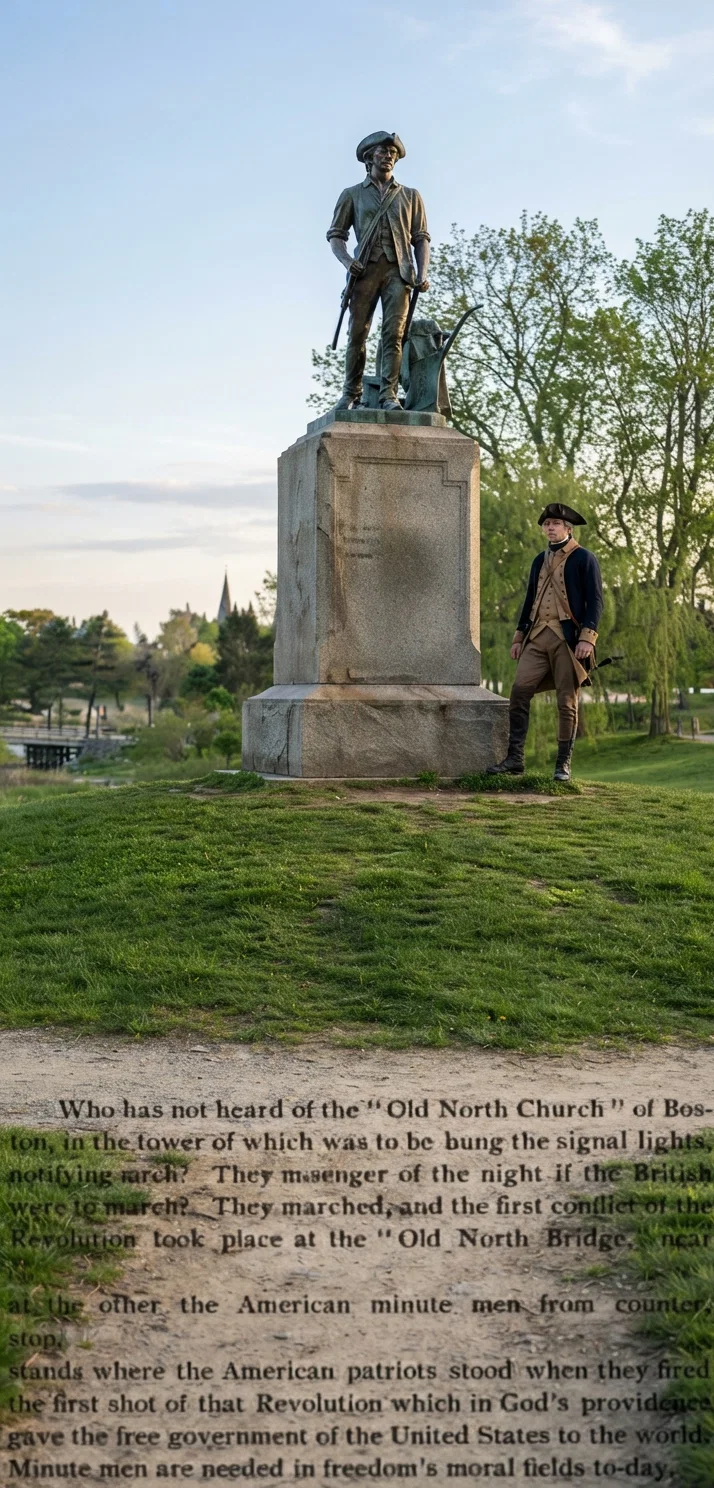
Photo by the editor. Inscription on the Statue of "The Minute Man," at Concord, Mass.
All this God has foretold in prophecy. The great Church-and-State system of government, which in different forms curses the world from Nimrod, the founder of Babylon, to the second coming of Christ, earth's lawful King, is represented in Revelation 13 by a composite beast with seven heads and ten horns. It includes in its symbolism the great persecutors of the church for conscience' sake in the great sad history of earth's past, and this in a two-fold sense, in both body and successive heads.
It possesses the mouth of a lion (Babylon, Dan. 7:4; Jer. 4:7, 13), the feet of a bear (Medo-Persia, Dan. 7:5), the body of the leopard (Grecia, Dan. 7:6), and ten horns of Rome (Dan. 7:7), and it is inspired and upheld by the dragon (the devil, Rev. 12:9). The heads represent the same powers, being successive (Rev. 17:9, 10), not contemporaneous like the horns.
The animus comes from the seat of the mind, the head. The head controls the beast, and makes the beast what he is while the head exists.
The beginning of this persecuting régime, this great, abnormal system, was Babylon, that power which has made all the kingdoms of earth drunken. The first head is Babylon, represented as a lion in its civil aspect, as a gorgeously-arrayed harlot in its religious aspect. The second head is Medo-Persia, continuing the same Babylonian system in another form. The third is Grecia. The fourth is Pagan Rome, through which the dragon, Satan, wrought to destroy Christ. Rev. 12:4. The fifth, the head dominant during the "forty and two months" of Rev. 13:5 (see also Dan. 7:25; Rev. 11:3; 12:6, 14) is usually known by the designation of the Papacy.
A Symbol of the New World System.
Just at the time when the papal head is wounded (Rev. 13:3, 10), beginning with the Reformation and culminating in 1798, John sees another power, symbolized by a beast, rising up out of the earth, having two horns like a lamb, yet speaking like a dragon. Rev. 13:11.
Now note that this beast must symbolize a power rising to prominence about 1798; it comes up, not out of the "sea" (denoting peoples, nations, Rev. 13:1; 17:1, 15), but out of the earth, a hitherto unoccupied region by the historic nations; its growth is rapid; its progress in coming up is visible; it has two horns like a lamb; it speaks as a dragon, and the latter part of the chapter is the development of this dragon spirit.
Two Horns like a Lamb.
It will be noticed that in this beast is combined two prominent apocalyptic symbols. (1) It has two horns like a lamb. In type and prophetic symbol a lamb stands for Jesus our Saviour. He is represented in Rev. 5:6 as "a Lamb having seven horns." A horn is an emblem of power, exaltation, strength. Seven would denote perfection in all things which would make the Lamb truly exalted and powerful. A beast with two horns like a lamb would denote a power professing to possess, holding in prominence, two Christian principles or characteristics, principles which, applied to civil government, would make that government characteristic, or distinguished from all other governments, even as they distinguished Christianity from all other religions. (2) A dragon is the symbol of Satan, operating through earthly governments, inducing them to persecute the children of God. "The dragon . . . persecuted the woman." Rev. 12:13.
Here are the prominent characteristics or specifications concerning the power symbolized by the two-horned beast:—
1. It must be rising to prominence in the world's affairs about A.D. 1800.
2. Its rise would be rapid and marvelous.
3. It must arise, not among the great nations of history—the sea—but in hitherto ungoverned, undeveloped regions, "the earth."
4. It will possess as characteristics of strength and prominence two principles, characteristic of Christianity alone among religions, and of itself alone among nations.
5. Nevertheless it would speak as a dragon, or promulgate persecuting laws.
Search through all the centuries and tomes of history and but one power, one nation, one government, alone, of all earth's governments can be found in which these specifications are fulfilled, and they are all fulfilled or fulfilling in that one.
That nation is our nation.
That government is these United States of America.
1. In 1798, when the papal beast went into captivity, this nation was just rising to power. July 4, 1776, its independence was declared. Then followed eight long, cruel, depleting years of war, not for conquest, but for liberty, for a principle. In 1789 its glorious Constitution was adopted. And at the time the prophetic vision applied it was the one great young power in the world.
2. Its rise since its birth has been rapid and marvelous, a fact familiar to all observers and students and citizens.
3. It came not up in the Old World, the theater of the great drama enacted in its several parts by Babylon, Medo-Persia, Grecia, and Rome, but from a New World, a new continent, amid untrodden solitudes and virgin forests.
4. It possessed in its making two principles only dreamed of by the most sanguine statesman who may have loved them in the past. In this glorious nation they were crystallized into its charters of existence.
The first of these was the equality of man. This is preeminently the teaching of Christianity, but of no other religions which the world has ever known. It was Christ who said: "One is your Master, even Christ; and all ye are brethren." Matt. 23:8. It was Christ's apostle who said: "There is no respect of persons with God." "God that made the world and all things therein, . . . hath made of one blood all nations of men for to dwell on all the face of the earth." Rom. 2:11; Acts 17:24-26.
The second great principle vouchsafed to men by Christian ethics, so far as interference of man is concerned, is the right and privilege of every man to worship God, or not to worship, how or when he will, providing he does not interfere with the equal rights of his fellow-men.
This principle may be termed religious liberty. The Gospel of Christ compels no one. It is not "Thou shalt," or "Thou shalt not." Its language is, "Whosoever will" "let him come." Rev. 22:17. Listen to a chosen servant of the King of heaven: "Now then we are ambassadors for Christ, as tho God did beseech you by us; we pray you in Christ's stead, be ye reconciled to God." "Knowing therefore the terror of the Lord, we persuade men." 2 Cor. 5:20, 11.
And Jesus Himself said: "If any man hear My words, and believe not, I judge him not; for I came not to judge the world, but to save the world." John 12:47.
(Continued on page 14.)10
"Time's Noblest Offspring."
(Continued from page 9.)
And that resolute apostle who was once so ready to use carnal weapons, writes: "Dearly beloved, I beseech you as strangers and pilgrims, abstain from fleshly lusts." "Neither being as lords over God's heritage." 1 Peter 2:11; 5:3. "Not for that we have dominion [lordship] over your faith," says Paul, "but are helpers of your joy; for by faith ye stand." 2 Cor. 1:24. How different are the words of these apostles from the practices of those "lords spiritual" who now claim to be their direct successors! "If ye were Abraham's children, ye would do the works of Abraham." John 8:39.
Look over all the religions of the past—pagan or perverted Christian—and in not one do we find these two particulars. The curse of caste, the creation of offices and positions, a haughty, imperious, and ambitious heirarchy, religious dogmas enforced by royal edict or legislative enactment, one or all are present in all the religions of earth save that of Christ. They are present in all forms of perverted Christianity.
Both of these divine principles of equality and liberty are embodied in the charters of our freedom in this country so far as they can be embodied in earthly government. In other words, the United States government embodied the Christian idea of civil government, or is in principle what a civil government ought to be. The first principle, equality of all men, is found in that document which sounded the birth-note of America's freedom, and which made Americans free men:—
"We hold these truths to be self-evident, that all men are created equal; that they are endowed by their Creator with certain unalienable rights; that among these are life, liberty, and the pursuit of happiness. That to secure these rights, governments are instituted among men, deriving their just powers from the consent of the governed."—Declaration of Independence.
The second principle—religious liberty—is embodied in this; but is guarded above question in the Constitution, the fundamental law of our government. The First Amendment reads:—
"Congress shall make no law respecting an establishment of religion, or prohibiting the free exercise thereof, or abridging the freedom of speech or of the press."
No other government of any note in the world holds these two principles. There are republics like Switzerland and France, but they have their State religions, supported by many to whom they are intolerable burdens. The United States Government stands unique in this respect; and these principles have been the magnetic power which has drawn to our shores from the autocratic and intolerant priest-ridden nations of the Old World the persecuted and oppressed millions. They found here religion "without a pope and a State without a king," and the consequent privilege of worshiping or not worshiping God according to their own consciences and understanding of His will.
The identity of these Christian principles in this government, and the fulfilment of the divine prophecy, are well set forth by America's great historian, George Bancroft:—
"The Constitution establishes nothing that interferes with equality or individuality. It knows nothing of differences by descent, or opinions, of favored classes, or legalized religion, or the political power of property. It leaves the individual alongside the individual. . . . Vindicating the right of individuality even in religion, and in religion above all, the new nation dared to set the example of accepting in its relations to God the principle first divinely ordained in Judea."—Hist. of the Constitution of the United States, book 5, chap. 1.
More than this: the influence of this government has ameliorated the Old World conditions, so that dungeon and rack have slunk into night and obscurity, and the martyr's pyre is extinguished.
Later on the shackles of slavery were broken from the feet of the slave, and the principle of liberty and equality again crystallized into fundamental law the following:—
"No State shall make or enforce any law which shall abridge the privileges or immunities of citizens of the United States; nor shall any State deprive any person of life, liberty, or property, without due process of law, nor deny to any person within its jurisdiction the equal protection of the laws."—XIV Amendment, sec. 1.
Grand and noble sentiments and principles! Would God they might continue in the government and nation forever. They made the best civil government upon which the sun ever shone; and if held in the hearts of the people, would continue such a government.
But, alas, the beast with the lamb-like horns speaks with a dragon voice; it becomes a persecutor. It makes an image to the ten-horned beast; that is, it unites Church and State. It enforces the mark of the Papacy, the sign which she claims of her power, the Sunday enforced by law. It enforces under penalties of legal boycott and even under death the image and the mark.
Is this possible? Nay, it is probable. Read in proof of it the departure of this country from her basic principles as set forth in other articles in this paper. What means the religious legislation of the last few years? What mean the many court-made laws and prosecutions for conscience' sake?
God forewarned us of these things eighteen centuries ago. Who will heed this warning? Who will place his affections upon the heavenly land, whose inhabitants know no blight, no sorrow, no death; but glorious life forevermore?
The Minute Man. Who has not heard of the "Old North Church" of Boston, in the tower of which was to be hung the signal lights, notifying that brave messenger of the night if the British were to march? They marched, and the first conflict of the Revolution took place at the "Old North Bridge," near Concord. At one end of the bridge stood the British troops; at the other the American minute men from counter, shop, and farm. The above statue of "The Minute Man" stands where the American patriots stood when they fired the first shot of that Revolution which in God's providence gave the free government of the United States to the world. Minute men are needed in freedom's moral fields to-day.
OUR COUNTRY—THE OUTLOOK.
By Editor
IT is with no desire to reflect upon the United States of America that this issue of the SIGNS OF THE TIMES is sent forth to our fellow-men. We are glad to recognize—
That this is a great and glorious country;
That the government was founded on the blessed principles of equality and liberty as no other which ever existed;
That despite all its inconsistencies, despite the slavery in its borders, it has been the grandest, freest, government that earth ever knew; and
That its glorious flag has symbolized freedom and humanity to all the earth.
We do not wonder that the patriot’s heart throbs with new joy and forceful impulses as he contemplates his country’s past. We can understand that to any one less than Christian, one of the most beautiful, most thrilling, objects upon which a patriot’s eyes ever looked with kindling joy is the flag of this country—the Stars and Stripes—waving in the free winds of heaven. We respect the whole-souled ardor of the true, loyal citizen, as he responds to his country’s call. All this we appreciate and heartily recognize. We have been there.
But, friends, the true statesman and true friend of his country must make deeper research, must take broader view. It will not do to cover with the court-plaster of expediency the ulcers of the body politic, nor limit the view to the little valley of the immediate present and near future, even yet hidden in the glory of the past. He must probe the wounds for the cause of the rotting ulcer, he must extirpate the roots of the cancerous growth; the blood of the body must be purified before the death sores will heal. He must climb the mountain and get a better, larger view if he would know the condition and outlook of his country. He must know not a few details of a few localities; he must understand the working of the whole, the general tendencies of the system and habits of the patient. He must know that only by adhering to the law of its life, the reason of its existence, can it continue to exist.
The Christian, if he be true to his Master, must search deeper still. He must by the power of God’s Word and Spirit look into the hidden springs of human action. Are the sources selfish? Then the end is death. Are they unselfish, consistent? There is continuance of life and vigor.
The Christian must get up into "the high mountain," even into the mountain of God, and by faith in prophetic ken, as set forth in the "more sure word of prophecy," he must see as God sees. He must not look upon the land of his birth as the only land, or the land for him and his, alone. He must see that all the lands are God’s, bought by the blood of Jesus Christ. He can not, as a Christian, confine his interest, his love, to the men of the land of his birth. He will love all men, because all are the purchase of the blood of Christ. For the same reason, as he is one of the redeemed ones, he is debtor to all, "both to the Greeks, and to the Barbarians; both to the wise and the unwise," both to the English and the Boers; both to the Americans and the people of the Philippines.
The Christian loves all lands, because "the earth is the Lord's." He loves all men, because they are the purchase of "the precious blood of Christ."
Not only so, but he looks beyond this life to the life to come. He believes God; he knows God. He knows that "the Most High ruleth in the kingdom of men, and giveth it to whomsoever He will;" that even "the wrath of man shall praise Him, and the remainder of wrath shall He restrain;" that when a nation will not work out His will, "He removeth kings and setteth up kings;" and that, finally, Jesus Christ the Branch will have gathered out of all the kingdoms of earth those who will eternally be loyal to Him, and who will share with Him His glorious universal kingdom, which is to come forth by His power alone from the ruin of all earthly powers. All this God has again and again foretold in His Holy Word.
The Christian should know as no one else can know, be he historian or statesman, that a nation must be true to the law of its existence if it is to continue to exist. He knows that this is true of experimental Christianity. He knows it is true because God declares it in His Word. The moment a church, or a nation, even as a man, departs from the law of its life, from that moment its decline is at hand.
Has this government of the United States of America departed, or is she departing, from those principles which gave her existence? In the light of the evidence presented in this issue of this paper, in the light of much more that might be presented, could we answer otherwise than to say, "She is so departing?"
If the Christian sees this, is it not his duty to give warning? Can he be excusable to High Heaven if he give it not?
Is this nation living her principles in the purchase and rule of the Philippines without the consent of their people? Is not our fathers’ struggle for freedom paralleled in theirs? Have we cast off the evil of buying and selling humanity as chattels in this country to renew it in the isles of the sea? Are we carrying out the spirit of the charters of our liberty in weakly yielding to the Church of Rome, in the indorsement of the Sunday institution, thereby constituting a civil court the arbiter of religious differences? Few are those who realize these dangers. Fewer still are those who, amid the roar of war, the whirl of patriotic sentiment, the maze of political ways, and the flood of political gush for political purposes, dare raise their voices in faithful warning, for fear of being regarded as enemies, or at least, pessimists. But the truest friends to nation, country and people are those who give faithful warning of the evil day.
O friends, fellow countrymen, will you not heed the warnings? Statesmen, legislators, judges, will you not, as did the fathers of the Republic (as stated by Madison), see "all the consequences in the principle," and avoid "the consequences by denying the principle"? Or will you be charmed by the siren voice of an apostate Christianity, and lured to ruin or be carried on to destruction on the almost resistless tide of a plutocratic ambition?
What will be your choice?
AN ANCIENT PREDICTION CONCERNING THE UNITED STATES.
By T.
THE United States has made a history that is the marvel of the whole world; and she has made this history in a most incredibly short time. When we take into account the colossal proportions to which it has grown, the extreme youth of the country is one of its greatest wonders.
Those who have the good fortune to live in a country like this are fond of expressing the desire that the nation might stand forever. And truly a nation with such basic principles as those possessed by this great Republic could do nothing else than stand, provided it always adhered to the justice and truth that are its groundwork.
America has given to the world a democracy that has been the admiration of even her enemies, and at the same time a beacon of hope to every down-trodden and oppressed soul on the face of the earth. And this same America, standing firmly upon her unsurpassed Declaration of Independence and just and reasonable Constitution, might go on amid a blaze of ever-increasing glory, to peacefully teach and completely revolutionize the world.
The ancient prediction, however, of the Seer of Patmos shows that this nation will depart from its solid principles of righteousness and liberty. The thirteenth chapter of Revelation, verses eleven to eighteen, are a prophecy of this country. This scripture presents this nation under the symbol of a beast that “had two horns like a lamb.” These lamb-like horns represent the perfect freedom in both civil and religious matters that was established in this new nation. All the countries of the Old World have always had their state religions; and religious tyranny, as well as civil despotism, has been exercised. But not so with this New World power. It was recognized as an “unalienable right” that “all men are created equal,” and that governments are established to secure these rights and not to grant them.
Such a perfect government was a new thing among the nations of men. The founders of this Republic abandoned the “divine right” of rulers as it had been taught to, and received by, the majority of mankind; they bid adieu to the “recognized and established11principles of government,” leaving behind them the persecutions and oppressions of the past; they said that since God has created men “equal,” and endowed them with certain “unalienable rights,” let us recognize those facts, and not fly in the face of Providence by opposing them.
Such, in brief, is a statement of the lamb-like principles upon which this government was founded. And every American can read them in full in the United States Constitution and Declaration of Independence.
But, according to the prophecy under consideration, these mild, yet eternally solid principles of civil and religious freedom will be abandoned. The sure Word of God says of this great nation, “And he spake as a dragon.” It is sad to contemplate it. But to controvert it, is to controvert the words of Jehovah. It is not mere men who have made the prediction, but God Himself has declared it. He has not decreed that it should be so, but knowing beforehand what would take place, He has simply announced to all who can be led to believe His Word what will be the end of this nation.
Like all of the great nations of antiquity, this country will go down. But when this country falls all the world goes with her. This nation has afforded an asylum for the oppressed. The cruel tyrant saw his victims escaping to this city of refuge and stopped to consider what would be the outcome of this “new experiment of democracy.” The lamb-like power grew and increased in might and influence. The deriding world began to wonder, then to admire, next to court, and finally to follow the great and glorious and free and liberty-loving Republic of the Western World. And with the world thus admiring and following, it is perfectly plain that all will fall into the same destruction that shall finally engulf the beloved America.
Some may question the fact of America's leadership in the world, but if you question, we pray you, be careful to recognize the facts. For the questioning of facts does not change them in the least. It only changes our attitude toward them, and may possibly throw us where we will go down in the oncoming destruction.
“And he spake as a dragon.” What are the indications to-day that this nation will so far forsake her principles that she will speak as a dragon? Let us consider a few points and see.
This country, especially during the last twenty-five or thirty years, has shown an unparalleled amassing of wealth into the hands of a few individuals. Already the principles of equality and freedom are so fully out of sight that a small minority of men hold every commodity of commerce and industry within their grasp. Everything now must be subordinated to the accumulation of money. And the influence of money is that which sways and moves the world. The money power has an iron grip on everything that pertains to this present world. Legislatures, city councils, and public officials in general are corrupted and controlled by the relentless tyranny of wealth.
These corrupting influences of the money power are destroying the consciences of men, and the money god is made paramount in every mind.
And to make the struggle for wealth all the more intense, this age has adopted a very extravagant manner of living. The simple and satisfying conditions of our fathers will no longer suffice. The glitter of the luxuriant enjoyments that may be purchased with gold is constantly before the attention. We meet it everywhere. And so every energy must be fully exerted to get money, and still more and more money.
And now it seems that America is not large enough. New territory must be conquered and colonies must be formed in order to widen commerce and give opportunity, so it is averred, for the business of the nation to be enlarged and extended.
But this will only serve to increase the strength of the money power, and render the slavery of the individual all the more complete.
And the saddest feature in all this in-coming condition of things is the fact that the Declaration of Independence and the Constitution are being thrown down and trodden under foot. Islands and peoples are to be conquered and held purely in the interest of commerce, with possibly a percentage of un-American ambition.
America, the beloved America of freedom, the haven for the oppressed of every clime, has reached the parting of the ways. A siren's voice is enticing her adown the evil road. The plunge over the precipice into the vortex of eternal ruin can not be far off. And the whole world is following her, and all will be engulfed together. These are ominous times! The very air is surcharged with the awful portents of the world's overhanging doom.
T.
THE INDIVIDUAL VERSUS THE INSTITUTION.
THE government which regards the rights of its subjects, will not exalt the institution, religious or social, above man, but man above the institution. The institution may be honored if men will, but its observance will never be compulsory.
All the Catholics in a community may with bared and bowed heads adore “the Host” as it is carried past in solemn procession; but no Protestant is to be forced to bow his head or remove his hat. All the Protestants of a community may, with reverent air, remove the hat or bow the head when the solemn public act of baptism—immersion—is performed at some lake side; but no Catholic is to be compelled to show reverence. He may not encroach upon the rights of any; he must be civil toward men, but he is not to be compelled to act religious.
A true government will not subject the individual man to the arbitrary demands of the many. Man surrenders no inalienable right to society or government. If the government be a true government it conserves and guards the rights of each one, and each one in his rights. And when each person is protected in his rights, all are protected in their rights. And as long as each individual is protected in his rights, so long can no class suffer from the infringement of their rights.
The thing to be exalted, therefore, in a just and permanent government is the inalienable rights—common to all men—of the individual man, whether he be pagan or Jew, infidel or believer, Catholic or Protestant; for in this only are the rights of all conserved.
IS THIS CHRISTIAN?
By Editor
Is It Original and True Americanism?
THE theory was that United States was to be the saviour of those whom Spain was oppressing; but it would seem from many reports from various sources that the war that United States is waging against the Filipinos is crueler than any war that Spain ever waged; and that already American soldiers have slain more than Spain has in all her rule in the Philippines.
Letters have been published from soldiers that the order is, "Take no prisoners." The natives were shot down. One company, it is said, started out with sixty native prisoners, and delivered but three, with no reprimand. Another started out with thirty odd, but came into camp with no natives, but a few chickens. Dr. Charles R. Brown, pastor First Congregational Church of this city, in a sermon on Palm Sunday (we quote from the printed copy), gives the following extract from a letter from a California lieutenant to a friend in Oakland:—
"I have seen a real war with all its horrors. I have seen two hundred acres of houses burned. I have put the match myself to houses while old women knelt at my feet sobbing and begging me to spare their shack of palm leaves. I have ordered the destruction of acres of vegetables and fruit trees, which meant months of labor and the only means of living to the poor fellow who was on his knees to me."
Dr. Brown says:—
"We read, also, that this people, who, in their desperation have fought for liberty for a hundred years against Spanish domination, are still struggling for the privileges of self-government in a way that touches our American hearts. The very women among the Filipinos have been enlisting; and when their troops were driven back from the trenches, among the bodies of the dead our men found the bodies of women clothed in men's garments and with hair cropped close. They, too, had shouldered their muskets that they might stand beside their husbands and brothers in their pathetic contest for the privilege of governing the soil where they lived. It may be that these ignorant people are misguided and that their estimate of our final purpose is not correct, but the desperation of their struggle against the idea of taxation without representation must touch the hearts of all those who have not forgotten our own war of revolution. Do we want to compel this unwilling people to accept our rule? Do we want to kill, burn, and devastate in order to defeat them in their desperate attempt to gain their freedom from any foreign domination?"
"We are told that Spain oppressed these people; but even cruel, ignorant, incompetent Spain has never burned a mile square of their homes in a single day. The death of thirty thousand of our men, on the principle that one American soldier is equal to five savage Filipinos, would mean the death of one hundred and fifty thousand of these uncivilized natives. If we should write that bloody record within the next two years it would eclipse the annals of any cruelty that can be charged for a similar period against Spain!"
Further on, this brave preacher says:—
"It is no excuse for our slaughter of the Filipinos for us to plead their alleged incompetency to manage their own affairs. In 1861 a certain great nation had a deadly dispute with itself. The North and the South were arguing out with the awful weapons of war that political principle which we call 'States' rights.' The lives of almost a million men were sacrificed and thirty-seven hundred millions of dollars were expended in determining which view of that principle should obtain. We would not have thanked any nation on earth to have said to us in those days: 'These American people are not capable of self-government. They are killing each other; their country is torn by rebellion; therefore, we must come in by our superior force, set up our government, and manage their affairs for them.' Let the Filipinos learn to govern themselves precisely as we learned to govern ourselves, and let us not soil our hands by killing them because they claim in desperation this solemn privilege. I remember it is urged that their leader, Aguinaldo, has once been bribed. Perhaps he was, and, if so, it was a grievous fault and grievously has Aguinaldo answered it. But here, at home, we do not kill men nor burn their towns because they have been bribed. If such were our settled policy, what awful conflagrations and what dreadful slaughter might have marked some of our State capitals."
"We announced at the beginning that this was a war for humanity and not for conquest; it was to deliver men from oppression but not to shoot them down or to compel them against their wills to submit to our rule. To me there is something more splendid than any conquest that we might win, and that is for a nation to keep its word."
When we read these letters of the cruelties practised by Americans upon the Filipinos, fighting for their independence, we recall the earnest, thrilling, glorious words of that true American, James Russell Lowell, words as applicable now as when written:—
Look on who will in apathy, and stifle they who can
The sympathies, the hopes, the words, that make man truly man;
Let those whose hearts are dungeoned up with interest or with ease
Consent to hear with quiet pulse of loathsome deeds like these!
Shame on the costly mockery of piling stone on stone
To those who won our liberty, the heroes dead and gone,
While we look coldly on, and see law-shielded ruffians slay
The men who fain would win their own, the heroes of to-day!
Are we pledged to craven silence? O, fling it to the wind,
The parchment wall that bars us from the least of human kind—
That makes us cringe and temporize, and dumbly stand at rest,
While Pity's burning flood of words is red-hot in the breast!
Tho we break our fathers' promise, we have nobler duties first;
The traitor to Humanity is the traitor most accursed;
Man is more than Constitutions; better rot beneath the sod
Than be true to Church and State while we are doubly false to God!
We owe allegiance to the State; but deeper, truer, man—
To the sympathies that God hath set within our spirit's core;—
Our country claims our fealty; we grant it so, but then
Before man made us citizens, great Nature made us men.
He's true to God who's true to man; wherever wrong is done
To the humblest and the weakest, 'neath the all-beholding sun
That wrong is also done to us; and they are slaves most base
Whose love of right is for themselves, and not for all their race.
Liberty for All
We plead not alone for liberty for ourselves, but for each and every man,—for our neighbor,—be he infidel or believer, pagan or Christian, Catholic or Protestant, Gentile or Jew. As long as the liberty of the individual is secure, the liberty of all and the stability of the nation are safe.