The Youth’s Instructor, Vol. 37, No. 44.

THE FIRST FALLING LEAF

The Youth’s Instructor

Oct 30, 1889

S. D. A. Publishing Association · Battle Creek, Mich. · Oct 30, 1889

THE FIRST FALLING LEAF.
To-day, down all the avenues The glorious autumn leaves are spread, And in the branches, 'gainst the blues Of heaven's changes overhead, They flash like gems of ruby red And gold, and then, like birds shot dead, They flutter where our sad feet tread,— Emblems of joy and song that's fled.
Though, glorious in their gorgeous hues, The leaves stand decked in gold and red, And blaze along the avenues, And make a carpet where we tread, O, somehow a strange sense of grief Falls on our hearts as we pass 'neath The glorious trees, like festal wreath: We note with pain the falling leaf.
O, 'tis not youth that flushes there In aureal beauty on the bough, Foretelling of a day most fair, With prophecies upon its brow. Nay, 'tis life's last great throb, that swells The nectar from love's emptying wells; Not amaranth, but asphodels,— Not life to come, but death, it tells.
From year to year the world has seen The flowers fade, the blossoms pale, And yet so frail are they, I ween We half expect that they will fail; But the great trees with such wide scope, With such magnificence of hope, Reaching toward heaven,—alas! we grope When their leaves prostrate line the slope.
The old first grief comes to our souls— When our first parents saw this change, When first they saw how Death controls, And works his miracle most strange. O, how they bowed, in tears and grief! The gorgeous shades brought no relief; They sobbed the forest trees beneath, And mourned to see the first dead leaf.
Death was a new thing to them then; The garden's glory still in mind, Only a short path through the fen To that fair life they'd left behind. But death came, leading them away, Blighting the beauty of the May, Painting with colors rich and gay, To mask the marring of decay.
Graves have grown thick since then; the breast Of mother earth's a charnel place, And million millions are at rest, Slain in their lovely grace. We tread on forests, humbled down From green to gold, from gold to brown: We tread on warriors of renown; We tread on kings that wore the crown.
But not in hopeless grief we move; For from the tomb Christ rose up free, And promised, in his pitying love, From death large immortality,— Promised from death's sad day of dearth A restoration day of mirth, Promised new heavens and new earth, Filled with all glory and all worth.
Some day, not long before us, he Will speak from his great heaven above, And his own captive ones be free At his great call of love. Graves will burst up with life anew; The clouds will leave unshadowed blue, The earth be filled with light and dew, With love and song, and all that's true.
Then forest trees will stretch their boughs— With a wide panoply of glee, And we shall smile with radiant brows Beneath each living tree. Yes, 'neath the tree of life we'll sing, Rejoicing in unfading spring; And how our shouts of joy will ring! And how we'll praise sweet heaven's King!
O falling leaves! to-day we weep To see you fill the golden air, Like birds that suddenly southward sweep To seek a clime more fair; We weep to see you fall, but grief Finds in God's promise sweet relief; The new earth comes! Delay is brief, And there, there'll be no falling leaf.
FRANCIS E. BOLTON.

SOUNDING AN ALARM FROM THE WATCH-TOWER.

AWAY back when men began to multiply upon the earth, iniquity also began to increase, and man's selfish nature to predominate, making it necessary for the weaker party to protect themselves from the encroachments of the enemy. Hence there originated with the ancients, and has been handed down through the generations to more modern times, the custom of fencing-in, or building walls around, their cities. These fortifications were made strong in proportion as dangers threatened. The walls were not only made very high, but in some instances very thick. The one around Babylon was eighty-seven feet broad, so that six chariots could be driven upon it. The wall of Nineveh would take three chariots abreast. Many of these walls were fifty feet high.
Oftentimes a second, and even a third wall was built some twenty or more feet from the main wall; and to make it more difficult for the enemy to capture the city, outside of all a great moat, or ditch, was dug.
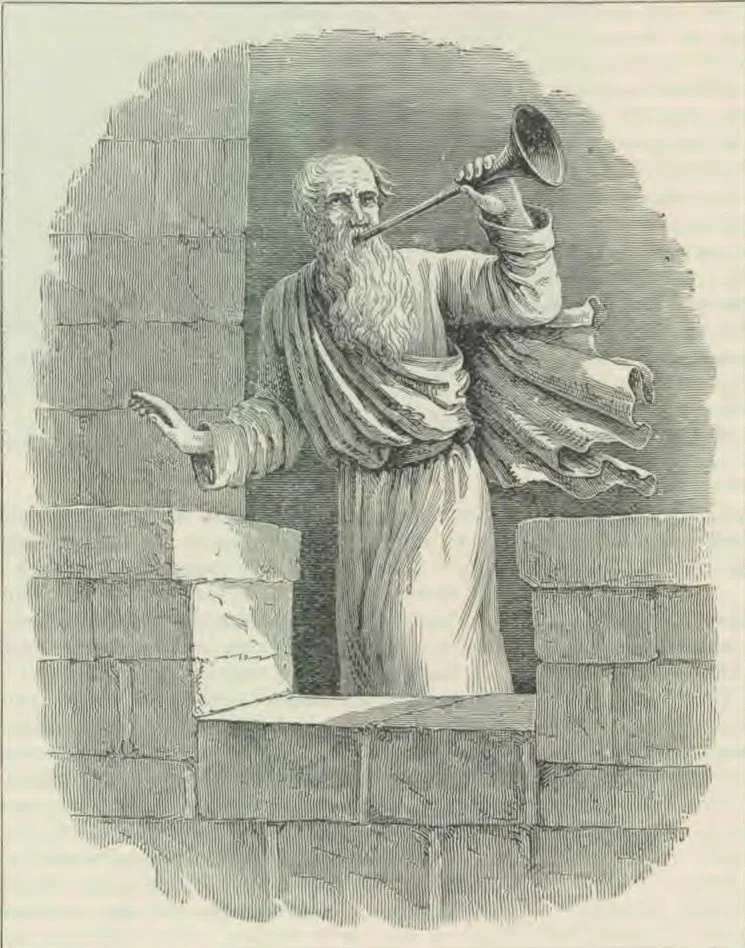
The entrances to the city were closed with strong gates, or doors, which, except upon certain occasions, were kept locked or barred, especially in time of war. Yet the walls and gates alone did not give the feeling of security the people desired, so they built, at regular intervals upon the walls, watch-towers of the same height, or nearly so, as the walls. In these, watchmen were set, especially near the gates, to keep a close lookout over all the surrounding country day and night, unless in times of peace, that at the first approach of impending evil, a cry could be sounded out from the tower that would bring the needed help for the protection of the city.
As a last means of defense, when all others failed, in the interior of some cities a much greater and higher tower than those on the walls was erected. This was called a citadel. Towers were built, too, in the country for the protection of wells, cattle, vineyards, etc. Villages also had their towers, with a watchman set in each to descry danger. Anciently the only distinction between a city and a village was that a city had walls and a village had none. Hence it would seem that in those times a village, unwalled as it was, had need of a tower and a watchman.
The watchman's task was made easy for him, the night being divided into three watches, and in later times even into four. But faithfulness was required of him; for should the enemy get the advantage through the watchman's neglect to sound the alarm, the watchman was responsible for the evil wrought. The Lord, speaking of an unfaithful watchman in Eze. 33:6, alludes to this ancient custom. He says: “If the watchman see the sword come, and blow not the trumpet, and the people be not warned, if the sword come, and take any person from among them, he is taken away in his iniquity, but his blood will I require at the watchman's hand.”
In the same sense the Lord holds us all responsible as watchmen. If we fail to warn those whom our influence can reach, we fail to sound the trumpet; or if by carelessness or indifference on our part any are turned from the narrow way, we have given the trumpet an uncertain sound. In either case we are unfaithful watchmen, with whom God will deal as he has said in the thirty-third chapter of Ezekiel. Please read the whole chapter. Let us one and all be faithful in receiving and giving the warning message that God has for this time, and so be shielded from the plagues that shall fall upon the wicked.
M. J. C.

UPSIDE DOWN.

“You've put that sleeve in upside down, Henrietta,” said Helen Marcy.
“What is the difference? They will never know it; it is finished; throw it into the box,” the young girl replied. “Nobody will know who made it.”
“Yes, but when they open the box at the mission, somebody will have to rip it out and put it in again before it can be worn.”
“They ought to be thankful to get anything to put on to those little vandals. Do you suppose they would know whether a sleeve was put in upside down, or even wrong side out, Helen?”
Helen Marcy made no reply, as she saw her companion throw the gingham shirt-waist into the box that stood in the middle of the floor, where the finished garments were deposited. She would have taken the sleeve out, and put it in again herself, but she had promised to finish off some other work that evening, as the box was going in the morning. These two girls belonged to the “Busy Workers' Sewing Society.” They had been preparing a box for a charitable institution in the city.
Henrietta Fassett was one of those persons who always did things, as her Aunt Jerusha expressed it, “in a whew.” She did not think it worth while to baste the pieces of her garments together; for that took too much time; so when she sewed under her mother's or her aunt's supervision, she was oftentimes obliged to rip out the stitches, and do the work over again. She had heard her aunt say a hundred times, “Lazy folks always take the most pains, Henrietta.” That afternoon she was responsible to no one, so the upside-down sleeve was allowed to be sent off, and that was all she thought about it.
Helen Marcy was entirely different in that respect from her intimate friend, Henrietta Fassett. It took her longer to finish her work, but it never had to be done over again. She was responsible to herself and her own honor in such matters. If she had made the mistake that her friend made, she would have sat up all night, if need be, to rectify it. She always aimed to do well whatever she did, and in the very best manner of which she was capable.
The matron at the charitable institution was glad to get the box. There were fifteen little boys in ragged garments waiting to put the fifteen new gingham shirt-waists on. It was such a help, she thought, to have them all ready to be put on—no buttons to be sewed, and no fitting to be done, and no running up of seams. Those new, clean, pretty gingham waists were all ready to be slipped over the boy's shoulders. How good and kind the “Busy Workers” had been!
Mrs. Leavenworth, a friend of Mrs. Marcy's, was there to see the box opened, and she was very proud to say that the box came from the young girls of the town where she spent her summers. One boy after another stepped up to the matron, and had a new waist put on, and marched off with a smiling face.
Fourteen boys had been equipped and sent off happy. Then the fifteenth boy came up; he was a thin, pale boy, with the saddest of faces. The matron said he had a very sad history, and sometime she would tell Mrs. Leavenworth all about it. Martin Beers stood by the box, with a smile lighting up his face; he was going to have a new waist, probably the first bright, fresh, new garment he had ever had. His right arm went into the sleeve, but there was something wrong with the set of it.
“What's the matter with this sleeve?” queried the matron. “Oh, I see, it is put in upside down; somebody's made a mistake. It will have to go to the sewing-room and be ripped out. The sewing girl is gone, too, this afternoon.”
Mrs. Leavenworth saw the disappointed look on the little fellow's face. All the other boys were in the playroom with new waists on. He would have to go back again with his old torn shirt on. The lady laid aside her bonnet and wrap, and said, “Wait a few minutes, Martin, and I will fix the sleeve,” and so the boy sat down on a stool by her side, and watched her rip out the sleeve and put it in again. It took half an hour to do the work, but she told Martin some pretty stories while she was at work. Then he marched off to join the brigade with new gingham waists.
Henrietta had forgotten all about the “upside-down sleeve,” until the president of the society rapped on the table a fortnight afterwards, and called the “Busy Workers” and talkers to order. Then she read what Mrs. Leavenworth had written about the box. She wrote how needy the boys were, and how pleased they all were with the new garments. But this lady thought best to tell the whole truth as well as part of it, and so she added one waist had to be fixed before the boy could wear it, as somebody made a mistake, and put the right sleeve in upside down. She only mentioned it because she knew that the waist would not have been sent so unless it was a mistake. She also thought it would be a good thing to tell the young girls, so that they would be more particular in the future.
“Who could have made that mistake?” asked the president, as she stopped in the midst of her reading. No one answered, and Helen Marcy would not betray her friend. But Henrietta, after a moment's consideration, spoke out clearly, “I made that mistake, girls, and I did not remedy it, but threw the waist into the box. I think I shall be more particular after this. I really did not think it would make much difference.”
Mrs. Leavenworth concluded the letter by giving the sad facts connected with Martin Beers's young life, and the account touched the hearts of the “Busy Workers” and brought tears to their eyes.
Henrietta seemed to be completely overcome as she listened to Mrs. Leavenworth's letter. When she went home, she stopped at the store, and bought material enough to make two waists for Martin Beers; and when she cut them out the next morning, she was so deliberate and particular about her work that her mother said, “It seems to me that you are taking more pains than usual with your work, Henrietta.”
“Yes, mother, I've got through doing my work upside down. I begin to realize how careless and thoughtless I've been all my life. I have done so many things in such an upside-down sort of way, and I've let them go without remedying the wrong, either. I begin to realize it all now. I may sometimes thoughtlessly do more of my work upside down; but if I do, I will stop and take it out, and do it all over again until it is right. One can do a great deal of work in life upside down, and I hope hereafter God will help me to have all that I do finished up square and true and lasting and right side up.”
“My dear, I cannot tell you how happy you've made me,” the mother replied as she put her arms around her daughter and kissed her.—New York Evangelist.

WOMEN WHO ARE BLACKSMITHS.

How would our girls fancy leading such a life as falls to many of their sisters on the other side of the ocean? They sometimes imagine that they have hard times, yet their lot is luxurious when compared with that of many a woman in the old world. Mrs. Leonora Barry, in writing home from Europe to the Pittsburg Commercial, has given, among many other interesting things, an account of the wretched condition of the laboring women of England and France, and the hardships they are subjected to. Our INSTRUCTOR readers may also like to know something about it. Speaking of the toiling women of Paris, she says:—
“I saw very many women in Paris yoked to carts, hauling market produce and merchandise of all kinds. Sometimes the woman pulled the great lumbering cart unaided, but sometimes she was assisted by either a dog or a donkey. This condition among women was also found at Brussels, but here the law specifies how many pounds the dog shall pull, seven kilos being the limit (a kilo equals two and a quarter pounds). But the woman may pull all she can.”
Yet far worse scenes are to be witnessed when one leaves the beaten track of tourists, and wanders through the hamlets and out-of-the-way places in any part of civilized Europe—Holland, for instance. In the latter it is a common sight to see women employed in the “lightening” of a vessel, that is, the loading or unloading of a vessel by means of a small sloop called a “lighter.” A man owning a lighter, and living upon it with his family, contracts to load or unload, or to coal, a vessel. The entire work will be performed by the wife and daughters, the lazy husband sitting in the stern of the vessel, smoking, and by coaxing and threats, and often by use of a whip, urging on the women to complete their task, while they toil from morn to night, patiently ascending and descending the steep gangways with their loads of coal or merchandise.
In Scotland, in the spring, in the severest easterly storms, that pierce one to the very marrow, scores of women can be seen on their knees in the onion fields, weeding, and at night plodding home with their garments frozen stiff as boards, cowering before the cutting winds, and staggering like drunkards, because of their benumbed condition. Their pay is but a few pence daily, on which some have to support large families.
Among other places visited by Mrs. Barry was the Lord Dudley Estate, near Birmingham, England. The following is her description of what she saw there:—
“From Birmingham, I went on about fifteen miles to Dudley, or what is known as the Black Country, and it is rightly named. Both in appearance and the conditions of its people, a blacker, more dreary life could not be conceived. It is the property of Lord Dudley. The ill-fated Johnstown, of Pennsylvania, did not present a more pitiful appearance after its fearful disaster than does this landed property of a lord. The country is divided into little hamlets bearing such burlesque names as Thibbet’s Gardens, Cinder Bank, Primrose Hill, Netherton Ruins (very appropriate), Cradley Heath, etc.
“A description of one of these places will suffice for all. Thibbet’s Gardens is a miserable, grimy, dirty path, with little hovels built along its one foul-smelling street, over which all sewage matter from roof and kitchen has cut little ditches. At the back of every dwelling, and included as a part of the rent, is a forge with fire-place sufficient for one or more anvils. Here, at these anvils, the women and children of this poverty-stricken locality stand day after day, until months roll into years, and years into a lifetime, swinging hammer and tongs, welding into every link of chain their health, comfort, and happiness.
“Nails, such as are used in the bottoms of ships, hobnails for heels and soles of shoes, and chains of different sizes, Nos. ½, ¾, and ⅜, are the sizes made by these women, some of whom are over sixty years old. The iron rod is brought from the factories in coils, and the women have to straighten it out preparatory to using. They get one hundred and twelve pounds of iron rod at a batch. They are allowed eight pounds for waste, and must be accountable for the balance.
“Chainmakers, by working steadily, make eighteen pence per day, which equals thirty-six cents, American money. The rent of a house of two rooms, with forge and two anvils, is two shillings, nine pence per week, sixty-six cents. One good woman, of whom the clergyman who accompanied us spoke very highly, said she had lived in one house and worked at one forge for seventeen years, and in that time no repairs had been made except such as were paid out of her own earnings. The husbands and fathers of these chain-and-nail-making women are miners, working for such a miserable pittance that it is absolutely necessary for the mother, wife, and daughter to live this cruel life.” W. S. C.

THE LAST DAY.

WERE this the last of earth, This very day. How should I think and act? What should I say? Would not I guard my heart With earnest prayer? Would not I serve my friends With loving care?
And yet this fleeting life Is one last day: How long so’er its hours, They will not stay, O heart, be soft and true While thou dost beat; O hands, be swift to do! O lips, be sweet! —Mrs. M. F. Butts, in Christian Union.

ALL THE WAY ROUND.

ONCE there was a merchant who advertised for a boy. Among those who presented themselves was one little fellow who was just as neatly dressed as his means would permit. His hands were clean, his face shone, his hair was nicely brushed, and his poor, thin, miserable shoes were blacked till you could see your face in them.
The merchant was a sharp, shrewd man, so he eyed all the various points of the many boys. He wanted a neat, particular boy, and this one seemed to be just about the kind he needed. But he did not engage him. Why? Because the first thing he observed was that the boy had not blacked his shoes “all the way round.” He had only blackened the toes, leaving the heels in their dingy drab color. The second thing he observed was, that when the boy stretched his arm out a little too far, he showed only too plainly that he had washed his hands just as far as his coat sleeves came. His coat was well brushed, his shirt sleeves, though much frayed, were clean. Ah! those had been his mother’s care. But when it came to the two things that depended solely on himself, then he failed utterly. He might have “forgotten” to black the backs of his shoes? True, but he might likewise “forget” to perform properly some business for his employer. What excuse for his dirty wrists, though? None. So the merchant argued.
Now, boys, do you see the point? When you do anything, do it “all the way round.” Not on the top or one side, but all around, everywhere. And when you wash your hands, don’t forget to wash the part covered by the coat sleeve.
Don’t do a little mean thing because you think nobody will see it. If you are open-hearted, and generous, and kind, and thoughtful, don’t be so only in the places where it will show. Let that which shows as good in you, extend clear up under your shirt sleeves, and all the way round the heels of your shoes.—Christian at Work.

“I’LL DO WHAT I CAN.”

“I’ll do what I can,” said a bright-eyed girl, And she gathered a fresh bouquet Of the sweetest buds and flowers, and placed In the room where her sick mother lay; And at night when the angel of sleep came round, He tucked under May’s head a pillow of down.
“I’ll do what I can,” said a thoughtful boy, And brought out the rake and hoe; Cleaned out the potatoes, the beans and peas, And the onions, row by row. And the shower came on, and the warm, bright sun, And finished the work the boy had begun.
“I’ll do what I can,” said a wayside flower; “I’m a tiny thing, to be sure; But my cup is as deep as some others I know, And the dew that I hold is as pure; So I’ll catch what I can for the bee that comes nigh, And scent the rough gale as it passes me by.”
“I’ll do what I can,” a streamlet said, As it ran on its pebbly way; “I will scatter life on every side, And bring up the flowerets gay; I will sing to the mountain, the meadow, the vale. Give drink to the thirsty, and strengthen the frail.”
So they did what they could, each one in its way. And the world was the happier by it; And if any of you little children doubt What I say, I ask you to try it: And you’ll find that through life ’tis an excellent plan, In every condition to do what you can. —Selected.

PLAYING GYPSIES.

MABEL and Fay thought it would be nice to play gypsies, and steal their baby brother away from mamma. Then they would make her pay piles of money for bringing him back. So they dressed up, and were dreadful-looking gypsies, in slouched hats and long coats. They hid little Georgie carefully on the front porch behind some chairs and an open umbrella.
Mamma was listening, and soon she said: “Where is Georgie? I saw some gypsies near here to-day; I am afraid they have stolen him.” So she looked in all the wrong places she could think of. Then she sent Dinah, the cook, and told her to offer ten dollars for the lost baby.
Presently the two dreadful gypsies came in, and asked her if she wished to buy a baby. She paid ten round pieces of gilt paper to the chief of the robbers, which was Fay, and got her dear, stolen baby back. Then she “made believe” she had been very much frightened about Georgie. The gypsies broke down, and one of them wept because she thought mamma really had been troubled. Then Mrs. Goodwin kissed the terrible gypsies, and told papa all about it when he came from the office.—Our Little Ones.

THE FROLIC WITH THE LONG NAME.

“There's no fun like a picnic!” declared Allie.
“No, indeed,” agreed her friend Lulu; “there's nothing in the world like being out under the trees, and picking wild flowers, and hearing the birds sing!”
“Where are you going, little girls?” some one asked the six little lassies, who came in a group, each one wearing a big shade-hat and a very bright smile, and carrying a basket.
“Oh, we're going on a picnic!”
“Just a little bit of a picnic!”
“Just we six!”
“And we've got lunches in our baskets”—
“And a little bit of sewing for our dolls, to do when we're tired, and all sit down together!”
They passed a poor-looking little house, and saw a poor-looking little girl, who gazed wistfully after them as they went on.
“Let's ask Nanny to go,—couldn't we?” whispered Lulu in a rather doubtful tone, as if she hardly dared to propose it.
“Oh! I think it would be nicer to be by ourselves,” said Hatty. “She isn't used to going with us.”
“She isn't used to going with anybody,—she or Bessy; and I guess it's because they're poor,” said Allie. “And I think it's too bad. I wouldn't like to be left out of things if I was poor.”
“We've got enough lunch to give her some,” said Elsie.
“Plenty!” said Allie. “Nanny,” she cried, running back to her, “wouldn't you like to come over to the woods to our picnic?”
“Yes, I'd like to,” said Nanny; “but I can't leave Bessy.”
“Can't Bessy come too?”
“No; she can't walk. She fell down a week ago, when she was carrying some hot water, and scalded her foot, and she has to sit still all the time.”
“That's too bad,” said Allie.
“It's very nice of you to ask me,” said Nanny, as the girls walked on.
“Oh dear!” said Lulu; “how dreadful it must be to have to keep still on such a fine day.”
“Let's go in and see Bessy for just a few minutes,” kind-hearted Amy quickly suggested.
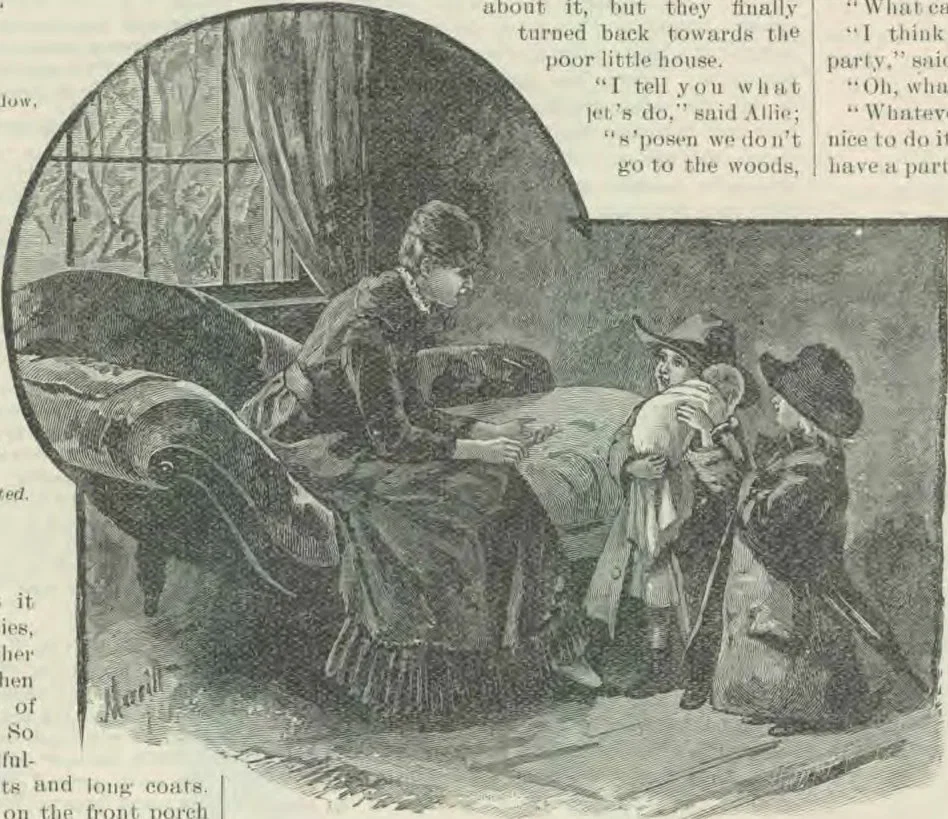
There was a little discussion about it, but they finally turned back towards the poor little house.
“I tell you what let's do,” said Allie; “s'posen we don't go to the woods, but stop and have our picnic here with poor Bessy!”
“A picnic in a house!” exclaimed Hatty.
“Yes; why not? Just think how glad it would make Bessy.”
“And we could have our lunch for supper, and play it was a party,” said Amy.
“So we could,” said Lulu. “Do let's do it, girls.”
A picnic in a poor-looking little house did not seem half so pleasant as one out in the woods, but no one had the heart to say so when they came in sight of Bessy's window, and saw her pale little face looking out. She could scarcely believe they really meant to come in, and she and Nanny were in a delighted little flutter about there being chairs enough for them all.
But they were soon seated, and then began plenty of merry little chat as the pretty doll work was taken from the baskets.
“Let's all make something for Bessy's doll,” whispered Allie to her next neighbor.
The word soon went round, and was answered with little nods and winks of agreement. After an hour of sewing, the work was set aside, and they played games in which Bessy could take part, until the poor little room rang with shouts and laughter as it surely never had rung before. It was surprising how fast that afternoon flew away. Every one was astonished when six o'clock came.
“Time for supper!” said Lulu.
And then the little girls went to where they had left their baskets in the little entry.
If Bessy had felt surprised at the arrival of such a bevy of bright-faced little visitors, what did she feel when those baskets were unpacked?
“No; you're not to bother getting plates and things, Nanny!” insisted Allie. “This is a picnic, and they never have things proper and regular at picnics. We're going to put things on our basket-covers, and gather close around Bessy's cot.”
Lulu took from her basket some gayly colored Japanese napkins, and then the feast was passed around,—sandwiches and jelly and gingerbread and sweet crackers and bananas, and little round cakes with frosting on them; and plenty for the two who had not been expected to share in them, and enough left over for Bessy's breakfast the next morning.
“I don't know what made you so kind, coming to see me,” said Bessy, when they wished her good-by.
“I guess it was because Allie remembered about little children loving one another,” said Hatty in a half-whisper.
“Wait! wait!” cried Nanny, running after them after they had left the house. “You have all forgotten your work!”
“No, we didn't forget it,” said Lulu; “we left it for Bessy.”
“Some of it isn't finished,” explained Amy, “but it will be fun for Bessy to finish it when she is all alone.”
“I'm glad we did it,” said Hatty, as they walked on.
“So am I,” said Lulu; “it's the best picnic I ever was at.”
“Picnic!” said Hatty. “I think it was more like a surprise party.”
“I think it was like a sewing society,” said Amy.
“What can we call it, any way?” asked Lulu.
“I think it was a sewing-surprise-picnic-society party,” said Allie.
“Oh, what a long name!” laughed the others.
“Whatever we call it,” said Hatty, “I think it was nice to do it, and I wish more little girls would try to have a party like this.”
I wish so too,—don't you? Perhaps you know of some little one to whom you could make just such a visit, carrying with you gladness and sweetness and loving-kindness, which may make a bright spot in some poor room which was not bright before.—Sydney Dayre.

PENNIES FOR THE TOWN SPARROWS.

It seems queer to call little boys and girls “town sparrows,” but it is not one bit funny when you know all about how they came to be called so. This is the way they got the name: Mrs. Smiley, who lives in Dublin, the capital of Ireland, is a Protestant lady who has fourteen hundred Catholic children in her ragged schools, learning to read and write and to give their hearts to the dear Lord Jesus. She calls one of her homes, “The Birds’ Nest,” another is for “Waifs and Strays,” and a third is full of “Town Sparrows.” I think she calls them that because she remembers the word of the Lord Jesus about the birds. He said that two of them were sold for a farthing, yet not one of them could fall to the ground without the notice of the heavenly Father. She knew that every little boy and girl going barefoot in the snow, or starving in a cellar or garret, was dear to the Lord, and she meant to take care of just as many of them as ever she could. She has had to give plenty of them their breakfast every day, for fear the poor little things would tumble off the benches, they were so faint with hunger.
She has a little grandson living in England, just outside of London. The dear little fellow made up his mind when he was only three years old that it was a great deal better to give his pennies to the Lord than to spend them for candy and toys. His brother, two years older than he, thought it was a foolish notion.
“See here, Harrie,” he said, “I would not give them all to the Lord, if I were you. You might give him half of them. I am going to save all of mine to buy a pony, and when you see me prancing about on my little horse, you will wish you had kept at least half of your pennies to buy one, too.”
That was a great temptation to Harold, but he said quite bravely, “I don’t care. I like the Lord, and I am going to give him every penny I get; so, there, now.”
For a while he thought that the money was all taken right up into heaven in some way; but when he was a little older, his mother told him about his grandmother’s ragged schools in Dublin, and that every penny he sent to them would buy a breakfast for a “Town Sparrow.”
Harold thought it was a good way to give his pennies to the Lord, because Jesus said that if we give only a cup of cold water for love of him, he would see that we have a reward.
One day I was at breakfast at Harold’s house, when the postman brought him a letter. It was from his grandmother about some money that he had sent her a few days before, when he was just seven years old. His birthday morning he had opened the box in which he kept his pennies, and found that he had two dollars and a half, and he sent it to Dublin for the “Town Sparrows.” The letter made him very happy. Would you like to read it? It went this way:—
“DUBLIN, Feb. 16, 1889.
“My Dear Harold: Your money for the ‘Town Sparrows’ came quite safely, and I have written it down in our book, and I know some one else has written it down in His book, too. Aren’t you glad of that? Fancy the one hundred and twenty-five breakfasts your money will buy; I am sure that you will be very happy about it, for the best way to be glad is to make others have a good time. If ever you feel unhappy, just ask yourself, Now, what kind thing can I do for somebody? and when you start to do it, you will forget how bad you felt, and be happy all at once. At half-past nine every morning for a hundred and twenty-five mornings you can remember that some little ‘Town Sparrow’ is having his breakfast out of the money that you saved in your box. If you could see them with their little bare feet in the snow, and then see how quick they are to learn, I am sure you would be glad to save every penny for them. That God will bless my dear little boy is the prayer of your loving GRANDMAMMA.”
Which do you think would take the most comfort with his pennies—Harold, giving breakfast to the little, half-starved “Town Sparrows,” or his brother, thinking how much pleasure he was going to have all by himself with his pony?
Continue reading: LETTER TO THE HEBREWS