“Passing the State’s prison in Wethersfield on foot, one spring morning, thirty years ago,” said an old gentleman, one of the prison commissioners of the State of Connecticut, “I saw the gate open, a man come out, and the gate close again. The man looked pale and worn and sad. He stood by the gate in the broad May sunshine in a perplexed, undecided way, and I noticed the tears were streaming down his cheeks. He looked up and down the road, up at the sky, and then stood with bowed head.
“‘Where now, my friend?’ I asked cheerfully. ‘I don’t know, good sir,’ replied the man, sadly. ‘I was just thinking that I would throw my hat straight up into the air, and go the way the wind blew it. I would rather go back into the prison, but they won’t have me, now that I have worked out my sentence. They won’t have me there, and I don’t suppose they will have me anywhere,’ he went on, in a broken voice, ‘but I have got to be somewhere. I don’t know what will become of me; foresight isn’t as good as hindsight, sir.’
“‘I am walking to Hartford; take passage with me,’ I said.
“‘You won’t care to be seen in such company,’ he replied, looking at me incredulously. ‘Perhaps you don’t understand that I have just worked out a sentence in the State’s prison here.’
“‘I understand,’ I said. ‘We are all wayfarers; come along, and we will talk the matter over, and decide as we go what can be done for you.’
“It was a lovely, warm day. We walked slowly, and talked a great deal, or rather my companion talked, and I encouraged him to do so. He answered my questions frankly, clutching hungrily at my ready sympathy. He was very free to talk of himself, and said at last, as I smiled at some unimportant disclosure,—
“‘Reserve was never one of my failings, sir. If I tell anything, I tell all. That is the way I came to get into prison. Had I kept silent, I should have gone free; but by this time, my heart, full of pent-up sin, would have been a mass of corruption.’
“I found that he had made shoes in prison. ‘I never had a trade before,’ he said. ‘I think if I had had, I would not have fallen into errors. Had I had a legitimate way of getting a living, I would not have been tempted as I was. I have a good trade to begin on now, however. I have brought that away with me, as well as a bitter memory and a lasting disgrace.’
“‘It is not the fact of your being in prison, but the crime that carried you there, wherein lies the sin,’ I said.
“‘But those who are not found out escape the disgrace,’ he replied bitterly, with a deep sigh; and I hastened to say,—
“‘I think I know a man here in the city who will hire you. He is a large shoe manufacturer, and I am sure he will make a place for you as a favor to me, even if he does not really need a man.’
“The more I thought about it, the more confident I felt that my friend would take him into his manufactory.
“‘If I were in your place,’ I said, as we entered the city, ‘I would not lisp a word about having been in prison.’
“The poor fellow stopped short and looked at me. The hopeful look dropped out of his face, his eyes filled with tears, and he said, in a broken voice,—
“‘You have been very kind, but I had better bid you good-bye, sir. I cannot live a lie. I promised my God last night, in my cell that was so dark at first, but so light at last, when Jesus came to me there, that I would be true, whatever befall me; and I will keep my word.’
“‘Forgive me for tempting you at the outset,’ I said; ‘come on.’
“I saw my friend, and told him the whole story. He had a little talk with my man, and made a bargain with him. That night, just at the hour for the shop to close, we three went into the work-room.
“‘Here is a poor fellow who was discharged this morning from the Connecticut State’s prison,’ said the proprietor. ‘I am going to give him a start in life by taking him into the shop; he will begin work to-morrow.’
“There were indignant glances among the men, and one spoke up hastily,—
“‘I shall leave if he stays. I will not work with a jail-bird.’
“‘Very well,’ said the employer; ‘any one who wishes to leave can bring in a bill of his time in the morning.’
“Only one man, the man who had constituted himself spokesman, left.
“Ten years later, that discharged convict was the owner of that manufactory, and the man who would not work with a ‘jail-bird,’ was one of the journeymen. As I said to begin with, that was thirty years ago. That man whom I met at the prison door is now a senator in the Legislature of one of our New England States. He said to me this day,—
“‘I tremble when I think what the result might have been had an evil instead of a good friend met me outside the prison door.’”—Advocate and Guardian.
Careless Lives.
By Page Roberts
I am afraid that the great majority of men allow their lives, as they do their beliefs, to go anyhow. They never form a distinct opinion as to the shape their life is to take, and they have never said calmly and strongly to themselves, “This is the intention that is to rule my life.” They play the part of the sculptor who has no model, and no fixed idea. There is the marble, and they knock a piece out here and there, but no man can predict the final result. Eating and drinking, working and playing, and the distracted existence so many of us are living, what shall we be to-morrow? We really cannot tell. It will depend upon the people we meet, the things which are said to us. We have no real rule. If we are tempted to do wrong, it is possible, it is even probable, that we may do it, unless it is some very bad thing quite out of our way. It is not impossible we may say that which is untrue; that for our own gain we may deceive this person, and attack with anger that. If opportunity befalls us, we may yield to intemperance, or take the dark road of impurity. We may be good-natured, or fly off into a fiery passion. We may help some one who is in trouble, or strike a blow by word or act at a rival or an enemy. We do not know what we shall do, because we have no plan, no decision. Instead of our lives being like some well-ordered state, they are more like anarchy, twisted and twirled by the last breath and the last appeal—a shapeless jumble of good, bad, and indifferent. Is not this a disgraceful state of things, which ought to make sensible men hang down their heads with shame?—Page Roberts.
TEN MINUTES' DELAY.
All well-informed people are familiar with the sad account of the death of the young Prince Napoleon, who fell pierced by nineteen wounds at the hands of the Zulus, in South Africa, June 1, 1879.
Many will remember that Captain Carey, in his published report, mentioned that after they had selected the camping-ground—the object for which the squad of six had been detailed—and had had coffee, and rested, he suggested that they should mount and return to camp. But the young prince, who commanded the squad, said,— “No, let’s wait ten minutes.”
Just as they were preparing to remount, at the expiration of the ten minutes, a body of Zulus came on them, and all fled but the prince, whose horse broke from him. After a desperate resistance, he fell, covered with wounds, and died “in the tall grass of the douga.”
I presume all do not know that this pleading for ten minutes’ delay was a habit of the young prince from early childhood.
A correspondent of a leading Paris journal interviewed the Empress as she was upon the eve of departure for the scene of the tragedy that had wrecked all their earthly hopes, and drew her into conversation on the subject of her son.
She talked freely during the interview, but with an evident anguish of spirit, which seemed only more sad from her effort at control.
During this interview, while speaking of the childhood of her son, the prince, she unconsciously revealed the trait in his character that had caused all this woe—to her, wrecked hopes and a broken heart; to him, the probable loss of a throne, an earthly future, and his life.
After describing her as still lovely in her lonely grief, the writer from whom we quote said, “The Empress had now risen and stood, slightly trembling with emotion, when, stepping rapidly and gracefully across the room, she opened a cabinet, from which she took a pocket-book, and read therefrom on a leaf, ‘Going with Carey’—the last words ever written by the prince; then she added:—
‘Of all that Captain Carey has ever written in regard to my son, those fatal ten minutes alone I hold to be true. It was ever his habit,’ she continued, ‘to plead for ten minutes’ delay; so much so that I used to tell him they ought to call him “Monsieur Dix Minutes.” It was always ten minutes more to sleep in the morning; ten minutes more at night to sleep in his chair; and when too much overcome with sleep to speak, he would hold up his two little hands, the ten fingers representing the ten minutes more for which he pleaded.’”
The habit of procrastination is a deadly foe to all prosperity in temporal or moral affairs. We should do every duty as soon as it can be done.—Selected.
Going Unto God for Heart-Rest
By J. P. Hopps
—Happy they who can go unto God, their joy, when they need heart-rest. What does the weary need? What does the tired child want at even-tide, when the little head is weary even with play? What but the good mother, beyond whom the little one cannot look, and need not look? For God’s light beams through her loving eyes, and God’s voice breathes in her gracious words. And are we much stronger than children, we children of a larger growth? And are there not times in our life when we are tired, ay, even of pleasure, when we sigh for rest and sorely need it? And do we not need an infinite love, an infinite strength, an infinite tenderness? Blessed are they who know their need and their Helper! Blessed are they who can say, “I will go unto God, my exceeding joy!”—J. P. Hopps.
The Two Covenants.
In Hebrews 8:8 we find this statement: “For finding fault with them [the Hebrews], he [God] saith, Behold, the days come, saith the Lord, when I will make a new covenant with the house of Israel and with the house of Judah.” The new covenant, which is the subject of this text, is called in the preceding verse the second covenant. This implies that going before this there was a first covenant, which by parity of reasoning is called the old covenant. These two covenants are singled out from the many covenants mentioned in the Scriptures, as first and second, old and new, because they relate particularly to the great work of the redemption of a lost race, and embody the two grand divisions of that work.
This subject is one in which every person has reason to feel the most lively interest; for it embraces the whole question of our relation to God in this world, and of all our hope for the future. The condition of those who do not place themselves within the provisions of the covenants, is set forth by Paul as wretched in the extreme. Read Eph. 2:11, 12. It is the condition of every unconverted person: no God, no Christ, no hope! It becomes, then, not merely a question of interest, but one of great spiritual importance, to ascertain what constituted the old covenant and what constitutes the new, what change took place between the two, and what the conditions are upon which the promises of the covenant are suspended, that we may know how to comply with them and secure the blessings.
A covenant is defined to mean a mutual agreement between two or more parties based upon mutual conditions and promises. The first covenant, we are expressly told, was made with the Israelites when they came out of Egypt. In the history of that most remarkable of all migrations we find an explicit account of the agreement which God made with them, the only transaction between them which could be called a covenant. The story begins in Ex. 19:3, and continues to chapter 24:8. The condition on God’s part was that the people should obey his voice; and that voice was shortly heard from the summit of Sinai, declaring the ten commandments. His promise was that they should then be a peculiar treasure to him above all people. The condition on the part of the people was, that the Lord should own them as his peculiar treasure; and their promise was, that they would then obey all that he had said. The ten commandments, being the basis of the covenant on God’s part, are in that sense called a covenant; but the sacred writer is careful to put in the qualifying word “his,” referring to God, to mark the distinction. He declared unto you “his covenant,” even ten commandments. And so God speaks of them as “my covenant,” since they are the basis of all his covenants, whether with individuals or nations, and the condition upon which all his blessings are suspended. Whenever the word “covenant” is applied to the ten commandments, it is in this sense. But they are not that which is called the first covenant; for that covenant was dedicated with blood, Heb. 9:19, 20, and the first covenant was thus ratified before the tables of the commandments were put into the hands of Moses. Ex. 24:7, 8. After the covenant had been dedicated with blood, the tables of the decalogue were delivered to Moses. Verse 12. The ten commandments were never sprinkled with blood.
The time allotted to the old covenant at length expired. Over six hundred years before this, the Lord had announced by the prophet Jeremiah that a new covenant should in due time be made. Read carefully the language in which that promise was given in Jer. 31:31–34. The new covenant was to be made with Israel and Judah. It was not to be according to the covenant made with their fathers. The chief points of difference named were that God’s law was, under this new covenant, to be written in the hearts of his people, and the complete removal of their sins was to be secured through its more gracious provisions.
Christ at length appeared to confirm this covenant. He made it, not with Gentiles, but with those who represented both the house of Israel and the house of Judah. (No outside ten lost tribes to come in afterward.) His blood was the blood of the new testament, or covenant. This covenant had better provisions than the former, having the blood of Christ instead of the blood of beasts. It was established upon better promises, inasmuch as it promised to take away sins in fact, which were taken away under the first only in figure. What was the basis of this covenant?—The same exactly that formed the basis of the first. Then it was God’s law; and now, says God, I will write my law in their hearts; no one can doubt what God called his law in the days of Jeremiah, when this promise was given.
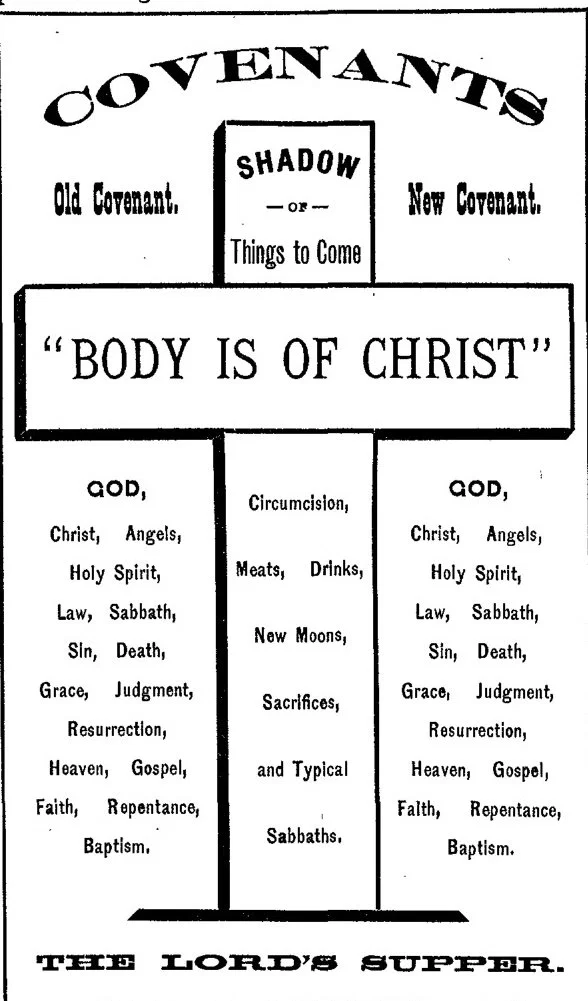
With these remarks the way is prepared to particularize more fully in regard to the difference between the two covenants. This difference is shown at a glance by the accompanying diagram. The cross standing in the center marks the dividing line between the two. On the cross the blood was shed which brought the old to an end, and ratified the new. We have simply to inquire, then, What did the people of God have before the cross which they have not had this side the cross? And, What have we this side the cross which the people of God did not possess before? And, What features belong in common to both periods?
Paul says that the worship of the former dispensation, the old covenant, was a shadow of things to come, but that the body is of Christ. Since Christ, we have had to do with the substance instead of the shadow, the antitype instead of the type. But what was done away in Christ? What was nailed to the cross? Answer: Circumcision, meats, drinks, new moons, sacrifices, and typical sabbaths. This Paul expressly teaches. And what remains? Answer: God, Christ, angels, Holy Spirit, law, Sabbath, sin, death, grace, judgment, resurrection, Heaven, gospel, faith, repentance and baptism. But all these the children of God had before the cross the same as after. We have the same God now as then, the same Christ and angels, the same Holy Spirit, the same law and Sabbath; for, as already noticed, the law (the same that in the days of Jeremiah was acknowledged to be the law of God) was under the new covenant to be enshrined in the very hearts of Christ’s disciples; and this law Christ magnified and made honorable, according to the declaration of the prophet, Isa. 42:21, by his perfect obedience to it, his instructions concerning it, and his sacrifice of his own life to its claims. And this law had a Sabbath, which continues with it,—the primeval, Edenic, God-ordained and God-sanctified rest-day. And this day Christ recognized, observed, and earnestly labored to set upon its true basis by stripping from it the burdensome load of Pharisaic glosses and rabbinical traditions, by teaching the people what could be done in accordance with the Sabbath law. But the most rigid Sundaytarian must admit that previous to the cross, where the new covenant was completed, ratified, and sealed with the blood of Christ, the testator, not a step was taken toward the introduction of the first day of the week as the Sabbath in place of the original seventh day. Then it cannot come in at all; for Paul declares that after the death of the testator nothing can be taken from or added to the testament, or covenant. Gal. 3:15; Heb. 9:17. This is one among the many considerations equally conclusive, each of which forever settles the Sunday-Sabbath question.
The other objects named in the diagram—sin, death, grace, judgment, etc.—existed before the cross, and exist equally since that time. And in place of that which was nailed to the cross, which pointed forward to Christ, we now have the Lord’s supper pointing back to him.
It becomes, therefore, the easiest thing imaginable to determine what change occurred in the transition from the old covenant to the new. All that was shadowy, typical, and ceremonial ceased at the cross. All else remains under the new covenant. And they who are teaching that the ten commandments were the old covenant and have consequently been done away, are doing a work in which the measure of their success is simply the measure of the condemnation which will rest upon their souls at last.
THE TURKISH GUIDE-POST.
From an article in Zion’s Herald on “The End of the Turk,” we take the following significant paragraphs:—
“All signs indicate the approaching dissolution of the Turk, and he himself is hastening the fatal denouement. His inevitable decline and ruin may seem strange in the face of a victorious career of hundreds of years on European soil; but times have changed, and the Turk has not. Two hundred years ago the Ottomans were a mighty people; and while they were laying siege to Vienna, all Europe trembled at the probability of the success of their possible inroad into Europe proper. The very prayers of the pulpit contained a clause begging a kind God to save them from the barbarous Turk.”
“In the matter of military duty the Turks are the only ones who are drafted into the army. Other nationalities are not accepted. This takes away a large mass of able-bodied Turks from their homes. Most of these men marry at about eighteen, and enter the army at twenty-one for seven years. They thus leave their wives for this long period, and the respective parties can know nothing of each other because neither can read or write. In case of war the most of them never return, and the wife has but little means of knowing, for a long while, whether her husband is dead or alive. This is said to lead to a great deal of immorality on the one hand, and childless homes on the other. Thus the Turks are dying out as a people, and nothing in the country is more common than to meet half depopulated cities and villages. The last war was so fatal to the Mohammedan population that a dead and heavy despair has taken possession of them, notwithstanding the enthusiasm with which they entered the contest. Every intelligent Turk now sees the beginning of the end, and knows that Turkish297rule in Europe must soon cease, while the ruling classes are trying to make the most of what is yet left. God speed the departure of the unwelcome intruder.”
And so say we; for “the departure of the unwelcome intruder” means the near advent of a welcome visitor, even the King of kings and Lord of lords, the great Lifegiver for whom his people have long waited, and whose long waiting is now soon to be crowned with triumph.
California Camp-Meeting.
By S. N. Haskell
This meeting was held on the picnic grounds in the City Park of Sacramento. Sacramento contains about 25,000 inhabitants, and is situated on the Central Pacific Railroad, on the direct route from the East to San Francisco. The Park is three miles from the depot, but the horse-cars run directly into it. When the horse-railroad company were notified in season, they provided a car which took our people directly to the ground free of charge.
Our meeting commenced Wednesday night, Oct. 12, and broke up Tuesday morning, the 25th, holding over twelve days. At first, the mornings were cool. But two large stoves made the tent very comfortable. The weather, however, became warmer in a few days.
A mistake was made in not having a large tent on the ground which could be used for especial purposes, such as making efforts for the young while the large pavilion was occupied with other meetings. This will be remedied next year. Our camp-meetings should ever be seasons of especial efforts for unconverted persons who may come upon the ground, and efforts should be made to induce those of this class to attend.
The State was well represented. Twenty-five churches were represented by fifty-one delegates. The presence of sister White added greatly to the interest of the meeting. Her testimony was appreciated by all present. Thirty-five discourses were given, and a Bible-class was held a number of times. Of the sermons preached, sister White delivered eight, besides bearing her testimony in many of the social meetings. Yet she was stronger at the close of the meeting than when she came on the ground.
On each Sabbath about seventy-five came forward for prayers. Thirty-two were baptized by Elds. Healey and Rice. Many of these were the fruit of the camp-meeting effort. Others who were not baptized took their stand on the truth.
The outside attendance on the first Sunday of our meeting was estimated at about three thousand; upon the second Sunday, at four thousand. There were seventy-five tents on the ground. One large tent was divided into fifteen apartments, and a house in the park, of considerable size, was occupied to its utmost capacity.
Five new churches were received into the Conference, with a membership of one hundred and twelve. Over ninety-five members were reported as having been added to the various churches during the year; but some had apostatized and some had died.
The impression the camp-meeting made upon the community was good. The character of our meetings, the quiet and good order maintained, and the truths heard upon the ground, were the talk of the city. There are two daily papers in the city, both of which published daily reports of our meetings. A complete synopsis of our faith was published, and at their request a census of the ground was taken, which was also published, with the complete address of each individual.
The matter of establishing a school upon this coast was introduced, and steps were taken to bring this about immediately. The various committees were appointed to seek a location, correspond with teachers, ascertain who would wish to attend, etc. The Conference Committee was instructed to invite Prof. Brownsberger to come and take charge of the same.
It is well known by the friends of the cause everywhere that the meeting-houses in San Francisco and in Oakland are largely in debt. San Francisco is a missionary field. People become interested in the truth, embrace it, and then immediately move away, it being difficult for them to live in the city. Oakland is also a missionary field. The church is composed largely of office hands, many of whom are apprentices and receive small wages. It therefore seemed utterly impossible for these churches ever to extricate themselves from their embarrassment. There was no public appeal made for means, but a paper was quietly passed around for those who felt able and willing to donate to this enterprise. Before the meeting closed, an even $10,000 was subscribed, and nearly $1,000 paid down. This was sufficient to remove the indebtedness.
The ministers who give their entire time to the work of the ministry in this Conference the coming year, are Elds. Wm. Healey, I. D. Van Horn (who remains here on account of the health of his wife), M. C. Israel, J. D. Rice, and R. A. Briggs. Eld. Waggoner will labor as is consistent with his office duties. Ten ministerial licenses were granted, and five received a colporter’s license. Most of these design to give themselves wholly to the work.
The tract society presented an encouraging report. The increase of reading matter distributed during 1879 and 1880 over any previous year, by reducing the periodicals to pages, would amount to over 2,000,000 pages. The increase of 1880 and 1881 over the previous year, reckoning in the same manner, would exceed 2,500,000 pages. This shows a gradual, healthy growth. The financial standing was also good, as will be seen by the reports in the Signs of Oct. 27 and Nov. 3. The Conference reports were equally encouraging in all respects. The interest manifested throughout the State in the conversion of members of the Sabbath schools, shows the influence of Bro. W. C. White in this department to be of the most valuable character. The report of the temperance work was also good, but owing to the sickness of the secretary, there had not been accomplished all that arrangements had been made to accomplish. Notwithstanding this, over 350 copies of Good Health, and many thousands of pages of health tracts had been used in introducing our literature in other temperance societies in the State, and some very interesting correspondence had been opened.
Over $700 worth of publications were sold at the book-stand during the meeting. Two hundred subscribers were obtained for our periodicals. The brethren returned to their homes greatly encouraged, feeling that they had met the great Teacher, our Lord Jesus Christ, upon the camp-ground, and that he had blessed them.
S. N. Haskell.
DISTRIBUTION OF LABOR IN MICHIGAN.
As there has been a universal request for more ministerial labor among all our churches, and as it is evident that there should be more system in this work, after consulting with all the ministers as far as possible, the Michigan Conference Committee have divided up the churches in the State into nineteen divisions, and placed each division under the charge of a minister. These divisions are not to interfere with the T. and M. districts. It is expected that the minister will, as soon as practicable, go to his field of labor, and confine his work to that field for one year. If it is necessary for any minister to labor out of his field during that season, this can be arranged in the spring by advising with the committee.
It has been found necessary to make such an arrangement in order to save expense in traveling long distances, to secure regular labor to each church, to avoid having two ministers spend their time where one could do just as well, and to place more responsibility upon each minister as to the prosperity of the work under his charge. It is expected that the minister will visit each church or company in his division, and labor with that church as long as may be necessary in order to look after all its interests; such as its spiritual condition, the conversion of the young or those under conviction, the interests of the Sabbath-school work, the temperance work, the tithing and other finances, and the missionary work, excepting that which belongs especially to the director.
It is hoped that the ministers will avoid putting out a list of appointments for simply a two or three days’ meeting in a place, as this involves much expense in traveling, and does not give them time to visit from house to house and make their work effectual. Neither should they remain with a church longer than the interest really demands. New fields should not be entered until all the churches in the division have been visited. Then, if there is time, effort should be made to raise up new churches in the same field.
As often as once a quarter, a general meeting of all the churches in a division should be held. This meeting may be attended by the president of the Conference. He designs to visit each division as often as once or twice a year, and oftener if possible. The president of the Sabbath-school Association and the Temperance Society, and the T. and M. director, can also attend these general meetings. These meetings, however, are not to take the place of the regular district T. and M. quarterly meeting.
All the churches and brethren in each division will look to the minister appointed to that field for whatever assistance they may desire. If he is informed immediately, he will visit the most needy churches first.
Instead of numbering the divisions, we have named them after the most prominent church or town in the division. If any church has not just the minister it would have chosen, or if any minister has not the field he would have preferred, remember that all cannot be suited, and that this arrangement holds only one year, when a change can be made.
Licentiates and any others not mentioned in the following list, will labor in new fields, under the direction of the committee.
The divisions and appointments are as follows:—
ALLEGAN DIVISION.
Elds. D. M. Canright and R. C. Horton.
Kalamazoo, Otsego, Allegan, Monterey, Douglas, Clyde, Fennville, and Leighton.
HILLSDALE DIVISION.
Elds. D. H. Lamson and M. S. Burnham.
Coldwater, Quincy, Spring Arbor, Hillsdale, Ransom Center, Jefferson, and Camden.
JACKSON DIVISION.
Eld. A. W. Bather.
Fairfield, Palmyra, Blissfield, Jasper, Napoleon, Jackson, West Liberty, and Gravel school-house.
CHARLOTTE DIVISION.
Eld. J. O. Corliss.
Charlotte, Potterville, Eaton Rapids, Dimondale, Burlington, Newton, Convis, and Marshall.
WRIGHT DIVISION.
Eld. W. H. Littlejohn.
Wright, Ravenna, Gaines, Blendon, White Hall, Twin Lakes, Fremont Center, and Shelby.
ALAIEDON DIVISION.
Eld. G. K. Owen and Wife.
Mason, Alaiedon, Leslie, Bunker Hill, and Howell.
MUIR AND LYONS DIVISION.
Eld. M. B. Miller.
Greenbush, Westphalia, Ovid, Matherton, Orange, Muir and Lyons, Saranac, and Vergennes.
GREENVILLE DIVISION.
Eld. E. H. Root.
Orleans, Greenville, Gowen, Lake View, Six Lakes, Sheridan, Stanton, and Bushnell.
GRATIOT DIVISION.
Eld. A. O. Burrill.
Cedar Lake, Carson City, Estella, Mt. Pleasant, Alma, Ithaca, St. Louis, and Breckinridge.
SAGINAW DIVISION.
Eld. Wm. Ostrander.
Freelands, St. Charles, Williamstown, and Edenville.
TUSCOLA DIVISION.
Eld. A. Weeks.
Tuscola, Vassar, Watrousville, Elmwood, Fair Grove, Reese, and Millington.
ROCHESTER DIVISION.
Eld. R. J. Lawrence.
Pontiac, Birmingham, Rochester, White Lake, Holly, Fenton, and Linden.
MEMPHIS DIVISION.
Eld. H. M. Kenyon.
Memphis, Armada, Smith’s Creek, Dryden, Lapeer, Imlay City, and Blaine.
FLINT DIVISION.
Eld. E. P. Daniels.
Flint, Thetford, Birch Run, Mt. Morris, Hazelton and Bancroft.
MORLEY DIVISION.
Eld. D. A. Wellman.
Cedar Springs, Sand Lake, Pierson, Howard City, Morley, Evart, and Harwick.
BROOKFIELD DIVISION.
Eld. F. Starr.
Springport, Olivet, and Brookfield.
HASTINGS DIVISION.
Eld. E. Van Deusen.
Hickory Corners, Hastings, and Maple Grove.
WASHINGTON DIVISION.
Eld. L. A. Kellogg.
Arcadia and Washington.
TRAVERSE DIVISION.
Eld. John Sisley.
Spencer Creek and Rapid River.
MICH. CONF. COMMITTEE.
MICHIGAN
Otsego.—We are having excellent revival meetings here with the church, holding them from house to house. The Lord has come very near to us, and all hearts have been melted down. Ten or more youth have taken up the cross, and are growing strong in the work by laboring for others. At nearly every meeting, some new one makes a start. We thank God and take courage.
Sunday, Nov. 6, we begin a course of lectures here, to continue as long as the interest requires.
As I have been appointed to look after the churches in Allegan county, shall be glad to hear from all who wish help. My permanent address is Otsego. D. M. Canright.
Arcadia, Gratiot Co., Nov. 1.—I was with this church Oct. 26-31. The church here is somewhat scattered, being composed of two separate classes; and as the roads were very muddy, the attendance was small. However, the friends did well in getting together. Some here who have professed the truth for years, are a hindrance instead of a help to those young in the faith; still others are trying to cause division by opposing a part of the truth. We hope they may see their mistake before they lead others to ruin. It seems evident that some are ready to go forward, while others are looking for a place “to slide off on.” Thus the honest, self-sacrificing ones are left to meet their opposition. L. A. Kellogg.
Decatur, Nov. 2.—Sunday, Oct. 23, I went to Brookfield, and after delivering a sermon on baptism, for the first time administered this sacred rite, the subjects being two dear friends. It was a solemn and pleasant occasion. One week ago I commenced meetings about three miles south of Decatur, in what is known as the Valley school-house. Have held five meetings—the house being otherwise occupied a part of the time. Good attendance and attention is rendered. The director says he never knew so good order to be maintained at religious meetings in the district. The cordiality of the people, and the numerous invitations to visit, are, in my experience, entirely unprecedented. While complying with these requests, I long for the guidance of Him who will make us fishers of men. God alone can give the increase. Frank Starr.
Lyons and Orange.—I have been with the Lyons church one week, visiting from house to house. Spoke seven times in their new hall. I found it easy laboring here. Everything has been looked after and kept up by Bro. Howe, and love and harmony prevail. Three received baptism. The diphtheria has been raging, so that our meetings were not as well attended as they otherwise would have been.
In company with Bro. Howe, we visited nearly all the families of the Orange church, and held one evening meeting. Five have died from the families of this church within the last year. The diphtheria is raging there, so we did not think best to have further meetings now. Our publications were taken quite freely; the sales amounted to $33.35. Our meetings were all good, and we leave the brethren and sisters refreshed in the Lord. A. O. Burrill.
Muir, Oct. 28.
NORTH CAROLINA.
By L. P. Hodges
Watauga and Bethel.—Our quarterly meeting at Watauga was held the first Sabbath and Sunday in this month, and was the best meeting we ever attended. Several of the brethren and sisters from the Bethel church met with us, which aided much in the meeting. The ordinances were celebrated, and the Spirit of the Lord seemed to draw very near. We take courage and press on. Pray for us here in this little church.
The quarterly meeting with the Bethel church was held last Sabbath and Sunday. This was a very good meeting. One was added to the church, and the ordinances were celebrated at this place also. My health is not good. My labors will have to cease if it does not improve soon. Pray for me. I desire to be able to warn sinners of the near coming of the Lord. Oct. 11. L. P. HODGES.
Bethel, Oct. 24.—I visited the Bethel church last Sabbath and Sunday. They have a very good Sabbath-school here. Bro. Kime preached Sabbath forenoon, and I preached in the afternoon, also on Sunday at 10 A. M. One united with the church. Bro. Kime and Fox start for East Tennessee the 3d of November next, to hold meetings for a few weeks if it is thought best. I have received several letters from East Tennessee within a few days; three of these were from Union county, one from Blunt county, and one from Green county. The writers all say they believe Saturday is the true Sabbath, and request us to come back there and preach to them. These men write that all the old citizens in that country are reading their Bibles with great eagerness, to see if these things are so. This is the result of a visit by Bro. Kime and myself to that section the first of August last. It seems that the doctrines of Seventh-day Adventists are making quite a stir in East Tennessee. I think some good can be done there with the proper labor. L. P. HODGES.
OHIO
Redford and Litchfield.—Oct. 15-19 I was with the Redford church. Held five meetings, and visited what I could. All seemed much encouraged. We celebrated the Lord’s supper, and received two into the church.
Oct. 21, Bro. and Sr. Cole took me to Litchfield, where I remained till Monday. Our meetings were good, and encouraging to all present. This church has passed through peculiar trials, yet most of its members are growing in the truth. We were sorry that we could not remain longer with them. Hope Eld. St. John will soon be able to visit this church, with others that need his help. I fear we are losing ground for the lack of needed labor among some of our churches. R. A. UNDERWOOD.
Norwalk and Mendon.—Oct. 8-16, I visited the Norwalk church. Found them all in harmony and growing in the truth. During my stay here I visited Berlinville, and lectured on the subject of temperance; also started the temperance work in East Norwalk.
I spent Oct. 21-25 at Mendon. This being the time appointed for the State quarterly meeting and the dedication of their house of worship, several ministers were present. On Sunday Eld. J. O. Corliss preached the dedication sermon. The house was filled with attentive listeners, and I think good impressions were made for the truth. The house is a very good one. It cost about $1,200, and was built by a membership of about eighteen, all of whom are in moderate circumstances. This shows what can be done where there is a will. Many of our churches are suffering for want of a suitable house of worship, when it is in their power to build one.
In company with Bro. Van Horn, I go to Van Wert and Dunkirk. Pray for the success of our work. G. G. RUPERT.