The Youth's Instructor, Vol. LI, No. 33

A Historic Town

The Youth's Instructor

August 20, 1903

Review and Herald Publishing Company · Battle Creek, Michigan · August 20, 1903

A Historic Town
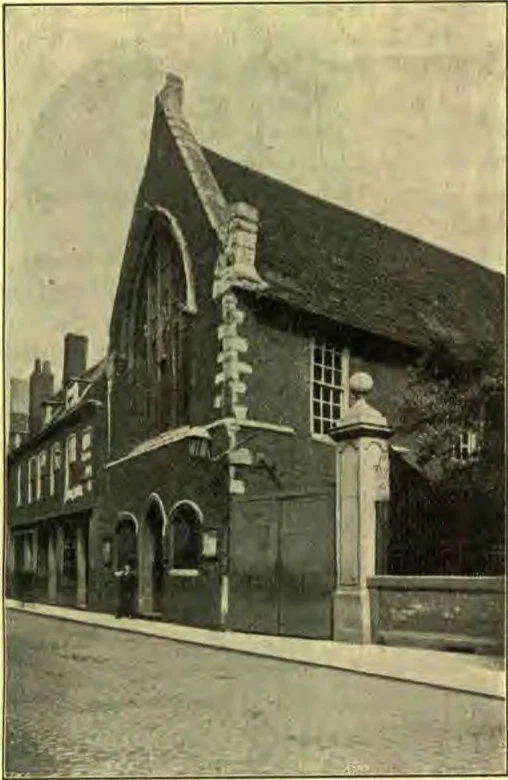
THE TOWN HALL
THE TOWN HALL
I HAVE just returned from Boston,—not the city by that name in Massachusetts, but the Boston which is situated on the east coast of England, the town from which the more modern Boston took its name. While there, I held meetings in an old hall, which in the seventeenth century was known as the Guild Hall of St. Mary. In the basement of this ancient structure, the old prison, with its iron-grated cells, remains practically as it was when John Cotton and his fellow “Pilgrim Fathers” were there imprisoned, and kept on bread and water, while in an adjoining room the prison keepers, with their friends, were regaling themselves with savory joints of meat which were there roasted before the great open fireplaces.
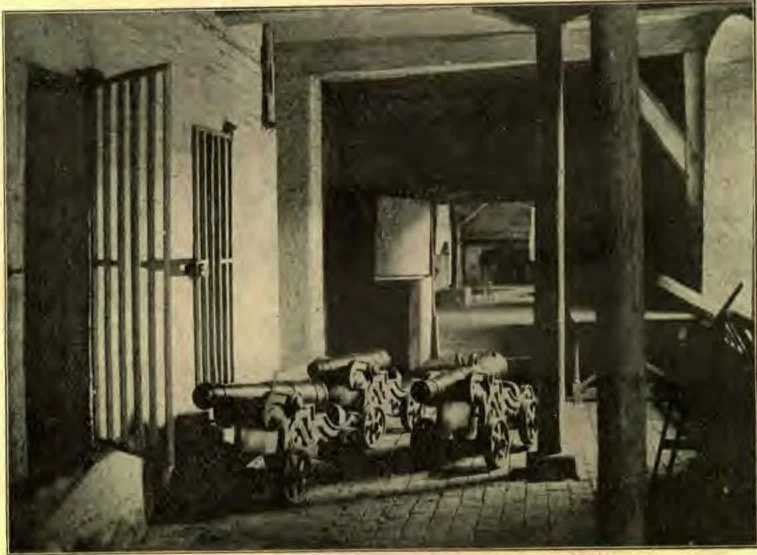
The room here shown, in which are the three cannon, is the old prison. At the left are seen the two cells, one with the grated door closed, the other having its door open. Mrs. Corliss and I were locked into the open one for a short time, just to understand how it would seem to be in such a place. These cells are about five by eight feet in size. The open door at the back, behind the cannon, gives a glimpse of the old kitchens, where the feasting was carried on during the imprisonment of heretics. In this room are the same flagstone floor, oak tables, and large open fireplaces used in those old days. One of the fireplaces still has over it the spit used for roasting meat, with the chain by which it was operated.
From the prison room, just back of the cells, there yet remain the narrow stone steps up which prisoners were led, through a trap-door, to the room above, for the purpose of standing trial before the town magistrate.
The hall where my meetings were held is in the front of the second story, being lighted at that end by the quaint old window seen in the engraving. The hall is entered by passing through the front door from the street, and traversing the flag pavement half way to the rear, to a flight of stairs. At the head of these a turn is made, and the distance is again traveled over to reach the hall.
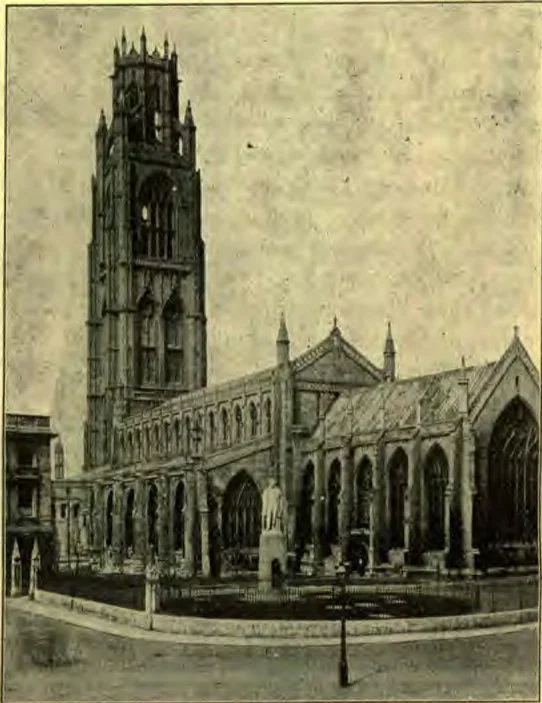
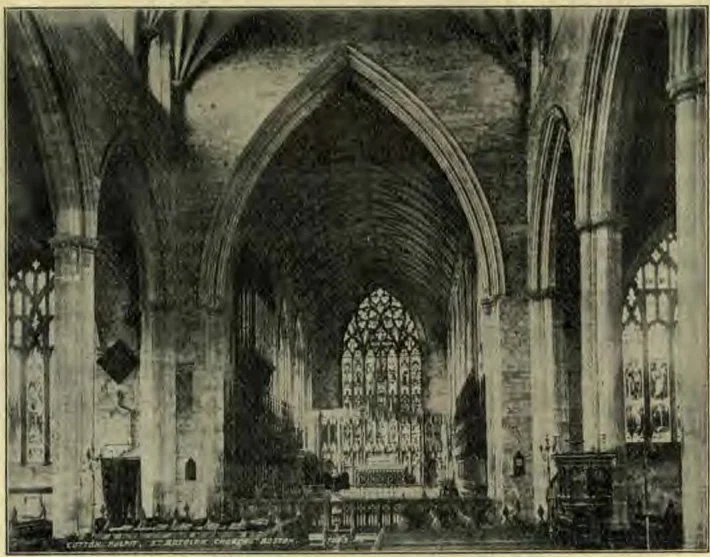
The first bishop of that town was St. Botolph, who is said to have appeared there as early as the seventh century, and built a monastery. From being known as St. Botolph’s town, the name was contracted to its present form,—Boston. The large church building which was afterward reared as the result of St. Botolph’s work, still stands as a monument to his earnest labors. It is now called the “Boston Stump,” from the fact that its spire was never finished, though the top of the base for it reaches three hundred feet in height. From an account preserved in the structure, I learned that the church was founded in 1309, and that the first stone was laid by one Dame Margery Tilney, in a bed of clay, nine feet below the bottom of the River Witham, on the bank of which it stands. The length of the building is over three hundred feet, the width one hundred feet. Its roof is arched with beams of Irish oak, adorned with embossed gold and curious figures. The pulpit now in use there, is the same from which John Cotton thundered forth the alleged heresy which resulted in his imprisonment in the guild hall, and his after retirement, in company with others from that place, and from Plymouth on the south coast of England, to America in the early part of the seventeenth century.
At one side of the town is the Hussey Tower (now in ruins), so named from a celebrated Quaker family that was associated with John Fox, whose residence was in Boston. The poet Whittier was also from that region; and Jean Ingelow’s residence is pointed out, with its garden running back to the river.
The town itself is quaint enough. Its narrow streets wind in and out like cow-paths in a New England pasture, and their names are as strange as their appearance. Here are a few, gathered at random: Liquorpond Street, Shodfriars Lane, Bargate, Threadneedle Street, Petticoat Lane, Wormgate, White Horse Lane, Pump Square, Pinfold Lane. The origin of such names is traced to events or scenes occurring within their precincts at an early day, when people were wholly absorbed in local affairs.
ST. BOTOLPH CHURCH
ST. BOTOLPH CHURCH
The town is one of deep interest to those who care to look over the place whence America’s “Pilgrim Fathers” began their stormy voyage across the western ocean, ostensibly to found a home free from persecution. It was with pleasure that I presented the message for our time in the very building where so many thrilling events occurred in the darker centuries of the past. J. O. CORLISS. London, England.

The Changa of Porto Rico

THE island of Porto Rico is not very different from other tropical countries; there are fleas, mosquitoes, large rats, centipedes, cockroaches, tarantulas, and many other insects and pests; but the greatest of all is the changa, or mole cricket. This little “pet monkey,” as the name “changa” implies, is a constant source of worry to the farmer of Porto Rico, and a destroyer of his crops. For many years it has been known to exist here, but not until about 1876, after the famous hurricane of that year, has it made such ravages as from 1892 to the present time.
In size this insect measures one inch and a quarter when full grown. Its home is in the ground, where it makes tunnels. It is of a light-brown color, mixed with a darker color of the same on the back, and a lighter shade underneath. I never saw anything that so nearly resembles a monkey as this little creature. One day while calling upon a friend, one of the young ladies caught a changa, and dressed it in a pink dress; had it not been for its size, I would have thought it was a monkey on exhibition.
Its antennae, or feelers, are made up of eighty joints, and are very sensitive. “It has two pairs of eyes and two pairs of jaws,” in one of which are found “six teeth and a blade each.” The upper part of its back, near the head, which is shaped very much like a shield, is used in burrowing in the ground. The whole make-up of this insect shows clearly that it was made to live in the earth instead of upon it. The most peculiar thing about it is that “it hears through its elbows.” It has been discovered that this insect’s legs are composed of “four picks and ten shovels;” is it any wonder that the planters dread to see it on their plantations?
In order to prevent the changa from getting wet, its body is covered with a yellowish down; this also saves it from drowning when the heavy rains come, and wash it out of its home. Its body is soft, clear, and so transparent that you can readily see its breathing-tubes, which are twelve in number, and are placed in two longitudinal rows.
The female changa lays her eggs during the months of January, February, and March. They are oval in shape, smooth, and of a dirty-yellowish color. It is claimed that one female will lay from fifty to one hundred eggs, after which she dies. The baby changa, or larva, is almost white, and is very spry, jumping twenty-five times its length. It does not reach maturity for at least a year, and it is supposed to live only six months after that. Its food consists principally of living plants, which it literally destroys. But do not think from this that the little fellow is a vegetarian; no, indeed, far from it! Often he makes a good fat meal on his dead companions. He does not wait for his food supply to become scarce; but when it begins to get low, he carries the plants into the galleries which he has made under the earth.
During the hurricane of 1876 all the blackbirds on the island were destroyed. These birds had kept the changa down; now it has become a nuisance to the island, and unless some means can be found whereby it can be exterminated, it bids fair to destroy most of the vegetables of Porto Rico. MRS. IDA M. FISCHER.

The Reporting Time

“KADESH! Kadesh!” rang through the ranks of Israel as orders for encampment echoed through the various tribes. They were near the promised land; already the dim outlines of its distant peaks were discernible, tinted with the delicate hues of an oriental sky. Their impulsive cry was in anticipation of immediate rest.
COTTON PULPIT IN CHURCH OF ST. BOTOLPH
God, however, had wiser plans. Israel was wholly unacquainted with the promised land in a practical way. So before an entrance into Canaan could be effected, there must be those prepared by direct contact with the land to represent in every respect the country into which they were to enter. These must be men of integrity and faithfulness, who could teach God’s requirements to every member of the camp. Should such, after viewing the land, be enthusiastic in favor of entering it, and give evidence that they had acquainted themselves with every feature of the country, what better evidence could be given that the land was a desirable one?
Accordingly, twelve men were chosen, who searched the land from north to south, from east to west. Upon their return to camp, however, they presented a division of sentiment. Ten of the spies had seen the beauties of the land without discerning God’s purpose in their mission, and so they advised Israel not to attempt to occupy the territory.
Caleb and Joshua, on the other hand, by their glowing description of the beauty and fertility of the land visited, and by the fervor of their pleas, pressed for immediate occupation. But the faithlessness of the ten only developed fully the same spirit in Israel, and so the promises of Jehovah were rejected. Of course such people could not be counted by God as fit subjects for the promised home, and so they were doomed never to enter that land of rest. Num. 14:23.
To Caleb and Joshua, however, the only faithful ones of that vast camp, was promised, because of their loyalty, the great privilege of seeing a people prepared through their ministrations and teachings for the inheritance. This involved constant and careful training of those under them through long, weary years. But the message was always the same spirited exhortation, “Let us go up at once, and possess it; for we are well able to overcome it.” The sequel of the history presents a generation planted in the “goodly land,” at rest from war, presided over by the ever-faithful Joshua, with Caleb enjoying the quiet and repose of the ancient city of Hebron.
To-day is the time of reports. Every one who has the kingdom of God implanted within his heart must become a Joshua or a Caleb. And as of old, his work is definitely that of reporting that which he has seen. In fact, this becomes a condition on which we are made “spies” for God. A people are to be prepared to inhabit the eternal home about to be offered them; and only those who have tasted the joys of redemption can fitly tell of the glories of God’s goodness to man. Though, viewed from a human point of view, the work seems a thankless one, we have seen how the Lord accomplished this very same work of preparation through the mediumship of Caleb and Joshua.
This work was begun at Kadesh among the young of that generation, and continued until they were led into Canaan. To-day the young people among us have as great a responsibility. The goodness of the Lord has passed before us, and this righteousness can be proclaimed only by those who have experienced its power. Then, as we become Joshuas here on earth in performing this work, so shall we in the new-earth state, as did Joshua in old Canaan, be vested with regal dignity; for He has “made us unto our God kings and priests.” T. C. O’DONNELL.

What Jeannette Missed

“No, I didn’t take Jeannette with me when I went to England last summer,” said Jeannette’s aunt, Miss Graham, talking to a friend.
“Such was my intention until after her visit to me in Washington during the winter. I found her one of those unpleasant persons who think it looks countrified to show surprise or pleasure at new things. When I took her to the Corcoran Art Gallery, she merely said that the collection was finer in the Metropolitan Museum. The Library of Congress had too much gilt in the mural decorations, and the Capitol was not so imposing in its appearance as it ought to be, according to her ideas.
“At the churches the music was not so fine as that she had heard in a small inland city church near her village home, which some minister who had traveled much said was the finest he had ever listened to, either in Europe or ‘America. She thought Washington so different from New York. It certainly is; but there is no comparison between the two cities, as I tried to point out to her one day.
“In addition to her criticisms, I was obliged to listen to her gossip of the small village where she lived, until I was tired. Her family, her friends, her neighbors, and herself were assumed to be of as much importance to the world at large as they were to Jeannette. She would wait with impatience for me to finish some remark, and answer with something concerning her own affairs. Before she went home, I said to her, frankly:—
“My child, you’re in a fair way to become a very disagreeable woman. Don’t you know it is only polite, when people take the trouble to show you about a new or strange place, to try to see only what is attractive? I advise you to cultivate the quality of being appreciative. And you should try to interest yourself in general matters when you are with strangers, at least. While, by virtue of our kinship, I am interested in all that concerns you, I grow weary of hearing you harp continually on one string—yourself, and your own affairs. You ought to learn to talk about books and current events; to listen more to the conversation of your elders.’
“Jeannette cried, and went home feeling hurt and resentful, not dreaming what she had missed when I went to England without her. I’m sorry for her. If she doesn’t reform, she is bound to become a soured, disappointed woman, and that bad habit of criticism and comparison will spoil her enjoyment of any pleasures that come her way. Don’t you agree with me?”—Congregationalist.

Life’s Inspiration

I MUST be good. How dare I, sinning, Set all my spirit’s peace ajar? What joy of heaven were worth the winning If I must brand a crimson bar Between my soul and purity? I must be good, or, shuddering, see The sweet world in its ecstasy Of light go by me, while, afar, I stand a blot upon the beauty. For every bird sings in the wood— Each flower in the bloom of duty. “I must be good! I must be good!”
How can I lift my eyes at even To meet the chastened twilight star, If I have broken faith with heaven, If act or word or thought have given My life a wound, my soul a scar? I must be good. He walks beside me Whose holy, tender eyes look in To see my secret wish—to guide me Out from the shadow of a sin. And gazing on Thy face, and seeing How dear thou art, my God, my being Rises and calls in yearning mood, “I must be good! I must be good!”
O sin! nor earth nor heaven own thee, The universe was never thine! Why have I ever loved or known thee, What hast thou wrought for me and mine? Faint, guilty, yet not quite despairing, I plead the blood of Christ anew, I listen to the great winds bearing The song of what my Lord can do. And reaching up, in heart contrition, I know that I am understood; My Saviour’s smile hath taught my mission, He loves me, and I must be good.
— Selected.

The Happiest of Men: Taking Joy in Others' Merits

Who is the happiest of men? — He who values the merits of others, and in their pleasure takes joy, even as if it were his own.—J. S. Blackie.

The Catacombs of Rome

Among the most fascinating of the many historic places in Rome and its suburbs are the Catacombs; and as these are referred to in the “parallel reading” of the young people’s lesson for this week, I will try to tell you of our visit to these wonderful subterranean cities of the dead.
There are several of these underground cemeteries in the environs of Rome and Naples, Italy, and in Alexandria, Egypt; but I will confine my description to the catacombs of St. Calixtus, the largest and most celebrated of all the Christian cemeteries, as these were the only ones we had the pleasure of visiting. They are situated in the suburbs of Rome, about four miles from the heart of the city.

An Early Drive

As there are no street-cars running to that locality, it was necessary to drive; and what a delightful drive it was! Imagine it if you can. It was early Sunday morning—one of those perfect days which have given Italy a world-wide fame, and together with its historic attractions have made Rome one of the world’s most famous resorts. The busy streets had scarcely begun to stir with life. The refreshing coolness; the deep, blue, cloudless sky; the grand old relics, and beside them the modern shops and dwellings, hotels and castles, where the merchant drives his bargains (as only an Italian merchant can), and the rich pursue their pleasures within the very shadows of a dim, gray past—ah, it can not be told fittingly! Some day you may be privileged to see the Italian skies, and feel the strange, wierd, yet delightful, influence of the Eternal City. Some day you may be called to carry the gospel to “them who are at Rome also.” I have no better wish for you.

Along the Way

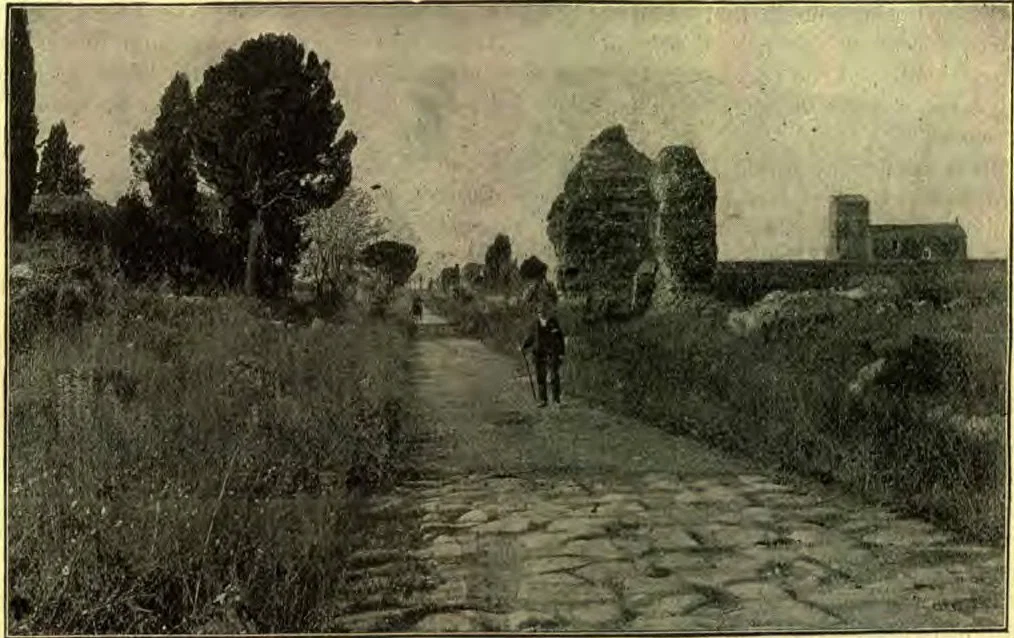
But let us be off to the catacombs. After a few minutes’ drive we pass on our left the ruins of the Golden House of Nero, and the Coliseum, and on the right the Roman Forum, the Arch of Titus, and the towering remains of the palaces of the Cæsars. Passing beneath the Arch of Constantine, the best preserved of all the relics of Rome, we leave the crowded city streets, and soon find ourselves actually driving along the Appian Way (Via Appia), that most famous of all the roads of Italy. It was begun by Appius Claudius in 312 B. C., and was the great military highway to Brindisi. It was over this road that Paul journeyed when he visited Rome; and he tells us (Acts 28:15) how he “thanked God, and took courage” when his friends met him at “the Three Taverns.”
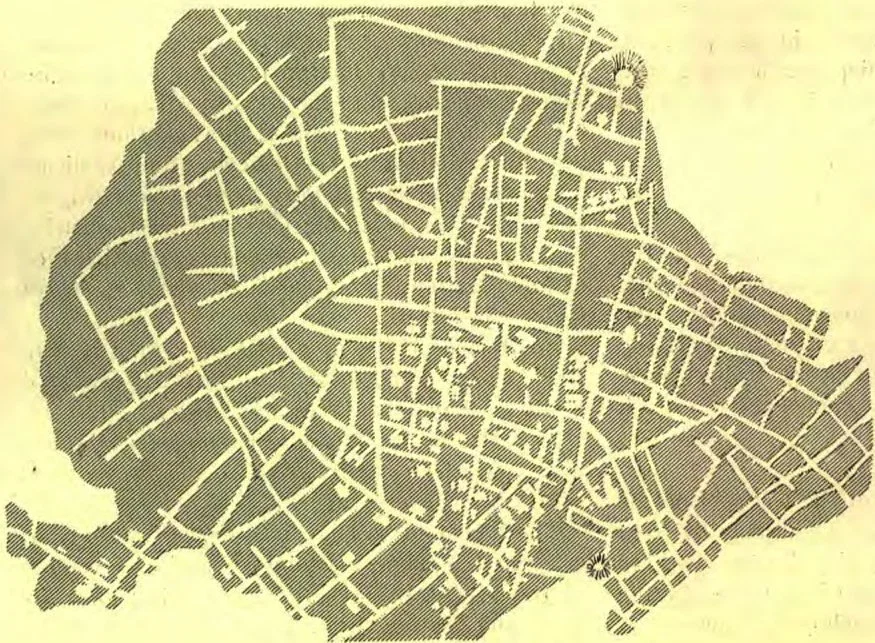
DIAGRAM OF THE CATACOMBS

The Monks for Guides

At the entrance to the catacombs we were directed to a little office where we were met by two monks, who sell admission tickets, candles, and curios, and act as guides. They belong to a peculiar order of monks, as indicated by their deep wine-colored gowns and hoods. Their general appearance is strikingly wierd and solemn, their movements are slow and mechanical, and their voices have a high, hollow, ringing pitch, as if acquired from the sepulchral surroundings.
VIEW ON THE APPIAN WAY
We paid the entrance fee of half a franc (ten cents), were each provided with a little candle, or taper, about the size and length of a common lead-pencil, and were directed to follow the guide.

The City of the Dead

The entrance to the catacombs is not unlike a large western cyclone pit. Descending a flight of about fifty stone steps, we entered the first street of this wonderful silent city of the ancient Christian dead.
This description can not be more fittingly introduced than by St. Jerome’s account of his visits to them in his youth.
“When I was a boy,” he writes, “receiving my education in Rome, I and my schoolfellows used, on Sundays, to make the circuit of the sepulchers of the apostles and martyrs. Many a time did we go down into the catacombs. These are excavated deep in the earth, and contain on either hand as you enter, the bodies of the dead buried in the walls. It is so dark there that the language of the prophet (Ps. 16:15) seems to be fulfilled. ‘Let them go down quick into hell.’ Only occasionally is light let in to mitigate the horror of the gloom, and then not so much through a window as through a hole. You take each step with caution, surrounded by deep night.”

Streets and Tombs

The accompanying diagram represents very accurately the intricate network of galleries or streets. Think of this as the map of a city, as indeed it is, each white line representing a street. This city lies from fifty to one hundred feet below the surface of the ground, and is lighted in places, though very dimly, by shafts extending to the surface. The streets are from three to five feet wide, and from ten to forty feet high. These are not the passages leading to the cemeteries; they are themselves the cemeteries, the dead being buried in horizontal recesses in the vertical walls of the passages, rising tier above tier like the berths in a ship, from a few inches above the floor to the ceiling, to the number of five or six, or even sometimes twelve, ranges. Each recess, or tomb, is about seven feet long, from one foot to eighteen inches high, and from three to four feet wide. After the body was deposited in this recess, the opening was closed with the greatest care with a marble slab running the whole length of the aperture, or with huge tiles, cemented together with great exactness, so as to prevent any escape of the products of decomposition. If any name or epitaph was given, it was always painted or engraved on this slab.
At frequent intervals there are doors entering into private burial places. These are seldom more than twelve feet square, and have burial places in the walls like those described in the passages. In some parts the doors to private tombs follow each other in orderly succession, like the doors to the chambers along the halls of a hotel.
Occasionally there is a large room or a connected suite of rooms, used evidently for worship during the dark periods when persecution raged most violently. Baptistries, supplied by spring water, and deep enough for immersion, are still in existence. Other evidences, such as fragments of altars, platforms, etc., bear conclusive witness to the well-known fact that these subterranean tombs were at times used as secret gathering places for worship.

Hiding-Places

The catacombs are admirably adapted for hiding-places. The intricate network of passages extends for many miles in such a maze that any one not familiar with the clue would be inevitably lost. The most conservative authority states that there are no fewer than three hundred and fifty miles of passageways; and as these wind in and out and up and down on different levels, and are studded all along the way with private passages and chambers, the pursued would be easily passed unperceived by the pursuers. As a rule, also, the catacombs have more than one entrance, so that while one entrance might be carefully guarded, escape would be easy by some secret entrance far away.

History

The earliest Christian catacombs may be assigned to the second century, and the largest number to the third and fourth centuries; and it is believed that their use as cemeteries entirely ceased with the sack of Rome by Alaric, 410 A. D. Near the close of the eighth century, and at the beginning of the ninth century, the popes removed many of the relics and remains from the catacombs, until they were nearly despoiled of their dead. The relics having been removed, the visits of pilgrims naturally ceased, and by degrees their very existence was forgotten, until in the sixteenth century (May 31, 1578) they were accidentally discovered by laborers who were digging for sand, thus revealing to the amazed inhabitants of Rome “the existence of other cities concealed beneath their own suburbs.” Bosio, who in the beginning of the seventeenth century devoted his life to the personal investigation of the catacombs, has been aptly designated “the Columbus of this subterranean world.”
It has often been conjectured that the catacombs were formed by the quarrying of materials for the building of Rome; but this supposition must be quite erroneous from the following facts: The formation of the earth in the greater part of the vicinity of Rome is in three principal strata, known as the “stony,” “granular,” and “sandy.” The first is quarried as building stone, and the “sandy” is used in making mortar. But the “granular” is a soft, volcanic formation, mixed with sand and clay, and wholly unfit for any use in building. The catacombs are invariably constructed in this “granular” strata. And the reason is evident; for while it is soft enough to be worked without great difficulty, it is hard enough to form good vertical walls with little danger of crumbling seriously or falling in.

Original Use

Undoubtedly these catacombs were formed as a part of the public works of the city of Rome, or at least with the consent and assistance of the city, as a provision for the burial of their Christian dead; and their later and secondary use, as hiding-places, and for secret worship, followed as the result of persecution.
We can not know definitely the history of these wonderful tombs, though little by little they are giving up to the world their long-hidden secrets; but when the Life-giver shall come, and call for his own, thousands from these mighty caverns will respond, and will come forth bringing with them long-hidden experiences, which, may God grant, each reader of this paper will be privileged to hear. E. R. PALMER.

The Weekly Study

Persecution and Its Results

(August 22-28)

SCRIPTURE STUDY:—

A time of trouble. Matt. 24:9, 21, 22; Heb. 11:36-38.
In the Master's footsteps. John 15:20; 2 Tim. 3:12.
The dangers of peace and prosperity. Ps. 119:67, 71, 75.
The blessing and salvation. Matt. 5:10-12; Rev. 7:14.

PARALLEL READING:—

“Great Controversy,” Chapter Two.
The article in this number of the INSTRUCTOR entitled “The Catacombs of Rome.”
Persecution is an attack by Satan in the person of his followers, upon Christ in the person of his followers. The controversy is between Christ and Satan.
Persecution is not war in its commonly accepted sense. It is a struggle between sin and righteousness—an effort of sin to overcome the good. Force arrays itself against love, and its apparent victory is its defeat; while love triumphs in defeat, and obtains life through death.
The church has enjoyed her greatest triumphs in times of persecution and trouble. In times of quiet and prosperity she has become corrupt and weak. Light shines the brightest in the dark. Tender trees and plants grow in quiet, sheltered retreats, away from the storm and tempest. The mighty oak thrives best upon the hillside, exposed to wind and storm, where every blast gives it strength and root.
“All that will live godly in Christ Jesus shall suffer persecution.” Rest and peace from the persecuting fires come only with the decline of the church. “It is only because of the spirit of compromise with sin, because the great truths of the word of God are so indifferently regarded, because there is so little vital godliness in the church, that Christianity is apparently so popular with the world. Let there be a revival of the faith and power of the early church, and the spirit of persecution will be renewed, and the fires of persecution will be rekindled.”
The study of this lesson will suggest to thousands of our young people the important personal question, “How shall I stand in the time of persecution?” When Daniel was brought face to face with the trying ordeal, and forced to stand alone with his God before the wrath of the king of Babylon, the record says of him that he did “as aforetime.” Dan. 6:10.
Yes, this is our time of preparation. In the time of peace we develop that sterling material, that moral fiber, which enables us to pass the great ordeal; and those who are true to-day, those who can stand for God in every trying place, are the ones who will pass triumphantly through the last great conflict.
But the greatest harvest of the lost will not be gathered by the whirlwind. Thousands of trees and vines are destroyed by tiny insects working at their roots, where only one is uprooted by the cyclone. There are many who could pass successfully through a great persecution and struggle, calling for heroic bravery and faithfulness, who are entirely unable to endure petty torments and small vexations in daily life. “Take us the foxes, the little foxes, that spoil the vines: for our vines have tender grapes.” Cant. 2:15. “Therefore we ought to give the more earnest heed to the things which we have heard, lest at any time we should let them slip.” Heb. 2:1; or, as the margin reads, “run out as water from a leaking vessel.” The leak may be almost imperceptible; but the failing of the waters is sure.
We lose our hold upon God little by little, until some sad day, when the testing trial comes, we find ourselves unfitted for the test.
May the Lord help us to be faithful to-day, while opportunity is given to choose “gold, silver, and precious stones” for our character building.

MARK WELL THE LESSONS:—

Peace, if purchased at the cost of principle, is too expensive.
Prosperity can not be judged correctly from outward appearances.
Great adversity in temporal things may attend the glorious triumphs of the cross.
Ease invites sin and makes weaklings; sturdy work, hardship, and self-denial give strength and life.
The danger of choosing easy places with good pay, and refusing the trial and self-sacrifice which are found in the footsteps of the Master.
Continue reading: Indiana Young People's Work