Your ShelfYour Projects

Review and Herald, Vol. 80, No. 34.

Publishers’ Page
Earlier text: Publishers’ Page

“Follow Me, and I Will Make You Fishers of Men”

MRS. E. G. WHITE
“And it came to pass, that, as the people pressed upon him to hear the word of God, he stood by the lake of Gennesaret, and saw two ships standing by the lake; but the fishermen were gone out of them, and were washing their nets. And he entered into one of the ships, which was Simon's, and prayed him that he would thrust out a little from the land. And he sat down, and taught the people out of the ship.
“Now when he had left speaking, he said unto Simon, launch out into the deep, and let down your nets for a draught. And Simon answering said unto him, Master, we have toiled all the night, and have taken nothing: nevertheless at thy word I will let down the net. And when they had this done, they inclosed a great multitude of fishes: and their net brake. And they beckoned unto their partners, which were in the other ship, that they should come and help them. And they came, and filled both the ships, so that they began to sink. When Simon saw it, he fell down at Jesus' knees, saying, Depart from me; for I am a sinful man, O Lord.”
Prostrating himself, and clinging to the Saviour's knees, Peter begged Jesus to depart from him. He acknowledged that he was a sinful man. With great force there came to his mind the conviction that he was in the presence of the long-looked-for Messiah; and although he said to Christ, “Depart from me,” he did not really desire him to go away; he still clung to the Saviour's knees, as if he could not be parted from him. “And Jesus said unto Simon, Fear not; from henceforth thou shalt catch men.”
When they had brought their ships to land, Peter and his companions forsook all, and followed Jesus. Thus were these humble fishermen called by the God of heaven to their life-work.

THE SECRET OF SUCCESSFUL MINISTRY

Every one who in living faith follows Jesus, with an eye single to his glory, will see of the salvation of God just as surely as these discouraged fishermen saw their boats filled by the miraculous draught. It was because Christ was in the ship that they were successful in their efforts to catch fish. The indwelling presence of the Saviour is equally necessary in the work of winning souls.
In order to save the fallen race, Christ, the Majesty of heaven, the King of glory, laid aside his royal robe and kingly crown, clothed his divinity with humanity, and came to this earth as our Redeemer. Here he lived as a man among men, meeting the temptations that we must meet, and overcoming through strength from above. By his sinless life he demonstrated that through the power of God it is possible for man to withstand Satan's temptations.
We may endeavor to resist temptation in our own strength, doing our best to overcome; but we shall meet with disappointment after disappointment. And thus it is in our efforts to win men and women to the Saviour. Dependence on our own wisdom will result in repeated failure, causing us much anxiety and sorrow. This was the condition of mind in which Christ found the fishermen on the shore of the sea of Galilee, after their night of unrewarded labor.
Long had the fishermen toiled that night; often had they been disappointed, as time and again the net was drawn up empty. But now, at the bidding of the divine One, they launched out into the deep, and once more cast their net into the sea. And what an abundance of fish they gathered! The sight of the miraculous draught swept away their unbelief, and they were ready to respond to Christ's invitation to follow him, and learn to be fishers of men.
The breaking net, the sinking ship, the surprise and gratitude of Peter and his companions, their willingness to follow the Saviour and to do his bidding—all these are object lessons for us in the work of soul saving. However long and faithfully we may toil in our human strength, we can hope for no results for good; but as soon as we welcome Christ into the heart, he works with and through us, for the salvation of souls.
God has promised to co-operate with those who choose to labor in harmony with his purpose. We are to do our utmost to act our part faithfully, in order that he may demonstrate to the world what he can do through us. By baptism, we declared that, being dead to the world, we would henceforth remember that our life is “hid with Christ in God,” and that we have taken our position on the exalted platform of truth, there to work in unison with the hand that never fails.
“We are laborers together with God.” It is God that gives success to human endeavor. Without his presence with us, our efforts would amount to nothing. We are simply channels through which his blessings flow to our fellow beings. From every one in whose heart Christ is an abiding presence, will go forth a power that will influence others to accept the Saviour as their Redeemer.

THE TRAINING OF MISSIONARIES

Parents, train your children to become workers with you in the church. Educate them to take delight in the thought of being workers together with God. Impress upon their minds the fact that as they grow older, their opportunities for service will enlarge, and their power and ability will proportionately increase. Let them understand that those who give themselves to God will become channels of blessing to others who know him not. Teach them how to have power to prevail with God. If this were done faithfully by every parent, we should see consecrated workers everywhere.
I hope that many of those who are receiving an education in our schools, will go forth as missionaries accepted of God. I have faith to believe that he will work upon the hearts of teachers and students, and that they will be clothed with the robe of Christ's righteousness.

OPPORTUNITIES FOR SERVICE

To us is given the commission, “Go out into the highways and hedges, and compel them to come in, that my house may be filled.” Are we preparing ourselves to engage in evangelistic house-to-house work?
When school closes, there will be opportunity for many to go out into the field as evangelistic canvassers. The faithful colporteur finds his way into many homes, where he leaves precious reading-matter containing the truth for this time.

THE DISTRIBUTION OF LITERATURE

We should treat as a sacred treasure every line of printed matter containing present truth. Even the fragments of a pamphlet or of a periodical should be regarded as of value. Who can estimate the influence that a torn page containing the truths of the third angel's message may have upon the heart of some seeker after truth? Let us remember that somebody would be glad to read all the books and papers we can spare. Every page is a ray of light from heaven, to shine into the highways and the hedges, shedding light upon the pathway of truth.
In the miracle of feeding the multitude with a few loaves and fishes, the food was increased as it passed from Christ to those who accepted it. Thus it will be in the distribution of our publications. God's truth, as it is passed out, will multiply greatly. And as the disciples by Christ's direction gathered up the fragments which remained, that nothing should be lost, so we should treasure every fragment of literature containing the truth for this time.

THE MINISTRY OF SONG

I am glad that a musical element has been brought into the Healdsburg school. In every school, instruction in singing is greatly needed. There should be much more interest in voice culture than is now generally manifested. Students who have learned to sing sweet gospel songs with melody and distinctness, can do much good as singing evangelists. They will find many opportunities to use the talent that God has given them, carrying melody and sunshine into many lonely places darkened by sin and sorrow and affliction, singing to those who seldom have church privileges.
Students, go out into the highways and the hedges. Endeavor to reach the higher as well as the lower classes. Enter the homes of the rich and the poor, and as you have opportunity, ask, “Would you be pleased to have us sing? We should be glad to hold a song service with you.” Then as hearts are softened, the way may open for you to offer a few words of prayer for the blessing of God. Not many will refuse.
Such ministry is genuine missionary work. God desires every one of us to be converted, and to learn to engage in missionary effort in earnest. He will bless us in this service for others, and we shall see of his salvation.

OUR HIGH CALLING

Students, educate yourselves to speak in the language of Canaan, the language spoken in the heavenly school by the members of the royal family. Sternly determine to put away all foolish talking and jesting, all selfish amusements. By faith grasp God's promises, and determine that you will be Christians here below, while preparing for translation.
If you strip yourselves of every hindrance to progress in the Christian life, your minds will be worked by the Holy Spirit, and you will become indeed “fishers of men.” The salvation of God will go forth from you as a lamp that burneth. If your own hearts are filled with light from above, you have the privilege, wherever you may be, of shedding light upon those who are in darkness. Continuing steadfast in God's service unto the end, you will be granted an abundant entrance through the pearly gates into the heavenly city, where you will be greeted with the words, “Well done, thou good and faithful servant: . . . enter thou into the joy of thy Lord.”

Drafts on the Bank of Heaven

PSALMS 34:15: “The eyes of the Lord are upon the righteous, and his ears are open unto their cry.”
Psalms 145:18, 19: “The Lord is nigh unto all them that call upon him, to all that call upon him in truth. He will fulfill the desire of them that fear him: he also will hear their cry, and will save them.”
Prov. 15:29: “The Lord is far from the wicked: but he heareth the prayer of the righteous.”
Jer. 29:12: “Then shall ye call upon me, and ye shall go and pray unto me, and I will hearken unto you.”
Matt. 21:22: “And all things, whatsoever ye shall ask in prayer, believing, ye shall receive.”
Matt. 7:7: “Ask, and it shall be given you; seek, and ye shall find; knock, and it shall be opened unto you.”
Mark 11:24: “Therefore I say unto you, What things soever ye desire, when ye pray, believe that ye receive them, and ye shall have them.”
Luke 11:9, 10: “And I say unto you, Ask, and it shall be given you; seek, and ye shall find; knock, and it shall be opened unto you. For every one that asketh receiveth; and he that seeketh findeth; and to him that knocketh it shall be opened.”
Luke 18:1: “And he spake a parable unto them to this end, that men ought always to pray, and not to faint.”
John 14:13: “And whatsoever ye shall ask in my name, that will I do, that the Father may be glorified in the Son.”
John 15:7: “If ye abide in me, and my words abide in you, ye shall ask what ye will, and it shall be done unto you.”
John 15:16: “Ye have not chosen me, but, I have chosen you, and ordained you, that ye should go and bring forth fruit, and that your fruit should remain: that whatsoever ye shall ask of the Father in my name, he may give it you.”
John 16:23, 24: “And in that day ye shall ask me nothing. Verily, verily, I say unto you, Whatsoever ye shall ask the Father in my name, he will give it you. Hitherto have ye asked nothing in my name: ask, and ye shall receive, that your joy may be full.”
James 1:5, 6: “If any of you lack wisdom, let him ask of God, that giveth to all men liberally, and upbraideth not; and it shall be given him. But let him ask in faith, nothing wavering. For he that wavereth is like a wave of the sea driven with the wind and tossed.”
1 John 3:22: “And whatsoever we ask, we receive of him, because we keep his commandments, and do those things that are pleasing in his sight.”
1 John 5:14: “And this is the confidence that we have in him, that, if we ask anything according to his will, he heareth us.”
—Selected.

Some Other Day

THERE are wonderful things we are going to do, Some other day; And harbors we hope to drift into, Some other day.
With folded hands and oars that trail, We watch and wait for a favoring gale To fill the folds of an idle sail, Some other day.
We know we must toil if we ever win, Some other day; But we say to ourselves, there's time to begin Some other day.
And, so deferring, we loiter on, Until at last we find withdrawn The strength of the hope we leaned upon, Some other day.
—N. Y. Tribune.

Take Up Thy Cross Daily

“CHARGE not thyself with the weight of a year, Child of the Master, faithful and dear— Choose not the cross for the coming week; For that is more than he bids thee seek.
“Bend not thine arms for to-morrow’s load; Thou mayst leave that to thy gracious God. Daily, only, he saith to thee, ‘Take up thy cross and follow me.’”

Principles

IT is not strength of brain that saves a man, or orthodoxy of creed, or connection with a church. All these have often proved to be but ropes of sand. They are not proof against the tides of temptation. There must be firm, heaven-implanted principle; for no one is safe in business, or in politics, or in social life, or anywhere, when conscience is unloosened from God. The parting of the cable may be unseen for a while, it may even be unsuspected; but it is a mere question of time how soon the backslider may strike the rocks. Jesus Christ never insures any one who unites with his church, and yet has no “anchor,” sure and steadfast, which entereth within the veil, and “binds fast to Christ himself.” And if you ever reach heaven, my brother, you will come in, as I have often seen vessels come into yonder harbor of New York, with the storm-tide anchor swinging proudly at the prow. “There are ships,” said the eloquent Melville, “that never go down in life's tempests. They shall be in no peril when the last hurricane shall sweep earth and sea and sky; and when the fury is overpast, and the light that knows no night breaks gloriously forth, they shall be found on tranquil and crystal waters, resting beautifully upon their shadows.” These are they who have been piloted by the Holy Spirit; these are faithful ones whose inner soul was anchored to Jesus Christ:—Theodore L. Cuyler, D. D.

Life Is Brief

“'Tis not for us to trifle. Life is brief, And sin is here. Our age is but the falling of a leaf, A dropping tear. We have no time to sport away the hours, All should be earnest in a world like ours.”

Central Cuba

W. A. SPICER
FORMERLY the eastern and western provinces of Cuba were far apart, so far as communication was concerned. New York was really nearer Havana than Santiago was. The new railway system now runs the entire length of the island, and three passenger trains each week ply between Santiago and the capital. It is a three days’ journey, however; for the trains run only by day, stopping over each night in the capitals of the two central provinces, the passengers finding hotels.
The Santiago division was only just completed at the time of my visit. The roadbed was so rough that passengers very quickly lost all regrets that we were not to make progress by night travel. The railway is of American construction, not greatly differing in style from our own systems. The fare, second class, for the entire journey, is twelve dollars, just half the first-class fare. The tourists in the first have upholstered seats; but in the second, one not only saves money, but sees the people of the soil as they crowd on and off at the way stations.
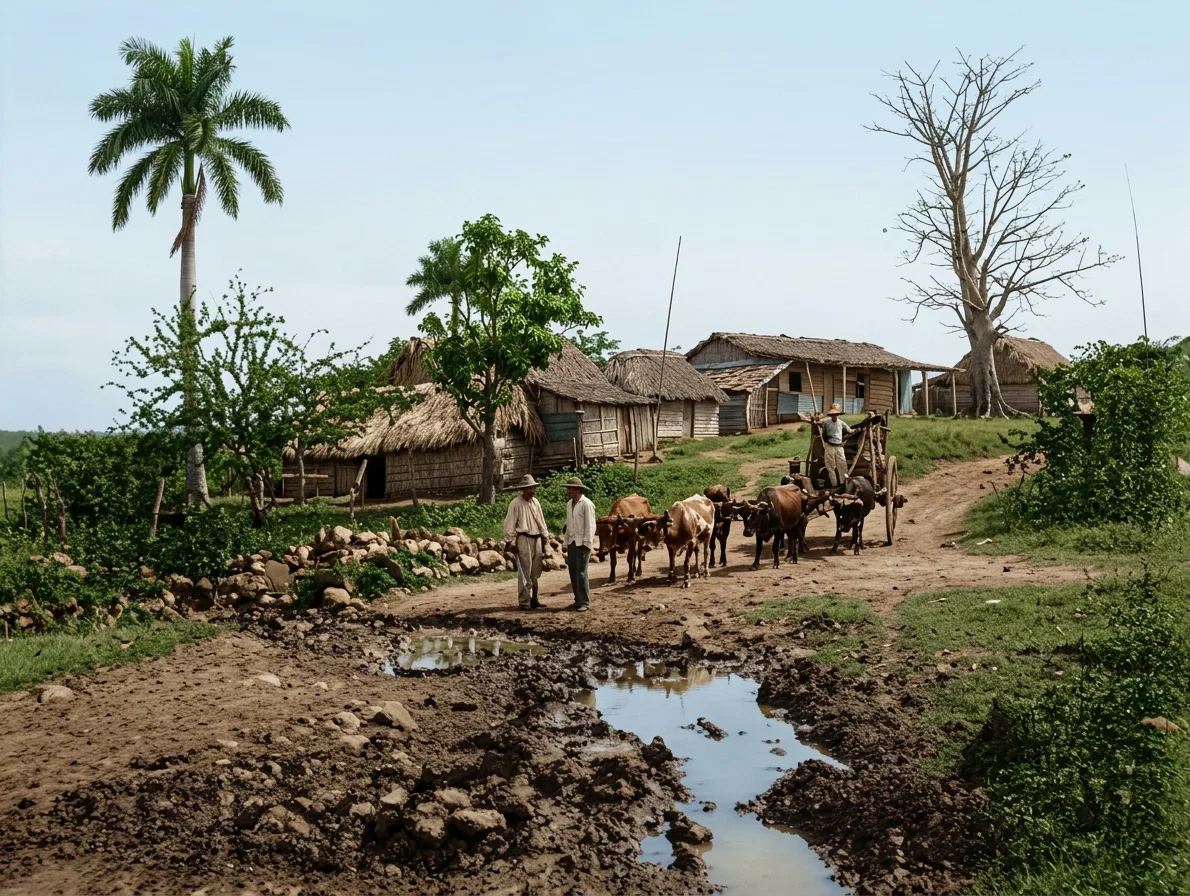
CUBAN LANDSCAPE
CUBAN LANDSCAPE
The loose blouse and battered felt hat predominate in the male costume. The long machete hangs at the belt of many of the men. This sword-like knife is not to be misinterpreted in time of peace. It is the farmer’s pocket knife in all the West Indies, his handiest tool in corn or cane fields, or in the jungle. Much of the country is new along the line between Santiago and Puerto Principe. But peasant cottages are springing up in the clearings, and women and children gather to see the train go by. The houses might be called huts if one did not know that they are often neat inside. The roof is generally thatched with palm, while the sides are patched into protecting walls by the help of boards and sheets of tin, or most often, perhaps, the dried slabs of palm fiber, stripped off the royal palm, which rears its head over all the Cuban plains.
The farmers may get three crops of corn a year in this district, I was told. There are no frosts, and gardens bring forth the year round. It is better, however, even here not to crowd the seasons. We passed through many a mile of some of the finest grazing land in the world. The guinea grass, on which the cattle fatten, grows tall and tender. The stock of Cuban cattle was almost annihilated during the war, and even now the pastures are poorly supplied.
Our first night out was spent in the city of Puerto Principe, capital of the province. I found an aged New York man keeping a simple hotel for work-a-day Americans, of whom there were many in this province. My friend said that many Americans were buying land in the district for stock raising and corn and fruit growing. Land could be had for from three to five dollars an acre. In clearing, the timber land yields a profit on the large trees, and the small growth is loosely rooted and is easily burned out. One of the finest reputed sections in all Cuba is that about Nuevitas, on the northern shore of this province; and I was told that a considerable American colony is growing up in the region. It was in the beautiful Nuevitas Bay that the real glories of the new world first burst upon Columbus, as his ships rode in after leaving the little island of San Salvador. Then he found over a million natives, gentle, mild-mannered, and so hospitable that he declared them the best race of people on earth. Ere many generations the last of the natives had perished, slaughtered under the auspices of the church that has smothered and stifled the souls of men in all the long Cuban history since that day. Now, ere the Lord comes, the full gospel of his kingdom must be carried through this fair island.
Puerto Principe is a town of twenty-five thousand inhabitants. These Cuban towns are much alike. The low dwellings, joined house to house, line the streets in solid wall of whitened plaster and cement, pierced by the wide doors and windows. Through these the people who do not walk the plaza and pavements in the evenings may watch those who do. There is little religious enterprise here. The Baptists have one small church. If the city people keep late hours, they are early awakened by the clanging bells of the several Catholic churches. I saw no signs of anybody going to early mass, however.
At eight in the morning our train moved on westward. We stopped for dinner at Ciego de Avila, a town on the famous “trocha,” or line of block houses, barbed wire, and military railway, stretched across Cuba from north to south by the Spanish forces, in the vain effort to confine the insurgents to the eastern provinces. While the passengers ate at the Chinese restaurant, I strolled along the hedgerows, and gathered over thirty varieties of flowers within a few yards of the station. Now, the journey westward took us through well-cultivated lands. The soil is dark. Fields of corn are planted with pumpkins between the rows. Cane and tobacco fields abound, and bananas and beans are favorite garden crops.
Evening brought us to Santa Clara, capital of the next province, where again we sought hotels. Here I found a Methodist general meeting in session, with Bishop Candler and several visiting brethren from America present. Nearly twenty Methodist workers were gathered. The Methodist mission is a corner store and dwelling, neatly fitted up, nearly opposite the chief Catholic church. The sign, “Mission Metodista,” is hung out prominently, and our Methodist friends are evidently making progress. One of the workers told me they now number seven hundred in all Cuba, over three hundred members having been gained this year. They hold services in halls and the open air, in clubs and private houses, and sell Bibles and literature. They take in members who might not be received in America as well-grounded Christians; but they get them within the influence of the church, and labor for their upbuilding in the faith.
A young Cuban spoke in Spanish at the evening meeting. About one hundred and fifty people were present. The sermon was followed by a consecration service. Another young worker, a Cuban trained in the States, I believe, earnestly exhorted the people, while the choir sang in Spanish the same gospel hymns with which we are familiar. Many of the people went forward and shook hands with one of the several ministers on the platform, an act which evidently was intended to signify consecration to service. Some, I must say, seemed to act in a light and formal manner, but many were evidently serious and devoted in taking the step. It means much to these simple Cubans to stand out publicly for a new and Protestant movement. Even though few of the people are held to the Romish Church by any positive convictions, to join the Protestants is to lay one’s self liable to petty persecutions and social ostracism.
In Santa Clara I found a bookstore, with a dozen or two books on the shelf. I asked our American railway conductor with whom I stood watching the evening crowd in the plaza, why it was that so few seemed ever to sit down and quietly read and study. He himself is a smoker, but he told me: ‘These people are cigarette and tobacco slaves. They smoke so much—men and women—that their nerves are unstrung, and they must be doing something. So they are forever on the move, and disinclined to sit and read.’
It is a ripe field for the message of the coming of the Lord with its reformation on the principles of health. One must admire these active, emotional peoples, and the truth as it is in Jesus will surely work wondrously for many of them. But we have not a soul in the field to tell it.

A Japanese Family Converted

F. MATSUKURA
A JAPANESE VILLAGE STREET
It had been over a year since I had visited my parents, and feeling anxious about their spiritual welfare, I decided to visit them once more. So on the twentieth of April I started from Wakamatsu, making a short stay at Fukushima, Sendai, then going to Aomori ken, far to the north. The native Methodist pastor at Hirosaki was very kind to me, giving me the addresses of several Christians, on whom he wished me to call. Here I met a Methodist pastor from Hokkaido, who believes in the second coming of Christ, and finds comfort and encouragement in “the blessed hope.”
I next visited a company of Christians in Akitaken, and found them to be members of the Greek or Russian Catholic Church. These believers are the fruit of missionary work done about twenty-five years ago. They purchased quite freely of the literature I offered them.
On the fifth of May I arrived at the home of my parents in Akita, where I remained over a month. From the first, my mother seemed favorable to the truth. On the second day after my arrival, I talked with her until late at night. She acknowledged the folly of worshiping idols, and that night decided to worship and serve the true God. The next morning she omitted the customary services at the household shrines. My father noticed this, and inquired the reason. When she told him, he expressed surprise, but was not angry. Soon after this I assisted my mother in breaking her images, and burning certain pictures and writings connected with the worship of the various gods. She will close her little shop, and lay aside her other work, on the Sabbath. I have two brothers at home, aged eight and twelve years. I talked to them about serving the Lord and keeping the Sabbath. They decided to keep the Sabbath with their mother, and not attend school on that day, even if the schoolmaster should punish them.
Only a few days before I left home, I had a long talk with my father, and he, too, decided to give up the worship of idols, and to serve the one true God. His present employment interferes with his observing the Sabbath; but he expressed his intention to change his work so that he can keep the Lord’s commandment. Soon after my father made his decision, I persuaded the family to adopt the use of one large table at mealtime, instead of the small individual tables used by many Japanese. Around this table we all united in asking God’s blessing upon the food.
During my stay at home I visited many old friends, and found some of them much interested in Christianity. There are many people in Japan who are longing for peace of mind, the peace that Christ alone can give. On my last Sunday at home I spoke by invitation at the Methodist church. And in the afternoon of the same day I addressed a meeting of about twenty young men. These young men had formed a society, and hold regular meetings for the exchange of ideas on various subjects. This meeting was attended by four Buddhist priests, and was held at the Buddhist temple where my father has been accustomed to worship. I spoke to them of salvation through Christ, and of the Christian’s hope.
“A prophet is not without honor, save in his own country;” still there is an advantage in going among those who know you, and have confidence in you. The Lord blessed me much in this work; and I feel especially thankful for what he has done for my parents and brothers. I have now returned to Tokyo to engage in the work here for a time.

Christian Boys’ School in Ningpo

“THE boys’ boarding-school in Ningpo, Central China, which last year had only twelve boys in the academy, this year registers forty-three. Of these about one fifth are the children of the gentry. One of these boys recently started a movement for Bible study, and all these sons of the gentry, as well as the children of Christians, get up every morning half an hour earlier than required, in order to have time for personal Bible study and prayer. This is a voluntary movement, and it is felt that the boys are beginning to measure their conduct by Christian standards. Over ten of them have already applied for baptism.”

European Settlement in the Barotse Countries

THE Barotse countries on the upper waters of the Zambesi will doubtless soon be settled by many Europeans. Reports come of a steamer having been launched above the Victoria Falls, and Europeans are coming in search of mineral wealth. The railroad is in process of construction from Bulawayo to a point near the Victoria Falls, and it has been said that the British South African Company has invited the British Association to meet at Victoria Falls in 1905. It is not quite clear whether this invitation is given seriously, but it certainly will not be an impossibility for a meeting of European savants in this section of Africa, two years hence. Some letters given in the Mission World for January tell of the return of Lewanika, the Barotse king, from England, whither he went to attend the coronation of King Edward. It is pleasant to learn that this monarch, for whom M. Colliard and the other French missionaries have had so much anxiety, has returned to his people unspoiled by his trip. It is said that neither he nor any of his party touched any intoxicating drink while absent from their home, and that their conduct was in all respects exemplary. Lewanika himself seems to have been much softened in temper by the experiences through which he has passed, and the French missionaries will take new heart in this change which seems to have come over the one who has, either consciously or unconsciously, been a great hindrance to their work.
Continue reading: The Educational Work in Battle Creek