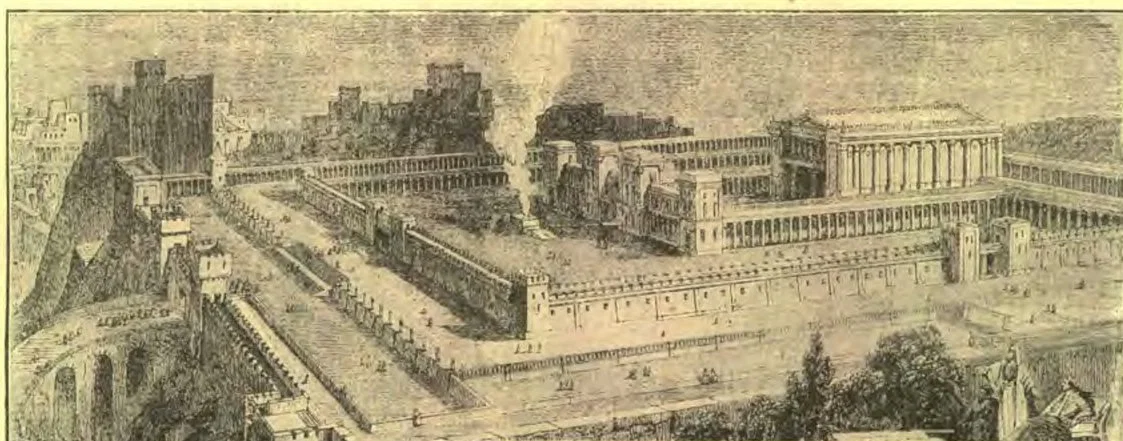
For a few months the work upon the temple ceased, in obedience to the command of the Pseudo-Smerdis, the Artaxerxes of Ezra 4; the children of Israel were required to abstain from labor upon the house of God.
“Now when the copy of king Artaxerxes’ letter was read before Rehum, and Shimshai the scribe, and their companions, they went up in haste to Jerusalem unto the Jews, and made them to cease by force and power. Then ceased the work of the house of God which is at Jerusalem. So it ceased unto the second year of the reign of Darius king of Persia.” Ezra 4: 23, 24.
As the period in which Pseudo-Smerdis reigned was counted into the dynasty of Darius, we see that the second year of Darius’s reign would mean only a few months, possibly nine at the most.
When Pseudo-Smerdis was slain and Darius Hystaspes assumed the government, God’s people should have had enough faith to at once begin the work. They had been stopped from their labor by Pseudo-Smerdis; and when he was removed, they should have felt that the only obstacle was out of their way, and taken again with energy and faith to the work of building. This, however, they did not do.
And so God sent them word through the prophet Haggai:
“In the second year of Darius the king, in the sixth month, in the first day of the month, came the word of the Lord by Haggai the prophet unto Zerubbabel the son of Shealtiel, governor of Judah, and to Joshua the son of Josedech, the high priest, saying, Thus speaketh the Lord of Hosts, saying, This people say, The time is not come, the time that the Lord’s house should be built. Then came the word of the Lord by Haggai the prophet, saying, IS IT time for you, O ye, to dwell in your ceiled houses, and this house lie waste? Now therefore thus saith the Lord of Hosts: Consider your ways.” Hag. 1: 1-5.
It is evident from this scripture that some of God’s people were saying that the time had not come to build the house. Altho the seventy years had ended, and the Lord had plainly instructed them to return to Jerusalem, and had clearly outlined their work in restoring and rebuilding, the first serious disturbance of their work by an impostor and a usurper of the throne, gives them an excuse to relinquish the work. They leave God’s house unfinished, and make themselves comfortable in their own homes. But God points out to them that this is inconsistent.
He asks them to consider their ways. He calls attention to the fact that they have been seeking to produce harvests, to earn wages, to clothe themselves, in short that they were struggling in vain for prosperity and things material. Now the Lord explains why they failed in this:
Saving to Lose
“Ye have sown much, and bring in little; ye eat, but ye have not enough; ye drink, but ye are not filled with drink; ye clothe you, but there is none warm; and he that earneth wages earneth wages to put it into a bag with holes. . . . Ye looked for much, and, lo, it came to little; and when ye brought it home, I did blow upon it. Why? saith the Lord of Hosts. Because of Mine house that is waste, and ye run every man unto his own house. Therefore the heaven over you is stayed from dew, and the earth is stayed from her fruit. And I called for a drought upon the land, and upon the mountains, and upon the corn, and upon the new wine, and upon the oil, and upon that which the ground bringeth forth, and upon men, and upon cattle, and upon all the labor of the hands.” Hag. 1: 6, 9-11.
The temple of Solomon, which was so much richer than the one built by Zerubbabel that many of the old people wept when they saw the new.
All this loss, all this lack of prosperity, was due to their lack of faith, to their failure to obey. Now the Lord asks for a new order of things:
“Go up to the mountain, and bring wood, and build the house; and I will take pleasure in it, and I will be glorified, saith the Lord.” Hag. 1: 8.
But altho God’s people had made a mistake, it is good to know that they now took hold by faith of the work which they were neglecting:
“Then Zerubbabel the son of Shealtiel, and Joshua the son of Josedech, the high priest, with all the remnant of the people, obeyed the voice of the Lord their God, and the words of Haggai the prophet, as the Lord their God had sent him, and the people did fear before the Lord. . . . And the Lord stirred up the spirit of Zerubbabel the son of Shealtiel, governor of Judah, and the spirit of Joshua the son of Josedech, the high priest, and the spirit of all the remnant of the people; and they came and did work in the house of the Lord of Hosts, their God.” Hag. 1: 12, 14.
Giving to Gain
The work began again. The Lord sent a comforting message through His prophet, assuring the people that He was with them:
“Then spake Haggai the Lord’s messenger in the Lord’s message unto the people, saying, I AM with you, saith the Lord.” Hag. 1: 13.
The first word through the prophet Haggai came from the Lord “in the second year of Darius the king, in the sixth month, in the first day of the month.” Hag. 1: 1. Only a very short period of time intervened between this instruction from God and the beginning of the rebuilding again of the temple; only a trifle over three weeks. According to one chronology the first word came from the Lord on the Sabbath. Three weeks intervened, and on the following Wednesday the work was again taken up.
The year mentioned is the second year of Darius’s reign, which would be B.C. 520; but the month mentioned is not that of the Persian year, but of the Hebrew year.
Nearly a month later the Lord sent further instruction to His people. It is evident that they were not as courageous as they might have been; that they were not taking hold of the work with the vigor that should have animated them. There were present engaged in the work those who had seen something of the splendor of Solomon’s temple, and knew how grandly that work had proceeded, and who contrasted the humble beginning now with that glorious building then. The Lord takes hold of this discouraging situation and calls their attention to this matter, which doubtless was upon their minds:
“Who is left among you that saw this house in her first glory? and how do ye see it now? IS IT not in your eyes in comparison of it as nothing?” Hag. 2: 3.
The Lord admits that in the comparison the present work suffers seriously. When this is compared with that, this seems as nothing. But they are not to be discouraged:
“Yet now be strong, O Zerubbabel, saith the Lord; and be strong, O Joshua, son of Josedech, the high priest; and be strong, all ye people of the land, saith the Lord, and work: for I AM with you, saith the Lord of Hosts.” Hag. 2: 4.
While God’s people were in prosperity in the reign of Solomon, and altho they were able to do a grand and noble piece of work in erecting that temple, the Lord gives them another event in their history from which they can extract courage and hope:
“ACCORDING TO the word that I covenanted with you when ye came out of Egypt, so My Spirit remaineth among you: fear ye not.” Hag. 2: 5.
In this statement He reminds them of their weakness and littleness when they came forth from Egypt.6From this small beginning the Lord had brought them up to the glorious times represented by the reigns of David and Solomon. From this they were to gather the lesson that tho the work was beginning in humility and in littleness, if they were faithful and true it should go on until it reached that point of glory, prosperity, and influence that God designed.
Higher Criticism
By Earle Albert Rowell
By Earle Albert Rowell
VII. Higher Criticism and Archeology
And some of the Pharisees from among the multitude said unto Him, Master, rebuke Thy disciples. And He answered and said unto them, I tell you that, if these should hold their peace, the stones would immediately cry out.” Luke 19: 39, 40.
Coincident with the rapid rise of Higher Criticism have been the important discoveries of archeology. As Sayce put it, every turn of the spade has furnished corroborative evidence of the minute truthfulness of Scripture history. Higher Critics have no sooner established a theory discrediting the Bible history and proving to their satisfaction its impossibility, than some silent worker in far-off Egypt or Palestine or Chaldea unearths some engraved facts which confound their theories and disprove their conclusions.
The Art of Writing
Once it was the fashion to argue that the art of writing was not practised anywhere before 1000 B.C. at the earliest, and hence it was impossible for the finished productions of the early part of the Bible and the psalms to be the work of Moses and David. The composition of the books of Moses was conveniently brought down to a few hundred years before Christ. That the art of writing was unknown in the time of Moses was so boldly asserted that few ventured to dispute it. Higher Critics were rejoicing over their victory, when the spade of the excavator unearthed vast libraries of the time of Hammurabi, a whole half thousand years before the time of Moses! A whole code of the laws of Hammurabi was discovered in 1903, proving that the art of writing was old in the time of Moses. The effect of these marvelous discoveries has been marked on some Higher Critics, who have yielded to the evidence. Hommel, Halevy, and Sayce, to mention only the most prominent, have abandoned their former Higher Critical views.
In Isa. 20: 1 we read that Sargon, king of Assyria, sent his tartan (or commander-in-chief) to besiege Ashod. But who was this Biblical Sargon? This was the only place not only in the Bible but in all literature, ancient or modern, the world over, where his name was mentioned. So of course infidels and Higher Critics did not hesitate to deny his existence, and actually used it as an evidence of the unreliability of the Bible history! Yet one of the very first important discoveries in Assyrian research was the palace of this selfsame king, containing his portrait and name, sculptures and numerous inscriptions giving an account of this very siege of Ashod. From an unknown king relegated to the limbo of oblivion by Higher Critics, he has become one of the best-known kings of all antiquity.
Babylon the Ancient
Not many years ago Gen. 10: 8-12 was held in derision. It affirms (1) that Babel and other cities named existed before Nineveh; (2) that Assyria was colonized from Babylonia; (3) and that the founder of Babylonian civilization was not a Semite, but a Cushite. All these facts were held in contempt by the Critics till the Assyrian excavations; but the monuments confirm the Bible on all these points.
In Gen. 10: 22 Elam is mentioned as the oldest son of Shem. Now this was long denied by Higher Critics, but recent discoveries have proved it. Nothing shows the futile makeshifts of Higher Critics when cornered, better than the statement of Dr. Driver on this very point in his “Genesis,” page 128: “It is true inscriptions recently discovered seem to have shown that in very early times Elam was peopled by Semites, . . . but the fact is not one that the writer of this verse is likely to have known!” Not likely to have known! And yet he did know it. Could criticism be more inept than this? And yet this is the kind of reasoning they use to establish most of their baseless theories. And they call it “the sure results of scientific criticism”!
Besides this have been found accounts of not only the Flood, but some tablets of Assur-bani-pal’s palace contain an account of the creation resembling that of Genesis in a remarkable degree.
The Sabbath Day
The Sabbath day, so far from being a late Jewish institution, as the Higher Critics would have us believe, is found to have existed in both Babylonia and Assyria centuries before the existence of the Jews, and was called Sabbatu, and was defined as “a day of rest for the heart.” On it ordinary work was prohibited to at least the king and the state officials. So it was a state institution, but proves the early existence of the Sabbath and is evidence of its origin in Eden.
On the monuments the Garden of Eden is repeatedly mentioned, and there is a seal with a man and a woman seated on either side of a tree, and reaching out their hands to pluck the fruit, while behind the woman a serpent rears itself, and is whispering in the woman’s ear!
There is also a detailed account of the Deluge, that reads in places exactly like the Biblical account. Even the words, “Enter into thy ship, and close thy door,” are present.
The inscriptions even give a translation of a man to heaven, but instead of Enoch it is the hero of the Flood story.
The Demonstrated Chedorlaomer
The names of Abraham and Jacob, tho considered myths by the Critics, are found on the monuments as historical personages.
One of the most wonderful discoveries is the confirmation of Genesis 14, which was so long scouted as impossible and absurd, and Chedorlaomer as a myth. But this story, substantially as told in the Bible, has been found on the monuments, with even the name of Chedorlaomer himself, so that even so radical a Higher Critic as Gunkel is compelled to accept Melchizedek as a historical person. And yet in “Genesis,” page 172, Dr. Driver gravely assures us, in the teeth of this proof, that “monumental evidence that the narrative is historical is at present entirely lacking!” Everything in the Bible is viewed with the eye of suspicion by Higher Critics, and put under the microscope of doubt. It is held to be a liar till it is proved true; and even positive evidence of its truthfulness, as shown above, is completely ignored in order that a pet theory may stand.
The facts in the history of Joseph in Egypt that were most confidently denied, are the very ones that have received the strongest and weightiest evidence from the monuments. On the authority of Herodotus it was denied that the vine was cultivated in Egypt, that flesh was a food of the higher classes, that the manners of women were so unrestricted as shown in Genesis; and was declared that the elevation of a young Hebrew to prime minister was romance, and that Pharaoh never gave Abraham sheep and oxen, because they were objects of hatred in Egypt. But all of these things have been confirmed, and in fact the making of wine in all its stages is pictured, and flesh is shown to be the principal diet of the upper classes. And most surprising of all are illustrations of sheep and oxen but not of horses, for inscriptions now reveal the fact that horses were first introduced in Joseph’s time. Even the story of Joseph’s temptation and exaltation appear in their literature; and this year has seen the discovery of an account of the seven years’ famine, and it is placed in the same year as that of the Bible record, 1700 B.C.
Israel in Egypt
In 1896 Professor Petrie found the name of Israel on Egyptian monuments saying, “The Israelites are brought so low that they have no seed,” which may be fairly interpreted to mean that since they have vanished into the desert there are none left in Egypt. There is even a picture of brickmaking in which masters are standing in threatening manner over the slaves, and in the masters’ mouths are put the words, “Be not idle,” reminding one of Ex. 5: 8, 17: “And the number of the bricks, which they did make heretofore, ye shall lay upon them; ye shall not diminish aught thereof: *for they are7idle;” and “Ye are idle, ye are idle.*” In the face of this, H. P. Smith in his “Old Testament History,” page 54, says: “The Egyptologists as yet have discovered on the monuments no evidence of a Joseph or an Israel in Egypt, as they have discovered none of the oppression or the Exodus. We are therefore obliged to look narrowly at the evidence of the Hebrew sources”! This illustrates how blind Higher Critics are to all evidence that contravenes their theories.
The Hittites
In Joshua and Kings are many references that imply the existence of a very powerful Hittite empire north of Palestine. Since nowhere in the world outside of the Bible was there a single reference to this nation, that was represented as equal in power to Egypt, the Higher Critics sneered at the Bible account, and laughed at those who were simple-minded enough to believe such an empire existed, simply on the unsupported statements of the Bible. But now from both Egyptian and Assyrian inscriptions we learn that the Hittites for a thousand years were a great power in Syria and Western Asia, and were as extensive and as powerful as either Egypt or Assyria, and the history of the Hittite empire now fills volumes. It seems impossible to human reasoning that so extensive and so powerful a nation could exist for ten centuries and escape completely all profane record, yet we now know such to be the case. Verily, the stones are crying out.
Scores of other instances might easily be given showing the utter baselessness of the Higher Critical theories; but the purpose of this article is only to call attention to the fact that the hand of God hovers over every historic page and His handwriting is on every ancient monument; that He never leaves His truth at the mercy of His enemies; that for thousands of years His hand has hidden these marvelous confirmations of His Word, and in these latter days, when they are most needed, He has brought them forth, and has actually made the stones to cry out when His professed disciples ceased to uphold the truthfulness of the Bible. Indeed “the Word of our God shall stand forever.” Isa. 40: 8.
Bethesda: The House of Mercy
Bethesda
[From “Walks and Homes of Jesus,” by the late Daniel March.]
“Now there is at Jerusalem by the sheep market a pool, which is called in the Hebrew tongue Bethesda.” John 5:2.
BETHESDA, “house of mercy,” a name of promise, and a promise wondrously fulfilled on the day when Jesus came there with His power to heal, and His mercy to forgive.
His Gospel makes the world a “house of mercy” to all that hear the joyful sound. We boast of justice in our dealings with our fellow men; but there is nothing of which we have so much reason to be afraid, as that God shall treat us as we deserve. Justice alone, untempered with mercy, would make the world a prison-house for the guilty. It would thunder from the heavens with the voices of vengeance. It would flame from the earth with fires of wrath. It would poison the air with pestilence. It would make every human habitation a house of mourning. It would send the thrill of pain through every fiber of the human frame. It would answer every desire of the heart with disappointment. It would make life a burden, and death the beginning of endless despair. Such would be the consequences to us all, were God to answer the prayer of the proud heart: “Give me only that which is my own. Let the justice of my claim be the measure of Thy bounty.”
But Jesus the Redeemer comes into a world which sin has made one great lazar-house of diseased and suffering humanity, and His presence makes it a house of mercy to millions. Mercy shines in the morning light, and mercy gilds the setting day. Mercy sings in the laughing stream, and shouts in the darkening storm. Mercy tempers the summer’s heat and the winter’s cold; revives the parched earth with the blessed rain; clothes the landscape with beauty, and crowns the year with goodness. Mercy flies on the wings of angels to the support of the feeble, to the defense of the poor, to the pardon of the guilty. Mercy broods with bleeding heart over the bloody field where armies meet in mortal strife, and watches amid scenes of horror and agony when the glory and the magnificence of battle have rolled away. Mercy brings the message of hope to the despairing, of joy to the sorrowing, of rest to the weary, and of life to the dead. Mercy removes the sting of the last bitter hour, and pours the glory of Paradise upon the vision that is dim with the shadows of death. Mercy makes a house of God in every place where the penitent bow in prayer. Mercy gives immortal life to all who look to Jesus to be “made whole.”
John or Judas?
By Elizabeth Rosser
By Elizabeth Rosser
THE voice that called the gentle John
To leave his finny spoil,
Called Judas with the same clear tone
To quit his daily toil,
And walk beside the Son of God,
As He the path of sorrow trod.
They saw Him heal the sick, the lame,
Give sight to blinded eyes,
Cleanse weary hearts from sin and shame,
And bid the dead arise.
Side by side with Christ they walked,
Daily with the Saviour talked.
John’s heart drank in the Saviour’s word,
Expanding like a flower;
Judas the same sweet pleading heard,
Resisting all its power.
John purer, whiter grew alway;
Judas, more hardened day by day.
So Judas farther from Him strayed;
John closer pressed beside.
Judas his Lord to death betrayed;
John for his Master died.
John to heaven’s heights shall soar;
Judas, perish evermore.
O, solemn thought! that life and death
In the same Word are borne,—
Life to those who hear in faith,
Death to those who scorn.
Lord, let me well this question con:
Am I a Judas, or a John?
Best Soldiers Come from the Highlands of Affliction
By C. H. Spurgeon
THE Lord gets His best soldiers out of the highlands of affliction.— C. H. Spurgeon.
God's Six-Day Creation Week Described
Needless to say we accept the Record. In the first place, it is simpler than the assumed hypotheses of science. In the second place, it is more reasonable to the believer in an infinite personal God. In the third place, it is just what we could expect a Creator to do who is not bound by certain laws and rules and hypotheses guessed at by creatures of a passing breath. In the fourth place, the soul can find in the various steps of God's remolding power mighty encouragement to holy living, of which more hereafter.
For the first day God spoke into the seemingly black abyss, and said, “Let there be light,” and LIGHT WAS. The dark mass was illumined, and the earth entered upon her normal career. The revolving earth, in that canopy of light and darkness, brought night and day,—the first day of that first week of time. The second brought an expanse, a breaking of the great cloud mass which enswathed the earth; the upper part forming clouds, the lower part covering the earth with water. The third day, by the fiat of God, witnessed the waters roll off from a portion of the land, leaving it dry, and forming seas and gulfs and lakes, and the earth brought forth vegetation. On the fourth day appeared the glorious panorama of heaven, the sun, moon, and stars. Then the feathered tribes of air and the finny tribes of the sea were created on the fifth day. On the sixth day were created all animal life upon the earth, of which man was the crowning work. Thus God, by His word-creative, formed, shaped, created the earth and its dwellers of beast and man.
The crowning day of that cycle, its completion, the day toward which all the other days tended, was the seventh, on which God ceased His work, took delight in its cosmic beauty, placed within it a blessing for man, and set it apart for man forevermore.
The reason is obvious if we will stop to think. First, man was made a worshiping being, and he will worship something, from the great invisible God to the rabbit foot he carries in his pocket or the beetle which crawls at his feet; and among his gods in general is SELF. Secondly, it is reasonable that man should devote some time to the worship of his Creator; and what could be more reasonable than that his Creator should state the proportion of time? Thirdly, man is normally a social being; he loves companionship; he herds together. Fourthly, being a worshiping being and a social being, it follows that he would worship with his fellows. This would demand not alone a proportion of time, but a definite period of time in the week. It is clear to all that God could not leave this to the choice of finite men, and must appoint the definite day; for He is not the god of confusion. Fifthly, this the Creator did. The proportion of time was one seventh; the definite day was the seventh, the day around which clustered and within which focused the great evidences of His creative Godhead. So much at this time for the origin of the week and the origin of the Sabbath.
1. Knowledge is taught of God
Knowledge
1. Knowledge is taught of God
“He that ch ทีastiseth the nations, shall not He correct, even He that TEACHETH MAN KNOWLEDGE?” Ps. 94: 10, R.V.
2. He teaches through His Word.
“Whatsoever things were written aforetime were written for OUR LEARNING, that we through patience and comfort of the Scriptures might have hope.” Rom. 15: 4.
In CHRIST “are hid all the TREASURES OF WISDOM AND KNOWLEDGE.” Col. 2: 3.
3. Knowledge is of great value.
“WISE MEN LAY UP KNOWLEDGE; but the mouth of the foolish is near destruction.” Prov. 10: 14.
“Receive My instruction, and not silver; and KNOWLEDGE RATHER THAN CHOICE GOLD.” Prov. 8: 10.
“I count all things but loss for the EXCELLENCE OF THE KNOWLEDGE OF CHRIST JESUS MY LORD; for whom I have suffered the loss of all things, and do count them but dung, that I may win Christ, . . . that I may KNOW HIM, and the power of His resurrection.” Phil. 3: 8-10.
4. Knowledge brings eternal life.
“This is LIFE ETERNAL, that they might KNOW THEE the only true God, and Jesus Christ, whom Thou hast sent.” John 17: 3.
“My people are DESTROYED for LACK of KNOWLEDGE: because thou hast REJECTED KNOWLEDGE, I will also REJECT thee, that thou shalt be no priest to Me: seeing thou hast forgotten the law of thy God, I will also forget thy children.” Hosea 4: 6.
5. There is no excuse for lack of knowledge.
“A scorner seeketh wisdom, and findeth it not: but KNOWLEDGE IS EASY unto him that understandeth.” Prov. 14: 6.
“A GOOD UNDERSTANDING have all they that DO HIS COMMANDMENTS.” Ps. 111: 10.
6. Knowledge is good for the weak.
“A wise man is strong; yea, a MAN OF KNOWLEDGE INCREASETH STRENGTH.” Prov. 24: 5.
Therefore “as new-born babes, desire the sincere milk of the Word, that ye may grow thereby” (1 Peter 2: 2); “GROW in grace, and in the KNOWLEDGE OF OUR LORD AND SAVIOUR JESUS CHRIST” (2 Peter 3: 18).
7. An encouraging promise is near to fulfilment:
“They shall not hurt nor destroy in all My holy mountain; for THE EARTH shall be full of the KNOWLEDGE OF THE LORD, as the waters cover the sea.” Isa. 11: 9; Hab. 2: 14.
Benefit of the Bible
A Roman Catholic priest in Belgium rebuked a young woman and her brother for reading the Bible. She replied: “A little while ago my brother was an idler, a gambler, a drunkard, and made such a noise in the house that no one could stay in it. Since he began to read the Bible, he works with industry, goes no longer to the tavern, no longer touches cards, brings home money to his poor old mother, and our life at home is quiet and delightful. How comes it that a bad book produces such good fruits?”
Lesson of Creation
By Cawdrey
As, when men behold any curious work of a skilful craftsman, straightway they will leave the work, and inquire after him that made it, that they may praise his skill; so it is the duty of Christians, when they behold everywhere in all the creatures the admirable and unspeakable wisdom, goodness, and power of God, to make haste from the creature, and go forward to the Creator to praise and glorify Him.—Cawdrey.
The first text — Gen. 1: 1 — is all-inclusive, embracing all of God’s creative work, from that far beginning when the light of suns broke on the black bosom of fathomless space, till this earth came into existence, and sin temporarily checked God’s work till the great problem is settled and the Creator stands justified by eternal right before the universe.
The second text — Ex. 20: 11 — is local, and pertains to man and his habitation. The time, the period, of the first is indefinite, and rests with Him who is “from everlasting to everlasting.” The second is limited by God to this earth and six days of time. We are aware that men have denied the time, and do deny it; but when they do, it means, as Higher Critics have declared, the denial of the Bible; in its light, language means nothing, and all that we find in the Bible is laid open to fanciful interpretation and vaguest guesses. If “day,” consisting of “evening” and “morning,” of “darkness” and “light,” ruled and governed in its period and succession by the sun, does not mean the day in the ordinary sense, measured by a revolution of the earth on its axis, language is meaningless, and the Bible is unreliable, undependable. True it is that the word “day” has other meanings; but where it does, context, topic, and use clearly determine it. When, however, the day is defined, determined, marked out successively, we may not question its meaning without weakening and discrediting the Record in which it is found. Six times are the “six days” referred to, and always obviously refer to ordinary days.
Creation and Redemption
“IN the beginning God created the heaven and the earth.” Gen. 1:1.
“IN six days the Lord made heaven and earth, the sea, and all that in them is.” Ex. 20:11.
Here are two expressions, quite similar, and yet different. The first refers to the whole vast creation of God, consisting of suns, and systems of suns, and clusters of systems, and universes of clusters, the whole imponderable mass created and held ponderable and under control of Him whom men would dethrone by the empty names of Law and Nature. It expresses to mortals the great fact of creation, which they may apprehend tho they can not comprehend the power and the wisdom involved. “IN THE BEGINNING was the Word, and the Word was with God, and the Word was God. The same was IN THE BEGINNING with God.” John 1:1, 2. “For by Him were all things created; . . . all things were created by Him, and for Him: and He is before all things, and by Him all things consist [hold together].” Col. 1:16, 17.
Elijah the Prophet and the Coming of the Lord
We quoted in our last week's issue the following scripture from Mal. 4:5, 6:
“Behold, I will send you Elijah the prophet before the great and terrible day of Jehovah cometh, for it is nigh at hand.” Joel 2:1.
“And he shall turn the heart of the fathers with the children, and the heart of the children with their fathers; lest I come and smite the earth with a ban [devoting to destruction].” A.R.V., margin.
It was shown that the prophecy was in part fulfilled in John the Baptist and in his message and work to the Jewish nation; and because that people did not heed the message, upon their land fell the awful curse. Their place and nation were lost forever.
But Malachi's message was broader than the Jewish nation. He was a prophet not alone of a messenger to the Jews of a Messiah and Deliverer to come, but of a Messiah, a Saviour, a Deliverer, for the world. Jesus Christ came to save mankind. His mission involved not alone the offering, the good tidings, the priesthood, but the judgment, and after that the everlasting kingdom. Therefore Isaiah predicts of Him that He should not only “bind up the broken-hearted,” “proclaim liberty to the captives,” “proclaim the year of Jehovah's favor,” but “the day of vengeance of our God.” Isa. 61:1, 2.
The first part of that message for the world Jesus proclaimed at His first advent; and He cites this very prophecy from Isaiah, omitting, “the day of vengeance of our God.” Luke 4:18, 19. This part of the prophecy will be fulfilled for the entire world in the proclamation of the message which will precede His second advent. “Blow ye the trumpet in Zion, and sound an alarm in My holy mountain: let all the inhabitants of the land [erets, earth, Gen. 1:10] tremble, for the day of Jehovah cometh, for it is nigh at hand.” Joel 2:1.
From this and many other scriptures it is evident that a message in the spirit and power of Elijah will precede the second advent. But this prophecy, too, has been perverted and misunderstood. By its perversion many have been deceived, and many more have turned from the prophecy with indifference or with contempt.
Not a few, some of whom we are bound to believe were self-deceived, have arisen claiming to be Elijah, and have drawn away disciples after them. Sooner or later the pseudo-Elijah has died or proved a bare-faced fraud, and his deluded followers have become broken and scattered.
Notable among these leaders in these our days were Sanford and Dowie. Sanford claimed to be Elijah, founded a home in Maine, erected there great buildings, claimed to heal all manner of diseases and even to raise the dead. He went to Palestine with great pretensions, left many of his followers in America deceived, shepherdless, and in want; and the last we heard of him he with a little band was camped in the vicinity of Mount Carmel, where some of Elijah's great exploits were performed. Only so could he advance superior claim to his rivals.
Dowie borrowed and patched together various things from the Roman Catholics, Mormons, and others, and founded a church and embryo state at Zion City near Chicago. He not only proclaimed himself to be Elijah, but applied to himself the prophecy of Acts 3:22, 23, which had direct reference to Christ. Dowie's last days were stormy and troubled. Many of his leading men; among them his own relatives, forsook him, and he died dishonored and in debt, leaving many of his followers in a pitiful condition.
A manifest and distinctive characteristic of the pseudo-Elijah, by whatever name he is called, is his great assumption, his self-centering. Like Simon the sorcerer he amazes the people, “giving out that himself is some great one;” and his followers cry, “This man is that power of God which is called Great.” Acts 8:9, 10. He is to be classed with those of whom Paul speaks, who will “draw away the disciples after them.” Acts 20:30. It is a characteristic of false prophets that they ever gather people to themselves, and build some great center to glorify themselves.
It was fitting that to one messenger should be given the message to one small people, as in the case of both Elijah and John the Baptist; but when the prophet and message go forth in their fulness, it is to all the world, and to all the nations; and then the antitype of Elijah is not one but many, carrying the same message of reform to all the peoples of the earth.
The conditions in Elijah's day demanded the message. God's people had departed from Him, and many had become sunken in the depths of idolatry, nature-worship and sun-worship; they had joined themselves in unholy alliance with outside nations, the acme of which was reached in the alliance of the weak Ahab and the strong, unprincipled Jezebel, daughter of the Sidonian king Ethbaal.
Now God's professed people in all lands have greatly departed from Him, following the leadings of unregenerate natures instead of God. Many of them are in close union with the world; and thousands of their shepherds are, through the influence of apostasy, seeking to unite the church with the state in unholy spiritual fornication.
The world needs a message of reform today, voices crying in the wilderness, pointing out sin, rebuking transgression, lifting up the world's only hope, “the commandments of God and the faith of Jesus,” without compromise, without shading, and in the spirit and power of Elijah. That message, reader, is going to the world; have you heard it? It exalts no man. It lifts up Jesus and His Word.