The steamship “Minnesota” on which we sailed, left Seattle, March 2, at a little past noon, and an exceptionally pleasant trip of fourteen days brought us to Japan. Here at the three principal ports we remained for about one week. The workers in the “Sunrise Kingdom” reported progress in the message, and were of excellent courage. Our stay with them was most pleasant and profitable. Sister Etta Dehn, a nurse from St. Helena, left our party at Kobe to connect with the sanitarium at that place.
There were a number of missionaries on board the “Minnesota,” and throughout the voyage it was our privilege to participate in morning worship together. We also conducted afternoon Bible studies on some of the principal subjects of present truth. Considerable interest was shown, and we earnestly hope that some who heard the message may yet be among the number who will proclaim it in these heathen lands.
When we had been out twenty-five days we dropped anchor at the mouth of the Yangtze River. Here Brethren Anderson, Hankins, and Winslow met us, and conducted us to the “Evans’ Missionary Home” in Shanghai, where they had arranged for us to remain for a few days. Dr. Selmon and Sister Westrup were also down from Honan. Several meetings were held in which we exchanged reports regarding the progress of the message; but, as our Chinese printing-press is to be established here, much of the time was spent in planning for it. Five of our company remained in Shanghai to connect with this enterprise.
After a few days, Sister Schilberg, Mrs. Cottrell, and myself, in company with three members of the China Mission Committee, started for a week’s trip up the river, traveling in the first-class Chinese cabin. We could eat their rice, but arranged to largely supply the remainder of our provisions ourselves.
The broad Yangtze reminded us of a long, narrow inland sea. During high-water the largest ocean steamships can ascend its current for eight hundred miles, and the native sailing craft are numerous for nearly a thousand miles up the river. At many places the scenery was most beautiful, spring-time having added her charms of green grass and foliage.
The fourth day brought us to Hankow, the Chicago of China. Here we changed steamers, and the second day following left the Yangtze, turning southward into the Tung-ting Lake, the largest one in China. The greater part of this lake is low land which is flooded only a small part of the year; at other seasons a considerable portion of it is planted to rice. This has been true only the last few years, as this lake, like others in central China, is said to be slowly drying up.
After crossing the lake, we continued our course by way of the Siang River. On reaching Chang-sha, we soon found Brother and Sister P. J. Laird who are located inside the ancient city, about one-fourth mile from the east gate. They have a native evangelist who appears to be a very fine and capable man. Some are keeping the Sabbath, and several others are much interested, though none as yet have been baptized. After counseling with us a few days, the brethren who had accompanied us inland, started northward for a visit to Honan.
We feel very thankful to the Lord for so prosperous a journey. Our health is good and our courage strong. It seems to us that the immensity of this empire is almost beyond comprehension, yet the third angel’s message has made a beginning in China, and may the Lord of the harvest speedily send forth many laborers who will return to the Saviour from this dark land the purchase of his blood.
Chang-sha, Hunan, China.
A Woman's Story
By MRS. J. N. ANDERSON
MRS. J. N. ANDERSON
Another unfortunate life has passed into the shades of a heathen grave. Tai So, as we called her, died yesterday. She lived in a tiny little house built against a jog in the wall of the fish-market on our west side. Her husband works at the market, overseeing the distribution of live fish to venders. She was always so cordial in her invitation to come in and sit for a cup of tea; though the room is so small one almost wonders how one would ever get turned around to come out again face first. But she seemed real happy there, and after the baby came, devoted herself to it with a slavish attention. It lived in a bundle on her back; winter and summer she was always on the lookout for a shady place to sit and amuse the little creature. It is a year and a half old now, and has always been a favorite in the alley where they live and among the men in the market.
Tai So was a second wife, and therefore was taken by the husband's own selection. He seemed very fond of her, and did most of the cooking and whatever housework there was to do. After the morning distribution of fish was over, one might see him coming down the alley toward their door with some tender bean sprouts or other greens intended to go with a slip of fresh fish and a steaming kettle of rice to make the family breakfast. They lived very agreeably together. In fact, we often remarked that real domestic13happiness prevailed in that tiny home. When the first wife came down from the country with her children for a visit, as she often did, she was received with the same cordiality as any other guest. The quantity and quality of the two daily meals was increased, and there were tea and some knick-knacks at noon. The two women sat together, smoked the little they could afford, chatted and exchanged compliments on each others' children in apparently perfectly easy relations till the visit ended, and the “Big Lady,” as Tai So called her, returned to the country.
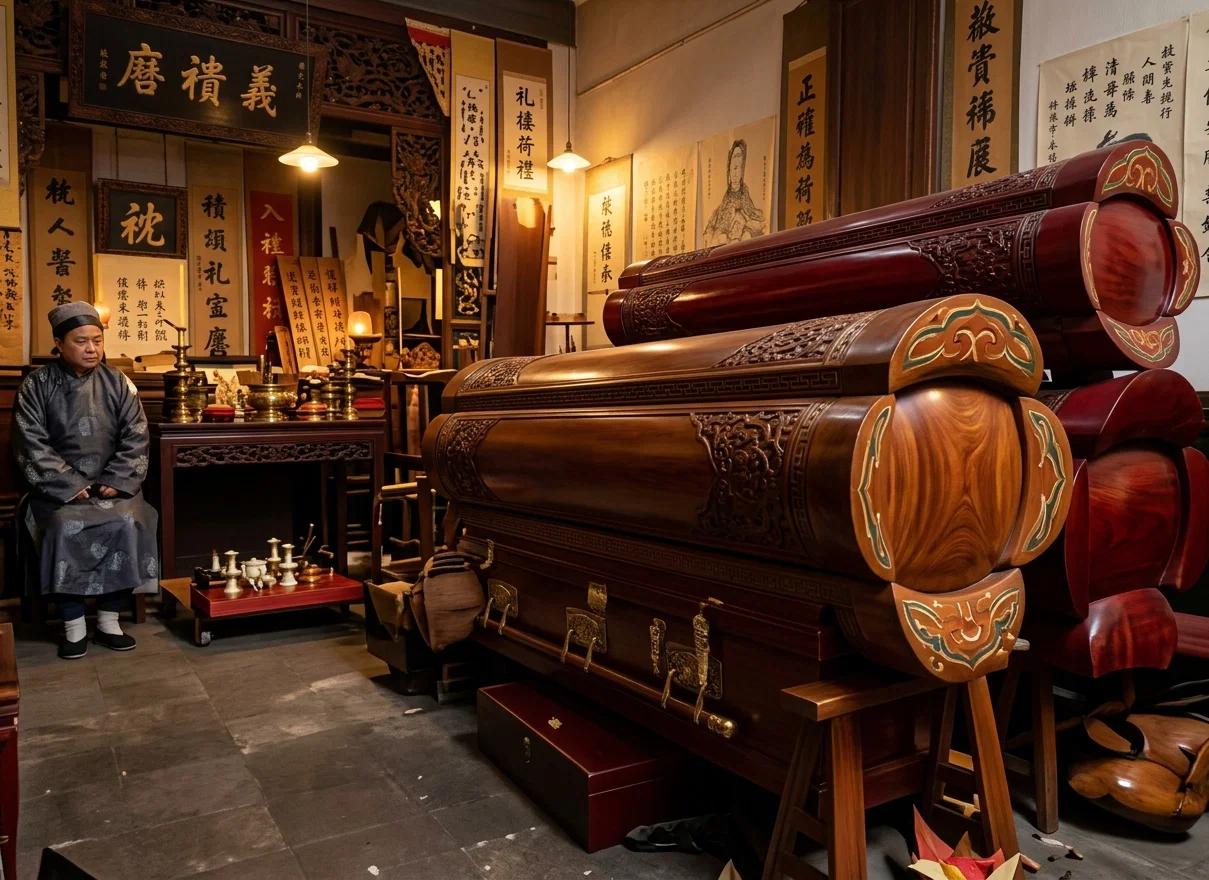
A CHINESE UNDERTAKER'S SHOP, SHOWING COFFINS
Tai So's life had not always run so smoothly, and perhaps the hardships she endured made this life bright by contrast. Born some place,—she did not herself know just where and when,—she had not been wanted as a girl-baby, and so had passed as a bond-servant into another family. Unfortunately she grew up good-looking; and so, as her unscrupulous owner could realize a large price for her, she was sent to the Canton Flower boat service, instead of being sold as a wife. How she made her escape, I do not know. I first saw her sitting at the door of a woman in our street making clothing. From early light till dark she sat stitching away at the heavy, blue homespun cotton. The face was delicate and pale, and the thin, slender fingers scarcely ceased stitching as the sad eyes were raised in greeting when we passed her at work. There was something appealing in her tone, though it was a long time before I knew a bit of her story, or anything about the character of the woman whose guest she was.
After a while there was a terrible quarrel at the place. Men and women scolded till they were red in the face, and too hoarse to yell longer. I could not tell what the trouble was, for the words were so indistinct; but evidently Tai So was concerned in it, for once in a while the blue sewing work was dashed to the ground, and she stepped inside to give vent to the indignation she could not repress. During the night things quieted somewhat. On the second day the storm burst out anew, till Tai So, pale and excited, gathered up the little she could get possession of, and left the house.
What could she do? She sat down on some building stones at the far end of the alley to rest and to think,—a young woman, penniless, a stranger, and alone. Some kind heart gave her a welcome, some supper, a straw mat, and an earthenware pillow for the night. A few months ago, when the old woman across the way was arrested for kidnapping, the real cause of the quarrel with Tai So came out. The girl saw through the plot, mistrusted she was not to be respectably married, according to promise, but was being betrayed back into the old life of shame, and so refused to follow her lead. This excited the old woman's vengeance.
The next day there was a stir in the alley—a grating of saws, a pounding of nails, and a general hurry-scurry of workmen. Then, after a few hours, everything was ready. Tai So came back to the door of her former hostess, but not alone. The man from the fish-market came with her, and a group of the alley neighbors came to back the claim she made. After a stormy defense, the old woman finally surrendered her unfortunate guest's few personal effects, and the young people went home to the tiny house that had so suddenly sprung into existence in the alley.
When the long, hot days came, followed by sultry nights in which the pillow was torture to one's head, I said to Tai So, “Do you find it very warm sleeping in your room?” The bedroom was so small that the broad bed four feet wide and six feet long reached the wall on all four sides and there was not a window, nor an opening for one, in the house. “When it gets too hot inside, I sit out here till it gets cooler. There is always a breeze from the river in this street,” she said, contentedly, adding, “but it must be hot in the houses farther in the city.” Then came the little daughter—an added joy into the woman's life. After three years of domestic life, and just twelve days before her death, a son was born; but the poor mother never rose from her bed in the tiny, dark room. I knew a boy baby had come, and thought how happy she must be; for she had told that it was because the first wife had borne only girls that the husband, though a poor laborer, had felt compelled to take a second wife. When I called, two evenings ago, they told me the baby had died five days before, and that they feared the mother must die too. She recognized me in the same sweet voice as before, only it was very weak now.
To my entreaties to allow the foreign doctor to call, they promised to send for her “to-morrow.”
Early in the morning I sent a boy to tell them the tide of the river was now favorable for the doctor to come in a boat, and beg them not to delay. He had just passed through the door when the shrill tones of a fife and the clanging of brass cymbals came from the alley. He sprang back, shut, and fastened the door, and then, turning with a broad grin all over his pale face, threw down his hands helplessly, and said, “Why should I ask? do you not hear that noise?”
“But go, and find out for sure; I can not bear to think that Tai So must die a heathen, and she has known only so little,” I insisted.
“How shall the women of China ever know about your Saviour? Think of all the women back in my country home who can not read, and have not yet heard a little. How will they ever know, when there is no one to teach them?”
That afternoon my friend in the alley was carried away to the hillside to fill another of the constantly increasing number of heathen graves of China. Only the Light of life can dispel this awful darkness. The servant boy's question is God's question put to his church to-day, “How shall they hear without a preacher?”
Canton, China.
The Unimportance of Prominence
A REAL test of leadership is the readiness to be invisible. The rudder is under water during a voyage, and is not seen by the passengers. If it were made chiefly to be seen, its guiding power would not amount to much. Until we learn not to care whether we are observed of men or not, we shall never become as effective in leadership as we might. The great forces of nature work chiefly without attracting attention. Let us faithfully do our work, and trust our Master to give what recognition is best for us.—Selected.
CLAUDE D. A. C. MOODY
By Claude D. A. C. Moody
Notes Along the Way—No. 3
CLAUDE D. A. C. MOODY
CONSTANTINOPLE, MARCH 29.— We have to learn not to be in a hurry in this country, especially when dealing with the government. I was not able to leave the Brusa until to-day, and then came away without the passport concerning which I wrote from Brusa, the twenty-fifth. It is hoped the British consul will receive it so as to mail it to me this week.
The narrow-gauge railroad from Brusa to the coast runs through a great olive-producing country. The road winds through the foot-hills of the majestic Mt. Olympus, at the foot of which lies the city of Brusa. The railroad does much angling about the sides of these coast hills before it is able to span out a short distance of track at sea-level as it approaches the Moudania port. The vast expanse of olive orchards stretching out on these slopes and across the basins was a rich sight to behold this morning. The region is so noted for its olives, that our consul in Brusa told me that he had just made out a special report of the manner of setting out the trees, the care and cultivation of them; in fact a complete report of the olive industry from the nursery tree to the marketed fruit, in response to a request for the same by those endeavoring to extend olive growing in California. In the immediate vicinity of Brusa many peaches are also grown. A few days ago from a position in the higher part of the city, looking down across a vast plain surrounding the lower side of Brusa, I saw one great field of pink14peach blossoms, the most beautiful sight of this kind I ever witnessed. Over the same district are olive-trees which are always green. These are not yet in blossom. The pink donned by the peach was greatly enhanced in beauty by the green olives about them. I have enjoyed a pleasant trip across Marmora to-day, and this evening finds me back in the Ottoman capital—the Levantine metropolis.
VIEW OF SANCTUARY IN ULU JAMI, MOSQUE OF BRUSA
BAGTCHEDJIK, APRIL 14.— I came down here from Constantinople eleven days ago, and will be going back to the city to-morrow. As I did not close and mail these notes while in Constantinople a few days ago, I desire to add something regarding Brusa.
The mosques and tombs of the kings in Brusa are among the most interesting features of the city to the visitor. Of the tombs, I visited several, but those of Osman I and Murad I are the most deserving of attention. To secure a photograph of the inside of these mausoleums a little strategy was necessary. Fortunately I secured some plates, which, though far from perfect, are very good considering the darkness inside a tomb, and the general conditions under which the photographing was done. Of course I prize them highly on this account.
The mausoleum of Murad I stands on a hill opposite the mosque bearing the same name. I also secured an inside view of this mosque. Besides the remains of Murad I, those of other members of the royal family are also seen inside the mausoleum. The central part, directly under the dome of the tomb, where are the remains of Murad himself, is most richly and artistically decorated, part of the railing enclosing it being overlaid with gold. There is also the Koran, used by the sultan, with the hand- written Arabic characters written to a nicety. The pedestal-like things before the tomb are for bearing the Koran. The mausoleum of Osman I, considered by the Turks to be their first sultan, is not so imposing as that of Murad. The most beautiful thing in this, and a thing that is really magnificent, is the great chandelier hanging immediately over the tomb.
In these tombs, as well as in others which I visited, breastplates and various pieces of armor worn by the early sultans are to be seen. But the thing of greatest interest to me was the horse-tail standards seen in several of these mausoleums. The horse-tail standard was an emblem of the power of the Ottoman rulers. How perfectly John the Revelator saw this in vision when he says, "And they had tails like unto scorpions," and "their power is in their mouth, and in their tails." It is impossible to express by pen one's feelings upon visiting these old monuments—tombs of the early sultans. Mighty conquerors were the successors of Muhammed once, but to-day he totters upon a weak throne.
The largest mosque in Brusa is Ulu Jami, and it is really grand. Three different sultans had a part in its construction: Murad I, Bayagid I, and Muhammed I. It was completed in the early part of the fifteenth century. Its massive roof is an arrangement of twenty small domes. In the center of the mosque is a magnificent fountain. The pulpit is a work of sculpture by an Egyptian artist. The sanctuary is all overlaid with gold. My photograph, though quite good in detail in showing the Arabic characters, can convey no idea of the wealth of gold in it. The two large Arabic words at the top of the picture, between the two windows, are Allah, and Muhammed, or "God," and "Mahomet." These two words are of course associated together on the walls and columns of every mosque. The chandelier seen before the sanctuary bears little cups of olive-oil.
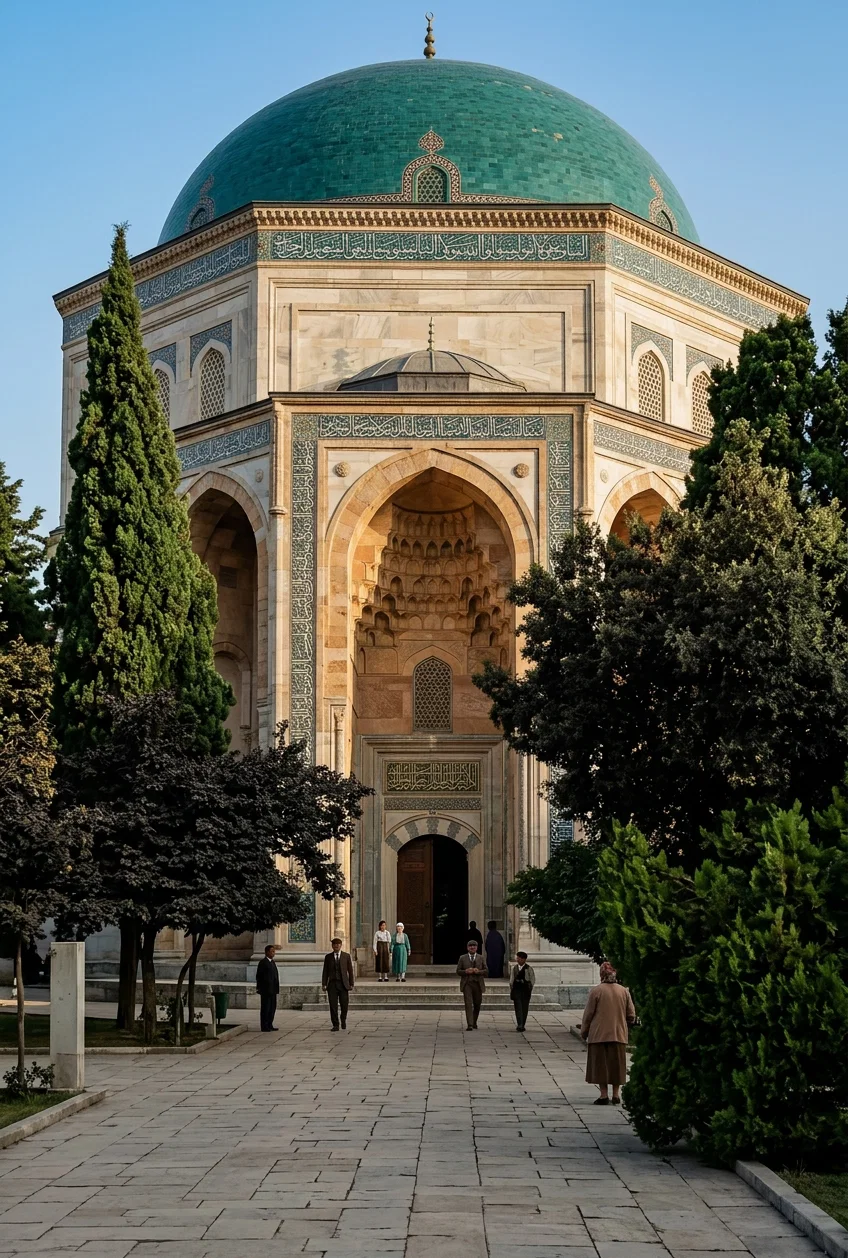
One of the most beautiful mosques of Brusa is "Yeshil Jami." I took only an outside view of this, as at the time I visited it the inside was being repaired. It was built by Muhammed I in 1418, and is chiefly noted for its exquisite marble work on the inside. Its great gate is inscribed with the first chapter of the Koran, carved in marble. Opposite the mosque is the Green Tomb, containing the cenotaph of Muhammed I and others. It is faced inside with exquisite green and blue tiles. All the mausoleums are kept up and in good condition at an enormous expense. Each mausoleum has one or two keepers.
Though monuments of early monarchs stand for centuries, yet their marks of decay, with many entirely in ruins, show us the instability of earthly grandeur. We know that the "king of the North" shall soon come to his end, "and none shall help him." Now is the time to work with utmost vigilance that He who shall ride upon "the white horse" conquering, may come quickly to possess himself of his kingdom. His kingdom shall not be destroyed.
Constantinople.
Gospel Doors Opening in Africa
IN the Missionary Review of the World for June, it is stated that Abyssinia, with its three million five hundred thousand inhabitants, is now partially opened to the gospel. “According to recent reports King Menelek, who seems to be possessed of not a few excellent qualities of both mind and heart, has partially opened the doors. For some years a Swedish missionary has been watching and waiting [and working] upon the northern border, scattering also The copies of the Bible. When one of these was presented to the king with the request that their introduction be forbidden, he replied: ‘I have read these books, and they are good; let the people read them too.’”
GREEN TOMB, CONTAINING THE CENOTAPH OF MUHAMMED I
So desirous are some of the tribes of West Africa for missionaries to come in among them, that it is recorded of the king at Kamerun, when a new place of worship was needed, that he ordered the erection of a building capable of seating two hundred persons.
Our Tour
By Ole Andres Olsen
After much prayer and counsel with the leading brethren, Mrs. Olsen and I decided that it would be best for her to return to England for a time, where our two sons are located, and connected with the Caterham Sanitarium. The reason for this move was that Mrs. Olsen's health, which has been much broken for many years, was in need of more care than it was possible for me to give her, as the work in Australia called me away from home for long periods at a time. To leave her alone in her condition of suffering was very trying to her, and also a source of much concern on my part, while with our sons she could be made so much more comfortable.
We left Sydney on February 13, stopping at Melbourne, Victoria, to attend the camp-meeting held at Balaklava, February 14-23. At the close of this meeting we took the train to Adelaide, and on February 27 joined the steamer “Orontes” of the Royal Mail service direct for London. We were greatly favored with a comfortable passage, for which we were thankful. Indeed, the Lord seemed to favor all our arrangements in a marked manner.
We arrived in London, March 29, and the same day at Caterham. We were pleased to meet our children, and find them all well, and very grateful for the good hand of the Lord that had been over us so graciously.
I remained a week in England. During this time I made a short visit to Watford, and was much pleased with this fine country location to which our institutions have been moved. It was also cheering to meet again a number of the brethren and sisters and fellow laborers and associations of former days. We would gladly have spent more time here, but in order to reach the Council of the General Conference Committee at Washington, I left England on April 8, arriving in New York on the sixteenth, after a rather stormy passage. The next day I came on to Washington, D. C.
I felt it a great privilege to attend this council, and meet so many of the brethren after a considerable absence. The meetings had already been in progress some four days on my arrival, so I did not get the beginning.
I remained in Washington till April 29; and it was an exceedingly interesting time to me. I never before was so profoundly impressed with the magnitude of this work. As day by day the needs of the work in the different fields were canvassed, the opening providences of God studied, and the urgent calls from every part considered, one could not help feeling almost overwhelmed with the immensity of the task in hand. And if it was left to human power and ingenuity, utter failure and disaster would be the result. But the work is in the hands of the One whose resources and power are unlimited.
The presence of the Lord in our meetings was very marked. As we met day by day, we could but feel our utter helplessness as we were confronted with the great questions at issue, but the presence of a higher power was very manifest. This great work is not left to the limitations of human power. God himself is directing the whole. What a privilege for us to be accepted as laborers together with God.
The presence of the Lord was also manifest in the union, harmony, and good will that prevailed through the entire council. The question causing the greatest perplexity was the lack of laborers to meet the many urgent calls for help that came from all parts of the world.
One would naturally think that at this stage of our work, laborers would have developed so that every need could be promptly met, but not so. Really, the scarcity of efficient, devoted laborers was never more felt than now. The fact is that the providence of God has all the way, and now seemingly more than ever, been so far in advance of our ability to meet it, that it is a source of real perplexity. But in this as well as all else, the help must come from God.
But after all is the present situation what God would have it to be? If the body of our people would rise as one man, and consecrate every God-given power to his service, putting away every hindering cause to the outpouring of God's Holy Spirit in full measure, would there not be a change? Would not men be forthcoming, and also funds, to meet every need of the work, and hasten it to its final accomplishment? I certainly believe there would be a marvelous change. Then why shall our lack of consecration, our lack of coming up to the help of the Lord against the mighty, stand in the way of finishing the work any longer? Rather let us rise in the strength of God to our high calling in Christ Jesus.
Leaving Washington, I stopped over one day at Mount Vernon, Ohio, to arrange for two workers for the Eastern Polynesian Mission. Brother and Sister Sterling will sail from San Francisco July 1, for Tahiti. I made a two-days' call at Green Bay, Wis., to visit my aged father, now ninety-two years old. I found him well and of good courage, waiting for our glorious redemption. I also made a call at Chicago, and went to Wichita, Kan., where I remained May 12-14. I had several meetings with the church, and a pleasant visit at the sanitarium with Dr. Braucht. From here I hastened on to the Pacific Coast.
Sabbath and First-day I was at St. Helena, and spoke to the church at the sanitarium on the Sabbath. I enjoyed a profitable time in council with Sister White and Brother W. C. White. I was pleased to find Sister White so well, and of such excellent courage, and her soul all aglow with the love of God and her deep interest for every branch of this glorious message. How wonderfully the Lord is working for his people in these last days so full of peril. I wonder if we fully appreciate the blessings of God's faithfulness in the many warnings, faithful admonitions, and cheering encouragements that God is so freely bestowing on his people at this time. May the Lord help us to do so.
May 20 I boarded the steamer “Mariposa” for Tahiti and had a good passage. On the morning of June 1, we arrived safely at our destination. Brethren B. J. Cady and W. H. Pascoe were on hand to meet us. We are to have a general meeting on the island of Raiatea during my stay here. O. A. OLSEN.
Papette, Tahiti.
The Work in New Zealand
By S. M. COBB
WHILE we have been intently watching the progress of the work in other fields, and rejoicing in the success and triumph of the truth in other countries, and while our prayers and thanksgiving for God's wonderful leading and mercies in all the work abroad have been ascending to the throne of grace, his gracious providence has also been manifest in this field.
The urgent calls for laborers to support the work in our foreign fields has greatly reduced our force of laborers in New Zealand. Three ordained ministers, one holding ministerial license, and one Bible worker have been taken from us within the last twenty months. This leaves our working force small at the present time; but we are not discouraged, and have been doing what we could.
A goodly number have accepted the truth the last year in our field, and we are planning to push the work as vigorously as possible with the help we have. Our next tent season will open about the first of October, and we are planning to put two tents in the field at that time. We are now having our winter in New Zealand, as May, June, July, August, and September are generally wet, and too cold for outdoor work. We have, however, one tent in the field at present (May 8) and we shall keep it there as long as the weather permits.
Brother J. L. McElhaney has recently connected with the work in this field, having come from Manila, where he has been laboring for the last two years. This addition to our working force will be very helpful to us.
The Maori work is receiving the labors and attention of two of our workers, and we are seeing some fruit; but the work for that people is slow and difficult, and attended with many perplexities. We are issuing a little monthly paper in the Maori tongue, filled with the truths for this time. Besides this we have a goodly number of our tracts and small books translated into Maori, and the natives are eager to get them. We shall continue to translate our tracts into the Maori till we have all the truths of the message in tract form in that language.
For several years our people in New Zealand have felt the need of a school for the education of their children, without sending them to Australia, so far from home, and without this great expense, as the return trip to Australia alone costs over fifty dollars. The urgent need for a school in New Zealand to accommodate the pressing demand of the many youth in this field, caused this matter to be brought before the union conference; and when their consent was obtained for a school in New Zealand, steps were at once taken to establish such an institution.
The first step was to raise what money16which was about fifteen hundred pounds, or seventy-five hundred dollars, for the purchase of a farm for the school. A locating committee was then appointed to find a farm and secure it; and after searching over the most of New Zealand, and spending nearly thirteen months, a farm was found in the northern portion of North Island, near the beautiful town of Cambridge, in the district of Waikato. This farm is all that we could wish it to be in every respect. It contains one hundred seventy acres, and is so situated that its location gives the school a commanding view of all the surrounding country. The scenery is really inspiring, the soil is good, and the climate the very best for a school or a sanitarium.
This farm cost eleven thousand seven hundred dollars. The stock, consisting of thirty-five cows, several young cattle, and four horses, with the farming implements, are all paid for, but we still owe fifty-seven hundred dollars on the land. This farm is all under cultivation, and very productive. The milk is taken to a creamery about one mile from the school, each day except the Sabbath, when it is kept at home. The farm was bought Dec. 22, 1906, possession was taken Jan. 23, 1907, and we began work on the farm at once, and continued till the last of February, when we began to make arrangements for the building of the school.
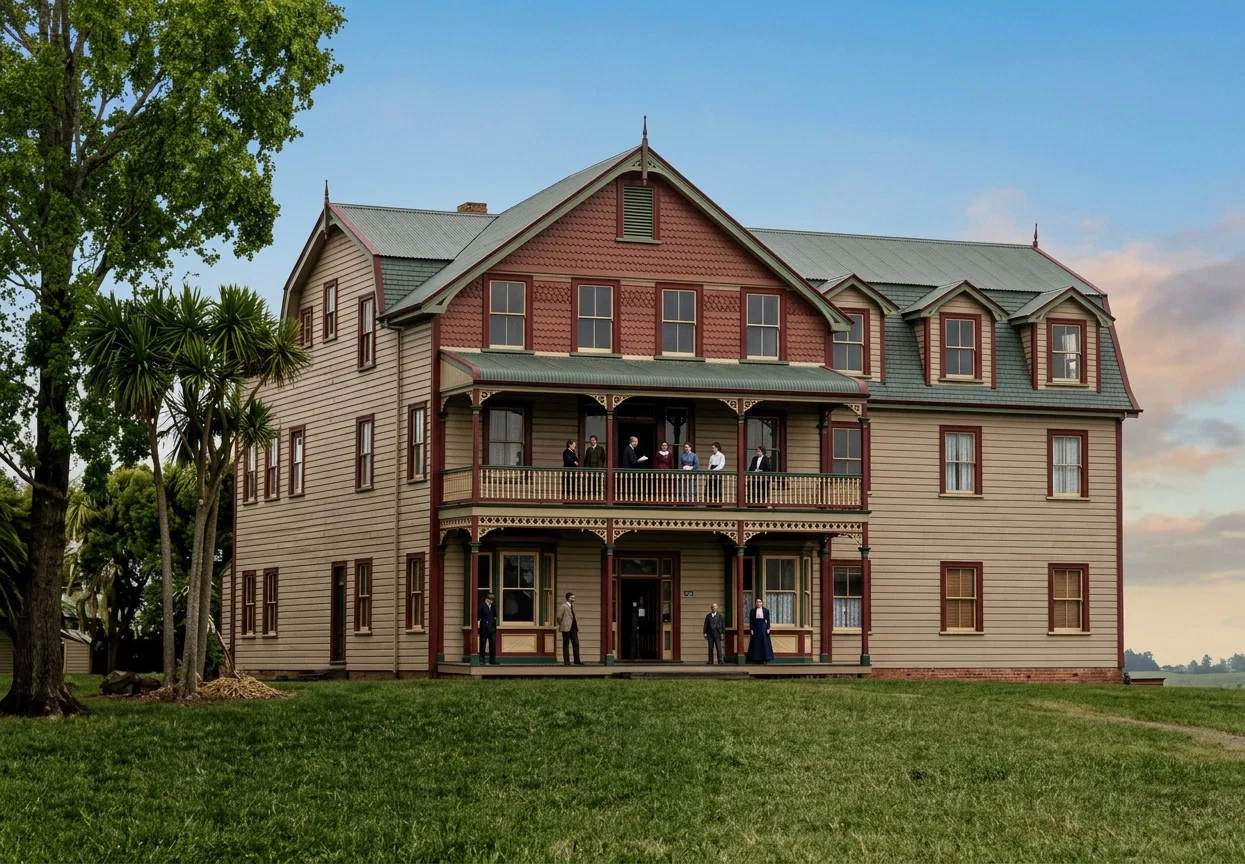
Prof. C. W. Irwin and Brother F. L. Chaney were, through the kindness of the union conference, permitted to come and help us in counsel and plans for the buildings, and Brother Chaney was left with us to connect with the work in New Zealand. He superintended the building, as he had some experience in such work. The work was nearly all done by Brother Chaney, eight students, and the writer, with some help that was donated. In this way the building which is represented in the accompanying cut was erected, ready to open the school, within thirteen months from the date of starting the work of excavating for the foundation.
This building is a three-story on the front and four-story on the back. The basement contains a kitchen and a store-room 36 x 36 feet. Directly above this room is the dining-room, 36 x 30 feet.
Still above this room is the chapel, 36 x 36 feet, seated the same as the Avondale school, except that each seat is divided into two parts, so that each student can rise and sit independent of the other or without disturbing his neighbor in the same seat. Directly above the chapel are the students' rooms, making that part of the building four stories high. Then there are class-rooms, an office room, and a library,—sufficient in all to accommodate sixty students. When we are able, and as the needs require, another wing can be added to the left side of the main building, and this will accommodate about one hundred students. There are now in attendance at the school about sixty students, counting the day students.
PUKEKURA TRAINING-SCHOOL, CAMBRIDGE, NEW ZEALAND
The building is well planned for school purposes, and is neat and well ventilated. This building has cost sixty-five hundred dollars, not counting the work, and to pay this our people of this conference are just completing the sale of five thousand three hundred sixty “Christ's Object Lessons” at $1.33 each. We expect to have these all sold by the first of next July, less than two months. This will greatly reduce the building debt, and will leave the school in a fair way for prosperity with the blessing of the Lord.
A five-roomed cottage has also been erected for one of the teachers, a barn 60 x 30 feet, and a cow stable at the back of the barn the same length as the barn and thirty-four feet wide, capable of housing twenty-six cows. The barn has a loft in which thirty-six tons of hay and oats were put during the last harvest.
The teaching staff consists of six teachers, as follows: Prof. F. L. Chaney, and Mrs. Chaney; W. J. Smith, Miss Piper, Miss Sisley, and Miss Hare, besides the matron, Mrs. A. S. Higgins, and the teacher in carpentry, Brother A. S. Higgins. The conference pays the Bible teacher, since he is as truly teaching the truth as if he were in the field.
Our school has now been running three and one-half months, and all are of good courage and are happy in their work. Since the camp-meeting, which was held on the school farm last January, about two weeks before the school opened, more than twenty of the students have been brought to the Saviour, and now are rejoicing in the love of God and in the truth. This good work is still going on in the school.
We are now hoping not only to provide our own field with laborers in the near future from the young men and women at the school, but to be able to send many to the fields beyond, to help to finish the great work that God has committed to us as a people.