Review and Herald Publishing Assn. · Washington, D. C. · May 24, 1904
Where the Nation’s Wealth Is Stored
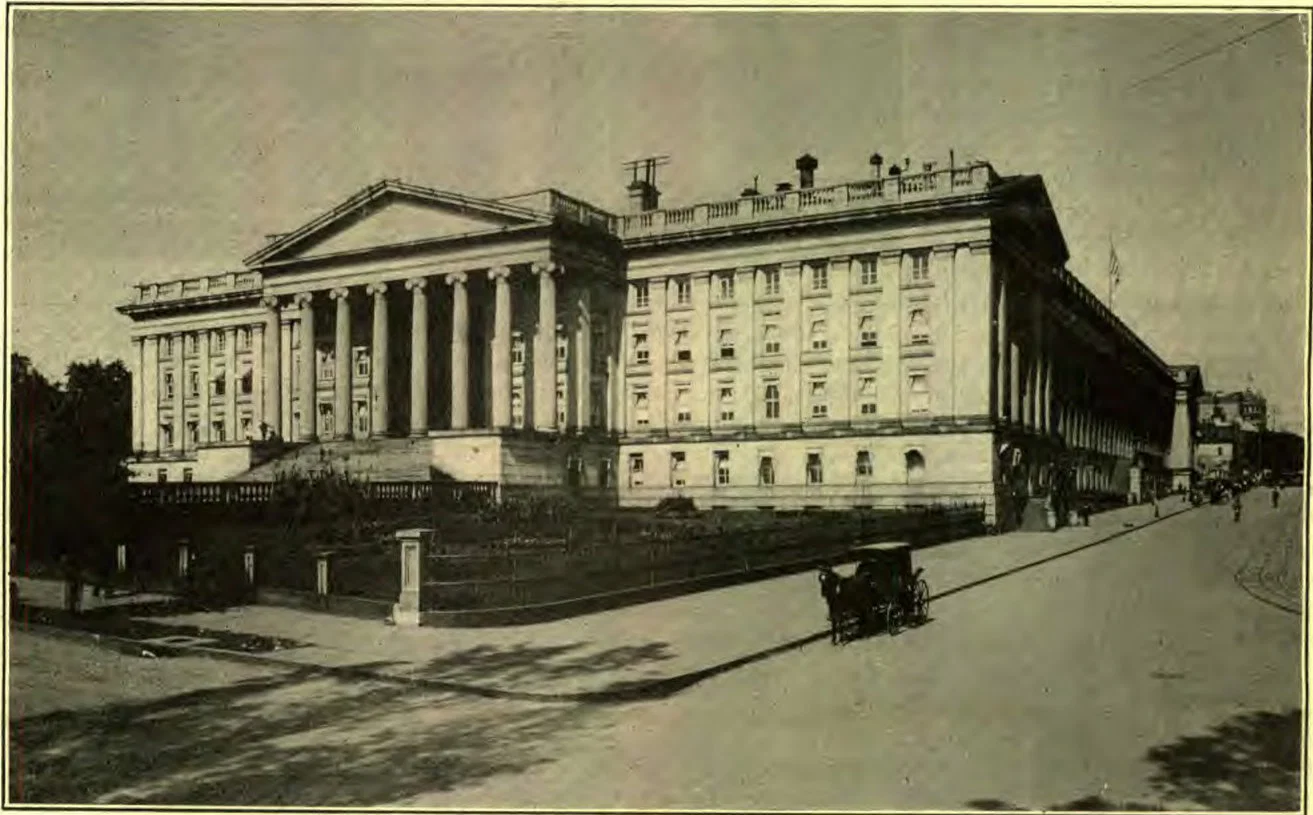
Of the various magnificent government buildings of the city, the Treasury has the distinction of being second only to the Capitol itself in architectural importance and costliness. The building is four hundred sixty-six feet long and two hundred sixty-four feet wide, and cost $10,000,000. Twenty-two years was it in building, being completed in 1869. It is an imposing structure, and very appropriately gives the impression of solidity and security. It is interesting because of its service to the nation; yet its location and the sameness of its great gray walls, with but little save the immense Ionic columns to break the monotony, make it somewhat of a disappointment to the visitor. It stands just beside the Executive Mansion—a convenient location—but in the main thoroughfare. This is to be deplored; for it should have been placed “amid grounds commensurate with its dignity, instead of obtruding it unceremoniously upon the thoroughfare.” This was the intent of the architect, but President Jackson became impatient at the long-delayed choosing of a site, and finally struck his cane into the ground one morning, and said, “Build it here!” and here it is to-day.
Its situation, however, does not seem to detract from its interest nor utility; for the interest here, of course centers in the money—how it is made, counted, preserved, the new exchanged for old, and the old destroyed. A company of well-trained guides is always on hand to explain to the ever coming and going throng of sightseers the mysteries and intricacies connected with the making and storing of those bits of paper so highly prized. The universal personal appreciation of money is recognized by the government in that the visitor is forced everywhere to look between iron bars, or stand outside solid, heavy steel doors and think merely of the millions on the other side, as the guide volubly explains—so carefully is everything guarded.
Visitors are first shown the Marble, or Cash, Room, which is said to be one of the costliest rooms in the world. It is not large, but cost $300,000. Neither delicately nor highly ornamented is it; its plainness rather is conspicuous to one who has just come from the Capitol or the Congressional Library. This room serves as the Cashier’s Office. The daily transactions run into the millions, and checks of enormous values are often cashed here, sometimes reaching as high as $10,000,000. The whole country is supplied with money from this room. Much of the work of making new money is done at the Bureau of Engraving, which will be doubtless described at another time. At nine o’clock every morning a million dollars is brought to the Treasury from the Bureau of Engraving in a locked steel wagon attended by a force of guards. It is taken to the Division of Issue. There experts verify the contents, one thousand sheets to the package, each sheet being composed of four notes of the same denomination. This money then is taken to the Sealing Room, and receives the seal appropriate to the denomination. It may be interesting to observe what denominations have the blue seal and which the red. If you chance to have any $10,000 certificates among your small bills, observe their seal. The Treasury seal has come down to us from the Continental Congress, and bears the inscription which is thought to express the hope of our forefathers; for it reads, “Seal of the Treasury of North America.” It was then hoped that Canada would join the Revolution and become one with us. Having received the seal, the sheets are cut into the four component notes, and the money then in packages of four thousand bills passes to its final counting. To guard against any possible mistake, these packages go through the hands of five successive counters. Each person to whom a package is even temporarily intrusted is obliged to receipt for it, so that its history may be traced from the paper mills to the Cashier’s desk; this necessitates fifty-two different persons separately counting the bills and receipting for them.
THE TREASURY OF THE UNITED STATES
The rapidity with which the lady counters do their work is marvelous both from a physiological and psychological standpoint. The counters lift each note by the upper right-hand corner, counting taking note of the seal and of any imperfection. The counting of fifty-two thousand notes a day is the requirement in some of the departments. Each counter is held financially responsible for any mistake she may make in her count, and no one is allowed a second count. The continuous intense concentration of mind demanded of these experts often results in serious injury to the nervous system.
Having received the final count, the money is sent to the sealing clerk, who makes it into packages containing from four thousand to four million, wrapping each in brown paper, and sealing them with the Treasury seal. The amount of money received by him at the close of the day must correspond exactly with the amount brought from the Bureau of Engraving and Printing. If it does not, every employee is held until the mistake is found. The money is now secured in the currency reserve vault.
The Treasury has seventeen vaults, and two new ones are being built. These are not mere closets like the largest of money-safes, but rooms. Vault Number 1 is a room eighty-nine feet long, fifty-one feet wide, and twelve feet high. Until the Spanish War, visitors, accompanied by guides, were permitted to enter the vaults; but at that time the Secretary of the Treasury ordered that no one be allowed to see inside of them, and the order has not been revoked, much to the regret of many. The eight vaults under the direct supervision of the Treasurer of the United States contain $1,133,523,289.18. The gold and silver in them weighs five thousand tons.
The money before being placed in the vaults is weighed by a pair of scales so delicate that they will register the weight of the ink required to write your name, or the weight of a hair from your head.2
At every change of administration, on the appointment of a new Secretary, all the money in the various vaults is counted. This is usually regarded as a three-months’ task for a committee of thirty-five men. When changing from the Cleveland to the McKinley administration, six months were required for the counting. Why this extra time was necessary, I was not informed.
In the Division of the National Banks, there are bonds to the value of $610,000,000 deposited in the vault. There are three hundred fifty national banks represented here. The government does not in any way guarantee the circulation of the banks of the country, but it makes this circulation perfectly safe by requiring each national bank to put up government bonds as security for its circulation. It may be of interest to those who have not already done so to observe the difference between a one-dollar bill issued by a bank and one by the government.
In the Redemption Division old money is exchanged for new. It is sent in from the banks throughout the country and from the sub-treasuries, which are located in Boston, New York, Philadelphia, Baltimore, Chicago, St. Louis, San Francisco, Cincinnati, and New Orleans. The mints are at Philadelphia, New Orleans, Denver, Carson City, and San Francisco. The old money is brought to the Treasury by the express companies in sealed packages. New dollars are given for all old ones received. The amounts having been carefully verified, the counter takes the money to the canceling machine, which punctures four holes through it, two in the upper half and two in the lower. The canceled packages are then taken to the cutting knife and cut lengthwise each half bearing the initials of the counter and the amount contained in the package. The upper half is sent to the Register’s Office, and the lower to the office of the Secretary of the Treasury. In these offices the half sheets are counted, and if the results agree, the money is sent to the macerator to be destroyed. If a counterfeit bill is found to have passed unnoticed by the counter, the amount is deducted from her wages.
In the office of the Secretary, there is a bill framed which was sent in to pass for a five-hundred-dollar bill. It was found to have been made of sixteen pieces cut from sixteen other five-hundred-dollar bills that had been previously redeemed as “mutilated” bills. Had the counter been less observing, she would have met with quite a deduction in her salary.
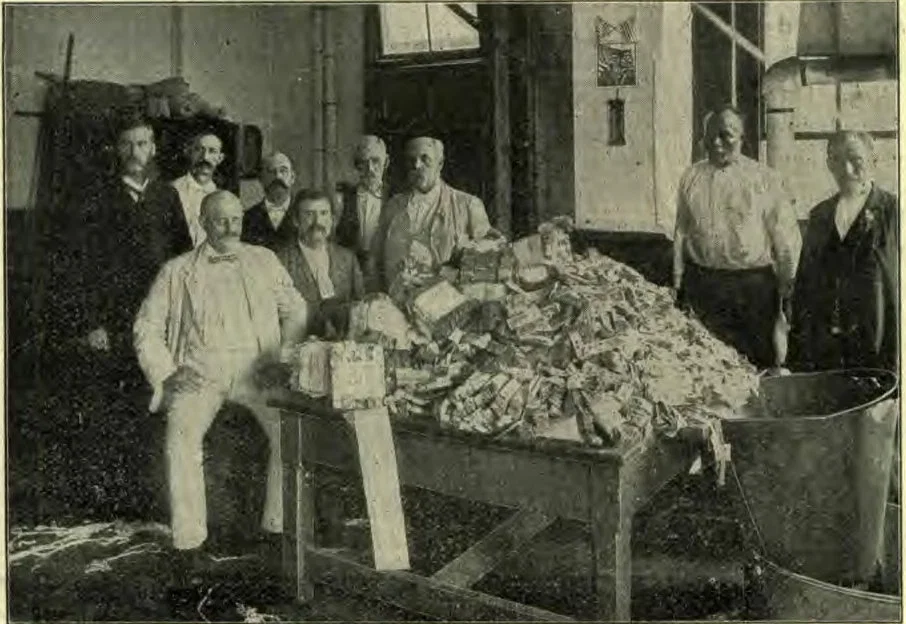
“The macerator is a huge spherical receptacle of steel, which contains water, and is fitted in the interior with closely set knives, which as they revolve, grind the contents of the machine exceedingly fine. The massive lid is secured with three Yale locks, each with its own individual key. The key of one lock is held by the Treasurer, of another by the Secretary, and of the third by the Comptroller of the Currency. Every day at one o’clock these three officials, or their deputies, with a fourth one to represent the banks and the people, assemble at the macerator to deposit in it the money to be destroyed. Each key-holder unlocks his respective lock; the lid is lifted, the money deposited, and the machine locked again, and left to do its work of destruction.” After the currency has been ground into a fine pulp, it is sent to the Bureau of Engraving to be rolled into sheets of bookbinder’s board, and sold for $40 a ton. It is also made into cardboard, Pullman car-wheels, tubs, pails, wrapping-paper, and souvenirs. One may buy a souvenir made of this old currency for a few cents that represents thousands of dollars. A million dollars a day is the usual amount that is destroyed, but on June 27, 1894, the Committee in one day sent to the macerator $151,000,000.
“In a room not open to visitors, works an expert in burned money, and in shreds and patches of currency, which would defy the skill of one less acute and patient. Her task is to unravel mysteries and solve problems which are exceedingly difficult of solution.” Some one unfortunately had fed his money to the swine, but the expert was able to detect in the pulpy mass traces of a ten-dollar note and also of a five-dollar bill.
A woman had hid her money for safe keeping in a grate, and afterward set fire to the contents of the grate without thinking of her money. The expert was able out of the fragments to identify a ten-dollar bill and two five-dollar notes. Many packages of such money is sent to the Treasury to be redeemed. If three fifths of a note is received, the bill is redeemed for its face value. If less than two fifths is received, it is not redeemable, unless it can be absolutely proved that the rest was destroyed.
CURRENCY DESTRUCTION COMMITTEE
The carelessness of some employees, even where it means much, is sometimes observed. Yet it is not strange that where drafts, vouchers, and bonds worth anywhere from one dollar to ten thousand dollars, and even more, are handled continually as so much cambric, that now and then inadvertently a slip of paper representing thousands of dollars falls into the basket.
To obviate losses that would result from the thoughtlessness on the part of any employee, two women classed as “experts” are employed by the government to examine waste-baskets. Hour by hour each day they go carefully through the piles of waste paper brought to them from hundreds of baskets. Not long ago one of the women found a ten-thousand-dollar bond.
Every basket is numbered so that the mistake can be readily traced to its author.
At the beginning of this present year, there was $2,763,152,326 in circulation; but even this vast sum if distributed evenly among all the inhabitants would give each one just $30.38. When one thinks of the many millionaires and the large business firms owning millions, he appreciates the fact that there must be a large number of persons who have not a penny. There are in circulation 447,175,860 gold certificates—the smallest denomination being a $20 certificate—and 469,425,000 silver certificates. The government has enough gold and silver coins deposited in the Treasury vaults to redeem every paper certificate. These are accepted all over the country simply because the people know that whenever they present the notes, they will be paid in gold or silver by the government, if the demand is made. Down in various South American countries, Colombia for example, there is paper money very similar to ours, but there is no metal behind it; so a sackful of it is required to make a meager purchase. There are more $10 bills in circulation than any other kind, perhaps to the surprise of those of us who deal more with the $1 notes than of any other denomination. The $20 notes claim precedence over the $5’s and $1’s.
Other departments of the Treasury have to do with various interests, such as the Bureau of Navigation, Lighthouse Board, Life-saving Service, Steamboat Inspection, Supervising of Erection of Government Buildings throughout the country, and the Customs and Internal Revenues.
Heard in the Street
What Was Said
You will find me most any time.
I told the two of them to go home.
I didn't look to see you to-day.
I have forgot my cheque-book.
The lines of that building are terribly good.
When he had money, he threw it away.
Was you a-callin' me?
I would kind of like to know where he is.
He always done his work well.
Where can I find McCarthy, he who moved your furniture.
A widow woman lives in the lower tenement.
Neither of them have any beauty to boast of.
Fresh air and exercise are the best preventatives.
You know as well as me that he never said no such thing.
I'll be glad to do all I can.
Where's my gloves?
You needn't put on kids to go there.
I had just laid down when the door-bell rung.
If I was as old as you be, I think I'd be able to do it.
This dress has never been laundered.
Where are you going to?
“I wish I could find a thing where it ought to be,” says I.
What Should Have Been Said
You will find me at almost any time.
I told both of them (or, them both) to go home.
I didn't expect to see you to-day.
I have forgotten my cheque-book.
The lines of that building are exceedingly good.
When he had money, he threw it away.
Were you calling me?
I should rather like to know where he is.
He always did his work well.
Where can I find McCarthy, him who moved your furniture?
A widow lives in the lower tenement.
Neither of them has any beauty to boast of.
Fresh air and exercise are the best preventives.
You know as well as I do that he never said any such thing.
I shall be glad to do all I can.
Where are my gloves?
You needn't put on kid gloves to go there.
I had just lain down when the door-bell rang.
If I were as old as you are, I think I should be able to do it.
This dress has never been laundered.
Where are you going?
“I wish I could find a thing where it ought to be,” said I.—Selected.
Proposed Bridge Linking Europe and Asia at Bosporus
EUROPE and Asia are to be connected by a bridge over the Bosporus, where the Persian king, Darius, crossed with his army, 513 B. C.
How Ice Is Made
By Edison Driver
“How is ice made, grandpa?” asked Joe, one especially hot evening.
“Yes, grandpa, where do they get the cold from when everything is so hot?” said Jenny.
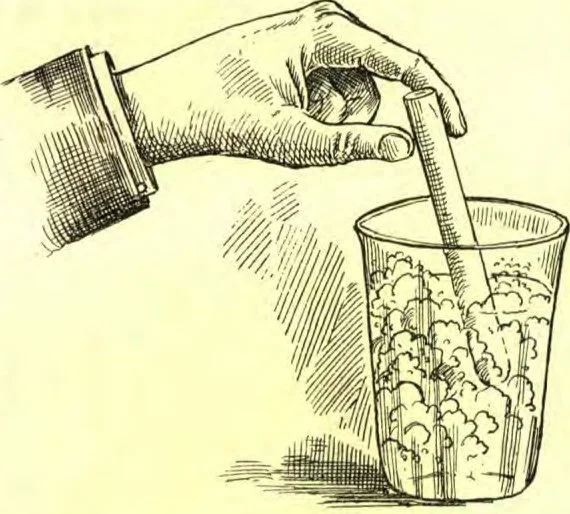
By way of answer grandpa took up a glass of water from the table, where it had stood for some time, and put some of it on the back of Jenny’s hand. Then he fanned it briskly with his palm-leaf fan.
“Oh,” cried Jenny, presently, “that’s almost as good as winter!”
“Well,” said grandpa, thoughtfully, “where did the cold come from when the water and the air were both warm? Now I will tell you. Whenever water evaporates, it takes heat out of whatever is near it. Don’t ask me why it does it, nor how it does it, because that is a very long story; it simply does it in order to get heat enough to cause it to evaporate.
Ice on the Great Desert
“Why, children, on the hot old Sahara Desert I have seen water as cold as the ice-water in the pitcher there, prepared simply by a process of evaporation. At the time the air was burning hot, the great sand waste fairly gleamed in the fierceness of the sun, but there, out of it all, came delicious, refreshing coolness. I tell you, it made me think of the wisdom of our Lord, who can bring calm out of storm, success out of failure, and reveal joy to the saddest heart. Let us but find the right way, and all the hard things of life will yield blessings to us.
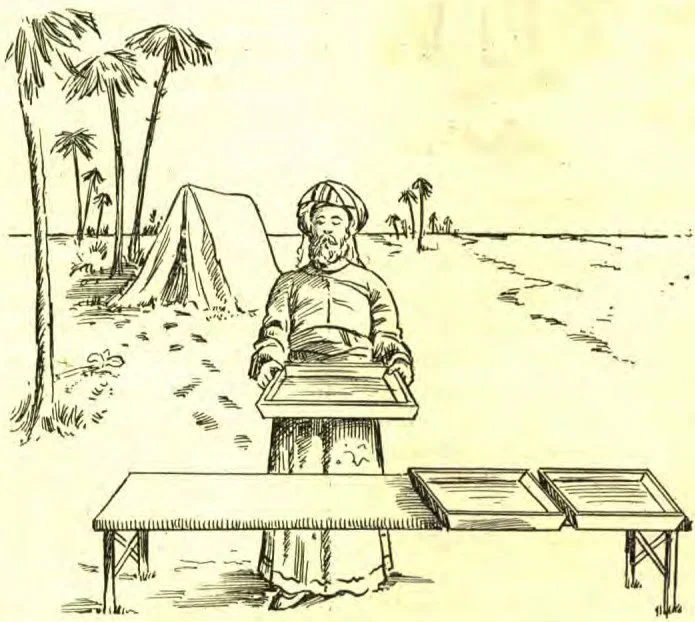
“Now I have drunk cold water on the desert; but in some parts of it a stranger thing has been observed. There men set out shallow earthen dishes of water in the wind at night, and the dry, hot air drinks up the moisture so fast, and carries such great quantities of heat from the water, that it soon sinks below freezing point, and becomes ice. Several of these frozen together make a piece that can be stored away for future use. To one who has not seen it done, this seems an impossibility; and to one who has, a miracle!”
“Could we make it that way?” asked Joe.
“No, because in our atmosphere water does not evaporate easily enough. To make ice here requires a lighter liquid. Alcohol is one of these, and ether is another, and ether machines are quite widely used for making artificial ice.
“However, one liquid, known as anahydrate of ammonia, has been found greatly superior even to ether. This is simply pure ammonia gas condensed like liquid air, and stored in steel tanks under great pressure. If left open to ordinary air and pressure, it evaporates like water in a furnace; or, to be more exact, boils at twenty-eight and one-half degrees below zero! Now, if water evaporating from your hand makes it cool, what would ammonia do? Yes, it would freeze it in time; and that is just what it does with water.
“In order not to waste the ammonia, it is allowed to evaporate only inside of great coils of pipe in tanks where the water cans are set. After it has evaporated once, it is sucked out by a powerful steam-pump, and compressed into liquid ammonia again, when it can be allowed to evaporate again and again, as many times as may be required to freeze the water in the cans.”
“Where does the heat it gets from the water go to, though?” demanded Joe.
“Ah, yes!” smiled grandpa, “I’m glad you reminded me of that; for it is really interesting. In compressing the ammonia into liquid, every bit of heat it steals from the water is forced out of it through the iron of the pump. You would be surprised to see eggs and even meat cooked on an ice machine, wouldn’t you? But such a performance is not at all uncommon, and really not strange either, when you come to think about it. Suppose, for instance, there are a hundred tons of warm water to be frozen, and all the heat in that water above freezing point must be drawn out through the pump,—why, isn’t it a wonder the iron itself doesn’t melt?”
“The main expense incurred in making artificial ice comes in the power that is required to run this heat-removing pump, sixty pounds of ice being produced for each four pounds of coal burned in the compressing engine.”
Why Ice Freezes Cream
“Sixty pounds!” exclaimed Joe, “why, that was just what we had at the picnic; but somebody forgot the salt, so we couldn’t freeze the cream a bit! What does the salt do, grandpa?”
“It makes the ice melt quickly, my boy, by undermining its structure. And ice requires much heat in order to melt, rapidly, just as truly as water requires heat in order to evaporate. The heat is taken from the ice-cream mixture, which then freezes. But the ice and salt do not give cold to the cream; remember that. They take heat from the mixture, notwithstanding many think the opposite is true.”
Having promised to perform some work-table experiments in cold, and to explain such things as blizzards, liquid air, and red snow at some future time, grandpa left the young people, and went out to hoe his melons in the twilight.
EDISON DRIVER.
In the Laboratory
By S. Alice Ranlett
“How pretty your working material is!” I said, seeing on the laboratory table a collection of delicate crystals of various prism forms, and of pale flesh-pink, yellow, translucent white, deep sky blue, and shining pearl tints.
“But you are spoiling the dainty things!” I added, as before the slender, intense blow-pipe flame, I saw a crystal-clear, shining flat prism turn opaque-white and crumble into powder.
“I have only removed from the crystal its water supply,” the chemist answered.
“Its water supply?” I repeated, taking in my hand another crystal of the same kind; “can these hard, shining prisms and these beautiful sky-blue crystals contain water?”
The chemist placed a blue crystal in a test-tube, and before the heat it also fell to a powder, and, besides, lost its clear-blue color.
“These pearly gypsum specimens,” said the chemist, “and the white and blue vitriol, with other minerals, depend for their crystal forms, in a mysterious way, upon their water of crystallization, which is not present in them as water, but is chemically combined with their substance; when this is driven off, the crystals generally crumble into powder.
“As you have seen, this water of crystallization does not seem to be any real part of the minerals, yet it is essential; without it, these pearly-white and sky-blue prisms can not be.
“May it not be that some of those elements,— pain, trials, sorrow, temptation,— which come so mysteriously in our lives and seem not to be any true part of them, but only to harm and mar, are really like the strange water of crystallization, absolutely necessary in God’s hidden plans to our lives, parts without which they would be dead, useless, unbeautiful things, never rising to the glory for which God designed them? Through tribulation comes patience, and patience must have ‘her perfect work,’ that ye may be ‘perfect and entire, wanting nothing.’”—S. Alice Ranlett.
Diligence Is the Mother of Good Luck
“DILIGENCE is the mother of good luck.”
Knowing Where to Look for Things
“NEXT to knowing a thing is knowing where to look for it.”
Living for the Betterment of All
“How much we take, how little give!
Yet every life is meant
To help all lives; each man should live
For all men's betterment.”
A Mechanical Envelope-Licker
A MACHINE that will seal from 8,000 to 15,000 envelopes an hour will commend itself to large commercial houses, government departments, political committees, and other institutions and organizations that send out mail in great quantities. Such a machine to handle envelopes of any ordinary bulk has recently been invented. Mixed sizes also may be fed to it.
The envelopes are supplied to a hopper, and are carried by an infeed belt and co-operating attachments to a moistening device. The latter holds the flap turned down during a portion of its travel through the intricate mechanism, moistens it, and presses it into a sealed position. The envelope is then delivered from the contrivance, and is ready to be stamped and mailed.
In large institutions at present, the business of sealing letters for the mail is a formidable undertaking. In the Treasury Department, for example, from ten to fifteen thousand letters are deposited daily in the mails. To seal these, the envelopes are placed face downward with their flaps overlapping, and clerks moisten them with paint-brushes dipped in water or paste. Each envelope then must be withdrawn, folded, and sealed.—Selected.
A Good Report
In a letter just received from the secretary of the Young People’s Society at Fresno, California, is an encouraging report of the work which has been done at that place. Perhaps some who are wondering what they can do, may get some suggestions from the following extracts which will help them to find the little things that lie nearest to their hands, for the command is, “Whatsoever thy hand findeth to do, do it with thy might.” Thus we know that the Lord wishes us to do the work that lies nearest to us just wherever he has placed us.
“Our meetings have been instructive and profitable. Among the subjects considered have been Conversion, Importance of Sound Doctrine, Experience of Advent People During 1843-44, Brother Lambert’s Missionary Experience in England, etc. We have also had readings from the Signs, Instructor, Life Boat, and other papers, and have had some papers written about foreign fields, besides having recitations and songs on religious subjects.
“The younger members of our Society have been doing quite a good deal of missionary work during the past quarter by selling Life Boats. I had a profitable experience myself in this work. It was my first effort with the Life Boat, but in about two hours I sold nineteen papers on the street.
“Last week our church pupils made a poor drunkard’s family glad by taking them a generous supply of provisions that had been contributed by different ones.
“We hold meetings every Sabbath, as a rule, at the hospital, and one of the young men supplies the prisoners at the jail with Life Boats and other reading-matter. Another is canvassing all the barbers in town for the Life Boat, and will keep a supply in each shop for the customers to read.
“A few days ago a call came to one of the leading newspapers for reading-matter for the soldiers in Manila, as they were sorely in need of it. An invitation was given to all to contribute, so our church embraced the opportunity to send a supply of our literature.”
Surely these young people are sowing seed which will bring them a glad harvest when Jesus comes.
MRS. CARRIE R. KING.
Missionary Gardens
By Hattie E. Allee
Last year a number of our Sabbath-schools throughout the conference were much interested in the plan suggested for missionary gardens, which afforded opportunity for many of the children as well as the youth and older members of the school to increase their donations to missions. The Lord is well pleased with systematic, well-defined methods of work in his cause, and abundantly blessed the efforts put forth by the Sabbath-schools last year.
In the autumn a large number of Sabbath-schools held an “Ingathering Service,” at which time they brought their offerings and presented them to the Lord with songs and prayers that he would accept the gift of the altar.
From a letter just received from the superintendent of the Horr Sabbath-school I quote the following, believing it may encourage others to engage in the same work:—
“We are planning for a large missionary garden for each family this summer. Our school is anxious to do much more for missions.”
To parents, teachers, and officers of the Sabbath-school, I wish to say, Begin to plan at once for this work for the summer. Enter into it heartily for the encouragement of the children, and while fostering in them the real missionary zeal and spirit, your hearts will be watered and abundantly blessed of heaven. The children desire to do something, but do not know how to begin work. With a little direction and encouragement they will enter heartily into the plans outlined. All may not be located where they can have a garden plot, but on some portion of the lot each may have a flower bed. There are many ways of earning something.
As never before in the history of our work are funds needed to carry the message to the world. The question of obtaining donations for the foreign missionary work may be solved by curtailing many supposed and imaginary wants. That which costs self-denial in its bestowal brings a peace and joy to the donor which easy and convenient giving can never bring. The keynote of Christian living is found in self-denial, in sacrifice for other's good. Christ emptied himself and gave all for us. We in turn should count it a blessed privilege to give all to him.—Hattie E. Allee, in West Michigan Herald.
Chapter Study: “Great Controversy,” Chapter Thirty-nine, from page 624.
Lesson Topics:—
Last-day deceptions.
God’s people flee to the mountains for refuge.
Their imprisonment and bondage.
God does not forget his children in their extremity.
Ministry of angels.
Promised deliverance.
Again, it seems that nothing could be as impressive as the words of the Chapter Study; then let the leader urge as many as can to bring “Great Controversy,” and read together the lesson. A social meeting can follow the reading with interest and profit.
If I Can Live
By Helen Hunt Jackson
If I can live
To make some pale face brighter, and to give
A second luster to some tear-dimmed eye,
Or e’en impart
One throb of comfort to an aching heart,
Or cheer some wayworn soul in passing by;
If I can lend
A strong hand to the fallen, or defend
The right against a single envious strain,
My life, though bare
Perhaps of much that seemeth dear and fair
To us on earth, will not have been in vain.
— Helen Hunt Jackson.
Busy Bees’ Missionary Society
By Ruth Williams
NOTWITHSTANDING the stormy weather of the first quarter of the new year, the Busy Bees’ Missionary Society of the Hartland, Vermont, church has met regularly every week, with very few exceptions. Although it was seldom that all the members could attend, those who could meet were not idle.
A web of cotton cloth has been purchased and made into sheets and pillow-cases, which are nearly ready to send to the treatment rooms at Burlington, Vermont.
Enough blocks of patchwork have been pieced for one quilt and half of another one. As soon as they are put together and tacked, they will be sent where they are most needed.
In addition to the seventy cents reported, $1.20 has been received for the feather dusters, made by the children last quarter. Nearly all the dusters have been sold by the younger members of the Society.
Twenty-two packages of papers have been wrapped and sent to different addresses.
There is now $1.41 in the treasury. The Society is laying plans for this quarter’s work, which, if carried out, will truly earn for each active member the name “Busy Bee.”—Ruth Williams, Assistant Secretary.