ONE of the most malignant of the family foxes is discourtesy, and he creeps into households where one would not suppose it possible for him to find even momentary hospitality. People who are ordinarily polite, well-bred and genial, are sometimes guilty of rudeness in manner and speech and action at home, of which they would be ashamed in society. Parents are hasty or fretful in their way of addressing or reproving children, and children forget the respect and honor due to parents. A great deal of unhappiness overclouds homes which might be bright as the morning, but for this wretched habit of brusqueness and incivility which fastens on some unfortunate victims like a second nature. It has its different phases, to be sure. When papa indulges in it, the family are apt to say that he is tired. If it is mama that is irritable and peevish, it is intimated that she is nervous. Like the lady in a charming little magazine-story, it is benevolently supposed that she may have "neural" on the top of her head! When aunt Kitty or sister Sophy are short and snappish, it is excused because they were up late last night to a party, and it is only little Floy or small Tom who is sent to bed in disgrace for answering impertinently and frowning blackly. A little leaven leaveneth the whole family lump, and it is curious to observe how rapidly and certainly this evil infection spreads. "Quiet people have quiet children," said a plain women to me the other day, and she was right. Persons who are invariably polite to each other in the presence of their sons and daughters, do not often have to check the latter in a thoughtless or improper manner of speaking, for courtesy as well as its opposite, is atmospheric and educational. It is worth while, if the fox we are thinking of has intruded into our vineyard and begun his work of spoiling our tender grapes of good-will, of gentleness, and of daily cheer, to think how best to banish him. There are three magic P's, which have never failed when properly179used, to utterly rout and destroy the subtle foe. Their names are Patience, Perseverance, and Prayer. If you feel that your family has fallen into the custom of being cross and unmannerly, pray first to have your own heart and temper sweetened, then meet angularity and crookedness with invincible patience, and be not discouraged in setting a good example.
—Mrs. Sangster, in Christian at Work.
HARMONY OF CHARACTER.
By Young Man's Counselor
The Abbe Mennais has made this beautiful remark: that “from the sun, whence pour inexhaustible floods of light and life, down to the spring that drop by drop exudes from the rock, all is ordered for a given end, to which all contribute in an infinite variety of ways, that are the more admired the more they are contemplated. There is not an action, a movement, in the universe, that does not successively contribute to the growth of a tuft of moss.”
In this harmony of nature—a harmony so complete and so necessary, that the failure of any one operation in the universe would neutralize the action of all the rest, and denude the earth of its beauty and adornment,—we may learn a profitable lesson in relation to the influence of character upon success. I wish to say with emphasis, that as in the operations of nature, so in the conflicts of life, the effect of great success is produced by the harmonious combination of each and every valuable quality. The absence of one qualification may hinder the productiveness of all the rest; the excess of another may undo all that the proper action of the rest had accomplished. For example, let a young man be industrious, versatile, energetic, intelligent, and yet lack integrity, what becomes of his prosperity? He may acquire wealth by dishonest means, but he must live without the confidence of good men, and die “as the fool dieth.” Or, suppose him to have integrity, intelligence, industry, economy, and to be defective in energy; he will sink in spite of all his high qualifications, beneath the obstacles which lie in every man’s path to eminence. Or, again, let him have an excess of energy, he will be rash and fall into irretrievable ruin; let him be excessively frugal, and he will become a miser; let him be over versatile, he will be the “rolling stone which gathers no moss;” an excessive attachment to letters will convert him into a theorist or a book-worm. Thus, it is apparent, that, to insure success, a young man must diligently attain and prudently cultivate all those particular excellences, which, when possessed in combination, make a failure next to impossible.
What reader of Holy Scripture has not felt a most tender regard for that interesting youth, who, in all the eagerness of self-confidence, stood complacently before the great Teacher, and asked:—
“Good Master, what shall I do to inherit eternal life?”
With what elation of soul did that young self-deceiver listen to the reply of the great heart-searcher: “If thou wilt enter into life, keep the commandments!”
Exulting in his fancied triumph, the young man replied: “All these have I kept from my youth up! What lack I yet?”
By one stroke—a stroke severely kind—the Redeemer prostrated all his hopes: “YET LACKEST THOU ONE THING!” And then he gave him a practical test, which at once unfolded his true state to his startled mind, and convinced him that, however externally spotless he might be, his heart was supremely selfish. He lacked that self-devotion to the glory of God which is the essence of all true religion—a lack that neutralized all his excellences, and was fatal to his confidence in the Divine favor.
Young man, you may, in like manner, fail of true greatness through one fatal deficiency, and be ranked with the men so fitly described by the great English bard:—
“Men
Carrying, I say, the stamp of one defect,
Their virtues else (be they as pure as grace,
As infinite as man may undergo)
Shall in the general censure take corruption
From that particular fault.”
Lord Byron’s history furnishes a most painful example of the ruin resulting from the want of symmetry in character. To use the splendid diction of Macaulay, “He was born to what all men covet and admire. But in every one of those eminent advantages which he possessed over others there was mingled something of misery and debasement. He was sprung from a house, ancient indeed, and noble, but degraded and impoverished by a series of crimes and follies. The young peer had great intellectual powers; yet there was an unsound part in his mind. He had naturally a generous and tender heart; but his temper was wayward and irritable. He had a head which statuaries loved to copy, and a foot the deformity of which the beggars in the street mimicked. He was distinguished by the strength and by the weakness of his intellect; affectionate, yet perverse,—a poor lord, and a handsome cripple.”
What was the result of these opposite combinations?—of this lack of moral symmetry? The first noticeable efforts of his muse, being directed by his perverse temper, brought him a harvest of contempt and hatred. Stung to the quick, he exerted his noble genius, and produced a composition which raised him to the pinnacle of fame; and “all this world, and all the glory of it, were at once offered to him.” Like a spoiled child, he now yielded to the violence of his passions, and the bitterness of his temper. For this, society cast him out of its pale. He fled to Italy; and there, by turns, cultivated his genius, and gratified his passions. He lost his health, his hair became gray, his food ceased to nourish him. The Grecian struggle for independence roused for a time his nobler sentiments. He dragged his diseased body to Missolonghi; and there, at the age of thirty-six, this “most celebrated English-man of the nineteenth century closed his brilliant and miserable career.”
Who will deny that Lord Byron’s life was a splendid failure? Why was it so? Not for lack of high qualities of men, but through excess of low and degraded passions. Had this unhappy man subdued his evil qualities, and sedulously cultivated what was high and noble in his nature, his name would have passed down to posterity as a model of all excellency and beauty. Neglecting this, he stands among the images of the past like some grim ghost on the great highway of life, scaring the advancing traveler from the ways of self-neglect and self-indulgence.
To resist temptations, to be prepared for all emergencies, to rise to real eminence, to answer life’s great end, you must avoid the example before you. You must cultivate all the conditions of success, and especially those in which you find yourself most deficient. See to it that there are neither excesses nor defects in your character, but a harmonious blending, a delightful symmetry, formed of fitting proportions of every high quality.
—Young Man's Counselor.
WHY SOME PERSONS ARE POOR.
In talking with a hired man who was a smoker, I asked him what his tobacco cost him a year. With some assistance in figuring, he found that the cost was only twenty dollars. He thought that was not a large sum. I told him by a few minutes calculation that if instead of smoking away twenty dollars yearly he would put that amount out at interest, and add the like sum every year, with interest also continually added in, he would accumulate in this way through life, say from twenty-five to sixty years of age, no less than four thousand dollars. He was startled at the amount, but had not the courage to leave off the habit. I knew another man, who used much more annually in tobacco, who discontinued the practice, and it enabled him in twenty years to build a three-thousand-dollar house. There are other practices which, wasting a very little at a time, cause a loss of a great deal annually. A domestic in the kitchen piles on the fire one-third more fuel than is needed. It amounts to a few cents daily, but twenty dollars at least in a year. Here is another waste of four thousand dollars in forty years. A farmer leaves his reaping machine exposed to the weather till November; his plows and harrows are out half the time; and in this way the needless decay amounts to more than twenty dollars annually—another sum running up to four thousand dollars, wasted. The want of fodder racks, and the exposure of his sheep and cattle to the winter, make a waste equal to fifty dollars yearly, and a loss of sheep by exposure, and the shrinkage in the flesh and milk of his cattle cause a yearly loss of fifty dollars more, over and above the cost or interest on properly erected shelter. These two sums would be equal to twenty thousand dollars in forty years of life-time.
There are many other small leaks, both on the farm and in the kitchen—such as scraps of bread thrown away, vegetables rotting for want of assorting, knives rusting for want of cleaning, tumblers broken by immersing in hot water, harness broken for want of oiling, carpets ground out by dirt under them, pumps split by freezing, tools decayed for want of oiling and painting; every single dollar of which thus needlessly wasted annually will amount to two hundred dollars in forty years, if with interest on interest. There is no necessity of being penurious or stingy, but only to prevent actual waste.—Advocate.
DEATH'S BLUNDER.
THE carven doors were open,
The sexton tolled the bell,
And the light from Gothic windows
Like shattered rainbows fell—
As through the perch of a splendid church
Crept little beggar Nell.
Low shrinking in the shadows
Beside the pulpit-stair,
She saw a little casket
Brought to the house of prayer,
And a sorrowing band of the rich and grand
Gather in silence there.
She heard the mournful music;
She heard the preacher say:—
"The Lord, who gave your treasure,
Hath taken her away.
Be sure, my friends, for the wisest ends
God worketh. Let us pray."
A ragged child stole forward,
While every head was bowed;
Through fragrant, snow-white flowers
She saw a snow-white shroud,
And golden hair, and a face most fair—
And she knelt and wept aloud.
Forth from among the mourners
Came the father of the dead.
He raised the little beggar,
And, wonderingly, said:—
"What strange child weeps for her who sleeps
With lilies round her head?"
"Why, Death has made a blunder;
'Twas me God meant!" she cried.
"I asked Him, for there's no one
To grieve, if I had died;
And there seems to be no room for me—
Though they say the world is wide."
"Nay, Death had made no blunder;
God means my heart shall be
Made sore enough by sorrow
To feel for one like thee.
It is his will that thou should'st fill
Her place, child. Come with me."
Now many friendless orphans
By him are clothed and fed;
In soothing others' sorrow
His own is comforted.
And Christ the Lord, as his reward,
Shall yet give back his dead.
—Congregationalist.
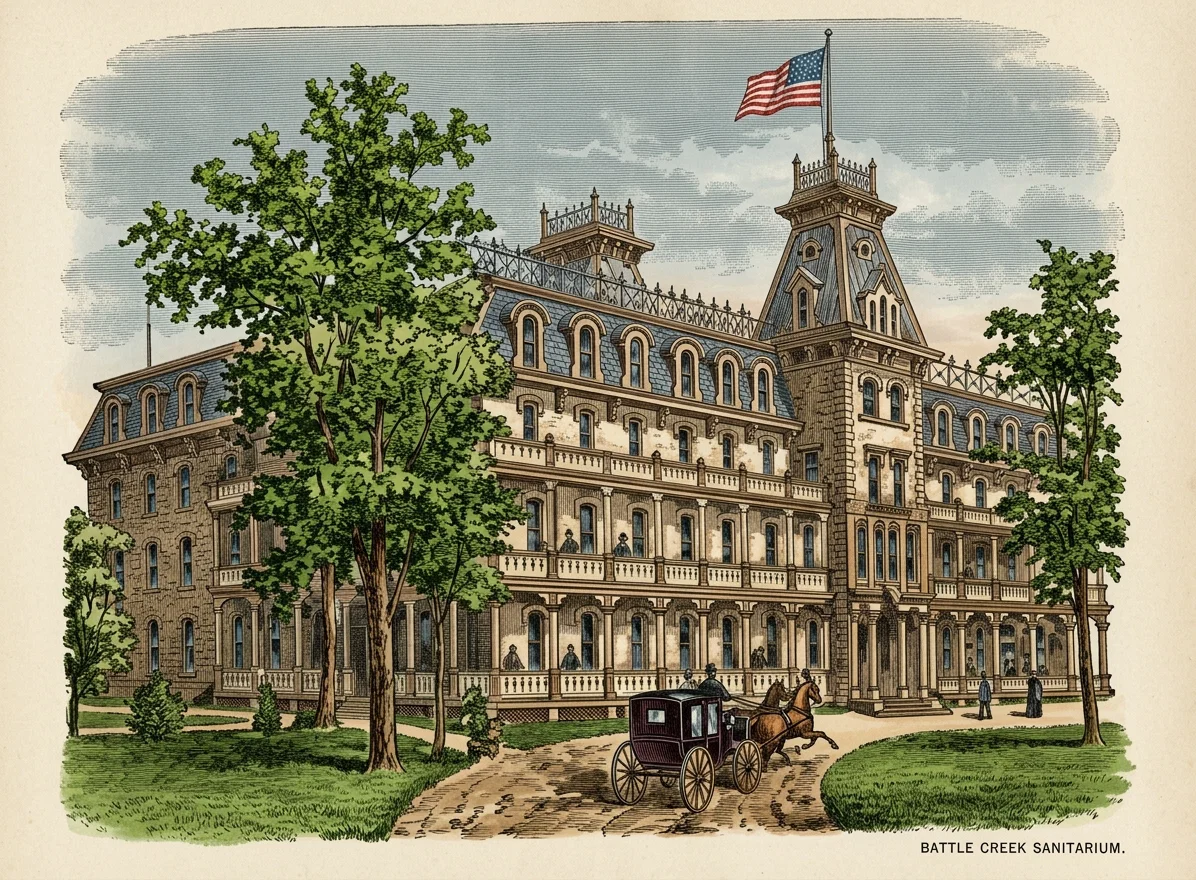
Battle Creek Sanitarium.
By John Harvey Kellogg
Institution Founded 1866......4000 Patients Successfully Treated.
THIS INSTITUTION, for completeness of appointment, and extent of facilities, is unrivalled in this country. Its splendid arrangements for HEATING AND VENTILATION, together with special appliances for regulating the humidity of the atmosphere, makes this Institution UNEQUALED AS A WINTER RESORT FOR CHRONIC INVALIDS.
Even persons suffering with pulmonary difficulties do much better here than in Florida.
All known useful remedies for disease are employed, including Turkish, Russian, Vapor, Electro-Thermal Electro-Vapor, all kinds of Water Baths, Sun Baths, Swedish Movements, Electricity, etc., etc.
Terms very reasonable. J. H. KELLOGG, M. D., Medical Superintendent.
Address for Circulars:—SANITARIUM, Battle Creek, Mich.
BOOKS, PAMPHLETS AND TRACTS, ISSUED BY THE SEVENTH-DAY ADVENTIST PUBLISHING ASSOCIATION, AND FOR SALE AT THIS OFFICE.
By Editor
The Sanctuary and the 2300 Days of Daniel 8:14. By Elder U. Smith. This question has developed the people known as Seventh-day Adventists, and is the pivotal doctrine upon which their applications of prophecy largely depend. 352 pp. $1.00
Thoughts on Daniel, critical and practical. By Elder U. Smith. An exposition of the book of Daniel, verse by verse. 384 pp. 1.00
Thoughts on Revelation. By Elder U. Smith. With notes or remarks on every verse in the book of Revelation. 352 pp. 1.00
Life of Wm. Miller, with portrait. Interesting sketches of the life and public labors of this pioneer in the Advent movement in this country. 416 pp. 1.00
The Biblical Institute. A synopsis of the lectures given at the Institute held at Oakland, Cal., April, 1877, covering the main points of our faith. 352 pp. 1.00
History of the Sabbath and First Day of the Week, for the period of 6,000 years. By Elder J. N. Andrews. This is a work of unusual interest, prepared with great care, and is full of historical and Scriptural facts. 528 pp. 1.00
The Nature and Destiny of Man. By Elder U. Smith. This work treats on the conditions of man in death, and his final destiny. 356 pp. 1.00
The Spirit of Prophecy; or the great controversy between Christ and his angels and Satan and his angels, in four volumes. By Mrs. E. G. White. These volumes cover the time from the fall of Satan to the destruction of sin and sinners at the close of the one thousand years of Revelation 20. Each 400 pp. —
Vol. I. Old Testament facts to Christ.
Vol. II. Life and Ministry of Christ.
Vol. III. The Death, Resurrection and Ascension of Christ, with the Lives of His Apostles.
Vol. IV. (In preparation). Each, 1.00
Life of Elder Joseph Bates, with portrait. 352 pp. 1.00
The Bible from Heaven. By Elder D. M. Canright. An argument to show that the Bible is not the work of men, but is of God. 300 pp. 80 cts. Revised edition (in preparation). 1.00
The Constitutional Amendment. A Discussion between Elder W. H. Littlejohn and the editor of the Christian Statesman, on the Sabbath. 1.00
Spiritual Songs. A choice collection of hymns and tunes. 416 pp. 1.00
Song Anchor, for Sabbath-school and Praise Service. By J. E. White. A new book, with excellent new words and music. 164 pp. Per hundred, $30.00. Single copies, 35 cts
The Two Laws, as set forth in both Testaments. By Elder D. M. Canright. 104 pp. 15 cts
The Sunday Seventh-day Examined. A refutation of the teachings of Mede, Jennings, Akers and Fuller. By Elder J. N. Andrews. 88 pp. 10 cts
The Seven Trumpets. An exposition of the subject as set forth in the 8th and 9th chapters of the Revelation. 96 pp. 10 cts
Refutation of the Age to Come. By Elder J. H. Waggoner. A most decisive refutation of the view that men may find pardon after the Saviour has closed his work in the Sanctuary above. 168 pp. 20 cts
The Morality of the Sabbath. By Elder D. M. Canright. A complete refutation of a common objection against the Sabbath. 96 pp. 15 cts
The Resurrection of the Unjust. A vindication of the doctrine, by Elder J. H. Waggoner. 100 pp. 15 cts
A Word for the Sabbath, or False Theories Exposed. A poem. By Elder U. Smith. 60 pp. 15 cts
The Ministration of Angels, and the Origin, History and Destiny of Satan. By Elder D. M. Canright. 144 pp. 20 cts
Sermon on the Two Covenants. By Elder J. N. Andrews. An able argument on an important subject. 48 pp. 10 cts
Vindication of the True Sabbath. By Elder J. W. Morton, formerly missionary of the Reformed Presbyterian Church, to Hayti. 68 pp. 10 cts
Systematic Benevolence. Setting forth the Bible plan of giving for the support of the ministry. 64 pp. 10 cts
The Nature and Tendency of Modern Spiritualism. By Elder J. H. Waggoner. A thorough exposure of Spiritualism; application of the Scriptures, and copious extracts from a library of Spiritualist publications. 184 pp. 20 cts
Matthew Twenty-four. A clear and forcible exposition of our Lord's discourse upon the Mount of Olives. By Elder James White. 64 pp. 10 cts
The Truth Found. The nature and obligation of the Sabbath of the fourth commandment. By Elder J. H. Waggoner. 64 pp. 10 cts
Christ and the Sabbath: or, Christ in the Old Testament and the Sabbath in the New. By Elder James White. 56 pp. 10 cts
The Atonement. By Elder J. H. Waggoner. An examination of a remedial system in the light of nature and revelation. 168 pp. 20 cts
Our Faith and Hope. Sermons on the Coming and Kingdom of Christ. By Elder James White. 182 pp. 25 cts
ADDRESS, SIGNS OF THE TIMES, OAKLAND, CAL.
ANY of the books, pamphlets, and tracts issued at this Office, may be obtained of Eld. J. N. Loughborough, Ravenswood, Shirley Road, Southampton, England, who will furnish catalogues and prices in English money, and receive subscriptions for all our periodicals.
THE STREET OF GOLD.
By B. A. Stephens
The main street of the lower town of Placerville, El Dorado county California, for about three-quarters of a mile, is very rich with gold. Years ago certain parties made an offer of fifty thousand dollars cash for the privilege of working it in order to get the precious metal, and also guaranteed to replace the soil so that the street would be as good as ever. On account of jealousies between rival companies, the privilege has never been granted.
An idea of the richness of the soil may be obtained from the fact that a well near the street, over one hundred feet in depth, more than paid all the expenses in digging and curbing from the gold it gave up. A pan-full of dirt, washed out, will yield from five to fifty cents, and upwards. Surely it is a street of gold. Few of those, who walk it daily, think of that heavenly city, the New Jerusalem, whose street is not part gold, but all gold, and whose gold is not the opaque metal of earth, but transparent, "like unto clear glass." Rev. 21:18.
Prof. Faraday, of England, has recently discovered that "fine gold under certain chemical influences becomes perfectly transparent like glass." Bible and Science, page 248. Again is it plain that nature and revelation are effects of the same Great Cause. To strengthen our faith in his promises God has permitted an earthly city to have a street nearly gold that we may "look for a city which hath foundations, whose builder and maker is God," "and the street of the city was pure gold, as it were transparent glass." Heb. 11:10; Rev. 21:21.
B. A. Stephens.
RECEIVE BY GIVING.
Two travelers in a mountain-pass were overtaken by a snow-storm. As the night drew nigh they were still far from their journey's end; their strength failed rapidly, and their limbs became stiffened by the cold. Their suffering soon changed into a feeling of lethargy, and they were about to lie down, utterly exhausted, without a hope of rising again, when they stumbled against an obstacle lying right across their path, and half buried beneath the snow. They stooped down, and examining it, discovered, to their astonishment, that it was the body of a man. They touched it, and even they—cold as they were—could feel its icy coldness. Was it a corpse or a living body? They raised it from the ground, and upheld it in their arms; they breathed into its motionless lips; they chaffed its frozen limbs, and lo! it breathed—it moved—its eye-lids opened—its eyes looked upon them in wonder, and then in gratitude; the man was saved. Very weak he was, and still needing their help, and they bore him between them to their journey's end. Although they had not thought of it, they had saved, not only him but themselves also, for their exertions in his behalf had roused and warmed and animated them to active life again.
Christian brother, are you complaining that you are cold and feeble, and all but dead? Stop not to lament your weakness; your lamentations will only increase it. Go, help some fellow-traveler dying near you; bend over his fallen form in pity and in faith; pray for him, work for him, and you will, through God's grace, revive both his soul and your own.—Leaflet.
GOOD HEALTH, FOR 1880.
By Editor
THIS POPULAR JOURNAL enters upon its fifteenth volume with the most flattering prospects not only of a continuance of the prosperity which has attended it in the past, but also of a great increase of patronage, although it already enjoys
THE LARGEST CIRCULATION OF ANY HEALTH JOURNAL IN AMERICA.
The interest of the journal for 1880 will be greatly increased by a series of practical articles from the well-known pens of
ELDER AND MRS. WHITE,
Whose contributions in the past have done so much to increase the popularity and the usefulness of the journal.
A SPLENDID PREMIUM BOOK
Is offered to new subscribers. Address, for specimen copy:-
GOOD HEALTH PUBLISHING CO.,
Battle Creek, Mich.
Or:-SIGNS OF THE TIMES,
Oakland, Cal.
VALUABLE BOOKS OF REFERENCE,
AND MANUALS OF INSTRUCTION FOR TEACHERS AND OFFICERS OF THE SABBATH-SCHOOL, AND BIBLE STUDENTS.
D'Aubigne's History of the Reformation, 5 vols. $4.50
Gibbon's Rome. The History of the Decline and Fall of the Roman Empire. 6 vols. $5.00
Josephus, by William Whiston. $1.50
Cruden's Concordance Condensed, a Complete Concordance to the Holy Scriptures, on the basis of Cruden, edited by John Eadie, D. D. This Concordance, published by the American Tract Society, contains nearly all that is useful in this line. It has 561 pages printed with clear type on fine tough paper, and is substantially bound in black muslin. The price has lately been reduced to $1.00.
The Art of Questioning, with an introductory address on Training Classes, by J. G. Fitch. 15 cts
The Use of Illustrations in S. S. Teaching, by J. M. Freeman. 15 cts
The Art of Securing Attention in a S. S. Class, by J. G. Fitch. 15 cts
Bible Geography, Hand-Book of. (New and Revised Edition.) Containing the Name, Pronunciation, and Meaning of every Place, Nation, and Tribe mentioned in both the Canonical and Apocryphal Scriptures. By Rev. Geo. H. Whitney, A. M. Illustrated by one hundred Engravings, and forty Maps and Plans. Four hundred closely printed pages. 12mo. $2.50
A Dictionary of the Holy Bible, for general use in the study of the Scriptures; with engravings, maps, and tables. Published by American Tract Society. Muslin Bound, $1.25 Sheep, 2.00
The Bible Atlas and Gazetteer, Containing six large and accurate maps, and a list of all geographical names with references to their Scripture places and to the proper maps; also a variety of useful tables. Muslin Bound, $1.00
NEW LESSON BOOKS.
Lessons on Prophecy, For the Bible Class. The lessons on prophecy, as issued with the Youth's Instructor for 1879, are neatly bound in pamphlet form. 10 cts
Lessons for Little Ones, No. 2. Designed for children who have completed the first book for little ones. It contains a year's study upon Bible history, from the birth of Moses to the time of Joshua. Flex. cloth. 15c
COLTON'S SABBATH-SCHOOL MAPS.
No. 1. Eight-sheet map of Palestine.—With topographical plan of the city of Jerusalem, and a plan of the vicinity of Jerusalem. Size, 116x81 inches. This beautiful wall map is printed in such a large, clear, distinct style, that everything upon it is clearly distinguishable from every part of a large school-room. Price, printed on cloth, $12.50.
No. 2. Map Illustrating the Travels of St. Paul.—Eight sheets. Size, 116x81 inches. This is the largest map of these countries ever published. The routes of St. Paul are distinctly shown by strong lines of different colors; the names of places visited in his various missionary tours are lettered very boldly to distinguish them from other ancient names; and the few modern names that are introduced to make the identification with places of present interest more easy, are in a still lighter style of lettering. Price, on cloth, $12.50.
No. 5. Map of the Peninsula of Mount Sinai.—Illustrating the wanderings of the Israelites in their journey from Egypt to Canaan, with a plan, on a large scale, of the vicinity of Mount Sinai, 72x52 inches. This map exhibits the results of the researches of the English and American expeditions for the exploration of this interesting region. Its large scale, bold lettering, and skillful execution have combined to produce a map which fully meets the want long felt by those who have attempted to teach the narrative of the Exodus. Price, on cloth, $5.00.
No. 6. Old Testament Map of Palestine.—Size, 58x41 inches. Price, on cloth, $3.00.
No. 8. New Testament Map of Palestine.—Size, 58x41 inches. Price, on cloth, $3.00. Address, SIGNS OF THE TIMES.
Happiness Is Perfected by Sharing
By Miss Porter
Happiness is a sunbeam which may pass through a thousand bosoms without losing a particle of its original ray; nay, when it strikes on a kindred heart, like the converged light on a mirror, it reflects itself with double brightness. Happiness is not perfected till it is shared.—Miss Porter.
Success Tempered by Delay
It is well for men that successes, for the most part, come slowly, late, and tempered with much alloy. When they come all at once they act like furious wine.—Blackwood's Magazine.
Life’s Contrasts
By Jean Paul
Our life is like Alpine countries, where winter is found by the side of summer, and where it is but a step from a garden to a glacier.—Jean Paul.
THE BOARD OF DIRECTORS.
By J. H. Waggoner
The Pacific Publishing Association never had a more efficient working Board of Directors than the present one. There were good reasons why Bro. C. H. Jones was elected; he is now occupying a responsible place in the office; his interest in the work here is earnest and untiring; and it was thought well to have him occupy a place where he would become most thoroughly acquainted with the working of the institution in every department, as, if Bro. White shall be called to go to Europe, such knowledge will be needed in the office. But Bro. Jones has shown his caution and prudence by refusing to take burdens faster than he can safely bear them. At the organization of the Board he resigned, and it became the duty of the Board to fill the vacancy, according to the By-laws. Bro. T. M. Chapman, of Petaluma was elected in his place, and I believe the brethren throughout the State will agree in the opinion that a better selection could not be made.
It is needless to say a word in behalf of the Officers of the Board. Elder Haskell’s ability and interest in this work are known wherever the work itself is known. While he remains in California he will give personal attention to all the interests of the Association, especially to improve its financial standing. Bro. W. C. White, who has had a large and valuable experience in connection with the publishing work in Battle Creek, will give close attention to the work at the office. A council was again appointed to act in connection with such of the Directors as may at any time be present. An excellent state of feeling seems to prevail in the office, and, with the blessing of God, we hope for the best results. J. H. WAGGONER.
SUGGESTION TO OUR TRACT SOCIETY.
At the meeting recently held in Oakland, the ministers present unanimously voted to act as agents for the Tract Society in the sale of our publications. That is, they will take the publications of the State Tract Society at retail price and pay all their proceeds in to the society. The society in return will pay the freight on the publications to the ministers. It was suggested, after a number of our directors left, that the same course be pursued with our districts; and those ministers and directors who were present seemed to be anxious to have a change effected in this respect at once.
The change suggested to our tract society is as follows: 1. Each district, as well as church librarian, be charged for bound books and pamphlets the retail price. The tracts only be furnished at reduced rates. 2. The ten per cent. heretofore added on the bill of tracts be discontinued. 3. The State Society, instead of the districts, pay the freight on all publications sent to the districts and churches.
There are reasons why we think this method will work well here in California, some of which would not apply in other Conferences. 1. It gives a greater profit to the local societies on the tracts which they have to give away. 2. It will bring our bound books and pamphlets on a retail basis to the members as it should be. 3. It secures to the tract society a sufficient profit to pay incidental expenses and not consume any reserve fund raised to carry publications for the benefit of the State Society. 4. It brings equality to districts, ministers, and members, in paying freight and incidental expenses of the State Society.
There will be a note sent to each director by the State Secretary, and if they consent to this change it will come before the State quarterly meeting in connection with the southern camp-meeting.
S. N. HASKELL.
NEWS ITEMS.
By Editor
—A terrific gale passed over central Ontario the night of April 10, causing much damage.
—Russian advices up to April 11 say the death of Prince Gortschakoff is hourly expected.
—The Harrisburg, Pa., Car Manufacturing Company’s planing mill and ten dwellings were burned on the 10th of April.
—In the elections in England the majority for the Liberals is much greater than was at first reported. It was a decisive triumph for Gladstone.
—Severe repressive measures against the Jesuits have recently been enacted in France. Soon America will be the only refuge for these relics of the Inquisition.
—Seven hundred men, women, boys, girls, priests, and foreigners have been burned alive at Rangoon, Burmah, as sacrifices for the restoration of the health of the king.
—A friend writing to the SIGNS office on business, from Gunnison County, Colorado, says the snow is now eight feet in depth there; and that the fall for the winter has been twenty-five feet.
—The termini of the Southern Pacific and Atchison, Topeka and Santa Fe Railroads are now but 200 miles apart. The latter road having received subsidies from the State of Sonora, will make Guaymas, Mexico, its Pacific terminus.
—There is rejoicing, not only in all California, but in all the country, over the rebuke given to "Rev. Mayor Kalloch" in the late election in San Francisco. His desperado followers are foiled, and already business begins to show favorably.
—Dr. Dana of St. Paul, Minn., says, "it is a humiliating confession to make that a large per cent. of the Congregationalists who go West is lost to the denomination." A Catholic bishop said the same of his church, and it is probably true of almost every other.
—A writer in the Wesleyan Christian Advocate, of Macon, Ga., complains that he is sometimes called to administer the sacrament of communion to large, well-dressed congregations, with "a large, ugly, black bottle, filled with sour blackberry wine." He does well to complain.
—Instead of the concessions promised to the Jews on the anniversary of the Czar’s accession to the throne, the government has indulged in more severe measures than formerly toward them. To escape expulsion from St. Petersburg, they are now obliged to represent themselves as Protestant Christians.
—The Asiatic quarrel over Kuldja, is becoming somewhat complicated. English influence has prevented the ratification of the treaty by which China ceded that territory to Russia. Prussian influences also are said to be at work in the same direction. On the other hand Russia has incited Japan to declare war with China, and is now engineering a league against China between Japan, Siam, and Burmah.
—In a diocese in Ireland, the Bishop refused absolution to those who sold liquor on Sundays, and the sale was thereby stopped, and as a consequence two local prisons have been closed up as being no longer necessary. If no liquor was sold on any day, nearly all the prisons might be closed. This shows that the license of this curse is unprofitable to the government.
—The Chicago and Northwestern Railway Company require every man entering their employ to sign the following pledge: "I hereby promise and agree that, while I am in the service of the C. and N. W. R. R. Co., I will entirely abstain from the use of intoxicating liquors of any kind, including ale, beer and wine; and that I will not frequent dram-shops, billiard saloons, or other places where such liquors are sold."
—Hon. Wm. A. Howard, Governor of Dakota, died at Washington April 10, aged 67. He had been in poor health for some time. He was one of the most prominent citizens of Michigan for the last quarter of a century, and had been a leading Republican. He served three terms in Congress, where he took the foremost position. He was a man of large abilities and a most able and pungent debater. He was at the head of the Michigan delegation to Cincinnati, and it was his influence more than any other that wheeled Michigan into line at the critical moment and turned the scale in favor of Hayes.
—There was a heavy and damaging gale at Buffalo, the afternoon of April 10. The water was the highest for years, overflowing wharves and almost entirely submerging the island between the river and the lake, the inhabitants of which had to flee for their lives. A number of shanties and five boat houses were washed away. The lowlands from Erie street to Black Rock were entirely submerged, and a portion of the Lockport branch of the New York Central Road was washed away, so that trains had to be abandoned on the Main-street line.
Appointments
By Editor
OAKLAND—Services at the Seventh-day Adventist church, corner of Thirteenth and Clay streets, every Sabbath (Saturday), at 11 A. M., and Sunday evening at 7:30. Prayer-meeting every Tuesday evening at 7:30. Sabbath-school at 9:30 o'clock Sabbath morning.
SAN FRANCISCO—Services at the Seventh-day Adventist church, on Laguna street, between Tyler and Mc Allister, every Sabbath (Saturday), at 11 A. M., and Sunday evening at 7:30. Prayer-meeting every Wednesday evening at 7:30. The Hayes Valley cars of Market street and the Lone Mountain cars of the Central railroad, cross Laguna street near the church.
MRS. E. G. WHITE, Providence permitting, will meet with the church in Dixon, Sabbath and First-day, April 17, 18. Let the appointment be properly circulated.
SOUTHERN CALIFORNIA CAMP-MEETING.
THE Southern California Camp-meeting will be held April 22-28, at Lemoore. The grounds selected are about half way between Hannaford and Lemoore. Trains will stop at the ground.
Hay and grazing for cows or horses; also wood will be furnished free. Tents will be furnished at a reasonable price by ordering immediately of G. W. Cody, Lemoore, Tulare Co., Cal. All mail matter designed for those upon the camp-ground should be sent to Lemoore.
This will be an important meeting for all Southern California. Time will be taken for instruction in the missionary work. Sister White and other help from the East will be present. A grand rally of all our friends in that section of the country is expected. Come and bring your children, neighbors, and friends. Come prepared to remain till the close.
CAMP-MEETING COMMITTEE.
CAMP-MEETINGS IN OREGON.
By Isaac D. Van Horn
THE Seventh-day Adventists in the North Pacific Conference, will hold two Camp Meetings this season: The first at Milton, Umatilla County, Oregon, will be held from May 20th, to 31st. All of our people East of the Cascade Mountains will need to attend this meeting, and should begin at once to get ready.
The second will be held at Hillsboro, Washington County, Oregon, from June 9th, to 15th. There should be a general turn out of our people West of the Cascades at this meeting. More particulars will be given soon. Help from the General Conference may be expected at both of these meetings. A general rally of our friends is anticipated.