The Youth’s Instructor, Vol. 33, No. 31.

SAINT PETER'S AT ROME

The Youth’s Instructor

Aug 19, 1885

S. D. A. Publishing Association · Battle Creek, Mich. · Aug 19, 1885

SAINT PETER'S AT ROME.
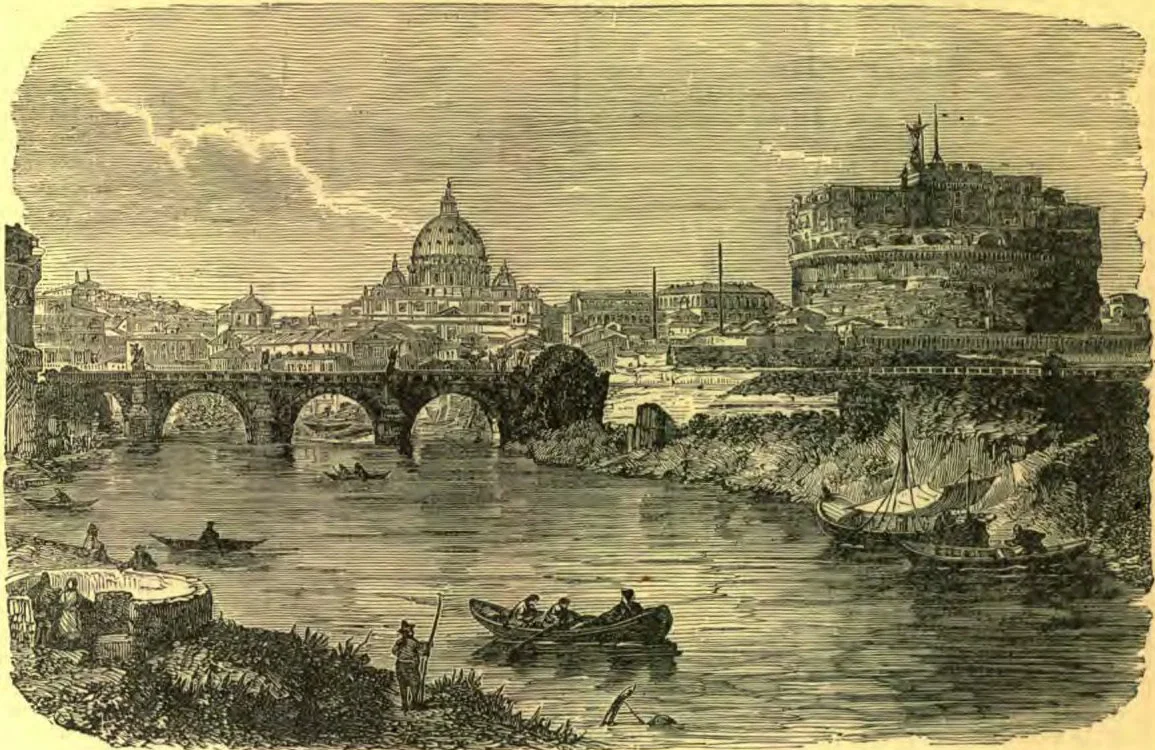
In the engraving we have presented a view of the famous church of Saint Peter's at Rome, the bridge across the River Tiber, and the castle of St. Angelo, as it is usually called. The picture could not, in the nature of things, present all the points of interest. These edifices are situated on the right bank of the river. The city was anciently upon the other side. As we cross the river from the city, we pass directly under the walls of the castle to the left, and soon pass into the great open court of St. Peter's, the high building with the large dome, somewhat to the left of the castle as seen in the picture. At the right of the great cathedral, and closely connected with it, is the great palace of the Vatican, the present abode of the pope, one of the largest, most costly, and best furnished palaces in the world. It contains many of the costliest works of art and one of the greatest and most ancient libraries in the world. There is a covered way from the palace to the castle, so that when there are popular uprisings in the city, and the pope's life is in danger, he can hie away to the castle for safety. The Vatican makes but a small appearance in the picture, though it is an immense building.
The grand court in front of the cathedral is very fine and extensive. It is in length one thousand one hundred and ten feet, in breadth seven hundred and eighty feet, in the form of an ellipse. In the center of the court is a large obelisk brought from Egypt centuries ago. At equal distances on each side is a most beautiful fountain. The outside of the court is bordered by imposing colonnades in the form of a semi-circle, and supported by four series of huge columns forming three passages underneath the roof, the middle one will permit two carriages to drive abreast. The paving of the court is very fine. The grand church of St. Peter's rises in massiveness at the further side of the court opposite the opening. We ascend quite a flight of stone steps before we enter the porch.
The outside of the church does not make such a fine appearance as we should expect, considering it is such a large building; for the front part of the porch is made so high and large that when one stands anywhere near it, the view of the immense dome is obstructed. But when it is entered, then we are lost in wonder and admiration. It will be impossible to give the INSTRUCTOR family any clear idea of the magnificence and beauty of this largest church in the world.
Let us notice some of the dimensions of this mammoth temple. Its length, including the portico, is six hundred and ninety-six feet. Length of the church proper inside, six hundred and two feet. So its total length is over forty rods, or more than one-eighth of a mile. It is built in the form of a cross. Its greatest width is four hundred and fifty feet. The height of the nave, that is, the main central part, is one hundred and fifty feet; its width seventy-seven to eighty-nine feet. There are side aisles leading from the central part all the way along on each side. The great central dome, from the pavement to the base of the great lantern, is four hundred and three feet, and to the summit of the cross is four hundred and thirty-five feet. The diameter of the cupola is one hundred and ninety-three feet. The circumference of the pillars which support the dome is two hundred and thirty-two feet. The dome is encircled and strengthened by six bands of iron. Leading to the roof is a stairway, broad and easy enough to permit a loaded horse to ascend to the top. The church contains twenty-nine altars and one hundred and forty-eight columns.
It is not so much its size which strikes the beholder with astonishment, as it is the richness and magnificence of everything within. One is astonished at the immense amount of statuary. Angels, good and bad, saints and popes almost without number, in marble pure and white, meet you at every turn. In all directions may be seen magnificent altars, where the pious devotees can worship; so that more than a score of meetings can be carried on at the same time, and yet be entirely separated from each other.
Confessionals are scattered in all parts of the church. Many of the INSTRUCTOR family will not know what these are, so I will explain. They are little stalls, or boxes, tall enough and large enough for a single man to stand up inside. On one side is a small opening, perhaps a foot square. Rich and poor Catholics alike, in short, all good Catholics, are expected to come and confess their sins to the priest. Here he is snugly ensconced in the confessional. They are expected to confess all their bad sayings and doings to him; and he claims to have power from God to forgive these sins. Of course he wants a fee of a little money to help the thing through just right. These confessionals have printed on them in many cases, the kind of language to be used; for you must recollect that St. Peter's is the great central church of the Catholic world. And at Rome nearly all nations are represented. So of course if a Russian Catholic, or a Spanish or a Chinese devotee wanted to confess his sins when at Rome, he would want to know to what little stall to go to find a priest who could understand him.
In the center, under the great dome, is an imposing bronze canopy borne up by four richly gilded, spiral columns. It is ninety-five feet in height, and weighs about ninety-three tons. Under this is the high altar, where only the pope reads high mass on great festival occasions. Under it is said to be the tomb of St. Peter and St. Paul, which is reached by descending a flight of marble steps. A gilded door opens into a small, most richly furnished apartment, where, in a little gilt box, the ashes of these two great apostles are said to rest. Just outside the little door, the marble statue of a pope, with wonderful flowing robes, kneels, his hands clasped in the attitude of prayer invoking the aid of the apostles, whose ashes repose in the little box. On the heads of all the statues of the popes is placed the three-fold crown, and “Pontific Maximus,” (Supreme Pontiff) is seen written in all directions. St. Peter's is a grand temple, made to exalt the popes almost to the position of God, and no effort is spared to produce this effect.
A few steps from this wonderful altar stands a dingy bronze image, with a little crown on its head. Its feet stand about half one's height from the pavement. Standing there a few moments, the visitor sees a long-robed priest, with a very sanctimonious countenance, approach this image. He makes the sign of the cross, bows down, and kisses the foot of the statue. Then comes in, perhaps a poor laboring man, and does the same. Then comes a very fashionable lady, dressed in her silks and satins. She takes her handkerchief, wipes the same foot, and imprints upon it a very sacred kiss. Then comes another priest, and does the same. In five or ten minutes, you may see ten or fifteen pious kisses bestowed upon the bronze foot. Actually, the surface of the foot is considerably worn away by the contact of human lips. The Catholics tell us this is the image of St. Peter. But history seems to show that it is an old heathen statue of Jupiter Olympus. It matters very little which it is.
The pictures in various parts of the church are wonderful. They are called mosaics, that is, they are made of small pieces of stone of various colors, perhaps a quarter of an inch square, and so blended as to appear at a little distance like a beautifully painted picture. They represent scenes in the life of Christ and his apostles. They last for ages without change. They are polished smooth. Many pictures are as much as twenty feet by twelve. Think of the immense cost of one such picture! There are many hundreds of square feet of such pictures in St. Peter's.
The floor of the church is all of smooth stone, laid in beautiful squares. The cathedral cost over fifty millions of dollars. The cost of keeping it in repair every year is about thirty thousand dollars.
Its history is said to be as follows: Anacletus, bishop of Rome, said to have been ordained by St. Peter himself, erected an “oratory” (or place of prayer) over the spot where St. Peter was buried. In A. D. 306, Constantine erected a “basilica” (a church) upon the spot. In 1450 Nicholas V. commenced a large building there. Popes Paul II. and Julius II. secured the services of a great architect to build a large cathedral worthy of St. Peter's memory. In 1514 Leo X. continued the work under other competent architects, among whom was the famous Raphael. Other popes followed in the same work. The great Michael Angelo took charge of the work in his seventy-second year. He is perhaps the most famous architect of modern times. He formed the plan of the church substantially as it now exists. The drum of the great dome was completed before he died, in 1563. The dome was finished in 1590, the nave in 1612, and the portico in 1614. It was dedicated by pope Urban VIII., on Nov. 18, 1626. The colonnade was finished 1667. So it was really about two hundred and fifty years in being completed. Thirty or forty different popes reigned during this time.
Had it been built for the glory of God, it might have been well. But its great design is to glorify popery. One feels sad to see religion as revealed in the Holy Scriptures so misrepresented. But Catholicism is a mixture of heathenism with Christianity, and the heathen element greatly preponderates in St. Peter's. UNCLE IDE.

A LOST DAY.

How many tasks I planned at dawn! I said, “When this fair day is gone, And I sit down at eventide To count the work my hands have done Between the rise and set of sun, I shall be fully satisfied.”
And then I wove a web of dreams, And hours slipped by like sunny streams, Unnoted in their rapid flight. And when I roused myself at last To act, I found the day was past, And sunset fading into night.
Oh foolish dreams! Oh wasted day! This, and this only can I say— “Not one good deed my hands have done.” How much I might have done, had I But used the hours as they passed by, But I have squandered every one.
God gives his days for us to use For some good purpose. If we choose To squander them, how great our sin! I shudder when I think he keeps A record of them all, and weeps To see the misspent ones therein.
Oh, ye who give to dreams God’s hours, A serpent lurks beneath the flowers Of idle moods and weak delays; Rouse; make to-morrow’s record fair; Be this the angel’s entry there, “To-day atones for yesterday.”

A MAN THAT WAS NOT TO BE BOUGHT.

Six or eight years since, in one of the towns of Eastern Massachusetts, there was a Mr. D., a livery-stable keeper, about whom I once had the opportunity of learning the following fact. Among his many other good habits, one was never to suffer his own feet or his horses' to tread profanely on the Sabbath-day.
On a certain Sabbath morning, three gentlemen from Boston, putting up with their wives at the village hotel, said to their host that they would go to Mr. D. and get three single-horse buggies, and take each his wife and go to camp-meeting, about six miles off.
“It will be of no use,” said the host, “for Mr. D. never lets his horses on the Sabbath.”
“I never saw the man yet that money wouldn't buy,” rejoined one of the party.
So they went and rang the bell at Mr. D.'s door. Mr. D. himself answered the call, and invited them in. After they had made known their errand, he said:—
“Gentlemen, I should be glad to accommodate you, but it is against my principles to let my horses go for hire on the Sabbath-day.”
“How much do you usually have a day for your single horses?” asked the gentleman who was the chief speaker.
“Two dollars and a half a day usually, sir,” answered Mr. D.
“Well, then,” returned the gentlemen, “here are three five-dollar bills; please take them and let your man harness the horses, and we will go away very quietly and will return just after dusk, and without noise.”
“Gentlemen,” said Mr. D., “I can only repeat what I have already said,—that it is against my principles to hire out my horses on God's day, and I must decline your liberal offer.”
At this the chief speaker on the other side stepped up closer to the sturdy Sabbath-keeper, and slipping into his hand a bright looking bill, said to him,—
“There, Mr. D., take that, and let your man quietly harness the horses for us.”
Looking down at what was thus thrust into his hand, he saw that it was a new one-hundred dollar bill on a Boston bank; but without hesitating a moment, and evidently without any inward struggle with the spirit of greed, he calmly but emphatically said:—
“Gentlemen, my principles in this matter are fixed, and should you bring me all the money in the city of Boston, it would not alter them. If you would like to attend worship, our bell is now ringing, and I should be most happy to show you a seat, but I cannot let my horses go on the Sabbath;” and he handed back the bill.
As the baffled tempter took the rejected money, he also looked Mr. D. admiringly in the face, and stretching out his hand toward him, said:—
“I want to shake hands with you, Mr. D.; I have sometimes heard of such men as you are, but I never saw one before.”
Each of the other two shook hands with him, expressing also their pleasure, and adding that before they returned to Boston, they would like a supply of cards, that they might know whom to direct their friends and acquaintances to as they visited the village. And as the secular week opened, all these gentlemen returned repeatedly to Mr. D.'s stable to obtain horses and carriages for their pleasure, thus testifying in the most express manner their approbation of his conscientious and unswerving conduct. And so it will be in all ordinary cases where Christians are high-minded, resolute, and incorruptible on all questions of duty.
To be not only true to ourselves, but also useful to others are among the reasons for which God has called us to his kingdom and glory.
“No man lighteth a candle and putteth it under a bushel, but on a candlestick, that it may give light to all that are in the house.”—Christians Weekly.

BEARING SHEAVES.

Soon life's spring-time will be over, And its autumn days will come; Happy then will be those workmen Who have sheaves to carry home. —A. T. Allis.

HATS AND HOW THEY ARE MADE

Written for the INSTRUCTOR.

HATS AND HOW THEY ARE MADE.

I WONDER how many little boys ever stopped to think where their hats came from, what they are made of, and how they are made? I don't mean their straw hats, but the soft, easy, wool hats which boys and men wear in the winter. The girls wear them too, sometimes. Now if you will go with me, I will show you all about it, so that you will always know hereafter how your hats are made.
Here we are at the hat factory. It is a very large building, as large as a big grist-mill. There are perhaps fifty men at work. In this room we see large piles of wool, just such wool as your father shears from the sheep every spring. This wool is brought from all parts of the world; from the United States, from South America, and even from Australia. It is spread out on a large table, and one man stands there, whose whole business is to sort that all over carefully. He makes three grades of it, and then it is carried to another room, where it is put into large troughs, or tanks. Here it is thoroughly washed with soap and water until it is clean and white. From this it is taken into another room, where it is put into large vats, with some coloring material; this takes out any grease that may be in it. It is then taken into another room, where it is thoroughly dried.
Next we go into the coloring room, where the wool is again put into large vats, and colored any shade desired. You ought to see the men who work here; their hands and faces are all colored up. I don't think I should want to work in this room. The wool is kept in this vat until it is thoroughly colored. The next man who takes it looks it all over carefully to see that there is nothing but the wool left; then it is carried to the carder. This wonderful machine takes the wool, and picks it until it seems as if every fiber would be separated. Then it cards it nicely into little fine sheets, as thin as white cotton cloth, and just about as wide. It looks like a thin layer of cotton batting.
As it comes from this machine in long strips, it is wound around a great block larger than a bushel basket; only it is very large in the middle, and tapers out small at each end. Now a girl takes a large pair of shears, and cuts this right in two in the middle, thus making two pieces; each piece is a hat, but it does not look much like one yet. It looks like a great funnel. If you were to put it on your head now, it would come way down over your shoulders, and run up to a little point above your head. You must handle it very carefully, or it will drop to pieces.
Next the hats are carried into another room, and put into soap-suds; this thickens them, and shortens them up wonderfully. Then they are thrown into a tank, where they are pounded with great wooden mauls. These are worked by machinery, and they pound away on these hats all day long. When they come out of here, they look rather sorry and discouraged, and wrinkled up, but are quite thick and hard. Now they are taken to another room, where they are stretched over blocks, and the top of each hat is pounded and pounded until it is the size and shape of the top of your hat. But there is no brim to it as yet. It is now passed to another man, and he puts it on a machine, which makes the rim by pounding and stretching the lower part of the hat. By this time it begins to look something like a hat, but rather battered, like an old hat that has been rolled around in the mud. It is now carried into the next room, where it is put upon a block, and then turned bottom side up and set down into another block. You see that there is a block inside of it, and another block outside of it. A heavy weight is brought to bear upon this, which presses it into just the shape desired. In the next room it is placed on another block. This block is put on a wheel, which is turned round and round very quickly. The hat is wet with water, and then it is rubbed very quickly and thoroughly with an old hat. This polishes it so that it shines nicely.
It is now taken into the trimming room; here it goes through several hands; one puts on the sweat band inside, and another binds it round the edge. The third puts on the band, and the fourth sews on a bow; and so it goes on through different hands until it is finished. Then it is put into a nice little bandbox, all alone if it is a very nice hat; if a cheap one, several are packed in a box. Now it is ready to put on a boy's head. And this is the way hats are made.
D. M. CANRIGHT.

INFLUENCE

If you put a piece of lead into a pocket full of shillings and sixpences, the lead has no intention of blackening its neighbors; but let them jingle together for a week, and then take them out, and you will find the silver pieces all black. So a bad man blackens the soul of his neighbors without intending it. A rose as it stands in the garden on a fine summer day has no intention of doing any good, but it cannot help casting its fragrance in the air, and tempting you, as you walk through the garden, to come and rejoice in it.
My children, all your life long you will be doing others either good or evil, not only when you intend it, but when you do not intend it. It all depends on this—whether you are good or bad yourself.—The New Song.

AN OPEN SWITCH.

A SWITCHMAN was walking backward and forward on the platform in front of the switch house, waiting for the on-coming express train.
“I locked that switch,” he mused, half questioningly, turning partially about; “yes; I locked it,” he added reassuredly, and resumed his preoccupied pacing.
The train dashed into sight, and the switchman paused to watch it, only to see it the next moment rush off the main track upon the switch.
“Oh, my soul! I did n't lock the switch!” An instant more, and the train was a wreck in the swamp beyond. What ruin was wrought by one moment’s neglect!
“Oh, if I had only locked the switch!” exclaimed the wretched man, viewing the mass of mangled humanity brought from the ruin.
How small a thing it would have been to do,—only a moment’s work; but the work of a lifetime could scarcely atone for an atom of the misery wrought by that moment’s neglect. “Oh, if I only had!”
The verdict of the coroner’s jury, “criminal neglect,” might have doomed the man to a criminal’s fate, but he never realized that penalty; for ere many days had passed, he was confined in a maniac’s cell, where, for the remainder of his life, his only words were, “If I only had!”
Not every neglect is fraught with such dire results; but neglect is dangerous always. Is there an open switch, boys and girls, anywhere along your daily track, where you or another may, in an unexpected moment, rush off into ruin? Is there coming a time when we would happily lay down our life if we could thus undo the wretchedness that a slight effort now would prevent? Those who do good shall receive manifold more, even in this present life, so Jesus has said; but they that sow the wind shall reap the whirlwind. That is not a pleasant view of the case; and it is one we need not contemplate; for here is a substitute which presents much brighter prospects. Let us try it:—
“If you’ve anything to do, Do it, do it! Let me whisper, friend, to you, Do it, do it! If you’ve anything to say, True and needed, yea or nay, Don’t defer another day; Say it, say it!
“If you know a torch to light, Light it, light it! Guiding others through the night, Light it, light it! If you’ve anything to give, That another’s joy may live, You a blessing may receive; Give it, give it!”
ADA DEYARMOND.

A WIDOW'S GIFT.

A MISSIONARY in Persia tells of a poor widow with two little children to support, and a mother and an invalid sister who needed all the help that she could give them. And still she desired to help those who were in suffering and distress.
“One day,” says the missionary, “she cut off the greater part of her beautiful hair, and sold it, and brought me the money. She knelt down at my feet, and with eyes full of tears said, ‘Take this money for the poor people; I want to give it to God. It is the price of my hair. I had nothing else to give.’”
It was not merely the value of the gift, but the willing mind that prompted it, which made it a sweet savor of love to the weary missionary, working among the poor and the distressed. The poor woman, like the widow of old, cast in her mite. Her choicest treasure was bestowed upon the poor.
How many Christian women there are who waste in personal decoration and adornment much that might be given to relieve distress, to enlighten darkness, to comfort those that mourn, and send the light of the knowledge of the Lord among those who sit in lands of darkness, beneath the shadow of death. Could not such learn a lesson from this poor Persian widow?—Little Christian.

The Chiming Bells.

In 1641, Evelyn visited Amsterdam, and went up into the tower of St. Nicholas’ church to note the playing of the marvelous chimes. He found a man away below the bells, with a sort of wooden shoes on his hands, pounding away on a key-board. The proximity of the bells, the clanging of the keys when struck by the wooden gloves, the clatter of the wires, made it impossible to hear the music; yet there floated out over the city and over the sea, the most exquisite melody. Many men paused in their work, and listened to the chimes, and were glad.
It may happen that in your watch-towers, where you are wearily pouring the music of your life into the empty lives of the lowly, the rattling of the keys and the heavy hammers, the twanging of the wires, the very nearness of the work, may all conspire to prevent your catching even one strain of the music you are creating; that far out over the populous city, full of weary souls, and far out on the eternal sea, the rare melody of your work blends with the songs of the angels, and is ringing through the corridors of the skies. It may gladden some burdened souls here, and sweeten even the rapturous music of heaven.

USEFULNESS OF CARRIER-PIGEONS.

Most every one knows there are species of the dove, or pigeon, that have naturally a strong attachment to their native home, and a faculty of finding it, although sometimes separated great distances from it; and that from a very early period they have been used for carrying messages from one place to another. But this “homing” faculty, as it is called, has been brought to a high state of perfection in some of the Eastern countries, by persons who give their attention to selecting the best varieties of the carrier-pigeon for breeding purposes, and then devoting much attention to training the birds for use.
The carrier-pigeon does not travel by night, nor when there is a mist, or anything to obscure its vision; and so it is supposed that it is principally by a sense of sight that it finds its way. In training it, they begin by taking it short distances from home, and then extending each journey as it becomes acquainted with the country, until it learns to pick its way back sixty or seventy miles. Some of the best species learn to find their way a distance of about five hundred miles. It is true they sometimes lose themselves, but a fair proportion of those which never reach home, fall a prey to ravenous birds.
The Chinese have used the pigeon as a carrier from a very early date; and to protect it from birds of prey in its aerial voyages, they attach a set of bamboo whistles to the tail, next to the body. “These somewhat resemble a reed pipe, and are so placed that when the bird flies through the air, it emits a shrill sound, which is said to have the effect of frightening away their winged enemies. When a flock of these pigeons is flying over a town, the sound made by the bamboo pipes may be heard at a great distance.”
Some varieties of the bird fly much swifter than do others. One Icelandic breed is very gentle and intelligent, and it is said to fly at the rate of one hundred and fifty miles an hour. Since the introduction of the telegraph, the pigeon is not employed so extensively as a carrier. It is used in England to some extent in conveying private messages, and regularly for forwarding news from fishing boats at sea; But in times of war, when modern methods of conveying news are liable to be interrupted, the pigeon is very serviceable. Of such value was it for the transportation of news in time of the late war between France and Germany, that “every fortress and fortified town in those countries, is now, it is said, provided with flights of highly-trained pigeons, which, in the event of war, would be ready for use.”
As an example of the pigeon’s usefulness during the siege of Paris, we quote a paragraph from “Science Gleanings in Many Fields”:—
“Throughout the many months when the Germans rendered all ingress and egress by the ordinary channels impossible, carrier-pigeons were passing overhead, conveying messages to and from the besieged Parisians. Fastened to one of their tail feathers was a quill about the size of a tooth-pick, rolled up in which there were about twenty collodion films. These weighed altogether not more than fifteen grains; yet each bore on its surface printed matter exceeding that of several newspapers. The letters to be sent by pigeon-post were first printed on large sheets, which were afterward reduced by microscope photographs to one eight-hundredth part of their original size; and thirty or forty copies of these reduced photographs on collodion films were usually dispatched by as many pigeons, to insure delivery. On arrival at their destination, the birds were relieved of their tiny post-bags, the image on the film was magnified and thrown onto a screen, and the letters were then copied and delivered to their owners through the usual channel. More than one hundred thousand of those films were, it is said, sent into Paris during the siege; and together with the service of balloons, they lessened considerably the hardness of the situation.”

IMPORTANT BIBLE SUBJECTS.

LESSON 58.—INHERITANCE OF THE SAINTS.

(Continued.)

THE GATHERING OF ISRAEL.

[NOTE TO THE STUDENT.—Do not consider the lesson learned until you can give at least the substance of every text, with the correct reference for each. The references in black letters indicate those texts that should be committed to memory. A little diligent application each day will enable you to do this.]
1. When God made the promise to David concerning his kingdom, what did he say of Israel? 2 Sam. 7:10.
2. Yet what happened to the people after this? (See notes on preceding lessons.)
3. What did Isaiah say concerning the gathering of Israel? Isa. 11:10–12.
4. Who are the children of Abraham? Give proof.
5. Relate a circumstance that occurred as Jacob was returning to Canaan from Syria. Gen. 32:24–29.
6. What name was then given to him?
7. Why did he receive this name?
8. What is the significance of “Israel”?
9. Then what name should be applied to those who overcome?
10. Who only will have a place in Christ’s kingdom? Rev. 3:21.
11. When are the overcomers called to a place in the kingdom of Christ? Matt. 25:31.
12. Why do the angels come with the Lord? Matt. 24:31.
13. Then what constitutes the gathering of Israel?
14. How extensively will God’s people be gathered? Matt. 24:31.
15. With what statement of Isaiah does this agree? Isa. 11:12.

NOTE.

“ISRAEL” signifies “a prince of God,” or “one who prevails.” An Israelite, therefore, is an overcomer. None but overcomers can have a place in the kingdom, and all who overcome will be there. Rev. 3:21. By this we may understand the statement that “all Israel shall be saved.” We are enabled to overcome by our faith in Christ, as we read, “And they overcame him by the blood of the Lamb and the word of their testimony.” Rev. 12:11. Thus it is that all overcomers are also children of faithful Abraham.

LESSONS OF THE ELECTRIC LIGHT.

The admirable apparatus for lighting a state-room on one of the steamers on Long Island Sound, added to the enjoyment of a recent trip, and suggested some thoughts in regard to Bible teaching.
Light, pure, strong, abundant, was provided. One had but to open the way, and the room was filled with the brightness constantly going forth. To have carried an ordinary lamp into that room, would have been a grand impertinence. In the Sabbath-school we need and may have the light of divine truth. Shall we substitute for it the flickering glare of human opinions?
The light could shine in that room only while it was in direct communication with the “dynamo” in the distant cabin. This connection must be by two wires. There must be a receiving and a giving back, in order to complete the circuit and secure illumination. Souls are enlightened, not by cold, stale, abstract truth, but by that fresh from its source. That which comes through a mind and heart in sympathy with the Master, his word, and his work; a spirit constantly receiving from Christ and giving back to Christ, in loving service to him, and to others for his sake.
It was a burnt stick from which the light in that room shone. Woody fiber had to be reduced to carbon, destroying the old, natural life, before the brightness could shine through it. He who is “the true Light” died that the world might see the “effulgence” of the Father’s “glory.” “I have been crucified with Christ, and it is no longer I that live, but Christ,” said that one of the apostles whose work did most to spread that light. Complete consecration is essential to the best light-giving.
Teacher, does the electric light shine in your class?—S. S. Times.

HOW TO QUELL DISORDER.

SABBATH-SCHOOL teachers and officers who are troubled with disorder and turbulence in their class and school work, will do well to consider the following keen words of Rev. C. H. Spurgeon, recently addressed to some ministerial students: “Dogs often fight because there is a scarcity of bones, and congregations frequently quarrel because they do not get sufficient spiritual meat to keep them happy and peaceful. The ostensible ground of dissatisfaction may be something else, but nine times out of ten, deficiency in the rations is at the bottom of the mutinies which occur in our churches.” Schools and congregations are much alike in this respect. If a class is disorderly, it is time for the teacher to inquire whether his scholars are not starving for spiritual food, or mischievous from the want of something to do.—S. S. World.

GATHER THE GRAINS.

GOD'S angels drop, like grains of gold, Our duties midst life's shifting sands, And from them, one by one, we mold Our own bright crown with patient hands. From dust and dross we gather them; We toil and stoop for love's sweet sake, To find each worthy act a gem In glory's kingly diadem, Which we may daily richer make! —George B. Griffith.

ONE OF THE “NOBLE METALS.”—GOLD.

The “noble metals” are those which can be separated from oxygen by heat alone, as gold, silver, platinum, etc. Gold is sometimes found in “nuggets,” but generally in scattered grains. It is separated from the substances with which it is mixed, by washing. If mixed with granite, the rock is crushed, and then the gold washed out. Gold is sometimes found mixed with silver.
Many of you may have seen gold leaf, as it is put up between sheets of paper in book form, to be used in gilding books, furniture, etc.; but few of you probably know how these books are made, so we will give you the process as furnished in the “Peoples’ Manual,” by Nelson & Phillips, N. Y. It says:—
“A gold mass is passed between rollers until it is reduced to a thin ribbon—an ounce making a ribbon an inch wide and fifteen feet long. This is cut into pieces an inch in length; one hundred and fifty of these are packed alternately with leaves of strong paper cut four inches square. The pack is then beaten with a heavy hammer, until the gold leaf is spread to the size of the leaves. Each piece is then ‘quartered,’ and the six hundred squares are packed between leaves of ‘gold-beaters’ skin,’ and re-pounded as before. These are again taken out by the breath, recut, and the twenty-four hundred squares re-pounded, and so on. The processes may be continued until the gold is so thin that it would require three hundred and sixty thousand leaves to make only an inch in thickness.”

MAGNA CHARTA.

The Busy Bee, in the following bit of English history, gives this explanation of Magna Charta (pronounced Mag-na Kar-ta), which may be interesting to our literary boys and girls:—
“Among the kings of England, there was one by the name of John. He was distinguished for his cruelty, and the tyranny with which he ruled over his subjects. He had so often trampled on the rights of the people and the privileges of his nobles, that the latter, no longer able to bear his rule, revolted against him. They met at St. Albans with their followers, headed by Archbishop Langton, and bound themselves to conquer, or die in defense of their liberty.
“The rights for which they contended were drawn up in regular form, and presented to the king, who at first indignantly rejected them. The nobles then took up arms, and having defeated the king’s forces in several places, entered London without opposition. The king, fearing for his crown, agreed to a conference, and they accordingly met him at a place called Runnymede. There, after much delay, he was compelled to agree to their demands, and finally, on the 19th of June, 1215, signed the famous document which is known in history by the name of Magna Charta.
“This charter secured important privileges to the nobles, the people, the Church, and the clergy, and secured to the people of England the right of being governed by their own laws.”

HOW THIMBLES ARE MADE.

The thimble is an indispensable article with the girls, so they will be interested to know how it is manufactured. An exchange says:—
“Coin silver is mostly used, and is obtained by purchasing coin dollars. Hence it happens that the profit of the business is affected instantaneously by all the variations in the nation's greenback promise to pay. The first operation strikes a novice as almost wicked, for it is nothing else than putting a lot of bright silver dollars, fresh from the mint, into dirty crucibles, and melting them up into solid ingots. These are rolled out into the required thickness, and cut by a stamp into circular pieces of any required size. A solid metal bar of the size of the inside of the intended thimble, moved by powerful machinery up and down in a bottomless mold of the outside of the same thimble, bends the circular disks into the thimble shape as fast as they can be placed under the descending bar. Once in shape, the work of brightening, polishing, and decorating is done upon a lathe. First the blank form is fitted with a rapidly revolving rod. A slight touch of a sharp chisel takes a thin shaving from the end, another does the same on the side, and the third rounds off the rim. A round steel rod, dipped in oil, and pressed upon the surface, gives it a lustrous polish. Then a little revolving steel wheel, whose edge is a raised ornament, held against the revolving blank, prints that ornament just outside the rim. A second wheel prints a different ornament around the center, while a third wheel, with sharp points, makes the indentations on the lower half and end of the thimble. The inside is brightened and polished in a similar way, the thimble being held in a revolving mold. All that remains to be done is to boil the completed thimbles in soapsuds, to remove the oil, brush them up and pack them in suitable packages for the trade.”
Continue reading: NEW YORK CUSTOM-HOUSE NIGHT INSPECTORS