The Youth’s Instructor, Vol. 33, No. 31.

SAINT PETER'S AT ROME
Earlier text: SAINT PETER'S AT ROME

NEW YORK CUSTOM-HOUSE NIGHT INSPECTORS.

SPEAKING of the Custom-house and its officers, a writer in Harper’s says of the night inspectors:—
“The night inspectors are appointed to prevent smuggling, are uniformed and armed, and are authorized to stop and search reasonably suspected persons who may go on board or come from the vessel. Their office involves watching, exposure, and fatigue. The Cuban steamers have been wont to bring men who inclosed cigars in rubber bags and threw them into the waters of the lower bay. Confederates in boats then picked them up, placed them in express wagons waiting on the shore, and then drove rapidly away. There is something contagious in the glee of wide-awake officials as they relate how they had watched unseen the whole operation until they were ready to start, when they seized the reins, and landed the spoils at the Seizure Room. One French steamer, notorious for smuggling by driblets, when searched by this force, was found to contain thirteen hundred bottles of spirits, which it was intended to send ashore bottle by bottle. Tins, about an inch deep and fitted to the body under the armpits, have been taken from the bodies of men who were thus stealthily bringing in valuable bay oil. One dealer in human hair, who died in possession of about $200,000, was detected in illicit importations under the shirts of his agents. Another vivacious fellow, belonging to a French steamer, rejoiced in a profitable trade in kid gloves secreted by the dozen in his immense boots.”
“Sailing vessels are watched by special agents whose duties are irksome enough to render special supervision by superiors a matter of positive necessity. Dealers in contraband goods, scamps who live by their wits, and unscrupulous traders of all kinds tax the resources of human ingenuity and craft to the uttermost. Logs of foreign wood, cunningly excavated and packed with cigars or spirits; cases of boots and shoes, in the heels of which watches and jewelry are hidden; miraculous trunks, false as Machiavelli, being thinly hollow on side and end, top and bottom, concealing hair, laces, trinkets, etc., etc., are among the common devices of ingenious freebooters. Keen, honest, true men—such as may be seen on any tour of night inspection, like mastiffs at their posts, and especially if visitors be expected—are needed to baffle the plots of the rascals. Political affiliations constitute no guarantee of efficiency. The best attainable is through rigid adherence to the rules of the civil service reform.”

Bismarck's Maiden Speech in the Prussian Diet

Bismarck’s maiden speech in the Prussian Diet was like Disraeli’s in Parliament, received with shouts of laughter and indignation, but the obstinate young man calmly drew a newspaper from his pocket, and perused it until the presiding officer restored order, when he concluded his oration.

A LESSON FROM THE BIRDS.

Dear Children, I have often thought I would like to tell you a story, that to me was interesting. A year or two ago, a pair of orioles, or golden robins, began to build a nest on one of the lowest branches of a Balm of Gilead tree. The tree stood directly in front of our sitting-room window; so that we had a good chance to see the birds at their work.
About the same time, a pair of yellow birds began to build their nest on the other side of the tree. The robins worked busily gathering material and weaving their nest. But just as soon as they flew away for more material, over came the little yellow birds; and tearing the robins' nest to pieces, they would carry the stuff over to their side of the tree, to build their own nest with.
The robins toiled on very patiently, still their nest did not seem to grow. One day they came back, and caught the little robbers at their pilfering. Now what do you think the robins did? They might have had a fight, and easily driven the yellow birds away; but they did no such thing. They very quietly withdrew, and we supposed they had chosen another place. But after the yellow birds had finished their nest, back came the robins. They worked as hard as ever, and soon finished their little cradle home. There they raised their family, living quietly and peaceably with their naughty neighbors.
They taught a lesson that all may profit by. If others trample on our rights and misuse us, let us do as the robins did,—bear patiently with them; it is the surest and best way to conquer an enemy. If we have the spirit of Christ, it will be easy for us to do this. He taught us to “love our enemies, do good to them that hate us, and pray for them which despitefully use us.” V. O. Cross.

A HARD EXAMPLE.

FLOSSIE DOLF was in trouble. It was recess, but she sat before her desk, her head resting on one hand, while in the other she held a pencil, with which she was making figures on her slate.
“O dear!” she exclaimed, impatiently, “I never can get this hateful example.”
Again and again she worked the example, but without success. At last she gave it up, and throwing her pencil down, laid her head on the desk before her, and burst into tears.
“Don’t cry, Flossy,” said Daisy Eaton, who was standing near. “If you try again, perhaps you will succeed.”
“But I have tried so many times, Daisy,” sobbed Flossie, “and I just can’t get it.”
“I would help you to work it if Miss Johnson would let me, but you know she wants to see how much we can do by ourselves,” said Daisy.
Then the bell rang, and Daisy had no chance to speak to Flossie until noon.
The day before, Miss Johnson had given the scholars an example which was a little more difficult than usual; and she wished to see how many could work it without help. Flossie Dolf was one of the best scholars in the room, and Miss Johnson really expected that she would be among the first to get the example; but, to her great surprise, she was one of the few who could not get it.
When the bell rang, Flossie took up her slate and pencil again, and worked patiently until noon; and still she did not have the answer.
She went out with the other scholars and was walking slowly homeward, when she heard some one calling her. She turned, and saw Daisy Eaton coming toward her.
“Have you the answer, Flossy?” asked Daisy, as soon as she overtook her friend.
“No; and I am not going to try any more,” answered Flossie.
“O Floss! I wouldn’t give it up that way.”
“What’s the use of trying when I know I can’t get it?” asked Floss, impatiently.
“Flossie,” said Daisy, suddenly, “have you asked God to help you?”
Flossie’s face flushed as she answered, slowly, “I forgot.”
“I thought so,” said Daisy, smiling. “Now, if I were in your place, Flossie, I would ask help this noon; and then, if you try, you will get the example. Will you do it?”
“Yes, I will, Daisy,” answered Flossie.
When she returned to school, she went to her seat, and took her slate and pencil.
“Why, Flossie Dolf!” exclaimed Alice Coyle, coming in from the playground, “are you going to work that tiresome example this noon?”
“Yes,” Flossie replied, quietly. “I intend to work on it until I get the correct answer.”
“Oh, let it go!” said Alice. “This one example will make no difference, and we want you to play.”
“No,” said Flossie, firmly; and Alice went out doors saying crossly that “Flossie Dolf worked as hard as though everybody was ahead of her, and it was just the other way.”
Flossie worked patiently on the example, and in fifteen minutes she had the correct answer.
“Daisy, I’ve got it!” she exclaimed, joyfully, as Daisy entered the room; “I did as you said, and I’ve got the answer.”
Flossie was fully repaid for her hard work when Miss Johnson said, kindly, “I am very glad you got the answer, Flossie. Remember, dear child, ‘Perseverance brings success.’”
“Ah,” thought Flossie, “it wasn’t perseverance altogether.”—S. S. Advocate.

TEN GOLD BOXES.

“Wild plum blossoms! How lovely!” exclaimed Blanche, looking over her mother’s shoulder, as she finished painting a cluster of white flowers. “But where is the stem?”
“I will show you,” said her mother, lifting up from the pot near her the bunch of flowers from which she had been sketching.
“Why, there is no stem. It isn’t plum blossoms after all.”
“No. See what a mass of flowers crowded together on a flat surface, in such full bloom that you could count a dozen to the square inch. It looks like moss, with its close-matted green tufts, and short-spreading fibrous roots. The flowers do resemble those of the plum, only not quite so large. It is a creeping evergreen that blossoms among the pines in sandy places, where it brightens the dreary stretches of barren ground. These came from the ‘pine barrens’ of New Jersey, and I think them as pretty as my favorite arbutus. Only this has not the fragrance of the Mayflower. I should think it might have, too, as it has such beautiful little gold boxes, just the thing, one would think, for perfume censers.”
“Where are the gold boxes?” said Blanche, looking at the painting.
“Do you think the painting a good representation of the flowers?” replied her mother evasively.
“Yes, perfect.”
“If it were, the flower would never have had its name. Take this microscope and look at the yellow-tipped stamens on the card. What do you see?”
“Two little yellow spots on each stamen top.”
“Now look at the stamen of the flower itself.”
“Oh, I see the gold boxes! How perfect the little lid! just like the top of a sugar-bowl. And they ought to be censers, for they are pointed at the bottom, and couldn’t stand like a box.”
“The pollen is in these little boxes, and when it is ripe and ready to fall, the lid opens, just like the lid of a box. Ten boxes of pollen to each little white flower. It would not have had its name but for the microscope, for it is called from these anthers Pyxidanthera, which means ‘a little box,’ and ‘anther.’ The other name (for you know all flowers must have two, one for the genus, and one for the species) is also derived from the anther, Barbulata, barblike.”
“Pyxidanthera barbulata!” exclaimed Blanche, laughing. “I shall remember it though, if it is a long one, and I don’t think it’s any too long for a flower that hides a secret of ten little gold boxes in its bosom.”—Christian Weekly.

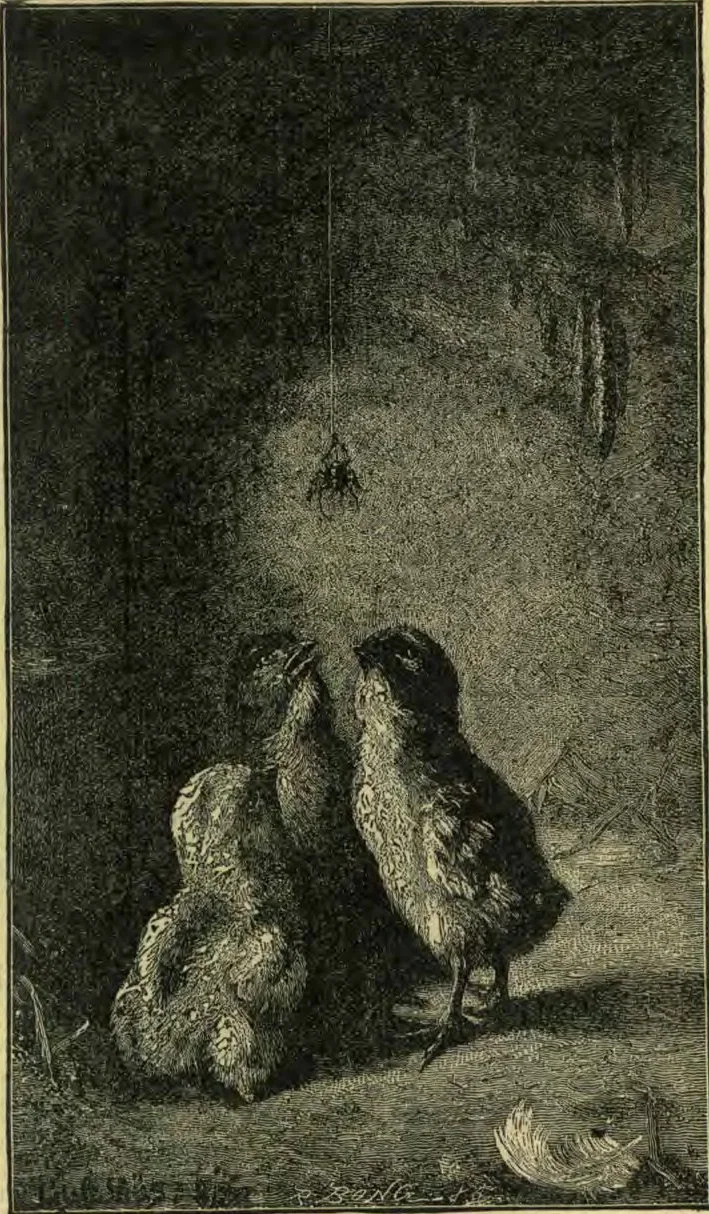
WAITING FOR BREAKFAST.

CHICK, chick, chick! Here's a spider; catch him quick! He must have murdered many flies, He's grown to such a fearful size. How glad you'll feel Of such a meal, If it doesn't make you sick!
But here's three to share the fun, And I only called for one. Much I fear he'll make a small Bit of breakfast for you all. See him! From that limb he crawls, And spins his ladder. Now he falls Swinging in the sun. Now he stops, now he drops. Why, he's gone!
S. ISADORE MINER.

Letter Budget.

A LETTER was published in a recent number of the INSTRUCTOR in which we said the writer forgot to sign his name. The little boy feels sure that he gave his name in the first of the letter as Clifford Wike, which we mistook for the Post Office. Our letter writers should use great care in writing their letters, and then should read them very carefully after copying, to be sure they are written plainly and that no words are left out.
MURL SLAGHT, of Erie Co., Pa., writes: “I am a little boy six years old. My father and mother are dead, and so is my little brother. I live with Grandma Davis, and we are Sabbath-keepers. We live alone, but the Lord takes care of us. We have Sabbath-school here at our house. There are eighteen members in the school. I have learned the names of the different books in the Bible from Genesis to Revelation. I have learned No. 1 Lesson Book all through, and am now in Book No. 2. I like the INSTRUCTOR very much, and I would like very much to see all the little boys and girls who read it. I want to be a good boy, and meet the INSTRUCTOR family all in the new earth.”
Murl says, “We live alone, but the Lord takes care of us.” He doesn’t express any fear that they shall sometime be forgotten. Why not, do you suppose? It must be that he believes the words of the Lord, “Whoso hearkeneth unto me shall dwell safely, and shall be quiet from fear of evil;” “he shall not be afraid of evil tidings; his heart is fixed, trusting in the Lord.”
EMMA J. JOHNSON writes from Douglas Co., Neb. She says: “I have written for the Budget once before, but I thought I would write again. I am nine years old. I have two sisters and one brother. My oldest sister, who is sixteen years of age, is canvassing for the Signs of the Times and ‘Sunshine at Home.’ She has already sold ten ‘Sunshines.’ We have a little lap-dog, which we call ‘Fanny’; also a pet cat, which we call Charcoal. We have three horses and one cow, and we have little chickens, which I help feed. I am taking music lessons now. My teacher comes up from Papillion. I go to day school. In my spelling class, I am the trapper. We were ten on each side last Monday. Now we are nineteen on my side. I am trying to get three subscribers for the INSTRUCTOR, so I can get the dictionary. I have let my school-mates read my paper, but no one wants it yet. Pray for me that I may succeed.”
Can the little people tell what a trapper is; and what gave Emma that name? We hope the dear girl may succeed in earning the dictionary, for she would find it a great help in learning her lessons.

You have reached the end of this edition.

The Youth’s Instructor · Aug 19, 1885