Your ShelfYour Projects

Review and Herald, Vol. 90, No. 18.

Is It Worth While?
Earlier text: The Spirit and the Word

Rome and the Cabinet

MR. WILSON'S failure to put any Catholic in his Cabinet is viewed with much concern and no little bitterness in Catholic circles. The Catholic Citizen, of Milwaukee, speaks thus in regard to the matter:—
The dead set made against the appointment of any Catholic in the Cabinet of the Democratic President naturally stirred the creed consciousness of the Catholic population. It was a proscriptive agitation, shared in, not merely by the “Guardians of Liberty” and their press, but prompted by such Methodist papers as the Christian Herald and by the resolutions here and there of many ministerial associations.
He [President Wilson] did not raise the religious consideration, nor wish it raised; but it was raised for him publicly and provokingly, and virtually in his official presence; for this slurring of the citizenship of millions of Americans—an actual majority of his party in the Northern States—was attempted as advising him in the performance of a presidential act; and many of the communications were officially so acknowledged by his secretaries. Could this seem to acquiesce, even tacitly?
The case recalls that notable incident when Reverend Burchard flung the phrase “Rum, Romanism, and Rebellion” at Mr. Blaine. Mr. Blaine was no bigot, but he did not instantly parry the thrust; his seeming acquiescence lost him the presidency. Next day was too late.
Mr. Wilson is fortunate in having more time. Vacancies will probably occur in the Cabinet during his present term, and it will be possible to meet this issue where, and as to what, it has been raised. A liberal doling out of subordinate offices will not answer.
“Know-nothingism” even in the diluted form in which it makes its appearance just now in Washington can not rule this republic very long, and the Wilson Cabinet represents that brand of “Know-nothingism.” The representation in it of a certain narrow, aggressive, and militant type of Protestantism is a marked feature of the new Cabinet,—the type to which Wilson himself and Mr. Bryan belong.
One can not fail to see in this utterance a grim determination to see to it that Mr. Wilson shall meet with the fate of Mr. Blaine if he should again be a candidate for the presidency, unless between now and the end of his present term he should so alter the personnel of his official family that it will include one or more Catholics. Nothing less than Cabinet positions for Catholics will free the President from the weight of this threat against his second election. Protestants are criticized in the above quotation for giving the President elect advice in the matter of his official family. If they merit criticism for that, what does such a threat as the above merit? It is not advice; it is a demand with a penalty attached to non-compliance. Such a demand indicates clearly a failure to understand and appreciate the spirit of the national Constitution in its provision which prohibits the giving of offices in the government on the basis of what religion a man may profess.

The Bible in Esperanto

THE new international language, Esperanto, has been so rapidly gaining in favor during the last few years that the Bible societies have deemed it a safe investment to have the entire Bible translated into that language and published. The New Testament, “La Nova Testamento,” is already published, and may be had now in the same bindings as the English or German or French Bible. The work of translating the Old Testament is rapidly going forward under the direction of Dr. Zamenhof, the inventor of the language. There are now nearly three million persons who read and speak Esperanto. Not all of these are Christians, but they will read the Bible in the new language because of their interest in the language. Thus, out of the invention of a new language, some will learn the message of the gospel. John 3:16 in Esperanto reads: “Dio tiel amis la mondon, ke li donis sian sole naskitan filon, por ke ĉiu, kiu kredas je li, ne pereu, sed havu eternan vivon.”
C. M. S.

In the Circuit of the Spring

WORTHIE HARRIS HOLDEN
The procession of the spring, How its joys the heart-gate swing! Swift the door opes wide to feel Balmy air its kisses steal; Ice founts burst to bounding rills; Waking bloom the spirit thrills; Luring bird-notes call to see Pledges of their ecstasy. O what cheer for everything In the circuit of the spring!
Soon where spring abides for aye, Verdant with eternal May, ’Neath the blest celestial bowers Filled with myrrh of fadeless flowers,— From all pain forever free, Crowned with immortality, We shall laud in rapture-song Our Creator, with the throng Who on earth his praises sing For the earnest of the spring!
Portland, Oregon.

God's Providential Guidance

Z. G. BAHARIAN
IN my last report I wrote that our lives were in danger here in Sivas, Turkey. Two Sundays we were obliged to omit our meetings. Several friends worked for us, advising those who had troubled us to do so no more. We heard that they would not attack again, so reopened our public meetings. But we found that some honest souls would not attend, fearing they could not listen to God's word in a quiet manner. However, from twenty to thirty attended regularly on Sundays.
Satan began again, this time stirring the children to gather before the street-door, waiting for the close of the meetings; and as soon as we were out, they would cry and yell and throw missiles at us. Each Sunday we would thank the Lord that he let us return safely to our home, and during the week would prepare ourselves for another battle.
January 18, toward the end of the Sabbath, we went out of the city to take some fresh air. We were five in number, two brethren having come from Diarbekir to study the Bible and prepare as workers in this field. It was a cold day, and the snow was deep. I was going ahead, and the soldiers' depot was before us a little way. I returned, and two of the brethren followed me, but the other two continued their way a little nearer the depot. As this road leading to the depot was well made and smooth, we had taken our walks on it, without going near the depot. As we were strangers in the city, the attention of the soldiers had thus been drawn to us, and the centurion had commanded them to arrest us when we were once more found on this road. This Sabbath the two brethren were arrested and carried to the depot, and from there sent to the police department to be investigated. The rest of us returned home, knowing nothing about the arrest. The sun set, but they did not come. One of the brethren went out to the road to look for them, met two robbers, saved himself from them, and arrived home safely, but with no news about the two brethren. Later we learned from a soldier that they were at the police department. I went to the department and found them. There were three chief commissaries, and we had a long talk about our work and general Bible subjects. The brethren were investigated, their answers were written, and we were all allowed to go out to our home. We thanked God, and began to watch interestedly the course the government would take toward us.
The next Sunday, January 26, we all went to our meeting-house at the appointed time, leaving our young Brother Levon at home. As soon as we were there, our neighbor who dwells in the same building began to attack us, crying and blaspheming loudly. Unable to satisfy his wrath in this manner, he came into our meeting-hall with a shovel in his hand, and tried to beat me. Brother Ashikian, our canvasser, who is a powerful young man, checked him and held his hands. At this time two men entered, having come for Bible study, and helped us against this angry man who was insisting on sending us out of the house. We saw that it was impossible for us to hold a study that day, and decided to leave the house. By this time others of “the baser sort” had come in, as previously arranged, and there arose a great uproar. We were all being beaten, but none of us would strike in return. I locked the door and ran out to the street, one of the disturbers following me. He caught me, but I saved myself, and ran to the police station and informed the officers of our situation. Two policemen went to our meeting-house, but the men had gone away. I learned from the brethren that after I left, they were beaten severely. Policemen could arrest only two of the attackers, and carried them to the station. There they began to insist that we had beaten them. We gave our version of the affair and went home. Then the police proposed to us that we write a petition, and refer the matter to the legal court. This we declined to do, seeing that this step would create many new troubles. The next day I called on the chief of police, who received me cordially. He promised to help us by sending a policeman to each service. This seemed to us a miracle.
His mind had been prepared for this by a friend of his, the physician in chief of the government, to whose son I was giving treatments. This, too, was providential indeed. We must always be prompt in doing good to others. God may use this service in our favor at a most critical point.
The following Sunday a policeman was sent to the meeting, and all was quiet. But I was not accustomed at all to this. During the twenty-one years that I have been engaged in this work I had never held a meeting under the care of a policeman. Now we are trying once more to gather the people to our studies.
Our present situation is this: Although the government is carrying on a deep investigation concerning us, it is also helping us in our meetings. May God direct in all.

The Majita General Meeting. German East Africa

L. R. CONRADI
This important meeting was held from Dec. 25-29, 1912. No less than twenty-one white missionaries were in attendance, and hundreds of the natives from half a dozen different tribes were present. Brother Kotz and a native teacher of the Pare Mission, Brother Carscallen and his eight Luo boys from the British side, Brother Dail, and I were the outside visitors.
From the field itself Brother Stein and his wife, Brother Seiler and his wife, Brother Ohme and his family, and Brethren Vasenius, Persson, Palm, Kaltenhauser, Munzig, Schurich, Wallath, and Winter were there from the beginning, while Brethren Bornath, Toppenberg, and Dominick arrived on the twenty-sixth, having been delayed on account of the sailboat. Sisters Vasenius, Persson, and Bornath were unable to come because of the long distance, and Sister Mertke was very ill in bed. All the brethren mentioned had brought with them some of their converts and native boys and porters, so we had Wasenaki, Kidzu, Wasakuma, and Majita people, besides the Kavirondos and Pare natives.
As we met on the afternoon of the twenty-fifth, we at once made our program, and a busy one it was indeed. As early as six in the morning there was a meeting with the natives. From eight to nine the missionaries had their prayer and social meeting. From nine to twelve, three to five, and in the evening we had general instruction and council meetings. From two to three the candidates for baptism had their meeting. Thus every moment of time was occupied. We were pleased to see that all our missionaries took hold, seeking God and at the same time studying the mighty problems before them.
In view of the large extent of the field, it was decided to divide it into three districts and have an ordained missionary over each district. First is the Majita District, which includes the seacoast stations of Majita, Iramba, Nyabangi, and also Schirati if a station is located there. Brother Ohme is in charge of this district. Then comes the Busegwe District, with Brother Persson in charge. In addition to Busegwe it includes Kidzu, Utimbaru, and Sisaki, the latter to be opened this year. Third is the Usukuma District, including the Ntussu, Itilima, Magala, and Kanage stations. The leader is to be supplied from the Pare field. Each of these three districts has its own language, and can now be far more easily handled than when the districts were as a unit.
The next item was the distribution of workers, and we found that we have ample help for the present to supply these stations. Brethren Kaltenhauser and Toppenberg, who have given most of their time to building, are each expected to take a station, as is also Dr. Vasenius. It was also decided to organize the field into three churches according to the districts, until a later date when each station has more converts and more churches can be organized.
We carefully went through the budget for 1913, which runs up to about fifteen thousand dollars, including the amount required for the new stations. About seven thousand of this sum is for the wages of the workers, several thousand for the transportation of goods, and the rest is for the fitting up of the new stations. In carefully considering the buildings necessary for common stations, we decided that if we did not count the wage of our own white missionaries, twelve hundred dollars would be the least needed for a good dwelling-house (with corrugated-iron roof and cement floors), school building, workshop, boys' dormitories, and the seed needed for the land. The German government usually grants us from thirty to forty acres of land about the station for a nominal sum.
Considerable time was spent on the educational question, and a unified plan was adopted for a four years' course. As we have good Swahili text-books for reading, arithmetic, etc., issued by the German government, we use these, and they prove a great help to us. A course for the native teachers was also supplied. No less than sixteen native teachers were granted permission to teach for us, and their wages were arranged on a general standard.
As our missionaries are increasing, we could not as hitherto put them all on the committee, but a committee of five was elected, consisting of the three district superintendents and Dr. Vasenius and Brother Kaltenhauser, while Brother Winter was chosen as secretary. Being so close to the beginning of the new year, we were able to go over the accounts of the missionaries, also to suggest the rate of wage, and it was unanimously agreed to that as the workers are receiving their goods with transportation paid from the home lands, they can get on with the same rate of wage in the field as we pay to our European workers.
Some time was also given to a consideration of the instruction for the candidates for baptism and their fitness. On Friday twelve natives were examined and accepted. Sabbath, the twenty-eighth, will always be a day remembered in the annals of this mission. Though the Majita chapel holds fully six hundred people, all the seats were crowded. The sultan and his sons came. God indeed gave the writer strength to set before this heathen congregation the love of Jesus and the certainty of the Christian's hope.
While I spoke in German, Brother Carscallen translated into the Luo, Brother Winter into the Majita, and Brother Persson into the Wasenaki. Thus the polyglot nature of our work becomes as apparent here as in Europe and elsewhere. After the sermon Brother Persson was set aside to the ministry. Brother Kotz first made some remarks in Swahili, Brother Ohme prayed, I gave the charge, which was translated, and Brother Dail welcomed him into the ministry. During the noon hour I called on the sultan, who lives about a ten minutes' walk from the station, near a large rock fortress that the Majita people had to defend a number of times against the warlike Massai. They had put up for him a European building with corrugated-iron roof, but we found it filled with cotton, so that it is used as a storehouse, while the sultan prefers to live in the native huts with his many wives.
In the afternoon Brother Ohme baptized twelve, six of whom were from Busegwe, five from Majita, and one from Kidzu. Then we organized three churches, thirty-five members in all, of whom fifteen were natives, and we had a splendid social meeting after the celebration of the ordinances of the Lord's house. Not only did the baptized Christians bear testimony, but a number of others testified of the love of Christ, and not less than twenty-eight stood up asking that they might be baptized in the future. The testimony of many of these was just as intelligent and as hearty as would have been borne by Sabbath-keepers in Europe or America. As nearly all of these boys are developing well, they will not only make us converts, but many of them will become excellent help as teachers, and later on as evangelists.
Before the Sabbath closed we had prayer with Sister Mertke, and she remarked that she was sorry she was kept so long in bed, and could not assist Brother Winter in the school, but rather made our workers extra trouble. She felt assured that she rested in the arms of Jesus whether she would be laid to rest or continue in the work. During the night she quietly passed away.
On the twenty-ninth we finished our business and arranged for our night trip. We had previously held an examination of both the boys and girls, and found that they had made really good progress. Ere the sun set, we gathered in the chapel for the funeral service. Brother Ohme first spoke in Swahili, I addressed the missionaries in German, and then we buried Sister Mertke beside Sister Kaltenhauser, near the chapel. As the workers stood about the open grave where dust would return to dust, we were cheered with the bright hope that the power of Christ's resurrection will not only raise all the faithful saints who sleep in him, but even prove his life-giving power in the heart of the missionary and in the hearts of his heathen hearers.
While the missionaries gladly give their lives in heathen lands, let those at home not only remember them in their prayers, but with their means, and let strong young men and women give their lives to God not only to fill up these gaps, but to answer the loud call for more workers.

Sao Paulo, Brazil

F. W. SPIES
SABBATH, Dec. 28, 1912, was another encouraging day for the small company of believers in the city of Sao Paulo, as again they gathered on the banks of the Tiete River and witnessed the burial of nine believers with their Saviour by baptism. Eight of these were the fruits of the work done in the city, whereas one brother, who is an apprentice in our publishing house at Sao Bernardo, joined the others in this rite.
Immediately after the baptism the brethren repaired to their place of meeting, and united in celebrating the Lord’s Supper. God certainly came near to his children, and this day will be one long remembered by all who had a part in its blessings.
The company at Sao Paulo is also very faithful in paying the Lord’s tithe. Twenty members paid about $150 during the third quarter, or about $7.50 per capita for the quarter; and yet they are not of the rich in this world’s goods. The financial statement also showed liberal donations to the various kinds of work.
We are glad to thus see the good work moving forward, but there are many calls coming in constantly from different places; and could we but respond to these urgent requests for help, we believe there would be many more precious souls brought into the fold of Christ. May the Lord who knows our needs provide for them according to his riches in glory.
We are also glad to be able to report that the canvassing work is constantly developing more and more, and that the book sales are increasing in our union. For all this we thank the Lord and give him the glory.
At present we are stopping at Curityba, Parana, where in a few days will be held the annual conference of this field.

With Him at Home

ELIZABETH CORNELL MARTIN
WHEN day is o’er and evening’s shades close ’round me, When the sun is sinking low into the west, When all is silent, e’en the birds, ceased singing, Have homeward flown unto their place of rest,
Then all my cares are gone and I am lonely, So lonely for that home where Jesus is, And I long to feel his loving arms around me, And know that he is mine and I am his.
But patiently I’ll wait a little longer, A few more years will bring us safely home; Faith ever tells of brighter things beyond us And rest, sweet rest, is there for all who come.
And so, amid this sorrow, pain, and weeping I’ll trust myself to him who cares and knows, And with his love I’ll share the sweetest blessing, And find within his arms a sweet repose.
Spartanburg, S. C.

Hyperacidity of the Stomach

THERE are four things that cause the body to fall below its normal or natural weight. Named in the order of their importance they are:—
  1. Hyperacidity, commonly called sour stomach.
  2. Malassimilation (bad digestion).
  3. Intestinal fermentation.
  4. Intestinal congestion, known as constipation.
All these conditions are in reality from the same general cause, and to the mind of the food scientist mean substantially the same thing, but for centuries they have been classed and treated as different disorders; therefore, we shall examine them separately and link them together as we go.
Sour stomach, that is, too much acid in the stomach, is a true disease. All the other conditions above named are merely symptoms.
Sour stomach causes the food to digest or leave the stomach too quickly. This causes congestion in the intestines (constipation). This in its turn causes inactive or torpid liver, headache, etc.
The entire intestinal tract is over thirty feet long, and when food passes out of the stomach containing too much acid, it irritates this entire thirty-foot canal, causing inflammation, and sometimes serious or even fatal disorders.
The nutrition is absorbed from our food through millions of little tubes, sometimes called “winking valves,” and when the mucous membrane (inside lining) is swollen and irritated from acid, these little valves are closed, the blood becomes impoverished, and the body emaciated or reduced in weight. As all the faculties are fed by or dependent upon the physical, both the body and mind share in the general decline.
This excess of acid causes fermentation in both the stomach and the intestines; fermentation produces gas; the gas distends the stomach and the intestines, and presses against the arteries that lead into and out of the heart. This causes irregular heart action, or so-called valvular heart trouble.
This excess of acid also irritates the mucous membrane, or lining, of both the stomach and the intestines, and causes abnormal appetite, which leads to overeating, and overeating causes autointoxication (food poisoning), which is expressed by many different symptoms, one of which is emaciation, or underweight.
The millions of little canals and nerve-fibers leading out from this thirty feet of irritated intestines to every part of the body also become irritated, and this causes worry, nervousness, insomnia, loss of memory, and loss of weight.
There is a direct nerve connection between the stomach and the brain, and when the stomach is overloaded, irritated with acids, liquors, sweets, and bad combinations of food, the brain shares the trouble with the stomach, and lack of concentration, forgetfulness, irritability, insomnia, etc., result.
All the symptoms herein given are generally classed and treated as separate disorders, in fact, emaciation or underweight is often treated as a specific disease. The error may be in diagnosis, or it may be a lack of knowledge in regard to the chemistry of food and the chemistry of digestion, but in any event it is obvious that the logical, and I might say the only, remedy is to remove the primary cause, which is acidity of the stomach.
Stomach acidity, often called fermentation, may be caused by any one of the following errors or a combination of them all:—
Eating too much cereal starch, such as white bread and mushy breakfast cereals, too much acid fruit, too many sweets, tea, coffee, tobacco, liquor, beer, or overeating of all foods.
Knowing the causes the remedy suggests itself.
First, limit the quantity of food to the actual demand of the body, regardless of appetite. (There is a very sharp distinction between appetite and hunger.)
Second, omit white bread and mushy cereals.
Third, omit all acid fruits.
Fourth, omit all sweets.
Fifth, omit tea, coffee, tobacco, liquors, etc.
Confine the diet to milk and eggs, fresh vegetables, such as potatoes, carrots, cabbage, parsnips, onions, squash, corn, and beans; also bread made from the entire wheat or plain wheat boiled five or six hours, served with butter or cream. The latter to be taken instead of oatmeal or breakfast cereal.
The plain wheat berry when boiled until thoroughly done is one of the most delicious articles of food to be had, and when eaten with cream or butter is well balanced and very nutritious. A healthful, fat-producing meal could be made entirely upon this, and the cost would not exceed two cents.
One desiring to gain weight should drink an abundance of water, especially with meals, but should carefully avoid the “washing-down” process, because thorough mastication is very important in order to produce healthful assimilation.
The human body is sixty-eight per cent water, and water, in order to enter the blood, must pass into the circulation with the food, and the food in order to be normal must carry at least sixty-eight per cent of water. Copious water drinking with meals, therefore, is of triple importance to those who are under weight.
  1. It dilutes the gastric juice and prevents hyperacidity.
  2. It aids digestion by relieving irritation in the digestive tract.
  3. It supplies the blood with the requisite amount of moisture, which promotes both purity and circulation.
If the people would give to the food question the amount of thought commensurate with its importance, both the health and morals of the nation would undergo a great revolution, for it is well known among scientists that good health leads toward good morals, and good morals make better government and better institutions.—New York American.

The Noon-Hour Prayer

“Evening, and morning, and at noon, will I pray, and cry aloud: and he shall hear my voice.” “And the Lord turned the captivity of Job, when he prayed for his friends.”
“PRAYER is the atmosphere in which the Christian lives; the key which opens the door of heaven; the wire which connects us with the great white throne; the gate through which we enter into the presence-chamber of the Eternal; the highway in which we meet the King in his beauty; the pillar of cloud by day and of fire by night which leads us through the wilderness of this world to the bright Canaan beyond; the valley in which still waters flow, and in which he whose name is Wonderful reveals himself; the golden stairway by which we convey the longings of our hearts up to our Heavenly Father.”

Requests for Prayer

191. A sister who has been deaf since childhood desires prayer for healing.
192. A Texas sister asks prayer that she may be freed from rheumatism.
193. Prayer is requested for the restoration of a sister in Connecticut who is afflicted with progressive insanity.
194. A brother in Alabama who is passing through a great trial desires us to pray that God will truly convert his wife.
195. An anxious sister writing from the same State (Alabama) begs our earnest prayers in behalf of her husband, who is a drinking man.
196. A Kentucky sister writes, “I request prayers that I may be restored to health.”
197. Pray for a brother in Wisconsin who is in great trouble and must have help.
198. A sister in Wisconsin asks prayer for the restoration of her hearing.
199. A friend in Tennessee asks for prayer that she may be strengthened mentally and physically, and united with her two little girls from whom she is separated on account of a husband who has gone astray.

Church Dedication

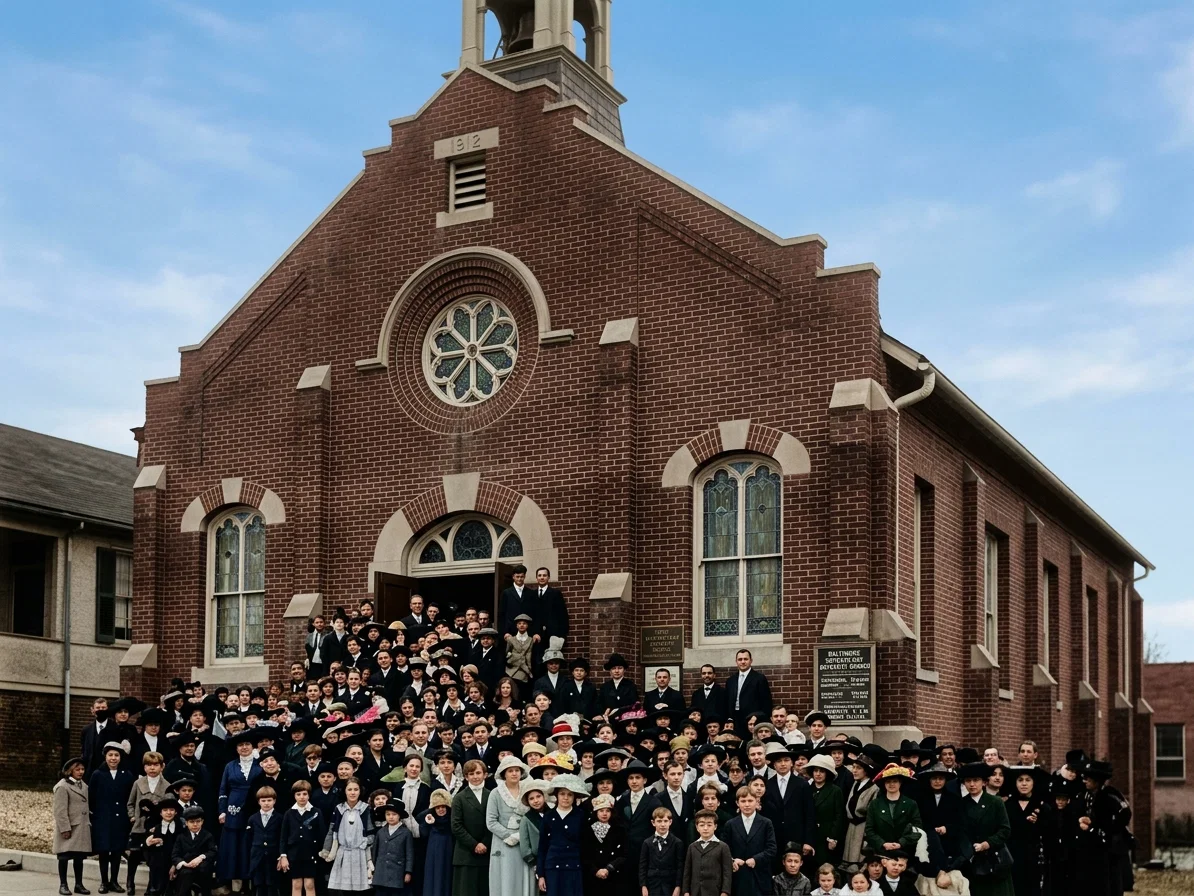
The dedication of the First Seventh-day Adventist church of Baltimore, Md., took place April 6, 1913.
BALTIMORE SEVENTH-DAY ADVENTIST CHURCH
The past six months have been especially busy and interesting ones in connection with the work of God in the city of Baltimore. For many years the church here has been greatly crippled and hindered by not having a church home. Out-of-the-way, noisy, and altogether unsuitable halls have been rented, but these do not lend dignity and give character to our work. Long has the church hoped and prayed that this condition might change; and in the providence of God this change has come. Through a united effort that has cost us much we are comfortably housed in our own new church home on Ninth Street, near North Avenue, Walbrook, Baltimore. A more commendable zeal and spirit of sacrifice on the part of all it is difficult to imagine. The Lord has blessed every effort, and to-day we have a property that has cost us $12,000 including $2,700 for the ground. We have a beautiful location in a fine section of the city. Our church building has two floors, with a seating capacity of 350 each, is supplied with all conveniences, toilets, baptistery, electric lights and gas, hot and cold water, steam heat, and a thorough system of ventilation.
The dedicatory services were particularly refreshing. Elder B. G. Wilkinson spoke on Friday evening, April 4. Elder Thompson on Sabbath at 11 A. M., and Elder A. G. Daniells preached the dedicatory sermon on Sunday at 4 P. M. The church was taxed to its utmost.
Elder R. T. Baer led a praise and social meeting Sabbath afternoon. A very liberal response was made to the call for financial assistance. The offering on the day of the dedication amounted to $1,332 in cash and pledges.
In the evening the writer spoke on Christian baptism, after which seventeen persons followed their Lord in this solemn rite. We feel that the sacrifices and labors of God's dear people of the Baltimore church, especially during the past few months, will mean much in enabling us to do the work expected of us by our great Leader. Pray for us. F. W. PAAP.

French Work in Worcester, Mass.

LAST summer a tent was pitched in this city and a series of meetings conducted in behalf of the French people. Worcester has a population of one hundred forty-eight thousand. About twenty-eight thousand speak the French language and most of these are Canadians. They are located principally in the northern, central, and southern parts of the city, so it was impossible to reach them all in the first effort. Our tent was located on French Hill in North Worcester, a very quiet place, but the attendance was small. The French papers closed their columns to us, and we were unable to advertise our meetings, even though we offered to pay. However, we circulated thousands of bills.
During November and December we made an effort to interest the lower class in the south part of the city, but we found them totally indifferent to religious work.
Since January we have rented a small hall in the central part of the city. There we are installed as Mission Française. Being centrally located, we believe this mission is just what is needed for the work in Worcester. Our Bible worker, Brother Arthur Jean, is a French Canadian and takes well with the Catholics. With help from on high his work should continue to bear much fruit. Work among this people calls for much prudence, great patience, and perseverance.
As a direct result of our efforts four are keeping the Sabbath, another keeps it in part, and several families, which we are visiting regularly, are in the valley of decision. At one time it seemed that God would give us a harvest of about twelve precious souls. Several so appreciated the truth that it seemed they could not do otherwise than obey it, but most of them have postponed yielding to God because they can not find work that will permit them to observe the Sabbath. However, we feel encouraged at the prospects in Worcester.
We plan to pitch the tent next summer in one of the French suburbs of the city. Let all our people unite their prayers with ours for the success of this work, that it may yield much fruit for the eternal kingdom. G. G. ROTH.

Learn to Forget

To forget—that is what we need. Just to forget. All the petty annoyances, all the vexing irritations, all the mean words, all the unkind acts, the deep wrongs, the bitter disappointments—just let them go, don’t hang on to them. Learn to forget. Make a study of it. Practise it. Become an expert at forgetting. Train the faculty of the mind until it is strong and virile. Then the memory will have fewer things to remember, and it will become quick and alert in remembering the things that are worth remembering. It will not be cumbered with disagreeable things, and all its attention will be given to the beautiful things, to the worth-while things.
No matter what business you are pursuing, no matter what literary subjects you may be studying, no matter what scientific problems you are trying to solve, take up the study of forgetting. The art of forgetting will give added luster to all your literary, business, or scientific attainments, and it will add immeasurably to health of mind and body. — St. Louis Christian Advocate.

The Royalty of Kindness and Truth

True worth is in being, not seeming, In doing each day that goes by Some little good deed — not in dreaming Of great things to do by and by. For whatever men say in their blindness, And spite of the fancies of youth, There's nothing so kingly as kindness, And nothing so royal as truth. — Alice Cary.
Continue reading: Progress of the Work Among the Jews—No. 2