Your ShelfYour Projects

Review and Herald, Vol. 80, No. 17.

God and His Picture
Earlier text: The General Conference
vestigate the best methods, and after looking the matter over carefully, they presented the same thing before our conference. It was recommended that all the schools be placed upon that basis, and about the first of January the matter was arranged. There is a conference treasury, where this money would come in, and from that time we have been paying all of the teachers from the treasury.
A. F. Harrison urged the missionary character of all our work, and feared that the question of a salary was being emphasized too much. He believed the young workers should be encouraged to go out and work, salary or no salary. He would use the second tithe for the poor, where he believed it belonged.
C. W. Flaiz: There are various methods that have been employed in various conferences for the support of the church schools. There is the second tithe, as we have heard this morning. Some schools have been supported by donations. Others have supported their schools by tuitions. I do not believe we are prepared to take any definite action this morning on any one of these. We have provided for the calling of a council to consider these problems. When that council shall convene, they will be more fully prepared to study those questions, and get some plan that will be recommendatory for trial. I therefore move that this recommendation be referred to that council, when that shall be convened.
R. C. Porter: I second that motion.
E. A. Sutherland: Mr. Chairman, I should like to make another brief statement before this motion is put. I know this is one of the vital questions of the church-school work, and the point of co-operation has been mentioned several times, that much more can be done by co-operating than can be done by the individual. One of the greatest evils that we now meet in trying to support the church-school work by the several churches is the moving of the Sabbathkeepers from weak churches to strong churches, where they can have the advantage of church schools without too much expense to themselves. We find that many are going to the cities. God has told us to go to the country; but, on account of the poverty and scattered condition of our Sabbath-keepers there, many are driven the other way.
About thirty years ago one church had one hundred members, with sixty-five children. To-day that church is not in existence. The children of one family are now in the truth. Two of these are workers in the cause, and two are not, but they are keeping the Sabbath. I asked, as I learned about this, "When did those other young people leave the truth?" I was told, "It was about the time they were prepared to go into the advanced schools of the world, or when they had finished the common branches and left home."
J. M. Rees: Did the members of that church all apostatize, or did they move away?
E. A. Sutherland: Many of the parents are, of course, dead; some apostatized, and the one who told me said he knew of only one family to-day that is in the truth.
Another church had seventy-five members, and thirty-five children in the Sabbath-school. Out of that number but three families are keeping the Sabbath to-day. Six of the children are keeping
the Sabbath, and only four of these are in the work to-day. The church has been gone for thirteen years.
Another instance: Twenty-five children were in the Sabbath-school ten years ago. To-day there are but two of those children keeping the Sabbath, one of whom is in the work.
Now I will take a representative case. Thirty years ago a church was established. There were seventy-five members. Their tithe, when they paid an honest tithe, was about $1,200 a year. That church has been disbanded, and nearly all are out of the truth on account of their children. I know something about the circumstances. We will say that twelve years ago that church ceased paying tithe. That would amount to about $15,000 that this denomination has lost in tithe since this church disbanded. The children have gone out of the truth. If they had paid tithe during the last twelve years, their tithe would have been at least $10,000; for I know something about what some of them have earned. That amounts to $25,000 that has been lost to the truth during the last twelve years from this one church. A church school would have kept this church together, and would have been the means of saving these youth, and during the last twelve years $25,000 would have been saved in tithe, which is nearly three times the whole cost of maintaining a school for the entire period of thirty years. Even if the expenses of the teacher had been borne by the conference, would it not have paid financially, if we consider it only so?
Six hundred and forty thousand dollars was paid in as tithe during the past year, and $100,000 in offerings, making $740,000, in round numbers. If God's plan had been followed out, we would have had $1,800,000, instead of $740,000. There is a great robbery going on somewhere in this denomination, and it is because the people do not recognize the necessity of paying more than one tithe. They feel that when they pay that, the rest of their obligation, in paying to God what they ought to pay, can be met by paying small sums just as they feel able.
The amount of money held by this denomination, according to the last Bulletin, is about $60,000,000. The highest per cent, so far as I can learn, paid by any State for public school instruction, is four per cent, or four dollars for every one hundred dollars of property. The lowest rate is one half of one per cent. If we would pay two per cent, we should have for church-school expenses, or educational expenses, $1,200,000. If we would pay one per cent, we should have $600,000 every year to carry on the educational work.
There are 2,070 churches in the denomination. If we were to support one teacher for each church for eight months every year, at $30 per month, it would amount to $240 per year for each teacher, or, for the 2,070 churches, $496,800, which is more than $100,000 less than would be a two per cent tax on our property, or, in other words, less than one half the amount that the citizens of some States pay, pro rata, for the education of their children in the State schools. The second tithe is the Bible plan, I believe, for the support of teachers. I do not ask at all that the first tithe be disturbed. The thing to do is to teach the people to bring up the rest of their offerings.
The motion to refer the question to the educational council, to be called, was carried.
At this point P. T. Magan was asked to make a report on the campaign for "Christ's Object Lessons."

The Relief of the Schools

P. T. Magan: It is now almost three years since the battle for the relief of our schools was begun. The first part of that fight is over; the flood tide, when every one was willing to go to the front, is also over, and we have now come to the place where we are to decide if we will stand by until the day is won.
I have been thankful during the three years in which we have been fighting that, to the best of my knowledge and belief, there has never been a word of censure from the Spirit of God regarding this work, or the way our people have taken hold and conducted it. There have been many, many Testimonies relating to it; but every one has been of good comfort and good cheer over what has been done. And in one, especially, I remember the expression that God was pleased with his people in this thing. So I believe this morning that, whatever the results may be, we have great reason to be thankful to God for what has been accomplished.
You will remember those touching words which appeared in one Testimony from Sister White, telling how the work started; that "God heard the prayers and saw the tears of a few poor men who were struggling with a terrible burden of debt; and in the night season revealed to me, his humble servant, the heaven-born plan of 'Christ's Object Lessons' for the relief of our schools." I have always felt thankful and comforted in thinking over those words. The author of the plan, the giver of the book, states that it was a matter of deep struggle for her to do it, as she had counted upon that book to pay her own debts; but after praying over it, and pondering over it during the night season, she decided to make the sacrifice, and then light filled her mind, so that this work has been born of God, and God's blessing has attended it every step of the way.
I suppose we can all look back to the beginning and see how different the work has been from what we expected it would be. When we started this work, we counted that we were about seventy thousand Seventh-day Adventists strong. We have come to the conclusion now that we are not quite so many as that, and we are not quite so strong as we ought to be. And if you doubt my word on that, I will hand you the signed reports of the presidents of conferences and secretaries of tract societies, in which the memberships of many of the conferences have grown smaller and smaller. One conference that I have in mind, that started out with a membership of three thousand, has been reduced to two thousand. One church that started out with a membership in the neighborhood of two thousand has come down to about nine hundred, I believe. But I am sure, when the sifting is over, and the smoke of the battle is cleared away, that those who stay in will be thoroughbred Seventh-day Adventists.
I know that it seemed as if it would be easy to get all our people to work, and thus sell three hundred thousand books. It looked as if seventy thousand Adventists
strong ought to be able to sell that number of books in a very short time, and I think you will all agree with me in this, that if our churches had been filled with the Spirit of God, the spirit of work, as we all wish they might have been, this whole work could have been finished up in three months' time.
Now I know that there are any amount of people who have sold six books, and have done it in a few days. And I know that any man or woman of average intelligence and strength and average spirituality can sell six books in a remarkably short space of time. But I am sure you will all have to agree with me on this, that when this work with "Christ's Object Lessons" came to us, it found our churches badly disorganized, as far as power to do active work for Jesus Christ was concerned. And it has revealed to us a number of weaknesses in our churches; and I believe this has been the means of eradicating some of these weaknesses, and has given us strength and blessing.
When this work came to us, the spirit of circulating literature was practically dead. There had been a time when the old tract and missionary work was a very live work among us; but that work had dwindled down to almost nothing.
The canvassing work, which ten or twelve years ago was in a high state of progress, had also dwindled; and I believe with all my heart that God gave this work to call us back to the work of spreading the truth by means of our literature. And while these debts, in one sense, have been a curse, in another sense God has used them and the method for getting rid of them as a blessing to this people, because there are thousands of the people all through our ranks who have learned that they may go out and do work. They have learned that, without waiting for any special commission, they can do real, live, active work for Jesus Christ; and we now have, as a result of this work, I believe, at least several thousand people in the Seventh-day Adventist denomination who are first-class, courageous canvassers. I have seen a number of instances, scores of them, yes, even hundreds of them, where I know that it is so.
I believe that if we will simply hold on to the principles of this thing, and continue the work with other literature, we shall have an army of active workers in this cause, such as we have never seen before. Now I do not believe that the thousands of Seventh-day Adventists who have become courageous Christian evangelistic canvassers as a result of this work should be allowed to lapse into their old ways again. I believe we ought to get some other good book, and follow right along, perhaps not exactly in the same way, but that every person among us should take an active part in selling our literature.
I have in my hand a sheet giving the figures returned by the different schools and societies and organizations which have become beneficiaries under this movement. Personally, I can not vouch for the absolute accuracy of all these figures. These are simply the compilations made in my office from the figures returned to me by the different schools. I may say, in the start, that, up to date, the movement to relieve our schools from debt has resulted in raising, as nearly as can be figured, $237,910.75.
That amount is not entirely made up of money from "Christ's Object Lessons;"
there are other gifts and donations and appropriations which have entered into that, which I will endeavor to explain as I go along.
The original amount of debt on the Healdsburg College is given as $42,846.78. The present amount of the debt is given as $22,784.66. The total amount paid on the original debt is given as $20,162.12. I understand that a large proportion of that is from other sources than "Christ's Object Lessons."
A. T. Jones: About ten thousand dollars.
P. T. Magan: The original amount of the Walla Walla School debt was $55,670. The present amount of the debt, $25,754.42. The total amount received from the sale of "Christ's Object Lessons" up to date, $9,000. The amount which has been paid on the original debt, $29,925.58.
My understanding of the Walla Walla debt matter is this: You will notice that only $9,000 is reported from the sales of "Christ's Object Lessons;" but they also report a large amount outstanding in accounts with tract societies. But I understand in that original amount of $55,670 debt they figure in the entire amount which has been placed in the institution by the General Conference Association, and that in the reapportionment of the General Conference Association liabilities they were relieved of $20,000 of that amount.
S. H. Lane: That is right.
P. T. Magan: So that while their debt has been reduced $29,925.58, a large amount of that has been by a gift from the General Conference Association.
Union College reports its original debt as $79,000. The present amount of its debt, $31,825.90. It has received from the sale of "Christ's Object Lessons" $47,139.19; and from other sources, $1,925.13. The amount paid on the original debt is $48,940.70. It has on hand $125.62 to apply on the debt, and there has been paid on interest, $1,766.60.
Mount Vernon Academy's original debt was $17,000. The present amount of the debt, $10,000. Total amount received from the sale of "Christ's Object Lessons," $7,000. Amount owing by the tract society, $1,000. Therefore total amount paid on debt, $7,000.
The original amount of the debt of the South Lancaster Academy is given as $44,000. The total amount received from the sale of "Christ's Object Lessons," $25,569.60. Debt on principal, $17,583.37. Cash on hand to be applied on the debt, $3,633.50. Amount paid on interest, $4,352.73.
L. A. Hoopes: Is that $20,000 in Walla Walla figured in this amount?
P. T. Magan: Yes, sir; that has been figured in, but there are eight or nine or ten thousand dollars, at least three thousand from one tract society alone, that has been received from the sales that is not figured in, and a number of amounts like that.
J. E. Jayne: Is it the same of the $10,000 in California?
P. T. Magan: The $10,000 is a genuine reduction, but it is not a distribution. The total reductions are figured simply on the reductions by "Christ's Object Lessons."
The only information I can give in regard to these three beneficiaries of "Christ's Object Lessons"—Graysville, the Southern Missionary Society, and Huntsville—is that to the Atlanta branch of the Review and Herald Office,
to the Southern Publishing Association, to the Southern Missionary Society, there have been shipped "Christ's Object Lessons" aggregating in value $12,262, as nearly as can be figured. How that money has been distributed, I have not the reports or figures.
The Emmanuel Missionary College has had from the sale of "Christ's Object Lessons" the sum of $22,393.10.
The original debt of Keene Academy was $17,624.40, according to their last report. The present amount of their debt is given as $5,395.64; the amount paid on their debt, $12,228.76; cash on hand to apply on debt, $100; amount on interest, $899.75.
The Battle Creek College has received from the sales of "Christ's Object Lessons," both before and after the transfer, from the Missionary Acre Fund, and from a transfer of some other property on the Review and Herald account, a net amount of $26,669.86. The old Battle Creek College property advanced to the Berrien Springs school on its equity in the property a sum, I think, in round numbers, of about $12,000. The corporation which owns the Berrien Springs property, on the other hand, turned over its assets, and from "Christ's Object Lessons" a considerably larger amount than that. I have allowed for those conditions on both sides, and I simply give the net figures. I think this will make the matter plain.
I will say, further, that computing these amounts has been an exceedingly difficult task. When the original amounts of these debts were given, I supposed they were reasonably straight, and I think everybody intended that they should be, but in the distribution of the liabilities of the General Conference Association vast differences have been made. Now, as I understand it, Union College in the beginning simply figured about $79,000 worth of notes, which were a standing and floating obligation against the property, and the entire amount which has been invested in it by the General Conference Association figured into that. Now, when you come to the distribution of the liabilities of the General Conference Association, they figured it like this: In Union College were several hundred thousand dollars' worth of property, and all that college was bearing was about $79,000, and it would be perfectly proper to ask this institution to take some $25,000 more. So, while a good deal has been done, we are not out of the woods yet.
The original debt of the Avondale School, in Australia, was $25,000, in round numbers. The amount paid altogether on the original debt from the sale of "Christ's Object Lessons" I understand to be practically $10,000.
The amount raised for the London (England) school I have approximated at about $10,000. I have not the exact figures, but some time ago they had sold the first five-thousand edition of the book, and were well along in the second edition.
The value of the foreign books sold in this country amounts approximately to $15,000, not all of which has been sent to the European fields.
The Canadian school has received $1,000 from the sale of "Christ's Object Lessons" for their work.
Now that is the total report of the returns which I have, making a gross amount of $237,910.75. That, of course, does not include the amounts which are
on hand in the tract societies and owing to the schools, or what is still in the hands of the people, to be paid in. Of course, those figures will have to be discounted to the extent of the apportioning of that Walla Walla debt, and whatever scale-down there should be on this English matter.
Are there any questions on the report as a whole?
H. W. Cottrell: Brother Chairman, I wish to make a statement. The figures of the South Lancaster Academy debt are based on a former estimate. We now think that it is somewhat more, but I dare not say just what it is, lest it be taken as official. We have an auditor working on it, and when the audit is completed, it will be an audit in the truest sense of the term, and then we shall know just exactly where we are.
A. J. Bourdeau: What is the general plan in regard to the amounts received from the sales of foreign books?
P. T. Magan: I will read a letter from Brother H. M. Mitchell, treasurer of the Mission Board, in regard to this matter:—
"Yours of the 11th instant is received, and, in looking into the matter in which you wish to be informed, we are able to give you the following facts: The total credits to the Danish school fund to March 1 are $5,685.07; Nyhyttan (Swedish) school fund, $4,612.59; Friedensau (German) school fund, $5,189.75. The total amount still owing us from the tract societies on these funds is about $1,500. I am not able to tell you how much belongs to each school fund, but the greater part of this sum is due the Swedish and German schools. Of course, you understand that there have been charges for freight, translating, etc., against all these funds, and the figures I here give you are not the balances now due these different schools. We have sent all but about $500 to the Friedensau school, and $1,000 to the Nyhyttan school, and the proceeds from the sale of Danish 'Christ's Object Lessons,' as you know, are given to the Christiania Publishing House debt."
The report of the material fund was then read. [This report was printed in the issue for April 21.]
L. A. Hoopes: I move that we accept the secretary's report and the auditor's report.
This was seconded, and the reports were adopted.
Adjournment was made, on motion, to 2 P. M. W. T. KNOX, Chairman. H. E. OSBORNE, Secretary.

Bay Islands

UTILLA.— We have been holding a number of Bible readings of late, and trying to do what we could to interest people in their salvation. We are glad to know that the Lord is blessing our efforts thus far. He has given us six new members. These were taken into the church subject to baptism. Three of these are among the largest students in our school. One is the wife of one of the wealthiest merchants of the Bay Islands. One, a young man, expects to go to Keene in a few weeks; and one young lady, twenty years old, desires to enter the work. Our school is progressing nicely. We are of good courage; not homesick in the least, and never have been.
L. O. CORWIN.

The Belfast Sanitarium

IT may not be generally known among the readers of the REVIEW that a small branch sanitarium was started in Ireland early the present year. There has long been a demand for a health institution in the Emerald Isle, and our brethren and sisters in that field were very anxious to begin institutional work. Belfast is the center of our small community of Sabbath-keepers, and naturally was the place selected for the health institution.
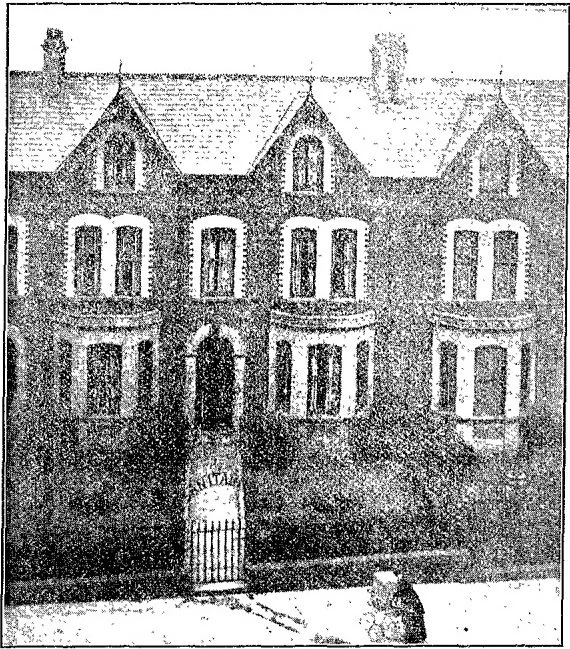
THE BELFAST SANITARIUM
About a year ago the first steps were taken toward the realization of a bath and treatment establishment. On returning from the autumn council of the General Conference and Mission Board, I told our friends in Ireland that the brethren in America would contribute one thousand dollars, provided they would furnish an equal amount, toward the establishment of treatment rooms in the city. The brethren eagerly accepted the proposition, and at once took the necessary measures to raise the funds. A committee was appointed last May, and they began at once to solicit donations.
While in this country, Dr. Kellogg twice visited Belfast in the interests of the new institution, giving the friends there his counsel and encouragement. He addressed two large meetings at the Y. M. C. A. hall, which were the means of stirring up a large interest in the enterprise. The Good Health has had a large circulation in Belfast from its very start, and a considerable number of Dr. Kellogg’s health books have also been sold in the place. By these means an interest was awakened in health reform, and the citizens were prepared to support the institution when it was started.
The Belfast Sanitarium is located in one of the most beautiful residential parts of Belfast, a city of about three hundred and fifty thousand inhabitants. It is on the Antrim Road, a highway to the famous Cave Hill, which is visited by all strangers going to Belfast. The tram lines pass in front of the house, which is set well back from the street, and within two minutes’ walk of one of the public parks. Of course the house is rented. The rent, taxes, and water rates amount to about sixty-five pounds, the rent alone is fifty pounds.
The house is a double-fronted one with three floors, and twelve good-sized rooms. The illustration on this page does not do justice to the place, but will perhaps give a fair idea of its size. On the ground floor, the room on the left is a dining-room; the one on the right a drawing- and sitting-room. Back of the drawing-room is the massage and treatment room, and back of that, with a glass roof, is the bath room, which also contains the needle spray. Back of the dining-room is a large, well-lighted kitchen, with several ample pantries close at hand; and at the rear of the building is the heating apparatus, which is very simple and efficient. It supplies hot water to the bath rooms, and also steam to two or three radiators. The second floor contains three large bedrooms, a large, well-lighted medical office, a laboratory with one window at the end of the hall, a small bedroom, and a second bath room, which is nicely equipped with bath tub, spray, and massage table. The third floor contains four large, comfortable bedrooms. They are more commodious than one would judge from the photograph.
The place has been equipped from the money raised by donations. The friends in Ireland have already raised in cash about two hundred pounds, with a little more to come in; this is an average of ten dollars for each Sabbath-keeper in Ireland. So far no money has been received from America for this enterprise, but with the consent of the General Conference the International Tract Society of London has very generously advanced one hundred and sixty pounds in behalf of the donation from our American brethren. There are still some items of equipment that have not yet been secured, but like the new institution in Caterham, the Belfast Sanitarium has never incurred any debt, and those in charge of it are determined to avoid debt at all events.
Just as soon as the place was opened, patients came, and according to the last word received, they had six resident patients, which is practically their full capacity, unless they put two in every guest chamber, and that is hardly possible. Besides these, they have a considerable number of non-resident patients, citizens of the town, who come in for the treatment regularly. The success of the Belfast Sanitarium has been most gratifying from the start, and we believe that it will be the means of accomplishing much good for the spread of the work in Ireland.
The board of managers consists of Dr. J. J. Bell; Elder William Hutchinson; G. B. Replogle; J. McAvoy; J. MacCreary. Dr. Bell is the superintendent, and his sister, Miss Isabella Bell, is the matron. Other members of the staff consist of Delmer Baker, of California, and Sister Annie Wright, of London, nurses; with Brother David MacClelland and Sister Pace as assistants. Dr. Bell is a qualified physician and surgeon, both in the United Kingdom and in the United States. He completed his work in Dublin University about a year ago, and since then has been busily engaged in work.
Great care and economy have been used in selecting the outfit for the institution, but everything is substantial and neat, and both the public and private rooms are exceedingly attractive. No matter where one goes in the institution, everything is clean and neat. The bath room, although not very large, is almost ideal in its equipment and arrangement, with a glass, glazed roof, which makes it very light, and gives an air of cheerfulness to everything. At one corner is a Russian bath room, which is provided with a marble slab. There is an excellent white enamel full-bath tub, a sitz bath of the same material, and a steam boiler for the fomentation cloths. The nickel-plate combined needle spray, shower, and douche apparatus was made at the Battle Creek Sanitarium, and is one of the attractions of the place.
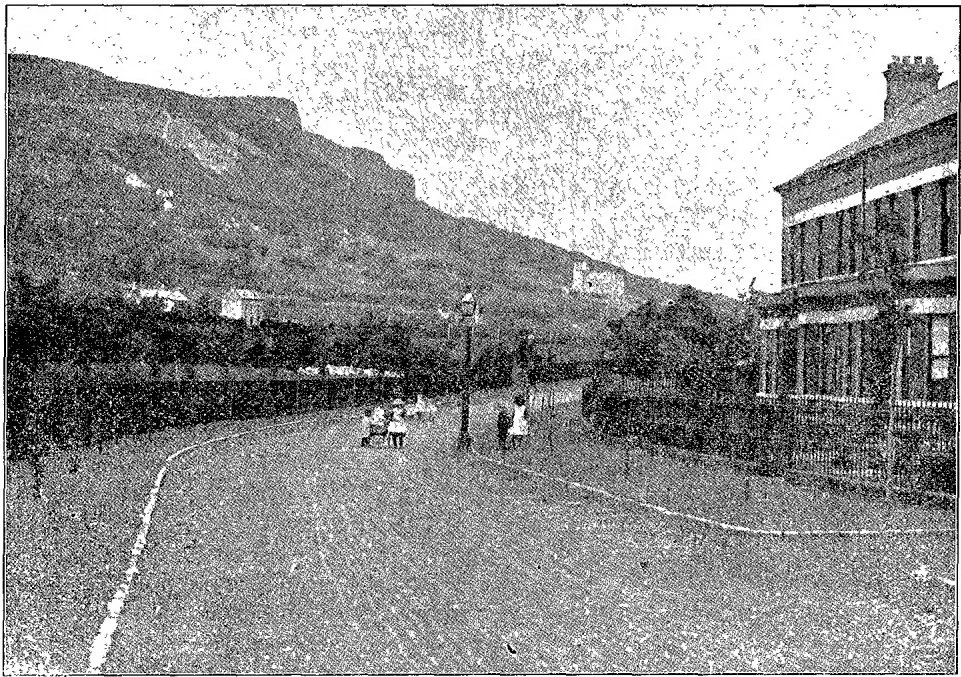
CAVE HILL, BELFAST
CAVE HILL, BELFAST
Belfast is one of the most enterprising cities of the United Kingdom, and in the opinion of many, more nearly resembles an American city than any other place. It is nicely located at the head of Belfast Loch, and is noted the world over for its shipyards. Here the famous “Celtic,” “Cedric,” and “Oceanic” were built, and only a few weeks ago the keel for a still larger vessel was laid at the leading shipyard. This vessel, when completed, will be the largest in the world, while the “Cedric,” which was recently put into commission, is now the largest vessel afloat. The surroundings of Belfast are beautiful, especially in the direction of the Cave Hill, an illustration of which is shown on page 19. The road is the one that passes the sanitarium, and leads out directly to the famous caves, of which there are several. The highest part of the hill is called McCarr’s Point, and is more than a thousand feet above the sea level.
The Belfast Sanitarium bids fair to become a splendid success, and I trust it will be the means of accomplishing a vast amount of good in the cause of true reform. Similar health institutions ought to be started in some of the other large towns and cities of Ireland. There is no better means of reaching the masses of the people than through genuine medical missionary work. May God bless this work, and bless all the workers who have so nobly given their lives to follow in the footsteps of the Master.
A. B. OLSEN.

Ceylon: Colporteur Travels Through India to Colombo

Ceylon

COLOMBO.—The first of November I came south with a young lady who accepted the truth not long ago, and who had been canvassing and doing Bible work. We traveled toward Madras, stopping at different stations en route. The Lord blessed our efforts for the books and papers in every place.
At Hyderabad, the most oriental city I have seen in India, we were invited to a Mahratta dinner. The father and mother of the family were Christians. There was present a strange mixture of nationalities,—an Australian missionary, two English missionaries, an ex-Mohammedan, a converted Jewess, Bengalis, Mahrattas, and one American missionary. After dinner we had hymns in Mahratta, Bengali, and English. The dinner was served in native style. We sat down on mats, and had large plantain leaves for plates. This was my first experience in eating rice with my fingers, but I managed it fairly well. They had compassion when the pudding came, and brought us some spoons. I tasted a certain green, pretty-looking mixture on my plate. I paid dear for my experience. My mouth was on fire, and nature refused to pass over the outrage without giving expression in some way to the fact that my mucous membrane had been abused. The tears flowed freely.
After leaving Hyderabad, we came to Madras, where we remained over a month, and then came to Colombo, stopping at different stations en route, crossing over to Ceylon the 13th of January. We expect to finish in another week, and will soon go up the mountains to Nawareliya. Here we shall have a breath of cold weather. This is the warmest month in Ceylon, and it is very hot; but it is wonderful how the Lord has helped us to endure the heat. We go out about eight in the morning, and usually work till noon, and then go home to dinner, and go out again from three to four P. M.
The Cingalese are an interesting and progressive people. Many of the men read and speak English. We have here Burghers (a mixture of Dutch and native) and Cingalese. Many of the Cingalese homes do not look like native homes, as they use furniture quite generally. But I have learned to recognize them, usually by a certain arrangement of the furniture. They seem to be more progressive than the people of India, with the exception of the Parsees. They are largely Buddhists.
Ceylon is a charming place. What I have seen of it calls to mind those lines,—
“What though the spicy breezes Blow soft o’er Ceylon’s isle; Though every prospect pleases, And only man is vile; In vain with lavish kindness The gifts of God are strewn; The heathen in his blindness, Bows down to wood and stone.”
The Lord has not only favored us with success in selling books and getting orders for the papers, but he has turned the hearts of strangers to show us unusual favors. We are both happy in the work, and thankful for a part in it. I do not mean that there are no shadows and trials, but out of even these the Lord brings blessings. We expect to go back up the west coast of India to Bangalore, and on to Bombay. If all goes well, we shall reach Bombay about the first of June, and canvass that city during the rainy season. It will not be difficult to canvass during the monsoons, as so many of the people live in blocks. One can find a morning’s work in some of those buildings. We are sadly in need of more canvassers. Some one ought to be canvassing at Bombay now. The subscriptions are running out, and we can not go there before June. I never before had such a love for the canvassing work. I would like to remain in it until the Lord comes. We have some most interesting experiences. ANNA ORR.

The General Meeting in Scotland

THIS meeting convened in Glasgow, April 1, and continued five days. It was not so large a gathering as the annual meeting in Ireland, but I think just as important. There are only about sixty believers in Scotland, but there is a good prospect for a much larger number before the close of the present year, providing the plans made at the annual meeting do not fail.
Inasmuch as the division of the British field was effected less than one year ago, this was the first annual convocation of Scotch believers in the third angel’s message. Of course some were not well acquainted with conference methods, but when matters were understood, the business moved off expeditiously. Credentials were granted to W. A. Westworth, and ministerial licenses were voted to D. P. Miller, E. Aplin, R. M. Lamie, J. Netherey, and Miss Mary Lamie.
The choice for chairman of the mission board for the coming year fell on W. A. Westworth, with W. B. Scott for secretary, and E. Aplin for treasurer. The associate members of the board chosen were W. B. Scott, E. Aplin, R. M. Lamie, and C. Dyer.
Some gratifying facts were brought out concerning the canvassing work. The mission has ten canvassers, who average in sales £3 10s., or $17, a week and the entire year. One man told me that for seven years he had supported his family, which now consists of six members, by canvassing. Of course all the agents do not do so well, but taking them all together, the average is as before stated.
I can not forbear mentioning a remarkable praise service enjoyed in that meeting. After a discourse on the Sabbath by Elder Olsen, the meeting was given to the congregation, when those in attendance followed one another in quick succession, testifying to the preciousness of the Lord to them in their Christian experience. It was a feast to me, because it was so much like meetings I had attended in other parts of the world, and it clearly testified to the uniform value of God’s blessing to the believer. The good results of this meeting can not fail to be manifest in the labors to follow it, in the Scotch Mission field. J. O. CORLISS.

Tobago: Island History, Missions, and Adventist Work

Tobago

This island is twenty-six miles long and seven and one-half miles wide, and contains one hundred fourteen and one-half square miles. It is situated in 11° 9' north latitude and 60° 43' west longitude, and is eighteen miles from Trinidad, to which it is politically connected. Its surface is rough and mountainous, and only a small portion is cultivated, although the soil is fertile. For the first one hundred and fifty years after its discovery and settlement, Tobago’s history is full of tales of bloody conflicts and disastrous wars between the Dutch, French, and English. After varying successes and failures, the English gained full control in 1793, which they still maintain. Its many ruined forts and decaying buildings speak of prosperous times, disappointed hopes, and the vanity of earthly things.
Formerly sugar was the principal export, but low prices brought financial trouble, and most of the estates are abandoned or turned into stock farms. Cocoa and coffee partly supply the demand of the people. Other products could be profitably raised.
Missionary operations were begun here by the Church of England in 1781, by the Moravians in 1789, followed by the Wesleyans in 1810. A good quantity of our literature has been sold by our agents. Here where so many battles have been fought for worldly honor and power, we have entered in the name of the Prince of peace to sound the last message of mercy to a dying world. If faithful, we expect to have sheaves for the heavenly garner from this island.
W. G. KNEELAND, I. H. MATHEWS.
Continue reading: West Coast, Africa