The Youth's Instructor, Vol. LI, No. 37

A Trip Through Egypt—I

The Youth's Instructor

September 15, 1903

Review and Herald Publishing Assn. · Washington, D. C. · September 15, 1903

A Trip Through Egypt—I

First Impressions
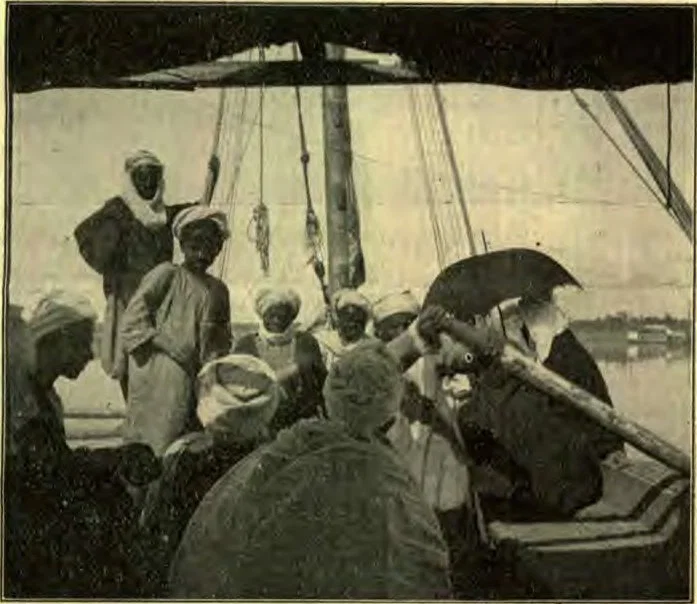
The European traveler, landing for the first time at Alexandria or Port Said, soon begins to realize that he has entered a new world. At first, perhaps, he is not so much surprised as he expected to be. The flat sands of the Delta seem very monotonous after the richly colored and beautifully picturesque mountains of Italy and the Mediterranean isles. There is little of that ingenious begging so prominent at Genoa and Naples, and the Egyptian peddler, of whose importunate cupidity the traveler has heard so much, is no rival in cunning mendacity to the Neapolitan vender.
ON BOARD A NATIVE FERRY-BOAT
But as the steamer stops near the quay, and the crowds of porters and tourist company agents swarm over the side, he notices the coal barges approaching, black with a new race of strangely dressed, or, more properly, undressed, laborers; and probably, while he is being rowed ashore in a miserable little ferry boat, one of the swarthy rowers addresses him in a strange, guttural tongue, and he hears for the first time that most used and abused word of the Arabic language, “Backsheesh, backsheesh, yakawakia! ana miskeen, ana aiyan, ana gian keteer (a gift, a gift, O sir! I am wretched, I am sick, I am very hungry),” until it becomes as a rattle of a car, or the roar of the waves in a steamer,—a sound that must be endured and tolerated, because it can not be prevented. It is utterly useless to attempt to silence the cry; for any gift simply stimulates the recipient to more importunate appeals, and attracts a crowd of others, thus only multiplying the evil; and no matter how large a gift is presented, no thanks need ever be expected.
The journey from the coast to Cairo affords many surprises. If the traveler has the hardihood to buy a third-class ticket, as a few economical ones occasionally do, he is likely to receive a very unfavorable impression of Egyptian traveling facilities. The short, low, narrow car, furnished with cushionless wooden seats arranged in the American style, is crowded with good-natured jabbering Arabs, each one the happy possessor of two or three large bundles, or a bunch of sugar-cane like an American “corn-shock.” This property fills up the aisle, and all other extra space; and the owners, firmly seated upon their respective possessions, alternately smoke cigarettes and chew sugar-cane, depositing the refuse upon such portions of the floor as still remain available, until it is covered to a depth of some inches. Over this animated chaos the conductor comes stumbling along, keeping up a running conversation with every one he encounters in so loud and apparently angry a tone you imagine he is swearing, which is not infrequently the case. One vainly endeavors to catch something of the meaning in the conversation, as he can do with most of the European languages; but this strange tongue is entirely different. He can not recognize a single word.
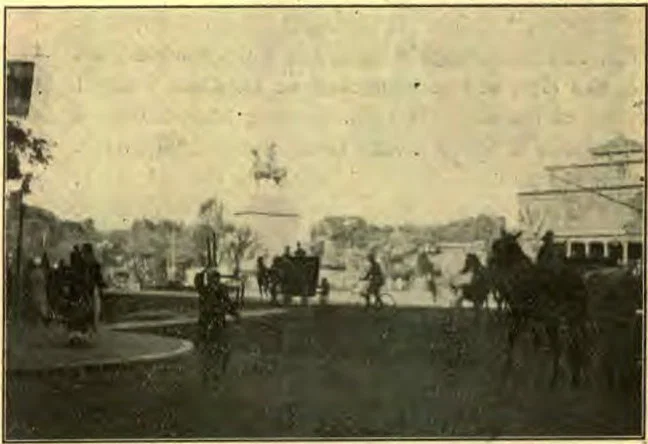
Upon his arrival in Cairo, which is usually at night, the traveler, having delivered his luggage to one of the importunate porters at the union station, enters a “victoria,” and is driven at once to his hotel. The conveyance passes along a wide street, looking very European, well lighted with electricity, so he sees nothing of importance that night except, perhaps, the fine statue of Ibrahim Pasha in the “Place d’ Opera.” He sleeps soundly, but on waking in the morning is surprised to find himself listening to the roar of a great city without. Going to the window, he sees for the first time that unending and ever-moving panorama which any one of the main streets of Cairo presents. The street is filled with a motley crowd, dressed in every style and color imaginable. He gazes fascinated for a long time, then turns, and prepares himself for sight-seeing in the capital of Egypt, with a new zest.

Cairo

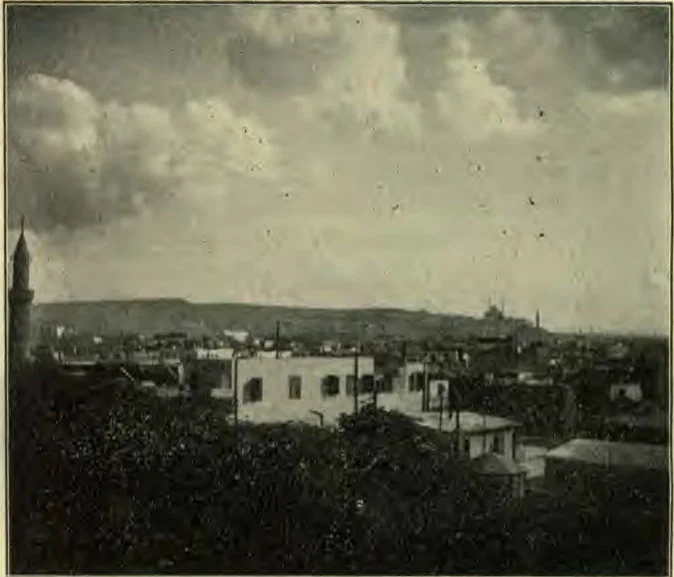
Cairo is the largest city in Africa. Its population of six hundred thousand is one of the most interesting and cosmopolitan in the world. Greeks, Jews, Arabs, Copts, Bedouins, Syrians, Italians and Turks, in their respective costumes may be seen at any time in the streets. A dozen different languages are spoken, but almost every one knows Arabic, while French is used principally among the better classes of Europeans.
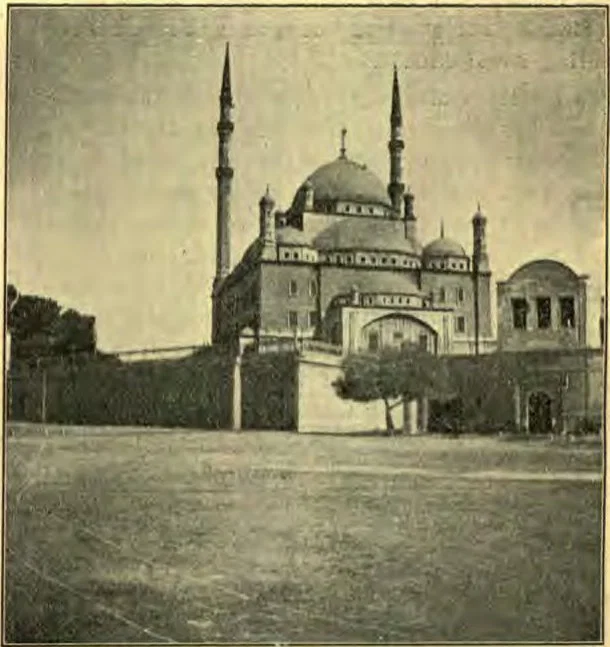
MOSQUE OF MOHAMMED ALI, IN CITADEL
Although Cairo has suffered much from war, pestilence, and destructive fires, it has been an unusually prosperous city, and now, under the salutary influence of Great Britain, it is growing with astonishing rapidity, having increased in population over sixty per cent in the last decade. The large European quarters of the city are of recent construction, and are built in the French style, with clean, broad, well-paved and well-shaded streets. This part of Cairo comprises the Kasr el Nil district, and the extensive and rapidly growing suburbs of Shoubra and Abbessieh. But the bulk of the population is packed away in the older portion of the town around the “Mousky,” the principal business street of the city. The shops and stores of “Mousky” present a European appearance; but the crowd which surge along it furnishes an inexhaustible field for the student of orientalism, and a source of continual amusement to the superficial sightseer.
STATUE OF IBRAHIM PASHA
But it is in the by-streets around Mousky that the traveler finds orientalism proper. The one who starts out alone, with no guide save the compass, will enjoy himself the most thoroughly; for then he will search with all the energy of an explorer, and feel all the exultation of a discoverer at the strange objects he finds. As the streets grow narrower and narrower, finally closing entirely overhead, the spectacle becomes more and more strange.
The counters of the little shops open right on the street, and behind each one sits the proprietor with his goods piled neatly around him. But one’s wonder increases as he sees the wealth displayed in the Jewish quarter. The dark, squalid, dirty streets, five or six feet wide, are lined with shops of goldsmiths, and silversmiths, jewelry stores, and miniature banks, whose safes stand in full view just back of the little counter. During business hours, when the streets are very crowded, these safes are usually open, displaying the piles of English, French and Turkish gold within. The display in the shops is not less striking, and a very wealthy visitor, such as the shah of Persia, not infrequently spends several thousand pounds during a trip through these streets. But the traveler is soon glad to leave the splendid squalor of these dark recesses, and feels almost relieved to find that an inexhaustible wealth of golden sunshine is pouring down outside.
To the lover of antiquities, a visit to the large museum is of interest. Here one may see dozens of kingly mummies, still resting in their splendid sarcophagi. It is wonderful to see the perfect preservation of these bodies, from two to four thousand years old. In form and feature, often even the color of the hair, they are so well preserved and the expression is so natural, that one finds himself half expecting them to smile. It would be beyond the compass of this article to try to enumerate the priceless treasures of ancient monuments, weapons, jewels, vases, etc., that this wonderful museum contains, so we will leave them to the imagination of the reader.
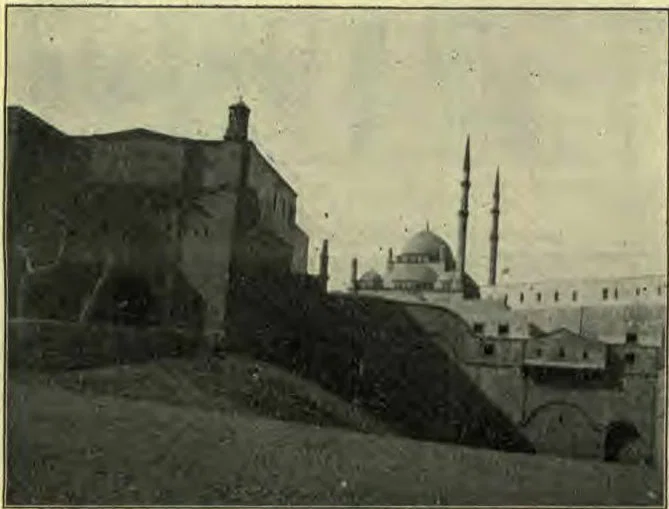
VIEW OF THE CITADEL
VIEW OF THE CITADEL
A prominent point of interest in Cairo is the citadel, built on a high rock in the southwestern part of the city, and commanding an excellent general view of the city. It is interesting historically as the scene of many bloody revolutions. The traveler is shown the court-yard, where, in the year 1811, the Mameluke Beys were treacherously massacred. In the midst of the citadel is the large and once splendid mosque of Mohammed Ali; but the decorative jewels and the finest of the columns were long since taken to Constantinople by the Turkish conquerors. Owing to the advent of modern long-range artillery, the citadel has lost its strategic value for the defense of the city, but it is occupied by a strong British garrison, whose guns command the city.
Near the citadel are the highly interesting tombs of the califs and mamelukes, whose bold domes and slender, graceful minarets present a highly novel and beautiful aspect.
The tomb of Keyet Bey is perhaps the most graceful specimen of Arabian architecture. Built in the style of a mosque, the stalactite decorations, the marble mosaic, and the elaborate ivory carvings are of unexcelled beauty. Within the mausoleum are two black stones from Mecca, which are believed by the faithful to bear the footprints of Mohammed.
In returning we will visit the great university, which has the distinction of being the oldest and largest in the world. None of the seven thousand pupils pay any fees, nor, with the ex-ception of the principal, who is paid about $500 a year, do any of the two hundred professors receive any salary. As this building is a mosque, the visitor must remove his shoes on entering. He finds the numerous students sitting on the floor, or rude benches, reading or reciting in the high-keyed monotone so universal in Eastern schools.
Returning, then, to our quarters, we will take a good rest to prepare for a longer excursion tomorrow.
GLEN WAKEHAM.

By Hook or Crook

“Tom,” said Robert Sturgis, “I wish you’d tell me what answer to make to Oscar Bartlet when he says there isn’t any God.”
“Who is this Oscar Bartlet that seems to know so much, and so little?” asked Tom, the collegian.
“Oh, he’s a new fellow at school; he has been around a lot, and the boys like to hear him talk.”
“And is that the way he talks?”
“Yes, he says nobody can prove that there is a God.”
“Well, the next time you hear him say that tell him you know a fellow that can find him proof of God’s existence, in less than half a mile from town. If you can get him to take you up, I’ll hold myself ready.”
This was how it happened that on a splendid September afternoon, when earth and air and sky were full of delight, Mr. Tom Sturgis might have been seen cutting across lots to Parson’s meadow, with half the village schoolboys at his heels.
“Your Mr. Parson’s must be a poor farmer,” said the new boy, contemptuously, gazing about him in the meadow, where many bold weeds were blooming, and even seeding, undisturbed.
“I’m afraid that is a true charge,” said the collegian, “but it is an ill wind that blows nobody good, and I would miss Mr. Parson’s crop of jewel-weeds, herb-roberts, witch-hazels, etc., if he cleaned up this meadow more thriftily.”
“What difference do these weeds make to you, I’d like to know, Tom?” asked one of the string of boys.
“Well,” said the collegian, “I am child enough to like my lessons with pictures to them; and these particular ‘weeds,’ if you like to call them so, print a fresh set of illustrations for me every fall.”
The boys looked at Tom with curiosity, as he carefully cut a stalk of jewel-weed, on which hung already the swaying seed-pods. “See what these hanging things feel like, Oscar,” he said, and a loud ha-ha was raised when the city boy jumped, for of course the pod split with a bang, and out popped the brown seed, ready to begin life for itself.
But even the country boys did not know why the jewel-weeds, herb-roberts, and witch-hazels had the fashion of shooting their seed off this way, until the collegian explained that if they all simply dropped at the root of the plant, they would not get a good start in growing.
“I was quoting that old proverb about the ill wind, just now,” said Tom, “and here’s a fellow to say ‘amen’ to it.” He brushed rather roughly the downy seed-ball of a late dandelion, and away flew the eager seed on their white sails. “They are in the same business, you see,—getting a place to start life in; and any breeze, however rough, is pressed into service for a carrier.”
“But the most determined and pushing and comical of these wise farmers are the ones that get their planting done ‘by hook or by crook,’ as we say. Here, Flag!” Tom called to the curly-haired sheep-dog; and as Flag trotted up, he seized his ear, and pulled off several seeds of the burr-marigold, which were made fast to the dog’s hair by their two-pronged hooks. “And there on your trouser legs are half a pint of Spanish needles, Oscar, ‘hooking’ a free ride to fresh fields and pastures new, as a large class of burrs and beggar-ticks and such folks do.”
“Hello!” cried Robert, suddenly, “I thought Tom brought us out here to show Oscar that he couldn’t say a fellow had no proof of God, and here he’s got on to his craze about weeds and things!”
“Well, boys,” said the young collegian, facing the crowd with a very earnest look in his eyes, “I put it to you now, as honest chaps, of average wits—where did all this wisdom of the seed bearers come from? Does it grow up out of the ground? Somebody taught the plants how to make these varied and successful schemes—who was it?”
VIEW OF CAIRO FROM ROOF OF VEGETARIAN PENSION
Everybody looked at Oscar. The new boy’s face got pretty red, but there was honest stuff in his make-up: “It looks as if it must have been God,” he said frankly.
“It certainly looks that way, boys,” said the collegian.—The Gem.

Lifting With Magnets

ONE of the practical uses of a magnet, and to those immediately concerned a highly important use, is that in which it is sometimes employed to withdraw small pieces of iron from such out-of-the-way places as the human eye. Another use of the tractive force of magnetism on a much larger scale is that to which it is put by Edison in his magnetic ore separator, in which the ore, previously crushed to a fine powder, is dropped down a chute past the poles of powerful electromagnets, in passing which the iron particles of the ore are deflected to one side, while the non-magnetic stone dust continues undeflected down the chute. Still another instance of the employment of magnetism in a small way is that in which a magnetized tack hammer is used in the manufacture of strawberry baskets on a large scale, in conjunction with a mechanical device which presents the tacks, one at a time and head up, to the operator, thereby greatly facilitating his work.
It is a far cry from lifting a tack by means of magnetism to the lifting of massive iron and steel plates, weighing four, six, and twelve tons, by this same force, which is now being done every day in a number of large steel works. Electro-magnetism, of course, is utilized, the form of the magnet being usually rectangular for this work and presenting a flat surface to the plates lifted. The magnets are suspended by chains from cranes, and pick up the plates by simple contact, and without the loss of time consequent to the adjustment of chain and hooks in the older method. It is also found that the metal plates can be lifted by the magnets while still so hot that it would be impossible for the men to handle them.—Selected.

—Lucy Larcom

Goldenrod

THIS flower is fuller of the sun Than any our pale North can show; It has the heart of August won, And scatters wide the warmth and glow Kindled at summer’s midnoon blaze, Where gentians of September bloom, Along October’s leaf-strewn ways, And through November’s path of gloom.
Herald of autumn’s reign, it sets Gay bonfires blazing round the field; Rich autumn pays in gold his debts, For tenancy that summer yields. Beauty’s slow harvest now comes on; And promise with fulfillment won; The heart’s vast hope does but begin, Filled with ripe seeds of sweetness gone.
Because its myriad glimmering plumes Like a great army’s stir and wave; Because its gold in billows blooms, The poor man’s barren walks to lave; Because its sun-shaped blossoms show How souls receive the light of God, And unto earth give back that glow— I thank him for the goldenrod.

—Lucy Larcom

Flower-Growing for Young People
THE raising of flowers for pleasure or profit is not necessarily confined to grown people. When a boy or girl has natural liking and ability for the work, it may be undertaken with a fair assurance of success. And when the requirements of the plants are not fully understood by young persons who desire to undertake their culture, there are often florists in one's neighborhood who could not only give practical advice, but also help one over the difficult places. Then, too, there are periodicals published exclusively for the aid of the amateur florist, and in those one may find just the advice and help needed.
There is no reason why any boy or girl should not manage a collection of flowering plants with success, when once their culture is understood; and there is no reason why these same plants should not yield a respectable income, if they are grown for that purpose, especially in communities where there is no local florist. However, the presence of a dealer in flowers need not deter one from attempting flower-growing, because his friends will often buy of him when they see that he means business.
In advising a novice to undertake the culture of flowers, I should recommend that he select such varieties as require the simplest treatment. Roses and carnations, although general favorites, are quite difficult to manage; and unless one has a greenhouse and can secure the aid of some one who understands the needs of the plants, it is best not to undertake their culture. They will prove a disappointment in the average living room; and even geraniums, unless thoroughly understood, will refuse to blossom at the season when their flowers are most desired.
The class of flowers that I would recommend to beginners in floriculture, demands no great expense, no greenhouse, no nicely regulated temperature, no extra attention to light, no worry in regard to insect pests, and neither previous knowledge nor skill to make them blossom into things of great beauty. Holland bulbs, when once planted and given reasonably good care and accommodations, will bloom with ease and certainty in most living-rooms; and no beginner need hesitate to undertake their culture for fear of failure.
Everybody knows what tulips and hyacinths are, and many are glad to buy these favorites during the winter months, when flowers are scarce. The former has fully opened flowers of bright, cheerful colors; the latter has thick, substantial trusses of deliciously fragrant, bell-shaped blossoms. In addition to these two favorites may be named the Chinese sacred lily, double yellow daffodils, paper-white and other varieties of narcissus, and crocuses.
During the fall, in September if possible, secure a fall bulb catalogue from a seedsman of good repute, and make your selections, so as to be sure of receiving the bulbs in October, in which month most of them will require to be planted, if they are expected to blossom by Christmas. After planting, the bulbs have to be set away in the dark for a number of weeks to form roots; and three months is none too long a time to allow for this purpose; therefore, aim to get the work done in October.
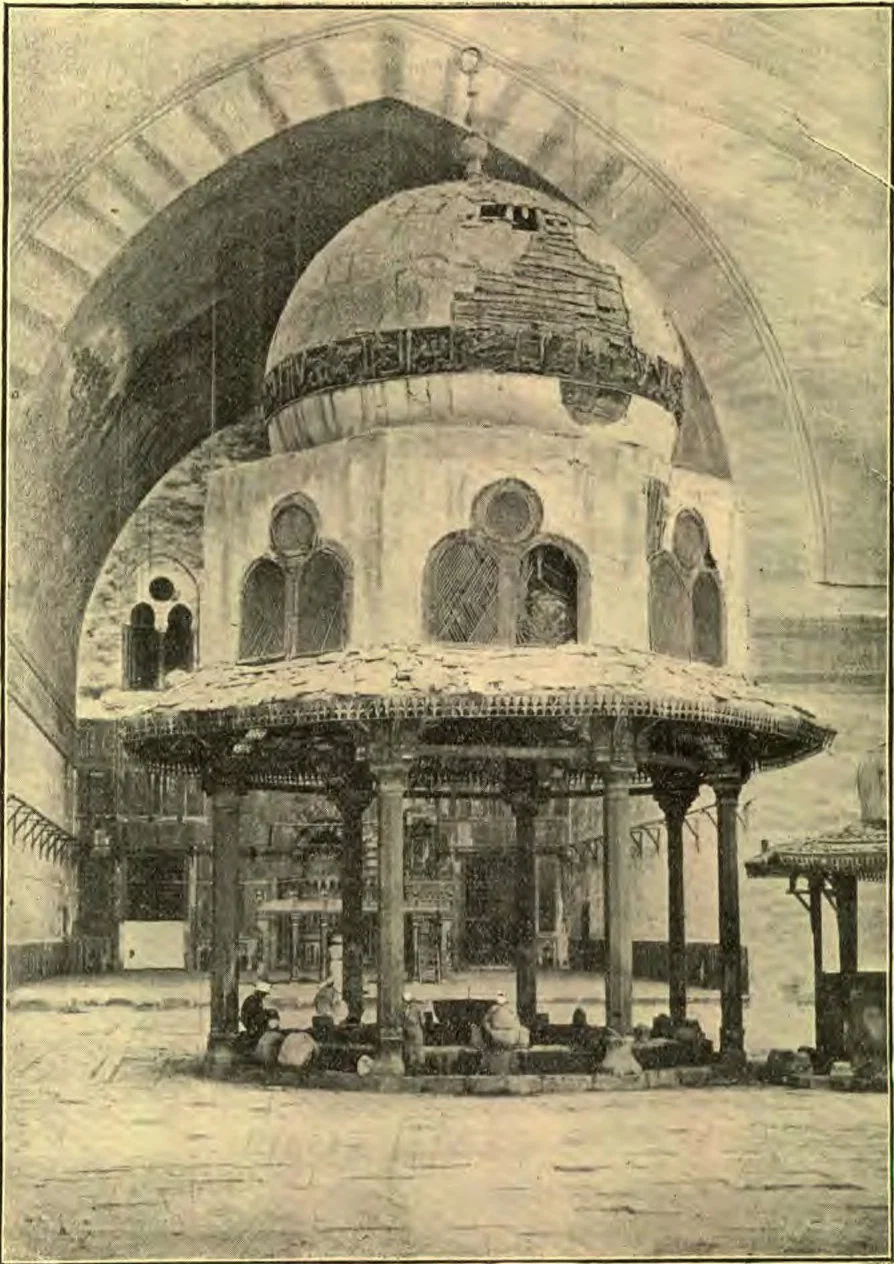
FOUNTAIN OF ABLUTIONS, MOSQUE OF SULTAN HASSAN, CAIRO, EGYPT
By investing from two to five dollars in bulbs now, one may reasonably hope to realize the sum expended and quite a bit besides, in a few months. To the person just beginning I would say, Content yourself at first with a few dozen each of hyacinths, narcissus, and Chinese lilies. These are about the easiest of any to get along with; and when once their culture is understood, you can branch out more extensively. A dozen each of Roman, Pampa, and single Dutch hyacinths, a dozen of daffodils and paper-white narcissus, and a half-dozen Chinese sacred lilies, together with a few Duc Van Thot tulips, will make a very beautiful and interesting window garden, and the proceeds from the hyacinths alone will probably cover the cost of the material, outside of the bulbs themselves.
Hyacinths, in bloom, ought to bring from fifteen to thirty cents apiece, according to the size and condition of the plant. A well-grown Chinese lily should demand at least fifty cents, while daffodils and narcissus usually go for about twenty cents each, tulips a few cents lower. Of course the cost of the pots, etc., has to be taken into account in fixing the price of flowers.
However, most people are not particular about what the bulbs are planted in; and if tin cans are used instead of flower pots, for at least half the bulbs, this expense may be considerably diminished. Fall bulbs will do quite as well in pint and quart cans as in costlier receptacles; and while the order is on its way, it would be a good plan to collect an assortment of cans, unsoldering the tops on a hot stove, and paint the outside surface dull-green or red. The bottom of each can should also be punched two or three times with a small instrument to afford sufficient drainage.
It will also be necessary to prepare a large box of soil in which to plant the bulbs when they arrive. This is the part of the work “where the fun comes in;” it is only a pleasure to collect the different kinds of soils, sift them, and mix them together. A half bushel of soil from the vegetable garden or almost any place around the yard, is the first thing to get; then a peck of fine, thoroughly decayed stable compost manure. Persons living in the country, or near woods, have the advantage of rich, brown leaf-mold, found under the layers of dead leaves, and a peck of this should also be added. A peck of sharp sand completes the compost.
It may often be necessary to “bake” the woods dirt and manure in a hot oven to kill insect and weed germs; and the soil should be passed through a coarse sieve to make it mellow and fine, and rid it of substances that would injure the bulbs. If one has no sieve handy, an old tin pan, with the bottom full of nail holes, will make an excellent substitute. After sifting, the different soils should be thoroughly mixed, and set where compost will keep moist. The soil should never be dust dry at any time of planting.
(Concluded next week)

A Blessed Experience Meeting

ONE of the most interesting features at the camp-meeting at Salem, Oregon, was the interest that was taken by the young people and children in doing practical missionary work in scattering our literature. One afternoon the young people gave away and sold over eight hundred and twenty-five papers, most of which were the Signs. They also gave away tracts at the close of the meetings, when the interest seemed to demand it, and in this way they distributed several hundred of our tracts. Below are a few of the personal testimonies given by the young people at an experience meeting, which I had the privilege of attending. I never was present at a more inspiring meeting. The whole tenor was consecration and loving service:—
“I can praise the Lord for the experience that I had yesterday. I know that in working we receive our greatest blessings. Yesterday I found people that had attended our meetings, and thought they were good, and wanted to come back. I found others who knew nothing of the Signs. I received many rich blessings. I hope the papers distributed yesterday will bring forth fruit.”
“I was ordered off the porch of the first house I went to yesterday. This slightly discouraged me; but the Lord was with me and helped me to try again, and I went on. I was greatly embarrassed. I suspect I made blunders afterward, but I received a rich blessing from the Lord. I found many people who are interested in this truth, and wanted to come to the meeting, and said they would come as soon as they could.”
“I thank the Lord for our experience yesterday. I wish it would last longer. I did not have any one shut the door in my face. Every one was glad to receive the paper. I found from my experience yesterday that it is sweet to work for Jesus, and it is my greatest desire to ever press on and do more good. The people where I went seemed to be glad, and thanked me for the papers, and many have promised to come to the meetings. Many had attended.”
“I had a good experience yesterday in delivering the Signs. One place where I went I rapped; the screen was shut, but the door was open. I heard no noise at first. Pretty soon a lady came feeling along the wall. She was blind. I rapped again, and she came to the door, and I told her what I had. ‘Well,’ she said, ‘I can not read, but you may give me a card.’ I went on and I met several people that were very glad to get the paper. One place I went they were just moving in. The lady said that as soon as they got settled, they were coming to the meetings. She said others had said they had attended, and enjoyed the meetings.”
“I thank the Lord for the blessings that I have received in this work. At one house the lady said she did not like to take the paper without paying for it. Another place I went in, and talked awhile. The lady was a Baptist, but she said she did not agree with everything in that church. She said that the sermons they heard were not sufficient. They were hungry for spiritual food. I had a good experience.”
“I am thankful that I had a part in the Master’s work yesterday. I met many that promised to come, and some that had already come and enjoyed the meetings. I met one or two that rejected the papers. I left a card at one of those doors, and they said that they would come. I praise the Lord for the blessings in this work.”
“Praise God that he sent me out yesterday. I had a good many experiences. I did not meet any one who rebuffed me in any way. One lady at first refused to take the paper, but after talking with her a few moments, she took it. I feel more inclined to continue this work. Pray for me.”
“Yesterday was my first experience in this work, and I thank the Lord that he was with me. The first house I went to, I thought there was nobody at home. I knocked several times. Pretty soon a lady opened the door. I gave her a paper, and invited her to the camp-meeting. She said she had been up here last night, and enjoyed the meetings, and would come again. I met quite a number that would not receive the papers at all.”
“I thank the Lord for my experience in the work. I thank him for his blessings. I know that he is with me. I was pleased to find so many who were interested. I am glad that I can have a part in doing something for the Lord.”
“I thank the Lord for the blessings he gave me when I was out with the Signs. I know he was with me. I found many that were interested in this meeting, and want to come. They took the papers and seemed glad to receive them.”
“I found several that seemed to be glad to get the papers yesterday. There was one man that told me when I had another bundle of papers to call again. I had just given him a Signs, so I gave him a Life Boat. He thanked me for both.”
“I praise God this morning for the experience I had yesterday. There was one lady who said her husband had been to our meeting, and enjoyed it.”

The Children’s Work

THE children caught the spirit of service, and were grouped off in companies of five or six, with an experienced young person at the head as leader. These thirty-five little ones came marching from the children’s tent up to the bookstand for their papers. The first afternoon over eight dollars’ worth of Life Boats and Pacific Health Journals were sold. Imagine their joy and the beaming of their faces when they returned, and were asked to relate their experiences. The little tots from three to five years of age sold tracts and pamphlets on the ground and near by. Over ten dollars’ worth of tracts and papers were sold by these children. I enjoyed their little experience meeting, and appreciated as never before the joy in service. A few of their testimonies were as follows:—
“I sold five papers and had a door slammed in my face, but I went right on.”
(With face beaming.) “I sold four Life Boats.”
“I sold nine papers.” (Five years old.)
“I sold nine tracts.” (Four year-old girl.)
“I sold fifteen tracts.” (Four-year old girl.)
“I sold some.”
“Sold five Life Boats and gave away one tract. I called on a Catholic lady, but she did not buy any.”
Some of the boys sold quite a number of papers in the court house and State Capitol buildings.
As we see even the children enthusiastically engaged in bearing the message to the world, I pray that it may stimulate us who have been longer in the way to a deeper realization of our responsibilities and opportunities. G. W. PETTIT.
Continue reading: THE WEEKLY STUDY