The Youth's Instructor, Vol. LI, No. 37

A Trip Through Egypt—I
Earlier text: THE WEEKLY STUDY

XIII—The Christian Soldier

(September 26)
LESSON SCRIPTURE: Eph. 6:10-24.
MEMORY VERSE: “Put on the whole armor of God, that ye may be able to stand against the wiles of the devil.” Verse 11.
Finally, be strong in the Lord, and in the strength of his might. Put on the whole armor of God, that ye may be able to stand against the wiles of the devil. For our wrestling is not against flesh and blood, but against the principalities, against the powers, against the world-rulers of this darkness, against the spiritual hosts of wickedness in the heavenly places. Wherefore take up the whole armor of God, that ye may be able to withstand in the evil day, and, having done all, to stand. Stand therefore, having girded your loins with truth, and having put on the breastplate of righteousness, and having shod your feet with the preparation of the gospel of peace; withal taking up the shield of faith, wherewith ye shall be able to quench all the fiery darts of the evil one. And take the helmet of salvation, and the sword of the Spirit, which is the word of God: with all prayer and supplication praying at all seasons in the Spirit, and watching thereunto in all perseverance and supplication for all the saints, and on my behalf, that utterance may be given unto me in opening my mouth, to make known with boldness the mystery of the gospel, for which I am an ambassador in chains; that in it I may speak boldly, as I ought to speak. But that ye also may know my affairs, how I do, Tychicus, the beloved brother and faithful minister in the Lord, shall make known to you all things: whom I have sent unto you for this very purpose, that ye may know our state, and that he may comfort your hearts. Peace be to the brethren, and love with faith, from God the father and the Lord Jesus Christ. Grace be with all them that love our Lord Jesus Christ with a love incorruptible.

Questions

1. In view of all that has been said before, where alone is our source of strength? Where is the mighty power of God illustrated? See also Eph. 1:19-21.
2. What will enable us to stand against the wiles of the devil?
3. Why do we need to be so thoroughly equipped for battle? Against what do we wrestle?
4. How much of the armor is required? Equipped with the whole armor, what will we be enabled to do? After everything else is done, what are we enjoined to do?
5. What is the girdle of the Christian soldier? What is the breastplate? What is the source of this righteousness? 1 Cor. 1:30; Phil. 3:9.
6. With what are the feet to be shod?
7. What is the shield? What will we be able to do with this shield?
8. What is the helmet? See also 1 Thess. 5:8. Whose sword do we use? What is this sword?
9. How is the value of this sword described in Heb. 4:12?
10. Clothed with this armor, what is yet essential?
11. For whom are we to pray? What request did the apostle make for himself? What lesson may we derive from this?
12. What was Paul’s relation to the gospel which he represented?
13. How did he desire to tell the good news intrusted to him?
14. By whom was this epistle sent to the Ephesians? For what purpose did Paul send Tychicus?
15. With what twofold benediction does the epistle close? Upon whom especially are these blessings pronounced?

Notes

1. The armor of the Christian described in this chapter is one of the most beautiful pictures in the Bible. Study each clause, and note the particular significance of the comparisons. The girdle, which held the rest of the armor in place, is truth. Without the truth of God’s word, the other parts of the armor would be useless. The breastplate protected the vital parts of the body from the attacks of the enemy; so the righteousness of Christ is our safeguard. With it our safety is assured.
The shield of faith protects not only the Christian himself, but every part of his armor. “And for an helmet, the hope of salvation” shows what will buoy the Christian up in all his warfare; it is the surety of victory through Christ, and eternal salvation with him. The sword, which is the word of God, is to be wielded by the Spirit. With a promise from God’s word, we can always withstand the enemy, and this will be suggested to us by the Spirit of God, when we need it, if we have hid God’s word in our heart. So we see the need of studying the word for ourselves.
2. Do not count the study of Ephesians completed. Read the book again and again, and make this truth your own. Become familiar with the contents of every chapter; and as you grow older, its truths will continue to unfold to you.
Is it not possible to be too busy? Is there not a very subtle temptation to be so much occupied with things as to forget to live, to be, as another has expressed it, “rich in outward incident, but poor in inward experience?” Our life must not be a mere round of telephone rings, of writing and receiving letters, of keeping engagements, and attending meetings and committees. As the tree is behind its leaves, and as the ocean is beneath its waves, so our life must be deeper than its incidents. When the self-questioning spirit comes, we look down into our lives, and ask, “Behind thy busy living, hast thou real life itself?”—Selected.

The New Home of the “Instructor”

WE wish all the readers of the INSTRUCTOR, old and young, might visit the new home of the paper this beautiful, sunny morning. Many of you have read, in the Review and Herald, the whole history of the change of the place of publication from Battle Creek, Michigan, to Washington, D. C., and have seen the picture of the building which furnishes a temporary home for the offices of the General Conference and the Publishing Association; but in order that every one may understand why this change has been made, we will tell the story briefly here:—
For many years the Lord has spoken to his people in Battle Creek, warning them against the dangers of selfishness, love of ease, and indifference to the crying need of the great world outside; and though the people listened, and many of them responded, yet there seemed to be no way from the great interests centered there to be scattered.
But the Lord works in ways that men do not see. In the very closing hours of 1902 the Review and Herald factory was burned to the ground. This great loss was hard to understand at first, and some urged that a new building be put up at once. But those at the head of the work said, “The Lord’s hand is in this: we will wait, and see what he would have us do.” A few months later, at the General Conference held at Oakland, California, Sister White said, plainly, that not a brick nor a stone should be laid in Battle Creek to build the Office there. “God has a better place for it,” she said. “He wants you to work with a different influence, and connected with altogether different associations, from what you have had in Battle Creek.”
The delegates at that meeting voted to establish the Review and Herald Office at some place on the Atlantic Coast; and, later, a number of the leading brethren spent some time in the East, looking for a suitable location. As the letters came from Sister White, their minds were turned more and more to Washington, and at last the definite word was received: “From the light given me, I know that, for the present, the headquarters of the Review and Herald should be near Washington.”
With this positive instruction to guide them, the brethren met in Washington the latter part of July, and began to look for a suitable location to establish the printing office, with a sanitarium and an industrial school.
In a few days a desirable place for the last-named purposes was found and purchased. It consists of fifty acres of wooded land seven miles north of the Capitol building, and only a mile from Takoma Park, a pleasant suburb of Washington. It is the plan to establish the printing factory within the city limits of Takoma Park.
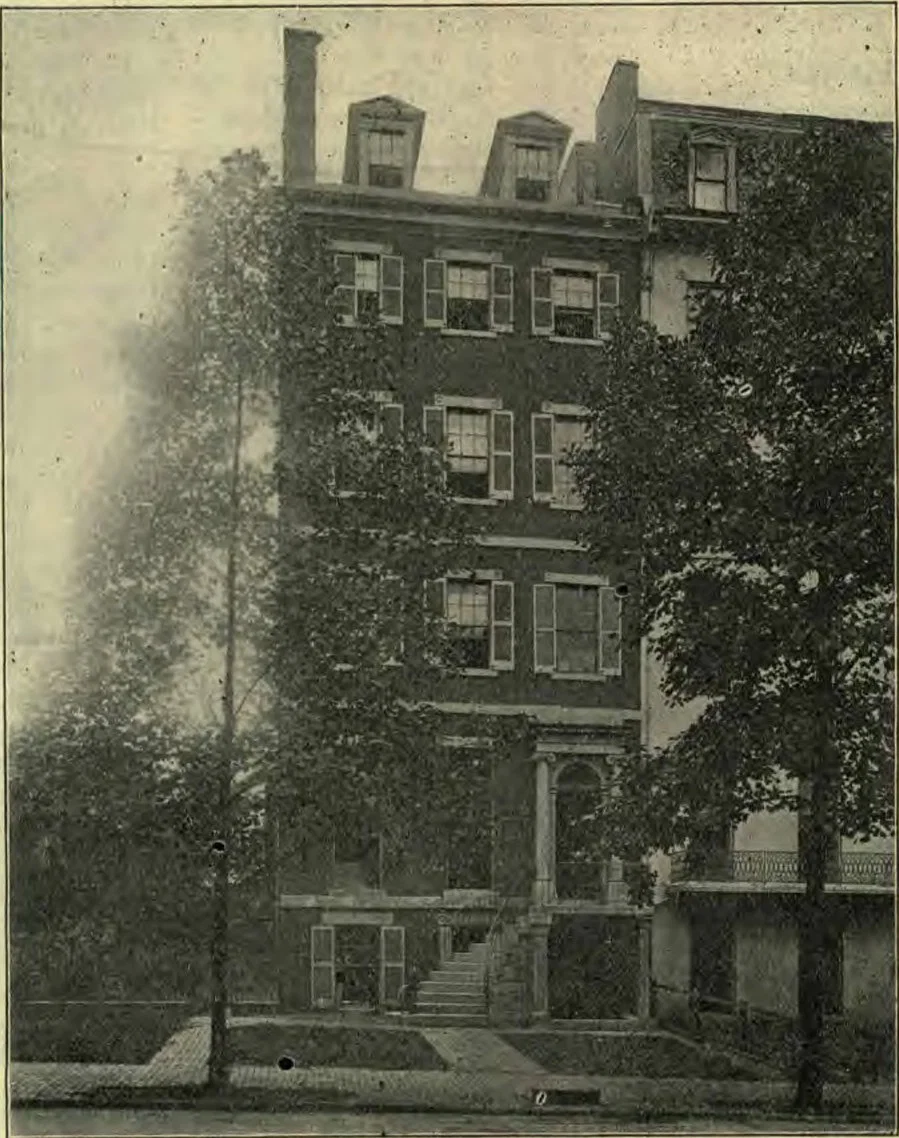
At this time also a building was rented for temporary offices for the General Conference, Mission Board, editorial rooms of the Review and the INSTRUCTOR, and in which the typesetting and folding and mailing of those papers could be carried on. This is the building shown in the picture, and is situated on North Capitol Street, only a few doors north of the Capitol.
The building itself, though said to be more than a hundred years old, is in excellent repair, and the rooms are large, airy, and well lighted. The INSTRUCTOR’S home is the front room on the fourth floor above the basement, and is a particularly cheerful, bright-looking room. Two east windows admit the morning sunshine, and show a pleasant view over the adjoining housetops, of the distant hills. From the south window one looks directly out on the north end of the Capitol. A little to the east rises the gilt dome of the Library of Congress, and to the west stretch the trees of the Mall, with their promise of coolness and shade and quiet walks. Beyond, and still to the south, may be seen now and then a glimpse of the Potomac, and still farther away, on clear days, the low hills of Virginia.
THE NEW HOME OF THE INSTRUCTOR IS ON THE FOURTH FLOOR OF THIS BUILDING,
It is a pleasant home, truly—this new home of the paper we love. But this is not the reason the INSTRUCTOR is here. It is because those in charge of the paper wish to follow the light and instruction that the Lord has given in this matter. Long ago, when the work was first established in the West, we were told that, ere the end, it would return to the East, and do a powerful work here. We believe that the time has now come when the Lord would have this work done, and we can trace his providence in bringing the paper to this place.
All who are associated with the work in this new field are indeed grateful for this privilege, and take up their work with happy hearts, because they know that the blessing of Heaven is with them. From the many words of good cheer and encouragement that are coming from the friends of this cause in distant places, we know that this feeling is general. So, with the workers here strong and in good courage in the Lord, and with the assurance of your co-operation and help, and with the knowledge that we are being led by him for whom we labor, we are confident that he will bless and establish and strengthen our young people’s paper, and make it a power in his work.

A Further Word

THOSE of you who have had experience in the matter know that even in moving a family from one place to another, there are always some things that are inconvenient and not just the way we like to have them best. And so it is in moving a paper,—those who have the work to do labor under a disadvantage at first, until they become familiar with its style and dress. In a short time we shall have a new typesetting machine set up in the basement of our office building, and then we shall be able to do all the work on the paper except the actual printing. This will not only be more convenient for us, but will help us to send the paper out to you as bright and clear as formerly.
We wish in this connection to call your attention to the fact that the new date of issuing the paper has been changed from Thursday to Tuesday. This will place our mailing day at least four days earlier in the week, and will make it possible to reach the most distant States in ample time to supply all the Sabbath-schools.

Special Notice!

A NUMBER of requests have been received that the stories given for Young People’s meetings be printed one week in advance of the time they now appear, in order that those who use them may have opportunity for longer preparation.
After giving the matter careful consideration, it has been thought best, instead of changing the date of these lessons, to omit the date under the heading altogether. This will leave the Societies free to arrange for the studies as may be best under the circumstances governing each.
Of course it is expected that the monthly field study will be given on the second Sabbath in each month—the day especially set apart for missions; but this is so generally understood that we hope no confusion will result from the omission of the date:

Ridicule Is Only a Shower

RIDICULE is only a shower; hoist your umbrella, and let it rain.—George Horace Latimer.

You have reached the end of this edition.

The Youth's Instructor · Sep 15, 1903