Your ShelfYour Projects

Review and Herald, Vol. 73, No. 30.

CONFORMITY TO THE WORLD
Earlier text: HOW TO TREAT OUR FELLOW MEN

NORTH DAKOTA.

Minnewaukan Missionary Acre Club.

About the last of April I left my home in Minnesota, and came here to teach school. I found a flourishing little Sabbath-school of about thirty members. The day on which I left home, I received a letter from Dr. Kellogg concerning the matter of planting a garden for the Lord, and immediately sent it to the elder of the church at Eunice, Minn., of which I am a member. He has since informed me by letter that they have put in an acre of wheat. As wheat is the only product that turns readily into money, I suggested that they put that in. There has been quite an increase in the Sabbath-school there, for which we feel to praise the Lord.
The superintendent at this place received a similar letter. He called the attention of the school to the matter, and it was decided to organize a club. Parliamentary rules were observed, and an organization was effected by choosing a temporary chairman, a permanent chairman, and a secretary. The meeting then adjourned until the next day, when a committee was appointed to draft some by-laws, and plans for work were discussed. The committee drafted a constitution consisting of a preamble and ten articles, which was adopted by the society at the next meeting. The officers consist of a superintendent, a secretary, and a treasurer.
The society is called the “Minnewaukan Missionary Acre Club,” and any who desire may become members of it by observing the laws, which compel no one to give, but leave all free to give as much as they feel disposed to. A free-will offering is the only offering acceptable to the Lord. Twenty-three persons joined the society. One is a man who makes no profession, but notwithstanding this, he gave an acre of wheat. The by-laws prescribe that all donations be made free of all expenses. It was indeed gratifying to see the interest manifested, and the willingness with which donations were made. About fifteen acres of wheat have been pledged to the Lord, besides beans, potatoes, etc.
H. W. Johnson.

NORWAY CONFERENCE.

This conference was held, as appointed, at Frederikstad, from June 28 to July 5. In the Sabbath-school the last Sabbath of the conference there were two hundred and two in attendance. This is about the number of Sabbath-keepers in attendance at the conference. On that Sabbath the school contributed $13.40 for the Southern mission in the United States. More than half of those in attendance at this annual meeting were from the Christiania church, some sixty miles distant. The Frederikstad church has only nineteen members, being a new company.
Our meetings were held in a house about 46 x 32 feet in size, which was purchased for about one thousand dollars, and has been nicely fitted up by the Norway Conference. The house stands on a massive rock. It was dedicated by appropriate exercises on the evening of June 30.
Last year the Norway Conference consisted of nine churches, with a total membership of four hundred and fifty. Three churches were voted into the conference, making an increase of fifty members, and there has been a gain during the year in the nine churches of twenty-one members, making the present standing of the conference twelve churches, and five hundred and twenty-one members, who paid into the conference funds, in tithes and donations, $3,574.80. During our meetings four persons were baptized, and others took their stand on the Lord’s side, who will be baptized at their home church.
On Sabbath, July 4, the following persons were ordained to the work of the gospel ministry: H. Hansen, O. J. Olsen, and L. O. Eneboe. The day services were conducted by Brethren Waggoner, Holser, and the writer. The night services were mostly carried on by the ministers of the conference.
It was a pleasant privilege for me to give twelve talks on the rise of the advent cause and the agencies the Lord has connected with the work. The Lord granted much of his presence in the meeting, and it was an occasion of much rejoicing among his people. Our meetings in the Denmark Conference commenced last evening.
J. N. LOUGHBOROUGH.
Copenhagen, July 8.

IOWA

REDDING.—Our tents are now pitched at Redding, Ringgold county. H. M. J. Richards and C. A. Hansen started the work here about four weeks ago. The place contains about three hundred inhabitants, and the farming community are very busy about their work at this time of the year, so the attendance has been rather small nearly all the time.
The prospects at present are a little better, and some are beginning to inquire if these things are so, and seem to be more inclined to take reading-matter. I have been here with the tent company only about one week, so I have not had time to become acquainted with the people very much. If there are Sabbath-keepers living near us, we should be glad to have them call on us at the tent. C. A. WASHBURN.

TEXAS

THARP.— The Lord blessed my work here. One family was keeping the Sabbath when I came, four of its members being adults. Fourteen adults, with their children, are now keeping all of God’s commandments. All but two are heads of families. July 17 it was my privilege to bury eight of them with their Lord in baptism. I look for others to follow them in the near future. To the Lord be all the praise.
July 21. J. B. BECKNER.
THE HOME.
THE HOME.

THE KEENE INDUSTRIAL ACADEMY.

After accepting the invitation of the managers of the Keene Industrial Academy to connect with their work as instructor in the Bible, I naturally wanted to know how things look at Keene. There may be others interested in the problem of industrial education which is being wrought out here, who would also like to know; so I will try to describe the situation.
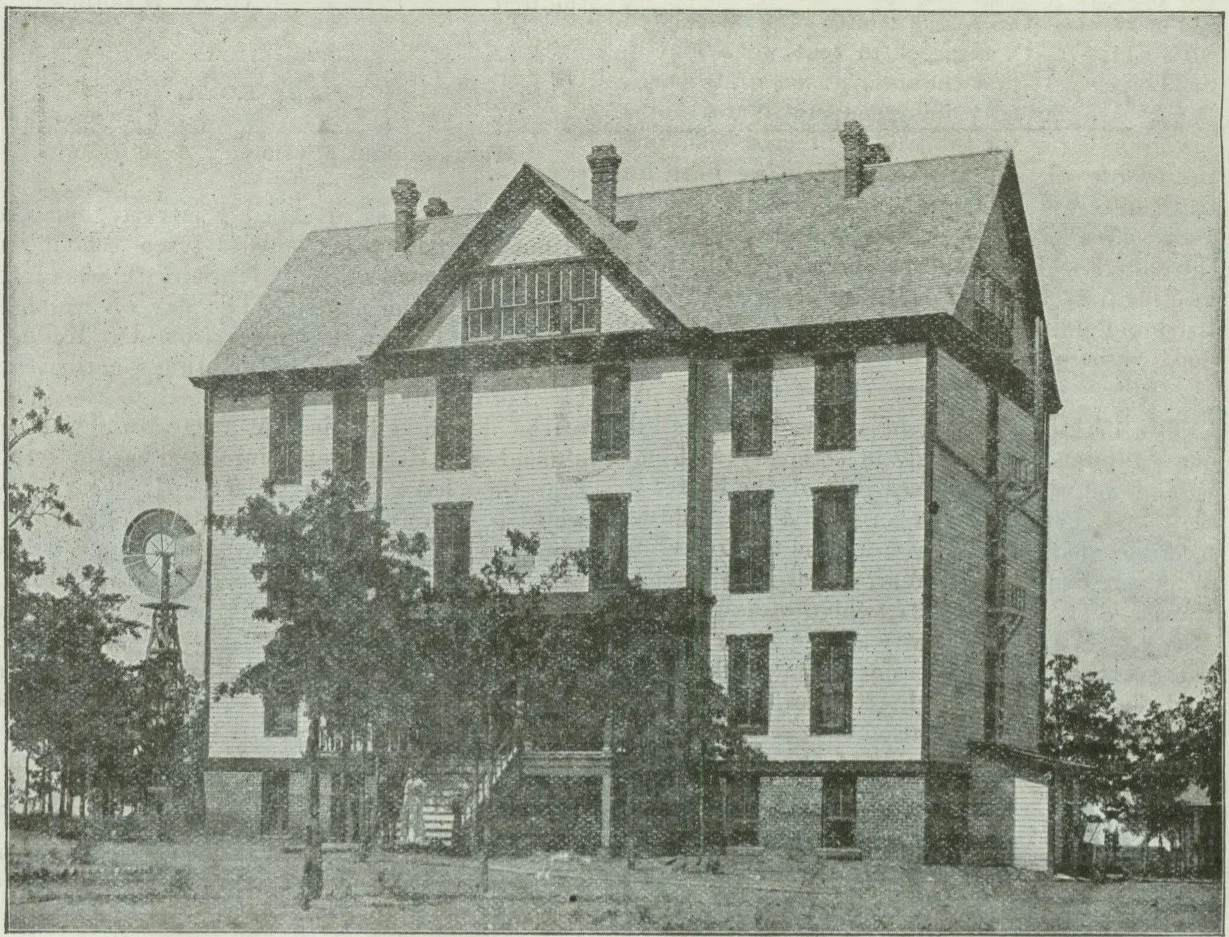
Stepping from the train at Cleburne, I found a clean, live, modern city of four thousand inhabitants. The town is lighted with electricity, furnished with an ice plant, and provided with a good school system. I counted one hundred and fifty teams about the court-house square. A drive of six miles, most of the way through an oak forest, brought us to Keene. I was not expecting to reach the place so soon, and was taken by surprise when, upon turning a corner, the driver called attention to the school buildings. They were much larger than I expected, and, standing out of the forest upon the highest elevation in all the country, they present quite an imposing appearance.
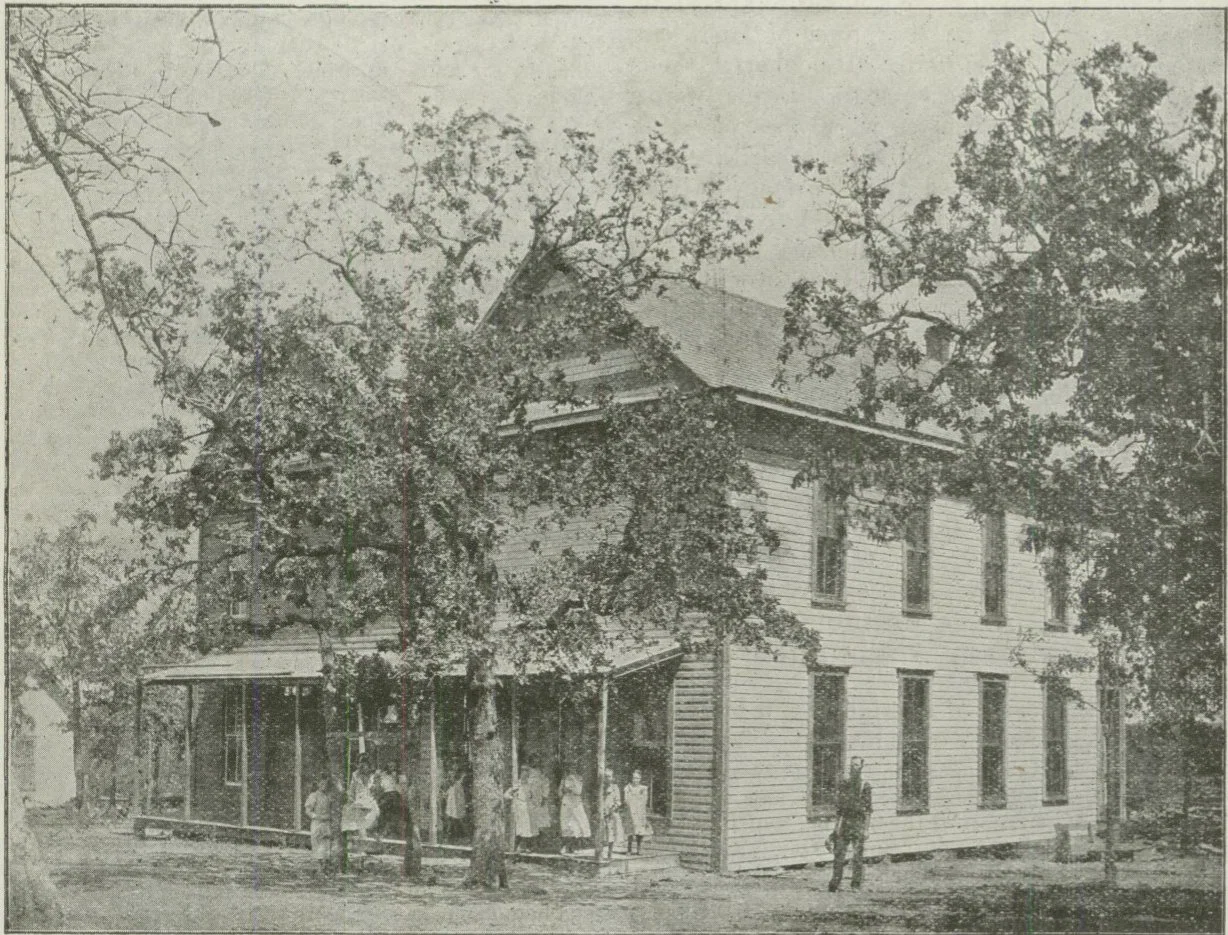
Perhaps I may as well anticipate information obtained later, and describe these buildings as we approach them. Academy Hall, which is not yet completed, but which has been used for recitations during the past term, is fifty by seventy-eight feet, and has three stories, an attic, and a basement. The first floor contains four large, airy recitation-rooms; the second floor has a library, an office, and hat-rooms, and a chapel capable of seating two hundred and fifty students. The third floor contains five recitation-rooms. The basement and attic will probably be used eventually by the industrial department. The home is thirty-two by sixty-four feet, and consists of three stories, a basement and an attic. It has accommodations for rooming and boarding sixty persons, and is well equipped for its purpose. Assembly Hall is forty-four by forty-seven feet. The first floor is devoted entirely to an assembly-room for the various meetings of the church and the academy, while the second floor is divided into three schoolrooms, occupied by the preparatory graded school.
The view to be obtained from the upper floors of the school buildings is delightful, the prospect stretching for many miles in every direction over an undulating landscape of oak woods and patches of prairie. In other respects also the location seems to be desirable. The site is high and dry. The soil is sandy, with a clay subsoil, absorbing quickly the rainfall, and securing comparative immunity from malaria. A drilled well seven hundred and fifty feet deep, in which the water rises four hundred feet, furnishes the school with an abundant supply of pure water, said to be as soft as rain-water.
The soil is especially adapted for fruit-culture, plants and trees making an astonishing growth. Peach-trees set out two years ago last spring, bore fruit this year, and are as large as one's arm, and ten feet high. Grapes set out last year are bearing this year. Other products that do well here are cotton, corn, sweet and Irish potatoes, and garden vegetables, for all of which there is a ready market at Cleburne and other surrounding towns. There is also a good market for fruit and vegetables in the “black prairie” country, where the people devote themselves principally to the cultivation of corn and cotton. I should have said that Keene is located in the “cross timber,” an elevated, sandy region, covered with oak woods, extending irregularly from north to south across the State, and dividing the “black prairie” region.
These conditions are favorable to the success of one of the foundation principles of the school; namely, the furnishing of daily employment to the student, whereby he may be able to meet part of his expenses. The school owns one hundred and forty-five acres of land, with seventy acres more under its control, with the privilege of purchasing. Of the one hundred and forty-five acres, fifteen acres are cleared and set out to fruit, and ten acres are devoted to the campus. About a thousand fruit-trees have been set out, three hundred plum and apple, and the rest peach. There are also five thousand blackberry canes and seven hundred grape-vines. These will be in full bearing next year. Thirty-five acres of the land controlled by the school are also under cultivation. The rest of the land is covered with oak timber, which will furnish the young men with remunerative employment for a number of years, as there is a ready sale for wood at a fair profit to the school. When one considers the fact that three years ago the site of the campus was a perfect tangle of trees and bushes and vines, the present condition reflects great credit upon the energy and perseverance of those who have had charge of the work.
ASSEMBLY HALL.
ASSEMBLY HALL.
The board of management have just issued their annual calendar, in which are announced four courses of study for the coming year,—preparatory and Christian workers’ courses of two years each, and academic and ministers’ courses of four years each. Those who are interested in a school whose chief object is to train Christian workers upon the industrial plan, are invited to write to the principal, Professor C. B. Hughes, Keene, Tex., for the new calendar, containing a full description of the school and its plans of work and courses of study.
C. C. Lewis.

THE UPPER COLUMBIA CAMP-MEETING.

This meeting was held in the city of Walla Walla, on the same grounds as last year. The attendance was about the same as at the previous meeting. The president, Elder Donnell, in his annual address spoke very encouragingly of the work of the laborers. Seven new churches have been raised up, which were admitted to the conference. Three hundred and fifteen persons have embraced the truth during the last year, increasing the membership of the conference to about fifteen hundred. One thing noticeable is that, with a loss of crops, and the hard times, the conference had enough money to pay all its laborers. This was a source of encouragement.
The meetings were characterized by the deep movings of the Spirit of God, and a spirit of union and love was seen among the brethren. Confessions were made, which had a tendency to soften and subdue feelings of alienation, and brought the spirit of love and harmony among the workers.
The laborers from abroad were Elders A. T. Jones and J. W. Westphal. Here, as at the Portland meeting, Elder Westphal invited other laborers on the grounds to speak to the German brethren, he acting as interpreter. This was much appreciated by these brethren. Considerable interest was manifested by them on the subject of education. If thirty Germans can be found to attend the college, a Bible teacher will be furnished for them. There are many Germans scattered throughout the North Pacific and Upper Columbia conferences; and with the help they have, the work is moving forward well. Elder Haffner will now spend his time between the two conferences until more help can be furnished.
There are important interests in these two conferences. In the Upper Columbia Conference the General Conference has established the college at Walla Walla. Those having charge of the educational work at the college are working to carry out plans that will develop workers in as short a time as possible, and still do good work. Steps were taken at the camp-meeting to have a physician labor in connection with the college. The sum of two thousand dollars was raised in cash and pledges toward erecting a building on the college campus, where more room can be had for class work, and where rooms can be fitted up for laboratory work.
Brother E. M. Morrison, general canvassing agent for the western district, was present, and labored hard to arouse an interest in this important work, but nothing special was done. The conference has spent considerable money on the canvassing work with but little results, so it did not feel free to place a State agent in the field. We hope to see the canvassing work start up in the Upper Columbia Conference as it has in other places. If it does, it will be necessary for all the laborers to become interested in it. For lack of funds, laborers in other fields are offering to take up the canvassing work, and become self-sustaining laborers. We shall not be surprised if this is done by many before the work closes. The laborers returned to their fields of labor, and the brethren to their homes, with good courage. If they continue to walk in love and humility, the Lord will continue to bless their efforts to advance the work.
A. J. BREED.

THE PROGRESS OF THE TRUTH.

Some of the workers in Boston and vicinity have been making earnest efforts of late to get the truth and the true principles of religious liberty before the minds of the clergymen and other leaders of religious thought. The Lord has greatly blessed them in this work, and they have had some wonderfully interesting experiences, and have realized truly that the Lord has gone out before them and prepared the way. In nearly every instance they have been received with the utmost consideration, and as the Sunday question and religious liberty are the live questions of the day, the attention is readily attracted and held, and the way thus prepared for other truths.
The pastor of the largest Baptist church in a neighboring city, quickly and strongly seized these truths; and as the light of God’s truth was flashed in upon his own mind and heart, he felt called of God to give it to his people. Hearing that upon a certain Sunday morning he would speak on the Sabbath, and tell why Sunday laws should not be enforced, I decided to go over and hear him. As I entered the large auditorium, and looked around on that sea of fine, intelligent faces, I wondered in my heart what he would dare to say in addressing such an audience; but as the pastor came forward, and I looked upon his pale, resolute face, and heard him implore the blessing of God not only upon those at that time worshiping, but upon all those who, the day before, kept that day holy unto the Lord, and listened to his earnest pleadings that the light of God’s truth might shine into all their hearts, that pastor and people might together sit at the feet of Jesus, and learn of the Author of all truth, I realized that he had been in the “secret place of the Most High,” and, like Moses, had not come up hence until he was assured that His presence should go with him.
He began by reading the forty-sixth psalm, beginning, “God is our refuge and strength;” also John 18:36, and took for his text, Ezra 8:22. He had no notes to refer to, but held in his hand the tract entitled, “An Appeal to Baptists,” reading passage after passage showing how Baptists have always claimed to stand upon the true principles of religious liberty, upholding the entire separation of church and state, maintaining the imperial dignity of the human conscience as answerable to God alone, and claiming that the Bible, and the Bible only, was their rule of faith. Then he said, “Baptists have got a long way from this old book,” laying his hand on the Bible, “but as a servant of God, whether popular or unpopular, wherever it may take me, I shall preach the everlasting truth of God.” He said he should stand by that old book. He seemed to be perfectly fearless in his clear, plain delineation of truth, and I could only pray that the God of all truth would stand by his servant. He said that no intelligent person at the present time, who had taken pains to investigate, would say that Sunday was the Sabbath; that there was nothing between the two lids of the Bible that would bear out that assertion; but that the seventh day (Saturday) was the only Sabbath there ever was. He advised those present who thought he was mistaken, to go home, take their Bibles, and investigate for themselves.
He then spoke of the origin of Sunday, with its degrading modes of worship, and said that he had got through calling Sunday “the Sabbath,” and if he made the mistake, he would correct himself. He said he could call it the first day of the week, or Sunday; for that was all it was; and if there was any sacredness attached to it as the day of the resurrection of our Lord, even then they had no right, under God, to compel any one else to keep that day, and in doing so they were usurping the prerogative of God. He also stated that as he was looking for a Sabbath hymn to sing that morning (Sunday), he found they all should have been sung the day before, in order to sing the truth. As these strong, cutting truths were presented, they were accompanied by the power of the Holy Spirit; for as I looked about for signs of displeasure, I saw only intense, breathless interest.
He went on to speak of the great theocratic movement, and of the Christian Endeavor society; in fact, he mentioned all those societies that, by their combined efforts, would lead us back to a union of church and state. He said: “Friends, that is what we are coming to.” He spoke of the convention of the Baptist Young People’s Union in Baltimore, and of their passing resolutions asking for more stringent Sunday laws, while at the same time riding here and there on Sunday, breaking the laws of the land. He told how at the same time an officer of the law entered the house of one poor man who had conscientiously kept the day before (Saturday) holy to the Lord, and was mending shoes quietly in his own home, and before the convention closed, he was lodged in jail. He said, “Consistency is a jewel.” He read this incident, as he did many other things, from the tract; but his word was clothed with power.
He said that unless people observed a day voluntarily, out of love to God, it would be far better for them to go about their ordinary vocations than to spend the day in idleness and dissipation. He said that he believed in “good citizenship,” with all his heart, but added, “Our citizenship is in heaven.” He declared it was the duty of Christians to convert people; that they should never resort to force, never take the words of any man, however good, however great, as they were all liable to make mistakes; and in closing made a powerful appeal to them to rely wholly on the power of God, and test everything by his word. He exhorted them to let the Christ-life so shine in all their words and deeds that their lives might be powerful factors in making the world better, in lifting men toward God. He asked them to sing, in closing, that grand old hymn beginning,—
“How firm a foundation, ye saints of the Lord, Is laid for your faith in his excellent word.”
We do not know what the outcome of all this will be, but we do know that at this time the Lord gave his servant strength and courage to proclaim his truth with wonderful force and clearness; and we hope all the friends of the truth will remember this brother at the throne of grace, that he and many of his people may be led in the way of all truth.
Mrs. G. B. Wheeler.

MINNESOTA TRACT SOCIETY PROCEEDINGS.

The twenty-third annual session of this society was held at Merriam Park, St. Paul, June 3-5. Two very interesting meetings were held, in which the various phases of the work were given their share of attention. Many encouraging features and helpful suggestions were spoken of by the president in his annual address. The reports of the secretary and the treasurer were read, and showed a marked improvement in the finances over the previous year. The treasurer’s report for the year showed the receipts to be $17,820.70, and the disbursements for the same time were $15,653.31. Some comparative figures were given, showing that the local tract societies had made very encouraging advancement in paying off their indebtedness to the State society.
Resolutions were adopted to the effect that at least one competent man be placed in the field to work in the interests of the Signs of the Times, to increase its circulation; also that the attention of our librarians and church elders be called to the importance of placing the REVIEW in the home of each family of their company that reads English; also that the second Sabbath in each month be set apart for the consideration of our foreign work and the collection of offerings for the same.
The corresponding secretary read a very interesting report of the year’s work, and among other good things she said: “Our experiences the past year have strengthened the conviction before expressed, that educational methods in missionary lines are not only needed but demanded, if we would keep the work where God has placed it, in the ‘advance column.’ The Spirit’s leading is ever upward, and if our work to day stood on the same level as it did a year ago, it would be evidence that we had been untrue to our Leader. We are glad to report progress; and throughout the year, as our faithful missionary workers have pressed forward, we have daily felt to thank God that Christ in the heart fills it not only with his deathless love, but with his deathless energy as well. The year has been one of earnest and persevering effort on the part of many, to make real advancement in this line of work; and God has encouraged our hearts by many tokens of his presence and blessing. . . . The subject of offerings for foreign missions has been one of serious thought and of earnest, prayerful effort. Some valuable lessons have been learned, and there is an increasing interest on this point in nearly all our societies.”
The following officers were elected for the ensuing year: For President, N. W. Allee; Vice-president, M. H. Ellis; Secretary and Treasurer, L. B. Losey; Assistant, A. G. Adams; Corresponding Secretary, Mrs. A. E. Ellis; State Agent, C. M. Everest.
N. W. ALLEE, Pres.
L. B. LOSEY, Sec.

News of the Week.

FOR WEEK ENDING JULY 25, 1896.

NEWS NOTES.

The condition of affairs in South Africa is still far from satisfactory. The rebellion of the natives has reached great proportions, and the consequent destruction of life and property is great. The settlers have congregated in the towns throughout the rebellious districts for safety. The government is acting with energy, but the scarcity of forage, and the great distances through which food for man and beast must be transported, make campaigning a slow and laborious process. It is now known that five hundred settlers have been killed by the native uprising. The scenes described remind one of the uprising of the Sioux in Minnesota. Many of the Africans are well armed, and they also are quite well drilled; but they do not seem to possess the fighting qualities of the American Indians.
One of the signs of the coming of the Lord is said to be “the sea and the waves roaring.” The great tidal wave which lately devastated the coast of Japan was a most remarkable fulfilment of this prophecy. The first reports declared that three thousand persons were killed. Gradually the reports of the number killed increased, until now it is ascertained that about thirty thousand people perished. The wave did not start very far from shore. Fishermen fishing a few miles from land did not observe it. The tide rose near the shore, and was hurled in an immense wall of water upon the land, sweeping everything before it. The town of Iwate lost twenty-three thousand people. Over seven thousand houses were destroyed. Great stones which formed portions of Buddhist temples were carried far inland. The number of the injured is very great. A relief fund of one hundred thousand yen has been collected. The emperor and empress gave fourteen thousand yen.
Five Japanese officials have lately passed through the United States to England on a very interesting errand. They represent the government of Japan, and go to England to secure the next instalment of the war indemnity which China is paying to Japan. This money is paid through a London banking house. The whole amount of the main war indemnity amounts to 200,000,000 taels, or about $150,000,000. Two instalments of this money, amounting to $75,000,000, have already been paid. There is also to be paid an indemnity of 30,000,000 taels for surrendering the Liao-Tong Peninsula, with its great stronghold of Port Arthur. China will also pay 500,000 taels yearly while Japanese troops remain at Wei-hai-wei. Japan will spend some of this money in buying new ships of war. Russia is determined to rob Japan of all the fruits of her great victory except the cash indemnity. Japan knows this, and she is preparing with feverish haste for a tug of war with Russia.

ITEMS.

— The explorer Stanley is recovering from his sickness.
— Russia borrows 400,000,000 francs of several German banks at 3 per cent.
— Gold still circulates freely,—between New York and England, by steamboat.
— Justice Field, of the United States Supreme Court, is very ill at Paso Robles, Cal.
— The centenary of the death of Robert Burns, the Scotch poet, was celebrated in many places, July 21.
— German army drills have been the cause of many fatal sunstrokes. At one town thirteen fell dead in the ranks.
— The New York State bankers, assembled in convention at Niagara Falls, July 18, passed resolutions in favor of the gold standard and against the free coinage of silver.
— Spain will soon send thirty-four thousand more soldiers to Cuba, the hundred and twenty-five thousand already there not being able to suppress the brigandage; for it must be understood that there is no war (?) on the island!
— Insurgents in Macedonia have attacked the Turkish troops and killed many of them.
— A strike of the union tailors in New York City has caused about 8000 men to stop work.
— The Chinese Mohammedan rebels have won another victory over the imperial army.
— Wall street brokers are offering to bet large sums of money that McKinley will win the election.
— A statue of Grover Cleveland, life-size, is being made in Carrara, Italy. It will be brought to New York, and will be paid for by his admirers.
— There is a report that forty villages in the province of Van in Armenia have been destroyed,—by whom the report does not say,—and 12,000 people murdered.
— The United States has demanded of the Colombian government an immediate apology for the seizure of the schooner “Whitford,” which occurred last March.
— Senator Teller, of Colorado, who, with a small party, bolted the Republican platform, has written to Mr. Bryan, the Democratic candidate, pledging him his support.
— A great bicycle race, lasting through three Sundays, is the present attraction in gay Paris. The racing the two first Sundays determines who shall ride the last Sunday.
— The director of the United States Mint has issued a circular stating that in case gold should be withdrawn from circulation, it would take thirteen years to replace it with silver.
— The cholera has attacked the British Nile Expedition with such violence that it has been thought best by the commanding general to withdraw the army from the river and establish a camp in the desert.
— Letters from leading Cubans show that there are eighty thousand men in arms for Cuba. Many of these are only imperfectly armed. Antonio Maceo declares that were they well armed they would be able to take Havana.
— The British Conservative party has been defeated in Parliament on one of the points of the Irish Land bill. When the result was announced, there were great cheers and cries of “resign” from the members of the Liberal party.
— Dr. Jameson and the other leaders of the unlawful raid into the territory of the South African Republic, have been formally arraigned for trial in London. No trial since the famous “Tichborne” case has excited so great an interest.
— Miss Ada Tillman, daughter of Senator Tillman, was instantly killed by lightning at Brevard, N. C., July 15. Rev. Robert A. Lee, who was with her at the time, was also killed. They were on horseback, returning from a ride.
— It has developed that nearly all the men who have of late committed so many daring robberies in Chicago, are young men, almost boys, who have lately been discharged from the reform school at Pontiac, Ill. The worst of it is that, according to the law, they will have to be returned there.
— Bishop A. Cleveland Coxe, of the Episcopalian Church, died at the sanitarium at Clifton Springs, N. Y., July 20. He was the second bishop of that church in the diocese of western New York. Bishop Coxe was a very able man, and his open letters to Pope Pius IX and to Satolli have been widely read.
— At a late meeting of the gold Democrats held in the Auditorium, in Chicago, there were representatives present from nine States. It was decided to issue a call for a national convention, and to form a new platform, and nominate candidates. If this should be done, Mr. Cleveland would be the logical candidate.
— W. C. Whitney, leader of the gold Democrats of the East, reproaches the Republicans for sticking to a high tariff, and says that that is all which prevents gold Democrats and Republicans from joining their forces. He declares that the Republicans do not appreciate the situation; and says that they ought to know that the tariff is as dead as slavery.
— The rapidity with which the United States Treasury is losing gold has alarmed the government officials, and they have appealed to the banks, which are offering them gold in exchange for treasury notes. One train took a million dollars from San Francisco to New York City. It is thought that the treasury will gain about $25,000,000 in this way. So the endless chain drags itself through the treasury.
— Mrs. Mary Forbes Cobb, of Kokomo, Ind., aged ninety-four years, is the great grandmother of the Democratic nominee for president, her first husband having been the great grandfather of W. J. Bryan. She was rubbing clothes in a wash-tub when she received the news of the honor conferred upon her great grandson. She immediately wrote him a congratulatory letter. She is a Republican in politics, and perhaps she is glad that she cannot vote, as she would be obliged to decide between her lifelong principles and her great grandson.

A COMPLAINT, A CRITICISM, OR A BROTHERLY ADMONITION.

We are in receipt of a letter from a brother in Kansas, which reads as follows:— Why don’t we have reports in the REVIEW as we used to have? When a minister went into a new place, we most always got a report of the meeting, but I am sorry to say we seldom see a report now. Only a few of the ministers report, and we should have a report from every meeting, especially those in new fields. The editor has been calling for reports. Will the call be in vain?—We hope not. We get several reports in the Kansas Worker which should be in the REVIEW, and the same is true of the Oklahoma Gleaner. Now, brethren, shall the reports stop? This is one reason why so many do not take the REVIEW. They take the State paper and get all the news in it, and it doesn’t cost as much as the REVIEW, so it satisfies them. Now if I understand it right, the REVIEW is the paper to send your reports to. Send your reports so that we can see what is going on in the other States as well as in Kansas. Brother Beeson held meetings in Willard about three weeks. Nine were baptized, and three others are ready to sign the covenant. So cheer up, brethren, the work is onward. The victory will soon be won; so let us hear the good news of souls’ accepting the truth. Send a short report to the REVIEW,—just a few lines. It will do us good.
Whether the foregoing letter may be considered a complaint, a criticism, or a brotherly admonition, we leave it to the reader to decide; but we feel that the letter is very much to the point, and that our ministers and other workers in the field should give more attention to reporting for our church paper, the REVIEW AND HERALD. There is no department in this paper that is read with more interest by our people than the Progress; there is no department in the paper that is more profitable to our people, or that will encourage them in the work more than to read of the progress of the cause in the various parts of the field. Hundreds of our workers are in the field at this season of the year in their tent efforts. A short article every week or two, giving the progress of these meetings, would be read with a great deal of interest and profit by our people everywhere. The brethren in Kansas will enjoy the reports that the brethren send in to the Kansas Worker; but the Kansas Worker will not help the brethren in Ohio, Pennsylvania, or New York, and they want to know how the work is going in Kansas just as well as in their own fields. Shall we not have many more reports from our workers than heretofore? A. O. TAIT.

GRAND TRUNK RAILWAY SYSTEM

(CHICAGO AND GRAND TRUNK DIVISION.)
Time Table, in Effect March 20, 1896.
Going East—Read down Stations Going West—Read up
10 Mail Ex. 4 L't'd Ex. 6 Atl. Ex. 42 Mixed Tr'n. 2 Pt. H. Pass. 11 Mail Ex. 1 Day Ex. 3 R. R. A. L't'd 23 Pass. 5 P'fic Ex.
a.m. 9.00 p.m. 3.10 p.m. 8.15 a.m. ... ... D. Chicago p.m. 6.45 p.m. 1.50 p.m. 9.10 ... a.m. 6.30
11.25 5.05 10.30 6.00 ... Valparaiso 5.05 11.55 7.10 ... 4.30
p.m. 1.05 6.30 12.00 10.05 ... South Bend 3.10 10.15 5.44 ... 3.07
1.46 7.12 12.45 12.40 ... Cassopolis 2.15 9.40 5.13 ... 2.25
2.33 ... 1.38 3.42 ... Schoolcraft 1.20 ... ... ... ...
2.44 7.55 1.48 4.30 a.m. 7.00 Vicksburg 1.10 8.52 ... p.m. 1.30 ...
3.30 8.36 2.40 6.20 7.00 Battle Creek 12.15 8.15 3.55 9.35 12.50
4.33 9.25 3.25 ... 7.47 Charlotte 11.14 7.23 3.07 8.40 11.55
5.10 9.55 4.00 ... 8.20 Lansing 10.40 6.55 2.40 8.00 11.25
6.30 10.45 5.03 ... 9.30 Durand 9.35 6.05 1.56 6.50 10.25
7.30 11.17 5.40 ... 10.05 Flint 8.35 5.35 1.28 5.47 9.00
8.15 11.50 6.15 ... 10.43 Lapeer 7.49 5.02 1.00 5.10 9.05
8.42 a.m. 6.35 ... ... 11.06 Imlay City 7.28 ... ... 4.48 ...
9.50 1.00 7.30 ... 12.05 Tunnel 6.50 3.50 11.55 3.50 7.55
9.25 ... ... ... ... Detroit ... a.m. 10.40 a.m. 10.40 p.m. 4.05 p.m. 8.00
... a.m. 8.15 p.m. 5.25 ... ... Toronto ... p.m. 9.20 ... ... p.m. 1.00
... p.m. 8.15 p.m. 7.25 ... ... Montreal ... p.m. 9.15 ... ... ...
... a.m. 8.12 p.m. 7.15 ... ... Boston ... a.m. 8.30 ... ... ...
... a.m. 7.50 p.m. 4.25 ... ... Susp'n Bridge ... p.m. 10.15 a.m. 7.05 ... p.m. 2.05
... a.m. 7.00 p.m. 5.40 ... ... Buffalo ... p.m. 10.15 ... ... p.m. 1.00
... p.m. 8.53 a.m. 8.03 ... ... New York ... a.m. 8.15 p.m. 6.10 ... p.m. 9.00
... ... a.m. 10.20 ... ... Boston ... p.m. 7.00 ... ... ...
Trains No. 1, 3, 4, 6, run daily; Nos. 10, 11, 2, 23, 42, daily except Sunday.
All trains will be served through trains in Chicago and Grand Trunk dining cars.
Valparaiso Accommodation daily except Sunday.
Way freights leave Nichols eastward 7:15 a. m.; from Battle Creek westward 7:05 a. m.
† Stop only on signal.
A. R. Mc INTYRE, Asst. Supt., Battle Creek.
A. S. PARKER, Pass. Agent, Battle Creek.
Continue reading: MICHIGAN CENTRAL