The Youth’s Instructor, Vol. 48, No. 33.

AUGUST

The Youth’s Instructor

Aug 16, 1900

Review and Herald Publishing Company · Battle Creek, Mich. · Aug 16, 1900

AUGUST
Oh the hills and the valleys are fast asleep In the warmth of the summer noon; The yellow lilies stand straight and tall Like sentinels under the grim stone wall; Butterflies, amber and white and brown, Whirl and flutter and settle down; Birds, like bits of the cloudless sky, Silently over our pathway fly; Brown bees, tired of the chase they've led, Rock in the clover blossoms red, And softly, sleepily croon;
Poppies, scarlet as sunset seas, Nod and bend in the idle breeze; Grasses, fringing the fields of wheat, Shimmer white in the waves of heat; And maples, under the light wind's play, Glimmer with mingled green and gray. The quiet world, in the silence mild, Thrills like the soul of a dreaming child.
Oh, golden lie the waiting fields, With sunshine o'er them glancing! And bright the winding river gleams, And all the rippling rills and streams With mirth and joy are dancing; The lakes are seas of burning glass, The brooks are crystal-clear; Like cheery prophets in the grass The cricket's chirp we hear. But through the beauty and the glee There rings a note of sorrow,— To-day is sweet; but ah, too fleet! Too soon will come to-morrow.
— Harper's Bazaar.

DO WE INHERIT CHARACTER?

Many young persons suppose that character is something they inherited from their parents, and so they settle down with the idea that they can do little either to remedy its deficiencies or to strengthen its weaknesses. This is a great mistake, and one of the enemy’s deceptions, which he effectually employs in his work of preventing young men and women from putting forth earnest and well-directed efforts for the development of true and noble characters.

Character is not Inherited

A child is born into the world without a character. Its character will be developed by the use it makes of its God-given life, together with the talents of time and opportunity that Heaven may place within its reach. We may inherit a predisposition to certain weaknesses of character; and, accordingly, it may be with much or little effort that we succeed in developing our characters along these particular lines. Let every youth bear in mind that while he may inherit certain tendencies that may be either a help or a hindrance to the development of a truly strong and noble character, the character itself is not inherited, but is built by himself. Eli was a godly man, but the wicked carelessness of his two sons is an evidence that the good character of the parent can not be transmitted, as such, to the child. A short time ago I met a young man, only twenty years old, who was well-nigh steeped in sin and iniquity. In talking with him, I learned that his mother a godly woman, and he himself had been carefully trained, and was well educated. I asked, “How does it come that you are in this sad condition?” Note his answer: “The many good things which my mother told me I failed to build into character. I have had good chances, but I have a weak, miserable character. There is where I have failed.”
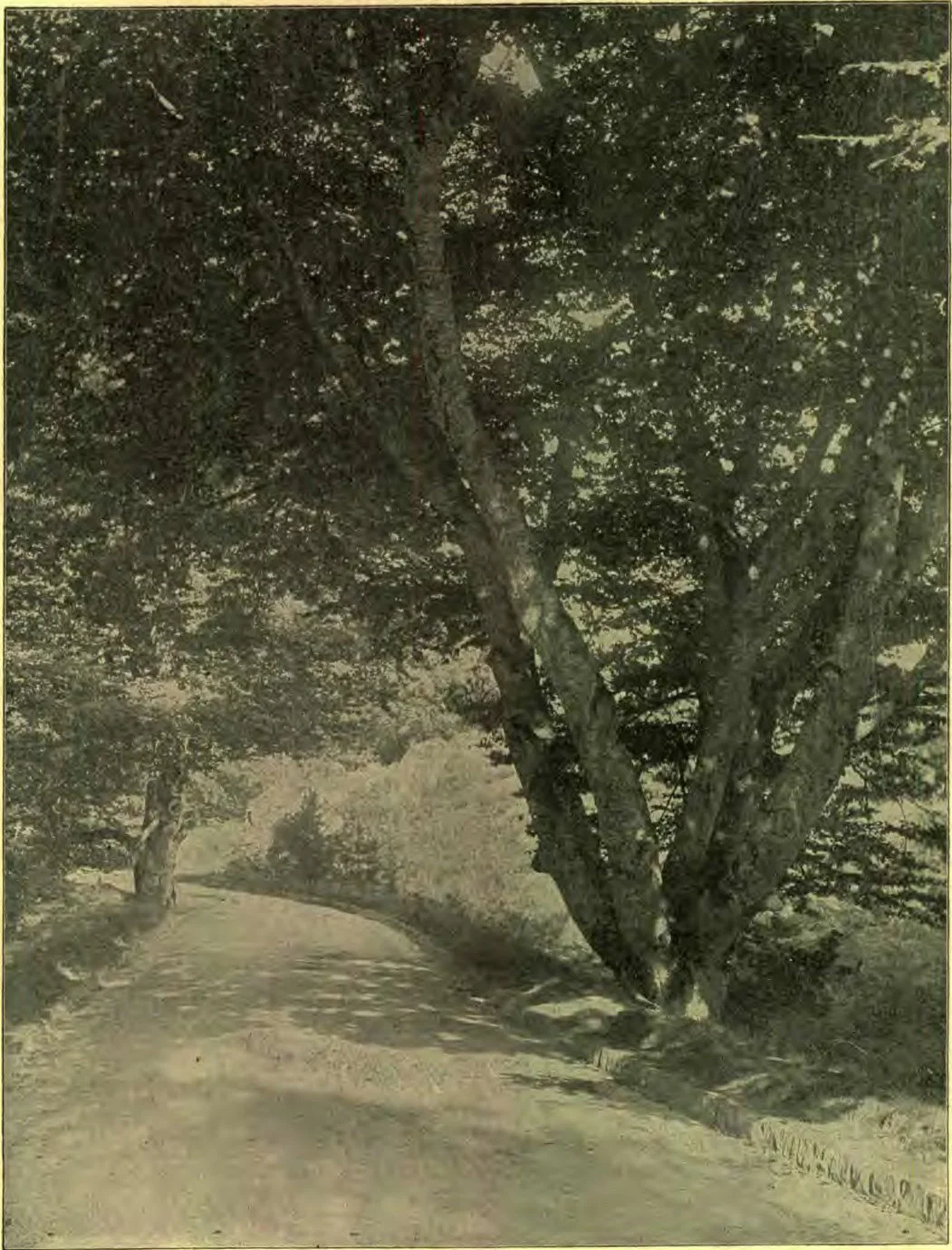
“GLIMMER WITH MINGLED GREEN AND GRAY”
And so, dear reader, you can not expect to succeed in this world, or prepare yourself for the next, upon either the goodness or the strength of your parents’ character.
Every act of our life—physical, mental, or moral—has its influence upon the character we are building. When we were born into this world, we inherited the nature of our parents; and when we are born of the Spirit,—born again,—we become partakers of the divine nature, we inherit the nature of God. It is upon this foundation—the divine nature—that we are, by the grace of God, to erect the structure of a divine character. Therefore we should let the mind be in us that was in Christ Jesus (Phil. 2:5); for with the divine nature as a foundation, and the divine mind daily controlling us, the product of our Christian experience will be a daily growth in grace and in the knowledge of our Lord Jesus Christ; in other words, the developing of a truly noble and Christlike character.
W. S. SADLER.

ARE YOU SOWING FOR GREAT USEFULNESS?

TRUTH has in it to-day the same fascinating, captivating power that it possessed when it fell from the lips of John the Baptist or of Christ himself; yet the people of those days left the cities, and went into the wilderness, in order to listen to the former, and made long, foot-sore journeys over dusty roads that they might have the privilege of following the latter. As individuals, neither became popular: one ended his life in a prison cell; the other gave up his life as a criminal on the cross.
Is not the gospel movement, of which we compose a part, represented by the work of John the Baptist? and in our individual lives are we not to represent again to the world the life of Christ? These are tremendous possibilities,—miracles of grace, which only divine power itself can produce,—yet the human agent has a part to act in order to become such an object lesson of what truth can accomplish for human flesh.
One important obligation that is laid upon the human agent is to study, not to win the approval of men, but to be “approved unto God, . . . rightly dividing the word of truth.” The most beautiful and attractive loaf of bread can be so crumbed and macerated that no one would suppose it fit food for any but the lower animals; or it may be laid off in beautiful, uniform slices: in both cases it is the same bread; the difference is only in handling it. So truth, on account of our failure to study it, may suffer such violence at our hands that it will lose for others its attractive and fascinating flavor; but if we are willing to study under God’s direction, multitudes will again, ere the close of time, receive the life-giving truths from our hands; for it is his purpose that living truth shall yet permeate the masses everywhere. The water of life is to percolate through every strata of society; and when this is accomplished, the end will come. Have you in view any higher ambition in your study than that you may become an effective instrument in the hand of God to accomplish this work? DAVID PAULSON.

The Deserted Homestead

The old house stands beneath the maple trees, With green boughs lying on the shingles gray; The chimneys crumble on the gables old, And doorsteps totter in their sad decay.
Wild mustard hides the lilacs, where, in spring, The purple blossoms fling their fragrance deep; The mayweeds crowd the lattice near the well, And sunflowers in the broken windows peep.
No sickles touch the grass upon the lawn, Growing waist-high about the gate unhung; Red clover tangles o’er the broken walks, And wrens build in the halls where laughter rung.
From spring to spring the sweet old garden blooms, Amid the weeds and desolation round; From fall to fall the apples ripen there, And drop unheeded on the sodden ground.
Thus man is false to what he once did love, Thus God is true to things formed by his will. Man wearies; but to nature’s loving eyes That which was lovely once is lovely still.
Minnie Rosilla Stevens.

THE LETTER-WRITING HABIT

“If Helen would only stop sending notes, I could love her dearly!” So said Louise Martin to herself as she shook her golden head over the letter the postman had handed her.
“I wonder what she can possibly have to write of this time,” she continued, as she opened the delicately perfumed missive. “We had a long, happy day together yesterday, and she was her sweet, natural self all the time.”
A moment later a flush of annoyance reddened Louise’s face, and the closely written pages received an impatient crumple. “What nonsense this is!” she ejaculated. “Helen has taken it into her head that I do not think as much of her as I used to. She says that although I have mercifully tried to conceal the fact, my affection for her, she knows, is waning. She reproaches herself for the change, and says she is conscious that she is unworthy my friendship. She is sadly aware that her manners are far from pleasing, but that a stubborn spirit within her causes her to be brusque and unsympathetic, even when her heart is really overflowing with affection.”
Louise’s bright face clouded as she re-read her friend’s effusion carefully. “There is not a single word of truth in it,” she said, with a touch of indignation, “and in her heart I am sure that Helen agrees with me. Every pleasant meeting we have is spoiled afterward by one of these reproachful notes, and as she always begs me not to reply, or even to refer to what she has written, I am powerless in the matter. I am afraid,” she added, “that if Helen really wishes to lose my friendship, she is going about it the right way. Such letters as these are hard to bear.”
Louise’s unwilling prophecy proved a true one. Helen’s persistent letter-writing habit led to the dropping of their old intimacy, and one by one her other much-tried friends fell away. Yet never did it dawn upon the blinded girl that her own morbid habit was the real cause of her isolation.
There are many girls who, like Helen, fancy themselves misunderstood and unappreciated, but who have the good sense to keep their thoughts to themselves. For this act of control they are afterward devoutly thankful. There are also girls who, like Helen, brood over every little incident, and fancy new and unintended meanings in the simplest sayings of their friends.
Alas for such a one if she yields to the temptation of putting her bitter thoughts upon paper! As she writes, a score of new ideas will pour into her mind from some source of evil inspiration; and by the time the pen is laid aside, the letter will contain much that in her normal state of mind she would not approve.
“But I am no harder on my correspondent than I am on myself,” says some self-convicted Helen.
My child, I should say to such a one, you have no right to inflict your criticisms of yourself upon your friends. There is no reason that they should think worse of you than you deserve, and, pardon my plain speaking, you are not apt to write the real truth when you are in a pessimistic, introspective mood. The criticism of your friends is still more unpardonable; and if repeated to a wearisome extent, will eventually cut you off from their society.
Still more, dear girl, the habit is distinctly an unchristian one. If your thoughts and time were but fully occupied, you would not indulge in these worse than profitless imaginings. Instead, you would be looking outward to the world that daily needs your services, and upward to the Master whose example you wish to follow.
Think of this, my dear girls, when the next fancied coldness or affront grieves you. A frank question may solve the mystery at the time; but if you do not choose this course, consider yourself bound by the obligation of our common Christianity to prevent the gathering in your head of unkind thoughts of others, and resolve that the morbid habit of writing down your grievances shall never be indulged in again.—Mrs. C. F. Fraser.

The Cliff House

ONE of the notable show-places in California is the Cliff House, with its view of Seal Island Rock. The Cliff House is a large five-story white building, the top being surmounted with pinnacles and a large tower. Its sides are all windows, and when the sun’s rays beam upon the glass in the evening, it shines like red or yellow gold. Inside is a large dining-room, where refreshments are served, and sea-shells, paintings, photos, and other souvenirs of the place are for sale. A fine view of Seal Island Rock may be obtained from this room, as its sides are all of glass.
THE CLIFF HOUSE
THE CLIFF HOUSE
The Cliff House is built upon a large ledge of rock, the western end of the house projecting over the water. Here it stands like a majestic temple overlooking the “gray and melancholy waste” of old ocean. Mingled with the constant roar of the ocean is the weird cry of the seals as they crawl with apparently laborious effort up the slippery rocks, trying to reach the top. After a frolic in the water, their coats appear dark-gray; but after spending some time in the sunshine, they are of a golden-brown color. When the sun shines, the seals come by hundreds to welcome him, until the rocks are covered with them.
East of the Cliff House is a steep ascent, which takes the visitor into a pretty park, where many persons go to watch the sunset from the Rotunda—an elevation higher than the top of the Cliff House. As the sun apparently nears the water, it sends forth the most brilliant and dazzling light, illuminating all the western sky; then slowly, slowly, it withdraws its bright face, till at length it drops, like a ball of fire, into the ocean.

True Prayer Seeks the Giver, Not the Gift

“It is not prayer— This clamor of our eager wants That fills the air With wearying, selfish plaints.
“It is true prayer To seek the Giver more than gift, God’s life to share, And love—for this our cry to lift.”

AS WE FIND THEM

The two had paused for a moment at the parting of the ways, and were talking of a friend.
“Lizzie is kind and generous,” said one, “and so energetic, too, if only she were a little more careful——”
“But she isn’t,” interposed the other, cheerily, “so we must just take her as we find her, and piece out her shortcomings, whatever they are, with our own long-goings. I suppose none of us quite fill the measure of what other people consider desirable, and probably Lizzie says of me: ‘Elinor is warm-hearted and well-meaning, and so careful, if only she were a little more ——’ something that I am not! I used to worry a good deal because I couldn’t make my friends over into what I thought they ought to be; but I am learning to take them as they are, and fill up their deficiencies with all love’s might.”
A laugh rippled through the words, and still shone in her eyes as she turned away. Taking people as we find them, valuing them for what they are, and filling up what is lacking with “love’s might”—what a heaven it would make of many a discordant earthly home!—Well-Spring.

WILD ROSES

THERE are five native wild roses common in this country. The one most frequently met with in Illinois is the climbing, or prairie, rose (Rosa setigera). It is the only American climbing-rose, and the only one that has united, protruding styles. The stems are armed with stout, nearly straight prickles, and these are not bristly. The petals are a deep rose-color, but gradually turn white. From this plant, by cultivation, was obtained the beautiful garden rose called the “Baltimore Bell.” This climbing-rose is found only in the West and South.
A rose that always grows in low or boggy soil is the swamp-rose (Rosa Carolina). The stems are from four to seven feet high, and the prickles are hooked. It has numerous flowers, which are of a delicate, but not uniform, pink color.
The dwarf wild rose (Rosa lucida) is much lower in height than either of the two already mentioned. The stems are usually one or two feet high, armed with unequal, bristly prickles. The flowers grow singly, or in clusters of two or three. It is to be met with in dry soil, or on the outskirts of swamps.
The early wild rose (Rosa blanda) may be known by its stems having few or scarcely any prickles, and these are easily shed. The flower is very pale pink, nearer white than any other of the wild roses. It grows near rocks and along banks, especially in stony soil.
There are two wild roses which have been naturalized from Europe. They are popularly called sweet-brier roses, and are much alike in general appearance. But Rosa rubiginosa may be distinguished from all others by the aroma of its crushed leaves. On the underside of these leaves are russet-colored glands, which produce the fragrance. L. A. REED.

A SIMPLE AQUARIUM

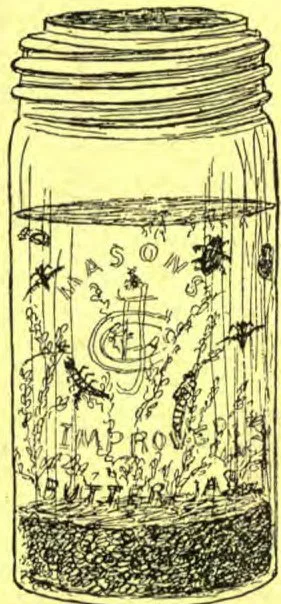
A LEAFLET for the use of public-school teachers, recently issued by the Cornell University College of Agriculture, gives directions for the making of an aquarium. The writer says:—
“An aquarium with living, moving insects in it is a very interesting ornament for the window-sill of a schoolroom. A glass candy-jar, or even a butter-jar, may be transformed into such an aquarium thus: First put into the jar a layer of sand about two inches deep; in this sand plant some small water-weeds, and then add a layer of gravel or pebbles; then nearly fill the jar with rain-water, pouring it in carefully, so as not to disturb the plants. The plants will keep the water in a right condition for the water-insects to live in; more water should be added from time to time to replace that which evaporates. In such an aquarium place any insects found in water, and watch their habits.”
Such an aquarium is within the reach of any boy or girl, and will prove a source of unfailing interest. Especially would it delight a young invalid, who is shut away from all outdoor pleasures and opportunities for observation.

GOD'S LOVE PERSONAL

WHOEVER has once absorbed the thought that God loves him individually, with a personal affection, has undergone a marvelous transformation. It is scarcely too much to say that a revolution has been wrought in his soul. He is not lonely any more. He can not despond. The promises belong to him. It is easy to believe. His bliss is assured. The troubles of earth are insignificant, its prizes contemptible. Very few comprehend the greatness of God's love to us—a love which no demand can exhaust, which will last forever, and which has back of it all wisdom, all power. A little inkling of this wonderful fact is enough to start one on a new life. Its full disclosure and discovery constitute heaven. We may well pray not only for more love to him, but for a clearer view of his love to us.—Zion's Herald.

THE BOY AND THE BIRD

Smileth the happy boy with the new gun: Proudly he's aiming for—“a bit of fun.” Softly the evening comes down, and broods over A little dead bird in the sweet, dewy clover.
Swayeth the willow branch, graceful and slender; Falleth the twilight so tearful and tender; Sleepeth the mother-bird,—Heaven defend her From the sheer thoughtlessness of the boy with the gun!
Morning will shatter your heart, little mother, Vacate the home-nest of sister and brother; Lieth the father-bird, songless and sweet, With the white clover for his winding-sheet, Nevermore dewdrops will moisten the throat Of the dear little songster who has trilled his last note.
Oh, if the clear eyes of the boy with the gun Could see through the shadow the deed he has done, His heart would awaken, and re-echo the cry Of the bird in the clover, that fell there to die.
Three cheers for the boy that is tender and true, Not only to think a brave thought, but to do The wise thing, the right thing, whoever may sneer, And who, knowing the right, can never feel fear.
Such is the need of the time and the nation; Not for the Deweys, the heart's admiration, But clean hands and pure hearts in our on-coming men— You can never live over your boyhood again!
Sun will rise, and moon wane, and their satellites shine; As the twig in youth bendeth, the tree will incline: And this is the moral my word-painting hath; Summer soon goeth by; then—the aftermath.
Mary Martin Morse.

BIBLE STUDY

The Events That Take Place When Jesus Comes

1. In what manner will Jesus come to the earth again?—“Behold, he cometh with clouds; and every eye shall see him.” Rev. 1:7.
2. What is the object of his coming?—“And I looked, and behold a white cloud, and upon the cloud one sat like unto the Son of man, having on his head a golden crown, and in his hand a sharp sickle, and another angel came out of the temple, crying with a loud voice to him that sat on the cloud, Thrust in thy sickle, and reap: for the time is come for thee to reap; for the harvest of the earth is ripe. And he that sat on the cloud thrust in his sickle on the earth; and the earth was reaped.” Rev. 14:14–16.
3. When does the harvest come?—“The harvest is the end of the world; and the reapers are the angels.” Matt. 13:39.
4. What will happen to the righteous dead when Jesus comes?—“For the Lord himself shall descend from heaven with a shout, with the voice of the Archangel, and with the trump of God: and the dead in Christ shall rise first.” 1 Thess. 4:16.
5. What becomes of the living righteous at that time?—“Then we which are alive and remain shall be caught up together with them [the raised, righteous dead] in the clouds, to meet the Lord in the air: and so shall we ever be with the Lord. Wherefore comfort one another with these words.” 1 Thess. 4:17, 18.
6. By what means are the righteous caught up to meet the Lord in the air?—“And he shall send his angels with a great sound of a trumpet, and they shall gather together his elect from the four winds, from the one end of heaven to the other.” Matt. 24:31.
7. What becomes of the wicked when the righteous are taken to heaven?—“And then shall that Wicked be revealed, whom the Lord shall consume with the spirit of his mouth, and shall destroy with the brightness of his coming.” 2 Thess. 2:8. O. C. G.

A Child's Kiss

“A CHILD'S KISS Set on thy sighing lips shall make thee glad; A poor man served by thee shall make thee rich, A sick man helped by thee shall make thee strong.”

No Load Is Heavy to a Cheerful Heart

“NO LOAD is heavy to a cheerful heart.”

SEED-SOWING

In his teaching, Christ called the attention of his hearers to the things of nature, the work of his own hands. He made the trees, the grass, the flowers, that they might teach us precious lessons. Nature was to him a great lesson-book, by which he sought to open the eyes of human beings to the love and power of God.
Nature is a lesson-book to which all, high and low, rich and poor, may have access; and from it the most helpful lessons may be learned. Ever in its varying seasons it repeats its lessons, that by its representations, man may grasp heavenly truth. The apparently commonplace things of earth are silent teachers, instructing us in purity, industry, economy, and patience.
The cultivation of the soil, the sowing of the seed, the care bestowed on the seed by the sower, represent different stages of Christ’s work for the soul. First appears the blade, then the ear, then the full corn in the ear.
The man who sows seed apparently throws away that upon which he and his family depend for a living. But he is only giving up a present advantage for a much larger return. He throws the seed away that he may gather it again in an abundant harvest. By faith he may look forward to large returns.
In order for the seed to grow, it must have care; and when man has done his part, this is only the beginning. After man has prepared the soil, and planted the seed, showing care and thoughtfulness in the work, he must depend upon God, the great Husbandman, to send sunshine and showers to water the thirsty ground, and cause the seed to spring up and grow. The combined influence of the Lord’s unseen agencies is necessary from the time the seed is buried in the ground till the harvest is gathered.
If we understood better the wonderful work of God in supplying his family on the earth with the necessities of life, we should know more of his power. He employs many unseen agencies to make the seed spring up and grow. It is his power that gives life to the seed. Without his power how could the harvest be perfected? Let man do his utmost, and he must still depend on the Creator, who understands just what is needed for the perfection of the fruit.
Christ taught his disciples to pray, “Give us this day our daily bread.” God hears this prayer, and is constantly working to answer it. He makes his sun to shine on the just and on the unjust, and gives to all wind and rain, thunder and lightning. These are God’s blessings, sent to purify the atmosphere from injurious, unhealthful agencies, which, if allowed to accumulate, would poison it, and destroy everything that breathes the breath of life.
Christ seeks to lead the mind from the natural seed cast into the ground to the gospel seed, the sowing of which will result in bringing man back to his loyalty. The Saviour came to this world to sow the seed of truth. Like a sower in the field, he scattered the seeds of truth in the hearts of men.
“He that received seed into the good ground is he that heareth the word, and understandeth it; which also beareth fruit, and bringeth forth, some an hundredfold, some sixty, some thirty.” Shall the expectation of the sower of the seed be disappointed? God forbid! for it is for the present and future good of the receiver that the seed sown be received into good ground. When it is received in faith, it will spring up and bear fruit.
What does it mean to receive into the heart the good seed?—It means to receive the words of Christ. This is a remedy for sin. Some give the truth a partial reception, a half-sympathy, wishing at the same time they had never heard it. In such soil Satan sows his seed, and soon there is a growth of thorns, which chokes the good seed. But when the gospel seed is sown in soil that welcomes it, when it is incorporated with the life, direct and glorious results are seen,—results that testify to the infinite love of God and the transforming power of the gospel.
It means much to receive the good seed. In Luke we read, “That on the good ground are they, which in an honest and good heart, having heard the word, keep it, and bring forth fruit with patience.” An honest heart is a heart, which, when the light shines into it, acknowledges that sin is the transgression of the law. “Take heed how ye hear,” said the Great Teacher. What will it avail to spend the life in self-deception? When truth is received into the heart, the tares growing there are uprooted. The appeals of God to the conscience are no longer turned aside as of no consequence.
All who receive the word into good and honest hearts will bring forth fruit. In their hearts will spring up the precious fruits of the Spirit,—love, joy, peace, long-suffering, gentleness, goodness, faith, meekness, temperance.
MRS. E. G. WHITE.
Continue reading: Astronomical Study No. XI: Saturn