The Youth’s Instructor, Vol. 48, No. 33.

AUGUST
Earlier text: AUGUST

Astronomical Study No. XI: Saturn

ASTRONOMICAL STUDY—NO. XI

Saturn

AS ALL our readers have now learned where to find the planet Jupiter, and have a fairly correct idea of this, the largest, and at present the most conspicuous, of all the planets, we will turn our attention to the next in order as we journey from the sun, and study for a time the most beautiful, if not to the naked eye the brightest, of our sister-worlds. We refer to the planet Saturn. This “mansion” of our Saviour’s creation, when viewed through a telescope, is the most wonderful, and the most beautiful to look upon, of any of the worlds that accompany our sun in its onward march.
To the unaided eye, Saturn appears as a first-magnitude star, shining with a steady, yellowish light, and is at present to be seen about thirty degrees to the east of Jupiter. It is among the first stars to appear in the early twilight after Jupiter. We hope you will all look for these planets, and fix their position in mind; you will then be prepared to watch these heavenly wonders as they, from night to night, speak to the inhabitants of this world of the glory of God; for the heavens do declare the glory of God, and he is pleased to have us reverentially study into their mysteries.
As a planet, Saturn has a mean distance from the sun of 886,065,000 miles. At its nearest approach, it is 841,097,000 miles, and at its farthest distance, 931,033,000 miles, from our sun. Its nearest approach to our earth is 774,000,000 miles, while its most distant point from us is 1,028,000,000 miles. Its length of day is ten hours, twenty-nine minutes, and seventeen seconds. Its equatorial velocity is 24,476 miles an hour, which is second only to that of Jupiter.
Its onward, or yearly, motion in its journey around the sun is slow, being only 21,560 miles an hour, requiring 10,759 days, or about twenty-nine and one-half years, of our time to complete one revolution. In size Saturn is next to Jupiter, being 75,036 miles in diameter. The great wonder connected with this planet, and that which makes it the most beautiful of all in our system, is its rings. These are three in number, and present many interesting features, which it will be our pleasure to study in a future article.
The accompanying illustration shows Saturn with its rings, also one of its eight moons. These rings are at present so tilted that they present to us much of their surface, thus making the planet appear brighter than it does when only their thin edges are turned toward the earth. In our next we shall learn some interesting things concerning these wonderful accessories of this beautiful world, which we trust we shall some day have the blessed privilege of visiting. DR. O. C. GODSMARK.

CONTENT, MY HEART

The lark soars high, his slender wings are strong; So he is blest. The little sparrow needs must sing his song Nearer his nest.
Content, my heart! To all it is not given To soar and sing. And lowlier praise may sound as sweet in heaven As song on wing. —Emma C. Dowd.

SERVICE

Be not an idler in this busy world. Fill every day with sweetness to the brim, Keep all thy radiant flags of hope unfurled, And lift along the way a joyous hymn; Strive valiantly, since right must vanquish wrong, But ever rush to battle with a song.
Thy Lord, who came to save, came lovingly To serve, and stooped to lowlier tasks than thine; By so much as he did, he asks of thee To halo toil with tenderness divine. Humility and patience, grace and peace, He giveth these, until thy labors cease.
Serve thou in pain, in poverty, in grief, But never serve in fear, since thou hast love; And love can ever send for thy relief At need, the angel host from realms above. Serve where he sends thee; serve the Lord with joy, And know his service should thy life employ.
— Margaret E. Sangster.

A HARD LESSON

“MAMA, may I go with Lois Hunter to get some lilac blossoms? There are lovely ones on the old Cole place. Hallie said so yesterday. We can go on our wheels. It isn’t more than a mile and a half.”
So said Ruth Colfax one bright morning in May. Lois was her special friend, and she expected much pleasure from the ride. They would cross the iron bridge, where the minnows played in the cool shadows; go past the deep woodland slopes, and the pretty stretches of prairie; and come back with their baskets filled with flowers. She stood wistfully waiting.
Mrs. Colfax hesitated. She knew that Ruth was inclined to be self-willed and disobedient. Could she trust her? She would see. After carefully weighing the matter a moment, she said, “Yes, you may go if you will be sure to be back in time for dinner.”
Ruth promised, and away the happy children went, enjoying to the full the bird songs, the new, fair dress of the woods, and the beautiful blue of the sky. But reaching the Cole place, they grew afraid. Though no one lived there, perhaps they ought not to take the flowers. It looked lonely and grewsome. Picking up their still empty baskets, they started for home.
The sun was high in the heavens; and by the time they reached the bridge, they were tired, thirsty, and very warm.
“Let’s go to auntie’s and get a drink,” said Ruth. “We can get some lilacs there, and some of those dear violets by the creek, and have plenty of time to get home before dinner. Our mothers won’t care.”
Auntie was working with the bees back of the house; but she heard the little girls knocking, and went to open the door. After bidding them good morning, she asked, “Have you ever had chicken-pox? Mr. Wince is very sick, and we have sent for the doctor to see what ails him. He has been exposed to what is called chicken-pox. You had better stay outside if you have not had it.”
Ruth thought she had not, and would not like to get it, as her eyes were weak, and it might hurt them.
“But we can get a drink, can’t we, auntie?” said Ruth.
“Yes,” said auntie; “come around to the well through the side gate,—but wait, I will get the water, and you may sit on the front porch and cool off. Here are some books to look at. I am sorry I can not ask you in.”
When tired of the books, Ruth asked for some flowers, and auntie gathered a great armful of the fragrant, purple lilac plumes for each of the girls, and then showed them the beds of violets, and brought them out some honey and bread and fruit for a lunch, telling them to play they were having a picnic under the locust-trees.
They enjoyed this, and having finished their repast, and picked all the violets they wanted, they asked if they might see Homer’s “park,” —a pretty flower garden, laid out in walks, and with rockeries here and there, and a grape arbor in the center.
Consent was given, but they soon ran back, saying there was a great snake out there, all coiled up.
Homer went to see, but it had crawled off; and hearing voices in the house, auntie went in.
The doctor had come, bringing with him the county health officer. After examining Mr. Wince, they pronounced the disease to be, not chicken-pox, but smallpox.
And auntie said, “There are those little girls out there!” The doctor went to the door, and said, “Run home as quick as you can; it is smallpox!”
That night they were quarantined. A red flag was hung out at each of their houses. The brother and sisters of poor Lois were hustled off to grandma’s, and both Lois and Ruth were vaccinated, and had to stay in the house for fourteen long days.
None of their young companions could come to see them, and even their mothers were kept at home.
When they got out of quarantine, people were still afraid, and would not let their children go near them. It was anything but pleasant; but auntie laughed, and told them their thoughtless disobedience had turned out just as it did in story-books, where disobedient children always get into trouble, run on to snakes, or fall into the water. She thinks it will be a lesson that they will remember through life.
God’s law is that children obey their parents. To obey them is to obey him.
S. ROXANA WINCE.

“A BOY OF A THOUSAND”

He is not what most persons would call a handsome boy; but he is strong and muscular, and walks as straight as a young Indian. And he is not a dressy boy — unless perfect cleanliness and wholeness make dressiness.
When at work, he wears blue denim overalls and a queer garment that boys call a “jump jacket.” But his Sabbath clothes are such as any boy might wear, and his linen is always as white as snow.
There is nobody but Fritz and the old father and mother. A long time ago, before Fritz was born, these two came over from the “fatherland” to our wide, free America. By such economy and self-denial as we know nothing about, they had saved enough to buy them a little home on the outskirts of the village. The day they moved into this simple home was a proud and happy one to them; for, in the “old country,” they had never hoped to own a home of their very own. In the corner of the yard Herr Gougenheimer put up a tiny shop with the word “Tailor” over the door. And there he sat and stitched in cozy content with his own lot, and with the rest of the world, never going in debt, and every year laying up a little something for the “rainy day” that comes to us all. To Herr Gougenheimer it came when Fritz was a little fellow six years old. Rheumatism gripped the honest tailor one whole winter; and when he was able to sit in his shop again, he was not the same man, and the savings had all melted away. His right arm, that had put in so many good stitches, was bent and almost useless.
He tried to work as of old, but the stitches and the work were not such as Herr Gougenheimer once did, so that people began to say, “Poor old fellow, his working days are over!” while his wife skimmed the milk closer than ever, and put no butter on her own bread. When they first moved into the little home, they had wisely put out fruit-trees and berries, and by this time they were beginning to bear. And before Herr Gougenheimer realized that he had lost his hold on the world, the good wife and little Fritz had slipped into the breach.
First, it was big, luscious strawberries, which he sold in nice, clean boxes, decked off at the top with a little bouquet of strawberries and strawberry leaves, that was pretty as a picture. Nobody ever found small, green berries at the bottom of Fritz’s boxes. What they were on top, they were all through. If he promised to let you have them at ten cents a box, on condition that you would take them all through the season, he did not wait until he had sold all the good ones at fifteen cents, and then bring you the refuse.
I learned to watch for the little boy with the cheery greeting; and when he left, I felt, somehow, as if the world was a clean, trustworthy place after all, and that I was glad to live in it. Besides fruit and berries, Fritz brought butter, too,—such glowing, golden molds, done up in cloths so snowy that, as my little ones said, “you could eat it in the dark!” He never left grimy finger-prints on those spotless cloths as he lifted the butter from the basket.
One day he handed me my butter, and it looked for all the world like that he had been bringing me. But he said: “That is not our butter. Our milk wouldn’t ‘turn’ to-day; so mother sent you some butter that her cousin made, but she said you needn’t take it unless it suited you.”
And this was the principle on which Fritz always dwelt—perfect honesty and reliability. If he promised to bring berries at seven o’clock, we did not have to delay our breakfast until half-past seven, or eat it without them. If ever there was a small “man of his word,” Fritz is one. I often hear the old business men talking about him as he goes taking his two cows to the pasture, or quietly selling some of his garden products. “There goes a boy of a thousand,” they say. “I never knew him to cheat any one out of a copper, and what he promises to do, he’ll do, if the stars fall.”
What is it, my little friends, that makes Fritz “a boy of a thousand”?—Truthfulness, reliability, steadiness, industry, honesty, cleanliness. And these qualities will make any boy respected, whether he be the son of prince or peasant.—Mrs. Eva Malone.

WHEN MATTIE CHURNS

When stirs the first-awakened bird Out from her nest among the ferns, A song is from the dairy heard, When Mattie churns.
And to her tuneful voice and sweet, Her swift, obedient dasher learns A true and merry time to beat, When Mattie churns.
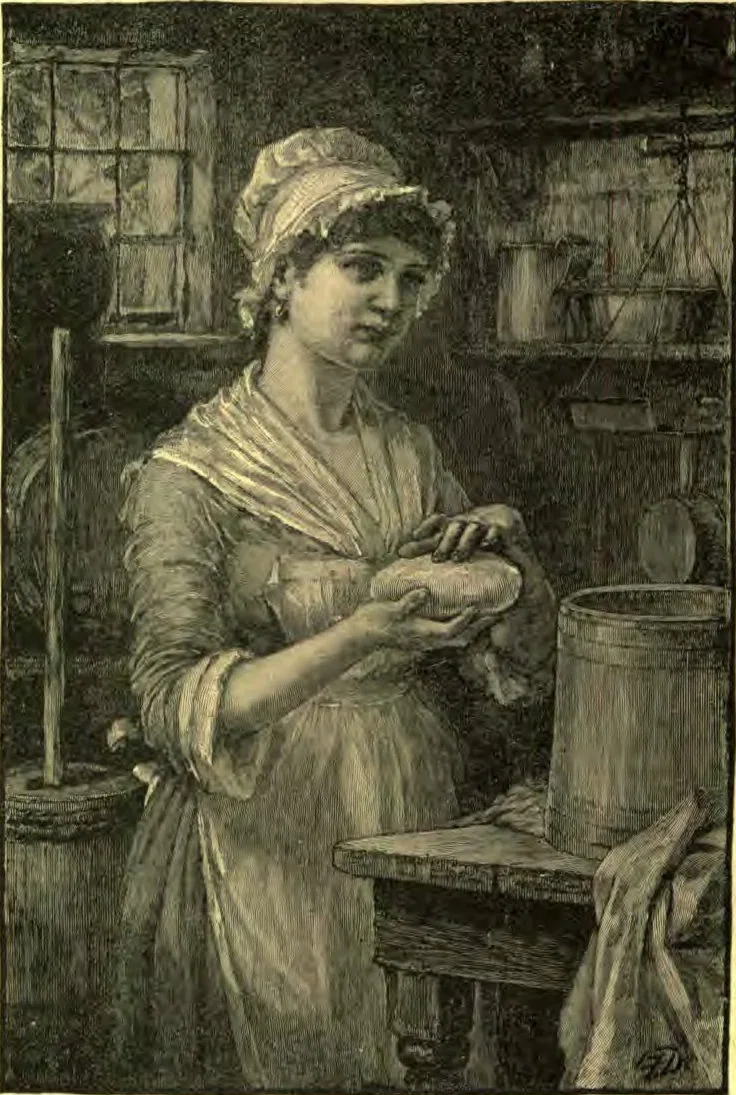
Then comes a gentle, patting sound, Her deft right hand the ladle turns, And shapely are the rolls and round When Mattie churns.
And when the ardent August sun In at her eastern window burns, He finds the dairy-work all done, When Mattie churns.
And from the fields of ripened grain, His willing feet her father turns, A bowl of buttermilk to drain, When Mattie churns.
ELIZABETH ROSSER.

The Codfish War

Perhaps there have been more riots and outbreaks in Holland than elsewhere; for Dutch indignation, though slow in kindling, makes a prodigious blaze when once fairly afire. Some of these disturbances have arisen only after long endurance of serious wrongs; and some seem to have been started at once by that queer friction-match in human nature, which, if left unguarded, is sure to be nibbled at, and so ignited, by the first little mouse of discontent that finds it.
There was a curious origin to one of these domestic quarrels. On a certain occasion a banquet was given, at which were present two noted Dutch noblemen, rivals in power, who had several old grudges to settle. The conversation turning on the codfishery, one of the two remarked upon the manner in which the hook (hoek) took the codfish, or kabbeljaauw, as the Dutch call it.
“The hook takes the codfish!” exclaimed the other, in no very civil tone; “it would be better sense to say that the codfish takes the hook.”
The grim jest was taken up in bitter earnest. High words passed, and the chieftains rose from the table enemies for life.
They proceeded to organize war against each other,—a bitter war it proved to Holland; for it lasted one hundred and fifty years, and was fought out with all the stubbornness of family feuds. The opposing parties took the names of “hoeks” and “kabbeljaauws,” and men of all classes enlisted in their respective ranks. In many instances fathers, brothers, sons, and old-time friends forgot their ties, and knew each other only as foes. The feud, being Dutch, raged hotter and stronger in proportion as men had time coolly to consider the question. A thicket of mutual wrongs, real or imaginary, sprang up further to entangle the opposing parties; families were divided, miles of smiling country laid waste, and tens of thousands of men slain—for what?
Those who fought, and those who looked on, longing for peace, are alike silent now. History can not quite clear up the mystery. I know how hard it must have been to settle the knotty question whether hooks or codfish can more properly be said to be “taken,” and how dangerous the little thorns of anger and jealousy become if not plucked out at the onset. It is certain, too, that the hoeks and kabbeljaauws were terribly in earnest,—
“But what they killed each other for, I never could make out.”
The kabbeljaauws had one advantage. When a public dinner was given by their party, the first dish brought in by the seneschal, or steward, was a huge plate of codfish, elaborately decorated with flowers,—something not only ornamental but substantial as well; while the corresponding dish at a hoek festival contained nothing but a gigantic hook, encircled with a flowery wreath.— St., Nicholas.

AUGUST STUDY OF THE FIELD

PART IV: “GREECE AS A MISSION FIELD PART II”
(August 19–25)
1. Ancient Religion of the Greeks.—The ancient religion of the Greeks was the most poetic and humane of polytheisms. It was a complicated system of mythology, in which gods and goddesses of all ranks, character, attributes, and degrees were supposed to rule over the destinies of mankind. Every household had its altars, which were crowned with myrtle and other foliage, and ornamented with votive offerings. Still they were pagans: futurity was shrouded with gloom. They held hopeless views of death. They dreaded old age and weakness, because it brought them nearer to the grave,—a grave upon which no cheering revelation shone. While they worshiped beauty, power, intellect, music, poetry, martial success, and manly strength, they showed that even the tender mercies of the cultivated heathen are cruel. They tortured slaves, and practiced terrible cruelties in war. Paganism taught them no love, no mercy, no pity. The majority of the Greeks, notwithstanding their culture and education, acted like the savages of the heathen world in their treatment of the aged and sickly, although here and there a few refined philosophers taught differently.
2. Their Many Gods.—The temples sacred to the worship of these deities were thickly planted up and down the land, and it is recorded that when the Athenians had erected a temple to every deity they knew, they finished by building an altar to “The Unknown God.” In fact, some writers say that the Greeks worshiped over thirty thousand deities; and that when all this was done, they built altars in their fields and plains to the unknown gods generally, in order that they might not fail in their duty to one of this vast imaginary host.
3. Paul in Greece.—It is interesting to know that Paul’s labors were not lost in Athens, but that there, as well as in Corinth, he planted a small Christian church. Among the most ancient Greeks, Zeus was the chief deity. He was called the father of the gods, and the god of gods. It was in reference to the attributes ascribed to Zeus, and the universal homage paid him, that Paul used the quotation, “For we are also his offspring,” as applicable only to that God whom he declared unto the ignorant Athenians. The entire passage from which Paul quoted will be read with interest:—
“Zeus fills the haunts of men, The streets, the marts; Zeus fills the sea, the shores, The harbors. Everywhere we live in Zeus. We are his offspring too. Friendly to man, He gives prognostics; sets men to their toil By need of daily bread; tells when the land Must be upturned by plowshare or by spade; What time to plant the olive and the vine; What time to fling on earth the golden grain; For he it was who scattered o’er the sky The shining stars, and fixed them where they are; Provided constellations through the year, To mark the seasons in their changeless course.”
4. Brief History of the Greek Church.—This church, being the most ancient of existing Christian churches, claims its descent from the times of the apostles. The apostles traveled in Greece and its colonies, founding Christian churches, and spreading abroad the knowledge of Christianity by their teaching, while Greek scholars made copies of the gospel. This Christian church became eventually the established church of the nation under Constantine the Great, who was converted in the year 312, and made Constantinople the capital of his empire. He extended protection to the Christians, rebuilt the churches that had been destroyed, and showed them much honor. The Greek nation was then prosperous, and the Christian religion was patronized by all classes of society, until it became fashionable to be a votary of the dominant faith. But a branch of this Christian church had also been established at Rome; and the bishops of Constantinople and the bishops of Rome began to regard one another with envy, both seeking the supremacy. In time, the bishops of Rome were called “popes,” while the bishops of Constantinople were named “patriarchs.” These titles are still worn by the respective heads of the churches in question. In these early centuries, various disputes arose between the Roman and Greek churches upon points of worship and doctrine; for both had degenerated from the simplicity of the apostles’ days, and both claimed the pre-eminence. The Greek Church denies many of the heresies taught in the Romish Church; while, on the other hand, it observes heresies of its own, such as image-worship and the intercession of saints. These disputes, occurring time after time, occasioned much strife and commotion between the two great branches of the early Christian church; and finally, in the eleventh century, a controversy arose over the manner of celebrating the eucharist, and the pope in anger issued a decree of excommunication against the whole Greek Church. Since then the two branches of the church have been completely separated, and known as the “Eastern” and “Western” churches.
5. Doctrines, Usages, and Superstitions.—The Greek Church is known and styled among the natives as the “Orthodox Oriental Church.” Some of its doctrines are identical with those held by Protestants, while others are generative of superstition. For instance, the Scriptures are held in the same estimation in the Greek Church as in our own, the Sixth Article declaring that “Holy Scripture containeth all things necessary to salvation;” also “that an atonement was made by Christ for the sins of the whole world.” But many errors have crept in, such as Mariolatry, or the worship of the Virgin, invocation of saints, image-worship, and transubstantiation. A liturgy is used, which contains many prayers consistent with Protestant views, although there are many others favoring idolatry. In fact, the doctrines of the Greek Church are far more Scriptural than its practice.
6. The Rule of Faith in the Greek Church includes the canon of the Scriptures. It holds seven sacraments—baptism, chrism, the Lord’s Supper, penance, ordination, marriage, and the euchelaion, or administration of holy oil. In baptism, oil is mixed with water, while among the Copts the sign of the cross is made during this sacrament no fewer than thirty-seven times, for the exorcism of evil spirits. Chrism is an ordinance corresponding somewhat to confirmation in the English Church. In the eucharist, the wine is mixed with warm water, and administered to clergy and laity alike, even children of tender years being allowed to partake. By penance is understood the performance of extraordinary alms, or undergoing prolonged fasts. Wednesday and Friday in each week are regularly observed by faithful Greeks as fast-days; while the total number of fast-days appointed throughout the year amounts to two hundred and twenty-six. Relics are held in great reverence in the Greek Church, but the doctrine of purgatory never obtained a footing there.
7. New Testament in Greek Schools.—A few years ago the ancient Greek Testament was adopted by the minister of education in Greece as a text-book in the schools of that kingdom. As there were then over twelve hundred schools, with about eighty thousand pupils, this measure will have an important influence upon the rising generation of Greece. Schoolboys at Athens will read Paul’s discourse on Mars Hill, as delivered to their forefathers; while those at Corinth may reverentially and wonderingly read the same apostle’s letters to the earliest Christians in that city.

TEACH ME.

Oh, teach me, Lord! that I may teach The precious things thou dost impart; And wing my words, that they may reach The hidden depths of many a heart.
Oh, give thine own sweet rest to me, That I might speak with soothing power A word in season as from thee, To weary ones in needful hour.
Oh, use me, Lord! use even me, Just as thou wilt, and when, and where, Until thy blessed face I see; Thy rest, thy joy, thy glory share.
— Frances Ridley Havergal.

NO RESPECT OF PERSONS

(August 25, 1900)
Lesson Text.—Gal. 2:6-10.
Memory Verse.—Acts 10:34, 35.

SUGGESTIONS FOR STUDY

Review the events of the last lesson, as recorded in Acts 15, and referred to in Galatians 2. Give special attention to the second chapter of Galatians, from the beginning, and including the present lesson. Read the epistle from the beginning, and get the points so fixed in mind that you can recall them readily.

QUESTIONS

1. What was the occasion of Paul’s second visit to Jerusalem? Acts 15:1, 2. How long was this after his first visit? Who went with him? Gal. 2:1. Who sent him? V. 2.
2. What did Paul lay before the apostles and elders at Jerusalem? V. 2. On whose account did he make this visit? What was involved in the question under dispute? V. 4; note 1.
3. To what brethren did Paul present the gospel as he had preached it among the Gentiles? Vs. 2, 6. Did he do this in order to learn from them? How much did they add to his knowledge of the gospel? V. 6; note 2.
4. What did they learn concerning Paul’s work? Concerning that of Peter? V. 7. Who worked for both Peter and Paul? V. 8. How, then, would the preaching of Peter and Paul agree? Note 3.
5. Which of the apostles were present at this council? What did they perceive of Paul and Barnabas? What did this lead them to do? What division of the gospel work was then made? V. 9.
6. What did the brethren suggest that Paul should do in his work? Did he need to be urged to do this? V. 10; note 4. When preaching the gospel, did he pass by the Jews? Note 5.

NOTES

1. Paul preached the gospel, which is the good news of freedom from sin. These false brethren taught a doctrine that would lead the believers back into bondage. Those who were troubling the Galatians were teaching the same false doctrine; and Paul says of them that they “would pervert the gospel.” Gal. 1:7. This was no small matter, therefore, but one that involved the whole question of salvation.
2. Paul did not go to Jerusalem to learn the gospel from the apostles there. The Lord had taught it to him years before. And the brethren learned from him that he preached the same gospel that they preached.
3. To Paul had been committed the gospel to the Gentiles; to Peter, the same gospel to the Jews. So both these apostles had received the same gospel; for there is only one. Gal. 1:6, 7. When it became plain that it was the true gospel that Paul was preaching, it did not take the brethren long to come to an agreement.
4. In Acts 11:28-30 we read how Paul and Barnabas were interested in aiding the brethren in Judea during a famine. This was some years before the council at Jerusalem. Again, in Acts 24:17, Paul speaks of the alms he had brought with him on his last visit to Jerusalem. He also makes frequent appeals in his epistles in behalf of the poor.
5. Paul not only remembered the Jewish brethren by receiving alms for them; but wherever he went, he preached to the Jews first. He says of his work, “Unto the Jews I became as a Jew, that I might gain the Jews.” 1 Cor. 9:20. Of the Gentiles he writes, “I am debtor to the Greeks, and to the barbarians; both to the wise, and to the unwise.” Rom. 1:14. As God is no respecter of persons, neither should his servants be.

THE CURE FOR LONELINESS

SELFISHNESS is one great cause of loneliness. If a man builds walls around himself, so that he may keep all that he has to himself, he soon finds that he has built walls around himself, which shut out all that might come in to him from others. The cure of loneliness may be the overcoming of selfishness. The medicines for this disease of loneliness are potions of generosity, of thoughtfulness for others, of self-sacrifice, taken in large doses. Even when the loneliness comes from the bitterness of loss and sorrow, forgetting self, going out of self and doing for others, is the only cure that God has given on earth for its healing. Are we ever lonely? Then let us go and do something for somebody. That is the cure.—S. S. Times.

To Reach BATTLE CREEK

FROM
CHICAGO, BUFFALO, DETROIT, OR TOLEDO,
Purchase Tickets Reading over the MICHIGAN CENTRAL
“The Niagara Falls Route.”
A First-class Line for First-class Travel between Chicago and New York and Boston. Elegantly equipped through trains pass Battle Creek in each direction daily.
R. N. WHEELER, O. W. RUGGLES,
Ticket Agent, Battle Creek. Gen’l P. and T. Agt., Chicago, Ill.

TAKE THE Canadian Pacific Railway

for . . . CHATHAM, OTTAWA, MONTREAL, LONDON, GALT, QUEBEC, WOODSTOCK, TORONTO, BOSTON, PORTLAND, and
All points in New England, the Maritime Provinces, Great Britain, and the Continent.
Illustrated literature, time-tables, and full particulars, upon application to—
J. FRANCIS LEE, GEN. AGENT.
Passenger Dep’t. 228 SOUTH CLARK ST., CHICAGO
Branch Offices: 76 Ottawa St., Grand Rapids, Mich.; Room D, Chamber of Commerce, Cincinnati, Ohio; 315 Chestnut St., St. Louis, Mo.

Cincinnati Northern Railroad Co.

TIME TABLE NO. 3.

IN EFFECT SEPT. 24, 1899.
Trains Pass Battle Creek, as follows:

WEST-BOUND.

No. 21, Mail and Express ................. 6.58 P. M.
No. 23, Accommodation ..................... 2.07 P. M.
No. 27, Local Freight ..................... 8.25 A. M.

EAST-BOUND.

No. 22, Mail and Express .................. 8.25 A. M.
No. 24, Accommodation ..................... 1.45 P. M.
No. 28, Local Freight ..................... 5.30 P. M.
Direct connections are made at Toledo with all roads diverging. Close connections for Detroit and Cincinnati.
L. READ, G. Ticket Agt., Battle Creek.
B. R. SMITH, City Pass. Agt., 6 West Main St.
E. W. Meddaugh and Henry B. Joy, Receivers,

CHICAGO & GRAND TRUNK R'Y.

Trains arrive and leave Battle Creek.

WEST-BOUND FROM BATTLE CREEK.

Train Time
No. 9, Mail and Express, to Chicago 12.15 P. M.
No. 1, Chicago Express, to Chicago 9.00 A. M.
No. 3, Lehigh Valley Express, to Chicago 3.40 P. M.
No. 5, Pacific Express, to Chicago, with sleeper 1.10 A. M.
No. 75, Mixed, to South Bend 8.20 A. M.
Nos. 9 and 75, daily, except Sunday.
Nos. 1, 3, and 5, daily.

EAST-BOUND FROM BATTLE CREEK.

Train Time
No. 8, Mail and Express, to Pt. Huron, East, and Detroit 3.45 P. M.
No. 4, Lehigh Express, to Port Huron, and East 8.27 P. M.
No. 6, Atlantic Express, to Port Huron, East, and Detroit 2.25 A. M.
No. 2, Leh. Exp., to Saginaw, Bay City, Pt. Huron, and East 6.50 A. M.
No. 74, Mixed, to Durand (starts at Nichols) 7.15 A. M.
Nos. 8 and 74, daily, except Sunday.
Nos. 4, 6, and 2, daily.
A. S. PARKER, Ticket Agent, Battle Creek

A Bonanza for Live Agents!

MEN OR WOMEN

The Magic Pocket Vaporizer

Is one of the best-selling articles on the market to-day. Compact and effective, it appeals at once to the man or woman suffering from catarrhal affections.
Energetic agents throughout the country are making good wages by its sale.
It will be to your advantage to read every word of the following unsolicited letter from one of our salesmen:—
1101 LINCOLN AVE., SAGINAW, W. S., MICH., Feb. 6, 1900.
Modern Medicine Co., Battle Creek, Mich.
GENTLEMEN: I have canvassed the greater part of the time for more than thirty years, keeping my eyes open all the time for the best-selling books and other articles that might come upon the market, but do not hesitate to say your Magic Pocket Vaporizer is the best thing I have ever found to pick up money with. It is a real money catcher, as you will see by the following. On arriving in my territory, I went directly to work. At sundown that day I had sold four and taken five orders; the second day I put in about eight hours, and had fourteen in orders and sales. I can usually average eleven orders out of fifteen exhibitions, or a profit of from four to six dollars a day. I have succeeded in putting thirteen Vaporizers in one home, receiving $12.50 for them; eight Vaporizers in another family; five to a Baptist minister; three to another family. Yours truly, H. S. MERCHANT.
Write at once to the MODERN MEDICINE COMPANY, 105 Washington Ave., Battle Creek, Mich., for terms and territory.
Continue reading: For Every Day of the Week