'For all have sinned, and come short of the glory of God.' Rom. 3:23.
2. What is the sure result of sin?
'Sin, when it is finished, bringeth forth death.' James 1:15.
'The soul that sinneth, it shall die.' Eze. 18:4, 20.
3. Yet for what does mankind, good or bad, continually long?
'What shall it profit a man, if he shall gain the whole world, and lose his own soul [life]?' Mark 8:36.
'Yea, all that a man hath will he give for his life.' Job 2:4.
NOTE.—The above is the true diagnosis of man's case. Proud man does not like to believe it. It is not flattering to the strong, the wise, the proud. They would rather believe, 'I am, and there is none else beside me.' They prefer to believe that man did not fall, that he is not a sinner; that he is not subject to death; but rather a child of nature on his upward way. Yet all of life, all relationships of life, all man's best consciousness of himself go to show that he is a sinner, one who has 'missed the mark,' and therefore he has come short of the glory, or goodness (Ex. 33:18, 19), of God. 'In the way of righteousness is life; and in the pathway thereof there is no death.' Prov. 12:28. God can not die, because He is absolute righteousness. Man does die, ever dies, because he is a sinner. Why not then accept of God's diagnosis of our case when there is so much in our own experience to confirm it? Man's longing for life, man's fear of death, are the evidences of his instincts, whatever his theories, that man is a sinner and subject to death. Satan declared what is everywhere obvious, when he said, 'Yea, all that a man hath will he give for his life.'
4. Can not our brother, or friends, or great men help us?
'None of them can by any means redeem his brother, nor give to God a ransom for him.' Ps. 49:7.
'Put not your trust in princes, nor in the son of man, in whom there is no help.
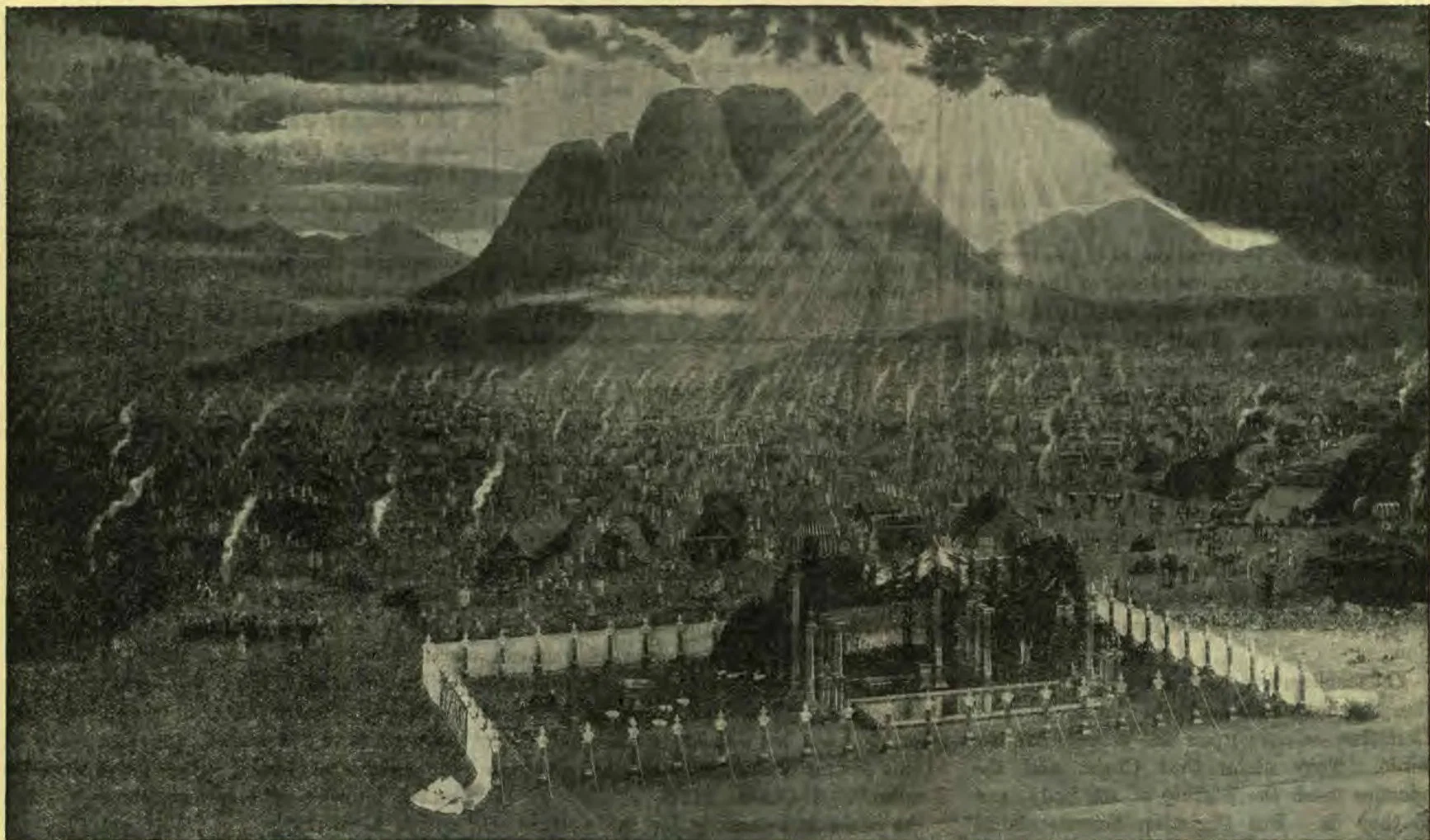
Sectional View of the Sanctuary Cut Away on Side, Showing the Holy and Most Holy Places, Together with the Outer Court.
His breath goeth forth, he returneth to his earth; in that very day his thoughts perish.' Ps. 146:3.
5. In whom alone can man be saved?
'Neither is there salvation in any other; for there is none other name under heaven, given among men [save that of Jesus Christ], whereby we must be saved.' Acts 4:12.
6. Whom does He undertake to save?
'This is a faithful saying, and worthy of all acceptance, that Christ Jesus came into the world to save sinners.' 1 Tim. 1:15.
7. How early was His sacrifice?
'Redeemed . . . with the precious blood of Christ, as of a lamb without blemish and without spot: who verily was fore-ordained before the foundation of the world, but was manifest in these last times for you.' 1 Peter 1:18-20.
'The Lamb slain from the foundation of the world.' Rev. 13:8.
NOTE.—Lucifer, the Day-star, sought his own glory, and aspired even to the throne of God. The Son of God gave Himself in the creation of the race, and He gave Himself for the redemption of His creation. It was not upon the cross He gave Himself; it was not in the desert of temptation; it was not when He became flesh; but in the beginning, when the first intimation of a charge came against the government of God. All later developments came in the fulfilment of His purpose. He is therefore in purpose 'the Lamb slain from the foundation of the world.'
8. How fully did He give Himself?
'Have this mind in you, which was also in Christ Jesus: who, existing in the form of God, counted not the being on an equality with God a thing to be grasped, but emptied Himself, taking the form of a bond-servant, becoming in the likeness of men; and being found in fashion as a man, He humbled Himself, becoming obedient even unto death, yea, the death of the cross. Wherefore also God highly exalted Him, and gave unto Him the name which is above every name.' Phil. 2:5-9, A.R.V., margin.
9. How far down did He stoop to save His creatures?
'Now that He ascended, what is it but that He also descended first into the7lower parts of the earth?' Eph. 4:9.
10. Why did God thus give His Son?
'For God so loved the world, that He gave His only-begotten Son, that whosoever believeth in Him should not perish, but have everlasting life.' John 3:16.
11. What part had the Son in this giving?
'Who gave Himself for us, that He might redeem us from all iniquity, and purify unto Himself a peculiar people, zealous of good works.' Titus 2:14.
12. What was the worth of this offering?
'For He [the Father] hath made Him [the Son] to be sin for us, who [the Son] knew no sin; that we [the sinners] might be made the righteousness of God in Him.' 2 Cor. 5:21.
'He was wounded for our transgressions, He was bruised for our iniquities; the chastisement of our peace was upon Him, and with His stripes we are healed.' Isa. 53:5.
NOTE.—It was love on the part of the great Jehovah which moved Him to give His Son; it was love on the part of the Son which moved Him to give Himself, offering His own life for a race of sinners, and so demonstrate the love of God to men, and the holiness, the beneficence, the perfection of God's government. The purpose of God as well as the sacrifice of Christ was all-inclusive. It embraced not only man and this earth, but all creation. From the time the Son of God gave Himself in that far-away beginning, there began His self-abnegation, His vindication of the divine government, His desire to save all. Therefore He became an angel among angels,—Michael the Archangel,—chief only because of more devoted service; demonstrating that angels could live for God. His next step brought Him to the human family, where He went to the very lowest depths, even death. That death was the climax of the sacrifice of the ages. But in all His experiences He faltered not, failed not, and so 'became the Author of eternal salvation unto all that obey Him.' Heb. 5:7-10.
13. How may the sinner avail himself of the benefits of Christ's sacrifice?
'Testifying both to the Jews, and also to the Greeks, repentance toward God, and faith toward our Lord Jesus Christ.' Acts 20:21.
'I acknowledge my sin unto Thee, and mine iniquity have I not hid. I said, I will confess my transgressions unto the Lord; and Thou forgavest the iniquity of my sin.' Ps. 32:5.
'If we confess our sins, He is faithful and just to forgive us our sins, and to cleanse us from all unrighteousness.' 1 John 1:9.
14. How did men formerly show faith in Christ's offering?
'And Abel, he also brought of the firstlings of his flock and of the fat thereof. And the Lord had respect unto Abel and to his offering.' Gen. 4:5.
'By faith Abel offered unto God a more excellent sacrifice than Cain, by which he obtained witness that he was righteous, God testifying of his gifts; and by it he being dead yet speaketh.' Heb. 11:4.
15. What was there in Abel's offering which recognized sin and the sacrifice of the Son of God for the sinner?
'Without shedding of blood is no remission.' Heb. 9:22.
'For the life of the flesh is in the blood: and I have given it to you upon the altar to make an atonement for your souls.' Lev. 17:11; Gen. 9:4.
16. But does the blood of beasts take away sin?
'For it is not possible that the blood of bulls and of goats should take away sins.' Heb. 10:4.
17. What did this blood typify?
'The precious blood of Christ, as of a lamb without blemish and without spot.' 1 Peter 1:19.
'Unto Him that loved us, and washed us from our sins in His own blood.' Rev. 1:5. See also Heb. 9:14; 1 John 1:7.
NOTE.—The above scriptures, and many others which might be given, if we had the space, clearly show that all God's appointed offerings were made in faith in Jesus Christ. Every lamb offered in faith for sin in the past was offered in virtue of 'the Lamb of God, which taketh away the sin of the world.' John 1:29. The blood represented the life. The blood of Jesus shed for man represents His life. 'The good Shepherd giveth His life for the sheep.' John 10:11, 15. Whenever a sinner brought to the altar a lamb, he laid his hand upon the head of the innocent beast, and confessed his sin before God; he presented that offering as standing for himself, who was worthy to die; the lamb was slain, and its blood offered in the sinner's behalf. The sinner by faith saw thru that sacrifice God's offering on his behalf, and God accepted him, counting his faith for righteousness.
18. When Israel was called out of Egypt, what center of worship was built?
'And the Lord spake, . . . Let them [the children of Israel] make Me a sanctuary; that I may dwell among them.' Ex. 25:1-9.
NOTE.—The making of this sanctuary and its furniture is described in Exodus, chapters 25 to 30; 36 to 40. A brief description (see engraving) is as follows: It was an oblong building 30 cubits long, 10 cubits high, and 10 cubits wide, made of upright boards of acacia wood, overlaid with gold without and within. It was divided into two compartments, the holy place and the most holy, separated by a heavy curtain or veil, the former twice the size of the latter. Ex. 25:33. It opened toward the east, so that the priest in his ministrations faced to the west. Num. 3:38.
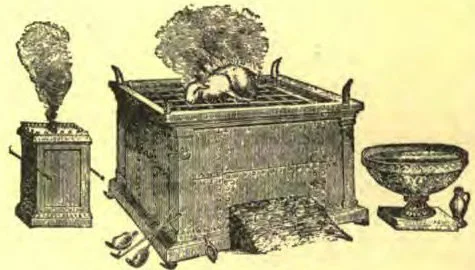
Before the sanctuary was the altar of burnt offering, where the victims were slain, and the laver where the priests washed. Ex. 27:1-8.
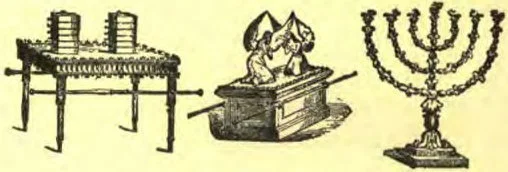
On the right as one entered, the north side, was the table of showbread, representing the word of God. Ex. 25:23-30; John 6:48, 56, 63. On the left, the south side, was the seven-branched candlestick, representing the fulness of the Spirit of God. Ex. 25:31-40; Rev. 4:5. In front of the veil separating the holy places, was the altar of incense, the incense representing the grace of God which makes His people's prayers effectual. Ex. 30:1-10; Rev. 8:3.
Within the second curtain or veil was the most holy place. Here was the holy ark. In that ark were the tables of stone upon which God had written with His own finger His holy law of Ten Commandments. Ex. 24:12; 32:15, 16; 25:21; Deut. 10:1-5. The transgression of this law is sin. 1 John 3:4; Rom. 7:7. The cover of this ark was the mercy-seat, upon which abode the glorious shekinah over which spread the wings of the covering cherubim. This was symbolical of God's throne between the cherubim (Ex. 25:17-22; Ps. 99:1), where mercy and truth meet together, and righteousness and peace kiss each other (Ps. 85:10).
Over all the sanctuary was a richly woven linen curtain, blue, purple, and scarlet, in which were wrought with gold, figures of cherubim. This formed the ceiling. Over this curtain was one of goats' hair; and as a tent over the sanctuary were placed two curtains of ram skins and badger, or seal, skins. All these were made after a heavenly pattern, which the Lord showed to Moses. Ex. 25:40; Heb. 8:5.
Holy garments were prepared for the priests and very particular rules were given for their ministrations.
19. What did all these sacrifices, the priests, and the priestly services typify or symbolize?
'An High Priest . . . holy, harmless, undefiled, separate from sinners, and made higher than the heavens; who needeth not daily, as those high priests, to offer up sacrifice, first for his own sins, and then for the people's; for this He did once, when He offered up Himself.' Heb. 7:26, 27.
NOTE.—All these things are object-lessons of the God who 'delighteth in mercy,' and who 'taketh pleasure in them that fear Him, in those that hope in His mercy.'
[The meaning of these symbols and what they symbolized in Christ's work will be our next study.]
Furniture of the Sanctuary. Upper Row, Table of Showbread, Ark of the Testimony, Golden Candlestick. Lower Row, Altar of Incense, Altar of Burnt Offering, Laver.
Existence Given for Action
By E. L. Magoon
EXISTENCE was given us for action, rather than indolent and aimless contemplation; our worth is determined by the good deeds we do, rather than by the fine emotions we feel. They greatly mistake who suppose that God cares for no other purpose than devotion.—E. L. Magoon.
December Twenty-five.
It will be observed that our schedule has made the regular date for this issue of the paper come on December 25—on Christmas day.
It is quite generally considered that Christmas is to be observed in honor of the birth of Christ, and yet most people know that He was born several months earlier in the year. It would seem that it was the direct design of God that the exact day of the birth of His Son should not be known. The exact day of His birth is not the fact that is of interest to the lost sinner. That Christ did actually come into the world, and that He has actually made a way by which every one may be rescued from sin, is the great fact that we all need to know, and this is the great fact that should be constantly kept before the world by His followers. "Faithful is the saying, and worthy of all acceptance, that Christ Jesus came into the world to save sinners." 1 Tim. 1:15.
The Christian people of no denomination do not, nor have they ever presented Christmas to the world as the exact day of the birth of Christ. But all Christians do unite in presenting to the world Him whom they have found—the One who has saved them from their sins. They present Him as the One who is able to save to the uttermost all who will come to God thru Him. They present Him in confidence, for they have found in their own experience that He is an ever-present Saviour.
The Christian who is following closely the prophecies that Jesus gave is looking forward with great joy to the privilege of personally meeting Him very soon; for all the prophecies unite in showing that the second coming of Christ is very near at hand. Those who have learned to know the Master, and who know from His word that His coming is very near, have a joy in their hearts all the time that is simply beyond the powers of description. It is always well to study anew the story of the Babe in Bethlehem, and it is also important to study the promises which show that He who is the Desire of all nations is due to appear on earth again at a very near-by day.
OUR study in Romans two weeks ago presented the list of iniquities and sins into which the heathen peoples plunged because they “refused to have God in their knowledge;” the mention of these iniquities is found in the concluding verses of the first chapter of Romans. From the facts stated concerning the depths of sin into which men will fall when they refuse God, the apostle proceeds to draw the following conclusions:
“Wherefore thou art without excuse, O man, whosoever thou art that judgest: for wherein thou judgest another, thou condemnest thyself; for thou that judgest dost practise the same things. And we know that the judgment of God is according to truth against them that practise such things. And reckonest thou this, O man, who judgest them that practise such things, and doest the same, that thou shalt escape the judgment of God? Or despisest thou the riches of His goodness and forbearance and long-suffering, not knowing that the goodness of God leadeth thee to repentance? but after thy hardness and impenitent heart treasurest up for thyself wrath in the day of wrath and revelation of the righteous judgment of God; who will render to every man according to his works.” Rom. 2:1-6.
“Wherefore” is the word with which the apostle begins the foregoing quotation. He signifies in this manner that he is now about to draw his conclusion from what he has already said. His conclusion is easily understood. The man who condemns the crimes and the unnatural sins that are enumerated in the first chapter, and yet who practises the same things is left without excuse. The very fact that a man will say that such things are wrong shows that he knows better, and therefore he will condemn himself in the day of judgment. He has said that such things are wrong in others. The man can not be found who will make the bold claim that the sins enumerated by the apostle are right. Every one condemns such things in others, and by condemning them in others he thereby condemns them in himself. Such is the clear logic of the apostle.
Then may we know of a surety that “the judgment of God is according to truth against them that practise such things.” And we can follow the apostle still further in saying, “Reckonest thou this, O man, who judgest them that practise such things, and doest the same, that thou shalt escape the judgment of God?” In condemning the heathen for practising such iniquities we pass judgment upon ourselves, unless we repent and are cleansed from the very sins that they are doing. We show by our own sentence of judgment against them that it would be right for God to pass sentence against us. And we may go still further. The heathen themselves who practise these sins are not without the evidence that they are doing wrong. They themselves will condemn in each other the things that are being practised, and they thereby join in the condemnation.
This first part of the second of Romans, when studied in connection with the last part of the first chapter, ought to make it perfectly plain to any one that God is just when He passes the sentence of condemnation upon the sins that men commit. These things show that God is good because He will not in any manner nor under any circumstances pass over such wrong-doing. And the goodness of God is all the goodness there is in the universe. And when God shows us the evil of wrong-doing it is that He may at the same time impart unto us the goodness that comes from Himself. For God by His Spirit impresses every one that it is necessary to come to Him if we would escape this thraldom of sin that we condemn in the world about us.
But those who condemn sin (and all do), but who do not accept the only remedy, place themselves in the category of despising the goodness of God. For immediately following the apostle’s statement that they that judge or condemn this course of sin are not to escape the judgment of God, he adds, “Or despisest thou the riches of His goodness and forbearance and long-suffering, not knowing that the goodness of God leadeth thee to repentance?”
The goodness of God in showing all mankind what is right, and thus planting in every one the disposition to condemn the wrong, is designed to lead us to repentance. It is designed to lead us to turn from the wrong and to seek the power from God that will enable us to repent of sin by confessing the wrong and turning our feet into the ways of right-doing. But when we do not avail ourselves of the wooings of the Spirit of God, in that very act we show that we despise the riches of God’s goodness. We show that we are willing to follow on in sin, trusting to some plan of human devising for our salvation.
And when we refuse God, we not only show by that act that we despise His goodness, but we make our hearts hard and impenitent, and this in turn “treasurest up for thyself wrath in the day of wrath and revelation of the righteous judgment of God.” Thus does effect follow cause. Thus is it shown that God’s judgments are righteous, and that they follow logically and philosophically the “despising” of His goodness. And thus is it shown that God does not reject any one until He has borne long and suffered long with him.
Every man will receive according to his works, is the statement of the last part of the quotation. A man’s works represent what he has actually done. And if he has continued to work the works of sin in the face of God’s efforts to save him from sin, he has already condemned himself by saying that the sin is wrong. And, therefore, he can not blame God if He concurs in the judgment that man has already passed upon his own wrong course. The impenitent sinner can not lift his head in the judgment to protest against the Lord when He arises to render the sentence and to execute the judgment. Thus will every act of the Lord be shown to stand in justice and fairness. T.
The Reality of Redemption.
WE earnestly hope that our readers will study our Bible-reading on "Types and Symbols," on pages six and seven of this paper. Let them there learn that it was not the hecatombs of sacrifices, not the blood of bulls and goats, which took away sin. They were but the symbols of the faith which God's devoted children offered in the days before Christ came. They were object-lessons showing the destructive nature of all iniquity, God's hatred of all sin, and yet His effort to save the sinner in making that Sacrifice to which all others pointed.
Thru the blood of his slain lamb, Abel saw "the Lamb of God, which taketh away the sin of the world." Thru the sacrifices which Noah offered he saw the great Sacrifice of Infinite Love who could truly give rest to His people, and was the Ark of Safety to all who would enter. Thru the ram which Abraham offered on Mount Moriah in lieu of his son of promise, he saw the greater Seed, God's only-begotten Son, who gave Himself for the world. Jesus says, "Abraham rejoiced to see My day; and he saw it, and was glad." John 8:56. Thru all the types and symbols of the sanctuary and its priesthood, Moses and Samuel and David and Hezekiah and Jeremiah and all the good of that age looked forward to the temple not made with hands, to Jehovah Our Righteousness, to the effectual Sin-bearer and eternal Priest, who is able to save to the uttermost.
They did not see all that those living since in the days of fuller development saw, but by faith they saw sufficient to regenerate character thru life-connection with God, saw far beyond what many see in the fuller, clearer light. Now, in these later days, how much more diligent students of the great plan of redemption ought the children of God to be. The sanctuary with all its types and symbols will form a great key which will open the portals of divine love and knowledge to the earnest seeker.
Studies in the Book of Daniel
God the Teacher.
A Lesson for the Ages.
(Concluded.)
The study of last week was of Babylon as an educational center, the extent of her schools, industries, and influence. This article is a continuation of that study.
The eating and drinking of the Babylonians was more or less connected with their religion, the root of which was nature-worship, and the chief of which was sun-worship. Great feasts came continually—weekly, monthly, yearly—in connection with this worship. Licentiousness in various forms was a part of it; and this licentiousness was fed and fostered by rich, unwholesome viands, the exciting condiments and sauces, and the stimulating, intoxicating, maddening wine drunken on all such occasions. The mad revels of students in our great institutions of learning, connected more or less with secret societies, may be easily traced to the idolatrous feasts and revels of the various cults and gilds of ancient Babylon. The Easter and Yuletide festivities, as well as the special feasting on Sundays, are all continuations of the ancient Babylonian feasts in honor of the sun and its "wild solar holiday of all pagan times."
But these religious feasts and revels were expressly forbidden by the law of Jehovah, in which the Judean youth had been educated. They had seen the sad result of this false worship and false education among their own people and their kings; and they themselves were reaping the fruit of the evil sowing in their captivity and enforced exile from beloved Zion, which lay in utter ruin. Even Israel's wisest king, who was famous thruout all nations for his knowledge, to whom all the world sought for wisdom; whose knowledge embraced botany, and zoology, and entomology, and rhetoric, and psychology, and art, and ethics (1 Kings 4:29-34); whose proverbs are even now, in their comprehensive scope, the wonder of the world,—even he, thru the seductive influences of wine and the idolatrous women of his court, fell. Knowing God's law, knowing and seeing the sad results of departure from it thru the popular worship and feasts of the heathen, the noble young men of Judah, the slaves, refused that part of their education which would have connected them most closely with the idolatry of Babylon.
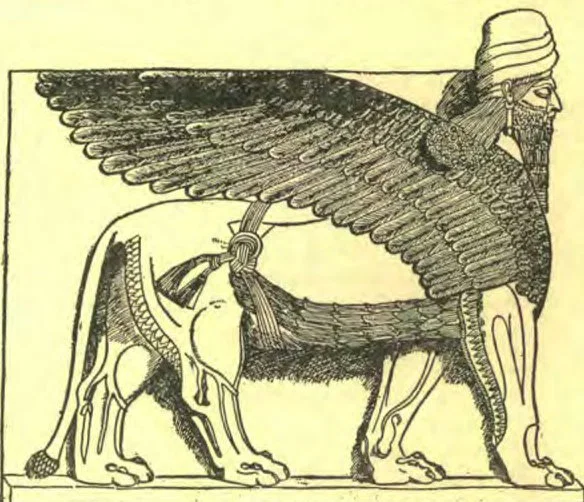
Assyrian Man-Headed, Eagle-Winged Lion.
Above all other considerations there must have come into the lives of the young men as controlling principles their duty and service to God. Their own names continually recalled God's goodness and their duty to Him: Daniel, "God's judge;" Hananiah, "whom Jehovah graciously gave;" Mishael, "who is what God is;" Azariah, "whom Jehovah aids." Nebuchadnezzar, knowing the influence of these, bestows others, in order to bind them to idolatry. Daniel was called Belteshazzar, "Bel favors;" Hananiah was called Shadrach, "circuit of the sun," or "royal one;" Mishael was given the name of Meshach, the first syllable retained, but the Babylonian "Shach," the goddess of love and mirth, substituted for "El," God. It was to connect the youth with the Babylonian Venus. Azariah was called Abed-nego, a "servant of Nego," or Nebo, the god of learning. But the language, the memories, the associations, of heaven-taught youth were stronger than the glittering generalities, the seductive atmosphere, the fulsome flatteries, the strong delusions of the popular education of wealthy, world-renowned Babylon; a lesson which all Christian parents should have taken to heart, but which having been neglected, is responsible for the Bible ignorance, the infidelity, the growingly low standards of morals everywhere manifest in the business and social world.
Temporal versus Eternal.
The education of Babylon promised great temporal advantages to those who excelled. Honorable positions among the Magi and Chaldeans were ever open, in which the growing scholar could wield great influence; and the mighty king was ever seeking such to fill important posts of responsibility in the affairs of his vast empire. But beyond these it offered nothing. True, there were the greater gods, and the promised reward among them in a world no better than this; for the gods, being deified departed heroes, were of like passions with men here; and the better or upper worlds were realms of plot and counterplot, war and strife, rape and marriage. Might and position awaited if a man could win it by strength, subterfuge, or the special favor of some deity; but of power over sin, of the "upright life and pure," of the right of existence because of righteousness, the polytheistic religion of Babylon knew nothing, and taught nothing which was free from condemning and all-destructive error. The very root of that religion, as we have already seen, was rebellion against God, perversion of His ways, rejection of His commands, and trust in the self-sufficiency of the creature.
Daniel and his brave, faithful companions turned from it all, and chose the simple course that would separate them as much as possible from sin-loving youth and all idolatrous associations. They had read in the words of infinite wisdom of the wrong course: "Avoid it, pass not by it, turn from it, and pass away." Prov. 4:15. We can readily understand that this course cost them something. We can easily hear the protests and ridicule of the disloyal Judean youths among the captivity. We hear the taunts of the Babylonians and captives from other nations. We can hear the reproach cast upon the simple diet of pulse (leguminous foods, as peas, beans, lentils, or perhaps seeds of any kind), and pure water. We can see the curled lip and contemptuous sneer; we can note the repressed word on the part of the persecuted; we can read their inward prayers; we can almost join them in their prayer-meetings, when alone, as they poured out their souls to the living God, their personal Friend. They were, like one of old, only bearing "the reproach of Christ," esteemed by them "greater riches than the treasures" of Babylon. They were building characters of eternal worth.
With beautiful Christian courtesy and wisdom, they lay the matter before the king's steward, and ask for a brief time of testing for the proposed diet. The brevity of the time shows clearly that they expected God to work manifestly. They were in Babylon to witness for Him; they would meet every condition so far as slaves could; and then God would vindicate their faith, and witness to His truth. The steward admitted the test, and the ten days of vegetarian diet satisfied him that the youths of Judea could hold their own, and he gave them their own way.10The three-years' university course soon terminated. The Judean princes had studied the language and learning of the Chaldeans, the arts, the sciences, the knowledge, all of worth, and doubtless much, unwillingly, not of worth, which the renowned teachers of Babylon had to impart. The result is told in the following simple record:
"Now as for these four youths, God gave them knowledge and skill in all learning and wisdom; and Daniel had understanding in all visions and dreams. And at the end of the days which the king had appointed for bringing them in, the prince of the eunuchs brought them in before Nebuchadnezzar. And the king communed with them; and among them all was found none like Daniel, Hananiah, Mishael, and Azariah; therefore stood they before the king. And in every matter of wisdom and understanding, concerning which the king inquired of them, he found them ten times better than all the magicians and enchanters that were in all his realm. And Daniel continued even unto the first year of King Cyrus." Dan. 1:17-21, A.R.V.
They had attended the schools of Babylon, but they had had a higher Teacher than Babylon knew. Beyond the voice of heathen tradition they heard the words of truth; beyond the deification of nature, they saw the working of the great Jehovah, high over all. High sounding over the traditions of the priests, the commentaries of the lawyers, the guesses of the scientists, the vague generalities of the evolutionists, they heard the voice of the Ancient of Days. They had opened the heart and soul and mind and flesh to let God in, and He came in with all the life-expanding and truth-progressing power of the Infinite. They were taught of God; how little in comparison were the hypotheses and suppositions and superstitions of man! With the whole being opened to Him who ever seeks entrance to His temple,—man's body,—what wonder is it that "God gave them knowledge and skill in all learning and wisdom;" and that when the king communed with those who studied the prescribed course at his universities, and thus tested them at the end of three years, "among them all was found none like Daniel, Hananiah, Mishael, and Azariah?" "Therefore stood they before the king," as counselors. But this was not all the test; in the affairs of his great and diverse kingdom, "in every matter of wisdom and understanding, concerning which the king inquired of them he found them ten times better than all the magicians and enchanters that were in all his realm."
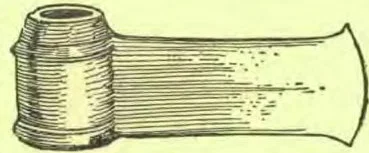
Babylonian Pilot Instrument Supposed to Have Been Used for Making Cancellous Characters on Soft Brick.
God did more than this for Daniel. He opened to his mind new revelations of the far future. He made him a seer—a see-er of the time to come. In his loyalty to God, Daniel could be trusted with the great prophetic gift, for the warning of the world, and the good of his people, to the glory of God. And these glorious lessons of infinite worth have come down to us. Will we heed them?