For years no one supposed that a lump of soft coal, dug from its mine or bed in the earth, possessed any other quality than that of fuel. It was next found that it would afford a gas which was combustible. Chemical analysis proved it to be made of hydrogen. In process of time mechanical and chemical ingenuity devised a mode of manufacturing this gas and applying it to the lighting of buildings and cities on a large scale. In doing this, other products of distillation were developed, until, step by step, the following ingredients for materials are extracted from it: 1. An excellent oil to supply light-houses, equal to the best sperm oil, at lowest cost. 2. Benzole—a light sort of ethereal fluid, which evaporates easily, and, combined with vapor or moist air, is used for the purpose of portable gas-lamps, so called. 3. Naphtha—a heavy fluid, useful to dissolve gutta percha, India rubber, etc. 4. An excellent oil for lubricating purposes. 5. Asphaltum, which is a black, solid substance, used in making varnishes, covering roofs, and covering over vaults. 6. Paraffine—a white crystalline substance, resembling white wax, which can be made into beautiful wax candles; it melts at a temperature of 110 degrees, and affords an excellent light. All these substances are now made from soft coal.
THE BETTER WAY.
LIBBY made a hat for her doll, out of the peel of half a lemon left over from Maggie’s cooking.
She took out all the inside, cut two slits in it, one on each side, through which she was going to put a tiny blue ribbon which dolly had worn for a sash, carrying the ribbon straight over the top; and, to make it complete, she would ornament it with a little feather out of the duster.
So, with her mind full of the picture of a yellow hat with blue strings and gorgeous crimson plume, she laid the lemon-peel on the window-sill and went after the ribbon.
Alas for the wonderful hat! Dear old grandpa came in and sat down by that very window, and seeing the lemon-peel there, (how should he know it was a hat?) took it up and nibbled it a little, just enough to spoil it.
He did not relish the taste of it, however, and tossed it over to the wood-box, and then leaned his head against the high back of his easy-chair for a comfortable rest.
Just then Libby came in with the doll and ribbon.
“Did you see my doll’s hat on the window-sill, grandpa?”
“No, dear, there was no hat here.”
“Then Maggie has taken it,” said Libby; “I wish she would let my things alone.”
“And it’s no hat that I see on the window at all,” said Maggie stoutly, “nothing but a bit of lemon-peel that your grandpa threw to the wood-box.”
Libby soon discovered grandpa’s innocent mischief, and feeling greatly injured, especially as Maggie laughed and grandpa almost smiled when she explained matters to them, was turning away with flushed cheeks and pouting lips to carry the story of her griefs to poor sick mamma upstairs, when a good thought came to her.
It was her morning verse, “Be ye kind, tender-hearted, forgiving one another;” and she turned and looked at grandpa, who was saying he was really sorry, and, besides, it “had left a bad taste in his mouth,” and all of a sudden it flashed into her mind what a dear, good grandpa he was, and she ran to him and kissed him.
“Isn’t that a better taste in your mouth, grandpa?”
“Yes, indeed, my dear.”
Libby had a happy heart the rest of the day.
It is always a better way to kiss and forgive, than to pout and be angry. Try it.—Child’s Paper.
Letter Budget.
WILLIE C. MOORE writes from Tarrant Co., Texas. He says: “I have but twenty-five cents, but I want the INSTRUCTOR as long as the money will pay for it, and then may be I will have some more. I like to read the nice stories in it, and we want to learn the lessons. I keep the Sabbath with my sister, mother, and another lady. We take the Review and Signs, and on the Sabbath we read them, with good books, sing and have prayer. I learn my Sabbath-school lesson and recite it to mamma. My papa is dead. My mamma is hired out, but she does all her cooking for the Sabbath, on Friday. The people with whom she lives do not mind eating cold victuals on the Sabbath, because mamma takes pains to prepare, the day before, something nice, and which they will relish, if not too cold. They laugh at us for keeping the Sabbath, and for our temperate habits in eating and drinking, etc., but they have to confess we are right about it. But I would like to live where I could go to Sabbath-school, and where I could have some good little boys to play with. There are so many bad boys here mamma does not allow me to go out much to play. I am twelve years old, but my health is very poor, so I cannot go to school. I study my lessons at home. If I was able, I should like to buy some of your nice books for children. I sometimes try to think about the beautiful new earth, how nice it will be to live where everybody is good and all love each other. I like to talk about it. Won’t you all pray that mamma and I may have a home there? I send my love to the INSTRUCTOR family.”
If any of our little boys and girls have more books than they have any use for, they might sometimes divide with the children who are not able to buy many. It is ever so much better than packing them away in the garret for the moths and mice. While we all pray for Willie and his mamma, don’t let us forget to perfect our own characters, that we may share together the blessings of the new-earth home.
ALICE M. C. MARK writes a letter from Wood Co., Wis. She says: “I want to tell you how very glad I am for the nice little paper I receive from you every week. I should feel very lonesome without it. Mamma always wants me to read the Budget to her first. It seems as if I get acquainted with the children of the INSTRUCTOR family, and I wonder how many of us will meet in the new earth. For one, I will try this new year to be a good girl. Will you pray for me? Our school begins next Monday. We have a nice new school-house. I have a little sister Clara five years old. I have two pet cows, Beauty and Jennie, and a lamb named Daisy. I also have a white kitty, and a big black dog named Beaver. I hope I may be truly thankful for the blessings of home. I send my love to the editors, and to the little friends of the INSTRUCTOR family.”
Yes, Alice, we will pray every day that you may help make up the number out of the INSTRUCTOR family who shall be saved. It is a sad thought that any who write for the Budget may miss heaven at last; but it is nevertheless true that some will not be thorough enough to make a success of life. Let us think soberly, and strive for the only thing of any worth,—eternal life.
MAY MERCER, of Madison Co., Iowa, writes: “I enjoy reading the Letter Budget very much; and as I had not seen any letters from here, I thought I would write. I first heard the truth from Eld. Pegg last spring, and have been keeping the Sabbath ever since, although my parents do not keep it with me. I attend Sabbath-school and learn my lessons in Book No. 6. I like my teacher, she is so good and kind. I am just fourteen years old. I have one brother, but no sisters. We had a Christmas tree at the church, and we there gave our money to the European Mission. It amounted to twenty-four dollars and some cents, which I hope will help teach some in that distant land the word of God.”
Do you remember how many were fed with the five loaves and the two fishes? and how many baskets of fragments were gathered up?—All this because God’s blessing was added! So you may ask God’s blessing on the Christmas donations; and who can tell how large a multitude shall receive the bread of life by this means? Be very kind and faithful, May, and you may yet have your parents with you in the truth.
JESSIE BRADFORD wrote from Barron Co., Ky., on Christmas day. She says: “I am a little adopted girl, and my mamma is very good to me. Papa has one child besides myself. I call him brother Willie. He is twenty years old, and I am seven. Brother is brakeman on the railroad, but he is at home with us every night. Mamma and I keep the Sabbath. We have no preaching, but we go to Sabbath-school at the church every Sabbath. I got the prize Christmas for regular attendance, and for having perfect lessons. I cannot write, so mamma writes what I tell her. I go to school and am trying to learn to write. I enjoy Christmas, for I always receive something nice. I want to be a good girl, and be saved with the INSTRUCTOR family.”
Your parents are very kind to you, Jessie, always to remember you on Christmas. Do you know any little people who have no friends to love them and make them happy? If so, it may be you will know how to make them glad sometimes.
MOLLIE POOL, a little girl ten years old, who loves the INSTRUCTOR, writes from Washington Co., Ark., that she goes to school and studies reading and arithmetic; and attends Sabbath-school and studies in Book No. 1. She is trying to be a good girl, and then, of course, she makes herself very useful, by doing cheerfully those duties which belong to her.
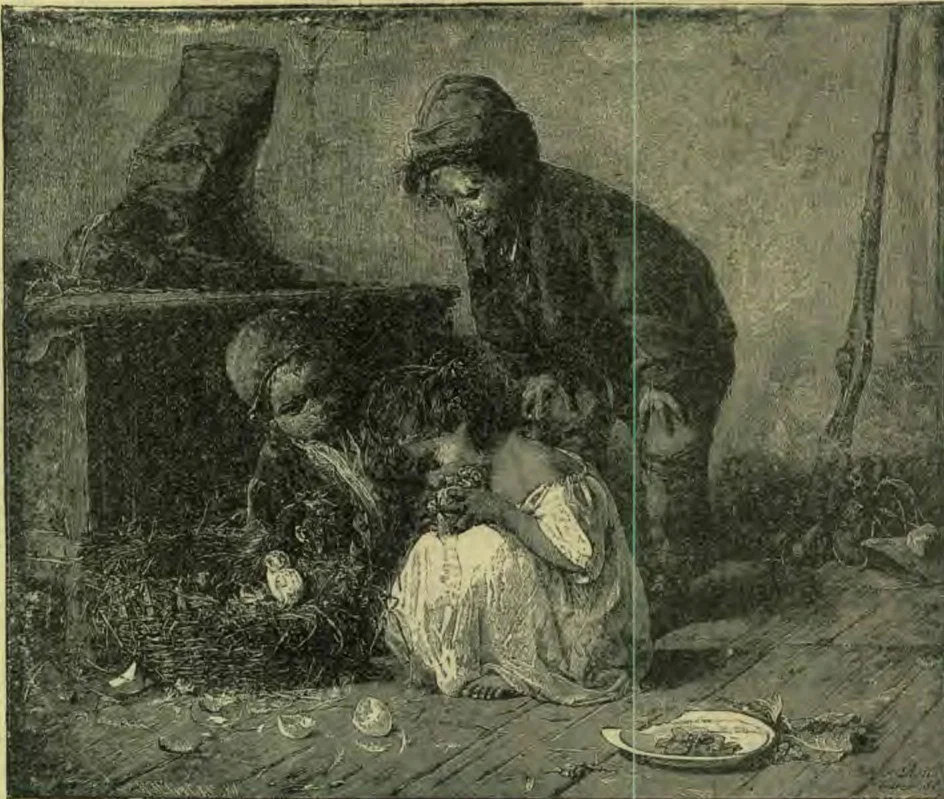
FREDDIE'S FEATHER BALLS.
By S. Isadore Miner
IN the granary, dim and dusty,
In a basketful of hay,
Little Freddie's pet hen, Goldy,
Made a nest one bright spring day;
"Cluck, cluck, cluck," she said to Freddie,
"I've no time to play."
Freddie watched her very gravely,
Seated on the floor;
Asked her why she sang so funny,
But she only clucked the more.
Freddie's mamma laughed, and gave her
Round, white eggs,—ten and four.
Three long weeks poor Freddie waited,
Paid her frequent calls.
One fine morning he came rushing,
Tumbling through the halls,
Shouting, "Come, quick, Ralph and Eva;
Goldy's got some feather balls."
Sure enough; for in the granary
Shells were scattered round,
And a dozen fuzzy dumplings
Were running o'er the ground,
Just as spry; and Fred's and Goldy's
Pleasure knew no bound.
S. ISADORE MINER.
BEGINNINGS OF EVIL
Said Frank to his mother one day, “Our school is a dreadful place, mother. I don't believe there is a boy in the whole school who does not use bad words.”
“Why Frank,” exclaimed the astonished mother, “not one? Where is my boy?”
“No, not one; even I sometimes say words that I know are wrong. It's catching, and you're surprised into it before you think. I wish you could help me do something about it.”
She promised to help him first to set a watch over his own lips, and then she encouraged him to speak to the boys, and try to get up a sentiment in the school against the practice. She realized the importance of this, as every good mother must. And she was rewarded—in her own boy, at least; for he grew up to be a noble, pure, good man, and one who did a great deal toward helping others out of the wrong path into the right one.
Most boys do not consider the fearful tendency of this bad habit. Impurity of speech leads directly to impure ideas. The heart becomes like the chamber of imagery described by the prophet Ezekiel, “full of every unclean thing,”—and by and by, when the boy has grown to be a man, how easy is the path to actual vice!
A great deal of wickedness is committed nowadays, but where did it have its beginning? The mighty river at its source is only a tiny spring; the raging, destructive fire was at first but a little spark; so wickedness, which appalls us by its terrible character and magnitude, has its little beginning in the school-room, on the street, in the boy's heart.
Boys, beware of the beginning of this sin! Ask God for a clean heart; let your lips be pure and every action as white as the snow. Then you will help to purify society. Every pure, upright man and woman helps to build up a solid barrier against vice and crime. “Blessed are the pure in heart for they shall see God.”—Foreword.
WRITING IT DOWN.
Uncle John would sometimes take a tiny note-book from his pocket and begin to write when the children were naughty and called each other names. Afterwards he would read aloud to them what he had written. They did not like to hear it, although they knew it was true, every word of it; “for somehow,” as Bess declared, “it wouldn’t have been so dreadful if it hadn’t been written down.”
By and by, whenever Uncle John began to write in the little book, they would run to him and say: “Please don’t write it down, we’ll not say any more naughty words.”
The good man would smile as he put away the little book, and spoke to them lovingly of “the Lamb’s book of life,” where every thought and word and deed is written down.
As time passes, we forget that we have been so naughty; but it is all there against us, and when the book is opened, we will find much written there that we would gladly erase.
Dear little friends, the pages of your life are lying clean and white before you, what shall be written there? Now is the time to begin a record of which you will never be ashamed. The last words uttered by John B. Gough were: “Young man, keep your record clean.”—Youth’s Evangelist.