The Youth’s Instructor, Vol. 36, No. 36.

THE LAST FEATHER

The Youth’s Instructor

Sep 5, 1888

S. D. A. Publishing Association · Battle Creek, Mich. · Sep 5, 1888

THE LAST FEATHER.

“I could not mean one feather, auntie, dear!” Said little May, and lifts her eyes so near That I can see, beneath their depths of blue, A challenge that I prove the proverb true. “O auntie,” she persists, “a whole big sack Of feathers could not break the camel’s back.”
“’Twas the last feather, child, that did the harm,” I whispered, ere the voice of tender charm Had left the lovely curving lips of red; And, as surprise grew on the face, I said:— “Though camels have large, homely backs, and strong, And carry burdens through the years so long,
“A fateful hour these desert creatures share, With all the swifter beasts that burdens bear, There comes a time when men may pile their backs, And bid them rise and bear, with cruel whacks; But the poor camel, past the working hour, Has lost, to bear a feather’s weight, the power.
“This proverb holds a lesson, little one: The many burden-bearers ’neath the sun With willing hearts will do and suffer long; Perhaps, upon life’s journey, pass with song; For loving service makes a load seem light, And hope will make a weary way all bright.
“We, thoughtless, lay our burdens one by one, Till the long way of life is almost done, Upon our loved ones, bearing all the years And telling naught of secret pain and tears. At last, from out our selfish ease, we start— A feather’s weight—the last—has broken the heart.”
—Well-Spring.

TIMOTHY

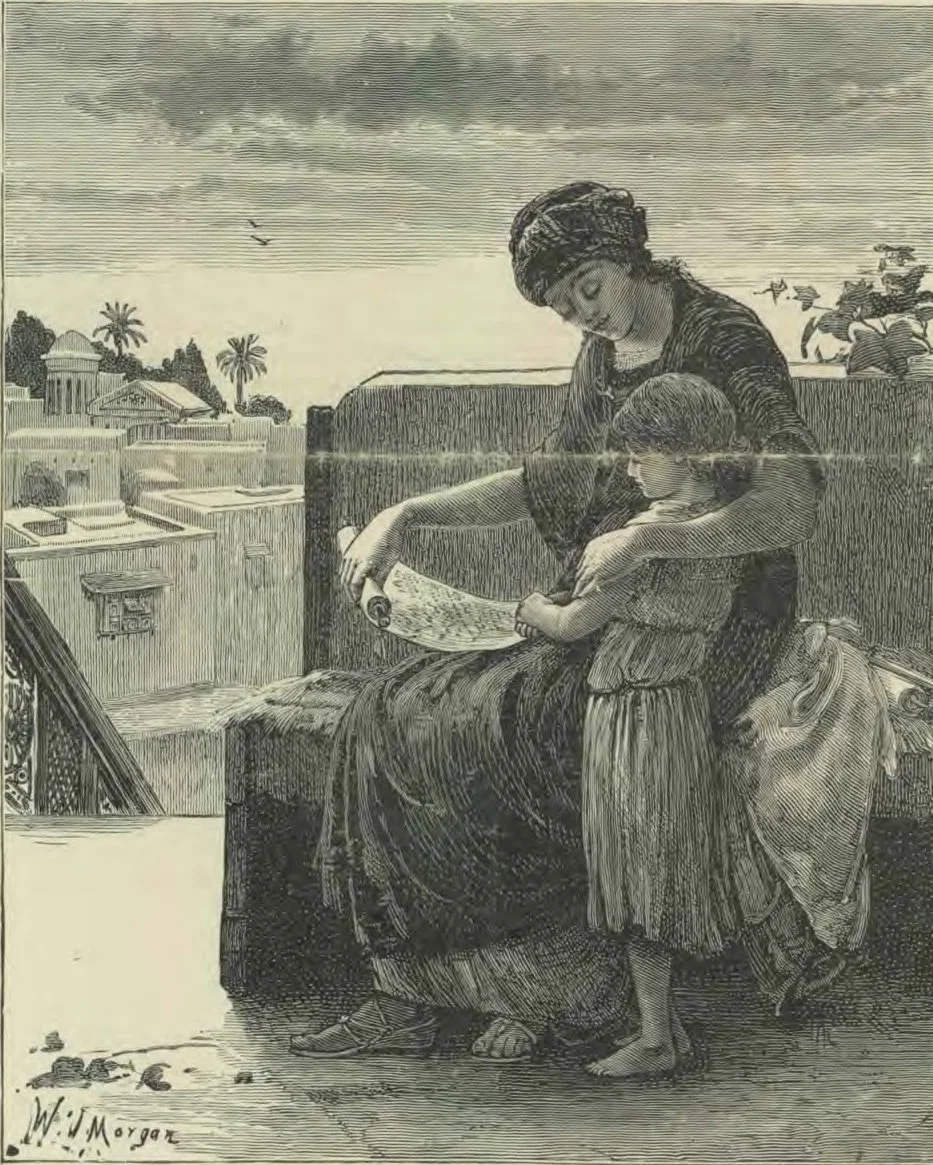
Far away over the ocean, in an old town, and in an old house, there once stood a little lad at his mother’s knee, reading with reverent face from a curious book. It was made of one long strip of parchment, written over with strange characters; and when the daily task was ended, instead of clapping the covers of his book together joyfully, the lad carefully rolled it up on the rollers fastened to either end. And this care was necessary; for years of busy labor were needed to produce another copy. It was a wonderful book from which he read,—wonderful in context, and wonderful in that, instead of falling into disuse and obscurity, as even the best of books are liable to do in time, its copies have been multiplied by thousands and hundreds of thousands, and it is loved and read everywhere. In this old book the lad read, “Blessed is the man that walketh not in the counsel of the ungodly,” and “The fear of the Lord is the beginning of wisdom;” and the words of the book made him “wise unto salvation.”
This boy’s father was a Greek. His mother was a Jewess; and not only that, but a good Christian. So while little Timothy was carefully trained in the doctrines and usages of the Jews, he learned also of the coming of the Just One, who gave redemption to mankind. And love for this dear Saviour, coupled with the “excellent spirit” that was his by inheritance from his mother Eunice and his grandmother Lois, constrained him to devote his life to spreading the doctrine of a crucified and risen Lord. With the great apostle he traveled among the early churches, strengthening and confirming those new in the faith; and exhorting them to steadfastness, sobriety, and a consistent Christian life. The apostle Paul found great comfort in the companionship of this young disciple; and when separated from him by the persecutions that befell the early church, he wrote him two letters which really contain the most we know about Timothy. These letters are full of loving counsel and encouragement, and it would do us good to read them often, as I have no doubt Timothy did.
He exhorted him to hold fast the “faith and a good conscience” that he “might war a good warfare;” to be an “example of the believers, in word, in conversation, in charity, in spirit, in faith, in purity.” “Meditate,” he said, “upon these things; give thyself wholly to them; that thy profiting may appear to all.” “Follow righteousness, faith, charity, peace, with them that call on the Lord out of a pure heart.” And “study,” he said, “to show thyself approved unto God, a workman that needeth not to be ashamed, rightly dividing the word of truth.”
Timothy must have paid good heed to the advice given him; for he was well reported of by the people that were at Lystra and Iconium. But all people did not love him for telling them the truth. They were angry at him, and shut him up for a long time in a cold, dark prison. But he was released at last, and preached to the people again about the Christ who had died for all.
And now I wonder how many of the INSTRUCTOR boys and girls will do as Timothy did,—search the Scriptures from childhood, that they may become wise unto salvation? and give themselves wholly to things good and pure and true, meditating on them to such effect that it will change their lives, and thus their “profiting may appear to all”? If they do this, they will, as St. Paul wrote to Timothy, “lay up in store for themselves a good foundation against the time to come, that they may lay hold on eternal life.”
— W. E. L.

THE LORD’S PRAYER AS A PASSPORT

In the third decade of this century, the Argentine Republic in South America was under the absolute dictatorship of President Rosas. Crafty and cruel, he had risen to this position from the lowest ranks; and while occupying it, he put to death more than six hundred men. From motives of policy he invited European immigration and protected industry and commerce; but no foreigner was permitted to enter public employ or hold a command in the army. During this period a young man from the interior of the country applied to the German consul from Bremen for a certificate of his birth of German parents; without this he would be forced to enter the army—which was no trifling matter under the rule of Rosas. The young man spoke Spanish fluently, and the conversation which followed took place in that language.
“Well, my friend,” said the consul, “where is your original certificate of parentage?”
“I have none.”
“And have you no other certificate?”
“No, sir.”
“Well, bring your parents here.”
“They are both dead, not long ago.”
“But you can speak German, can’t you—a few words at any rate?”
The young man was silent.
“It is a difficult case. How can I give you a certificate of German parentage unless you furnish the evidence?”
“As truly as God lives, it is certain that I am a German; both my parents came from Germany, and I was born there. I am not telling a lie.”
The consul walked to and fro, considering. The young man had an honest look, and spoke openly and frankly; and yet—. Suddenly an idea occurred to the consul; he stopped before the applicant and said,—
“My friend, don’t you remember something of your childhood—some hymn or prayer which your mother taught you?”
The eyes of the young man brightened. “Yes, sir!” he exclaimed; and folding his hands like a child, he repeated the Lord’s Prayer in German accurately and without hesitation; and as he concluded, tears stood in his eyes at the remembrance of the mother at whose knees he had learned this prayer. Twenty years had blotted from his memory everything that could prove his German birth except this first prayer.
The spontaneousness and naturalness of this evidence stamped it as genuine, together with the reverent air of the young man, his emotion at the thought of his mother, and the sacredness of the words he called to mind—for it was almost like calling God to witness, and such artless appeals have great convincing power with men, even without the formality of an oath.
The consul himself was much moved. “Well, my young fellow-countryman,” said he, “now I can safely give you the certificate you desire; for only a German mother can have taught you the Lord’s Prayer in your mother-tongue.”
Blessed are those parents who succeed in engraving the Lord’s Prayer and his other teachings on the hearts as well as the memories of their children. The hour will come when the one thing we most need will be some sure evidence to certify that we are children of God. No certificate of birth from pious parents will then avail; but happy shall we be if the Searcher of hearts finds the Saviour enthroned there.—The Child’s Paper.

ICE TRANSPORT AT THE NORTH.

One Monday night in early spring we left Switzerland to go north into Denmark and Sweden. The weather was warm. Rain was falling. The snow had nearly left the beautiful valleys; but up on the mountains on the right and left, Nature still wore the white cap with which she protects the delicate plant-life at that high altitude from biting winds and cold. We started with little expectation of meeting snow and ice on our journey to Christiana. But as we passed up the Rhine, through mountains and valleys, a material change took place in the atmosphere, and by the time we reached Hamburg, a little snow had fallen. As we stepped out to change cars for Kiel, we were told that it was doubtful if we would be able to cross the Baltic, and we were refused tickets farther than the shore on the south.
However, we pushed on as far as we could go, hoping that we might cross, but found that the sea was frozen over. The curse that fell on the world at the building of Babel was never more forcibly impressed on our minds than when trying to gain some information in regard to crossing the sea. The good-hearted Germans tried with all candor and earnestness to explain the situation; but it seemed only so much foolishness to our unaccustomed ears.
In the night, the ice closed in the boat with a firmer grasp, and we were obliged to seek some other place to cross. After vexing delays of nearly two days, caused by the deep snow, we succeeded in reaching Fredericksort, distant but seventy-five miles. Here we crossed the Little Belt, but were told that it was doubtful if the Great Belt could be crossed, as passengers had been out all day upon the ice, and had been obliged to return nearly perishing with cold. But the ice-boats were to make another trial trip at six o'clock in the morning.
When we went down to the shore in the morning, nothing could be seen but broken blocks of ice piled up by the bleak north winds; with here and there a blue stretch of salt-water that had not been congealed. It was by no means a pleasing prospect, yet we decided to pull for the other shore. The company numbered two hundred and fifty. Our baggage was put into the ice-boat; and at least half the company were harnessed to the boats, and shod with iron corks to enable them to draw the ice-boats across to mid-sea, where we hoped to meet the vessel. It was hard traveling. The morning was bitter cold; but the expedition was a novel one for an American.
With interest we watched the prospect ahead. Soon a Danish vender began an unintelligible jargon, at the same time holding up a pair of straw shoes, whose use he explained with as good grace as though I understood all he said. Some pulled a kroner out of their pockets and exchanged it for the straw shoes, saying that they were necessary to keep one's feet from freezing in the ice and water. So I bought a pair, pulling them on over my American Arctic overshoes.
It was amusing to see each man in harness, taking firm hold of the ice with his iron-shod boots, and pressing the heavy burden forward. These ice-boats are somewhat like our canoes except that they are larger and heavier, and have a runner on either side of the keel, so as to keep the boat from falling over in case the men lose their balance. There are two men at each side, and two in front to steer the boat between the blocks of ice that are driven up in piles by the fierce winds of the north.
After walking behind the boat six miles, and pushing as hard as we could, we reached the ship that was waiting for us in mid-sea. We took our baggage out of the little ice-boats and put it on the vessel, walking up to the ship on solid ice.
We were no more than seated in the vessel, when we learned that another train had arrived from the south, and wanted to cross the belt. A communication was held between the captain and the railroad by means of balls of different colors. The good captain raised the ball to indicate that he would hold the boat for their arrival; and we sat amidst the ice till they reached us. Then the engineer turned on the steam, and we could hear the powerful stroke of the engine and the grinding of the wheels as the vessel slowly broke through the ice that surrounded her, leaving behind a path of cold blue salt-water. In a few hours we arrived on the other shore at Korsor. Next time we will tell you how we passed the night in this old town.
R. A. HART.
Christiana, Norway.

RAMABAI

The Pandita Ramabai, who came from Hindoo-land to this country in 1886 to plead the cause of Hindoo women, will sail for her native home sometime during the present month. The following brief sketch of her life, as furnished to the St. Nicholas by Mary L. B. Branch, will give you some insight into her character and mission:—
“You are used, girls and boys, to your school-rooms and blackboards, to your satchels and books, your slates and pencils. May be you think it hard, sometimes, that you have problems to solve, boundaries to learn, and sentences to parse. But how would it seem to you to be awakened from a sound sleep, every morning before daylight, to learn a lesson in Sanskrit, that ancient and most difficult language, familiar to but few, and those, usually, eminent scholars? To learn Sanskrit is a greater task than to learn Greek, and a much greater task than to learn Latin.
“This is what a little Hindoo girl named Ramabai had to do. She was awakened every morning before the day dawned, for her Sanskrit lesson; this being the only time her mother could spare from household cares to teach her little daughter.
“Their dwelling was on the mountains, in a forest clearing, and there were wild animals in the jungles all about them. The first night that Ramabai’s young mother spent in that solitude, before they had any home at all, she lay upon the ground, wrapped in a cotton quilt, trembling with terror; meanwhile her husband watched until daybreak, keeping off a great tiger which prowled about them, uttering hideous cries. After their home was built, the husband, who was a Brahman priest, and also a very wise and good man, taught his young wife Sanskrit, because he loved the poems written in that language, and wished her to enjoy them with him. So, when Ramabai was six or seven years of age, her mother, in turn, taught her little daughter Sanskrit, from her own lips, without any book. We are told that ‘The little maiden, heavy with sleep, was tenderly lifted from her bed upon the earth, and aroused with many endearments and sweet mother-words; and then, while the birds in the forest about them were chirping their morning songs, the lessons were repeated.’
“The father’s dwelling-place in the mountains came to be regarded as sacred by the people, and students and pilgrims sought out the learned priest. His hospitality and religious duties involved him in debt; and by the time Ramabai was nine years old, his poverty was so diminished that the family were obliged to give up their home, and to wander about from one locality to another, as pilgrims themselves. So we have to think of Ramabai, not only as the child student of Sanskrit, but as a little pilgrim girl, roaming up and down the earth, from the time she was nine until she was sixteen—homeless and often in want.
“Ramabai afterward became known as a Sanskrit scholar and lecturer. She married a graduate of the Calcutta University, but in less than two years was a widow with a little daughter of her own, named Manorama, meaning Heart’s Joy.
“Her love of education was so great that she then went to England and entered the college at Cheltenham, where she became Professor of Sanskrit, and at the same time studied mathematics, natural science, and English literature. In 1883, she came to our own country, in pursuance of her object, and at the time of this writing, she is still here.
“She has a lofty purpose.” It is that Hindoo girls shall be educated—fully, amply educated; and that with their studies they shall also learn to be teachers, governesses, nurses, and housekeepers. The girls of India have lived under a cloud of ignorance, and in bonds of caste and custom which, it has seemed, no hand could break. But Ramabai, who learned her lessons in the forest among the singing birds, has found her way into light and liberty, and will never rest content until she has thrown open the doors so that her Hindoo sisters may follow her.”
Another writer, in Illustrated Pacific States, makes the statement that “there were in India, by the census of 1881, 21,000,000 widows, of whom about 80,000 were under nine years of age, over 200,000 under fourteen, and nearly 400,000 under nineteen;” and that Pandita, in conversation with a friend the other day, said: “Widowhood throughout India is regarded as the punishment for horrible crimes committed by the woman in her former existence upon the earth. If the widow be the mother of sons, she is not usually such a pitiable object as otherwise, although she is certainly looked upon as a sinner.
“The widowed mother of girls is treated indifferently, and sometimes with special hatred. But it is the child-widow upon whom, in an especial manner, fall the abuse and hatred of the community as the greatest criminal upon whom Heaven’s judgment has been pronounced. The widow must wear a single coarse garment. She must eat only one meal during the twenty-four hours of a day, and must never take part in family feasts. A man or woman thinks it unlucky to behold a widow’s face before seeing any other object in the morning. The relatives and neighbors of the young widow’s husband are always ready to call her bad names, and there is scarcely a day of her life on which she is not cursed by these people as the cause of their beloved relative’s and friend’s death.”
The States further remarks: “With such an appalling showing as this, it can be realized what an educational undertaking the Pandita has entered upon, and what a triumph hers will be if but even an infinitesimal part of complete success be achieved.”

ALCOHOL AND HEART-BEATS.

I was recently able to convey a considerable amount of conviction to an intelligent scholar by a simple experiment. The scholar was singing the praises of the “ruddy bumper,” and saying he could not get through the day without it, when I said:—
“Will you be kind enough to feel my pulse while I stand here?” He did so.
“Count it carefully. What does it say?”
“Seventy-four.”
“I will now sit down in a chair, and ask you to count it again.” He did so, and said:—
“Your pulse has gone down to seventy.”
I then lay down on the lounge, and said:—
“Will you take it again?” He replied:—
“Why, it is only sixty-four! What an extraordinary thing!”
I then said: “When you lie down at night, that is the way nature gives your heart rest. You know nothing of it, but that beating organ is resting to that extent; and if you reckon it up, it is a great deal of rest, because, in lying down, the heart is doing ten strokes less in a minute. Multiply that by sixty, and it is six hundred; multiply it by eight hours, and within a fraction there are five thousand strokes difference; and as the heart is throwing out six ounces of blood at every stroke, it makes a difference of just thirty-six thousand ounces of lifting during the night. When I lie down at night without any alcohol, that is the rest my heart gets. But when you take your wine or grog, you do not allow the rest, for the influence of alcohol is to increase the number of strokes, and then, instead of getting this rest, you put on something like fifteen thousand extra strokes, and the result is, you rise up very seedy and unfit for the next day’s work until you have taken a little more of the ‘ready bumper,’ which you think is the life of man.”—Dr. Richardson.

Toil as the Law of Life

If you want knowledge, you must toil for it; if food, you must toil for it; and if pleasure, you must toil for it. Toil is the law. Pleasure comes through toil, and not by self-indulgence and indolence. When a man gets to love work, his life is a happy one.

HOW TO OBTAIN SPIRITUAL RESULTS OF SABBATH-SCHOOL LABOR.

In the great field of Christian endeavor the Sabbath-school has now become a permanent factor. Every instrumentality that God has been pleased to adopt to contribute to the accomplishment of his work in the earth is designed to be a potent means to a specific end. It is evident that the end to be attained in the Sabbath-school is to afford its members such a knowledge of Bible truth as will lead them to experience its converting and saving power. In short, to make intelligent Christians is the only legitimate outcome of all Sabbath-school effort. If, then, this branch of the Master's work is not constantly maturing this precious fruit, it signally fails to carry out its high and holy mission.
Let us seriously consider what our Sabbath-schools are actually accomplishing. Is the fruitage what God designs it should be? How many can conscientiously give an affirmative answer? I verily believe not one. If it is not, why not? To the discovery of this why we will now address ourselves.
In the first place it is evident that the generality of laborers in the Sabbath-school have altogether too low an ideal of its nature and purpose; we have no adequate notion of the exalted character of the work, and consequently are too prone to regard the Sabbath-school institution as one of secondary importance. We seem to think that it exists as the result of precedent or custom, and as being therefore merely subsidiary to other branches of Christian labor; and the necessary result is that we fail to give the work our highest and best efforts. An absolute prerequisite to the achievement of the highest success in any department of human activity is that the actor possess a high ideal conception of the dignity and import of his work; for it is impossible to attain to greater excellence in any thing, than that which characterizes the ideal model for the realization of which we labor.
“As a man thinketh in his heart so is he,” says Inspiration; and hence those who think that the Sabbath-school work is of but ordinary importance must be but ordinary factors in its make-up—altogether too ordinary to constitute an active and responsible element in an institution so sacred. God grant that our spiritual discernment may be quickened so that we shall be enabled to know and appreciate the momentous and eternal consequences with which this work is fraught. Would that we could keenly sense the weight of responsibility which the nature of the service imposes! How happy would it be for us to have so much of the spirit of Christ that we could know and feel the grandeur, glory, and dignity of this work as he does! Can we not get into this condition of mind and heart? Yea, must we not, if we would expect the fruit of our labor to endure, or, in other words, if we would render acceptable service for the Master? We assert, then, that no one who does not have that purity and elevation of mind necessary to enable him to adequately appreciate the high and sacred calling of the Sabbath-school laborer, is qualified to serve in any of its several capacities. But in order that this condition of mind and heart may be attained, it is necessary that we be partakers of the divine nature; that we be born of the Spirit; in short, that through genuine conversion we become imbued with the spirit of Christ, which will beget in us an ardent love for him, and a burning zeal for the promotion of his cause in the earth.
This brings us to the vital point of our theme. Spiritual fruits can result only from the labors of the spiritually minded. This is a necessary truth, inasmuch as it is impossible for an evil tree to bring forth good fruit. And as the one ultimate object of all Christian endeavor is to effect spiritual results, the Sabbath-school, just as far as it fails to realize such results, is a failure, and therefore reproaches rather than honors the cause of Him in whose name it professedly exists. This being true, we must conclude that the first requisite condition to successful Sabbath-school labor is a converted teaching force; and this can be secured only through the individual godliness, consecration, and devotion of those who comprise such force. It is therefore morally incumbent upon every one who assumes any responsibility in connection with this work to examine his spiritual condition with the utmost scrutiny. Let no one dare to presume in this matter. It is the sheerest hypocrisy for any one to attempt to present to others the claims of God's truth who has not himself accepted its claims and experienced its converting power. No one has a right to undertake such work unless his credentials bear the seal of God, and that seal is the mark of a regenerated and sanctified heart. Does any right-minded man doubt the necessity of a converted ministry? Certainly not. Is the work of the Sabbath-school teacher any less critical and sacred than that of the minister? Are they not both laboring to the attainment of identical results? And if purity of heart and consecration of powers are an indispensable condition of success to the minister, are they not equally so with the teacher who labors to the same end? Both are ambassadors for Christ, and as such their distinctive work is to carry forward his mission upon earth, which is “to call sinners to repentance.” We naturally shudder at the idea of placing an unconsecrated person in the pulpit, but would not such an one be equally out of place if put in charge of a Sabbath-school class? Certainly. Dear teachers, do we appreciate the fact that our work is identical with the work of the great Teacher while on earth,—a work of such vast magnitude and importance as to constrain him to lay aside his royal glory and splendor in heaven to become a despised wanderer and the victim of his great enemy's malice upon earth? How can we then expect to succeed in a work so sacred unless we are fully imbued with the spirit of its Author? We are teachers either true or false—true if in Christ, false if not. Can any one bear the thought of standing in the light of a false shepherd? “Unto the wicked God saith, What hast thou to do to declare my statutes?” Ps. 50: 16. Nothing, emphatically nothing.
“As the branch cannot bear fruit of itself, except it abide in the vine; no more can ye, except ye abide in me.” This is a clear, express declaration not to be misunderstood. Now let every Sabbath-school teacher seriously ask himself the questions: Am I virtually connected with the true Vine? Is it the love of Christ that constrains me to engage in the work? Do I regard such service as the most exalted, most responsible in which it is possible for man to engage? Do I esteem it a Heaven-bought privilege to labor in the Sabbath-school? or is it a task? Do I daily plead with God for the conversion of the individual members of my class? and would I be willing to sacrifice my dearest earthly interests, if need be, to secure such a result? Am I constantly learning lessons of humility, trust, patience, forbearance, tenderness, and love at the feet of Jesus? Am I doing all I can to build up the interests and promote the general efficiency of our school?
The ability to answer these questions affirmatively will be evidence that Christ is enshrined in the heart, and that the requisite spiritual qualifications are possessed. The teacher who is thus qualified will not be long in acquiring all the other elements of successful teaching. That a faculty for hard work, strong sympathies, tact, perseverance, and a cheerful, happy, yet earnest disposition of mind are essential elements of teaching power, no one can doubt. But is it possible to conceive of an individual abiding in Christ and thus constantly partaking of his nature who does not daily cultivate these higher graces of head and heart?
The term “lazy Christian,” which we sometimes hear, is a misnomer; for the existence of such a being is not possible. A Christian is one who lives in Christ, the very source and personation of all life, energy, and power, and must necessarily therefore be imbued with the same spirit, at least in kind, if not in degree. A converted teacher is an industrious teacher—one who toils, thinks, plans, devises, hopes, prays, and, if need be, suffers, for the success of his work. His Master's business is the business of his life, and like Him all his powers are devoted to its prosecution. Such a teacher insensibly sheds a heavenly benediction upon his pupils, and the spirit of Christ through him captivates their hearts and inspires them with noble and heavenly aspirations. His yearning, loving, tender heart begets a like condition in their hearts, and thus silently but forcibly draws them to Jesus. The power and influence of such a teacher for good cannot be estimated; gold cannot measure it; it is above rubies.
The majority of Sabbath-school scholars are children and youth in the formative period of life; and hence their plastic minds will receive lasting imprint of the teacher's mental and moral cast. It must therefore be a moral necessity that teachers bear the divine mold. If they do not, they not only bring unto themselves condemnation, but their adverse moral influence is likely to affect the eternal destiny of their pupils. Is it any wonder then that Jehovah himself should decree that the unwashed should have nothing to do in declaring (teaching) his statutes? In the face of all this how can any one accept the sacred trust of a Sabbath-school teacher without first giving himself unreservedly to Christ? Otherwise he does injustice to himself, commits a gross offense against his class, and offers insult to Heaven. There is great room for improvement in our Sabbath-schools, but I am convinced that the first step necessary to such improvement is thorough conversion and complete consecration on the part of teachers and officers. Fervent piety and godliness make the one necessary antecedent condition to all other features of reform and improvement. This once secured, the inevitable result will be that God's blessing will rest upon our Sabbath-schools in such richness and power as will conquer sinners and rejoice the hearts of saints.
GEORGE W. RINE.
Continue reading: EARLY BIBLE WORKERS