The Youth’s Instructor, Vol. 30, No. 40.

THE MIRAGE OF LAKE SUPERIOR

The Youth’s Instructor

Oct 4, 1882

S. D. A. Publishing Association · Battle Creek, Mich. · Oct 4, 1882

THE MIRAGE OF LAKE SUPERIOR

Written for the Instructor.

THE MIRAGE OF LAKE SUPERIOR.

THE St. Louis River and other smaller streams that flow down among the rocky hills on the north-west shore of Lake Superior, accumulate in St. Louis Bay. From thence they pour a brownish-red tide into the upper end of Minnesota Bay, a sheet of water about eight miles long by one mile wide, and separated from the head of the Lake by a long, narrow curved neck of land. The Nemadi River, roily at times, and light red-stained, enters the lower end of this bay. From this, by a direct channel, it opens into the Great Lake, in whose pure waters it makes a line of red for two or three miles. The St. Louis waters, entering from the upper end of the bay, also form a current in the lake of a peculiar hue. To these variously tinted currents, atmospheric conditions being favorable, the phenomenon of the mirage is probably due.
Recently, while looking through a small telescope from the city of Duluth to the south shore of the lake, here about ten miles distant, I noticed that the forest seemed to come sheer down to the water’s edge, broken here and there by high, bare banks of light red clay. While looking at this scene, I was surprised to see what appeared to be a long stratified cloud suddenly forming midway up the great bank, and stretching away to the right and left. It presently assumed an appearance of rippling water, opening as a beautiful bay into the great lake.
A distinct bank, or cape, was thus found, continually separating, or withdrawing, from the true bank, but perfectly natural in appearance, with characteristic slopes, growth of timber, and margin of sand. The tongue, or head, of the bay in the meantime gradually advanced inland at a moderate angle with the shore of the lake, and was surrounded with a distinct appearance of flame, as if to burn away the timber to form a channel for the advancing waters. At length the cape, or promontory, seemed gradually to sink into the water, and finally disappeared, leaving only the wide expanse of the lake and the dull outlines of the distant shore. Had it not been for the gradual shifting of the scene, the known contour of the shore of the lake, and the flaming tongue of the phantom bay, the illusion would have been complete, so perfectly natural in other respects was the beautiful scene.
When the apparition had vanished, a bright rainbow rested upon the bosom of the lake,—a reminder of the faithfulness with which the great Creator keeps covenant with the sons of men,—an assurance and seal to every promise of future good to his waiting children. A. SMITH.

THE WATER-MILL.

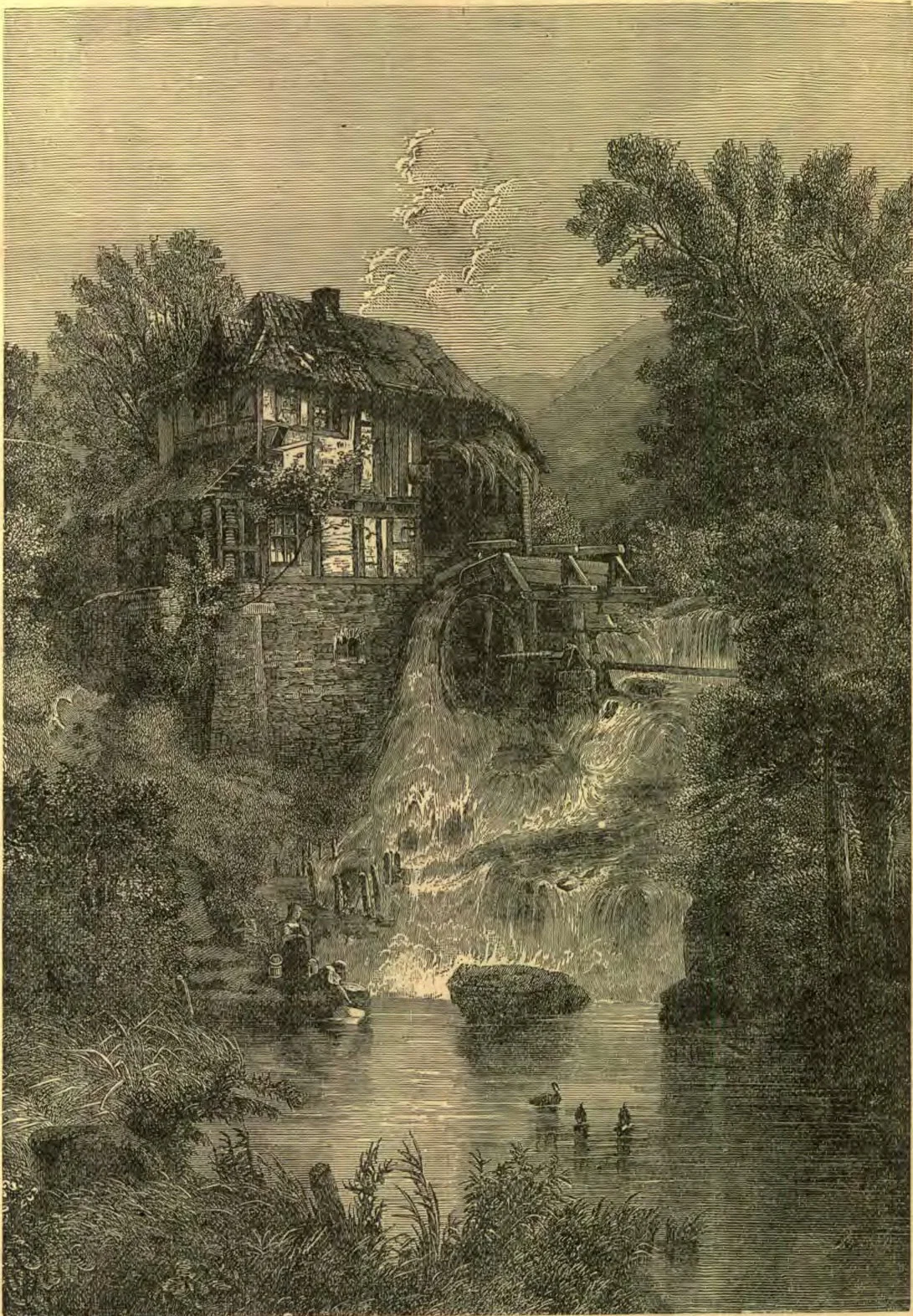
LISTEN to the water-mill all the livelong day, How the creaking of the wheel wears the hours away! Languidly the water glides useless on the sill, Never coming back again to the water-mill. And a proverb haunts my mind as the spell is cast, “The mill will never grind with the water that has passed.”
Take the lesson to yourself, loving heart and true, Golden years are passing by—youth is passing too— Try to make the most of life, lose no honest way; All that you can call your own lies in this—to-day. Power, intellect, and strength may not, cannot last. “The mill will never grind with the water that has passed.”
Oh! the wasted hours of life that have flitted by; Oh! the good we might have done—lost without a sigh. Love that we might once have saved with but a single word, Thoughts conceived but never penned, perishing unheard. Take the lesson to your heart, take, oh, hold it fast, “The mill will never grind with the water that has passed.”

PET BEETLES.

We were sitting on our piazza one warm evening, when our neighbor over the way opened his front door and proceeded to cross the street.
Now we had never felt much interest in this particular neighbor, a grave, silent man; but this evening every eye was fixed upon him with attention, for as nearly as we could discover in the surrounding darkness, he appeared to be bringing to us a basin of fire, real fire, that lighted up his whole face so that we could see quite plainly how anxiously he watched his fiery dish.
As he came nearer, we all rose, eager to see what this dish contained that burned with such a strange greenish light, and, as we could now see, appeared to be water, blazing water.
As our neighbor paused to open the gate, he stumbled, and the next instant all was confusion.
We saw two gleaming lights rise from the dish, heard a crash of broken crockery, and then were astonished at the sight of our grave neighbor bobbing about up and down the high steps, making quick snatches at the two lights that danced about his hands.
Presently both lights disappeared, while our neighbor entered our family circle so suddenly that several chairs and small children were overturned.
“Beg your pardon,” gasped the gentleman, when he had, at last, found a safe resting-place. “I was sure I’d lost them. Look here, you young folks, did you ever see fire-bugs like these?”
We, children and all, crowded about him in the darkness, and by the faint light that came through the parlor-blinds, could see him slowly open his hands, and then we saw nothing but two ugly brown beetles, apparently quite dead.
“Well, I declare,” said our neighbor in consternation, as the two beetles refused to respond to the friendly shaking he gave them, “I’m afraid I squeezed ’em too hard.”
At some one’s suggestion the injured beetles were taken into the house and water sprinkled on them to “bring them to,” but the shower-bath only had the desired effect upon one leg of each beetle. The revived legs kicked vigorously, but the rest of the beetles refused to come to life until they were dipped in a bath prepared in the canary’s bath-tub, borrowed for the occasion.
This bath proved the beetles to be impostors, for no sooner had they touched the water than their legs flew out in every direction, and from two large yellow spots on their shoulders streamed the strange, beautiful blaze that had lighted up the water in our neighbor’s bowl, now lying broken on the steps.
Those who have never seen the “Elater,” as this tropical phosphorescent beetle is called, can have no idea of the strange brilliancy of the light that shines steadily from the spots on its shoulders.
As the beetle lifts its wings, you see the soft body also flaming with light, and you soon think of these spots as windows through which the light from the body shines.
Our neighbor told us of a poor prisoner, who was shut up in a dungeon so dark that he could not see his hands before his face, to whom friends succeeded in sending a little scrap of paper in which was folded one of these elater beetles.
When the frantic, half-mad prisoner unfolded the paper, a wonderful light shone out about him, and in spite of the terrible darkness into which he had been cast by cruel men, he was able to read, by the friendly, steady gleam of the elater, directions, written on the scrap of paper, for escaping by a secret passage leading from his dungeon.
This beautiful light proved true to him, for after a patient search it showed him the stone described in the paper, that could be rolled aside from the hidden door.
We were all glad when we knew that the two fire-beetles were ours, and the children immediately named them Jupiter and Mars.
A pretty little red Chinese lantern with perforated paper over the top made an elegant house for our new pets, and when we had put for their refreshment a piece of banana in the tin candle-socket, and hung the lantern to the gas-fixture, we thought Jupiter and Mars might be quite comfortable. When we put the gas out, they rewarded us by brightly illuminating their red castle.
From the first they were very tame, or very stupid, and seemed to have no fear. The children made a tiny chariot of thin white paper and covered it with diamond powder. This chariot was harnessed by silken threads to Jupiter and Mars, and a lovely paper fairy with diamond-glistening hair was drawn by these fiery steeds round and round a marble table. In a dark room, with the weird greenish light from the beetles falling upon the gleaming chariot, this made a very pretty sight.
The entertainment was sometimes varied by placing Jupiter and Mars upon their backs. In this position they were helpless as turtles, until they gave a spring in the air and came down right side up again.
This performance delighted the children, but one evening Jupiter and Mars became tired of the sport, and with one accord rose in the air, dragging the chariot after them, and throwing out the fairy driver, who was badly injured in the efforts of the children to capture the runaway steeds.
Poor Jupiter came to an untimely end at length, through being fed, by the little ones, on wet sugar stirred with a match. The phosphorous paste, thus innocently made, wholly disagreed with the poor beetle’s digestion, and we felt so badly over our dead elater that we did not grieve when Mars, taking advantage of the general confusion, escaped through an open window.
“He was safe from matches, anyway,” the children said.—Youth’s Companion.

THE LITTLE WAVE.

A LITTLE wave started out to cross the broad ocean. Her green dress sparkled in the sunlight, and on her head she wore a cap of white sea-foam.
“I know I’m but a little thing,” said she, “but there must be some work for me to do.”
So she went dancing on, her happy heart full of loving and sweet thoughts.
She passed many white-winged ships on her way, yet none of these needed her help. The strong sea-breeze lent them his willing hand, and their sails flapped merrily in his face, as they sped swiftly through the waters.
“My work is not here,” said the little wave, as she kissed their broad hulls, and hurried by.
Out on the broad sea, struggling for life, is a poor sailor-man. With nothing but a bit of spar to cling to, he is nearly ready to let go his hold, and drop into the deep waters below.
Courage, sailor-man! our little wave is coming to your help. Tenderly she clasps him in her arms, and, calling the breezes to her aid, swiftly bears him to the land.
Well she knows she will die if she touches the shore; but her heart is strong and brave, and she speeds quickly along. She grows larger and fuller as she nears the beach, till at last, with one brave leap, she lays her burden tenderly down on the sands, and rolls slowly, gently back to her grave in the broad bosom of the ocean where she was born.
When the sailor-man rose up, he thanked God that his life was spared, but he thought no more of the little wave that had given her life for him.—Well-Spring.

SCENES IN THE LIFE OF CHRIST.

LESSON 89.—THE MARRIAGE OF THE KING'S SON.

Adam and Eve were the first human beings upon the earth. They were holy and happy until they sinned. Then they lost their Eden home; and when Cain, their own son, angrily rose up and killed his innocent brother, they began to realize the terrible effects of sin. Seth and some of his descendants were good men, but by the time the world had stood about fifteen hundred years, the people, who were then very numerous, had become so very wicked that it was necessary to destroy them by a flood. Noah spent one hundred and twenty years in warning the people, and in building an ark, as the Lord had instructed him to do. After the flood, Noah's descendants multiplied and became a great people; but they also became wicked and proud, and the Lord scattered them abroad over the earth.
Then Abraham was called, and had the promise that he should be the father of a great nation, and that if he and his seed after him would be faithful and true, they should be God's peculiar people above all others; that they should have the land of Canaan for a possession, and an everlasting inheritance in the world to come. But Abraham died, and his descendants went down into Egypt, where they finally became slaves, and suffered great hardships. Then Moses was raised up to deliver them, and after forty years of disobedience and wandering in the wilderness, they were brought into the land of Canaan. This was many hundred years before the time of Christ, and during all that long period of time the Lord had kept sending them prophets and teachers, who warned them against their evil ways, and told them how to so live that they might one day sit down to the marriage supper of the Lamb, in the New Jerusalem. But the proud Jews often slighted the teachings of God's messengers, and treated his prophets in a most cruel manner, beating some, and killing some, till finally Christ, the Son of God had come, and now they were about to take his life.
So Jesus on the last day of his teaching in the temple, gave them a parable about the marriage of the king's son. In that parable he showed them their wicked course, and how the Lord would destroy them and their city, and send his messengers to invite the Gentiles to come to Christ. “And Jesus answered and spake unto them again by parables, and said, The kingdom of heaven is like unto a certain king, which made a marriage for his son, and sent forth his servants to call them that were bidden to the wedding; and they would not come. Again, he sent forth other servants, saying, Tell them which are bidden, Behold, I have prepared my dinner; my oxen and my fatlings are killed, and all things are ready; come unto the marriage. But they made light of it, and went their ways, one to his farm, another to his merchandise; and the remnant took his servants, and entreated them spitefully, and slew them. But when the king heard thereof, he was wroth; and he sent forth his armies, and destroyed those murderers, and burned up their city. Then saith he to his servants, The wedding is ready, but they which were bidden were not worthy. Go ye therefore into the highways, and as many as ye shall find, bid to the marriage. So those servants went out into the highways, and gathered together all, as many as they found, both bad and good; and the wedding was furnished with guests.”

QUESTIONS.

  1. Who were the first human beings upon the earth?
  2. How long did they remain happy?
  3. How were they brought to realize the effects of sin?
  4. What may be said of Seth and his descendants?
  5. Into what condition had the people fallen about fifteen hundred years after the creation?
  6. How did Noah spend the last one hundred and twenty years before the flood?
  7. Describe the course of Noah's descendants after the flood.
  8. What good man was then called?
  9. What did the Lord promise him?
  10. What calamity befell the descendants of Abraham?
  11. How were they delivered from bondage?
  12. Where did he lead them?
  13. How long was this before the time of Christ?
—More than fourteen hundred years.
  1. What did the Lord do for them during all this long period of time?
  2. What did these messengers do?
  3. How did the Jews treat them?
  4. What were the Jews now going to do?
  5. On the last day that Jesus taught in the temple, what parable did he give besides those we have already studied? Matt. 22.
  6. What did Jesus set forth in this parable?
  7. Relate the parable as far as to the close of the tenth verse.
  8. Who is the king spoken of in the parable?
  9. Who is the son?
  10. Who is meant by those who refused to come to the wedding?
  11. What is meant by their ill treatment of the king's servants?
  12. Have the Jews received the punishment which our Lord predicted?
  13. Who are meant by the people that were gathered from the highways and hedges?

LICHENS

The book of nature is full of beautiful lessons, and if we will only look carefully, we may find them at every step.
A few weeks ago, while riding in the country, I saw many illustrations of God's love and kindness. But coming suddenly upon an old log house, long ago deserted, I thought, surely here is nothing to remind one of God's love! The walls were old and decaying, and the broken doors, through which long ago had passed the burial or the bridal train, were now creaking dismally on their rusty hinges. The whole house looked forsaken indeed.
But on a nearer view we found the house to be covered over with beautiful green moss and gray lichens. They had crept over the desolate ruins and settled affectionately into every crevice and corner. They kept off the piercing rays of the sun in summer; and when winter came with its ice and snow, the old house still had friends, which neither cold winds nor storms could drive away.
Then I thought, “God's love is like the lichens. When we grow weak and weary, friends leave or forsake us, and life seems shorn of all its beauty, then is His love still over us.” And I thanked God for the sweet lesson as we rode slowly onward. Let us take courage. He will not leave or forsake us in sorrow or in death. M. E. G.

God's Mercy Brings Summer Flowers and Hope

God, who in his mercy gives the flowers each summer to his world, leaves no life to be all winter; but as he “sends rain on the just and on the unjust,” so to every one there comes some help when it is most needed, some color, some blossom of happiness or of hope.

NEW-TESTAMENT HISTORY.

LESSON 103.—JESUS BROUGHT BEFORE THE HIGH PRIEST.

The men who laid hold on Jesus led him away to Annas, who had formerly been high priest, and was father-in-law to Caiaphas who, being high priest that same year, had given council to the Jews that it was expedient for one man to die for the people. It seems that Annas did not detain Jesus very long, but sent him immediately to Caiaphas, for the record says, “Then took they him, and led him, and brought him into the high priest’s house.”
“And Simon Peter followed Jesus, and so did another disciple: that disciple was known unto the high priest, and went in with Jesus into the palace of the high priest. But Peter stood at the door without. Then went out that other disciple which was known unto the high priest, and spake unto her who kept the door, and brought in Peter. Then saith the damsel that kept the door, unto Peter, Art not thou also one of this man’s disciples? He saith, I am not. And the servants and the officers stood there, who had made a fire of coals; for it was cold: and they warmed themselves: and Peter stood with them, and warmed himself.
“The high priest then asked Jesus of his disciples, and of his doctrine. Jesus answered him, I spake openly unto the world; I ever talked in the synagogue, and in the temple whither the Jews always resort, and in secret have I said nothing. Why askest thou me? Ask them which heard me, what I have said unto them; behold they know what I said. And when he had thus spoken, one of the officers who stood by struck him with the palm of his hand, saying, Answerest thou the high priest so? Jesus answered him, If I have spoken evil, bear witness of the evil: but if well, why smitest thou me? Now Annas had sent him bound unto Caiaphas the high priest. And Simon Peter stood and warmed himself. They said therefore unto him, Art not thou also one of his disciples? He denied it, and said, I am not. One of the servants of the high priest, being his kinsman whose ear Peter cut off, saith, Did not I see thee in the garden with him? Peter then denied, and immediately the cock crew.” “And the Lord turned, and looked upon Peter. And Peter remembered the word of the Lord, how he had said unto him, Before the cock crow, thou shalt deny me thrice. And Peter went out, and wept bitterly.”
“And the chief priests and all the council sought for witness against Jesus, to put him to death; and found none. For many bare false witness against him, but their witness agreed not together. And there arose certain, and bare false witness against him, saying, We heard him say, I will destroy this temple that is made with hands, and within three days I will build another, made without hands. But neither so did their witness agree together. And the high priest stood up in the midst, and asked Jesus, saying, Answerest thou nothing? What is it which these witness against thee? But he held his peace, and answered nothing. Again the high priest asked him, and said unto him, Art thou the Christ, the Son of the Blessed? And Jesus said, I am, and ye shall see the Son of man sitting on the right hand of power, and coming in the clouds of heaven.
“Then the high priest rent his clothes, and saith, What need we any further witnesses? Ye have heard the blasphemy; what think ye? And they all condemned him to be guilty of death. And some began to spit on him, and to cover his face, and to buffet him, and to say unto him, Prophecy; and the servants did strike him with the palms of their hands,” “saying, Prophecy unto us, thou Christ, who is it that smote thee?” “And many other things blasphemously spake they against him.”

QUESTIONS.

  1. Where did the men who laid hold on Jesus first take him? John 18 : 13.
  2. What office had this man formerly held?
  3. How was he related to Caiaphas?
  4. What office did Caiaphas now hold?
  5. What council had he given at a former meeting of the Jews?
  6. What did Annas do with Jesus?
  7. What does the record say about it? Luke 22 : 54; John 18 : 24.
  8. What disciples followed Jesus to the palace of the high priest? John 18 : 15.
  9. How did they gain admittance to the palace?
  10. How did the servants and officers make themselves comfortable in the open court? Verse 18.
  11. Who stood and warmed himself with them?
  12. What was said to Peter by the damsel who kept the door? John 18 : 17.
  13. On what points did the high priest question Jesus? John 18 : 19.
  14. How did Jesus answer him?
  15. How was Jesus treated by one of the officers who stood by?
  16. How did Jesus reply to this insult?
  17. What was said to Peter as he stood warming himself?
  18. What reply did he make?
  19. Relate the circumstances of Peter’s third denial.
  20. What took place immediately after this?
  21. How did the Lord admonish Peter? Luke 22 : 61.
  22. What did this look cause Peter to remember?
  23. How was he affected by the thought?
  24. For what did the chief priests and all the council seek? Mark 14 : 55.
  25. With what success did they meet?
  26. What testimonies did some of the witnesses give?
  27. What destroyed the force of this testimony?
  28. What question did the high priest ask Jesus?
  29. How did the Lord treat these questions?
  30. What other question did the high priest then ask?
  31. How did Jesus reply?
  32. What did he say they should yet see?
  33. What did the high priest then do?
  34. What response was made by the members of the council?
  35. How was Jesus then treated?

GENERAL SUMMARY OF S. S. REPORTS

For Quarter Ending June 24, 1882.
Names of States Names of State Secretaries No. Schools reported Membership Average Attendance New Members Enrolled Dropped from Record Number Under 14 Number Over 20 Church Members Number of Classes Members in Primary Division Intermediate Division Senior Division Kept Complete Records Number of Instructors Taken Contributions Received Amount Sent State Association Amount State Sent General Association
Alabama C. O. Taylor
California M. A. Chapman 17 747 548 153 131 272 311 343 95 280 105 347 15 621 $117 13 $2 05 $1 00
Colorado 1 41 29 7 4 1 00
Dakota Nellie C. Kier 7 226 192 50 5 57 115 130 25 37 36 76 7 65 4 98 13
Indiana Leanna Morrell 20 482 344 16 8 193 234 244 63 126 93 249 17 273 24 37 2 51 26
Illinois Lizzie S. Campbell 35 680 474 34 21 208 292 331 93 159 98 316 26 246 22 69 3 56 36
Iowa Mrs. P. A. Holly 31 994 562 102 72 400 451 357 117 294 213 407 28 378 35 17 2 08 20
Kansas Mrs. Clara A. Gibbs 29 799 544 107 59 310 356 326 83 199 186 381 30 254 13 46 1 36 15
Kentucky Lula Osborne 3 60 15 4 2 27 21 33 9 19 12 29 1 12
Michigan Eva Bell 62 2018 1930 226 130 640 922 1043 297 462 461 839 55 889 179 94 13 78 2 00
Missouri D. T. Jones 8 179 177 112 26 26 85 95 22 50 18 87 4 86 9 64 28 50
Maine Hattie Gifford 7 172 102 2 5 47 70 61 18 17 14 61 4 71 79 54
Minnesota E. S. Babcock 31 1317 834 140 99 446 580 640 170 355 228 518 37 511 61 82 4 95 10
New York Mrs. N. J. Wadsworth 16 282 166 15 4 61 176 184 42 45 32 207 13 112 7 81 4 64
North Pacific R. D. Benham 6 164 141 29 2 25 78 73 19 47 31 76 6 91 12 90 1 25
Nevada C. M. Kinney 2 64 38 5 1 18 28 31 4 8 17 21 51 14
New England Mrs. E. D. Robinson 20 424 312 39 26 105 246 232 56 67 41 282 18 327 43 93 4 24 1 00
Nebraska Mrs. Mary Clausen 17 490 357 55 51 195 200 240 57 153 100 216 15 196 18 77 1 21
Ohio Verna Null 28 614 412 58 49 208 312 326 86 157 97 343 24 293 47 67 2 94
Pennsylvania Mrs. F. C. Oviatt 19 375 243 86 19 146 193 136 60 107 78 166 16 160 15 08 1 25 12
Tennessee & Va. Mattie Moore 9 160 113 18 4 53 82 75 16 26 43 83 7 54 40 47
Texas Sue Dickerson 9 292 100 30 33 148 112 118 30 7 46 143 7 108 11 30 1 05 12
Vermont Ann E. Smith 13 240 148 21 25 70 151 144 30 41 40 148 8 89 12 43 1 01 10
Wisconsin Mrs. Nellie Taylor 56 960 111 123 54 351 372 425 124 244 195 359 23 334 32 74 2 84 28
Upper Columbia Mrs. M. O. Beck 6 143 100 23 50 60 70 72 18 41 33 60 6 47 3 50 35
Totals 452 11853 8057 1455 852 4061 5527 5665 1538 2921 2216 5306 362 5268 $3675 87 $48 74 $7 73
EVA BELL, Secretary General Association.

STEAM-BOATS

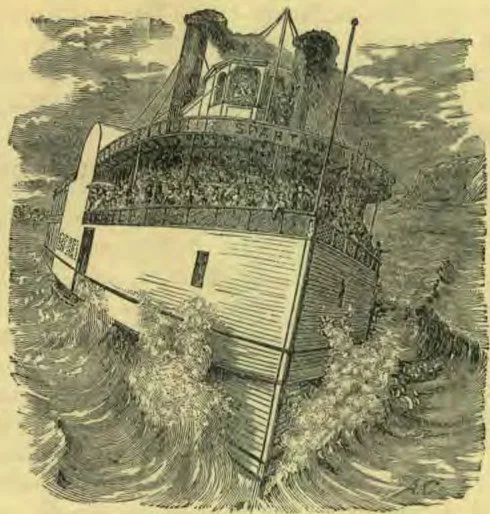
HOW many of my young readers have ever stood on the sea-shore or on a wharf on a bright afternoon, watching the big steamers as they go by? Those who have, will remember what a thrill of pleasure it gave them to see one as it came in or went out from the harbor, moving along with such graceful power that they almost fancied it to be a thing of life.
No doubt many of you have enjoyed the pleasure of a steam-boat excursion on some one of our large lakes, or perhaps on the ocean; and did you ever stop to think, while treading the elegantly furnished cabin deck of a large steamer, who the man was that built the first steam-boat? His name was Robert Fulton; and although he is called a great man now, he had to meet many difficulties and discouragements before his rude craft was finished. Day after day the people would come to the place where the boat was building, and talk in a sneering way about his “wild scheme,” as they called it; and during the whole time that the work was going on, the great inventor received not a single word of encouragement. But his perseverance finally overcame all obstacles, and on the 2nd of Sept., 1807, Fulton invited a few of his friends to take a trip to Albany with him on his new boat.
A great crowd gathered on the shore to see the strange vessel start off, and though it did not move at the first signal, the difficulty was soon removed, and after a little delay, at the second signal, the boat left New York, and made a successful trip up the Hudson river to Albany, where it arrived on the next day. For many years, this first rude steamer, called the Clermont, sailed on the Hudson River.
Great improvements have been made in steam-boats since the first one was built, and if the Clermont could have been kept to our day, it would probably be as great a curiosity now, as it was when first built.
EUGENE LELAND.

GOD KNOWETH.

All that lies beneath the sun, God knoweth. Silent tears and work undone, Evil thoughts that lead to bane, Tender words like summer rain, Hearts that break and give no sign, Love that proves a draught divine, God knoweth.
Ah! the heart he made so weak, God knoweth.
Ah! the hands which vainly seek But to bind one harvest sheaf, Free from weed or withered leaf, All their strivings, all their pain, Steps which fall, yet press again, God knoweth.—Mrs. M. B. Williams.

WORDS TO GIRLS.

How much do you help mother? Do you do all you can to lighten her burdens? When you see her weary, do you offer to help her? I have seen some who did not do this, and I have wanted to tell them how much their mother needed their help. Some mothers don’t want their daughters to work. This is not right. Girls need to learn to work. They should do their own work at least—make their own beds, and sweep, and take care of their own rooms. It is a disgrace for a young woman in health to let this work be done by her mother or any one else.
Girls should help their mothers wash and cook as soon as they are old enough to do these. The girl that grows up and don’t know how to wash, iron, and cook, is not educated, and therefore is unfit to be a housekeeper. Learning to sing, and play the piano and organ is not the best part of an education. These may come in their place, but the pantry, with its well filled shelves, is as pleasant a sight as the music-room, and the sound of dishes as entertaining as the notes of an instrument of music. The music-room could better be removed than the kitchen and pantry.
Then, girls, don’t forget that mother needs your help.—Selected.

BE SLOW TO CALL FOR HELP.

It is right and honorable to ask for help when needed, but not till then. Many young people become too much accustomed to asking help. This is a habit easy to form, but hard to correct. Take heed! God has given you muscle and mind; always test that thoroughly before bothering anybody. Be slow to call for help. Be independent by depending upon yourself. Don’t task the sympathy of friends too much. Cautiousness generally gains more than it loses; but never more so than when applied in this connection. Who wants to help any one who has not done his utmost to help himself? Looking ever to others for aid, your imaginary helplessness will become understood, and sympathy lost; you will be left coolly alone,—abandoned to your own resources. In little things, as in great, do your best first, and only after repeated failures, and in real need, ask aid. Then you will merit help.—The Sunday-School Messenger.

DON'T FORGET.

A DEAR little girl had been taught to pray especially for her father. He had been suddenly taken away. Kneeling at her evening devotion, her voice faltered; and, as her pleading eyes met her mother's, she sobbed,—“Oh, mother, I cannot leave him all out. Let me thank God that I had a dear father once, so I can keep him in my prayers.” Many stricken hearts may learn a sweet lesson from this little child. Let us remember to thank God for mercies past, as well as to ask for blessings for the future.

LITTLE HUGH.

Little Hugh is awake at the breaking of day, And out in the sunny fields beaded with dew; Wherever I wander, I soon hear him say From somewhere behind, “Here is Hugh! Now where are you going? I want to go, too.”
At noon, when no bird can be heard in the tree, And the air is still as if wind never blew, As brisk as a little red squirrel is he; On the doorstep he cries,—“Here is Hugh! Now where shall we go? I am going with you!”
If I hide by the side of a tumble-down wall, Or under a sweet-brier clump, out of view, Or deep in the meadow, his laugh and his call Ring close to my ear, “Here is Hugh! Wherever you go, I am going with you!”
On the warm pasture-ground all around us, there grow Wild grasses, and blossoms so sweet! not a few; He runs hither and thither, with brown cheeks aglow, And a flower in his hand, “Here is Hugh! And oh! here is something so pretty, for you!”
We look into the sky, Hugh and I, and we trace In the clouds every moment a fantasy new, An angel, a lamb, or a soft baby-face,— And he says, “Stay till sunset! for Hugh Likes to look at the clouds and make pictures, with you.”
The still, lonely hillside before me lies green; It holds in its shadow a little lake blue; And a small, sunburnt boy always slips in between, With a dance and a shout, “Here is Hugh! You can’t get away! I am going with you!”
And the wish that I send, little friend, far away, Where you rove here and there in the prairie-lands new, Is that they whom you follow may not lead astray, When you trustingly call, “Here is Hugh! Wherever you go, I am going with you!”
—Lucy Larcom.

LETTER BUDGET.

ALTA GATES writes from Wellman, Iowa. She says: “I like to read the INSTRUCTOR and learn the lessons. We go two miles and a half to Sabbath-school. I wrote a letter once before for the ‘Budget,’ but it was not printed. I have a brother and sister younger than myself. We are all trying to be good children.”
JOSIE DRAKE, of Prescott, Indiana, says: “I am twelve years old, and I have a sister seven. Our mother died when we were little, and we live with grandma. We take your paper, and like to read it very much.”
FREDDIE WOOD says: “I am six years old. I have a little brother three. We keep the Sabbath with our grandma and aunties. Our mamma is dead. We like to go to Sabbath-school, and I like very much to hear the little letters read from the INSTRUCTOR, so I thought I would get my auntie to write one for me. I want you all to pray for us.”
KATIE VANDERWOLK writes from Dallas, Texas: “I am a little Holland girl ten years old. I have been in America ten months. I can speak the English language quite well. I am not a Sabbath-keeper, but I go to Sabbath-school. My teacher’s name is Mrs. Fannie Crawford. I like her very much. I have never missed a lesson yet. My teacher is going to give me an English Bible for a present if I get my lessons perfect all through this quarter. I like to read the INSTRUCTOR very much. I hope to see this letter printed.”

You have reached the end of this edition.

The Youth’s Instructor · Oct 4, 1882