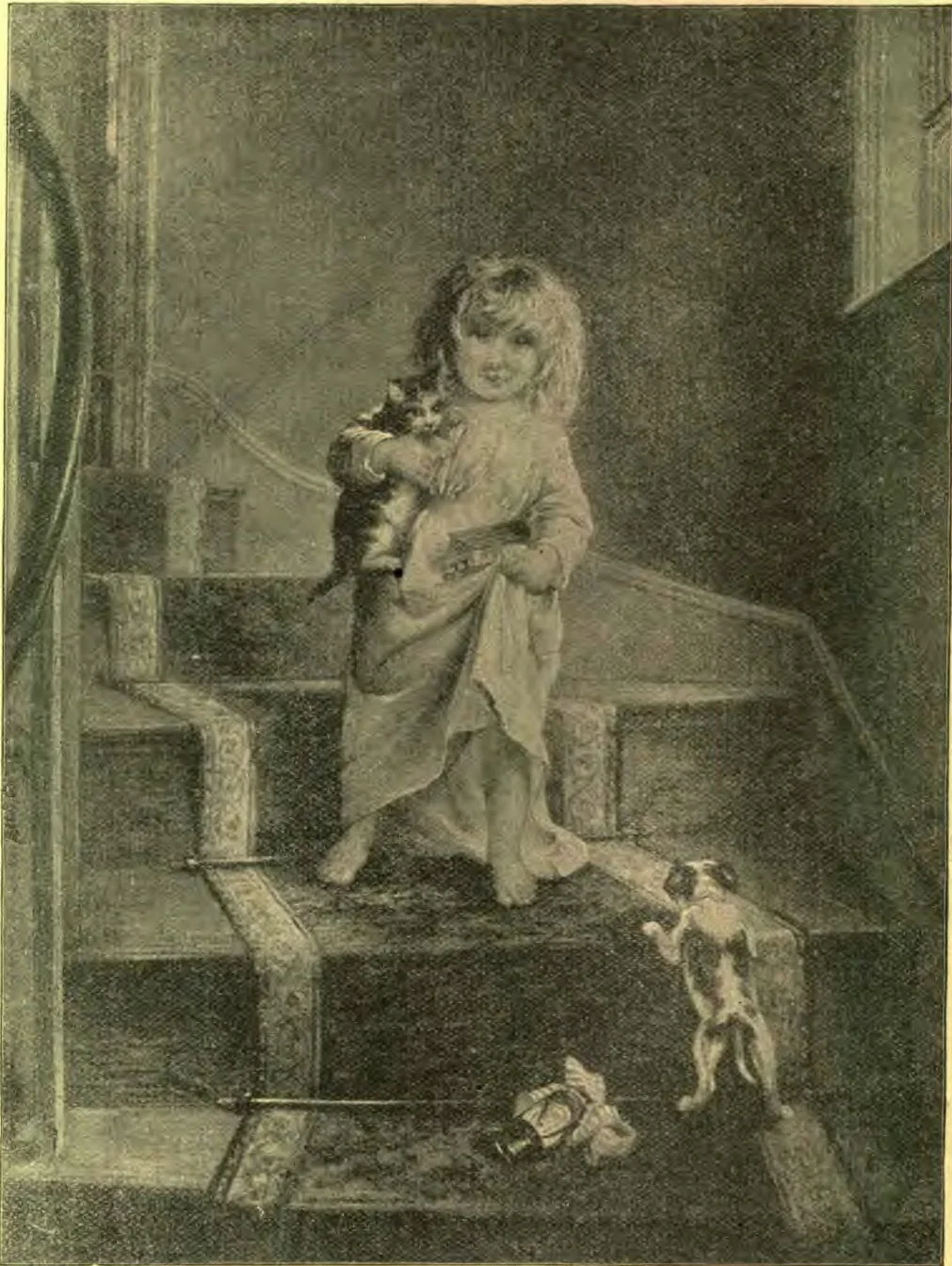
“Won’t you buy one, auntie?” pleaded a little girl, as she reached out toward some small, block-shaped packages, neatly wrapped in thin white paper, and tied with baby-ribbon. “Just o-n-e, auntie!” and the chubby hands soon grasped firmly the “just o-n-e” package of figs.
It was not long before the little block was “poiled,” as baby termed the process of unwrapping it. How good the figs tasted! She would pick one up, and turn it over and over before eating it. By and by she ran to auntie’s side, and holding up a fig, asked her to “tell a story” about it.
“We’ll play the fig is telling its own story,” said auntie, as she put down her work, and lifted the little one to her lap. “Listen to what it says:—
“Eat me up! eat me up! Boston is a cold place, and I’ve been used to hot weather. I was born and raised and steamed and packed where things are warm. My first view of this world was a host of little twigs and branches covered with hard green bulbs, not so large as the tip of your little finger. The sun shone so bright that very soon a snug green roof grew just over my head. I felt proud of my little home, but soon discovered that all my brother figs were just as fortunate as I. The big tree was covered with leaves.
“I had a fine time at the end of a long branch. The little birds swung me to sleep, and the breezes kept me cool. Finally I and all my brothers and sisters grew so large that the branch bent low down, and one day I jumped to the ground.
GOOD MORNING!
There I had to lie in one spot, while bugs and ants and bees came to sip my sweet nectar.
“‘There comes the crew,’ said one of my brothers; ‘they’ll take care of us;’ and sure enough I was soon tumbled into a basket, from which I was poured out into a box about three feet long and two feet wide. When the teamster drove by, he called out, ‘That sweat-box here boys!’ and then hauled us away.
“Next day we were dipped in boiling salt water, spread out on trays, and shoved into an air-tight box filled with sulphur smoke. We suffered so there for three hours that we turned from green to white. I’ve heard some one say that this was to kill the germs, so perhaps we ought not to complain. Anyway, that was only the beginning.
“For days and days we lay baking in the sun,—and remember, that was where the sun really shines, away over on the other side of Uncle Sam’s farm, in California. Looking around one day, we saw some clouds, and presently it began to sprinkle. Then there was a great bustle, and we were crammed into boxes in a twinkling:
“About the next thing I knew we were tossed into a large wagon, and hauled away, boxes and all, to a packing-house in Fresno. I can’t remember how long we stayed stacked up on its wide porch, before they placed my box, with seven others, on a hand-truck, wheeling us away and piling us up inside.
“While stacked up in the packing-house, we could hear a loud rumbling, whizzing, sissing noise, and after awhile we were plunged into a boiler of bubbling water, salty too. When you eat me, and call me sugared, you are mistaken. I’m salted; all the sweetness I have came from my mother tree. Well, I swam down near the bottom, looked through the screen, and saw some pipes with steam-holes in them. Then the screen flew up with a jerk, and out we slid into some small boxes. Almost before I reached the box, a man jerked it up, shouldered it, and ran into a—, well, it wasn’t a bee-hive, no! bees couldn’t make such a humming, buzzing noise. The man carrying us ran down an aisle between two long tables lined with girls and women, some of them busy, but most of them crying out, ‘Fruit here! fruit here!’ And such longing glances followed us as we were hurried on to where the man thought he ought to pour us into another box! The pleasant girl who received us smiled, then began to work in regular machine fashion, picking us up one by one, slitting each of us down the side, and cramming most of us into a little space about an inch deep and three inches long. There were four of these spaces in one block, called a ‘form.’ She jerked me up, slit my side, pulled and pressed me into a flat, round cake, and dropped me into a little box at one side, where the larger figs were saved for ‘layers.’
“When the four little spaces were all filled, she handed them to the waiter, who took them up to a machine called a press, where a wooden block jammed them together so tightly that they stuck together in one solid cake. The waiter then took my lady’s ‘form,’ together with six or seven others, and started down the aisle, handing them back to the packers.
“We large figs were then placed on the top as layers. Being on top, I could see all that was going on. My lady pressed us down with a block dripping with cold water, and just the size of the open space. All the wooden fixtures were wet, so as to keep us from clinging to the form. Then we were shoved out of the form, wrapped in fine white paper, and placed in a158box just large enough to hold ten of us. Each block weighs about a pound, and is called a ‘carton.’
“While all this was going on, I heard a score of voices all shouting at once, ‘Fruit! Fruit! FRUIT! Empty boxes! Paper! Fruit here! Facings! Press, me! Press, here!’ etc. I wondered that the poor waiter didn’t lose his head, but somehow he didn’t.
“When our box was filled, my lady placed us on the floor under the table; still I could hear all that was said.
“The work went on until twilight; then the women went away. Presently the whistle blew, and only the men were left. They soon gathered us up, wheeled us to the next room, and stacked us up; then they cleared off the tables, swept the floor, and made everything tidy.
“The next day found us at the ‘ribbon’ table. There the cartons were emptied out of the boxes, and tied with gaily colored baby-ribbon. When a little maiden picked us up, I heard her say, ‘You’re solid enough;’ then she pulled some ribbon from a huge spool, wrapped it around us, tied a little bow, clipped it from the spool, and put us back into the box. Then we were ready for the nailer, who fastened a cover on the box, and shut the outside Fresno world forever from our view.
“At seven o’clock the whistle blew again, and several men who were willing to work after supper came with hand-trucks, and wheeled us into a freight-car. We all went to sleep, and were only awakened when the Boston fruit dealer uncovered our box, and put us in his bright show-case.
“Think a moment of all our experiences,—that is, if you’re not hungry, and in a hurry to eat me. But if you are hungry, just think of my tempting sweetness, and eat me up without a thought of my wide-spreading birthplace, of the burning sun that ripened me, of the birds and bees that tasted me, of the sulphur-box, the sweat-box, the seething dipper, the fig-room, the perplexed waiter, the press, the labeling machine, the ribbon table, or the box-maker.”
William Yarnell.
MAY STUDY OF THE FIELD
PART IV: “OPENINGS IN ITALY;” “FIVE YEARS IN CHILE;” “ST. THOMAS, W. I.”
(May 20-26)
1. One Need of Italy.—Nominally, Italy is Christian. Of her thirty million inhabitants, fully one third are devoted Catholics. But education has been at a low ebb, and the masses of the people are incredibly illiterate; even among the better classes many are unable to read or write. During the last two decades something has been done to alleviate this, schools being opened for even the girls; and in a small degree the percentage of illiteracy is diminishing. There are seventeen national universities, and many other schools of learning; but among all these students there seem to be none who are earnest Christians,—no young men or young women who are planning to devote their lives to the spread of the gospel. In the recent move among Christian young people to better fit themselves for service in this and other lands, none are found among the young people of Italy. Here is the need—Christian young men and women, who will carry the gospel to young people—educated, but not Christians.
2. One Illustration of the Gospel in Italy.—Signor Cavalier Lingi Capellini, who died less than two years ago in Italy, was one illustration of the power of the word of God upon the heart of a devout Catholic. Born of true Catholic parents, he was educated and trained in the tenets of that church, his parents desiring that he should become a priest. In 1860 he enlisted in the army of King Victor Emmanuel, and fought for the deliverance of his country from foreign despotism and papal tyranny, yet spiritually he was still very much attached to his church. One day in moving about the courtyard of the barracks, he picked up a few fragments of the New Testament, and out of curiosity glanced through them. The page he had in his hand contained the fourteenth chapter of the Gospel of John; and that page was, under the providence of God, the means of his salvation. His spirit was instantly touched, and to the right purpose. He at once began missionary work among his comrades, reading Protestant literature to them and with them. As soon as he could, he left the army, and devoted himself to the work of a missionary to his countrymen. It was he who organized the Military Evangelical Church of Italy. He was a faithful laborer until death; and although some of the seed sown fell by the wayside, some on stony ground, and some among thorns, much fell upon good ground, which yielded fruit that sprang up and increased.
3. Our Present Work in Chile.—The year following the advent of the canvasser in Chile, Elder Baber and his wife were sent to this field. Through the combined efforts of these workers, several native laborers were raised up. There are to-day three organized churches and eight companies, with a membership of at least one hundred and fifty Sabbath-keepers. With Chile as a center, the laborers have reached out into Peru and Bolivia, although the work in these places is only begun.
4. A Picture of Chilean Priesthood.—The variety and manner of dress of the priests of Chile, especially attracts the attention of the visitor to that country. The Dominican priests are divided into two classes, according to dress, one wearing a gown of entire white, while the other class put a black gown over the white. The Jesuits are the most wealthy, and their dress is a rich black gown, reaching from shoulders to feet. The Capuchinos wear a heavy, coffee-colored robe, and show their bare feet through their sandals. Their beard is generally long, and their heads are always shaved smooth, but kept covered with a skull cap below their large straw hats. The Salician priests wear a kind of double bib, the recoletas, to show that in their hearts they have pity for all mankind. They also wear red embroidered hearts on the left side of their cream-colored robes. Not only do they dress elaborately, but they also live upon the fat of the land. And these men represent the lowly Nazarene! Is it to be wondered at that very few of the people have an experimental knowledge of the Saviour’s love?
5. Early History of St. Thomas.—Columbus discovered the little group to which the Danish Islands belong, in 1493, and named them the Virgin Isles. They now are divided about equally between the Danes and the British. When discovered, they were peopled by Caribs, or Arawaks; but the buccaneers of various nations, with their powder and lead, their fire-water, smallpox, and other evils, made short work of these people, and for a time held sway. Then a commercial company, backed up by Danish and German capital, took possession, making St. Thomas the grand depot for West Indian smugglers, and the clearing-house for slaves caught in Africa, and shipped as merchandise to the Western continent. Gradually it became a dependency of the Danish crown, to whom it has belonged for about two centuries. The town and harbor are the island. The greater part of the remainder is totally unfit for cultivation, being rocky and mountainous, as the island is of volcanic origin.
6. Importance of This Island.—“The place which is on the way to every other place,” is the mariner’s terse way of describing St. Thomas. That it is the gateway to the Caribbean is not mere poetic fancy. Vessels from England to any Central American port, from Spain to Cuba or Mexico, from the United States to Brazil, or from the Greater to the Lesser Antilles, go by St. Thomas, and find its port not only the most convenient, but one of the best, of the West Indies. For ship missionary work it is thus an excellent port, opportunity presenting itself for giving the message to representatives of every land.
7. From a Late Letter.—“St. Thomas is a beautiful place. The people are respectful and well-behaved. I believe the Lord has a work for us to do here. We have obtained a permit from the government, and are busily at work. I have also been permitted to have the use of a school for meetings Sundays and Wednesday nights. People listen with great interest. several sick have called for advice and help.159Some have in vain tried many physicians. The Lord is wonderfully blessing our simple remedies. I have taken several orders for books, and have sold some. Thus far the Lord has blessed my efforts in a marked manner. We need reading-matter for free distribution. This is, as you know, an entirely new field. The language used is English. Our hands are full. Still more work is coming on.”
ONE SWEET SMILE
By Emma C. Dowd
ONE sweet smile and two kind words;
Three merry laughs, like the songs of birds;
Four bright faces that once were sad;
Five little hearts made cheery and glad;
Six brave fathers doing their best;
Seven tired mothers strengthened and blessed;
Eight dear children filled full of glee;
Nine happy families pleasant to see;
Ten big blessings in one short while,—
And all springing forth from one sweet smile.
— Emma C. Dowd.
MAKE THE BEST OF YOURSELVES
SHAKE off your listless, shuffling ways, boys, gather up your God-implanted energies, and set about making all there is to be made of yourselves. Now is your spring-time—your budding, growing, improving time; make the most of it, and fill each day to the very brim with sturdy activity and manly action. Throw back your shoulders; straighten up; look with a keen, straight glance out upon the great work-field of the world, and see what it can teach you. The world has little need of you as yet, but you have great need of the world. It is full of experiences, and object-lessons, and hints, and suggestions, for the days coming to you. Use your tongues little, but your eyes constantly. If young people would only use well their keen, quick eyes, and be governed by what they see, they would be spared many a tumble into pitfalls that those in advance are just drawing themselves away from.—Selected.
Glorious It Is to Wear the Crown
By Adelaide A. Procter
GLORIOUS it is to wear the crown
Of a deserved and pure success;
He who knows how to fail has won
A crown whose luster is not less.
— Adelaide A. Procter.
Prayer in the Hour of Sorrow
By Brooks
A SORROW comes upon you. Omit prayer, and you fall out of God’s testing into the devil’s temptation; you get angry, hard of heart, reckless. But meet the dreadful hour with prayer, cast your care on God, claim him as your Father; and the degrading, paralyzing, embittering effects of pain and sorrow pass away, a stream of sanctifying and softening thought pours into the soul, and that which might have wrought your fall but works in you the peaceable fruits of righteousness. You pass from bitterness into the courage of endurance, and from endurance into battle, and from battle into victory, till at last the trial dignifies and blesses your life. The answer to prayer is slow; the force of prayer is cumulative. Not till life is over, is the whole answer given, the whole strength it has brought understood.—Brooks.
1. What circumstances led Jesus to teach the wonderful truths of the Sermon on the Mount? Matt. 5:1, 2; note 1.
2. Upon what class is a blessing first pronounced? What assurance is given them? V. 3; note 2. What precious promise is given to those who mourn? V. 4.
3. Who are to inherit the earth? V. 5. What blessing is in store for those who long for God’s righteousness? V. 6; note. What is said of those who cherish a merciful spirit? V. 7.
4. Who only shall see God? V. 8. Of what class shall it be said that they are “the children of God”? V. 9. Besides the “poor in spirit,” what others are promised the kingdom of heaven? V. 10.
5. In what seemingly forbidding circumstances may the child of God find blessings? V. 11; note 3. Seeing things as blessings, what will one be able to do? Why? V. 12.
6. To what did Jesus liken his people? V. 13. What question did he then ask? What forcible statement did he make in connection with his question? Id.
7. As a blessing to the world, under what further figures are Christ’s disciples spoken of? V. 14. What is the proper use of the lighted lamp? V. 15. In what way does the Christian’s light shine? With what result? V. 16; note 4.
NOTES
1. The Sermon on the Mount may aptly be termed our Lord’s inaugural address. Though he had carried forward his work for several months, he had not yet openly and fully declared the principles of the wonderful kingdom he had come to establish. But now his fame had spread far and wide, and at this time representatives had come from almost every part to see and hear the marvelous Teacher. Expectancy filled every heart; for it was thought that Jesus could be no other than the mighty Messiah, for whom they had been looking, and who, they thought, would break off from Israel’s neck the yoke of Roman tyranny. It was therefore an opportune time to set before the world the truth that his cause and work were not of earth. He sought also to instruct his disciples, whom he was soon to send forth to proclaim the gospel. They, too, had been misled, sharing with the Jewish people the belief that their Master would set up an earthly kingdom. To them his sermon brought great and surprising revelations. But Jesus was speaking for the benefit of all his followers to the close of time. His eye beheld all, and the needs of all. And that the path might be made plain for all, he spoke the words we are now to study. May his Holy Spirit lead his people to see the precious blessings here in store.
2. Each and every blessing pronounced by Jesus is to be realized and enjoyed in this life,—not so fully, of course, as in the hereafter, but at least in part. The “kingdom of heaven”—the kingdom of grace set up in the heart—is entered immediately at the time of conversion (Col. 1:13); the Lord says we should “have a heaven to go to heaven in.” God’s kingdom is to be known in two ways: first, as a kingdom of grace; and, second, as a kingdom of glory. But it is the same kingdom always. In this world the glory is given in the form of grace; by and by the grace will be given in the form of glory. Of the mourners it is said, “They shall be comforted.” The comfort is administered now, for it is needed now. See 2 Cor. 1:3, 4; Ps. 86:17. In the better world this blessing will be realized in its fullness. Isa. 60:20. The meek “shall inherit the earth.” Even a foretaste of the blessing of inheritance is known by those who here have no continuing city. Eph. 1:13, 14. They “that hunger and thirst after righteousness” are now to be filled with all God’s fullness. Eph. 3:19. The merciful “shall obtain mercy.” This is a law that also operates here below (Luke 6:38), and the Lord will certainly observe it in bestowing the final reward. The “pure in heart” are to “see God,” not only face to face in the world to come, but in his word, in his works, and in his providential dealings with them here on earth. The “peacemakers” are to be called “sons of God.” R. V. God calls them sons now. 1 John 3:1, 2. And of those who are reviled and persecuted for Jesus’ sake, it is said that they are “blessed” “when” men mistreat them. In the very time of affliction and ill-treatment they are blessed—happy. This was Paul’s experience all the way along (Rom. 5:3); and “God is no respecter of persons.”
3. Only one thing can enable the child of God to be happy in time of tribulation, and that is to recognize and receive a blessing in whatever experience life brings. Nothing comes by chance to the soul that trusts the Lord. “All things are for your sakes,” if you are Christ’s. 1 Cor. 3:21–23; 2 Cor. 4:15. “The trials to which Christians are subjected in sorrow, adversity, and reproach, are the means appointed of God to separate the chaff from the wheat. . . . Afflictions, crosses, temptations, adversity, and our varied trials, are God’s workmen to refine us, sanctify us, and fit us for the heavenly garner.”
4. Works, not words, are what convince the world that the gospel of Christ is the power of God unto salvation. The gospel of Christ is better seen than heard, better felt than listened to. The life that is barren of good works is barren of the gospel. The life that bears no fruit will never reap a harvest. The greatest sin in God’s church to-day is that of omission. They say, but do not. May God put upon his people the spirit of work!
$1,000 PICTURE FOR 20c.
We have produced at an enormous expense a beautiful color-type of forty-six wild, fur-bearing animals in their natural color. The reproduction is just the thing for a boy to have in his room, and is the best guide to knowledge of wild, fur-bearing animals. The price we ask for this beautiful picture only helps to cover the cost of printing and postage. Send twenty cents in stamps, to-day, and you will receive the same, postpaid.
Northwestern Hide and Fur Co.,
411 Main St., Minneapolis, Minn.
To Reach BATTLE CREEK
FROM
CHICAGO, BUFFALO, DETROIT, OR TOLEDO,
Purchase Tickets Reading over the MICHIGAN CENTRAL “The Niagara Falls Route.”
A First-class Line for First-class Travel between Chicago and New York and Boston. Elegantly equipped through trains pass Battle Creek in each direction daily.
R. N. R. WHEELER, O. W. RUGGLES, Ticket Agent, Battle Creek. Gen'l P. and T. Agt., Chicago, Ill.
TAKE THE Canadian Pacific Railway
for . . . CHATHAM, LONDON, WOODSTOCK, PORTLAND, OTTAWA, GALT, TORONTO, and MONTREAL, QUEBEC, BOSTON,
All points in New England, the Maritime Provinces, Great Britain, and the Continent.
Illustrated literature, time-tables, and full particulars, upon application to—
J. FRANCIS LEE, GEN. AGENT,
Passenger Dept. 228 SOUTH CLARK ST., CHICAGO
Branch Offices: 76 Ottawa St., Grand Rapids, Mich. Room D, Chamber of Commerce, Cincinnati, Ohio. 315 Chestnut St., St. Louis, Mo.
Cincinnati Northern Railroad Co.
TIME TABLE NO. 3.
IN EFFECT SEPT. 24, 1899.
Trains Pass Battle Creek, as follows:
WEST-BOUND.
No. 21, Mail and Express ................. 6.58 P. M.
No. 23, Accommodation .................... 2.07 P. M.
No. 27, Local Freight .................... 8.25 A. M.
EAST-BOUND.
No. 22, Mail and Express ................. 8.25 A. M.
No. 24, Accommodation .................... 1.45 P. M.
No. 28, Local Freight .................... 5.30 P. M.
Direct connections are made at Toledo with all roads diverging. Close connections for Detroit and Cincinnati.
J. L. READE, Ticket Agt., Battle Creek.
E. R. SMITH, City Pass. Agt., 6 West Main St.
E. W. Meddaugh and Henry B. Joy, Receivers,
Chicago & Grand Trunk R’y.
By A. S. Parker
Trains arrive and leave Battle Creek.
WEST-BOUND FROM BATTLE CREEK.
No. 9, Mail and Express, to Chicago … 12.15 P. M.
No. 1, Chicago Express, to Chicago … 9.00 A. M.
No. 2, Lehigh Valley Express, to Chicago … 3.40 P. M.
No. 3, Pacific Express, to Chicago, with sleeper … 1.10 A. M.
No. 5, Mixed, to South Bend … 8.20 A. M.
Nos. 9 and 75, daily, except Sunday.
Nos. 1, 3, and 5, daily.
EAST-BOUND FROM BATTLE CREEK.
No. 8, Mail and Express, to Pt. Huron, East and Detroit … 3.45 P. M.
No. 4, Lehigh Express, to Port Huron, and East … 8.27 P. M.
No. 6, Atlantic Express, to Port Huron, East, and Detroit … 2.25 A. M.
No. 2, Leh. Exp., to Saginaw, Bay City, Pt. Huron, and East … 6.50 A. M.
No. 74, Mixed, to Durand (starts at Nichols) … 7.15 A. M.
Nos. 8 and 74, daily, except Sunday.
Nos. 4, 6, and 2, daily.
A. S. PARKER, Ticket Agent,
Battle Creek.
Patience Amid the Raspings of Circumstance
By Eli Fay
He who can not preserve the equanimity of his soul in patience despite the raspings of circumstance, can expect but little comfort in a world like ours, keyed though it is to grand possibilities.—Eli Fay.
Japan's Crown Prince Builds Earthquake-Resistant Palace
The crown prince of Japan is building for himself a new palace. There is nothing remarkable in that; for kings and princes have always delighted to build new homes for themselves, or remodel old ones, very much as their subjects enjoy doing the same. The remarkable thing about this palace is that, it is intended to make it so solid and firm that the frequent earthquakes of the much-shaken little empire will have no effect upon it. Long, wide, and comparatively low, its steel skeleton will be securely anchored in a bed of solid concrete by four hundred columns; and around this framework will be built up the walls of granite and marble. Nothing will be left undone that will in any way contribute to the resisting power of the palace are against earthquakes: but after all, how puny is man’s effort when pitted against the forces of nature—the forces of God! And how soon—how very soon—will come the “great earthquake,” before whose awful power the mightiest works of man will go down! How many—say rather how few!—of the men and women of the Flowery Land have ever even heard of the coming of that event, which means so very much to each one of them? Have we no responsibility in this matter?
Rendering to God What Is God's
The world makes certain demands on the time and strength, the ability and means, of every person living in it; and most of us are only too willing to render to Cæsar what is his. Our best gifts, the greater portion of our time, the majority of our possessions, are freely given to the world. But standing by the side of the command to give to Cæsar the things that are Cæsar’s, and equal with it, is the sacred obligation to render to the Lord his own. That is where we fail. We are his, for he has bought us; and from every one of us he has the right to expect cheerful, loving service. But to many his messages and invitations for help for his children fall on deaf ears; his tender pleas for his suffering cause are unheeded; his claims are unacknowledged. The first and best — often the whole — are given to the world; and when the demands of Heaven are brought to the attention, the heart turns away. Should we treat the world better than we treat God? would we dare treat it as we often treat him?
FOR EVERY DAY OF THE WEEK
Sunday:
“Use what talents you possess. The work of the world is done mostly by ordinary ability, while geniuses are waiting for splendid opportunities.”
Monday:
Only a little word,
Only a word of cheer,
Only a loving look,
Only a kindly tear;
Yet oh, how precious to the heart
Are these sweet gifts untouched by art!
— Selected.
Tuesday:
Not to-morrow, but to-day, calls for the best that is in us. Life is made up of daily performances. The nobler, sweeter, and purer our activities, the better for ourselves and for others.—Selected.
Wednesday:
“Everlasting arms of love
Are beneath, around, above;
God it is who bears us on,
His the arm we lean upon.
He, our ever-present guide,
Faithful is, whate'er betide;
Gladly, then, we journey on,
With his arm to lean upon.”
Thursday:
The life of man upon this fair earth is made up for the most part of little pains and little pleasures. The great wonder-flowers bloom but once in a lifetime.—Longfellow.
Friday:
“Take time to think!
Thought oft will save thee from the snare,
Bring thee to cooling streams and bowers
Spare thee from nursing needless care,
Surround thee with defensive towers,
Yield thee the harvest of content,
Lift thee from dust to starry ways,
Discover comfort, Heaven-sent,
In thy most dark and cheerless days:
Therefore, take time to think.”
Sabbath:
“We are his workmanship, created in Christ Jesus unto good works, which God hath before ordained that we should walk in them.” Eph. 2:10.
SABBATH-SCHOOL OFFICERS, ATTENTION!
By Editor
This week sample copies of the INSTRUCTOR will be mailed to all Sabbath-school officers whose names we have, who do not receive the paper regularly. This is done in order that such may have an opportunity to examine the INSTRUCTOR, and recommend its use in their school. “What shall our young people read?” is a question that many anxious parents, teachers, and other workers are asking. The YOUTH’S INSTRUCTOR will help answer this question. No Seventh-day Adventist home where young people are growing up should be without it. You, dear Sabbath-school workers, can do much toward helping us in our effort to reach every young person in the denomination. May we not have your co-operation?
LEARNING THE BOOKS OF THE BIBLE
There are sixty-six books in the Bible,—thirty-nine in the Old Testament, and twenty-seven in the New. They are classified thus: Pentateuch, five books; Historical, twelve books; Poetical, five books; Major Prophets, five books; Minor Prophets, twelve books. Those are the Old Testament. The New Testament may be arranged as follows: Gospels, four books; Historical, one book; Pauline Epistles, fourteen books; General Epistles, seven books; Prophetical, one book. By learning one group at a time, it will not be long before the whole list will be memorized; and the knowledge thus gained will often be of service to the young Bible student.
Subscription Remittance from Monitor, Oregon
HENRY E. MORTENSEN, Monitor, Ore., writes: “Enclosed you will find post-office money-order for seventy-five cents, to apply on one year's subscription to your valuable paper. I like the INSTRUCTOR very much; and as long as I can manage to get it, I shall certainly not be without it.”
BOOKS AND WRITERS
THE LESSONS ON NATURE STUDY
Written by Prof. M. E. Cady for use in our church schools have been completed, and may be had in two styles of binding,—the perforated binder, secured by means of cords, and the regular cloth binding. The price of the first is $1, and the price of the second is $1.50. Any one desiring copies of these lessons may place the order with Mr. Frank Richards, Medical College, Battle Creek, Mich.
A NEW SONG-BOOK
With the attractive title, “Heavenly Sunlight,” has come to our table. It contains many new songs by some of the most prominent hymn-writers in the world, besides a large number of old and tried favorites. Printed in large, clear type, on excellent quality of paper. Ninety-six pages, strongly bound in flexible cloth covers. Price only twelve cents each, postpaid. Mc Calla & Co., 237-239 Dock St., Philadelphia.
Labor and the Money Power
“LABOR AND THE MONEY POWER,” by Geo. W. Rine, B. L., is the title of No. 160 of the Bible Student’s Library. The increase and concentration of wealth are shown to be a direct fulfillment of the prophetic word, and one of the signs of the days “when the coming of the Lord draweth nigh.” An excellent tract to place in the hands of thoughtful-minded persons everywhere. Published by the Pacific Press Publishing Company, Oakland, Cal. Price, two cents. Order of your tract societies.