The Youth’s Instructor, Vol. 38, No. 19.

SHUT THE DOOR

The Youth’s Instructor

May 7, 1890

S. D. A. Publishing Association · Battle Creek, Mich. · May 7, 1890

“SHUT THE DOOR.”

He had left the door in his haste wide open, As he hurried out to play, And I heard his mother, gently chiding, To the thoughtless fellow say, As she’d done full many a time before, “Be careful, my son, and shut the door!”
And I thought there are lessons more deep and lasting Than the lad or his mother see, In those words of reproof so often spoken, And forgotten so frequently; Than the common meaning there’s something more In that simple sentence, “Shut the door!”
When evil seeketh your heart to enter, How grave or how slight the sin, Remember no wrong can gain an entrance Unless you shall let it in; Bethink you then of this homely lore, And to every temptation “shut the door!”
When angry words to your lips are leaping, Or those impure or profane, Let this warning come like a voice from heaven, Your hasty speech to restrain,— ’Twas the prayer of the psalmist, o’er and o’er, That his lips be guarded,—“Shut the door!”
When one in your presence speaks of another In language false or unkind, Show plainly his story affords no pleasure; Bring the Golden Rule to your mind; Just turn from the tale in your ears he’d pour, To every traducer, “shut the door.”
To scenes of vice (save to aid the erring), To everything base and low, Close the portals of vision. God gave us eyelids; Their moral use we should know. Youth’s purity lost no art can restore; Through sight sin may enter. “Shut the door!”
Life’s doors at times it is wise to throw open, And to leave them wide open in sooth, To every influence high and holy, To wisdom and virtue and truth. But other than this let me still implore, Heed well the injunction, “Shut the door!”
—The Congregationalist.

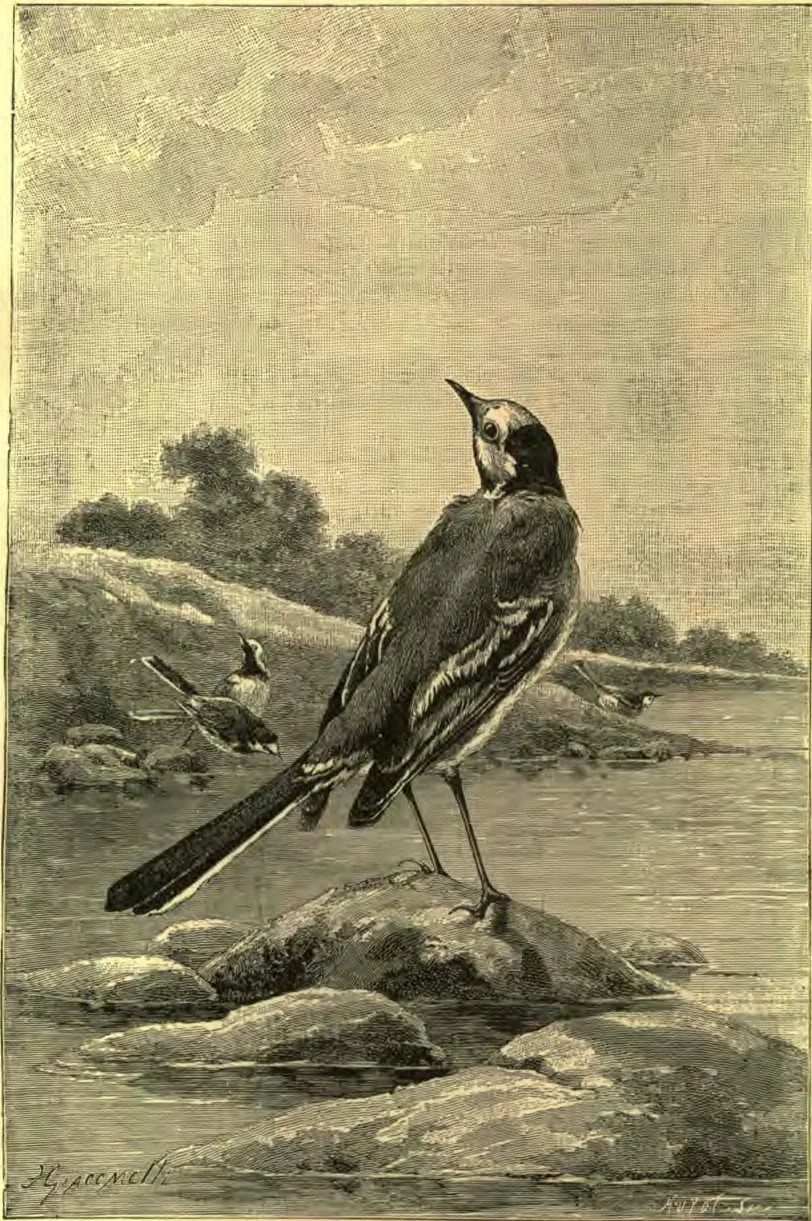
THE WAGTAIL.

THE pert little songster shown in the accompanying engraving is the wagtail, an inhabitant of portions of Europe and the British Isles. It is related to the larks, which it somewhat resembles, and is a common sight in the fields and along the river courses of the Old World. In describing this bird, a French naturalist, Andre Theuriet, remarks:—
“The plumage of the wagtail is yellow, with an olive brown tint. It dwells in prairies where cattle come to graze, or it flutters about in the fields, following the laborers. It has a fine bill, thin, long feet, and a long tail which it is incessantly wagging. It is a great devourer of flies and gnats, having a weakness for large blue-bottle flies.
“The wagtail is sedentary in its tastes, and does not leave us even in the bad season. In winter it gets nearer to the villages, seeks shelter near the banks of ponds which freeze only rarely, and there, in spite of cold, it sings a low, soft, discreet strain. As soon as the month of March brings back the season of field labor and sowing, you can see the wagtail following the laborer who is pushing his plough, or perching on mounds of fresh soil, where it is sure to find an ample provision of worms.
“In April it begins to build its nest in the fields or sometimes in the roots of some tree on the banks of a rivulet. The nest, placed on the ground, consists of dried grasses and small roots, lined on the inside with feathers and hair. The female lays six or seven eggs; they are of a whitish hue with yellowish spots. When the young ones are fledged, towards mowing-time, the father and mother take them to some new-mown fields where cattle are taken to pasture.
“Then begins an idyllic life for the wagtail. The big, russet-colored oxen are lying about on the short grass of the pasture-commons; around them swarms of flies are buzzing, and to the right and left, bands of long-tailed birds dart on the insects, without being in the least frightened by the neighborhood of the weighty ruminants. Some of the wagtails are daring enough to perch on the black horns of the cows. Others follow the sheep dispersed about the commons, following the lead of the shepherd, who walks ahead, wrapped in his cloak.
“In the eighteenth century, when naturalists yet lent to the animals they were studying the sentimental ideas that were then the fashion, they pretended that wagtails were so fond of the shepherd as to warn him when a wolf or a sparrow-hawk was drawing near. This story is as ingenious and pretty as it is unlikely. Wagtails care little about the wolf, of whom they have nothing to fear; as to the hawk, they are very much agitated when they see it soaring above the pasture commons; it is therefore only interest for their own preservation and not friendship for the shepherd, who does not fear the bird, which causes their warning; for a hawk will attack birds but never flocks of sheep.
“All day long the wagtail will follow the herds in their evolution. Now evening draws near: the shadows of the elms lengthen on the plains; light mists arise in the background; the moon shows her crescent above the dusky woods; the shepherd is blowing his horn to call his scattered sheep; pushed by the dogs, the flocks rush forward, on the dusty road, bleating noisily; the bellowing cows turn their heads towards their stables, and in the rear, hopping over tufts of grass, wagging their tail and uttering low, shrill cries, the wagtails accompany the herd to the extremity of the fields.”

DOMESTIC LIFE IN GREENLAND.

ARE we thankful as we should be for the return of the spring-time, the bright, warm sunshine, the song of the birds, the blooming of the flowers, the growth of grass and grains and fruits for man and beast? How would it be if we had dull, gloomy weather, with cold rains and biting frosts all the year round? How would we like to live in a land where there is nothing but snow and ice month after month, and where people have nothing to live on but the flesh of polar animals and the fat or blubber of the seal or whale?
The papers tell of a lady from Greenland, Miss Olof Krarer, who has been lecturing in our country about her native land. She is only forty inches in hight, and when asked whether she represented the average size of her people, she replied, “Few women are taller. A man four inches taller would be thought a tall man.” At the close of her lectures she appears again, in her “native costume,” as she calls it, a dress made of polar bear skin, which she wore in her own home.
She tells much about her own people which ought to make our hearts ache for them, and make us thankful for the homes and privileges God has given us in this good land. Existence in Greenland, Miss Krarer declares, is not life, or if it is, it is frozen life. The condition of human beings in that congealed continent is a perpetually benumbed one, both of body and mind. The ever-present sensation is that of extreme chill.
It is so cold, she says, that even “love” is frozen. When asked if mothers love their babies, she replied, “I do not think they do—they are too cold—they cannot care much for anything.”
Calling attention to her arms, which are quite bowed, she said this bent form is universal, and is owing to the constant folding over the breast, which mothers compel their children to practice, in order that a little more heat may be retained.
Greenland mothers have a custom, which, however hard it would seem to our children, who are so often petted and humored, shows no little good sense. A crying baby in Greenland is never noticed! When the wail of the icy mite of humanity ceases, a charming morsel of the loveliest blubber is presented—a premium thus being offered, contrary to what prevails in many nurseries—to good instead of ill nature. Very early lessons in self-control are thus impressively taught, the habit of not fancying itself the center of the domestic, not to say social circle being lastingly acquired.
The temperature of the snow huts in which they live is always freezing, as one can easily see must be the case. Otherwise, the skins placed on the walls when wet, and frozen fast, would not remain frozen to the walls.
Greenlanders do not drink. There is nothing to drink.
No food is cooked, not even for infants, who from the age of one month are fed upon blubber. In a land where water is never fluid, and an occasional fire of whalebone and fat is all that the resources of the country provide, and the nature of their dwellings permit, there is no natural food supply for the infants, and even if this were not the case, nothing short of a diet of pure fat can create heat enough to maintain life.
Many have supposed that somehow the natives had become accustomed to it, and probably rather enjoyed it. But no one can ever think this again, who has seen the look and heard the tone with which this little lecturer says, “Oh, it is so cold, so cold in my country! No one is ever anything but cold there.”
With eyes heavy with unshed tears, she said, “Human beings ought not to live where my poor people live. There no progress is possible to them. Since I have seen the world, I have thought and thought so much about what can be done for them. They are not responsible. They do as well as they can, as well as any one could do. Some day, some day, God will help them.”—Youth’s Evangelist.

MRS. BLAKE'S TOP SHELF.

“Did you put on your rubbers, Dolly?” called her mother, as the child was opening the door.
“Yes, mamma.”
“And looked on the top shelf?”
“Oh, no, mamma, but I will.”
A rush to the sitting-room closet and back, then the cheery voice again: “I’ve got ‘Ben Hur’ and the jelly tumbler;” and the little maid was off for the tennis ground.
“Now, Mary Blake,” said I, as we settled ourselves to the mending-basket, “will you please read me this top-shelf riddle? Ever since I came, I’ve been puzzling over it. Yesterday morning when Dolly started for school, you asked her the same question, and she answered something about a fringed napkin and a gossamer. And last night before Ted went up the street, I heard him tell you that he’d looked on the top shelf, but there wasn’t anything in his line there; what sort of things is it you keep on that shelf, any way?”
“I don’t wonder you ask,” laughed my friend. “You see, it’s a contrivance of mine for getting borrowed articles returned. You know how they accumulate in a house,—newspapers and books and dishes and umbrellas and what not. I used to get disgracefully behindhand with them, going out so little myself. Every now and then, in desperation, I’d devote an afternoon just to returning things—start out with a whole basketful on my arm, may be. But that didn’t work very well, our friends live in so many different directions, so finally I hit on this plan. It’s a new broom yet, but I think it’s going to sweep clean right along. Just as soon as we’re through with the article—whatever it is—I put it on the top shelf. I keep a tiny pad there, with a pencil tied to it, and it doesn’t take a minute to write down the name of the owner, tear off the bit, and lay it with the article. Then I’m teaching the children to look on the shelf as they’re going out, and if they see anything that belongs anywhere on their road, to take it with them. To-day, for instance, the paper inside the jelly tumbler said, ‘Mrs. Turner,’ and the one in the book, ‘Nellie Jay,’ and Dolly could call at both those places on her way to the tennis just as well as not.”
“But doesn’t she mind the trouble of stopping?” I inquired.
“Not nearly so much as she would being sent on purpose. Of course I don’t expect her to look at the shelf every time she sets foot out-of-doors—only when she’s going far enough to make it worth while. Then sometimes for days together she won’t find anything ‘on her beat,’ as Ted says. There’s been more than usual lately, so many things turned up at housecleaning, I blush to say.”
“But will she be sure to give the message just as you’d like to have her?” I persisted.
“No, perhaps not. I often think of that. Some things I keep till I can carry them back myself, on that very account. Still, the children do pretty well, for children. And promptness counts for a good deal, you know. If I make up in that what I lack in ceremony, I don’t believe my friends will complain.”
“I should think not,” I said. “Dear me, I wish some of mine would start a ‘top shelf.’”—The Congregationalist.

ROUND THE WORLD.—II.

IN THE EASTERN PROVINCES.

Grahamstown is inland about one hundred and six miles from Port Elizabeth, and, next to the beautiful environs of the western metropolis, it is without question the most pleasant place of residence in the colony. Embosomed in green hills,—the spurs of the Zurenburg range,—the city, with its broad streets lined with trees, and its houses interspersed with gardens, presents a decidedly English appearance. It is also the sanitarium of the Eastern Province, and has lately been connected by rail with a favorite watering-place, known as the Kowie some twenty-five miles distant on the Indian Ocean.
At the upper end of the main street stand some quaint-looking buildings, now a public school, but where, in years gone by, the Colonial Parliament held its sittings.
It is midsummer now, and all nature is clothed in garments of luxuriant verdure. The trees are filled with the “Christmas beetle,” a curious little insect, of much the same color as the leaves. They make a shrill whistling noise, and are only heard just prior to, and immediately after, the festive season from which they derive their name.
In the middle of High Street stands Saint George’s Cathedral, where, in front of the communion table, is a monument erected to the memory of Col. Graham, from whom the place takes its name. There are large military barracks and an old fort, but these have long since been abandoned by the troops. The surrounding district is dotted all over with battlefields, and once, in 1819, the town was attacked by three Kaffir chiefs,—T’Shambie, Congo, and Lynx,—but, after some severe fighting, they were repulsed with heavy losses.
In some of the neighboring vicinities, the land is mostly owned by English farmers, but in others it is largely settled by the Fingo and Basuto tribes. They are controlled by the British, but still support chiefs of their own. The municipality of Grahamstown does not permit the natives to live within the limits of the town, except those that are employed as household servants or in stores; all the others live outside. They have, as it were, a little suburb to themselves, where the kraal is by far the most conspicuous pattern of dwelling-house.
It is impossible to enter Grahamstown without crossing a hill, as it is surrounded on all sides. On the tops of these, as they form an almost unbroken chain, is a pretty drive, from which, in clear weather, the Indian Ocean can be seen.
The period is comparatively short since the inhabitants of this part of the country lived in fear and trembling on account of the surrounding tribes of natives; and some who are well acquainted with the political status of affairs at present say that hatred of the white man is still smoldering in the breast of the African, and that it would take but a slight breeze to fan the embers into flame. There have been among the natives some political movements of a most singular nature, and dangerous to the welfare of European settlers. In 1854 a Kaffir prophet, named Umhlagaza, arose among the Galekas, under the patronage of the chief Kreli; and, professing to have held converse with the departed Kaffir chiefs, he conveyed a message from them to all the Kaffers to destroy their cattle and corn, and refrain from cultivating the ground, assuring them that when these orders were carried out, a new state of things would follow,—namely, that the past heroes and all the dead of the Kaffers were to arise, all cattle would also be restored to life, and the white man and other of their enemies would be swept from the earth. It is inconceivable, the extent to which these predictions were believed and acted upon. Thousands and thousands of fine cattle were slaughtered. In the Gcaleka country, Kreli gave word that the spirit of their ancestors must be obeyed, and such quantities of corn and cattle were destroyed that hunger began to make havoc among the ranks of his followers. This was a critical time for the peace of the frontier, as the whole thing was really a delusion to incite the people, after they had destroyed their means of sustenance, to make an onslaught on the colonists; but there was not that harmony of action among them to insure success. As soon as the crisis was over, all who survived the delusion were fed and cared for by the government, and the colonists benevolently came forward and co-operated with the authorities in relieving the sick and suffering, and saving the remnant of the nation, so far as possible, from the consequences of its mad act of self-destruction. F. T. M.

KEEP YOUR TEMPER.

The cool man is the strong man, the popular man, and the great man. We always associate coolness with bravery, and we cannot imagine a truly courageous man in a high state of excitement, roaring out what he is going to do. There may be persons who are boasters and fighters at the same time, but the combination is certainly rare.
Perhaps you remember reading about the French soldier who jocularly spoke of the shower of sand cast by a cannon ball on the dispatch he had written, as his “blotting paper.” If you did, you must have admired his coolness as much as did Napoleon, who stood by.
It is not alone in war that good temper is requisite. The cool, self-balanced man is always the successful man in business. To act on impulse is to act wrongly nine times out of ten. It rarely takes more than a few minutes to inquire into details, and look at all sides of a question before coming to a decision, and, as a rule, it saves hours and perhaps days of after vexation.
The man who loses his temper is not always in the wrong, but, to the on-looker, he always appears to be wrong.
When two persons engage in an argument or debate, the one who keeps his temper will invariably get the best of it.
Why do the utterances of a judge have so much weight with a jury?—Because he keeps his temper. The lawyers may be ever so vehement, pathetic, or angry, but the judge must be calm and cool, or he is not fit to be a judge.
Boys and girls are men and women in miniature, and youth is the time to form the habits of after life.
“Think twice before you speak once” is an excellent rule for your guidance. To keep your temper, you cannot afford to speak hastily.
If for no other reason, you should keep your temper on the score of good health. Choleric people are rarely long-lived. People have been known to die in a fit of anger, while none ever heard of a death caused by being too placid.
Nothing will preserve good looks to old age, like a good temper. The irritable, quarrelsome person is always wrinkled and distorted in visage as well as mind, and the only way to avoid these terrors of old age is to keep your temper.—Golden Days.

What to Do in Temptation.

FRED was a little fellow, who had been told not to go through a hole in the hedge into a neighbor’s garden. He minded pretty well usually, often “peeping through,” it is true, but keeping the letter of the law faithfully, till one day when he heard, his mother’s voice speaking on that forbidden side, and his sharp eyes caught a glimpse of her blue dress as she stood talking with her neighbor. Then began a tug and tussle with temptation. Oh, he wanted to, so! But mamma said not! Oh, but he couldn’t help it! Mamma said not!
All at once mamma heard a little shaky voice calling, a little frightened voice, with the note of entreaty that always claims attention:—
“Mamma, tum here! Tum see to Freddy! I feel jest like I is going froo!”
And sure enough he was half way through, and she came just in time to save him from entire disobedience. In the very stress and strain of temptation he had called out for help against himself, and found it.
Dear young folks, try little Fred’s plan. Keep away from the “hole in the hedge,” if you can, but if ever you feel as if “you were going through,” call out to the One who is “never out of hearing.” When you are angry, when you are envious,—no matter what the hole in the hedge is,—not only count twenty-five like Saltycoram, but look up and say, “Lord, help me! my feet are well-nigh slipped!”
“He never yet forsook at need The soul that trusted him indeed.” —Selected.

Life's Worthy Prizes Require Patient Toil

THE prizes of life that are really worth having are seldom obtained by a mere stroke of luck. Usually they have to be toiled for strenuously and waited for patiently.

A LOST STITCH.

GRANDMA sat busily knitting away A trim little stocking, all scarlet and gray; Katie stood leaning on grandma's knee, Anxiously waiting and watching to see How quickly the pretty stripes could grow, With grandma's fingers a-flying so. All at once, in a round of gray, The busy needles ceased their play. “Dear me!” said grandma, “I can't tell which, But somewhere here I have dropped a stitch; And I cannot see, it has grown so late, To pick it up; so we must wait Till the lamps come in.” Down Katie went, Moved by a sudden, kind intent; Down in the firelight on the floor, Searching the hearth-rug o'er and o'er. “What are you looking for, my child?” Mamma questioned and slyly smiled. Soberly answered the little witch,— “I am trying to find my grandma's stitch!” —Companion.

HANS PETERSON'S GIFT.

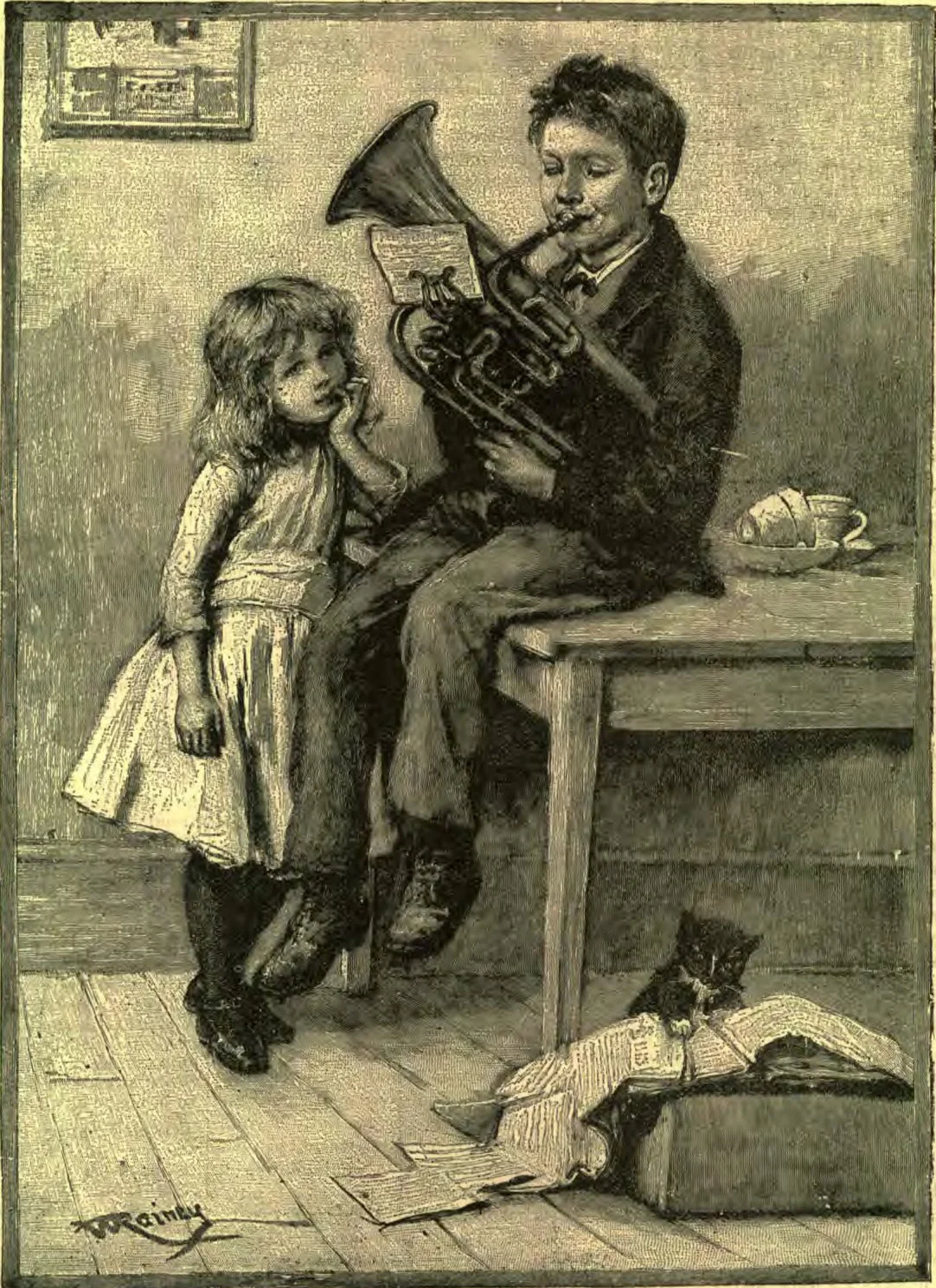
Hans Peterson was born with a love for music. His grandfather had been a musician, and had made him a present of a beautiful cornet and a music book. These were Hans's only treasures. His father had laughed when Hans came home from the farm with a great brass instrument, and said he wished grandfather had given him a saw and an ax instead; for he could see little sense in a boy's having a cornet. Hans's mother was dead, and he and his little sister lived with their aunt. Hans's aunt was not a cross woman, but she also thought that a cornet was of little value to a boy. Besides, it nearly drove her wild to hear the horrible sounds that Hans made in learning to play. In fact, the whole neighborhood around was disgusted with the cornet.
Hans used to take it out to the barn, and while other boys were playing marbles, or teasing the cats and dogs, or spending their time in running after circuses, Hans was “hardening his lip” on the brass mouth of his instrument, puffing and blowing till his face was as red as his rich young blood could make it.
But at last he mastered the scale, and then simple melodies, and then more difficult pieces. But all the time Hans was looked upon by his father and his aunt as a person to be reproved. They scolded him for loving music, and told him he would never amount to anything in the world. This made Hans feel very sad. Sometimes he would go to the barn, and lie down on the straw and cry, and sometimes his little sister, who loved music too, would come to him, and tell him not to feel bad, and then the cry would end up with a “play” on his cornet.
“It's in me,” said Hans to himself, “and it's got to come out. Didn't grandfather tell me about Remenyi when he was a little boy?” “What's that you are saying?” asked Rita. “I was saying that grandpa told me about a great musician, who, when he was a little boy, used to get up in the night to play, because his father didn't like to hear him play. One night the father even beat him with his violin, but you see after awhile he became a great musician. Say, Rita, I believe God put the love of music into me. And how can it be so bad when heaven is going to be full of fine music? “Don't you remember that picture in ‘Pilgrim's Progress’ where the heavenly hosts had trumpets, playing on them? And the Bible speaks of having harps, and of the music that will sound like the rolling of the ocean. Grandpa told me to stick to it; for if God meant me to be a player on an instrument, he would give me perseverance and patience.”
Hans did pray to God to help him to do right, and tried to be faithful in doing up his chores and in his school work, but as soon as he was free, he always went to the barn to play. Hans did not care to romp much with the boys, and did not learn their slang words or rough ways. As he played on his cornet, now making the tones rich and full, and then softening them to a sweet lullaby, he learned the meaning of some of the best thoughts of those who had written the music, and these good thoughts of gentle things made him gentler and finer. Sometimes it seemed to him as if his very heart-thoughts went into the tone of his instrument, and his prayers and longings quivered in the notes.
Though the neighbors had at first found much fault with Hans, they after awhile began to feel pleasant towards him; for he was always modest, kind, and thoughtful. Little children loved him, and the old people knew who it was that helped them over the slippery walks, or carried their heavy baskets from the market.
Hans had two home friends that he prized very much. One was his little sister and the other was the pet kitten. Little Rita was very fond of her brother, and often stood and listened to his playing. One day when the children were home alone together, he brought his cornet over to the kitchen, and played for her all the afternoon.
Kittie was fond of music too, it seemed, and did her share of playing with Hans's music book. Neither of the children noticed how she tore leaf after leaf from the book, till a great many leaves were ruined. When Hans saw it, at first he felt very much vexed, but in a moment he said, “Poor kittie, she didn't know any better.”
That night a stranger came home with Hans's father. After awhile he began to talk about music; and Hans kept his ears open, and his father bade him bring his cornet, and play for them. This surprised Hans, but he did as he was told, and the stranger said Hans played well.
Then he took the cornet and played himself. Hans was delighted, and felt that he never would be satisfied till he could do as well.
The stranger seemed much pleased with Hans, and offered to help him. Hans's father looked pleased too, and patted Hans on the head, saying, “After all, may be you will make something yet.”
“Yes, it's in the boy,” said the stranger, “and boys or men or women will always do best at what they love best. It seems to me a wrong to the gifts God has given, to force a person into an employment that he is not fitted for by nature, and to discourage him from doing the thing for which he has a gift. There are many people who have an idea that men cannot glorify God, with certain talents he has given, but I think that is a mistake. The Bible says, ‘Neglect not the gift that is in you.’ If we devote our talents to the service of God, he can make them useful to his cause.”
“The other evening I was at the great hospital for the poor, and a celebrated cornetist was there, giving the people pleasure by his playing, and not only giving them pleasure, but helping them toward health and toward God. ‘Every good and perfect gift is from above, and cometh down from the Father of lights.’”
People thought Hans a very “lucky” boy to have so good a chance to learn music, but he had worked and prepared himself for the chance. The work we prepare ourselves for will come to us. Let no little boy or girl imagine that things happen to us without any reason; for God is in heaven, and he gives us what we are fitted for, in his own good time.
Some day, perhaps, you may have the pleasure of hearing Hans play on his cornet; for he is the kind of boy that is likely to be heard from. FANNIE BOLTON.

EYES OPEN.

Rachie went off to school, wondering if Aunt Amy could be right in what she had been saying.
“I will keep my eyes open,” she said to herself, “and find out.”
She stopped a moment to watch old Mrs. Bert, who sat inside her door binding shoes. She was just now trying to thread her needle, but it was hard work for her dim old eyes.
“Why, if there isn’t work for me!” exclaimed Rachie. “I never should have thought of it if it hadn’t been for Aunt Amy. Stop, Mrs. Bert; let me do that for you.”
“Thank you, my little lassie. My poor old eyes are worn out, you see. I can get along with the coarse work yet, but sometimes it takes me five minutes to thread my needle. And the day will come when I can’t work, and then what will become of a poor old woman?”
“Mamma would say the Lord will take care of you,” said Rachie, very softly; for she felt she was too little to be saying such things.
“And you can say it too, dearie. Go on to school now. You’ve given me your bit of help, and your comfort, too.”
But Rachie got hold of the needle-book, and was bending over it with busy fingers.
“See!” she presently said, “I’ve threaded six needles for you to go on with, and when I come back, I’ll thread some more.”
“May the sunshine be bright to your eyes, little one!” said the old woman, as Rachie skipped away.
“Come and play, Rachie,” cried many voices, as she drew near the play-ground.
“Which side will you be on?”
But there was a little girl, with a very downcast face, sitting on the porch.
“What is the matter, Jennie?” asked Rachie, going to her.
“I can’t make these add up,” said Jennie, in a discouraged tone, pointing to a few smeary figures on her slate.
“Let me see, I did that example at home last night. Oh, you forgot to carry ten—see?”
“So I did.” The example was finished, and Jennie was soon at play with the others.
Rachie kept her eyes open all day, and was surprised to find how many ways there were of doing kindness, which went far toward making the day happier. Try it, girls and boys, and you will see for yourselves.—Christian Secretary.

THOSE SEALS.

What funny fellows they were, with their bright, soft, lustrous eyes, and clumsy, dark, slippery bodies. Le Baron had never seen anything so funny in all his life. It was at Horticultural Hall, in Boston, and quite a number of other boys and girls were there with their parents, looking at the seven wonderful performing seals. These seals seemed just like human beings. They certainly had wonderful intelligence. Anybody that saw them perform would not wonder at all that Gen. Swift said, when he saw them, “Why, they know more than many of the voters that come to us from the Old World.” You would think so, too, if you saw how quick, docile, and intelligent they were, and then how stupid and besotted some men have made themselves.
These seals were in a great tank of water. The first thing Le Baron saw, when he got up high enough to look into the water, was four or five small, dark heads lifted up out of the water, and as many pairs of uncommonly bright eyes surveying the on-lookers. The seals seem to be just as anxious to see the folks as the folks are to see them. They are of different sizes, from twenty up to one hundred and twenty pounds. Pretty soon a rather funnily dressed man came down the platform to the edge of the tank, and called them to him. Some he called by name; one was Mr. Toby, and another mischievous one was Mrs. Toby. At the same time a boy ran along one side of the tank, and a man the other side, and put a big board into the water, and then pulled it along to drive the seals up on the platform. Some of them went along nicely, but others just flopped right over this big bar and went down, souse, into the water, and stayed there. But the obedient ones clambered up the slippery beams on to the platform, and took their places ready for action.
Such a performance as they went through! They rang bells hung in wooden frames, and it was very funny to see them seize the handles on the ends of the ropes, with which they rang the bells, with their fore flippers. These flippers are a sort of cross between an arm and foot or hoof. The seals are very strong, and can make these flippers go very fast. Then they played on violins, and old Mr. Toby beat a drum. Everybody was surprised to see how easily they understood commands, and how perfectly they obeyed them. Mr. Toby did the best of all, but Mrs. Toby couldn’t wait till all were ready to begin. She would strike in ahead of time, and the man had to scold her. Just as soon as they were done each performance, the man gave them great chunks of raw fish. Just think! those seven seals eat ninety pounds of fish a day.
It was great sport to watch one of the seals rescue a little girl lost, away off in a boat, at sea. This seal just came up, and seized a rope in the boat, and pulled it to the foot of the platform. Another one seized a rope handle, and was drawn up under a scaffolding out of the water, and was swung back and forth for some time. But the best fun was to see two of them waddle around on the stage, till they got behind guns, supported at angles of about forty-five degrees, and then, at the word of command, fire off these guns. One seal fired off a seven-barrelled revolver just as steadily as a man, one barrel after another, waiting for the command to fire each time. Le Baron was delighted with them; they seemed so good-natured, and looked so happy and intelligent.
Is it not wonderful how such animals can be trained? And if they can learn to be obedient, how much more ought little boys and girls. And how thankful should we be that God cares for and watches over everybody and everything, both great and small, that he has created.—Selected.
Continue reading: REFRESHING A THIRSTY CITY