Your ShelfYour Projects

Signs of the Times, Vol. 21, No. 47.

WE MAY KNOW
Earlier text: WE MAY KNOW

EVIDENCE FROM THE APOCALYPSE.

BY F. M. W.
THE Apocalypse or the Revelation occupies no unimportant part in the sacred canon of Scripture. It deals with questions of the most solemn import as related to the scheme of redemption. Its bold and striking imagery, its vivid portrayal of future events, and the grave importance attached to the great questions with which it deals, serve to make it one of the most interesting as well as instructive of all the contributions to sacred literature.
The book contains nearly a dozen separate lines of prophecy. These prophecies for the most part are confined in their scope and limitation to the Christian dispensation, and all point to or converge at that one notable event above all others,—the second coming of our Lord and Saviour Jesus Christ.
Space forbids an extended exposition of these prophetic periods in this brief paper. We must content ourselves with a brief, synoptical view of the field covered, glancing only at several of the more important prophecies. Extended proof can not be given here. For this as well as for a wider range of prophetic exposition, the student is referred to publications noted elsewhere in this journal. We will consider these prophetic periods in the order of their presentation by the sacred writer:—

The Message to the Seven Churches. Chapters 1-3.

While addressed to the seven churches in Asia, it must be evident that a far broader application should be given to the instruction imparted under this head. Many reasons might be adduced to show that the names of the churches employed properly represent in their meaning and definition seven distinct periods of the church, extending from the days of John down to the end of time.
Ephesus, meaning desirable, was a fitting designation of the church in the apostolic period, before sin to any great extent had found an entrance. Smyrna signifies a “sweet-smelling savor.” Purified from dross and sin by the furnace of affliction in the fiery ordeal of persecution through which it had passed under Diocletian and others, the faith and fortitude of the church, its trust and triumph, ascended as a sweet savor to Him who delighted in his people.
Pergamus, the height or elevation of the church under Constantine, makes this designation at that period most fitting. Pride, unholy ambition, worldly emulation, and desire for wealth and position, moved the vast majority. There was need of the warning: “Repent; or else I will come unto thee quickly, and I will fight against them with the sword of my mouth.” Chapter 2:16. Thyatira brings to view the state of the true church during the long reign of papal supremacy from the middle of the sixth to near the close of the thirteenth century. Its charity, its faith, its patience, are commended, but reproof is administered for the sufferance of sin. There was peculiar appropriateness in the exhortation as recorded in chapter 2:25, “But that which ye have already, hold fast till I come,” inasmuch as it was during this period of the church, May 19, 1780, that there occurred the notable darkening of the sun set forth in our Saviour’s great prophecy as a sign of his return to the earth.
Sardis brings to view the church after it had emerged from the papal reign of darkness. Worldly prosperity has sapped its spirituality, and it had only a name to live, being in reality devoid of true spiritual life. Formalism has supplanted its heartfelt service. This condition of God’s professed people called for a reformatory work. Such a work is brought to view in the sixth, or Philadelphian, age of the church. “Behold, I come quickly.” Prepare to meet thy Lord, was the message for the church in that period. Thousands in the great advent movement of 1840-44 heard that cry and sought a new consecration. The unity, the oneness, and the brotherly love which characterized these believers are most appropriately represented by the term Philadelphia.
In this period is brought to view “an open door.” Chapter 3:8. This has reference to the entrance made by Christ into the holy of holies in the heavenly sanctuary, there to enter upon the closing priestly service, a work of judgment. With the beginning of Christ’s judgment work in 1844 began the last or Laodicean state of the church. Laodicea signifies judging of the people. Even now is that work going on. “The judgment has set, the books have been opened.” The cases of all are being examined. Only he who possesses the gold, the eyesalve, and the white raiment will be found spotless. How long the work will continue we can not tell. But most solemn is the thought that we are now in the hour of God’s judgment. When the cases of all have been decided, Jesus will come to reward every man according to his works.

The Seven Seals, Chapter 6.

Here again is brought to view the condition of the church during the Christian era. The white horse with his rider going forth conquering and to conquer, fitly represents the purity and power of the church as it was constituted by its divine Head. The change to the red horse of the second seal indicated the growing separation of the church from its primitive simplicity as regards doctrine and practice, and the entering in of war and strife. The second century witnessed the beginning of this change. The mystery of iniquity accomplished its deadly work. Soon the period represented by the black horse was ushered in. The church united its interests with the world. It bartered its purity, its simplicity, its holy character, for worldly gain and political power. Such was its condition in the times of Constantine and in the years succeeding his reign.
A pale horse companioned by death and hell followed the others. No more fitting figure could be found to represent the long, long reign of persecution which followed the corruption of the professed church. Men indeed were killed “with the sword, and with hunger, and with death, and with the beasts of the earth.” Verse 8. Fifty millions of dissenters were put to death. These went down to an ignominious end, loaded with infamy, and branded as heretics, and as enemies to God and to humanity. But, like the blood of Abel, their unrighteous condemnation called to God for vengeance. The reformation of the sixteenth century opened the eyes of the truth-loving, and they who before had been counted as the offscouring of the nations, were regarded in their true character, as martyrs for God. “White robes” were indeed given to them.
The sixth seal opens with a great earthquake, followed by the darkening of the sun and the falling of the stars. The great Lisbon earthquake of 1755, the notable darkening of the sun of May 19, 1780, and the great meteoric shower of November 13, 1833, stand as prominent waymarks, indicating the progress of transpiring events under this seal.
The remaining events noted are yet future. We are living in the little interim between the events of the thirteenth and fourteenth verses. Soon will the heavens depart as a scroll, and Jesus will be revealed. Happy will he be in that day who, instead of seeking refuge in the rocks, can hide in the secret of his pavilion.
The seventh seal is brought to view in the eighth chapter. It meets its fulfillment after the close of probation, in the coming of Jesus to the earth. Under the sixth seal, as contained in chapter 7, is brought to view a work of reform, the design of which is to prepare a people to meet the Lord at his coming. That message is now being heralded to the world in the proclamation of the coming kingdom and the reform upon the law of Jehovah.

The Seven Trumpets, Chapters 8-11.

As the message to the seven churches and the symbols of the seven seals bring to view the condition of the church, we have under the seven trumpets the political changes of the world most graphically portrayed. The scene under the first trumpet represents the furious invasion of the Roman Empire under the Gothic leader, Alaric, in the fifth century. “Hail and fire mingled with blood” (Rev. 8:7) are proper symbols of the ruin and desolation which followed in his train. The great naval victories of Genseric are fittingly represented by the expression, “a great mountain burning with fire was cast into the sea” (Rev. 8:8), as brought to view under the second trumpet. The “great star from heaven, burning as it were a lamp” (Rev. 8:10), under the sounding of the third trumpet, most appropriately symbolizes the invasion of Attila at the head of his Hunnish hordes. Flashing forth at first like a brilliant meteor, his conquest was indeed one of wormwood (bitterness) to the vanquished; but, like the sudden sinking of the western sun into the ocean, so he passed from the stage of action almost as suddenly as he had appeared.
The fourth trumpet presents the downfall of Rome under Odoacer. The luminaries of heaven were fitting symbols of the Roman dignitaries whose powers were either abolished or greatly lessened by the conqueror. Odoacer’s conquest was of western Rome, hence the expression “the third part,” used here and previously.
The rise and progress of the Mohammedan power is shown under the fifth trumpet. A definite time prophecy is here introduced. Power was given to hurt men five months (chapter 9:5), or, counting a prophetic day for a literal year (Eze. 4:6), making 150 years. And this was the actual time during which the Mohammedan power stood as a menace to the empire of the Greeks. Beginning its work in 1299, it completed the downfall of the Greek Empire in the subjugation of Constantinople in 1449. Then was the last obstacle to its progress removed. Henceforth it would have not only power to “torment” men, but power to put them to death. The four angels—representing the provinces of Aleppo, Damascus, Bagdad, and Iconium—were loosed for their work of destruction by the removal of the last bar to their advancement. The record says they were loosed “for an hour, and a day, and a month, and a year” (chapter 9:15). By prophetic-time computation this would represent a period of 391 years and 15 days. Beginning at the close of the 150 years of the fifth trumpet, when Constantinople was captured, July 29, 1449, this prophetic period would extend to August 11, 1840; and on this date, true to the prediction, the Ottoman Empire lost its independence by its acceptance of the ultimatum of the Christian powers of Europe.
Coming now to the tenth chapter, we have thrown in between the sounding of the sixth and seventh trumpets a prophecy embracing the same work as noticed in the message to the Philadelphian age of the church from 1840-44. The striking fulfillment of the prophecy noted above in the downfall of the Ottoman Empire gave great impetus to the work of Wm. Miller and his co-laborers at that time. The first part of the eleventh chapter brings to view the work of infidel France in condemning to death God’s two witnesses, the Old and the New Testaments. Under the sounding of the seventh trumpet, earth’s history as pertains to the present age closes. The kingdoms of this world become the kingdom of our Lord and of his Christ. Thus are we once more brought down to the close of all earthly events. The next great event for which we are to look, is the setting up of the everlasting kingdom of our Lord and Saviour.

The Prophecy of the Dragon, Chapter 12.

The dragon is plainly declared to be the devil and Satan (verse 9). But the devil works through wicked men and governments. Through Pagan Rome, in the reign of Herod, Satan endeavored to devour the man child, Christ, when he was born to the woman, the church (verses 1-4). Through Papal Rome he persecuted the church for a “time, times, and half a time” (verse 14), or for a “thousand two hundred and threescore days” (verse 6), or literal years. This period extended from 538, when the bishop of Rome was made corrector of heretics, till 1798, when by the French his power to persecute was taken away. During this period did the church of God suffer at the hands of her persecutors.
But later even than 1798 was Satan to thus harass and persecute the followers of Jesus. The remnant, the last division of the church to exist before Christ comes, was to feel his power (verse 17). The special reason for his wrath against the remnant is found in the fact that they keep the commandments of God and have the testimony of Jesus. Reference need only be made to the persecutions carried on in our own country, in Australia, in Switzerland, and in England, to demonstrate that we have reached the remnant period of the church, and that this particular of the prophecy is meeting its fulfillment. Thus this prophecy, like all the preceding ones, brings us down to the last and the present generation. Soon will Christ come to usher in deliverance.
But one more prophecy can claim our attention at this time, and that is the

Prophecy of the 13th Chapter.

This prophecy opens with a description of Papal Rome as symbolized by the leopard beast (verses 1, 2). The same persecuting, blasphemous character as brought to view in the symbol of the little horn of Daniel 7, is seen here (verses 5-7). The same period of tribulation, “time, times, and the dividing of times,” is seen in the forty-two months of verse 5. The breaking of the power at the end of this period, or in 1798, is likewise noted. At this time, when the papal power goes into captivity, another power, symbolized by the beast with two horns like a lamb, is seen coming up.
Our own nation, the United States of America, meets most fully the specifications of this last symbol. When Rome received its deadly wound, this government was just coming into prominence. Its two great principles, equality of men and rights of conscience, represented by the two horns of the beast, have made it what it is. But, untrue to its lamblike profession, it was to attempt an imitation of the papal beast, and, like it, to act as the mouthpiece and tool of the dragon in persecuting the people of God. As Papal Rome was a union of church and state, this government could not constitute an image to the Papacy unless a like union was consummated here. Such a union is rapidly approaching completion. Already both the state and general governments have begun to legislate on religious questions. Note the Sunday-closing proviso attached to the World’s Fair appropriation by the Congress of 1892, and the many instances of persecutions for Sunday labor in Massachusetts, Arkansas, Maryland, Tennessee, Georgia, Illinois, and other states. The fact that in nearly a dozen states during the last three years men have been fined, imprisoned, or worked in the chain-gang with common criminals, all on account of their own conscientious, religious convictions in the observance of the Lord’s Sabbath, shows that the spirit of papal persecution is fast being developed in this, the much-valued land of liberty. But the end is not yet; other and more extreme measures for the crushing of the truth will be witnessed in the near future (verses 15-17).
But while Satan is thus using the nations of earth to accomplish his malicious purposes, God is seeking to save men from the snares and pitfalls laid for their feet. To the world he is sending a message warning men against rendering obedience to the beast or to his image. See Rev. 14:9-12. Of this message the faith of Jesus and the commandments of God constitute the two great central principles. The minds of men are called from the service of dead works to a living hope and faith in the Prince of Life, and from the false sabbath, the sign of papal sovereignty, and the carnal commandments of men, to the commandments of God and the seal and rest day of Jehovah. To earth’s remotest bounds, by land and by sea, is this message now sounding. Till the close of probation’s hour will the warning be heralded. Soon will our longing eyes see the King in his beauty. Soon will appear the great white cloud upon which will sit the Son of man to reap the harvest of the earth. Chapter 14:14. That great event is even now at the door. The Lord is coming. Prepare to meet him in peace. Procrastination now is fatal. The present only is ours; may we improve it faithfully.

— Frances Ridley Havergal

Thou art coming! At thy table We are witnesses for this, While remembering hearts thou meetest, In communion clearest, sweetest, Earnest of our coming bliss, Showing not thy death alone, And thy love exceeding great, But thy coming and thy throne— All for which we long and wait.
Not a cloud and not a shadow, Not a mist and not a tear, Not a sin and not a sorrow, Not a dim and veiled to-morrow, For that sunrise grand and clear! Jesus, Saviour, once with thee Nothing else seems worth a thought. O, how marvelous will be All the bliss thy pain hath bought!

— Frances Ridley Havergal

SIGNS IN THE HEAVENS.
BY J. H. D.
The Lord has a tender regard for his people. He is not arbitrary in any of his requests. He has good reasons for all his acts, and is willing that his servants shall know of his plans. We may therefore expect that the Lord will be as faithful in warning the world and enlightening his people in regard to the time of his second appearing, as he was in regard to any of the judgments of the past.

There Shall Be Signs.

“And there shall be signs in the sun, and in the moon, and in the stars.” Luke 21:25. He leaves on record the plain declaration that there shall be signs in the heavenly luminaries. That these signs, whatever they are to be, are to enlighten the world in regard to his coming, the context fully proves. After speaking of other signs than those already mentioned, he concludes by saying, “And then shall they see the Son of man coming in a cloud with power and great glory.” Thus we must conclude that the signs referred to are to precede the second advent.
While we are to deal only with the signs that are to be seen in the heavens, yet these are but the beginning of a series of signs that are mentioned by our Saviour, which are to precede his second appearing. These signs that open the series must be clearly defined, or men may be mistaken in them, which would cast reflection on the One who gave them. Signs are inscriptions that give clear directions as to some place. The believer is on the road to the kingdom of God, and the signs must tell him something about the way and the nearness to the consummation of his hope.

In the Sun.

The sun, the great luminary that was given to rule the day, is to contain the first sign of this series which the Saviour gives in his discourse. Simply the declaration that there shall be a sign in the sun is not sufficient. We must not be left to decide what this sign is, for men would as likely go wrong as right in the matter. In Matthew 24 we are told what this sign is to be, and when it can be looked for: “Immediately after the tribulation of those days shall the sun be darkened.”
The sign of which our Saviour speaks is a darkening of the sun, which, in itself, is not remarkable, as it occurs quite frequently in the way of a total eclipse. So we must study this sign more carefully before we decide as to the time of its fulfillment.
The text says, “Immediately after the tribulation of those days shall the sun be darkened.” Then the darkness was to come at a specified time. In verses 21 and 22 we read of the tribulation:—
“For then shall be great tribulation, such as was not since the beginning of the world to this time, no, nor ever shall be. And except those days should be shortened, there should no flesh be saved; but for the elect’s sake those days shall be shortened.”
There are three points in this text that should receive especial attention: (1) The tribulation spoken of in this chapter is to be the greatest one that ever was to that time, or ever would be in the future. (2) It is a tribulation upon the elect, or the saints of God. (3) It had a certain allotted time, which had to be shortened in order to preserve any of the seed of the elect.
Do the Scriptures or history give us any account of such a tribulation? We read in Dan. 7:25 of a power that was to wage war against the saints of God for a specified time: “And he shall speak great words against the Most High, and shall wear out the saints of the Most High; and he shall think to change the times and the law; and they [the saints, the times, and the law] shall be given into his hand until a time and times and half a time and half a time.” R. V. This period, three and a half times, is three and a half prophetic years, or 1,260 years. This was the period that marked the supremacy of the great apostasy, or the papal persecution, which began in A. D. 538 and ended in 1798. But the Saviour says, “Except those days should be shortened, there should no flesh be saved; but for the elect’s sake those days shall be shortened.” The only way to shorten the days would be to check the persecution, or tribulation.
But what was the character of this tribulation? If it is the one spoken of by the Saviour, it must be the most severe ever known to the people of God in the history of the world. History bears witness to the fact that not less than fifty millions of souls were put to death between A.D. 538 and 1798. And had not the Reformers begun their work when they did, thus checking the persecution, there soon would not have been a soul left as a witness for the true faith once delivered to the saints. About A.D. 1776 circumstances had so changed that some of the persecuting states had issued edicts of toleration, and the truth had made such inroads in the others that the tribulation had practically ceased. Yet the 1,260 years, the days of tribulation, did not end until 1798 A.D.
“But in those days, after that tribulation, the sun shall be darkened.” Mark 13:24. It is here plainly stated that the darkening of the sun to which the Saviour referred as the opening of this series was to occur after the tribulation, and within the days. Then this sign must be seen between A.D. 1776 and 1798. There may be darkenings of the sun innumerable, but the one that Jesus gives as the sign was to take place just after the great tribulation, and before the end of the time allotted to the Papacy, as a persecutor of the saints.
Was there such a sign at that time? Let authentic records answer this question. Webster’s Dictionary, edition of 1869, has the following:—
The Dark Day, May 19, 1780—so called on account of a remarkable darkness on that day, extending over all New England. In some places persons could not see to read common print in the open air for several hours together. Birds sang their evening songs, disappeared, and became silent; fowls went to roost, cattle sought the barnyard, and candles were lighted in the houses. The obscuration began about ten o’clock in the morning, and continued till the middle of the next night, but with differences of degree and duration in different places. For several days previous the wind had been variable, but chiefly from the southwest and the northeast. The true cause of this remarkable phenomenon is not known.—Vocabulary of Prominent Names and Events.
The dark day in North America was one of those wonderful phenomena of nature which will always be read with interest, but which philosophy is at a loss to explain.—Herschel’s Astronomy.
History testifies to the fulfillment of Christ’s prophecy so clearly that it must be clear to all that we have entered the series of signs that were to mark the soon coming of the Lord. Since May 19, 1780, the world has entered the time when the signs were to be hung out in the heavens and seen upon the earth. The darkening of the sun is in the past, and we are fast hastening on to the time when the heavens shall roll together as a scroll.

In the Moon.

“There shall be signs in the sun and in the moon.” The moon borrows its light from the sun, and when its source is obscured, it must also be darkened. But what was the sign to be seen in the moon?—“The moon shall not give her light.” Matt. 24:29. In another description of these signs another phenomenon is spoken of: “And I beheld when he had opened the sixth seal, and, lo, there was a great earthquake; and the sun became as black as sackcloth of hair, and the moon became as blood.” Rev. 6:12.
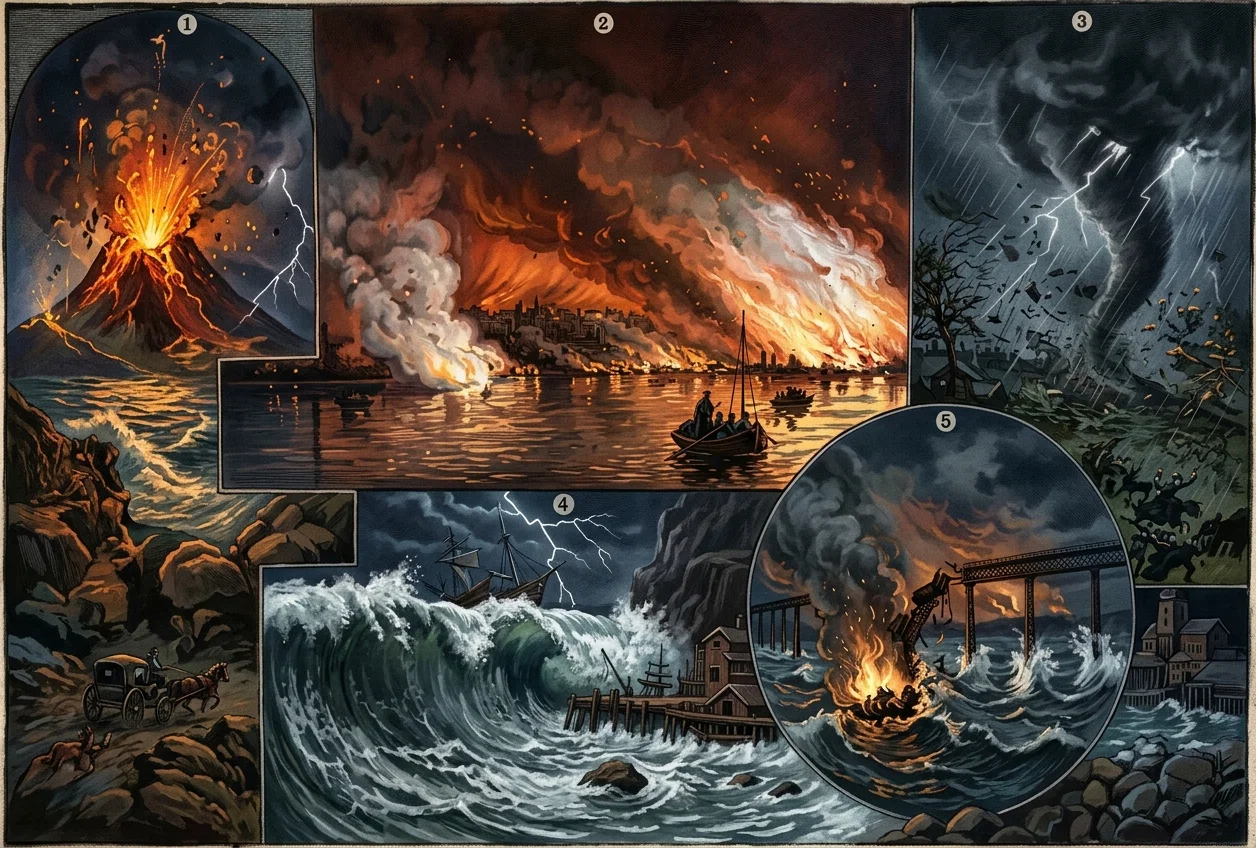
The great earthquake evidently refers to the Lisbon earthquake of 1755 A.D. This great calamity marked the opening of the sixth seal, the seal under which all these signs were to be seen, and covering a period from 1755 to the coming of Christ. Verses 13–17. The seal opened just twenty-five years before the first signs were hung out in the heavens.
But did the moon refuse to give her light on the evening of the dark day? Did she appear as blood when seen at all? Again we must call to our aid the historical records:—
The night succeeding that day [May 19, 1780] was of such pitchy darkness that, in some instances, horses could not be compelled to leave the stable when wanted for service. About midnight the clouds were dispersed, and the moon and stars appeared with unimpaired brilliancy.—Stone’s History of Beverly (Mass.).
Some authorities inform us that when the moon was seen that evening it appeared like a ball of fire,—as red as blood. Thus we see that the second sign which our Saviour gave was as literally fulfilled as the first, and that the public mind at that time was deeply impressed that they were phenomenal.

In the Stars.

“And the stars of heaven shall fall.” This sign is the last definite one that will be set in the heavens, until they see the heavens departing as a scroll. It must be as literal as the previous signs, and of a character that will call the mind to that event of which it is a sign. There is another prediction of this phenomenon that is more minute than the one recorded by either Mark or Matthew: “And the stars of heaven fell unto the earth, even as a fig tree casteth her untimely figs, when she is shaken of a mighty wind.” Rev. 6:13. Here it is not only stated that “the stars shall fall from heaven,” but the manner in which they will fall is also given. They are to fall as unripe fruit falls when the tree is shaken by a mighty wind.
Let us again appeal to historical evidence:
By far the most splendid display of shooting meteors on record was that of Nov. 13, 1833. It seems to have been visible over nearly the whole of the northern portion of the American continent, or, more exactly, from the Canadian lakes nearly to the equator. Over this immense area a sight of the most imposing grandeur seems to have been witnessed. The phenomenon commenced about midnight, and was at its height about 5 A.M. Several of the meteors were of peculiar form and considerable magnitude. One was especially remarked from its remaining for some time in the zenith over the Falls of Niagara, emitting radiant streams of light. In many parts of the country the population were terror-stricken by the beauty and magnificence of the spectacle before them. A planter of South Carolina thus narrated the effect of the phenomenon on the minds of the ignorant blacks:—
“I was suddenly awakened by the most distressing cries that ever fell on my ears. Shrieks of horror and cries for mercy I could hear from most of the negroes of the three plantations, amounting in all to about six hundred or eight hundred. While earnestly listening for the cause, I heard a faint voice near the door calling my name. I arose, and, taking my sword, stood at the door. At this moment I heard the same voice still beseeching me to rise, and saying, ‘O my God, the world is on fire!’ I then opened the door, and it is difficult to say which excited me the most—the awfulness of the scene or the distressed cries of the negroes. Upwards of one hundred lay prostrate on the ground—some speechless and some with the bitterest cries, but with their hands raised, imploring God to save the world and them. The scene was truly awful; for never did rain fall much thicker than the meteors fell toward the earth. East, west, north, and south it was the same.”—Quoted in Milner’s Gallery of Nature, p. 140.
The meteors of which the above shower was composed seem to have been seen of three different kinds:—
1. Phosphoric lines, apparently described by a point. These were the most abundant; they passed along the sky with immense velocity, as numerous as the flakes of a sharp snowstorm.
2. Large fireballs, which darted forth at intervals across the sky, describing large arcs in a few seconds. Luminous trains marked their path, which remained in view for a number of minutes, and in some cases for a half an hour or more. The trains were generally white, but the various prismatic colors occasionally appeared, vividly and beautifully displayed. Some of these fireballs were of enormous size; indeed, one was seen larger than the moon when at its fall.
3. Luminosities of irregular form, which remained stationary for a considerable time. The one above mentioned as having been seen at the Falls of Niagara was of this kind.—Quoted in Milner’s Gallery of Nature, Chambers’ Astronomy, pp. 795, 796.
Other records of this wonderful phenomenon describe it nearly in the language recorded in Rev. 6:13. It is said that the stars seemed to fall towards the four points of the compass and form one center in midheaven. In every case the people were impressed with the judgment day. It impressed upon the mind the very thing of which it was a sign.
After this sign others follow, and in conclusion the Saviour says, “And when these things begin to come to pass, then look up, and lift up your heads; for your redemption draweth nigh.” Luke 21:28. Have not they begun to come to pass? Then is it not time to lift up the head and look for the final redemption? Reader, are you looking up? Do you see the signs that show you that he is near, even at the door? To them that look for him he is to appear without sin unto salvation. Do you look for him? Some will be asleep, but he has given us the signs to show us that he is near.
May the Lord help us to see the signs that he has given us. May we look up, and say, “Come, Lord Jesus, come quickly.”
Continue reading: SIGNS IN THE RELIGIOUS, SOCIAL, MORAL, PHYSICAL, AND POLITICAL WORLD