[This is a continuation of developments in the Chinese republic. Our readers will be interested in the light thrown on the opium question.]
ON May 2, at twelve o'clock noon, formal recognition was extended to the republic of China by the United States of America.
Mr. E. T. Williams, American chargé d'affaires, and acting minister to China, accompanied by the entire staff of the American legation, visited the winter palace, Yuan Shih Kai's headquarters, at eleven o'clock in the forenoon.
The president sent a private carriage with a guard of honor to take Mr. Williams to the president's office. The route from the legation quarter through the imperial city to the winter palace was lined with soldiers. As the party entered the gates, the palace band played a tune of welcome.
The party entered boats, and were conveyed across the lake to the buildings which the president uses as offices. Here they were met by a delegation including military and naval officers and the foreign minister. After a few minutes' chat with the foreign minister, Mr. Williams was informed that the president was ready to receive him in an adjoining room. Mr. Williams and the staff entered, bowed to the president, and proceeded immediately to read President Wilson's message, the text of which is given as follows:
President Wilson's Message to China
"The government and people of the United States, having abundantly testified their sympathy with the people of China upon their assumption of the attributes and powers of self-government, deem it opportune at this time, when the representatives in the National Assembly have met to discharge their high duty, setting the seal of full accomplishment upon these aspirations of the Chinese people, that I extend, in the name of my government and of my countrymen, greeting and welcome to the new China which is thus entering into the family of nations. In taking this step, I entertain the confident hope and expectation that in perfecting republican form of government, the Chinese nation will attain the highest degree of development and well-being, and that under the new rule, all the established obligations of China which passed to the provisional government, will in turn pass to be observed by the government established by the Assembly."
After reading this, Mr. Williams spoke as follows:
"Mr. President, having communicated to your excellency the message of the president of the United States giving formal recognition to the Chinese republic, I desire for myself, and on behalf of my countrymen resident in China, to express the satisfaction we all feel in the action taken by the American government. As citizens of a sister republic, we can not be indifferent to anything affecting the success of republican government in China. We shall watch your progress with interest, trusting that the hopes that animated the martyrs of the revolution will find their full fruition in the free institutions now being established. We rejoice with you to-day in the confident belief that this new government, 'broad-based upon the people's will,' by the establishment of lasting peace and equal justice, will minister to the highest happiness of the people, and merit the blessing of Heaven."
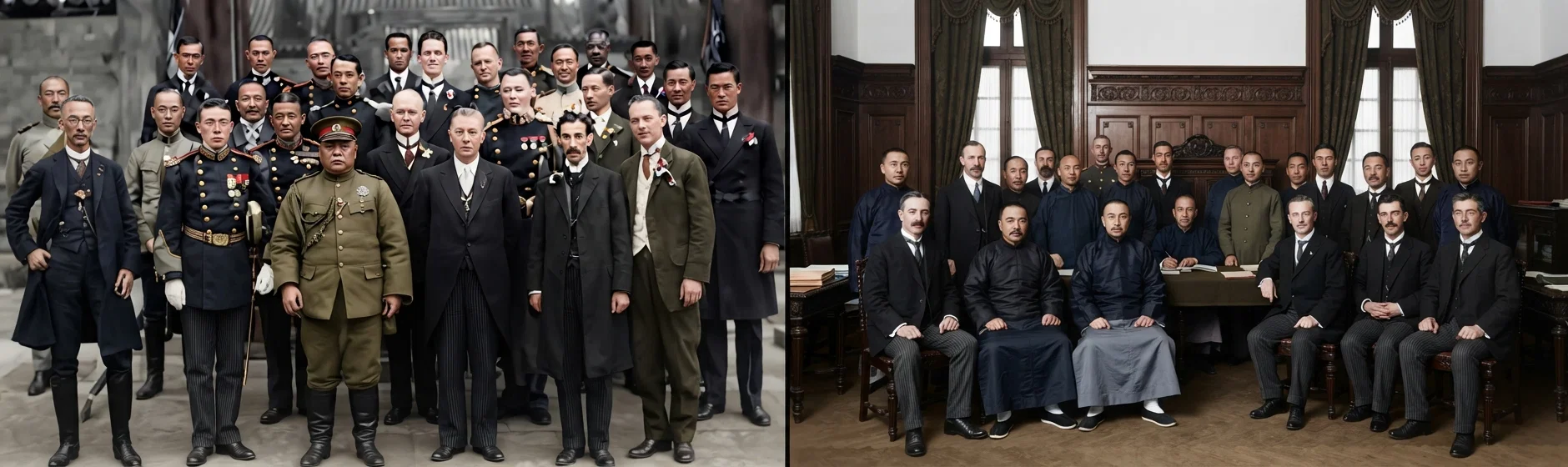
Those who took part in the historical proceedings at the palace of President Yuan Shih Kai, when America accorded recognition to the republic of China, on May 2, 1913. The short, heavy man in front, in military dress, is Yuan Shih Kai. Mr. E. T. Williams, American chargé d'affaires, stands at the president's left. Others are officials and soldiers of the two governments. There is warm friendliness in China now toward America. May it continue. Officials at Shanghai who participated in the ceremony of recognition by America of the Chinese republic. United States Consul-General Wilder and staff represented the United States. On the Chinese side were Tutuh Chen and staff, and Commissioner of Foreign Affairs Ivan Chen and staff. There were also present other prominent officials of the republics United States, France, and China, and other prominent men.
Yuan Shih Kai then responded as follows:
Mr. Chargé d'Affaires, I listened with the profoundest satisfaction to the welcome message from the president of the United States which you have just read, and to the assurances of sympathy which you eloquently extended. On behalf of the government and the people of China, I thank you, and also beg you to transmit our thanks to your president. Tho young in years, the republic of China is founded on principles of liberty and freedom which are already deeply graven on the hearts of the Chinese people. We believe that through the permanent establishment of this form of government, we have found the best means of insuring us what you have been enjoying through the same means for one hundred and forty years; namely, the unalienable rights of life, liberty, and the pursuit, of happiness. It is equally gratifying and significant that the political ideals of two great peoples, tho separated by a broad ocean and living under different skies, are of one and the same kind. I am confident in the hope that this common faith in the soundness of republican government will serve to bring China and the United States into yet closer contact than they are now, and will further strengthen the friendly relations which have invariably existed between them."
The formal proceedings ended, the reception committee escorted the visitors around the palace, after which they took luncheon with President Yuan Shih Kai.
In all the treaty ports and cities in China at which consuls of the United States are located, recognition was extended at precisely the same hour. May 8 was declared a holiday to celebrate the recognition of China by the United States. In Peking, Shanghai, Nanking, and other large cities, great enthusiasm was exhibited. Speeches were made at various places, followed by vociferous cheers for America, and college yells from the students.
There has been growing up, during the last decade, a marked friendship between China and the United States, and a confident belief, on the part of the Chinese people, that America was her "friend indeed," without any sinister motives back of her friendship. The events of the last three years have served to strengthen this feeling, and cement the tie of friendship into a bond of love; and to-day the two largest republics in the world stand with hands clasped across the Pacific, united in aim and object, one great ideal common to both—that of securing to the men and women of their respective countries their God-given rights of life, liberty, and the pursuit of happiness.
America's aid in the time of great distress, famine, and flood, her friendly attitude during the revolution, and recently her withdrawal from the Six-power Loan Syndicate, and lastly her recognition of the new republic at the most opportune time,—these actions, combined with the many words of sympathy expressed by individuals and government representatives, have made a lasting impression on the Chinese, which will never be forgotten, and will live and grow in the minds and hearts of the people, as a surety of pleasant and harmonious relations in the future between the two great Pacific republics.
There is another way in which America has helped China in the past and recently in a special manner, and that is in lending her sympathy and aid in the11
Suppression of the Opium Traffic
For the last seven years, China has carried on an aggressive and determined campaign against opium-smoking, and has endeavored to stop entirely the cultivation of the poppy plant from which the opium is extracted. The old government in 1906 passed laws calling for the gradual decrease of the opium traffic, in all its phases, on a ten per cent a year scale, which would end the business at the end of ten years.
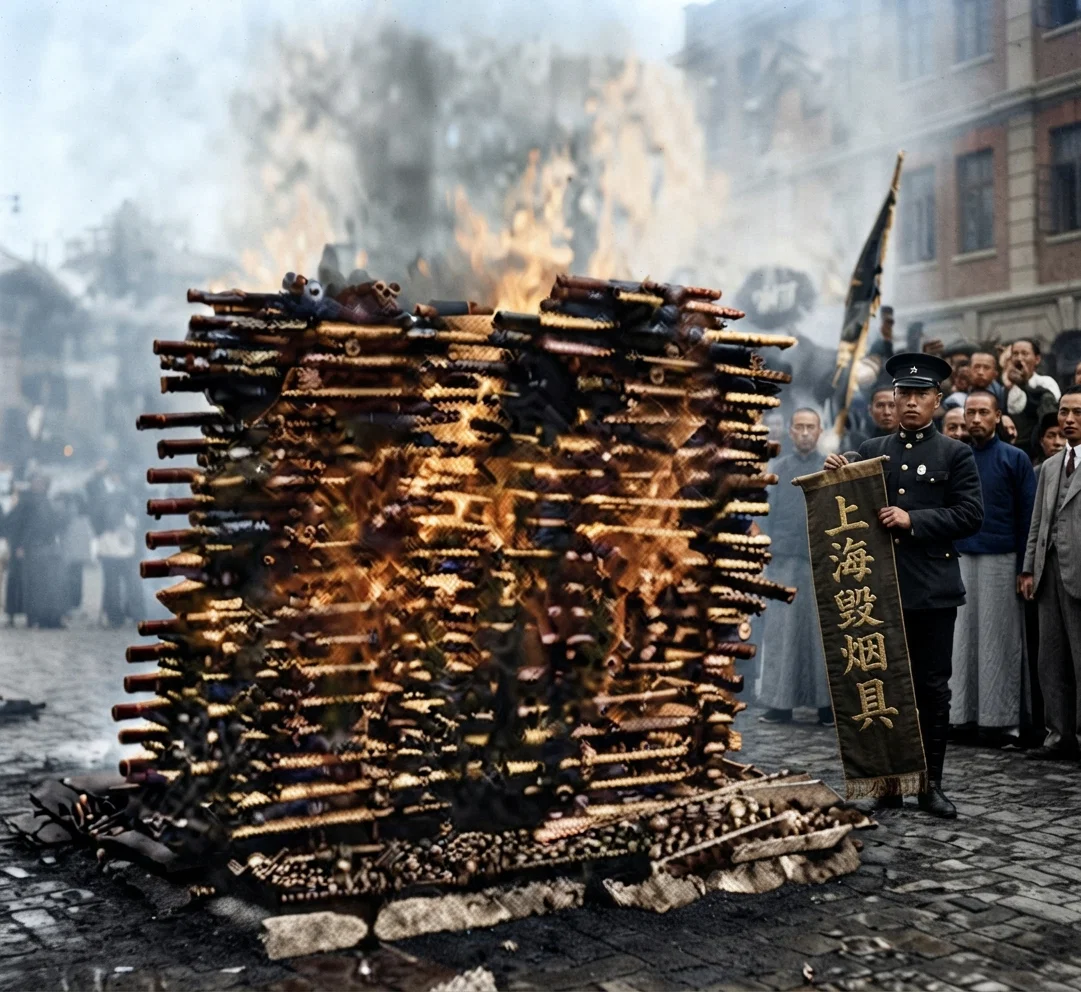
This campaign was carried on in a vigorous manner. Opium dens were closed, the paraphernalia confiscated and burned, farmers who refused to stop planting opium were imprisoned and killed, and officials who smoked, or refused to coöperate in this business of stamping out the opium, were dismissed from office.
It was soon seen, however, that all this good work was of no avail as long as foreign governments were importing opium into China to the amount of ten million pounds a year; so an appeal was sent to England asking her to coöperate in the good work and stop bringing the deadly drug into China. She replied that her treaty with China gave her this privilege and she could not stop on account of the tremendous loss that would result to the merchants who carried on this business. Not a word about the terrible loss of both body and soul of thousands of Chinese who were slaves of the opium habit!
Early in 1911, thirty thousand Chinese signed a monster petition, written on two hundred sheets of paper joined together, one hundred and thirty feet long, which was sent direct to the king of Great Britain. It read in part as follows:
"We, the four hundred million people of China, carefully present this letter to your majesty, king of Great Britain. We perceive that the opium has and will continue to poison continually, and we know that if we do not cease to use it, the future of our country will be very gloomy. Therefore we make bold and pour out our hearts' blood before your majesty, hoping you will listen to us. Our country has already suffered from the poison of opium for fifty years. The injury is so great that we can not speak even one ten-thousandth part of it; and when we think of it, we regret and hate it. Now our government, being enthusiastic in reorganizing our country, has determined to prepare a constitution and earnestly prohibit opium. But even while this strict prohibition has been issued and executed for three years, and our government and our people are both anxious to carry it out, the poison can not be entirely put down. We have searched for the reason, and find that even if we prohibit our countrymen from planting the poppy, that which comes from abroad is still being imported more and more. How can we succeed when five million pounds comes annually from abroad? We therefore cry out and exclaim before your majesty, king of Great Britain, begging your majesty to pity us and give back our liberty to prohibit opium. . . . Your country is most respected by all the countries of the world. Can you endure to throw away your reputation and glory for the sake of money? We know that all other countries are sympathetic in our reform; but if your great country does not quickly stop importing the opium, the reform will be destroyed. We are earnest at the present critical time, and beg your majesty will pity us and excuse us for our ignorance, and immediately issue an edict prohibiting opium, and so save our four hundred million people from death."
This remarkable appeal brought forth no response from Britain, so the Chinese appealed to the other nations; and upon the invitation of the United States government, the International Opium Convention was called at The Hague, which convened at the end of the same year.
At this convention an international agreement was signed, in which Great Britain promised to reduce the importation of opium, and close the opium dens in the British concessions, in the same ratio as the Chinese prohibited the cultivation of the poppy.
That their part of the agreement has never been carried out can be proved from the customs reports, which show that the importation of opium has increased rather than decreased. An excuse was made for this action, that at the time of the revolution, the laws could not be carried out, and many of the farmers took to raising the poppy again. Persistent reports from supposedly reliable Chinese correspondents were published in the London 'Times,' saying that whole provinces were given over to the cultivation of the poppy unrestricted since the establishment of the republic.
The British government, to vindicate itself, sent out special men to investigate the true conditions; and on May 26, two of these commissions returned to Peking, and reported that the provinces of Anhwei and Honan were entirely free from the poppy plant. This has been a cause of great rejoicing among the Chinese people, and renewed efforts are being made now in Shanghai to close all the opium shops and dens. They have succeeded in a remarkable manner; and now when any one wants to smoke opium, he seeks refuge in the British concession, where the opium shops are doing a rushing business on nearly all the important streets.
Burning opium pipes and paraphernalia, Shanghai
Covering a short distance of about a quarter of a mile along which the writer has occasion to pass daily on the way to our street chapel in Shanghai, we have noticed no less than five or six of these shops. One of our inquirers, a woman who is greatly interested in the gospel, wished us to call upon her husband, which we did repeatedly, but were never able to find him at home; and upon inquiry from the neighbors as to the reason, we were told that he was an opium-smoker, and as he lived on Chinese territory, he was not permitted to smoke at home, so he spent most of his time in the foreign concession, where he was allowed to smoke as much as he liked. It is needless to say this brought the blush of shame to our foreign cheeks, because, in the eyes of the great majority of the common people, no distinction is made of the nationality of foreigners, and the innocent suffer with the guilty in regard to their reputation.
Less than a month ago the officials of Shanghai native city, together with the representatives of the Opium Suppression Society, made overtures to the British Municipal Council, who control the British concession, asking their coöperation in the matter of prohibiting the sale of opium in the concession.
The chairman of the council told them plainly that they had no intention of stopping the sale of the opium as long as the people wanted it, and told the commission that if they wanted to do any reform work, they should teach the people not to buy the drug. When reminded of the agreement made by Britain at The Hague, he replied that England never had any intention of keeping that agreement, that it was only given to China as a sop.
Early in June, the following protest was signed by Americans in Shanghai, and sent to the secretary of state in Washington:
"We, the undersigned, Americans resident in China, protest against the continuance and increase of opium shops in the international settlement of Shanghai, in view of the fact that the Chinese authorities have closed up their own shops for the retail sale of opium. 'The increase of these shops in the settlement here from 316 in 1911, to 374 in 1912, to 449 in 1913, seems to be in direct violation of the International Opium Convention signed at The Hague on January 23, 1912; article 18 agreeing definitely that opium shops in the concessions and foreign settlements in China shall be reduced pari passu with China's reduction. As our government is represented in this international settlement, we feel that the United States is deeply concerned in this question; and in view of the fact that the Opium Convention was called at the invitation of our government, we request that you take this matter up, and if possible arrange with the other powers for the carrying out of the provisions of this convention. We believe this is not only justice to China, but a duty required to uphold the standing of international treaties and agreements."
At Tien-tsin, on June 5, opium valued at sixty thousand dollars which had been confiscated by the government, was publicly burned in nine great caldrons. Addresses were delivered by Chang Po Ling, Commissioner Lin, and Mr. E. W. Thwing, secretary in China of the International Reform Bureau. Music was provided by a band, and great enthusiasm prevailed.
Thus the present government is pursuing the work of suppressing the opium traffic with great determination, and nothing short of a complete eradication of the evil in all its branches will satisfy those who are responsible for this movement.
General Chang, who was appointed special commissioner to England, is in London now endeavoring to bring about a better understanding of the question, hoping to be able to reach some solution of the problem of what is to be done with the accumulation of something like twenty-three hundred chests of the drug, valued at eight millions sterling, which is in bond in Shanghai and Hongkong. Since the present government has refused to allow this to be sold, it has become a serious burden to importers and to the banks who have advanced money on it, causing no little anxiety as to its influence on trade generally.
Because of this congestion caused by the firm stand of the government not to allow this drug to be distributed in the interior, the Indian government has at last announced their intention to suspend the exportation of opium to China until further notice. Now if some method could be devised of disposing of the present stocks on hand, it would seem that the opium traffic is nearing the end of its existence.
Speaking of this action of the Indian government, the London 'Times' has this to say with reference to the subject: 'Thus quietly disappears a traffic which has been conducted under British auspices for far more than a century, has contributed to bring about a war, has been investigated by a famous royal commission, and has formed the subject of indiscriminate denunciation at numberless public meetings in this country. When all is said that can be said, however, it is indisputable to-day that the Indian opium12traffic with China is an unpleasant page in British history. It began in the desire of a trading company for profits, and the desire was transmitted to the regularized administration which succeeded the company. The craving for profits continued to the end, and has only disappeared when profits were no longer obtainable. The casual verdicts of the House of Commons do not always command approval, but it is plain now that the house was justified in declaring the traffic to be 'morally indefensible.' We have frequently sought, in the past, to clear the question from the misstatements in which it was constantly wrapped, but we are glad now that Great Britain has done with it.'
F. E. STAFFORD.
A Statesman's View of the World's Progress
By T.
O N a recent date Mr. Bryan, the secretary of state, made an address in Chicago before the Union League Club on "the signs of the times." He brought three propositions before his audience to show that the world is advancing in intelligence and morals and the science of government. Mr. Bryan presented many facts to show that education is on the increase, that countries like Japan that fifty years ago were bound in ignorance have now broken their chains and are sharing in the world's progress.
There is no question in regard to great material progress having been made during the last hundred years. There is no question but we have in this time some of the most stalwart men in morals that have ever lived on this planet. They are doing heroic work for the cause of humanity, but when we come to say that the world is getting better morally the proof is lacking.
For instance, Mr. Bryan referred to the increasing sentiment in favor of temperance, and gave some splendid incidents to show what is being done in that direction. But notwithstanding this strong temperance sentiment, the statistics of our government, which are supposed to be absolutely reliable, show that each succeeding year brings an increase in the consumption of alcoholic drinks. In 1850 the amount per capita in this country was only four and eight tenths gallons, while now the amount per capita is twenty-two and three fourths gallons.
We have our army of W. C. T. U. workers; we have our Prohibition Party; we have our Anti-saloon League, and many other allied organizations, and orators and journals, and they have done mighty work for the cause of temperance. But in spite of all this work, the statistics show that an average of nearly twenty-three gallons of strong drink is consumed in a year by each man, woman, and child throughout the nation. Now we know there are many who, like Mr. Bryan, refuse in the face of the ridicule of some people to touch wine even upon state occasions, but nevertheless some one, somewhere, is drinking his twenty-three gallons of strong drink. You might go through the nation and find thousands of people who never touch a drink of the iniquitous cup that is laden with alcohol, but for these strong temperance people there must be found others who drink their share in order to bring the average to this twenty-three gallons. That is, there are some who are drinking very much more than twenty-three gallons in order to bring up the average.
Now how can we say that we are making headway against intemperance when the amount being consumed is increasing right along? And so we might continue in all of the fields of reform. Heroic work is being done to suppress vice, but vice is nevertheless on the increase, and has reached such proportions that leading educators and statesmen are crying out against it as a menace to our civilization. There is great danger that we look at our big organizations that are working for reform, and hear only their music and the marching of their brave army. But unless the world were in an awful condition morally why would we have need of such multitudes of organizations that are working to suppress child labor, and to protect women, and to get proper wages for the employee, to put down vice and intemperance, and so on to the end of the list? Would it not be well to recognize that the Bible states fact when it says that "evil men and seducers shall wax worse and worse, deceiving, and being deceived"? Would it not be well to recognize the truth of the ringing words of the prophet Daniel which he himself applies at the time of the end? He says:
"The words are closed up and sealed till the time of the end. Many shall be purified, and made white, and tried; but the wicked shall do wickedly: and none of the wicked shall understand; but the wise shall understand." Dan. 12:9, 10.
Observe that his prophecy was given for the time of the end. Many shall be purified and made white and tried, and furthermore he tells us that "the wicked shall do wickedly; and none of the wicked shall understand." Now that scripture very plainly shows that there will be a trying process that will purify and make white many people in "the time of the end," but on the other hand many of the wicked will do wickedly and none of the wicked will understand.
We wish to encourage every true reform work, because it is all in the providence of God and under His fostering hand, so that the vice that Satan is seeking to bring into the world can be held in check until the work of Jehovah is finished upon the earth. Because many in this time are to "be purified, and made white, and tried," we must not make the mistake of believing that their divinely appointed work is causing the world as a whole to be getting better. These good, true workers will be climbing to the very heights of purity and righteousness, and their noble souls will lift them to that exaltation that they may be tempted to believe that the world is getting better, by what they see being done by themselves and their associates; but we must remember that evil men will wax worse and worse, and furthermore that the wicked will do wickedly in the time of the end. And if we confine ourselves to facts instead of fancies, we will have no difficulty in seeing the literal truth of the divine word.
A Murder Syndicate to Abolish War
A MURDER syndicate to put an end to war is one of the latest organizations in Europe. It is said to be a secret society that has been formed in France and Germany. There are many leading individuals connected with it, particularly among the women. Some women said to be as high in social and political life as princesses are members of the organization.
They say that the only response so far to their "lawful efforts" has been the increasing of the military term of service in France, and in Germany some three million men have been added to the military forces. Acting upon the suggestion and example of the militant suffragettes in England, they believe that the only way to make themselves felt is to inaugurate and secretly plan wholesale murders. Their principal line of attack is to be on the generals of the armies and rulers who are specially warlike. The king of Greece and the Nazim Pasha are said to have perished at the hands of this organization. They were also nearly successful in taking the life of King Alfonso of Spain. The despatches quite fully reported the latest attempt on the king's life, but it has only recently come out that this murder organization were the conspirators.
It is believed that the recent book entitled "The Human Slaughter-House," written by Wilhelm Lamszus, the German author, has also done its full share in building up this murder organization. The book was suppressed by the German emperor, but it has been translated into other languages and is being widely circulated.
War is certainly awful beyond description, but how can sane people be led into the belief that such wholesale murders would be justifiable? The fact that such an organization has been formed and that it has already been successful in some of its reprehensible work is a strong commentary on the conditions of our day. One is very forcibly reminded of the graphic utterance of the prophet Jeremiah: "For I have heard a voice as of a woman in travail, and the anguish as of her that bringeth forth her first child, the voice of the daughter of Zion, that bewaileth herself, that spreadeth her hands, saying, Wo is me now! for my soul is wearied because of murderers." Jer. 4:31.
Man Makes Nature His Slave
Man Makes Nature His Slave.—A daily paper devotes a page of large type and illustration to boasting of the wonderful mastery that man is getting over nature—how he is compelling nature, through steam, electricity, etc., to do his slavish work and bear his burdens and attend to his menial tasks. There is a great deal of truth in this. Man has been able, during the last half-century, to make wonderful discoveries that have given him many advantages. Secrets of power that were locked up in steam and electricity when our fathers were boys are now used by us in the great lines of manufacture and in all forms of industry. But when it comes to man harnessing nature and making it a slave, there is a side to the question that we should not overlook. When those great tornadoes swept through the central part of this continent a few weeks ago, they left desolation everywhere. The Scientific American, in commenting upon them, averred that before these mighty forces of nature man is a very insignificant creature. He is absolutely helpless when nature breaks loose with her masterly power. And while man has done much in the way of using some of the forces of nature, he needs to be very careful how he boasts over his great attainments. We must not forget that back of the great forces of nature is the infinite power of the God who is the author of nature; and when man becomes too proud and boastful, it is sometimes necessary for him to have some of these great lessons in order to make him realize that he is not all in all himself.
The Coffee Habit
A woman was brought into the police court the other day, requiring two policemen to restrain her,—temporarily insane from drinking too much coffee. Twenty cups a day had done the work. The judge let her go free, and she went to the mountains for rest, promising to try to rid herself of the coffee habit. One reason why people like coffee and tea is because of the intoxicating principle, thein, found in both. It is not needed in the human system; and thousands can testify, after years of experience as tea and coffee drinkers and as abstainers, that the life of abstinence is the better.
Suffragettes Campaign in India
The militant suffragettes have carried their campaign into India. They opened their work by the circulation of literature, and by damaging the golf links at Simla. The British crown has had a great deal of difficulty in handling the turbulent elements in India during the last few years. It will be interesting to see what effect this agitation of the women will have upon the already revolutionary population.
Monks Strike for Food and Trousers
By Editor
We noted two weeks ago a strike of the Swiss Guard in the Vatican. We note this week the strike of monks of St. Michael's Monastery at Maikop in the Caucasus. They demand more food, more leisure, and a supply of trousers. The head of the monastery refuses to grant the demand, and consequently the bells are silent.
Marriage Bans for the Diseased and Unsound
Pennsylvania legislature has enacted a law to prohibit a marriage license to persons afflicted with a transmissible disease, or to imbeciles, or persons of unsound mind.
Mount McKinley’s Height
Mount McKinley has been ascertained by Archdeacon Hudson Stuck, who recently ascended it, to be 20,500 feet high, the highest mountain in North America.
Shop in this money-saving store
without leaving your easy chair
Our thousand page catalog, accurately illustrating and describing our merchandise, is our sole representative and salesman. By selling to you through this book, we eliminate several agents' profits which you have been in the habit of paying.
MONTGOMERY WARD & COMPANY, Chicago
CHICAGO AVENUE BRIDGE
This means that the cost of your life's necessities is reduced from 20 to 50 per cent.
Millions are saving, each year, many dollars — often hundreds of dollars — that they had been needlessly spending before.
This opportunity can be yours also, if you will send for your free copy of our catalog, and start buying from its bargain-crowded pages.
Our merchandise includes almost everything within the ordinary wants of man — articles to eat, to wear, or to use in any way. We guarantee the quality to be the best that can be secured for the money. We guarantee also that you will be thoroly pleased with each purchase. If you are not, you may return the unsatisfactory purchase, and we will refund your money, together with the transportation charges you have paid.
Merely drop us a card to-night, and we will mail our big catalog of money-saving offers free of charge to you.
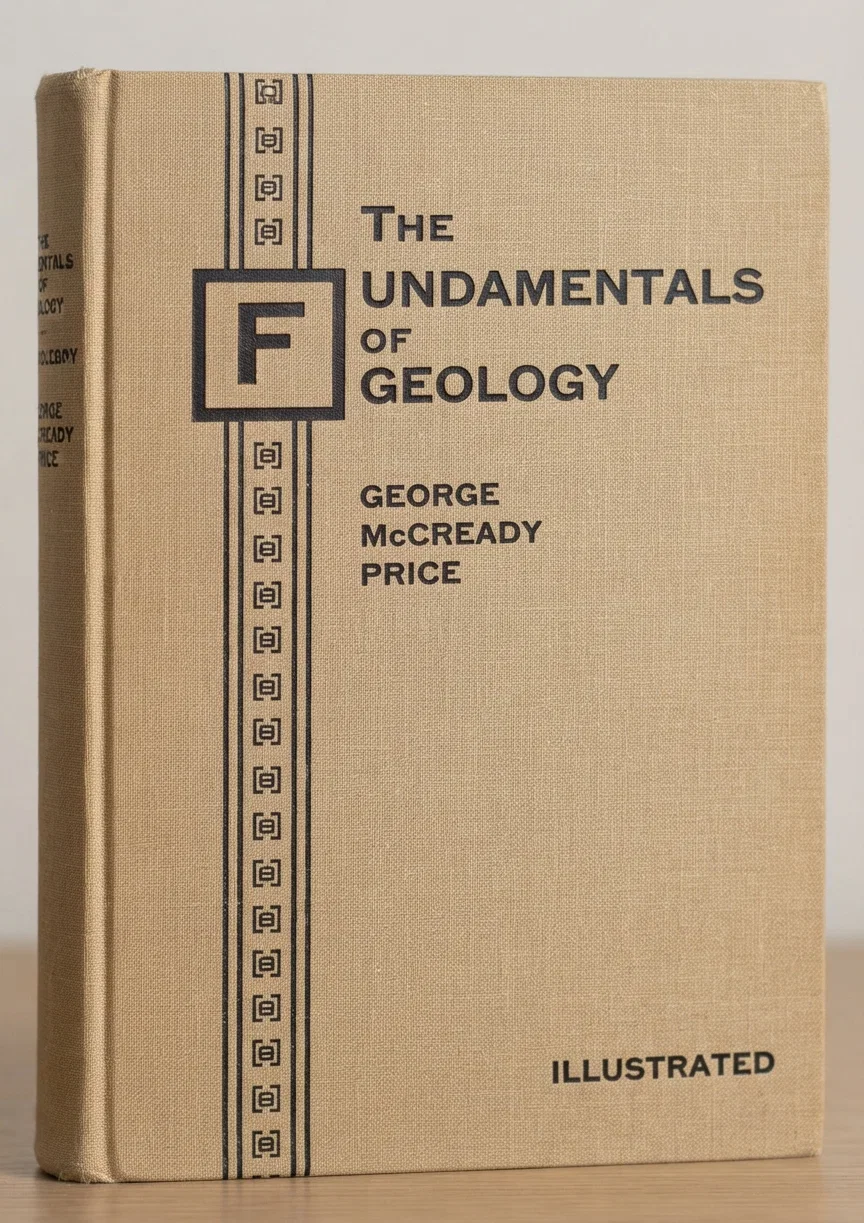
The Fundamentals of Geology
Every person who would understand how to meet the present-day theories of geology and evolution as opposed to the Bible story of Creation should have this book. The fundamentals of geology, and the theories taught, are presented in a most interesting way. Maps and illustrations of great sections in Montana and Alberta where geological research is being carried on are given.
In the closing chapter, where the evidence is grouped, the author says: "And now geology, when allowed to give her testimony in a thoroughly scientific fashion, testifies to the same general truth regarding the great groups of plant and animal forms, like physics and chemistry pointing backward along the great perspective of the ages to the same vanishing-point, already charted long ago in the Christian Bible as the birthday of the world."
Thus this book scientifically meets the theories of geology and evolution which destroy confidence in the word of God. It is intensely interesting and easy to understand.
247 pages, bound in strong cloth. Price $1.25.
(Price 10% higher in Canada)
Pacific Press Publishing Association
Mountain View, California
Overland Limited
IN THREE DAYS
SAN FRANCISCO
Overland Limited
TAKES YOU
To Chicago
ACROSS GREAT SALT LAKE
AND
HIGH SIERRA BY DAYLIGHT
Luxurious High-class Equipment
Electric Lighted Throughout
Pullman Drawing-room
Stateroom
Vestibuled Sleeping-cars
Careful and Attentive Dining
Service
Parlor Observation-car with
Library and Cafe
Ladies' Reading-room
Gentlemen's Smoking-room
Daily News Bulletins
Latest Papers and Magazines
Southern Pacific
SPECIAL BUREAU FOR
FOREIGN MISSIONARIES
Recognition of our unexcelled shipping service to foreign ports is seen in the fact that we have recently been appointed the official and exclusive shipping agents for the International Committee of the Y. M. C. A.
The safety, economy, and reliability of our foreign shipments is everywhere known. We alone, of all American merchandise houses, make car-load shipments to the Orient, thus securing the lowest possible rates on the shipments as a whole and on each individual shipment. We also ship in car-load lots to Atlantic export points.
We solicit the handling of outside export shipments. We will gladly ship donations and presents to missionaries in foreign lands—whether the supplies are secured outside of our establishment, or combined with purchases from this store.
For the sake of economy and safety you should use our unexcelled shipping service. Before making a foreign shipment, consult with Mr. M. D. Howell, manager of our export division. He will gladly give you the benefit of his experience and knowledge without cost to you.
Missionaries in foreign lands can order from this one store the necessities and comforts to which they had become accustomed in the home land. This will prove both an economy and a convenience. Our catalog will be sent free to any address on request.