The Youth’s Instructor, Vol. 43, No. 44.

JAPANESE TEMPLES

The Youth’s Instructor

Oct 31, 1895

S. D. A. Publishing Association · Battle Creek, Mich. · Oct 31, 1895

JAPANESE TEMPLES.
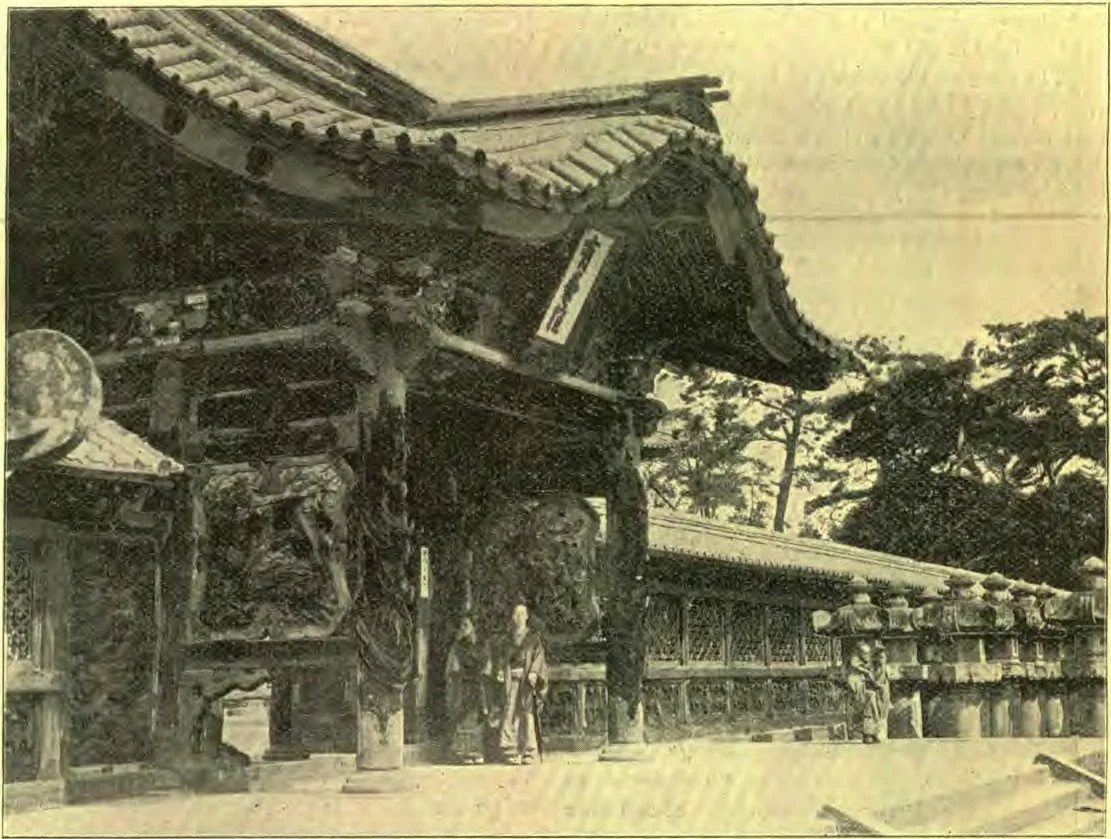
In Japan there are eighty-four thousand nine hundred and twenty-four Buddhist temples, and the number of priests attached to them is about fifty-seven thousand seven hundred. This does not include the Shinto temples and shrines, which are numerous. There are also many wayside shrines, where travelers stop and worship as they pass. In every heathen household there is the niche where the gods are kept, and all the members of the family daily bow before the gods, and make them offering of food.
The Buddhist temples are generally adorned with grotesque carvings, and resplendent with gilding. In our illustration is represented the gate of the temple at Shiba, Tokyo. This is quite a celebrated temple. The courtyard contains the tombs of several of the noted shoguns of Japan. The temple at Asakusa, a district in Tokyo, is also a place of note. It is surrounded by pleasure gardens, many acres in extent. In these grounds are fairs, refreshments, booths; and the people eat, smoke, dance, and engage in every gay sport and pleasure known. To the Japanese mind there is no incongruity in placing a temple cheek by jowl with a theater.
It is a regular fair, the busiest mart in the city. There are venders going about hawking their wares, beggars, thieves, pickpockets,—all mingling in the motley throng, and plying their vocations. The priests in their sermons tell the people that they can invest their money well by laying it out upon articles to be obtained in the temple grounds, such as dress, ornaments, fancy pipes, combs, strings of beads for prayers, gods made of various kinds of metal, shrines for family altars, and the like.
Before the temple gate stand two gigantic wooden demons, reminding one more of the mythological gate-keepers of the infernal regions than of the guards of a sacred place. They are adorned with straw sandals hung upon them by coolies, to propitiate them and cause them to give the donors strength in their feet. Within the temple there is a babel of noise and confusion, with filth and bad smells. There are sacred pigeons whirring here and there to the detriment of hats and clothing. There are ladies elegantly arrayed in silks, officers dressed in splendid uniforms, coolies, rustics, children with dirty-faced babies on their backs,—all mingling promiscuously in the throng, making their offerings and saying their prayers.
GATE OF TEMPLE AT SHIBA, TOKYO.
The main altar, behind which the chief god sits, is protected by a wire grating. The worshipers must be careful to throw money into the coffer before praying to him. They write their prayers on slips of paper, put them into their mouths, chew them to pulp, and spit them out at the god. If he is hit and the wad sticks, it is considered a good omen, and they believe that the prayers will be answered. Hearing, you see, depends upon the softness of the wad and the skill of the ejector. Of course the old god is a disgusting-looking object, with these spit-balls sticking all over him.
Not far from the main altar stands the old god Binzuru, supposed to be the healer of diseases. Crowds are always gathered around him. They rub the repulsive-looking old monster, supposing that in this way healing power is extracted from him, and then rub the diseased portions of their own bodies. This idol is greasy and filthy beyond description. Portions of his face are quite worn away by the friction of so many hands. They doubtless contract disease in this way. For instance, a man who has some contagious skin disease rubs the idol well, and leaves germs which cling to the hands of the next man who touches him; and so the god is a means of conveying infection.
Isn't it pitiful to think of people supplicating this monster to heal them of their bodily infirmities, and knowing nothing of God, who is the healer of soul as well as body? The Buddhists are now building a temple in Kyoto, which has already cost five million dollars, and will probably cost as much more. Why, the very ropes with which the gigantic beams were elevated to their places, were made from the hair cut from the heads of the devoted women and girls of Japan! Isn't that a spirit of sacrificial devotion? If we were as ready to sacrifice for Christ as some of these people are to sacrifice for their heathen gods, it would not be long before the far East would be rejoicing in the glorious liberty of the gospel.
The Buddhist temple services are very similar to those of the Roman Catholics. The Buddhists have altars, shrines, candles, flowers, incense, shaven heads of priests, processions, beads, etc. The priests sing out the prayers and sermons in a monotonous way, while the people sit on the floor in true Japanese fashion, and nod their heads at intervals. Prayer-meetings or church services such as we have, in which the congregation takes an active part in the speaking and praying, is unknown among them. You can readily see how empty and hollow is all this show, and how unsatisfying to an earnest soul, who is really a seeker after truth.
There is nothing in heathen religions that can give the people any help or comfort amid the perplexities and trials of life, or that can shed one ray of light or consolation into the dark portals of the grave. How the great tender heart of the Master, who died for them, yearns over them in pity and compassion, as he sees them dying without the knowledge of his saving love! His commands to us are explicit: “Go ye into all the world, and preach the gospel.” Shall we not show our love to him by our obedience, and hasten to send the bread of life to those who have not yet received it? To us has been committed the truth. Again let us remember his command: “Freely ye have received, freely give,” and if we are faithful to the trust that our Lord has committed to us, it will not be long before it can be said of Japan, “The people which sat in darkness saw great light; and to them which sat in the region and shadow of death light is sprung up.” MRS. J. A. BRUNSON.

CHRIST THE YOUTH'S SAFEGUARD.

(Conclusion.)
WHAT privileges and blessings are granted to those who have obtained like precious faith with the disciples of Christ! Nothing is withheld from them. The apostle says, “His divine power hath given unto us all things that pertain unto life and godliness, through the knowledge of him that hath called us to glory and virtue.” The standard is lifted up, and yet we are to reach it individually. We may attain unto glory and virtue, though weak, sinful mortals, by learning daily lessons in the school of Christ, by becoming conformed to the divine image, by manifesting his excellence of character, by adding grace to grace, by climbing round by round the ladder heavenward, by becoming complete in the Beloved. As we shall work upon the plan of addition, by faith adding grace to grace, God will work upon the plan of multiplication, and multiply grace and peace unto us. We are to be diligent students in the school of Christ, having a knowledge of his will, and becoming active laborers in his vineyard.
The apostle describes to us the plan on which we are to work. He says: “Giving all diligence, add to your faith virtue; and to virtue, knowledge; and to knowledge, temperance; and to temperance, patience; and to patience, godliness; and to godliness, brotherly kindness; and to brotherly kindness, charity. For if these things be in you, and abound, they make you that ye shall neither be barren nor unfruitful in the knowledge of our Lord Jesus Christ. But he that lacketh these things is blind, and cannot see afar off, and hath forgotten that he was purged from his old sins. Wherefore the rather, brethren, give diligence to make your calling and election sure: for if ye do these things, ye shall never fall: for so an entrance shall be ministered unto you abundantly into the everlasting kingdom of our Lord and Saviour Jesus Christ. Wherefore I will not be negligent to put you always in remembrance of these things, though ye know them, and be established in the present truth.”
If our youth would take heed to the rules laid down in this chapter, and practise them, what an influence they would exert on the side of right, whether they were at Ann Arbor, in our institutions, or in any place of responsibility! They would see this truth, and their life-work would be successful. They would realize the need of being much in prayer, of being rooted and grounded in the truth, so that by precept and example they might be living witnesses for Christ. They would then be like Paul, who after his conversion was a channel through which bright beams of light were shed upon the great plan of salvation. They would be workers together with God in re-shaping moral character, and would be instruments through which the image of God might be retraced in man. They would respond to the working of the Holy Spirit, and become one with Christ in God. No longer would the law which they have transgressed be a yoke of bondage, but it would be the law of liberty, the freedom of sonship. Having repented toward God, having exercised faith in Christ, they have experienced forgiveness, and esteem the law of God above gold, yea, above fine gold.
Jesus is the sin-bearer. He takes away our sins, and makes us partakers of his holiness. O what tender, pitying love dwells in the heart of Christ toward the purchase of his blood! He is able to save unto the uttermost all who come unto God by him. There is power in these precious promises, and we should coöperate with the working of Christ, devoting all our God-given talents to the service of the Master, that the Holy Spirit may work through us to the glory and honor of Christ.
Students should have a growing, expanding idea of what it means to be a Christian. To be a Christian means to be a learner in the school of Christ. It means the connecting of soul, mind, and body with divine wisdom. When this union exists between the soul and God, we are taught of God, who gives wisdom and knowledge. His Spirit imparts thoughts that are clear and holy, and gives the knowledge that lives through eternal ages. Those who are consecrated, diligent, persevering laborers, putting to use every ability, employing all their faculties for the glory of God; who are not slothful in business, but are fervent in spirit, serving the Lord, will reap an eternal reward. But it is our part to be courageous, to exercise firm faith in God.
The end is near, and students should make most diligent effort to carry forward the work of acquiring knowledge that they may impart to others. If the converting power of God should come upon these souls, if they should come to realize that they need a power out of and far above themselves, they would not remain a day longer like mere machines, but would have a desire to work for God. Has the truth been lodged in the soul? Has the love of souls for whom Christ died become a living principle in their hearts? Unless they become vitally connected with God, they can never resist the unhallowed effects of self-love and self-indulgence and temptation to sin. If they were soundly converted to God, they would experience the love that dwells in the heart of Jesus; and under the inspiration of the Holy Spirit, it would well up like an irrepressible stream, refreshing their own sterile lives, and refreshing all those who are connected with them. I long to address the young men and women who are so willing to reach only cheap standards. O that the Lord might influence their minds to see what perfection of character is! O that they might know the faith that works by love, and purifies the soul! We are living in days of peril. Christ alone can help us and give us the victory. Christ must be all in all to us; he must dwell in the heart; his life must circulate through us, as the blood circulates through the veins. His Spirit must be a vitalizing power that will cause us to influence others to become Christ-like and holy. MRS. E. G. WHITE.

The Coming of His Feet.

In the crimson of the morning, in the whiteness of the noon, In the amber glory of the day's retreat, In the midnight, robed in darkness, or the gleaming of the moon, I listen for the coming of His feet.
I have heard His weary footsteps on the sands of Galilee, On the temple's marble pavement, on the street, Worn with weight of sorrow, faltering up the slopes of Calvary,— The sorrow of the coming of His feet.
Down the minster-aisles of splendor, from betwixt the cherubim, Through the wondering throng, with motion strong and fleet, Sounds His victor tread, approaching with a music fair and dim— The music of the coming of His feet.
Sandal ed not with shoon of silver, girded not with woven gold, Weighted not with shimmering gems and odors sweet, But white-winged and shod with glory in the Tabor-light of old— The glory of the coming of His feet.
He is coming, O my spirit! with His everlasting peace, With His blessedness immortal and complete! He is coming, O my spirit! and His coming brings release— I listen for the coming of His feet.
— Lyman Whitney Allen, in New York Independent.

WATCH THE LITTLE THINGS.

In my childhood a faithful teacher taught me this memory verse: “Lost, yesterday, somewhere between sunrise and sunset, two golden hours, each set with sixty diamond minutes. No reward is offered; for they are gone forever.” Many, many times since, I have repeated that verse with deep regret because of the consciousness that I had lost forever much valuable time that I might have saved. Our lives are made up of little things. There are no trifles.
“One little grain in the sandy bars; One little flower in the field of flowers; One little star in a heaven of stars; One little hour in a year of hours,— What if it makes, or what if it mars?”
“But the bar is built of the little grains; And the little flowers make the meadows gay; And the little stars light the heavenly plains, And the little hours of each little day Give to us all that life contains.”
Those who learn in youth to estimate rightly the value of the moments, and to be intensely resolute in doing little things well, will save themselves many defeats in the warfare of life. The world worships heroes; but true heroism is not found alone in those whom the world calls great. The truest and grandest heroes are unknown to fame. Those who are truest to duty, whatever it may be, display the greatest heroism. It is our privilege to be heroic in whatever station in life our lot may be cast. Many of us can never do the great things of which we dream, but we can all be faithful in doing with our might whatsoever our hands find to do.
Our lives take on the color and tone of the little things scattered through them. The little things which we say, and the little things which we do, are the warp and the woof, which when woven and interwoven in the great loom of life, come out the finished fabric—character. The little things we say and do each day should be right, painstakingly right. Then watch the little things. The care of the pennies, that they may multiply into dollars; the watchfulness of the moments, that they may combine into useful hours; the proper attention to trifles, that they may contribute to the success of the whole,—this is what is required of us.
MRS. L. FLORA PLUMMER.

Prayer as Word, Thought, and Action

The poet utters, the thinker meditates, the righteous acts; but he who stands upon the borders of the divine world, prays, and his prayer is word, thought, action in one.— Balzac.

AMERICAN SWINDLES.

America claims to be great in all good things; and while this may be, it is also very probable that it has the greatest rogues in the world. Our great cities are full of the keenest and most unprincipled swindlers, who, if it were possible, would deceive the very elect. Advertisements of the most glowing description, setting forth the vast profits that may be made, are sent out by millions, and then these sharks proceed to “work” those who respond to these advertisements for all that can be got out of them.
One very common way is to pretend that there has been discovered a great estate in England, or some other foreign country, the heirs of which are in America. Not a week passes but some American family is keyed up to a high pitch of excitement because of some prospective millions in store for them, when they shall be able to prove their relationship to the deceased foreigner, whose enormous estate or immense amount of personal property is awaiting the appearance of the lawful heirs. All these are frauds, pure and simple, and all the money received is by the sharp lawyer-swindler. The American spider feasts on the American fly; that is all.
Some years ago an American minister to England (we think it was General Schenck) authoritatively announced to the people of his country that there was no property in England for American claimants. He received so many letters from Americans asking for information in regard to property which they had been led to believe they possessed in England, that he was obliged to have blanks prepared to lessen his work of replying to these letters. There are many men who walk the streets of our cities, clad in the latest tailor-made suits, with silk hats, kid gloves, and gold-headed canes, who get their money by deceiving ignorant people into believing that a few dollars, and just a few more, paid to these human vampires, will secure a fortune!
Another American system of gaining money fraudulently is by the sale of bogus lands,—lands which have no real existence. The law, or absence of law, in some of our States is such that a man may have a river or a lake surveyed (in imagination), bounding his claims by “metes and bounds,” and not by objects, get it recorded, and then sell his land, giving deeds all regularly made out and recorded in good business order. Chicago swindlers are now selling land(?) half a mile out in Lake Michigan. Such land is too unstable for building purposes, and too damp for agriculture! It may be said, however, that it needs no irrigation! We knew a man who took two Chicago lots at five hundred dollars apiece, which were both in the Chicago River! Another friend bought a lot in Florida, which proved to be located in the center of a pond full of alligators! It is remarkable that the agent for this land did not represent that it was already stocked! Yes; the American swindlers are sharp and totally unprincipled; but it is hard to say which is the most noteworthy,—the sharpness of the swindlers, or the credulity of those who are taken in by them! Look out for swindlers; and do not buy property that you cannot see, and know that it is as represented.

AN UNHAPPY OLD MAN.

Leo XIII, pope of Rome, and head of the Roman Catholic Church, is generally credited with being a much better man, morally at least, than many of his predecessors, and he has consented, in some measure, to allow the church to come into harmony with the spirit of this progressive age. He has a grand palace of some thousands of rooms, galleries of art, extensive and priceless libraries, is the acknowledged head of the Roman Catholic Church in every part of the world, is amply,—yes, elegantly,—supported, and is at perfect liberty to go where he pleases, and come when he pleases; and still he is not happy! There is a Mordecai in the gate, and that Mordecai is the occupation of Rome by the king of Italy as his capital, and the loss of the temporal power.
The pope is not satisfied with being head of the Roman Catholic Church; he wants to be a king, and to send ambassadors who shall represent the papacy, both civilly and religiously, to the different nations. He would be pleased to have Monsignor Satolli represent the papacy to the government of the United States, instead of representing the pope to the American Catholics, as the legate now does. The pope would be glad, through these ambassadors, uniting with the Catholics of each country, to influence governments to make laws favoring the spread of Catholicism, and hindering the propagation of every other religion. He would like a concordat with every nation, by which the nations should be pledged to maintain the Roman religion, to support Catholic schools, pay Catholic priests, and thus bring all the nations of the world into a kind of feudatory relation to the papal see. In short, to use a well-known Americanism, “He wants the earth;” and because he has not got it, he is unhappy, miserable, and life is almost a burden.
Lately he has suffered more than common, and he has given vent to his feelings in a most doleful complaint. The immediate cause of this latest agony is the celebration of the twenty-fifth anniversary of the Italian occupation of Rome, which occurred September 20. The assembling of fifty thousand people at Rome on that day, in one vast audience, the booming of cannon, the speech of Crispi, and the unveiling of the statue of the great liberator, Garibaldi, on the Janiculum Hill, was, to the aged pontiff, like the last feather which breaks the camel’s back; and like one of old time he seems to have exclaimed, “My punishment is greater than I can bear!” Poor old man! all his troubles come from assuming a false position, and trying to occupy a place which God never designed that any man should fill,—the headship over the church.
He now especially mourns the loss of the temporal power. This was gained by an abuse of the spiritual power, and he now fears that the loss of the temporal power is but the prelude to the loss of his spiritual authority. The temporal power of the papacy was gained in A. D. 753. Since then, until 1870, the popes were kings as well as popes. But many royal families have gone down by revolutions and wars since 753, and why should the papal kingdom not share the fate of other kingdoms? When the papacy entered the arena of the world as a civil power, it added a new danger to itself; as a civil power it has given and received blows; and if it is finally knocked out in a fair fight, it has no reason to complain. It now has much more power than legitimately belongs to it, or than is conducive to the peace and well-being of mankind. The pope’s temporal power is gone, let us hope forever.

UNCLE SAM'S POOR INVESTMENT.

A correspondent of the Chicago Herald tells a curious but apparently truthful story of the way the United States has been cheated out of a large sum of money by the State of Arkansas. The story grows out of the founding of the Smithsonian Institution at Washington, D. C. In 1827 Mr. James Smithson, fellow of the Royal Academy of London, died in Geneva, Italy, and bequeathed to the United States of America his private fortune, to be used “to found at Washington, under the name of the Smithsonian Institution, an establishment for the increase and diffusion of knowledge among mankind.”
The United States government made the necessary effort to secure this gift, was successful, and in July, 1838, the money, eleven boxes of gold sovereigns, was delivered at New York City, and was soon placed in the United States treasury. This money, coined over into United States currency, amounted to $508,318.46.
That the money might be invested, and not lie idle until the wish of the donor could be carried out, it was proposed in Congress that it be invested in State bonds at five per cent interest, and the State of Arkansas got the money, giving bonds for the same. There is not much more to tell. Not only were the bonds never paid, but not a cent of the interest has ever been received by the United States. The bonds, fifty years old, with the interest coupons still unclipped, are in the United States treasury at Washington. In a fit of remorse, Congress, in 1846, voted a sum of money to build the Smithsonian Institution, and every year since the sum of thirty thousand dollars has been appropriated to keep up the Institution, but not a cent of the Smithson money was used in its construction.
At the present time, Arkansas owes the United States two million dollars, principal and interest of this money, and Arkansas State officials are proposing a settlement which will make this money practically a gift from the United States to Arkansas! In view of this transaction and the Pacific railway schemes by which the government was cheated out of millions of dollars, it looks as though it would pay the national government to employ a good common-sense lawyer to look after its affairs. If a man should do business so carelessly, upon the demand of his heirs the courts would appoint a guardian over him! Does Uncle Sam need a guardian?

IN THE ORIENT.

Several very interesting events have lately occurred in the far Orient. The Japanese are drawing a net of military positions around the “Black Flags,” and the surrender of these hardy mountaineers to the Japanese forces is daily expected. While this success is gratifying to the Japanese, their pride is humbled in another direction. Russia has issued another peremptory demand for the immediate evacuation of Port Arthur and the peninsula on which it is located. This demand is supported by both France and Germany. It is even hinted by Russia that the indemnity to Japan will be much reduced. This will increase the hatred, already very bitter, of Japan against Russia.
There is a revolution in Korea; the queen has been murdered in her palace, and it is said that the deed was done by disguised Japanese. Marines from Russian, British, and American warships have been landed to protect their respective consulates, and to maintain order. Russia will be glad of an opportunity to interfere in Korean affairs, and oust the Japanese from the country.
M. E. K.

THE BLESSING OF THE MEEK.

“BLESSED are the meek: for they shall inherit the earth.” Matt. 5:5. True meekness is one of the fruits of the Spirit of God, and its possession by an individual is an evidence that he has had at least some portion of Christian experience. Meekness is defined to be “the state or quality of being meek; gentleness of disposition; forbearance; submission to the divine will; humility.” Upon people of this character a blessing is pronounced, and a promise is given them that they shall inherit the earth. Meekness is not one of the natural endowments of man since the fall. Mankind is not naturally gentle, forbearing, or submissive to the will of another, human or divine. To have our own way is a desire deeply implanted in every human heart; and it is only in hearts that have been changed by a power from above, a power beyond the power of man, that meekness dwells. We must be able to distinguish the difference between outward reverence and obsequiousness and real humility. The first may be put on,—assumed as a garb of meekness for a purpose to be secured in this life. The latter is real; it is being, not seeming, and in it there is no evil desire or selfish motive.
There is only one way and one experience through which we can pass that will produce in the heart the true meekness that brings the blessing of God and the promise of the inheritance. That way is the way of the cross, and that experience comes by the knowledge of our own sinfulness. If our conduct is such that we are justly doomed to die; if an examination of our hearts reveals the fact that sin, and only sin, is there, what is there then to nurse our pride, or make us satisfied with ourselves? This is our true condition, and it is the work of the Holy Spirit to reveal to us the condition of our own hearts; not to discourage us, but to encourage us to seek for a better life.
The same Holy Spirit which reveals to us the hidden springs of evil within us, at the same time presents to us the true ideal of all perfection in Jesus Christ, and promises us a divine and infinite power to aid us to step from the low level of sin to the exalted plane of holiness. We cannot be truly meek until the false light which a depraved nature has thrown upon our hearts and actions is dispelled by the light of God’s word and Spirit. Then we become poor in spirit; then we mourn because of our sins; then we are comforted by the promises of God.
The Lord has often been obliged to lead his children through very severe trials, to cause them to lose their selfishness and become meek. We read in the Bible: “Now the man Moses was very meek, above all the men which were upon the face of the earth.” Num. 12:3. But Moses was not always noted for meekness. He was educated at the court of Egypt as the prospective heir to the throne, which would be very likely to encourage his vanity and pride. Indeed, when he learned that he was not an Egyptian, but an Israelite, he was far from being meek. He thought he was just the man to deliver Israel; and filled with vain confidence, he slew an Egyptian. Then he had to flee for his life, and he spent forty years in the humble occupation of a shepherd, among the hills and mountains of Midian. There, amid the grand scenes of nature, he learned God’s power and his own weakness; and when by this experience he was fitted for the great work of leading his people from Egypt and bondage to Canaan and liberty, he shrank from the task, and declared himself unable to do the work. But God knew his abilities better than he knew them, and in meekness he did the work which his experience and changed relation to God enabled him to do. Paul knew something of this experience, for he said: “Therefore I take pleasure in infirmities, in reproaches, in necessities, in persecutions, in distresses for Christ’s sake: for when I am weak, then am I strong.” 2 Cor. 12:10. To distrust our own powers is a step toward confidence in God’s might. Then God, who always seeks the humble instrument by which to magnify his power, can use us for his own glory and the good of our fellow men.
“Blessed are the meek: for they shall inherit the earth.” The earth was given to man; it was the first dominion. It was lost through sin; but Christ, through the humility of the cross and the righteousness of his life, redeemed it. It is his by creation and by redemption. Not only does he redeem the earth, but he redeems man,—all of the human race who will avail themselves of the plan of salvation. He gives them a part to act in the work of saving themselves; they must give up their hearts and wills, be submissive to him, and take an active part in the salvation of others; and then they become partakers with him in the inheritance. They are heirs of God, and joint heirs with Christ. While the inheritance is still future, we may have the blessedness now. If we are Christ’s, we are heirs to a glorious inheritance,—the earth, purified and redeemed from sin, and watered with a flowing river which shall make glad the city of God. All this will be given to the meek. They have come into harmony with God, and nothing that he has will be denied them. “To him that overcometh will I grant to sit with me in my throne, even as I also overcame, and am set down with my Father in his throne.” Shall we be among the overcomers?

LIFE IN GOD'S WORD.

CHRIST said that the words which he spoke were spirit and life, but they only bring forth fruit in those who receive and believe them. There is life in the tiniest seed. It is entirely beyond our comprehension how the germ of a new life is wrapped up in the seed, but we know that it is. We also know that unless the seed is put in a proper place, it will not grow. The best wheat will not grow where there is no moisture; but there is life in the seed just the same. Place it in the warm, moist earth, and the life will appear. So of God's word; it must be received into the heart. The believing heart is as perfectly fitted to receive the word of God and bring forth good fruits, as the best soil and finest climate are suitable to cause the wheat to grow and bring forth a bountiful crop.
The parable of the sower (Matthew 13) was told to illustrate this truth. The seed was all good, but there was a marked difference in the crop. In one case the seed had no moisture; in another, it was choked, and there was no perfect fruit. The good ground,—the trusting, believing heart,—allowed the seed to develop and bring forth good fruit.

LOVE FOR MOTHER.

WHEN Jesus was dying upon the cross, he thought of the one to whom, as far as human ties were concerned, he was bound by the strongest tie,—his mother. He was to pass through the dark valley of death for mankind, and then ascend to the Father; but his mother must be left for somebody to care for in her old age. To the care of some one of his disciples must be committed his mother, who had rocked him to sleep in infancy to the songs of David, relating the wonderful dealings of God with his people. All his disciples were poor; there were none of them possessed of fine houses, and even what little they had, might soon be taken from them. But if there is love in a home, it will be happy, even if there be poverty; while without love the finest palace is but a dreary prison.
It is probable that in that hour of agony Jesus made a hurried mental estimate of his disciples. Where would his mother be made the most comfortable and happy? His mind rested on John, the “beloved disciple,” and he said to his mother, “Woman, behold thy son! Then saith he to the disciple, Behold thy mother!” And from that hour that disciple took her unto his own home.” John 19:26, 27. This was his last earthly act; these were his last earthly words, except the words, “I thirst.” Thus it is recorded in God’s book that the last thoughts of the divine Son of the infinite God, before dying for the sins of all mankind, were of his mother; his last words were to provide for her welfare!
When we read the letters of John, we can better understand the love of Jesus for him, and his action in committing his mother to John’s care. No other gospel writer magnifies love as does John. To him God was love, and to walk in love was the all in all of Christianity. This peculiarly kind, loving disposition of John may be seen in his report of the words of Christ. Other apostles wrote of Christ’s parables and of his miracles,—the great things which he did; but John wrote his words, in which his love is revealed. No other apostle records the words of Jesus to Nicodemus, when he said that “God so loved the world, that he gave his only begotten Son, that whosoever believeth in him should not perish, but have everlasting life.” John 3:16. And no other apostle records that wonderful prayer of Jesus for his disciples in all ages, in which a love too deep to be fathomed is seen. John 17. Those manifestations of love were more to John than walking on the water or stilling the tempest. He recognized the power; but the love which controlled all the manifestations of divinity, made the greater effect upon the heart of John. This cannot be accounted for on the ground that he was naturally better than the other disciples. He must, however, have been a better scholar in the school of Christ, drinking deeper at the fountain than the others.
It is almost unnecessary to point out the lessons which should be drawn from these interesting facts, they are so clear to be seen. Two, only, will be noticed; the readers may draw as many more as they please: 1. Mother is worthy of the purest love and the kindest attention. 2. Jesus committed his mother to a home where he knew love dwelt. Would he commit her to your home? and if he would not, will he go there himself? He has left us this promise: “If a man love me, he will keep my words: and my Father will love him, and we will come unto him, and make our abode with him.” John 14:23.
M. E. K.

LESSON 7.—THE TWO REALMS.

(November 16, 1895.)
1. WHAT is the highest power, or kingdom? — God’s.
2. What are the higher powers? — Earthly powers, or kingdoms.
3. How many are commanded to be subject to the higher powers? Rom. 13:1.
4. Does this include Christians?
5. Who is supreme in civil affairs? Eccl. 8:4. (See note .)
6. Who is supreme in religious matters?
7. Are there not, then, two distinct realms? Matt. 22:21.
8. To whom are we commanded to render tribute? Rom. 13:7.
9. To whom is tribute due? — Cæsar, or earthly rulers.
10. Why is tribute due to them? Matt. 22:17-21; Rom. 13:4-6.
11. To whom are we to render honor? Rom. 13:7; 1 Peter 2:17. (See note .)
12. When men become Christians, does God require them to cease rendering to Cæsar those things which belong to Cæsar, and render them to him? — No; the instruction given in Matt. 22:21 and Rom. 13:1-7 forbids this.
13. To whom are we to pay the vows we have made to the Lord? Ps. 50:14; 76:11.
14. To whom does the tithe belong? — To the Lord. Lev. 27:30.
15. To whom does the Sabbath belong? Ex. 20:10.
16. Has civil government the right to require any one to render to it the things that belong to God? — No; debts cannot be discharged in this way, by paying to one what we owe to another.
17. What infallible rule does the Saviour lay down by which we are to be governed, in determining to whom we are to render any service or obligation? Mark 12:17.
18. In any case, therefore, what is the only question to be decided in order to know to whom an obligation of any kind is to be rendered? — Whose is it? To whom does it belong? See Matt. 22:20.
19. Although commanded of God, why has not the state a right to compel men to pay tithes, pray, etc.?
20. Why may not the state command men to be baptized, attend church, and partake of the Lord’s supper? (See note .)
21. Why has not the state a right to compel men to observe the Sabbath? (See note .)
22. Why has not the state the right to teach religion, or to require the performance of any religious act or ceremony? (See note .)
Continue reading: SABBATH-SCHOOL HINTS