The Youth’s Instructor, Vol. 43, No. 44.

JAPANESE TEMPLES
Earlier text: JAPANESE TEMPLES

SABBATH-SCHOOL HINTS.

GIVE close attention during the recitation.
Your attention may be the means of impressing the truths of the lesson on some heart.
Remember that an earnest class will make an earnest teacher.
If you are in earnest to receive a knowledge of the truths of God’s word, and have your lessons well learned, your teacher will soon find that unless he is filled with good things to give you, he will have to give up his place to some one who is alive, and filled with the Spirit.
Improve the opportunities you have in the class for learning, so that you may soon be able to teach others. You need not spend your time in aspiring to the position of teacher; but be an earnest, prayerful student, full of life, and an example of what you are learning, and the position will soon seek you.
THE LESSON.—There are twenty-two questions and five notes in the lesson this week. There are twenty-three Scriptural references to look up. Let us suggest the following plan for study: 1. On the Sabbath when you recite Lesson 6, spend a part of the afternoon in turning to the scriptures that form a part of Lesson 7. Either go over them slowly, so that the thought of each is fastened in the mind, or read them over two or three times. 2. During the next four days,—from Sunday to Thursday,—make a careful study of four questions each day, and the accompanying notes. 3. On Friday study the remaining questions and notes four and five; also review the entire lesson. 4. On Sabbath morning have a season of secret prayer for the blessing of God on your teacher, that you may receive a greater blessing from the lesson than you have already received. J. H. D.

JACOB'S LADDER.

THERE is a ladder between earth and heaven on which angel messengers carry up our prayers to God, and bring his answers down. Nay! this is but the hope of our dreams; the reality transcends it, for God is here, and needs neither ladder nor angel to communicate with us, or open to us communication with him—here in our hours of sorest need, of bitterest loneliness, of self-inflicted sorrow, of well-deserved penalty, of more poignant remorse; here as he was in the burning bush to Moses, and in the mysterious visitor to Gideon, and in the still small voice to Elijah, and in the child wrapped in the swaddling clothes to the stable guests, and still by most of us unseen and to most of us unknown. But when the veil is taken from our faces, and we see him, then the ground becomes consecrated ground, the stable a sacred place, the lowing of the cattle an anthem, Horeb a sanctuary, the land of Midian a holy land, our pile of stones a Bethel. — Lyman Abbott.

THE DAILY ROUND.

LIFE to every one is a common round of continual beginnings and endings. Each day is a little circle returning where it began. Each year is a wider circle linking on its last day to its first. We lived within the same limited, circumscribed horizon. We have to perform, day after day, the same actions, to repeat the same duties, to go round and round in the same routine of daily tasks. Our range is as narrow as that of the ox that treadeth out the corn among the heap of sheaves. And all this is apt to become monotonous and wearisome. Some are so consumed by ennui that life has lost all relish for them; and some have grown so tired of pacing the irksome daily round, that they have put an end to it by violent means. But surely it gives a new zest to life if we realize that all this constant doing of the same things, this constant going round and round the same little circle of daily duties, is not a treadmill penance, a profitless labor like weaving ropes of sand, but is designed to bring out and educate to the utmost perfection of which we are capable all that is best and most enduring in us. And surely it heightens the interest immeasurably to be assured that God has not merely ordained this long ago as part of his great providential plan for the world, but that he is daily and hourly superintending the process of our discipline and education by his personal presence, compassing our path, going round with us in the circle of life's toils and duties, and causing all our experiences, by his blessing, to work together for our good.— Dr. Mac Millan.

Launching Onto the Waves of Time

No wave on the great ocean of time, when once it has floated past us, can be recalled. All we can do is to watch the new form and motion of the next, and launch upon it to try, in the manner our best judgment may suggest, our strength and skill.— Gladstone.

HIS SISTER’S KEEPER.

“Bah!” Hartley Plummer happened to glance up from the Thoreau he was devouring, and through the car window at a row of girls on the sidewalk. They walked arm in arm, five abreast, forcing the people they met into the street; and as Hartley looked up, they turned to smile and simper at a flashily-dressed young man who had just gone by. In spite of himself, Hartley’s eyes refused to keep to the page. He looked again, and the hot blood came up into his face. He could not be mistaken; one of those girls was Fay—his own sister. He drew a long breath. She was a family disgrace! Well, just wait till he should see his mother! He went back to “Wild Apples,” but they had lost their flavor. Fay! Shame on her. His mother’s temper was as sharp as his own, and he was glad to think she would deal severely with such behavior.
But it was a long ride to Liberty street, and Hartley found himself wondering how it happened that Fay was in such company (he didn’t know the girls), and how long she could have walked the street in this way, unknown to his mother.
He remembered he had picked up a paper a day or two before, and read something about a girl who had won her brother from bad company, and he had sneered a little to think of a girl’s having to uphold a boy. How about turning the tables? His mother went out a great deal. In fact, it seemed as if she was almost always out, or somebody in; but he had never cared so long as he had his books and his workshop. And Fay? Really, he had never thought whether she was out or in. “It’s a rather queer way we live, now I think of it,” he said to himself, as he got off the car at the Natural History building, with some new ideas starting in his mind.
For the next hour he was busy with birds, but at supper time he had leisure to notice Fay. Two ladies were taking tea with Mrs. Plummer, and they were going to some convention directly after. There was no chance to say anything, and Hartley went on thinking. He heard Fay ask her mother if she could go over to May Titcomb’s a little while. May was a new girl who had just moved into the next block, Fay explained. Mrs. Plummer was arranging her hair over her forehead at the hall mirror, and trying to hear what Miss Barstow was saying in the parlor about the eligibility of somebody for president of something, and she answered hastily: “Did you practise this afternoon? Yes, a little while, but come home by nine o’clock;” and then she gave all her attention to her hair and Miss Barstow, and presently, after they had all kissed Fay, and her mother had charged her to be a good girl and come home early, the front door banged behind them, and Hartley felt that the battle was with him. He wondered if they would have been like this if his father had lived; and suddenly he remembered he was eighteen years old. Why not do something to fill that father’s place? “God helping me, I will,” he said, going back into the dining-room, where Fay was eating another piece of cake.
“Don’t you want to help me after you practise?” he asked, as carelessly as he could.
Fay looked up in open-eyed astonishment.
“You have to practise, don’t you?” he said, wondering at himself. He had noticed what his mother had not noticed,—that Fay made no reply to the question of afternoon practise.
“Yes, I s’pose so,” she said, slowly, finishing her cake, and going into the parlor; “but I hate Miss Miller,” she added, with a pout, as she arranged the music-stool and loitered over the music. “She’s just as particular about everything! She’s fussy!”
Hartley found himself all at once interested in Miss Miller.
Fay played a bar, and then ran her fingers lightly down a scale. “May Titcomb’s teacher,—Arth—Mr. Stevens,—is just elegant. He says I have a splendid touch. He’s teaching May and me a duet.”
Hartley made a mental resolve to see this Mr. Stevens, and learn what made a man elegant in Fay’s eyes. It had never occurred to him—he had little taste for music—that a music teacher was anything but a music teacher, but it seemed that there were differences.
“What does Miss Miller say about it?” he asked, rubbing out a line in his drawing, and bringing himself back to the subject with some difficulty.
Fay was playing part of a popular street air now, and it struck Hartley that Miss Miller might have cause for complaint, if this was a specimen of Fay’s practise.
“What? Oh, about my touch?” Fay laughed. “She says: ‘What’s touch, if you don’t know what to touch?’ Catch her praising anybody!”
Hartley smiled grimly. He thought Miss Miller’s query had a wide application, but he said nothing. Fay fidgeted on her stool, went out for a drink of water, peeped out of the window to see if there was a moon, and after announcing in a tone of satisfaction that her hour was almost up, began playing her exercises again in a way that rasped even Hartley’s uncultivated ear. He began to feel that he had undertaken more than he had guessed. He grew irritated. Fay was light. She hadn’t really practised fifteen minutes of the hour; and now she slipped off the stool, closed the book with a knock and a bang, and came to the table with, “What is it, Hartley? What are we going to do? I won’t go to May’s, if we can do something nice at home.”
Hartley forced a smile as he looked up,—he was sure it was a miserable grin,—but Fay was too little accustomed to any attention from him to be critical.
“O dear!” he said; “I wish there was something in your lesson that bothered you as much as this bird does me!”
Fay watched him a moment in silence. “There is one place I know Miss Miller will scold about,” she said presently, in a low tone.
“Well,” Hartley looked up again, and the smile came more easily this time, “I wish you’d go over that as many times as I’ve gone over this line. Won’t you play a little longer—just that one hard place while I wrestle with this bird? and the one that is perfect first may give the other a holiday.”
Fay went back to the piano reluctantly, but the point was gained. They both worked steadily for twenty minutes, when Fay cried, “Done!” and Hartley put down his pencil, and asked her to go over the whole exercise. “I don’t know much about music,” he said, as she stopped, “but it seems to me that you have a good touch, Fay. I’ll ask Miss Miller what she really thinks. Why—”
But little Fay’s eyes overflowed, and the tears ran down her face. “You never praised me before, Hartley,” she choked.
Hartley had the grace to be ashamed, but he didn’t know how to talk about it, so he called Fay to see his drawing.
“Oh, the sparrow,” she said, taking up one of the sketches. “That is Venus’s bird, you know.”
“What’s that?” asked Hartley, who was no mythologist; and then Fay was proud to be the teacher, and out of the talk grew the idea of making a bird game. “And then I could learn something about birds, without studying,” said Fay, “for I don’t like to study, though I want to know something; and if we could only have somebody come in here sometimes, Hartley, and you would play games—I get so lonesome—” and poor Fay drew a long sigh, and looked at her brother, half-frightened that she should have said so much.
“My brother’s keeper,” thought Hartley; “I guess ‘brother’ means ‘sister’ this time;” but to Fay he only said cheerily: “Of course we can, and I’ll tell you, Fay, we’ll go to the Schumann concert next week; that is, on one condition—when anybody asks you to go anywhere, you’ll say, ‘I must see first if my brother doesn’t want me to go somewhere or do something with him.’ Is it a bargain?”
It was a bargain that soon cemented itself. Sometimes Hartley got tired of giving so many of his precious hours to Fay, and was cross, for Fay had none of his devotion to work; but with his encouragement, she made great improvement in music, and after he looked and talked over her school reports with their mother, Mrs. Plummer awakened by degrees to the fact that she had something more to do than to sign them; and so she fell into the way of walking over to school with Fay, and reviving her French and history in listening to the recitations.
“Only think, Hartley, we had a lovely, lovely speech in my school to-day,” Fay said one night at tea to her brother, “and you know the lady who made it.”
Mrs. Plummer smiled as her son looked up, and Fay waved a teaspoon at her triumphantly.
“Will you please give me a biscuit, Hartley?” Mrs. Plummer said, blushing a little. “It wasn’t a great speech,” she went on. “I only told a little story I read the other day. A woman who has read so many club papers, ought not to be ashamed to speak to some nice girls, surely.”
“I wish you’d come and talk to the boys in my school,” said Hartley gaily. “We need it; and we should like it, too,” he added, after a little pause.
Hartley had grown manly in six months. Mrs. Plummer said he had taken most of her cares, and once she put her arms around him as she met him in the hall, and said, “My boy, you grow to look like your father,” and her lip quivered as she turned away quickly—a little quicker than Hartley wanted.
Mrs. Plummer declined to join a new club about that time, and gave up her membership in two of the three to which she already belonged.
“There is no doing anything with her,” said Mrs. Beals, one of her co-workers. “She seems to have fallen in love with her children lately, and it is almost impossible to get her out without them. The girl is a sweet little thing, but I always thought the boy rather disagreeable.”
“He improves a good deal,” replied Mrs. Chadborne, a near neighbor of the Plummers. “He used to appear almost gruff and surly, and he was a real bookworm; but his sister seems to have brightened him up a good deal. Her companionship is just what the boy needs. He appears very well in company since Mrs. Plummer has had evenings at home once in two weeks. I suppose she has seen what the children need, and devotes herself to them, to have one offset the other.”—Annie M. L. Hawes, in Wellspring.

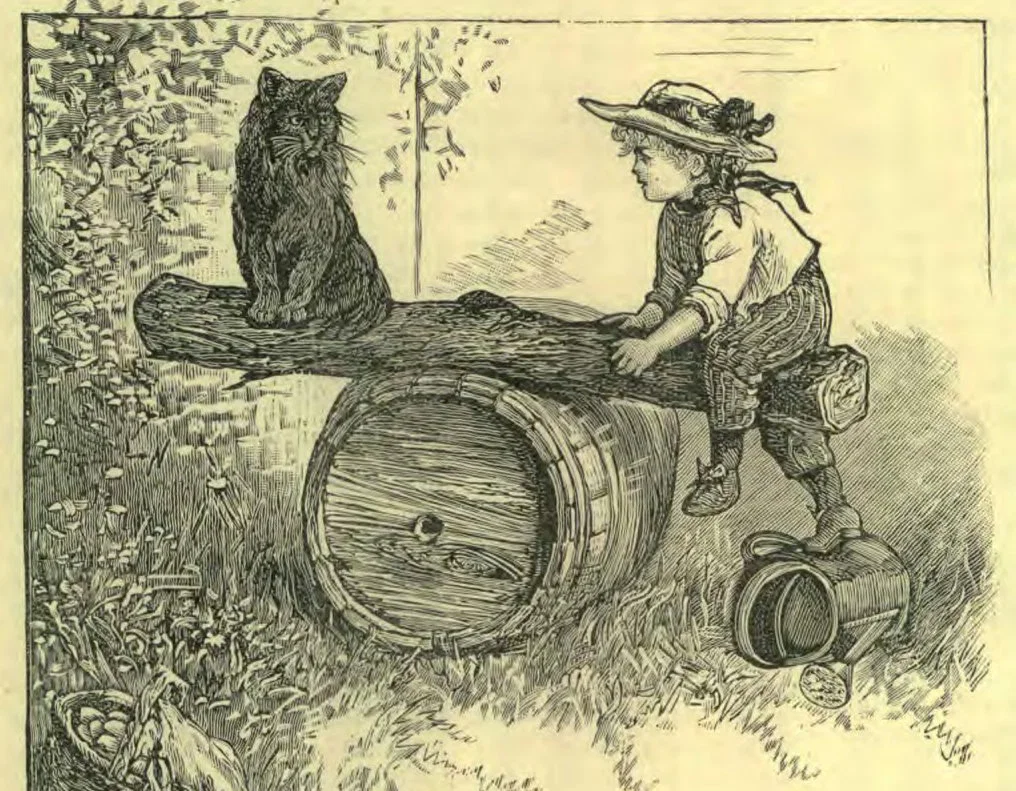
THE KITTY'S TEETER.

Now, pussy, you've taken your place over there, So now for a seesaw we'll each have a share. We will teeter and teeter, up and away. We're having a picnic; we'll stay here all day. There's a basket of apples all ready to eat, With a napkin spread over,—I know they are sweet. I like good sweet apples, but oh, it's too bad You can't eat an apple! I wish that you had A bowl of nice milk, and a big piece of bread; But when we go home, you shall surely be fed. Oh, we go up so high! I'm almost a man! Don't fall off, my kitty; hold on if you can. But mama is calling, and home we must go; I'm tired and sleepy, and you're hungry, I know.
EMMA L. KELLOGG.

OPERATIONS UNDER THE CALL

HOW LAWS ARE MADE.—NO. 3.

OPERATIONS UNDER THE CALL.

WHEN it becomes important that every member of either House should be present and vote upon a bill, those who are present can compel the attendance of the absentees. We will suppose a case. Mr. Smith or Mr. Brown has a bill that is of interest to many in the State. When it comes time for the vote to be taken, some of the members have left the chamber because they do not wish to vote,—“place themselves on record.” So Mr. Brown arises and says, “Mr. President, I move a call of the Senate.” If a majority of those in the chamber second the call, it is carried, the doors are closed, the serjeant or one of his assistants is placed on guard, and no member can leave the room until the Senate adjourns, or “further proceedings under the call are dispensed with.”
The serjeant-at-arms, upon motion, is sent for the absentees, and he has power to arrest all members who are not in the Senate chamber, unless they have been excused from that sitting. Again, taking a supposable case: the serjeant has found Senator Jones, who was out in the corridor having a visit, or who had just returned from the House or from the library. The serjeant conducts the senator to the bar of the Senate, and announces the senator’s name to the president. The president instructs the senator to be admitted within the bar, then asks what excuse the gentleman has to offer for not being in his seat during the session of the Senate. The Senator makes whatever excuse he sees fit, and if the Senate is satisfied, some one will rise and move that the member be excused; but if the Senate is not satisfied, the member can be fined, and the fine taken out of his per diem,—his daily wages.
Many comical excuses are given, and the members are usually excused unless the absence is manifestly unpardonable.
One evening during a certain session, the talk was prolonged and not very interesting, so that some of the members thought they might just as well go home and sleep, as to stay. Along about eleven o’clock, however, some one moved that there be a call of the Senate. Several members were found absent without leave, and the serjeant was sent for them. He routed some of them out of their beds, and in the course of an hour had several back. All were excused, but the session continued till long after midnight. Messengers were sent for lunches, and a recess was declared for eating. The whole thing came in the nature of a joke on some of the members who thought that the Senate was not working hard enough, and were free to say so.

SOME INCIDENTS.

The solemn quiet of a session is disturbed sometimes by a humorous speech or dry joke. One day the serjeant came in with a new spring suit on. The pattern of the goods was a large check, and the suit was a little inclined to be flashy. The serjeant sat on a sofa near one of the senators, who in the midst of a dry discussion arose and said: “Mr. President, it is so noisy that I can hardly hear.” The president replied that he was not aware of any noise, to which the senator responded, “The serjeant-at-arms has such a loud suit of clothes on that I cannot hear the others talk.” The serjeant lay down flat on the sofa to get out of sight, while the usually sober senators indulged their mirth.
At the close of the entire session, presents are sometimes made to the presiding officers and to some of the older members of the Houses, and where fighting once had been, peace reigns supreme. The closing moments of a session are full of business, and sometimes where a resolution has been passed to close the session at a certain hour, it becomes necessary for the serjeant to turn the clock back, so as to give time to finish the work.
During the session of 18—, a bill was up for the lowering of railway fare to two cents a mile. Mr. S., who weighed about three hundred avoirdupois, was talking in favor of the bill, when Mr. W. arose and said, “Mr. Speaker, I would like to ask the gentleman one question. Does the gentleman think that the railways can afford to carry him for two cents a mile?” The question raised a laugh at the expense of the speaker, and he was compelled to forego making the rest of his speech.
During the progress of the debate on this same bill, Mr. M. made the statement that several railways in the State of New York were carrying passengers for two cents a mile. Mr. L. said there was only one in the State of New York that did so. Mr. M. brought in a railway guide, which gave several roads, as he had before said. Angry words followed, and Mr. M. said, “I do not wish to say that the gentleman lies, but he talks just as I do when I lie.” Thus do grown-up boys forget themselves, and even in the high places of the land, indulge in language that would better be left unsaid.
One morning, after a very hard fight over the seating of a new member, during which time several members had lost their temper, the chaplain chose for the Scriptural reading, “Why do the heathen rage, and the people imagine a vain thing?” A smile, almost audible, betokened some wonderment as to which side in the discussion the scripture was intended to refer. Next day the chaplain apologized, saying he had no idea of making any personal allusions.
All kinds of schemes are resorted to in order to get bills through both Houses, from open bribery, which is sometimes found out and punished, to the trading of votes, in a “you-vote-for-my-bill, and-I’ll-vote-for-yours” way. Yet there are many truly honest men among the law-makers, and some rascals. Would that all were honest. J. G. LAMSON.

WALTZING MICE.

The Japanese have a queer little domestic animal—a black and white mouse with pink eyes. The peculiarity of this breed of mice is that when other baby mice are just beginning to walk, these are beginning to waltz; and they keep up their waltzing the greater part of their waking hours all their life.
If several mice are together, they often waltz in couples; sometimes even more than two join in the mad whirls, which are so rapid that it is impossible to tell heads from tails. If the floor of their cage is not smooth, they actually wear out their feet, leaving only stumps to whirl on. These remarkable whirls seem to be as necessary to the waltzing mouse as mid-air somersaults are to the tumbling pigeon.
An upright peg forms a convenient pivot for these Japanese pets, “but even without this guide,” says Natural Science, “they would not, in several minutes, cover an area larger than a dinner-plate, and they easily spin under a tumbler.”

A FROST MEDLEY.

A SCENE most fair before me lies, Of landscape wide, and shining skies; Of forests wild, and mountains bold, Where castles rise with turrets old; While mingled with a curious grace Objects both rare and commonplace, The rude encroaching on the fine, Yet harmonized by art divine, Conspire to form a picture grand Of beauty culled from sea and land,— A gallant ship with masts so tall, A ruined fort, a crumbling wall, A forest lake, a stream so bright, An iceberg gleaming in the light, A totem-pole so quaint and high, A broken cart with wheels awry, “A city set upon a hill,” A winding country road, a mill, A rustic bridge, toboggan slide, A vineyard on the mountain side, Electric wires with posts well set, A mosque with spire and minaret. A sphinx looks on with solemn face; While clinging vines, with dainty grace, Are climbing, trailing everywhere. Gay butterflies fill all the air; Bright diamond dust the sun flings down, Bedecking all from base to crown. And over all, from mountain peak, A sacred cross doth vigil keep. All this, and much beside, I see, Which Nature's hand, so kindly free, With cunning craft and sheen of frost Has on my window-pane embossed.
JULIA H. DUFFIE.

THE DIFFERENCE.

Father Tab, in homely phrase, thus describes the difference between some sinners and other sinners:—
“'Unc' Si, de holy Bible says, In speakin' ob de jus', Dat he do fall seben times a day; Now, how's de sinner wuss?”
“'Well, chile, de slip may come to all: But den de diffe'nce foller; For, ef you watch him when he fall, De jus' man do not waller.”
— Exchange.

AN IMMENSE AMERICAN ESTATE.

Henry Miller and Charles Lux, cattlemen of San Francisco, confess to owning more than fourteen million acres of land in three States. As the San Francisco Examiner puts it, this makes an estate equal in area to the States of New Hampshire, Massachusetts, Rhode Island, and Connecticut together. It is half the size of New York, and three times the size of New Jersey. It is about the size of West Virginia, and an eighth the entire area of California. It is as large as Greece with the Ionian Isles, of which Byron wrote. It is four times the area of Alsace-Lorraine, over which France and Germany fought. It is but little smaller than Ireland, and half again as large as Switzerland. It is twice as large as Belgium, and one third the size of England and Wales together. These two remarkable men are natives of one of the Rhenish provinces of Germany.

A REVISED STANDARD.

A man was arraigned in a Chicago court a few days since, charged with revising, or attempting to revise, the standard of dry measure. In other words, he was selling three pecks for a bushel! When brought before the court, he stoutly protested his innocence, and declared that according to his best information and belief there were only three pecks in a bushel! He made an eloquent plea for himself, but it was of no use; the facts in the case, the law, and everything, was against him, and the old standard of four whole pecks in a bushel was reaffirmed by the judge.
The public and the law will hold that no man can be innocent who tries to sell three pecks of vegetables for a bushel; but what about those who call three pecks four pecks, and make three pecks a bushel that way! Are they any better than is the man who pretends to give only three pecks for a bushel? A short bushel is a short bushel, whether it is made up of three honest pecks or four dishonest ones. From what we have seen, we believe that every year millions of dollars are paid out in this country for goods that are never received, because what pretends to be a bushel will not weigh what the law demands that it shall weigh. False weights and false balances are an abomination unto the Lord, and why should not a guess measure be an abomination, too, when the article offered is guessed by the seller, and is guessed to be much more than it really is? Our standards are all right—so many pounds to the bushel. What we want is revised honesty.

A RECENT DISCOVERY.

It is generally thought that there is nothing more to discover in North America; but every little while some enterprising traveler finds something of great interest, not known before. Not many years ago the great Yukon River in Alaska was discovered; and now, if we may credit what we hear, another great river has been found in Canada. Such discoveries show that although America was discovered some centuries ago, there may still be made great discoveries in America. In regard to the newly-discovered river, the following, written to the Chicago Times-Herald by a correspondent from Ottawa, will speak for itself:—
“Professor Bell, of the geological survey, who returned to the city to-day, reports having discovered a river in the province of Quebec, of large dimensions. Shortly after the party crossed the height of land, they followed an unknown river, which gradually widened until it assumed a great size. They followed this river to James Bay. The river had three large branches, one of which has its source north of Three Rivers, another in the Lake St. John region, and the third near Lake Mistassini.
“This new river, for which the Indians have no name, is much larger than the Ottawa, and Dr. Bell affirms it to be the sixth of the great rivers of the world. Its average width is considerably over a mile, and it has expansions many miles in width. It runs through a level clay country, is very deep, and may be called a new Nile of the North. The river is five hundred miles in length, and great stretches would be navigable for steamers.
“Toward James Bay there are successions of great rapids, which render it useless as an inland route. These rapids cannot be ascended, except with great difficulty. The river banks are heavily wooded with pine, spruce, tamarac, balsam, and white birch. The primeval forest extends along the whole length of the stream.”

CHINESE MONEY.

It is held by some that the coinage of China was invented especially for the confusion of the foreigner. At any rate, two market villages twenty miles apart are quite certain to have a different rate of exchange, and—but this may be only a coincidence—the foreigner is not the one who profits thereby. Thus, suppose you tender one dollar at Stone Umbrella mart, and after much weighing and testing thereof, are given in exchange ten hundred and thirty brass coins strung on a string, of varying weight and thickness.
Arrived at the Plain of Peace, you buy one dollar’s worth of fowls, and put down your ten hundred and thirty coins, only to be told that the exchange is eleven hundred and sixty, and you have to find the balance. Next day, having invested all your savings in cash, you return to Stone Umbrella, intending to buy up all the silver in circulation at the lowest rate of exchange.
Alas, for your hopes! You are met with a chilling, “These coins are ten parts—one hundred per cent—worthless,” and in corroboration of his statement, your would-be-victim points out, or pretends to point out, the absence of certain blurs on the horrid little rings of brass.—Blackwood’s Magazine.

THE GREAT BELL OF PEKING.

The emperor Yong-loh, founder of the Ming dynasty,—just previous to the present one, and contemporary with Ferdinand and Isabella of Spain,—in order to mark the removal of his capital from Nanking to Peking, and at the same time to honor Buddha, and win personal merit for himself in the future world, resolved to have cast at Peking a great memorial bell. To this end he invited to his northern capital the most skilled masters in this ancient art. In due time, after divination and consulting Buddhistic scholars as to the prayers to be embossed on the bell, and collecting vast quantities of different metals, constructing furnaces, models, and molds, the work was satisfactorily accomplished, and the event celebrated by great civic and religious rejoicings. It is in many respects the finest work of art in Asia,—the product of native skill,—and could not be duplicated by the highest ability or resources of Western foundries. It stands fourteen feet high, thirty-four feet in circumference, is nearly one foot in thickness, and weighs over one hundred and twenty thousand pounds. But what makes the bell the chef-d'œuvre of Asia is the fact that, without a flaw or defect of any kind, it is completely covered in relief, both inside and out, with myriads of Chinese characters, each one not an inch in size, consisting of prayers from Buddhistic classics. It is one of the vagaries of Buddhism that the prayers of the faithful may be infinitely and acceptably repeated by mechanical helps, as, for instance, when written petitions are attached to revolving wheels, as the writer has often witnessed; so here, when the lips of this mighty and eloquent bell are moved by a fitting tongue, they breathe forth in deep, sweet, prolonged, and wonderfully vibratory voice, these prayers to Buddha, and call, as well, all devotees to worship.—Selected.

Devout Thoughts Outweigh Earthly Estates
A DEVOUT thought, a pious desire, a holy purpose, is better than a great estate or an earthly kingdom. In eternity it will amount to more to have given a cup of cold water, with right motives, to a humble servant of God, than to have been flattered by a whole generation.—Dr. Cumming.

You have reached the end of this edition.

The Youth’s Instructor · Oct 31, 1895